


PC GIULIANOTTI, MD,FACS Distinguished Lloyd M Nyhus Chair in Surgery Professor and Chief Division of General, Minimally Invasive and Robotic Surgery University of Illinois at Chicago Robotics in General Surgery: State of Art and Future Perspectives
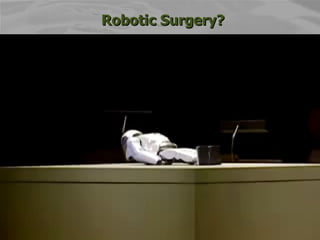
Robotic Surgery? Robotic Surgery ?
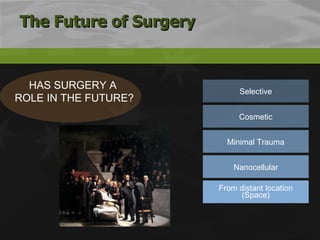
The Future of Surgery HAS SURGERY A  ROLE IN THE FUTURE? Selective Cosmetic Minimal Trauma Nanocellular From distant location (Space)
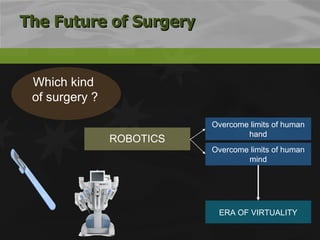
The Future of Surgery Which kind  of surgery ? Overcome limits of human hand Overcome limits of human mind ERA OF VIRTUALITY ROBOTICS
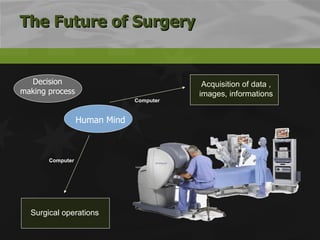
The Future of Surgery Decision making process Human Mind Acquisition of data , images, informations Surgical operations Computer Computer
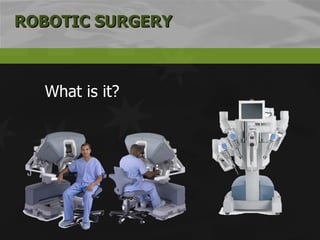
ROBOTIC SURGERY What is it?
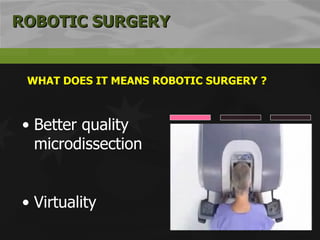
ROBOTIC SURGERY WHAT DOES IT MEANS ROBOTIC SURGERY ? Better quality microdissection Virtuality
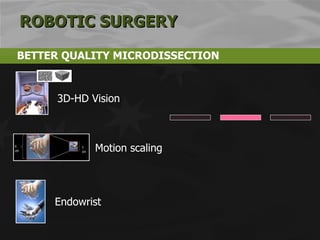
BETTER QUALITY MICRODISSECTION ROBOTIC SURGERY 3D-HD Vision Motion scaling Endowrist
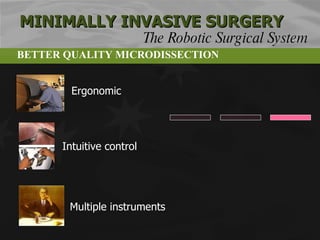
MINIMALLY INVASIVE SURGERY BETTER QUALITY MICRODISSECTION Ergonomic Intuitive control Multiple instruments The Robotic Surgical System
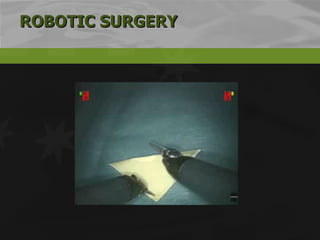
ROBOTIC SURGERY
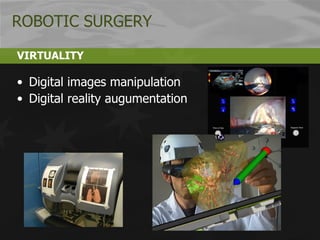
Digital images manipulation  Digital reality augumentation VIRTUALITY ROBOTIC SURGERY
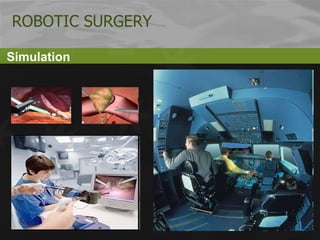
Simulation ROBOTIC SURGERY
WARNINGS IN REAL TIME   ROBOTIC SURGERY Warning
MEMORY ROBOTIC SURGERY
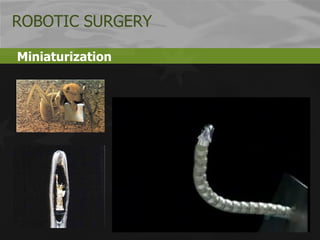
Miniaturization ROBOTIC SURGERY
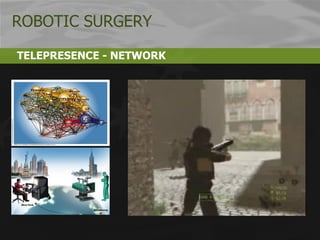
TELEPRESENCE - NETWORK ROBOTIC SURGERY
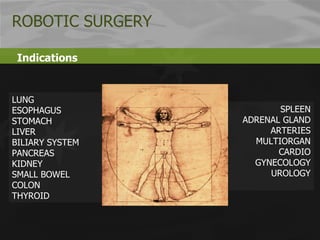
LUNG ESOPHAGUS STOMACH LIVER  BILIARY SYSTEM PANCREAS KIDNEY SMALL BOWEL  COLON  THYROID SPLEEN ADRENAL GLAND ARTERIES MULTIORGAN CARDIO GYNECOLOGY UROLOGY Indications ROBOTIC SURGERY
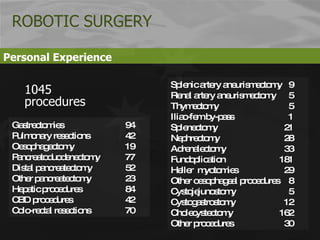
Personal Experience   1045 procedures Gastrectomies 94 Pulmonary resections 42 Oesophagectomy 19 Pancreatoduodenectomy 77 Distal pancreatectomy 52 Other pancreatectomy  23 Hepatic procedures   84 CBD procedures  42 Colo-rectal resections   70 Splenic artery aneurismectomy 9 Renal artery aneurismectomy 5 Thymectomy 5 Iliac-fem by-pass  1 Splenectomy   21 Nephrectomy  28 Adrenalectomy 33 Fundoplication 181 Heller  myotomies 29 Other oesophageal procedures 8 Cystojejunostomy 5 Cystogastrostomy 12 Cholecystectomy 162 Other procedures 30 ROBOTIC SURGERY
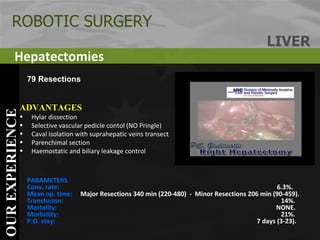
OUR EXPERIENCE ADVANTAGES Hylar dissection Selective vascular pedicle contol (NO Pringle) Caval isolation with suprahepatic veins transect Parenchimal section Haemostatic and biliary leakage control Hepatectomies PARAMETERS Conv. rate:   6.3%. Mean op. time:   Major Resections 340 min (220-480)  -  Minor Resections 206 min (90-459). Transfusion:   14%. Mortality:   NONE. Morbidity:   21%.   P.O. stay:   7 days (3-23). 79 Resections ROBOTIC SURGERY LIVER
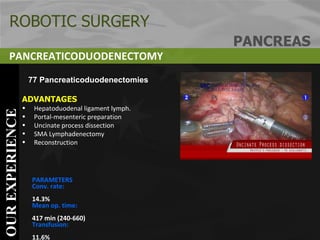
ADVANTAGES Hepatoduodenal ligament lymph. Portal-mesenteric preparation Uncinate process dissection SMA Lymphadenectomy Reconstruction PARAMETERS Conv. rate:   14.3%  Mean op. time:   417 min (240-660)   Transfusion:   11.6% Mortality:  3.8% Morbidity:   34%   Lenght of stay:   Italy 15 day, US  10 days  OUR EXPERIENCE ROBOTIC SURGERY PANCREAS PANCREATICODUODENECTOMY 77 Pancreaticoduodenectomies
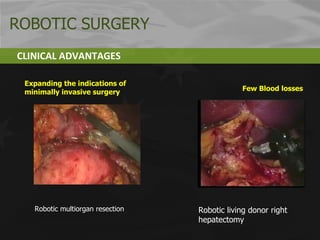
Expanding the indications of minimally invasive surgery Robotic living donor right hepatectomy Few Blood losses CLINICAL ADVANTAGES Robotic multiorgan resection ROBOTIC SURGERY
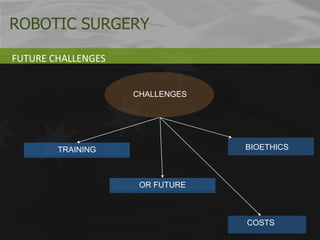
TRAINING OR FUTURE COSTS BIOETHICS CHALLENGES ROBOTIC SURGERY FUTURE CHALLENGES
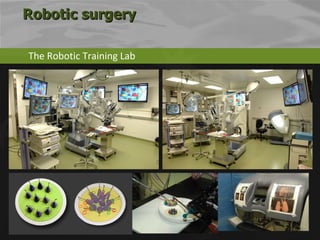
Robotic surgery The Robotic Training Lab
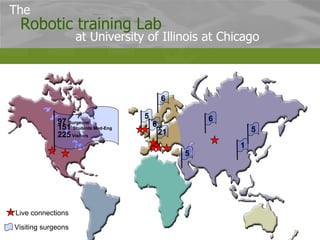
6 5 1 21 5 6 97  Surgeons 151  Students Med-Eng 225  Visitors 6 Robotic training Lab at University of Illinois at Chicago The Live connections Visiting surgeons 5
INSTITUTE ADVANCED ROBOTIC SURGERY Robotic Surgery
Robotic Surgery
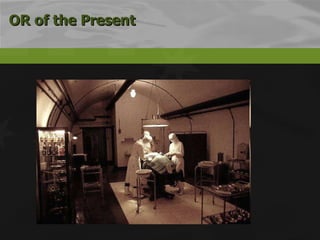
OR of the Present
New technologies  New energies ( monpolar, bipolar, radiofrequency, harmonic, ) New diagnostic tools ( US, Xray, NMR ) New equipments ( laparoscopy, Robotics ) New  operations OR of the Present
OR of the Present
OR of the Present
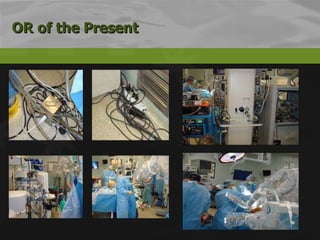
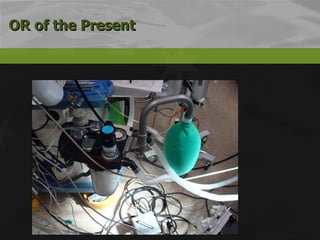
Adaptation of the container Addition of technologies Addition devices Addition personnel Addition screens, visualization systems Addition of energies Addition of cables OR of the Present
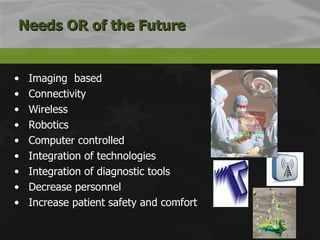
Imaging  based Connectivity Wireless Robotics Computer controlled Integration of technologies Integration of diagnostic tools Decrease personnel Increase patient safety and comfort  Needs OR of the Future
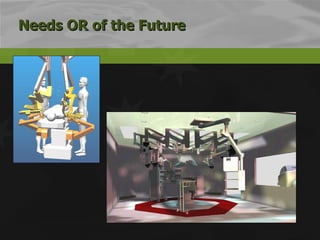
Needs OR of the Future
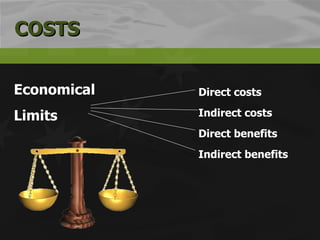
Economical Limits Direct costs Indirect costs Direct benefits Indirect benefits COSTS
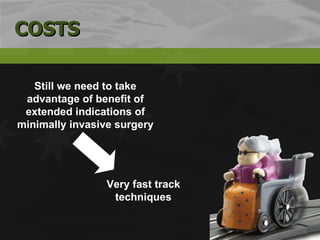
Still we need to take advantage of benefit of extended indications of minimally invasive surgery Very fast track techniques COSTS
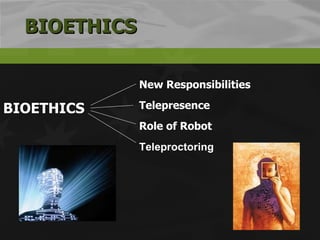
BIOETHICS New Responsibilities Telepresence Role of Robot Teleproctoring BIOETHICS
Thank you

P. Giulianotti - Robotics in General Surgery: State of Art and future perspectives

  • 1.
    PC GIULIANOTTI, MD,FACSDistinguished Lloyd M Nyhus Chair in Surgery Professor and Chief Division of General, Minimally Invasive and Robotic Surgery University of Illinois at Chicago Robotics in General Surgery: State of Art and Future Perspectives
  • 2.
  • 3.
    The Future ofSurgery HAS SURGERY A ROLE IN THE FUTURE? Selective Cosmetic Minimal Trauma Nanocellular From distant location (Space)
  • 4.
    The Future ofSurgery Which kind of surgery ? Overcome limits of human hand Overcome limits of human mind ERA OF VIRTUALITY ROBOTICS
  • 5.
    The Future ofSurgery Decision making process Human Mind Acquisition of data , images, informations Surgical operations Computer Computer
  • 6.
  • 7.
    ROBOTIC SURGERY WHATDOES IT MEANS ROBOTIC SURGERY ? Better quality microdissection Virtuality
  • 8.
    BETTER QUALITY MICRODISSECTIONROBOTIC SURGERY 3D-HD Vision Motion scaling Endowrist
  • 9.
    MINIMALLY INVASIVE SURGERYBETTER QUALITY MICRODISSECTION Ergonomic Intuitive control Multiple instruments The Robotic Surgical System
  • 10.
  • 11.
    Digital images manipulation Digital reality augumentation VIRTUALITY ROBOTIC SURGERY
  • 12.
  • 13.
    WARNINGS IN REALTIME ROBOTIC SURGERY Warning
  • 14.
  • 15.
  • 16.
    TELEPRESENCE - NETWORKROBOTIC SURGERY
  • 17.
    LUNG ESOPHAGUS STOMACHLIVER BILIARY SYSTEM PANCREAS KIDNEY SMALL BOWEL COLON THYROID SPLEEN ADRENAL GLAND ARTERIES MULTIORGAN CARDIO GYNECOLOGY UROLOGY Indications ROBOTIC SURGERY
  • 18.
    Personal Experience 1045 procedures Gastrectomies 94 Pulmonary resections 42 Oesophagectomy 19 Pancreatoduodenectomy 77 Distal pancreatectomy 52 Other pancreatectomy 23 Hepatic procedures 84 CBD procedures 42 Colo-rectal resections 70 Splenic artery aneurismectomy 9 Renal artery aneurismectomy 5 Thymectomy 5 Iliac-fem by-pass 1 Splenectomy 21 Nephrectomy 28 Adrenalectomy 33 Fundoplication 181 Heller myotomies 29 Other oesophageal procedures 8 Cystojejunostomy 5 Cystogastrostomy 12 Cholecystectomy 162 Other procedures 30 ROBOTIC SURGERY
  • 19.
    OUR EXPERIENCE ADVANTAGESHylar dissection Selective vascular pedicle contol (NO Pringle) Caval isolation with suprahepatic veins transect Parenchimal section Haemostatic and biliary leakage control Hepatectomies PARAMETERS Conv. rate: 6.3%. Mean op. time: Major Resections 340 min (220-480) - Minor Resections 206 min (90-459). Transfusion: 14%. Mortality: NONE. Morbidity: 21%. P.O. stay: 7 days (3-23). 79 Resections ROBOTIC SURGERY LIVER
  • 20.
    ADVANTAGES Hepatoduodenal ligamentlymph. Portal-mesenteric preparation Uncinate process dissection SMA Lymphadenectomy Reconstruction PARAMETERS Conv. rate: 14.3% Mean op. time: 417 min (240-660) Transfusion: 11.6% Mortality: 3.8% Morbidity: 34% Lenght of stay: Italy 15 day, US 10 days OUR EXPERIENCE ROBOTIC SURGERY PANCREAS PANCREATICODUODENECTOMY 77 Pancreaticoduodenectomies
  • 21.
    Expanding the indicationsof minimally invasive surgery Robotic living donor right hepatectomy Few Blood losses CLINICAL ADVANTAGES Robotic multiorgan resection ROBOTIC SURGERY
  • 22.
    TRAINING OR FUTURECOSTS BIOETHICS CHALLENGES ROBOTIC SURGERY FUTURE CHALLENGES
  • 23.
    Robotic surgery TheRobotic Training Lab
  • 24.
    6 5 121 5 6 97 Surgeons 151 Students Med-Eng 225 Visitors 6 Robotic training Lab at University of Illinois at Chicago The Live connections Visiting surgeons 5
  • 25.
    INSTITUTE ADVANCED ROBOTICSURGERY Robotic Surgery
  • 26.
  • 27.
    OR of thePresent
  • 28.
    New technologies New energies ( monpolar, bipolar, radiofrequency, harmonic, ) New diagnostic tools ( US, Xray, NMR ) New equipments ( laparoscopy, Robotics ) New operations OR of the Present
  • 29.
    OR of thePresent
  • 30.
    OR of thePresent
  • 31.
    Adaptation of thecontainer Addition of technologies Addition devices Addition personnel Addition screens, visualization systems Addition of energies Addition of cables OR of the Present
  • 32.
    Imaging basedConnectivity Wireless Robotics Computer controlled Integration of technologies Integration of diagnostic tools Decrease personnel Increase patient safety and comfort Needs OR of the Future
  • 33.
    Needs OR ofthe Future
  • 34.
    Economical Limits Directcosts Indirect costs Direct benefits Indirect benefits COSTS
  • 35.
    Still we needto take advantage of benefit of extended indications of minimally invasive surgery Very fast track techniques COSTS
  • 36.
    BIOETHICS New ResponsibilitiesTelepresence Role of Robot Teleproctoring BIOETHICS
  • 37.

Editor's Notes

  • #19 Aggiunte: 1hepdx + 1 bisegment + 1 segment + 2 splenect+ 3dpsplpres
  • #20 Una volta definito il problema, concentrarsi sulla ricerca di soluzioni. Incoraggiare l'apertura mentale e la creatività dei partecipanti e chiedere loro suggerimenti. Rispettare la diversità di opinioni. Diversi punti di vista favoriscono la risoluzione dei problemi e aggiungono sostanza alla discussione. Prendere nota delle idee. Considerare tutti i suggerimenti. Mantenere un atteggiamento sicuro e incoraggiante per tutta la durata della discussione. Coinvolgere i partecipanti nella discussione. Elencare le alternative in ordine di importanza. Utilizzare le proposte scaturite dalla discussione per determinare la soluzione.
  • #21 Una volta definito il problema, concentrarsi sulla ricerca di soluzioni. Incoraggiare l'apertura mentale e la creatività dei partecipanti e chiedere loro suggerimenti. Rispettare la diversità di opinioni. Diversi punti di vista favoriscono la risoluzione dei problemi e aggiungono sostanza alla discussione. Prendere nota delle idee. Considerare tutti i suggerimenti. Mantenere un atteggiamento sicuro e incoraggiante per tutta la durata della discussione. Coinvolgere i partecipanti nella discussione. Elencare le alternative in ordine di importanza. Utilizzare le proposte scaturite dalla discussione per determinare la soluzione.