Evaluating Current Laparoscopic Applications in Surgery George S Ferzli, MD Armando E Castro, MD
Evidence-Based Medicine Formulate answerable questions: Which is superior, open or laparoscopic approach? Is the laparoscopic approach safe? Is the laparoscopic approach feasible? Are the outcomes of the laparoscopic approach acceptable?
Evidence-Based Medicine Utilizing available scientific data to develop guidelines for medical practice Used to evaluate and integrate emerging techniques and advances into practice Laparoscopy lends itself to evaluation and practice through evidence-based medicine
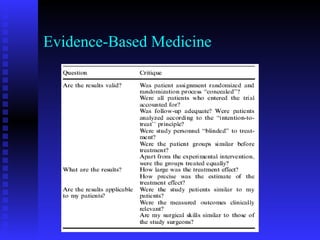
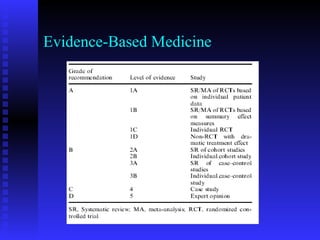
Evidence-Based Medicine
Evidence-Based Medicine What does the available and most current data tell us regarding the practice of laparoscopy in general surgery?
Laparoscopic Applications in Surgery Esophagus Stomach Pancreas Liver Colon Appendix Adrenal Spleen Groin hernia
Laparoscopic Applications - Esophagus What are some of the current uses of laparoscopy in esophageal surgery? Achalasia – Heller Myotomy Hiatal hernia/GERD – Fundoplication Epiphrenic Diverticulum Cancer
Laparoscopic Applications - Esophagus Achalasia Surgical treatment of achalasia: current status and controversies Literature review of the current management of achalasia Laparoscopic Heller myotomy is generally accepted as the operative procedure of choice  Less invasive, associated with less pain and postoperative disability, shorter hospital stay Abir F et al, Dig Surg 2004;21:165-176
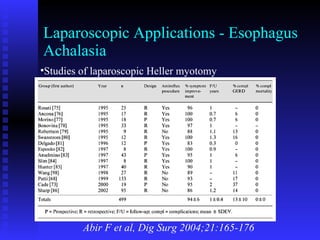
Laparoscopic Applications - Esophagus Achalasia Abir F et al, Dig Surg 2004;21:165-176 Studies of laparoscopic Heller myotomy
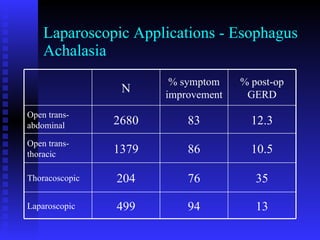
Laparoscopic Applications - Esophagus Achalasia 35 76 204 Thoracoscopic 13 94 499 Laparoscopic 10.5 86 1379 Open trans-thoracic 12.3 83 2680 Open trans-abdominal % post-op GERD % symptom improvement N
Laparoscopic Applications - Esophagus Achalasia The laparoscopic approach has a good to excellent response rate compared to other surgical approaches  Lower incidence of postoperative GERD than open or thoracoscopic approaches Based on current evidence, laparoscopic Heller myotomy is the operative procedure of choice for achalasia Abir F et al, Dig Surg 2004;21:165-176
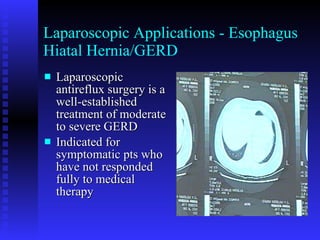
Laparoscopic Applications - Esophagus Hiatal Hernia/GERD Laparoscopic antireflux surgery is a well-established treatment of moderate to severe GERD Indicated for symptomatic pts who have not responded fully to medical therapy
Laparoscopic Applications - Esophagus Hiatal Hernia/GERD Laparoscopic antireflux surgery for gastroesophageal reflux disease: experience with 688 laparoscopic antireflux procedures Review of author’s experience with GERD 24 pH monitoring, esophageal manometry, and analysis of failure prospectively reviewed Granderath F et al, Int J Col Dis 2004 Jan;18(1):73-77
Laparoscopic Applications - Esophagus Hiatal Hernia/GERD Laparoscopic antireflux surgery for gastroesophageal reflux disease: experience with 688 laparoscopic antireflux procedures Overall complication 7.6% Mean f/u 4.8 years with normal 24-h pH and esophageal manometry in 93% of pts Granderath F et al, Int J Col Dis 2004 Jan;18(1):73-77
Laparoscopic Applications - Esophagus Hiatal Hernia/GERD Laparoscopic antireflux surgery for gastroesophageal reflux disease: experience with 688 laparoscopic antireflux procedures Conclusions: Laparoscopic antireflux surgery is feasible and effective, with low morbidity and good to excellent functional and symptomatic results Granderath F et al, Int J Col Dis 2004 Jan;18(1):73-77
Laparoscopic Applications - Esophagus Hiatal Hernia/GERD Laparoscopic treatment of gastro-oesophageal reflux disease. Reviewed 9 randomized trials comparing open and laparoscopic fundoplication Combined results of these trials confirms advantage of the laparoscopic approach Watson D, Best Pract Res Clin Gastroenterol. 2004 Feb;18(1):19-35
Laparoscopic Applications - Esophagus Hiatal Hernia/GERD Laparoscopic treatment of gastro-oesophageal reflux disease Laparoscopic fundoplication is now the “gold standard” for the management of pts with severe GERD New endoscopic treatments will need to achieve similar outcomes before they are accepted replacements for laparoscopic approach Watson D, Best Pract Res Clin Gastroenterol. 2004 Feb;18(1):19-35
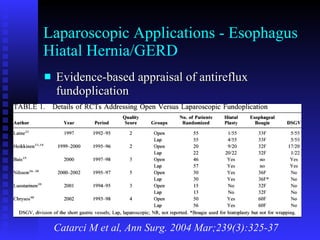
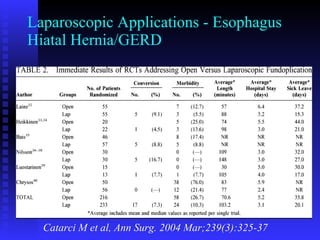
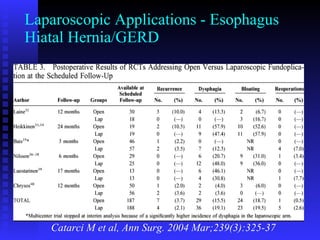
Laparoscopic Applications - Esophagus Hiatal Hernia/GERD Evidence-based appraisal of antireflux fundoplication Catarci M et al, Ann Surg. 2004 Mar;239(3):325-37
Laparoscopic Applications - Esophagus Hiatal Hernia/GERD Catarci M et al, Ann Surg. 2004 Mar;239(3):325-37
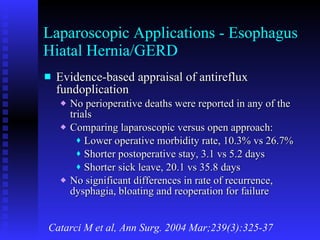
Laparoscopic Applications - Esophagus Hiatal Hernia/GERD Evidence-based appraisal of antireflux fundoplication No perioperative deaths were reported in any of the trials Comparing laparoscopic versus open approach: Lower operative morbidity rate, 10.3% vs 26.7% Shorter postoperative stay, 3.1 vs 5.2 days Shorter sick leave, 20.1 vs 35.8 days No significant differences in rate of recurrence, dysphagia, bloating and reoperation for failure Catarci M et al, Ann Surg. 2004 Mar;239(3):325-37
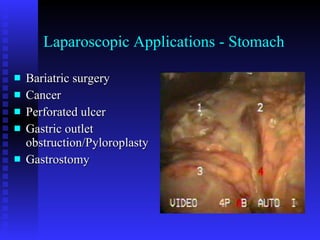
Laparoscopic Applications - Stomach Bariatric surgery Cancer Perforated ulcer Gastric outlet obstruction/Pyloroplasty Gastrostomy
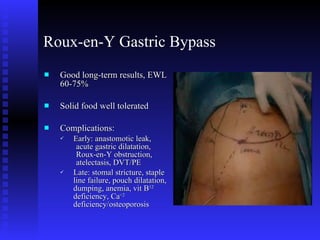
Roux-en-Y Gastric Bypass Good long-term results, EWL 60-75% Solid food well tolerated Complications: Early: anastomotic leak,  acute gastric dilatation,  Roux-en-Y obstruction,  atelectasis, DVT/PE Late: stomal stricture, staple line failure, pouch dilatation, dumping, anemia, vit B 12  deficiency, Ca +2  deficiency/osteoporosis
Vertical Banded Gastroplasty Edward E. Mason (1982),  University of Iowa Restriction with polypropylene band, Marlex mesh, or silastic ring  Rules of eating Soft calorie syndrome Complications:  Leak Persistent vomiting
Laparoscopic Adjustable Gastric Banding Kuzmak (1990), Lodz Medical Academy,Poland  Adjustable band connected to port implanted in subcutaneous tissue Complications:   O perative: s plenic and esophageal  injury, conversion to open procedure Late: b and slippage, reservoir deflation/leak, failure to lose weight, persistent vomiting, acid reflux
Laparoscopic Applications - Stomach Gastric bypass The laparoscopic gastric bypass is now the preferred surgical treatment for morbid obesity
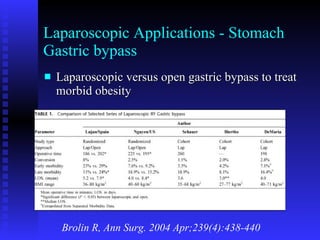
Laparoscopic Applications - Stomach Gastric bypass Laparoscopic versus open gastric bypass to treat morbid obesity Presentation of selected series of Roux en Y gastric bypass Brolin R, Ann Surg. 2004 Apr;239(4):438-440
Laparoscopic Applications - Stomach Gastric bypass Comprehensive review of 18 published cohort studies (10 laparoscopic, 8 open) favored laparoscopy Shorter LOS Lower incidence of abdominal wall hernias Mortality and wound infection rate in combined cohort studies also favors the laparosopic approach versus open Brolin R, Ann Surg. 2004 Apr;239(4):438-440
Laparoscopic Applications - Stomach Gastric bypass In combined cohort studies the open approach had a significantly lower incidence of late stomal stenosis and bowel obstruction Brolin R, Ann Surg. 2004 Apr;239(4):438-440
Laparoscopic Applications - Stomach Gastric bypass Laparoscopic versus open gastric bypass to treat morbid obesity Brolin R, Ann Surg. 2004 Apr;239(4):438-440
Laparoscopic Applications - Stomach Cancer Comparison of laparoscopic and open gastrectomy for malignant disease Retrospective case-matched study comparing laparoscopic (n = 12) and open (n = 13) partial gastrectomies for cancer Stage, extent of lymphadenectomy, and 18 month survival were compared Weber KJ et al, Surg Endosc. 2003 Jun;17(6):968-71.
Laparoscopic Applications - Stomach Cancer Comparison of laparoscopic and open gastrectomy for malignant disease No statistical difference in stages between groups Resection margins in laparoscopic group were all free of tumor No difference in extent of lymphadenectomy between groups No difference in survival between groups at 18 month follow-up Weber KJ et al, Surg Endosc. 2003 Jun;17(6):968-71.
Laparoscopic Applications - Stomach Cancer Comparison of laparoscopic and open gastrectomy for malignant disease Conclusions: The laparoscopic approach to gastric cancer allows for adequate margins and can follow oncologic principles, and is this an viable alternative to open surgery There is no difference in short-term survival between the two approaches Weber KJ et al, Surg Endosc. 2003 Jun;17(6):968-71.
Laparoscopic Applications - Stomach Cancer Application of minimally invasive treatment for early gastric cancer. To propose indications for the application of minimally invasive therapy for EGC Retrospective analysis of 566 pts who had undergone gastrectomy with D2 or more extended lymphadenectomy Risk factors for lymph node metastasis were identified Hyung WJ et al, J Surg Oncol. 2004 Mar 15;85(4):181-5.
Laparoscopic Applications - Stomach Cancer Application of minimally invasive treatment for early gastric cancer. Lymph node metastasis was associated with submucosal invasion, larger tumor size, undifferentiated histology and presence of lymphatic or vascular invasion (LBVI) Minimally invasive treatment can be possibly applied for pts with EGC using these four independent risk factors for lymph node metastasis Hyung WJ et al, J Surg Oncol. 2004 Mar 15;85(4):181-5.
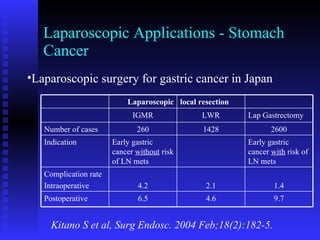
Laparoscopic Applications - Stomach Cancer Current status of laparoscopic gastrectomy for cancer in Japan. Review of current indications for and outcomes of laparoscopic procedures for gastric cancer Laparoscopic wedge resection (LWR) Intragastric mucosal resection (IGMR) Laparoscopy-assisted distal gastrectomy (LADG) Kitano S et al, Surg Endosc. 2004 Feb;18(2):182-5.
Laparoscopic Applications - Stomach Cancer Current status of laparoscopic gastrectomy for cancer in Japan. Laparoscopic procedures are useful in early gastric cancer (EGC) because of Minimal invasiveness Decreased pain Faster recovery Improved outcomes with laparoscopic approaches for EGC have led to the application of these approaches to more advanced gastric cancer Kitano S et al, Surg Endosc. 2004 Feb;18(2):182-5.
Laparoscopic Applications - Stomach Cancer Kitano S et al, Surg Endosc. 2004 Feb;18(2):182-5. Laparoscopic surgery for gastric cancer in Japan 9.7 4.6 6.5 Postoperative 1.4 2.1 4.2 Complication rate Intraoperative Early gastric cancer  with  risk of LN mets Early gastric cancer  without  risk of LN mets Indication 2600 1428 260 Number of cases Lap Gastrectomy LWR IGMR local resection Laparoscopic
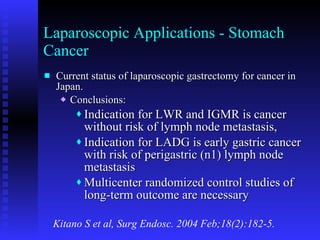
Laparoscopic Applications - Stomach Cancer Current status of laparoscopic gastrectomy for cancer in Japan. Conclusions: Indication for LWR and IGMR is cancer without risk of lymph node metastasis,  Indication for LADG is early gastric cancer with risk of perigastric (n1) lymph node metastasis Multicenter randomized control studies of long-term outcome are necessary Kitano S et al, Surg Endosc. 2004 Feb;18(2):182-5.
Laparoscopic Applications - Pancreas What are some of the current uses of laparoscopy in pancreatic surgery? Diagnostic Therapeutic
Laparoscopic Applications - Pancreas Diagnostic Pancreatic surgery in the laparoscopic era Diagnostic laparoscopy has been used to detect peritoneal metastases and obtain biopsies since 1960’s Staging laparoscopy avoids unnecessary laparotomy in one-fifth of patients with pancreatic cancer The addition of laparoscopic ultrasound may also be beneficial in detection of intrahepatic metastases and vascular involvement Ammori B, J Pancreas 2003;4(6):187-192
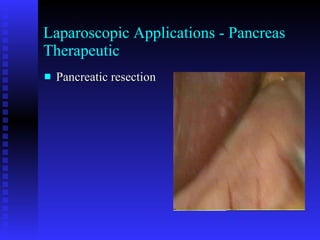
Laparoscopic Applications - Pancreas Therapeutic Pancreatic resection
Laparoscopic Applications - Pancreas Therapeutic Laparoscopic pancreatic surgery.  Current indications and surgical results Evaluated the outcomes and feasibility of laparoscopic pancreatic surgery Shimizu S et al, Surg Endosc 2004 Mar; 18(3):402-6
Laparoscopic Applications - Pancreas Therapeutic Fifteen patients (8M, 7F) Distal pancreatectomy (DP) for solid tumor (n=4) DP for cystic lesion (n=3) DP for chronic pancreatitis (n=2) Cystgastrostomy (CG) for pseudocyst (n=4) Enucleation of insulinoma (n=2) Shimizu S et al, Surg Endosc 2004 Mar; 18(3):402-6
Laparoscopic Applications - Pancreas Therapeutic Laparoscopic pancreatic surgery.  Current indications and surgical results Mean OR time was 249+/-70 min DP  ~5 hrs, CG and enucleation ~3hrs Mean blood loss was 138+/-184g Shimizu S et al, Surg Endosc 2004 Mar; 18(3):402-6
Laparoscopic Applications - Pancreas Therapeutic 2 DP were converted to open  No related mortality 2 pancreatic fistula (1 DP, 1 enucleation) both treated non-operatively Shimizu S et al, Surg Endosc 2004 Mar; 18(3):402-6
Laparoscopic Applications - Pancreas Therapeutic Laparoscopic pancreatic surgery.  Current indications and surgical results Conclusions Laparoscopic pancreatic surgery (LPS) is safe and feasible for patients with benign tumors and cystic lesions Shimizu S et al, Surg Endosc 2004 Mar; 18(3):402-6
Laparoscopic Applications - Pancreas Therapeutic Although some retrospective studies have shown that LPS results in faster post-op recovery and morbidity rates comparable to open surgery, no randomized controlled study confirming reduced invasiveness or superiority has been presented Shimizu S et al, Surg Endosc 2004 Mar; 18(3):402-6
Laparoscopic Applications - Pancreas Therapeutic Laparoscopic resection of the pancreas.  A feasibility study of the short-term outcome 32 patients with pancreatic disease were evaluated Neuroendocrine tumors (n=13) Unspecified tumors (n=11) Edwin B et al, Surg Endosc 2004 Mar; 18(3):407-411
Laparoscopic Applications - Pancreas Therapeutic Cysts (n=2) ITP with ectopic spleen (n=2) Annular pancreas (n=1) Trauma (n=1) Splenic artery aneurysm (n=) Adenocarcinoma (n=1) Edwin B et al, Surg Endosc 2004 Mar; 18(3):407-411
Laparoscopic Applications - Pancreas Therapeutic Laparoscopic resection of the pancreas.  A feasibility study of the short-term outcome Enucleations (n=6) Distal pancreatectomy (DP) with splenectomy (n=12) Edwin B et al, Surg Endosc 2004 Mar; 18(3):407-411
Laparoscopic Applications - Pancreas Therapeutic DP without splenectomy (n=5) Laparoscopic exploration only (n=3) Five procedures (13%) converted to open One resection converted to hand-assisted  Edwin B et al, Surg Endosc 2004 Mar; 18(3):407-411
Laparoscopic Applications - Pancreas Therapeutic Laparoscopic resection of the pancreas.  A feasibility study of the short-term outcome Mortality rate for laparoscopic resection 8.2% (2/24) Complications occurred after resection in 38% (9/24) Median hospital stay 5.5 days Post-op opioids for median of 2 days Edwin B et al, Surg Endosc 2004 Mar; 18(3):407-411
Laparoscopic Applications - Pancreas Therapeutic Laparoscopic resection of the pancreas.  A feasibility study of the short-term outcome Conclusion Laparoscopic approach to pancreatic resections is feasible in selected patients Edwin B et al, Surg Endosc 2004 Mar; 18(3):407-411
Laparoscopic Applications - Pancreas Therapeutic Offers benefits to patients similar to those provided by minimally invasive procedures for other diseases Prospective randomized trials needed to confirm potential benefits Edwin B et al, Surg Endosc 2004 Mar; 18(3):407-411
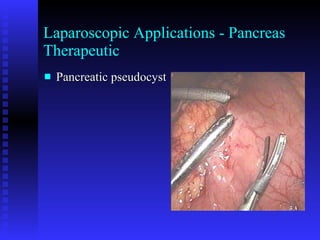
Laparoscopic Applications - Pancreas Therapeutic Pancreatic pseudocyst
Laparoscopic Applications - Pancreas Pseudocyst Minimally invasive approaches to the management of pancreatic pseudocysts Endogastric, transgastric and extragastric techniques described Bhattacharya D et al, Surg Laparosc Endosc Percutan Tech 2003 Jun;13(3):141-148
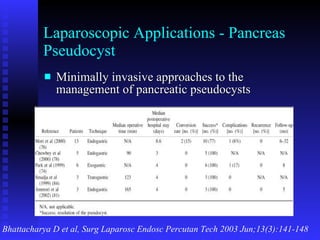
Laparoscopic Applications - Pancreas Pseudocyst Approximately 40 cases described  Median post-op stay 4 days 89% success rate No recurrences at median f/u 6-32 months Complications in 2 patients (7%) Bhattacharya D et al, Surg Laparosc Endosc Percutan Tech 2003 Jun;13(3):141-148
Laparoscopic Applications - Pancreas Pseudocyst Minimally invasive approaches to the management of pancreatic pseudocysts Bhattacharya D et al, Surg Laparosc Endosc Percutan Tech 2003 Jun;13(3):141-148
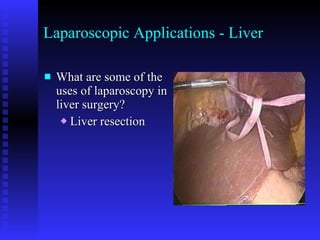
Laparoscopic Applications - Liver What are some of the uses of laparoscopy in liver surgery? Liver resection
Laparoscopic Applications - Liver Laparoscopic liver surgery: analyze the experience on 36 cases Laparoscopic fenestration and drainage were used in 7 patients with nonparasitic liver cysts Popescu I et al, Chirurgia. 2003 Jul-Aug;98(4):307-17
Laparoscopic Applications - Liver Nine patients had hydatid cysts 7/9 partial pericystectomy after inactivation and evacuation 2/9 ideal pericystectomy in segments II and III Only in the case of metastasis was a left lateral sectorectomy performed (all other resections were non-anatomical) Popescu I et al, Chirurgia. 2003 Jul-Aug;98(4):307-17
Laparoscopic Applications - Liver Laparoscopic liver surgery: analyze the experience on 36 cases No mortality 11.11% morbidity Mean f/u 18 months All patients asymptomatic Popescu I et al, Chirurgia. 2003 Jul-Aug;98(4):307-17
Laparoscopic Applications - Liver Benefits are those of minimally-invasive surgery Less   abdominal wall trauma, early mobilization, shorter LOS, aesthetics Popescu I et al, Chirurgia. 2003 Jul-Aug;98(4):307-17
Laparoscopic Applications - Liver Laparoscopic liver resection: benefits and controversies Comparative studies often favor laparoscopic over open approach Decreased analgesic requirement Shorter delay to oral intake Decreased hospital stay Quicker improvement in transaminase levels Gagner M et al, Surg Clin North Am. 2004 Apr;84(2):451-62
Laparoscopic Applications - Liver These advantages are most commonly seen in patients undergoing cyst or benign tumor resections Gagner M et al, Surg Clin North Am. 2004 Apr;84(2):451-62
Laparoscopic Applications - Liver Laparoscopic liver resection: benefits and controversies Comparison of survival of patients after laparoscopic malignant tumor resection to open approach is not established Gagner M et al, Surg Clin North Am. 2004 Apr;84(2):451-62
Laparoscopic Applications - Liver Bleeding and bile leakage are the most common perioperative complications Difficult to control laparoscopically Often lead to conversion to open approach Gagner M et al, Surg Clin North Am. 2004 Apr;84(2):451-62
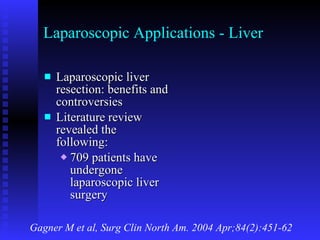
Laparoscopic Applications - Liver Laparoscopic liver resection: benefits and controversies Literature review revealed the following: 709 patients have undergone laparoscopic liver surgery Gagner M et al, Surg Clin North Am. 2004 Apr;84(2):451-62
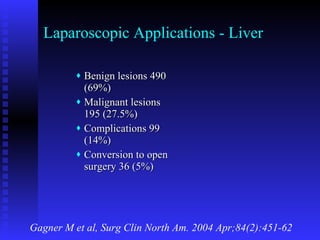
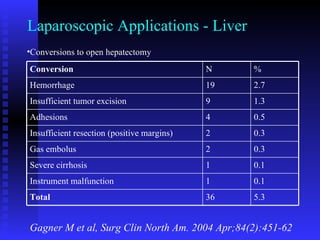
Laparoscopic Applications - Liver Benign lesions 490 (69%) Malignant lesions 195 (27.5%) Complications 99 (14%) Conversion to open surgery 36 (5%) Gagner M et al, Surg Clin North Am. 2004 Apr;84(2):451-62
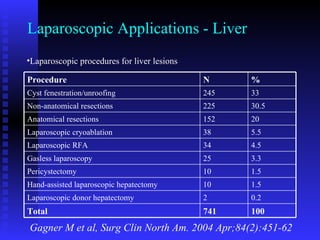
Laparoscopic Applications - Liver Gagner M et al, Surg Clin North Am. 2004 Apr;84(2):451-62 Laparoscopic procedures for liver lesions 100 741 Total 0.2 2 Laparoscopic donor hepatectomy 1.5 10 Hand-assisted laparoscopic hepatectomy 1.5 10 Pericystectomy 3.3 25 Gasless laparoscopy 4.5 34 Laparoscopic RFA 5.5 38 Laparoscopic cryoablation 20 152 Anatomical resections 30.5 225 Non-anatomical resections 33 245 Cyst fenestration/unroofing % N Procedure
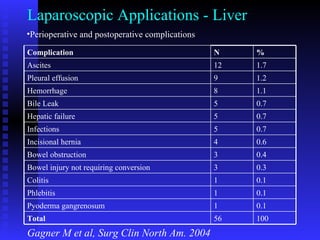
Laparoscopic Applications - Liver Gagner M et al, Surg Clin North Am. 2004 Apr;84(2):451-62 Perioperative and postoperative complications 100 56 Total 0.1 1 Pyoderma gangrenosum 0.1 1 Phlebitis 0.1 1 Colitis 0.3 3 Bowel injury not requiring conversion 0.4 3 Bowel obstruction 0.6 4 Incisional hernia 0.7 5 Infections 0.7 5 Hepatic failure 0.7 5 Bile Leak 1.1 8 Hemorrhage 1.2 9 Pleural effusion 1.7 12 Ascites % N Complication
Laparoscopic Applications - Liver Gagner M et al, Surg Clin North Am. 2004 Apr;84(2):451-62 Conversions to open hepatectomy 5.3 36 Total 0.1 1 Instrument malfunction 0.1 1 Severe cirrhosis 0.3 2 Gas embolus 0.3 2 Insufficient resection (positive margins) 0.5 4 Adhesions 1.3 9 Insufficient tumor excision 2.7 19 Hemorrhage % N Conversion
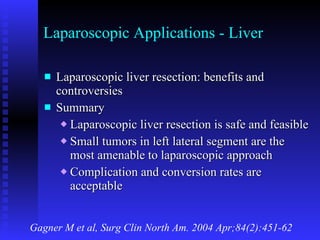
Laparoscopic Applications - Liver Laparoscopic liver resection: benefits and controversies Summary Laparoscopic liver resection is safe and feasible Small tumors in left lateral segment are the most amenable to laparoscopic approach Complication and conversion rates are acceptable Gagner M et al, Surg Clin North Am. 2004 Apr;84(2):451-62
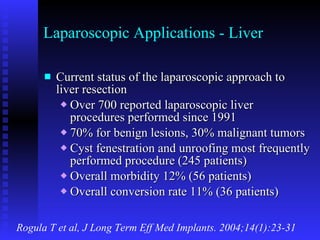
Laparoscopic Applications - Liver Current status of the laparoscopic approach to liver resection Over 700 reported laparoscopic liver procedures performed since 1991 70% for benign lesions, 30% malignant tumors Cyst fenestration and unroofing most frequently performed procedure (245 patients) Overall morbidity 12% (56 patients) Overall conversion rate 11% (36 patients) Rogula T et al, J Long Term Eff Med Implants. 2004;14(1):23-31
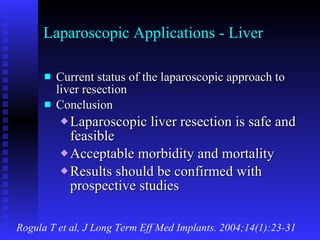
Laparoscopic Applications - Liver Current status of the laparoscopic approach to liver resection Conclusion Laparoscopic liver resection is safe and feasible Acceptable morbidity and mortality Results should be confirmed with prospective studies Rogula T et al, J Long Term Eff Med Implants. 2004;14(1):23-31
Laparoscopic Applications - Colon Diverticular disease Resection for malignancy
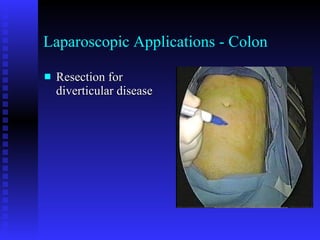
Laparoscopic Applications - Colon Resection for diverticular disease
Laparoscopic Applications - Colon Diverticular Disease Laparoscopic treatment of sigmoid diverticulitis Retrospective review of 103 patients treated for Hinchey I-III diverticulitis One-stage laparoscopic resection with primary anastamosis planned procedure Pugliese R et al, Surg Endosc. 2004 Jun;18:1334-1348
Laparoscopic Applications - Colon Diverticular Disease Hinchey IIa patients with abscesses were drained percutaneously pre-operatively Hinchey III patients underwent emergency surgery Four-trocar approach with left iliac fossa minilaparotomy used Pugliese R et al, Surg Endosc. 2004 Jun;18:1334-1348
Laparoscopic Applications - Colon Diverticular Disease Laparoscopic treatment of sigmoid diverticulitis Laparoscopic treatment successfully completed in 100 patients 2.9% intra-operative complications 1 uretheric injury in H3 2 anastamotic failure in H1 and H2a 2 conversions due to anatomic difficulties Pugliese R et al, Surg Endosc. 2004 Jun;18:1334-1348
Laparoscopic Applications - Colon Diverticular Disease Laparoscopic treatment of sigmoid diverticulitis 8% post-operative procedure related morbidity 3 wound infection (2 in HI, 1 in H3) 2 anastamotic leak (1 in HI, 1 in H2a) 1 intestinal obstruction (HI) Pugliese R et al, Surg Endosc. 2004 Jun;18:1334-1348
Laparoscopic Applications - Colon Diverticular Disease 1 anastamotic bleed (HI) 1 intraperitoneal bleed (HI) 2 pneumonia (H3) No mortality Longer LOS for H2b patients treated for colovesical fistula Pugliese R et al, Surg Endosc. 2004 Jun;18:1334-1348
Laparoscopic Applications - Colon Diverticular Disease Laparoscopic treatment of sigmoid diverticulitis There were no significant differences between classes of patients (HI-III) with regard to Operating time Nasogastgric tube days Pugliese R et al, Surg Endosc. 2004 Jun;18:1334-1348
Laparoscopic Applications - Colon Diverticular Disease There were no significant differences between classes of patients (HI-III) with regard to Post-operative ileus days Days to oral intake LOS Pugliese R et al, Surg Endosc. 2004 Jun;18:1334-1348
Laparoscopic Applications - Colon Diverticular Disease Laparoscopic treatment of sigmoid diverticulitis Conclusion Laparoscopic resection for diverticulitis can be performed without additional morbidity in HI   Pugliese R et al, Surg Endosc. 2004 Jun;18:1334-1348
Laparoscopic Applications - Colon Diverticular Disease Laparoscopic treatment of sigmoid diverticulitis can be a safe and effective gold standard procedure for HI-III patients in experienced hands Pugliese R et al, Surg Endosc. 2004 Jun;18:1334-1348
Laparoscopic Applications - Colon Colectomy for colon cancer
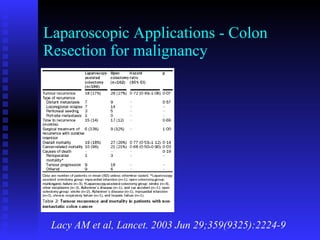
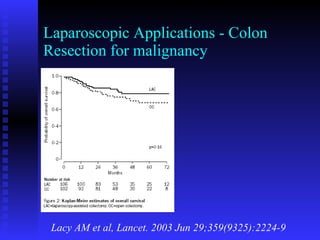
Laparoscopic Applications - Colon Resection for malignancy Laparoscopy-assisted colectomy versus open colectomy for treatment of non-metastatic colon cancer: a randomised trial Comparing the efficacy of laparoscopy-assisted colectomy (LAC) and open colectomy (OC) in terms of tumor recurrence and survival Lacy AM et al, Lancet. 2003 Jun 29;359(9325):2224-9
Laparoscopic Applications - Colon Resection for malignancy 219 patients randomised to LAC or open colectomy Lacy AM et al, Lancet. 2003 Jun 29;359(9325):2224-9
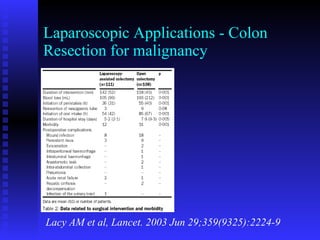
Laparoscopic Applications - Colon Resection for malignancy Lacy AM et al, Lancet. 2003 Jun 29;359(9325):2224-9
Laparoscopic Applications - Colon Resection for malignancy Patients in the LAC group had decreased time to peristalsis and oral intake than OC Patients with LAC had shorter LOS than open group Morbidity was lower in LAC than OC Lacy AM et al, Lancet. 2003 Jun 29;359(9325):2224-9
Laparoscopic Applications - Colon Resection for malignancy Probability of cancer-related survival was higher in the LAC group than OC In patients with stage III tumors, LAC was independently associated with reduced risk of tumor relapse and death from cancer-related cause compared to OC Lacy AM et al, Lancet. 2003 Jun 29;359(9325):2224-9
Laparoscopic Applications - Colon Resection for malignancy Conclusion: LAC is more effective then OC in the treatment of colon cancer in terms of morbidity, LOS, tumor recurrence and cancer-related survival Lacy AM et al, Lancet. 2003 Jun 29;359(9325):2224-9
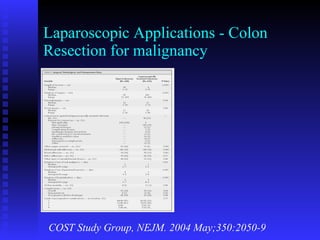
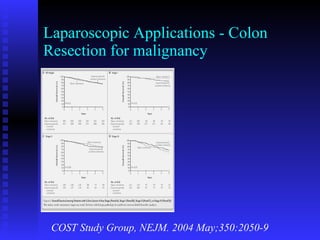
Laparoscopic Applications - Colon Resection for malignancy A comparison of laparoscopically assisted and open colectomy for colon cancer Prospective, randomized trial 428 patients underwent open colectomy (OC), 435 patients underwent laparoscopically assisted colectomy (LAC) Primary endpoint was time to tumor recurrence COST Study Group, NEJM. 2004 May;350:2050-9
Laparoscopic Applications - Colon Resection for malignancy COST Study Group, NEJM. 2004 May;350:2050-9
Laparoscopic Applications - Colon Resection for malignancy Surgery: Operating times longer for LAC  Extent of resection similar in both groups Margins <5cm in 6% OC vs 5% in LAC Median number of 12 lymph nodes examined in each COST Study Group, NEJM. 2004 May;350:2050-9
Laparoscopic Applications - Colon Resection for malignancy Recovery/Complications - No significant difference in: Rate of intraoperative complications 30-day postoperative mortality Rate/severity of postoperative complications at discharge Rates of readmission COST Study Group, NEJM. 2004 May;350:2050-9
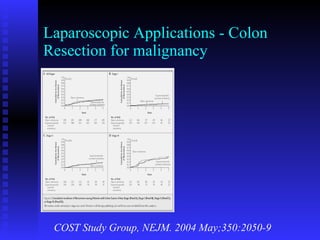
Laparoscopic Applications - Colon Resection for malignancy COST Study Group, NEJM. 2004 May;350:2050-9
Laparoscopic Applications - Colon Resection for malignancy Survival and Recurrence at 4.4 years - No significant difference in: Number of patients with recurrence in each group Cumulative incidence of recurrence between LAC and OC patients COST Study Group, NEJM. 2004 May;350:2050-9
Laparoscopic Applications - Colon Resection for malignancy Overall survival rate Disease-free survival rate These were true for any stage   COST Study Group, NEJM. 2004 May;350:2050-9
Laparoscopic Applications - Colon Resection for malignancy Conclusion This data suggests that LAC does not confer additional risk for cancer recurrence LAC is an acceptable alternative to OC and therefore it is safe to proceed with LAC in patients with colon cancer COST Study Group, NEJM. 2004 May;350:2050-9
Laparoscopic Applications - Colon Resection for malignancy Laparoscopic resection of colon cancer  Consensus of the European Association of Endoscopic Surgery (E.A.E.S.) Review of the current literature to formulate evidence-based recommendations on the role of laparoscopy in resection of colon cancer Veldkamp R et al, Surg Endosc. 2004 Jun;18:1163-1185
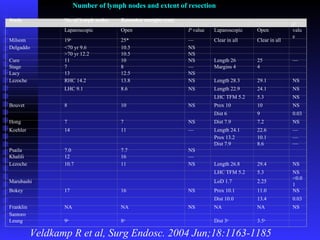
Laparoscopic Applications - Colon Resection for malignancy Laparoscopic resection of colon cancer Advanced age, obesity and prior abdominal surgery are not absolute contraindications to laparoscopic resection of colon caner Conversion is highest in presence of bulky or invasive tumors Veldkamp R et al, Surg Endosc. 2004 Jun;18:1163-1185
Laparoscopic Applications - Colon Resection for malignancy Operative time is longer for laparoscopic resection  Specimen size, extent of resection and pathological examination is similar to open resection Veldkamp R et al, Surg Endosc. 2004 Jun;18:1163-1185
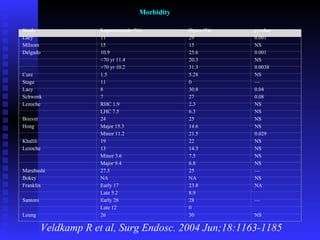
Laparoscopic Applications - Colon Resection for malignancy Laparoscopic resection of colon cancer Immediate postoperative morbidity and mortality are comparable for open and laparoscopic resection Veldkamp R et al, Surg Endosc. 2004 Jun;18:1163-1185
Laparoscopic Applications - Colon Resection for malignancy Laparoscopic resection results in  decreased pain better-preserved pulmonary function Earlier return of GI function Decreased LOS Veldkamp R et al, Surg Endosc. 2004 Jun;18:1163-1185
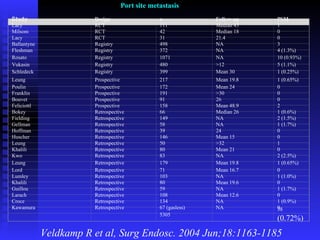
Laparoscopic Applications - Colon Resection for malignancy Laparoscopic resection of colon cancer The postoperative stress response is lower after laparoscopic resection The incidence of port site metastasis is <1% Veldkamp R et al, Surg Endosc. 2004 Jun;18:1163-1185
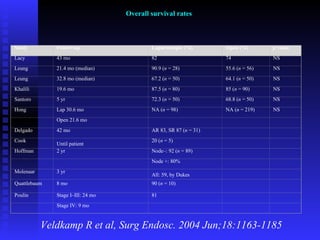
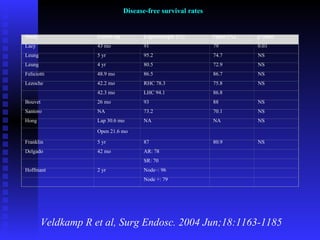
Laparoscopic Applications - Colon Resection for malignancy Survival after laparoscopic resection appears to be equal to that after open resection The costs for laparoscopic resection is higher than for open resection Veldkamp R et al, Surg Endosc. 2004 Jun;18:1163-1185
Laparoscopic Applications - Colon Resection for malignancy Laparoscopic resection of colon cancer Laparoscopic resection for colon cancer is safe and feasible, with improved short-term outcomes Results of studies of long-term survival will determine more precisely its role Veldkamp R et al, Surg Endosc. 2004 Jun;18:1163-1185
Number of lymph nodes and extent of resection Veldkamp R et al, Surg Endosc. 2004 Jun;18:1163-1185 Study No. of lymph nodes Resection margins (cm)           Laparoscopic Open P  value Laparoscopic Open p  value Milsom  19 a 25* — Clear in all Clear in all   Delgaddo  <70 yr 9.6 10.5 NS         >70 yr 12.2 10.5 NS       Cure  11 10 NS Length 26 25 — Stage  7 8 — Margins 4 4   Lacy  13 12.5 NS       Lezoche  RHC 14.2 13.8 NS Length 28.3 29.1 NS   LHC 9.1 8.6 NS Length 22.9 24.1 NS         LHC TFM 5.2 5.3 NS Bouvet  8 10 NS Prox 10 10 NS         Dist 6 9 0.03 Hong 7 7 NS Dist 7.9 7.2 NS Koehler 14 11 — Length 24.1 22.6 —         Prox 13.2 10.1 —         Dist 7.9 8.6 — Psaila  7.0 7.7 NS       Khalili  12 16 —       Lezoche  10.7 11 NS Length 26.8 29.4 NS         LHC TFM 5.2 5.3 NS Marubashi        LoD 1.7 2.25 <0.01 Bokey  17 16 NS Prox 10.1 11.0 NS         Dist 10.0 13.4 0.03 Franklin  NA NA NS NA NA NS Santoro              Leung  9 a 8 a   Dist 3 a 3.5 a  
Morbidity Veldkamp R et al, Surg Endosc. 2004 Jun;18:1163-1185 Study Laparoscopic (%) Open (%) p  value Lacy  11 29 0.001 Milsom  15 15 NS Delgado  10.9 25.6 0.001   <70 yr 11.4 20.3 NS   >70 yr 10.2 31.3 0.0038 Cure  1.5 5.28 NS Stage  11 0 — Lacy 8 30.8 0.04 Schwenk  7 27 0.08 Lezoche  RHC 1.9 2.3 NS   LHC 7.5 6.3 NS Bouvet  24 25 NS Hong  Major 15.3 14.6 NS   Minor 11.2 21.5 0.029 Khalili  19 22 NS Lezoche  13 14.3 NS   Minor 3.6 7.5 NS   Major 9.4 6.8 NS Marubashi  27.5 25 — Bokey  NA NA NS Franklin  Early 17 23.8 NA   Late 5.2 8.9   Santoro  Early 28 28 —   Late 12 0   Leung  26 30 NS
Length of hospital stay  Veldkamp R et al, Surg Endosc. 2004 Jun;18:1163-1185 Study Laparoscopic Open p  value Week  5.6 ± 0.26 6.4 ± 0.23 <0.001 Hewitt  6 (57) 7 (4–9) — Milsom  6.0 (3–37) 7.0 (524) NS Delgado  <70 yr 5 7 0.0001   >70 yr 6 7 0.0009 Curet  5.2 7.3 <0.05 Stage  5 (3–12) 8 (5–30) 0.01 Lacy  5.2 ± 1.2 8.1 ± 3.8 0.0012 Lezoche  RHC 9.2 13.2 0.001   LHC 10.0 13.2 0.001 Bouvet  6 (2–35) 7 (4–52) <0.01 Hong 6.9 ± 5.4 10.9 ± 9.3 0.003 Koehler  8.1 (6–14) 15.3 (9–23) — Psaila  10.7 ± 4.7 17.8 ± 9.5 0.001 Khalili  7.7 ± 0.5 8.2 ± 0.2 NS Lezoche 10.5 13.3 0.027 Marubashi] 18.7 35.8 <0.0001 Franklin  <50 yr 5.2 (2.0–9.2) 9.35 (517) —   >50 yr 7.84 (448) 12.85 (941)   Leung  6 (3–22) 8 (3–28) <0.001
Overall survival rates Veldkamp R et al, Surg Endosc. 2004 Jun;18:1163-1185 Study Follow-up Laparoscopic (%) Open (%) p  value Lacy  43 mo 82 74 NS Leung  21.4 mo (median) 90.9 ( n  = 28) 55.6 ( n  = 56) NS Leung  32.8 mo (median) 67.2 ( n  = 50) 64.1 ( n  = 50) NS Khalili  19.6 mo 87.5 ( n  = 80) 85 ( n  = 90) NS Santoro  5 yr 72.3 ( n  = 50) 68.8 ( n  = 50) NS Hong  Lap 30.6 mo NA ( n  = 98) NA ( n  = 219) NS   Open 21.6 mo       Delgado  42 mo AR 83, SR 87 ( n  = 31)     Cook  Until patient 20 ( n  = 5)     Hoffman  2 yr Node–: 92 ( n  = 89)         Node +: 80%     Molenaar  3 yr All: 59, by Dukes     Quattlebaum  8 mo 90 ( n  = 10)     Poulin  Stage I–III: 24 mo 81       Stage IV: 9 mo      
Disease-free survival rates Veldkamp R et al, Surg Endosc. 2004 Jun;18:1163-1185 Study Follow-up Laparoscopic (%) Open (%) p  value Lacy  43 mo 91 79 0.03 Leung  5 yr 95.2 74.7 NS Leung  4 yr 80.5 72.9 NS Feliciotti  48.9 mo 86.5 86.7 NS Lezoche  42.2 mo RHC 78.3 75.8 NS   42.3 mo LHC 94.1 86.8   Bouvet  26 mo 93 88 NS Santoro  NA 73.2 70.1 NS Hong  Lap 30.6 mo NA NA NS   Open 21.6 mo       Franklin  5 yr 87 80.9 NS Delgado  42 mo AR: 78         SR: 70     Hoffmant  2 yr Node–: 96         Node +: 79    
Port site metastasis Veldkamp R et al, Surg Endosc. 2004 Jun;18:1163-1185 Study Design n Follow-up PSM Lacy  RCT 111 Median 43 1 Milsom  RCT 42 Median 18 0 Lacy  RCT 31 21.4 0 Ballantyne  Registry 498 NA 3 Fleshman  Registry 372 NA 4 (1.3%) Rosato  Registry 1071 NA 10 (0.93%) Vukasin  Registry 480 >12 5 (1.1%) Schledeck  Registry 399 Mean 30 1 (0.25%) Leung  Prospective 217 Mean 19.8 1 (0.65%) Poulin  Prospective 172 Mean 24 0 Franklin  Prospective 191 >30 0 Bouvet  Prospective 91 26 0 Feliciottl  Prospective 158 Mean 48.9 2 Bokey  Retrospective 66 Median 26 1 (0.6%) Fielding Retrospective 149 NA 2 (1.5%) Gellman  Retrospective 58 NA 1 (1.7%) Hoffman  Retrospective 39 24 0 Huscher  Retrospective 146 Mean 15 0 Leung  Retrospective 50 >32 1 Khalili  Retrospective 80 Mean 21 0 Kwo Retrospective 83 NA 2 (2.5%) Leung  Retrospective 179 Mean 19.8 1 (0.65%) Lord  Retrospective 71 Mean 16.7 0 Lumley  Retrospective 103 NA 1 (1.0%) Khalili  Retrospective 80 Mean 19.6 0 Guillou  Retrospective 59 NA 1 (1.7%) Larach  Retrospective 108 Mean 12.6 0 Croce  Retrospective 134 NA 1 (0.9%) Kawamura  Retrospective 67 (gasless) NA 0     5305   38  (0.72%)
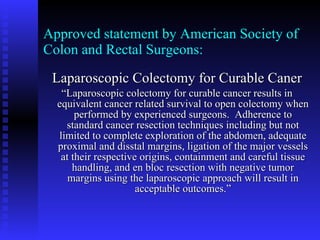
Approved statement by American Society of Colon and Rectal Surgeons: Laparoscopic Colectomy for Curable Caner “ Laparoscopic colectomy for curable cancer results in equivalent cancer related survival to open colectomy when performed by experienced surgeons.  Adherence to standard cancer resection techniques including but not limited to complete exploration of the abdomen, adequate proximal and disstal margins, ligation of the major vessels at their respective origins, containment and careful tissue handling, and en bloc resection with negative tumor margins using the laparoscopic approach will result in acceptable outcomes.”
Laparoscopic Applications - Appendix Laparoscopic vs open appendectomy.  What is the real difference?  Results of a prospective randomized double-blind trial 52 men randomized to open or laparoscopic appendectomy (OA, LA) Operative time, LOS, lost work days, pain scores and operative times were compared Ignacio RC et al, Surg Endosc. 2004 Mar;18:334-337
Laparoscopic Applications - Appendix Laparoscopic vs open appendectomy.  What is the real difference? No statistically-different difference in: LOS Post-operative pain days 1 and 7 Mean time to return to work Operative costs $600 higher for laparoscopic group Ignacio RC et al, Surg Endosc. 2004 Mar;18:334-337
Laparoscopic Applications - Appendix Laparoscopic vs open appendectomy.  What is the real difference? Conclusions: LA appears to confer no advantage over OA for LOS Post-operative pain Lost work days Further studies may address possible advantages for specific patient populations (e.g. obese, women) Ignacio RC et al, Surg Endosc. 2004 Mar;18:334-337
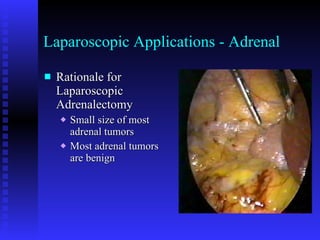
Laparoscopic Applications - Adrenal Rationale for Laparoscopic Adrenalectomy Small size of most adrenal tumors Most adrenal tumors are benign
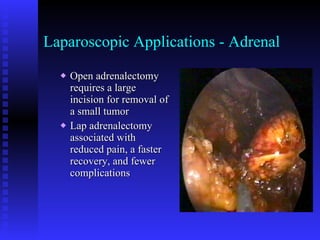
Laparoscopic Applications - Adrenal Open adrenalectomy requires a large incision for removal of a small tumor Lap adrenalectomy associated with reduced pain, a faster recovery, and fewer complications
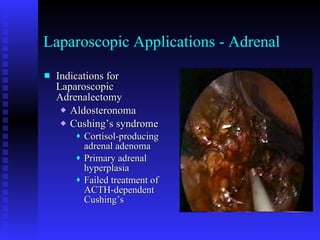
Laparoscopic Applications - Adrenal Indications for Laparoscopic Adrenalectomy Aldosteronoma Cushing’s syndrome Cortisol-producing adrenal adenoma Primary adrenal hyperplasia Failed treatment of ACTH-dependent Cushing’s
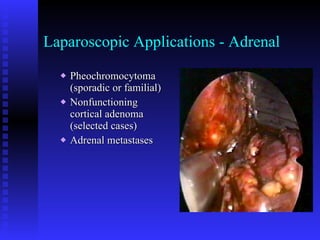
Laparoscopic Applications - Adrenal Pheochromocytoma (sporadic or familial) Nonfunctioning cortical adenoma (selected cases) Adrenal metastases
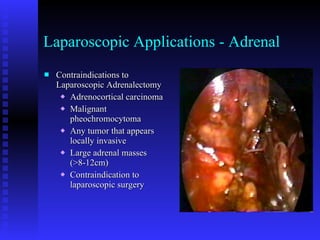
Laparoscopic Applications - Adrenal Contraindications to Laparoscopic Adrenalectomy Adrenocortical carcinoma  Malignant pheochromocytoma Any tumor that appears locally invasive Large adrenal masses (>8-12cm) Contraindication to laparoscopic surgery
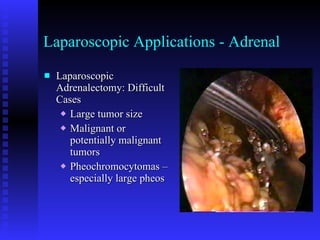
Laparoscopic Applications - Adrenal Laparoscopic Adrenalectomy: Difficult Cases Large tumor size Malignant or potentially malignant tumors Pheochromocytomas –especially large pheos
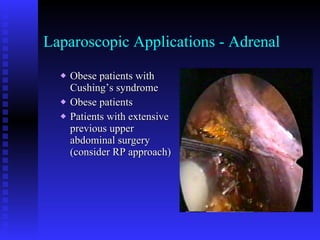
Laparoscopic Applications - Adrenal Obese patients with Cushing’s syndrome Obese patients Patients with extensive previous upper abdominal surgery (consider RP approach)
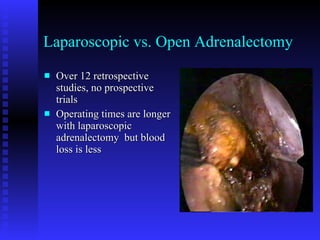
Laparoscopic vs. Open Adrenalectomy Over 12 retrospective studies, no prospective trials Operating times are longer with laparoscopic adrenalectomy  but blood loss is less
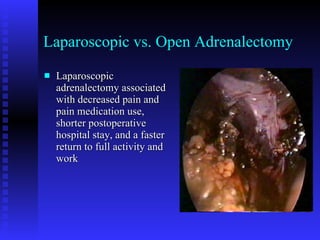
Laparoscopic vs. Open Adrenalectomy Laparoscopic adrenalectomy associated with decreased pain and pain medication use, shorter postoperative hospital stay, and a faster return to full activity and work
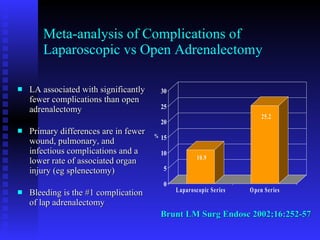
Meta-analysis of Complications of Laparoscopic vs Open Adrenalectomy LA associated with significantly fewer complications than open adrenalectomy Primary differences are in fewer wound, pulmonary, and infectious complications and a lower rate of associated organ injury (eg splenectomy) Bleeding is the #1 complication of lap adrenalectomy Brunt LM Surg Endosc 2002;16:252-57
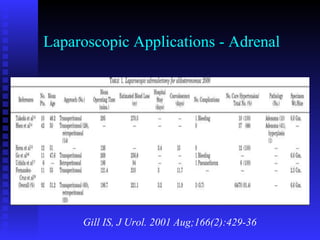
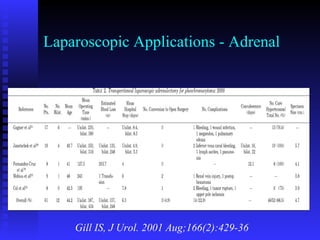
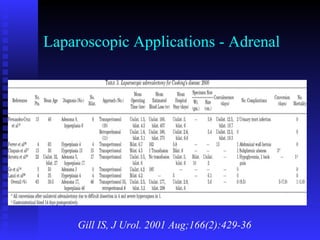
Laparoscopic Applications - Adrenal The case for laparoscopic adrenalectomy Review of literature addressing the role of laparoscopy in adrenal disorders Studies comparing open versus laparoscopic adrenalectomy were evaluated Gill IS, J Urol. 2001 Aug;166(2):429-36
Laparoscopic Applications - Adrenal Gill IS, J Urol. 2001 Aug;166(2):429-36
Laparoscopic Applications - Adrenal The case for laparoscopic adrenalectomy Conclusions: Data from available literature indicates that laparoscopic surgery is safe and efficacious for Aldosteroma Pheochromocytoma Cushing’s disease Incidentaloma Gill IS, J Urol. 2001 Aug;166(2):429-36
Laparoscopic Applications - Adrenal The case for laparoscopic adrenalectomy Conclusions, cont’d Compared to open surgery, laparoscopic adrenalectomy provides Equivalent outcomes Decreased morbidity Financial benefits The role of the laparoscopic approach to adrenal cancer demands further study Gill IS, J Urol. 2001 Aug;166(2):429-36
Laparoscopic Applications - Adrenal The case for laparoscopic adrenalectomy In the majority of patients with adrenal disease, laparoscopy may now be considered the gold standard for surgical treatment Gill IS, J Urol. 2001 Aug;166(2):429-36
Laparoscopic Applications - Adrenal LA is the preferred method of removal of the vast majority of adrenal tumors Complete biochemical work-up and localization pre-op Keys to a successful outcome: patient selection, surgical approach, meticulous dissection and hemostasis Avoid difficult cases during “learning curve” Lap ultrasound may be useful early in one’s experience and in difficult cases, esp. obese patients with difficult to find tumors
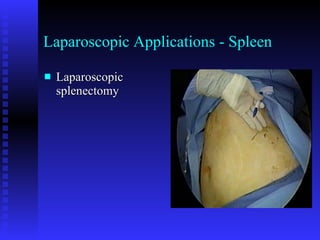
Laparoscopic Applications - Spleen Laparoscopic splenectomy
Laparoscopic Applications - Spleen Laparoscopic splenectomy: evolution and current status Review of literature addressing the role of laparoscopic splenectomy (LS) Klinger PJ et al, Surg Laparosc Endosc. 1999 Jan;9(1):1-8
Laparoscopic Applications - Spleen Laparoscopic splenectomy: evolution and current status Compared to OS, LS results in: Fewer perioperative complications Less morbidity Shorter LOS Klinger PJ et al, Surg Laparosc Endosc. 1999 Jan;9(1):1-8
Laparoscopic Applications - Spleen LS has a limited role in hypersplenism and traumatic splenic injury LS is the operation of choice for spleens <20cm in diameter Klinger PJ et al, Surg Laparosc Endosc. 1999 Jan;9(1):1-8
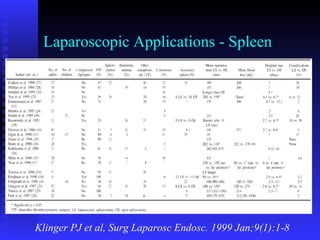
Laparoscopic Applications - Spleen Klinger PJ et al, Surg Laparosc Endosc. 1999 Jan;9(1):1-8
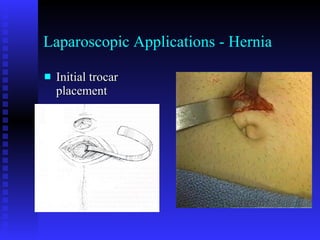
Laparoscopic Applications - Hernia Initial trocar placement
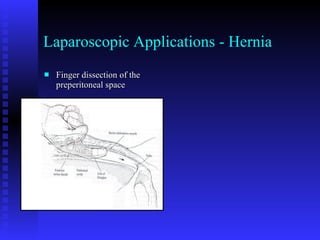
Laparoscopic Applications - Hernia Finger dissection of the preperitoneal space
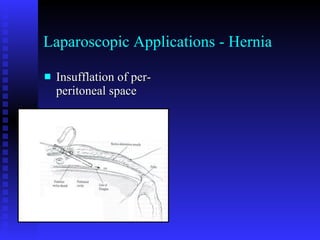
Laparoscopic Applications - Hernia Insufflation of per-peritoneal space
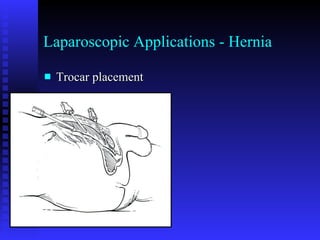
Laparoscopic Applications - Hernia Trocar placement
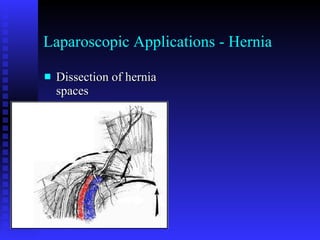
Laparoscopic Applications - Hernia Dissection of hernia spaces
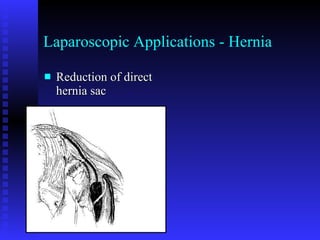
Laparoscopic Applications - Hernia Reduction of direct hernia sac
Laparoscopic Applications - Hernia Reduction of direct hernia sac Easily identified medial to the epigastric vessels Easily reduced away from the thinned transversalis  fascia
Laparoscopic Applications - Hernia Reduction of indirect hernia sac In the presence of hernia: The vas deferent is not visible The sac is seen  over the spermatic cord The sac has to be always separated from the cord structures prior to any attempt of reduction
Laparoscopic Applications - Hernia Placement of mesh
Laparoscopic Applications - Hernia Fixation of the mesh Stapler  Tacker  Adhesive butyl-2-cyanoacrylate * Fibrin sealant **  (fibrinogen plus thrombin) No fixation
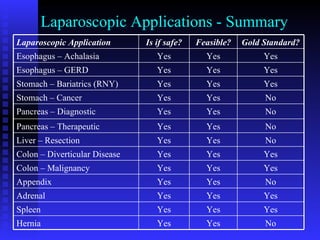
Laparoscopic Applications - Summary Yes Yes Yes Spleen No Yes Yes Hernia Yes Yes Yes Adrenal  No Yes Yes Appendix Yes Yes Yes Colon – Malignancy Yes Yes Yes Colon – Diverticular Disease No Yes Yes Liver – Resection No Yes Yes Pancreas – Therapeutic  No Yes Yes Pancreas – Diagnostic No Yes Yes Stomach – Cancer Yes Yes Yes Stomach – Bariatrics (RNY) Yes Yes Yes Esophagus – GERD Yes Yes Yes Esophagus – Achalasia Gold Standard? Feasible? Is if safe? Laparoscopic Application

Evaluating Current Laparoscopic Applications In Surgery

  • 1.
    Evaluating Current LaparoscopicApplications in Surgery George S Ferzli, MD Armando E Castro, MD
  • 2.
    Evidence-Based Medicine Formulateanswerable questions: Which is superior, open or laparoscopic approach? Is the laparoscopic approach safe? Is the laparoscopic approach feasible? Are the outcomes of the laparoscopic approach acceptable?
  • 3.
    Evidence-Based Medicine Utilizingavailable scientific data to develop guidelines for medical practice Used to evaluate and integrate emerging techniques and advances into practice Laparoscopy lends itself to evaluation and practice through evidence-based medicine
  • 4.
  • 5.
  • 6.
    Evidence-Based Medicine Whatdoes the available and most current data tell us regarding the practice of laparoscopy in general surgery?
  • 7.
    Laparoscopic Applications inSurgery Esophagus Stomach Pancreas Liver Colon Appendix Adrenal Spleen Groin hernia
  • 8.
    Laparoscopic Applications -Esophagus What are some of the current uses of laparoscopy in esophageal surgery? Achalasia – Heller Myotomy Hiatal hernia/GERD – Fundoplication Epiphrenic Diverticulum Cancer
  • 9.
    Laparoscopic Applications -Esophagus Achalasia Surgical treatment of achalasia: current status and controversies Literature review of the current management of achalasia Laparoscopic Heller myotomy is generally accepted as the operative procedure of choice Less invasive, associated with less pain and postoperative disability, shorter hospital stay Abir F et al, Dig Surg 2004;21:165-176
  • 10.
    Laparoscopic Applications -Esophagus Achalasia Abir F et al, Dig Surg 2004;21:165-176 Studies of laparoscopic Heller myotomy
  • 11.
    Laparoscopic Applications -Esophagus Achalasia 35 76 204 Thoracoscopic 13 94 499 Laparoscopic 10.5 86 1379 Open trans-thoracic 12.3 83 2680 Open trans-abdominal % post-op GERD % symptom improvement N
  • 12.
    Laparoscopic Applications -Esophagus Achalasia The laparoscopic approach has a good to excellent response rate compared to other surgical approaches Lower incidence of postoperative GERD than open or thoracoscopic approaches Based on current evidence, laparoscopic Heller myotomy is the operative procedure of choice for achalasia Abir F et al, Dig Surg 2004;21:165-176
  • 13.
    Laparoscopic Applications -Esophagus Hiatal Hernia/GERD Laparoscopic antireflux surgery is a well-established treatment of moderate to severe GERD Indicated for symptomatic pts who have not responded fully to medical therapy
  • 14.
    Laparoscopic Applications -Esophagus Hiatal Hernia/GERD Laparoscopic antireflux surgery for gastroesophageal reflux disease: experience with 688 laparoscopic antireflux procedures Review of author’s experience with GERD 24 pH monitoring, esophageal manometry, and analysis of failure prospectively reviewed Granderath F et al, Int J Col Dis 2004 Jan;18(1):73-77
  • 15.
    Laparoscopic Applications -Esophagus Hiatal Hernia/GERD Laparoscopic antireflux surgery for gastroesophageal reflux disease: experience with 688 laparoscopic antireflux procedures Overall complication 7.6% Mean f/u 4.8 years with normal 24-h pH and esophageal manometry in 93% of pts Granderath F et al, Int J Col Dis 2004 Jan;18(1):73-77
  • 16.
    Laparoscopic Applications -Esophagus Hiatal Hernia/GERD Laparoscopic antireflux surgery for gastroesophageal reflux disease: experience with 688 laparoscopic antireflux procedures Conclusions: Laparoscopic antireflux surgery is feasible and effective, with low morbidity and good to excellent functional and symptomatic results Granderath F et al, Int J Col Dis 2004 Jan;18(1):73-77
  • 17.
    Laparoscopic Applications -Esophagus Hiatal Hernia/GERD Laparoscopic treatment of gastro-oesophageal reflux disease. Reviewed 9 randomized trials comparing open and laparoscopic fundoplication Combined results of these trials confirms advantage of the laparoscopic approach Watson D, Best Pract Res Clin Gastroenterol. 2004 Feb;18(1):19-35
  • 18.
    Laparoscopic Applications -Esophagus Hiatal Hernia/GERD Laparoscopic treatment of gastro-oesophageal reflux disease Laparoscopic fundoplication is now the “gold standard” for the management of pts with severe GERD New endoscopic treatments will need to achieve similar outcomes before they are accepted replacements for laparoscopic approach Watson D, Best Pract Res Clin Gastroenterol. 2004 Feb;18(1):19-35
  • 19.
    Laparoscopic Applications -Esophagus Hiatal Hernia/GERD Evidence-based appraisal of antireflux fundoplication Catarci M et al, Ann Surg. 2004 Mar;239(3):325-37
  • 20.
    Laparoscopic Applications -Esophagus Hiatal Hernia/GERD Catarci M et al, Ann Surg. 2004 Mar;239(3):325-37
  • 21.
    Laparoscopic Applications -Esophagus Hiatal Hernia/GERD Catarci M et al, Ann Surg. 2004 Mar;239(3):325-37
  • 22.
    Laparoscopic Applications -Esophagus Hiatal Hernia/GERD Evidence-based appraisal of antireflux fundoplication No perioperative deaths were reported in any of the trials Comparing laparoscopic versus open approach: Lower operative morbidity rate, 10.3% vs 26.7% Shorter postoperative stay, 3.1 vs 5.2 days Shorter sick leave, 20.1 vs 35.8 days No significant differences in rate of recurrence, dysphagia, bloating and reoperation for failure Catarci M et al, Ann Surg. 2004 Mar;239(3):325-37
  • 23.
    Laparoscopic Applications -Stomach Bariatric surgery Cancer Perforated ulcer Gastric outlet obstruction/Pyloroplasty Gastrostomy
  • 24.
    Roux-en-Y Gastric BypassGood long-term results, EWL 60-75% Solid food well tolerated Complications: Early: anastomotic leak, acute gastric dilatation, Roux-en-Y obstruction, atelectasis, DVT/PE Late: stomal stricture, staple line failure, pouch dilatation, dumping, anemia, vit B 12 deficiency, Ca +2 deficiency/osteoporosis
  • 25.
    Vertical Banded GastroplastyEdward E. Mason (1982), University of Iowa Restriction with polypropylene band, Marlex mesh, or silastic ring Rules of eating Soft calorie syndrome Complications: Leak Persistent vomiting
  • 26.
    Laparoscopic Adjustable GastricBanding Kuzmak (1990), Lodz Medical Academy,Poland Adjustable band connected to port implanted in subcutaneous tissue Complications: O perative: s plenic and esophageal injury, conversion to open procedure Late: b and slippage, reservoir deflation/leak, failure to lose weight, persistent vomiting, acid reflux
  • 27.
    Laparoscopic Applications -Stomach Gastric bypass The laparoscopic gastric bypass is now the preferred surgical treatment for morbid obesity
  • 28.
    Laparoscopic Applications -Stomach Gastric bypass Laparoscopic versus open gastric bypass to treat morbid obesity Presentation of selected series of Roux en Y gastric bypass Brolin R, Ann Surg. 2004 Apr;239(4):438-440
  • 29.
    Laparoscopic Applications -Stomach Gastric bypass Comprehensive review of 18 published cohort studies (10 laparoscopic, 8 open) favored laparoscopy Shorter LOS Lower incidence of abdominal wall hernias Mortality and wound infection rate in combined cohort studies also favors the laparosopic approach versus open Brolin R, Ann Surg. 2004 Apr;239(4):438-440
  • 30.
    Laparoscopic Applications -Stomach Gastric bypass In combined cohort studies the open approach had a significantly lower incidence of late stomal stenosis and bowel obstruction Brolin R, Ann Surg. 2004 Apr;239(4):438-440
  • 31.
    Laparoscopic Applications -Stomach Gastric bypass Laparoscopic versus open gastric bypass to treat morbid obesity Brolin R, Ann Surg. 2004 Apr;239(4):438-440
  • 32.
    Laparoscopic Applications -Stomach Cancer Comparison of laparoscopic and open gastrectomy for malignant disease Retrospective case-matched study comparing laparoscopic (n = 12) and open (n = 13) partial gastrectomies for cancer Stage, extent of lymphadenectomy, and 18 month survival were compared Weber KJ et al, Surg Endosc. 2003 Jun;17(6):968-71.
  • 33.
    Laparoscopic Applications -Stomach Cancer Comparison of laparoscopic and open gastrectomy for malignant disease No statistical difference in stages between groups Resection margins in laparoscopic group were all free of tumor No difference in extent of lymphadenectomy between groups No difference in survival between groups at 18 month follow-up Weber KJ et al, Surg Endosc. 2003 Jun;17(6):968-71.
  • 34.
    Laparoscopic Applications -Stomach Cancer Comparison of laparoscopic and open gastrectomy for malignant disease Conclusions: The laparoscopic approach to gastric cancer allows for adequate margins and can follow oncologic principles, and is this an viable alternative to open surgery There is no difference in short-term survival between the two approaches Weber KJ et al, Surg Endosc. 2003 Jun;17(6):968-71.
  • 35.
    Laparoscopic Applications -Stomach Cancer Application of minimally invasive treatment for early gastric cancer. To propose indications for the application of minimally invasive therapy for EGC Retrospective analysis of 566 pts who had undergone gastrectomy with D2 or more extended lymphadenectomy Risk factors for lymph node metastasis were identified Hyung WJ et al, J Surg Oncol. 2004 Mar 15;85(4):181-5.
  • 36.
    Laparoscopic Applications -Stomach Cancer Application of minimally invasive treatment for early gastric cancer. Lymph node metastasis was associated with submucosal invasion, larger tumor size, undifferentiated histology and presence of lymphatic or vascular invasion (LBVI) Minimally invasive treatment can be possibly applied for pts with EGC using these four independent risk factors for lymph node metastasis Hyung WJ et al, J Surg Oncol. 2004 Mar 15;85(4):181-5.
  • 37.
    Laparoscopic Applications -Stomach Cancer Current status of laparoscopic gastrectomy for cancer in Japan. Review of current indications for and outcomes of laparoscopic procedures for gastric cancer Laparoscopic wedge resection (LWR) Intragastric mucosal resection (IGMR) Laparoscopy-assisted distal gastrectomy (LADG) Kitano S et al, Surg Endosc. 2004 Feb;18(2):182-5.
  • 38.
    Laparoscopic Applications -Stomach Cancer Current status of laparoscopic gastrectomy for cancer in Japan. Laparoscopic procedures are useful in early gastric cancer (EGC) because of Minimal invasiveness Decreased pain Faster recovery Improved outcomes with laparoscopic approaches for EGC have led to the application of these approaches to more advanced gastric cancer Kitano S et al, Surg Endosc. 2004 Feb;18(2):182-5.
  • 39.
    Laparoscopic Applications -Stomach Cancer Kitano S et al, Surg Endosc. 2004 Feb;18(2):182-5. Laparoscopic surgery for gastric cancer in Japan 9.7 4.6 6.5 Postoperative 1.4 2.1 4.2 Complication rate Intraoperative Early gastric cancer with risk of LN mets Early gastric cancer without risk of LN mets Indication 2600 1428 260 Number of cases Lap Gastrectomy LWR IGMR local resection Laparoscopic
  • 40.
    Laparoscopic Applications -Stomach Cancer Current status of laparoscopic gastrectomy for cancer in Japan. Conclusions: Indication for LWR and IGMR is cancer without risk of lymph node metastasis, Indication for LADG is early gastric cancer with risk of perigastric (n1) lymph node metastasis Multicenter randomized control studies of long-term outcome are necessary Kitano S et al, Surg Endosc. 2004 Feb;18(2):182-5.
  • 41.
    Laparoscopic Applications -Pancreas What are some of the current uses of laparoscopy in pancreatic surgery? Diagnostic Therapeutic
  • 42.
    Laparoscopic Applications -Pancreas Diagnostic Pancreatic surgery in the laparoscopic era Diagnostic laparoscopy has been used to detect peritoneal metastases and obtain biopsies since 1960’s Staging laparoscopy avoids unnecessary laparotomy in one-fifth of patients with pancreatic cancer The addition of laparoscopic ultrasound may also be beneficial in detection of intrahepatic metastases and vascular involvement Ammori B, J Pancreas 2003;4(6):187-192
  • 43.
    Laparoscopic Applications -Pancreas Therapeutic Pancreatic resection
  • 44.
    Laparoscopic Applications -Pancreas Therapeutic Laparoscopic pancreatic surgery. Current indications and surgical results Evaluated the outcomes and feasibility of laparoscopic pancreatic surgery Shimizu S et al, Surg Endosc 2004 Mar; 18(3):402-6
  • 45.
    Laparoscopic Applications -Pancreas Therapeutic Fifteen patients (8M, 7F) Distal pancreatectomy (DP) for solid tumor (n=4) DP for cystic lesion (n=3) DP for chronic pancreatitis (n=2) Cystgastrostomy (CG) for pseudocyst (n=4) Enucleation of insulinoma (n=2) Shimizu S et al, Surg Endosc 2004 Mar; 18(3):402-6
  • 46.
    Laparoscopic Applications -Pancreas Therapeutic Laparoscopic pancreatic surgery. Current indications and surgical results Mean OR time was 249+/-70 min DP ~5 hrs, CG and enucleation ~3hrs Mean blood loss was 138+/-184g Shimizu S et al, Surg Endosc 2004 Mar; 18(3):402-6
  • 47.
    Laparoscopic Applications -Pancreas Therapeutic 2 DP were converted to open No related mortality 2 pancreatic fistula (1 DP, 1 enucleation) both treated non-operatively Shimizu S et al, Surg Endosc 2004 Mar; 18(3):402-6
  • 48.
    Laparoscopic Applications -Pancreas Therapeutic Laparoscopic pancreatic surgery. Current indications and surgical results Conclusions Laparoscopic pancreatic surgery (LPS) is safe and feasible for patients with benign tumors and cystic lesions Shimizu S et al, Surg Endosc 2004 Mar; 18(3):402-6
  • 49.
    Laparoscopic Applications -Pancreas Therapeutic Although some retrospective studies have shown that LPS results in faster post-op recovery and morbidity rates comparable to open surgery, no randomized controlled study confirming reduced invasiveness or superiority has been presented Shimizu S et al, Surg Endosc 2004 Mar; 18(3):402-6
  • 50.
    Laparoscopic Applications -Pancreas Therapeutic Laparoscopic resection of the pancreas. A feasibility study of the short-term outcome 32 patients with pancreatic disease were evaluated Neuroendocrine tumors (n=13) Unspecified tumors (n=11) Edwin B et al, Surg Endosc 2004 Mar; 18(3):407-411
  • 51.
    Laparoscopic Applications -Pancreas Therapeutic Cysts (n=2) ITP with ectopic spleen (n=2) Annular pancreas (n=1) Trauma (n=1) Splenic artery aneurysm (n=) Adenocarcinoma (n=1) Edwin B et al, Surg Endosc 2004 Mar; 18(3):407-411
  • 52.
    Laparoscopic Applications -Pancreas Therapeutic Laparoscopic resection of the pancreas. A feasibility study of the short-term outcome Enucleations (n=6) Distal pancreatectomy (DP) with splenectomy (n=12) Edwin B et al, Surg Endosc 2004 Mar; 18(3):407-411
  • 53.
    Laparoscopic Applications -Pancreas Therapeutic DP without splenectomy (n=5) Laparoscopic exploration only (n=3) Five procedures (13%) converted to open One resection converted to hand-assisted Edwin B et al, Surg Endosc 2004 Mar; 18(3):407-411
  • 54.
    Laparoscopic Applications -Pancreas Therapeutic Laparoscopic resection of the pancreas. A feasibility study of the short-term outcome Mortality rate for laparoscopic resection 8.2% (2/24) Complications occurred after resection in 38% (9/24) Median hospital stay 5.5 days Post-op opioids for median of 2 days Edwin B et al, Surg Endosc 2004 Mar; 18(3):407-411
  • 55.
    Laparoscopic Applications -Pancreas Therapeutic Laparoscopic resection of the pancreas. A feasibility study of the short-term outcome Conclusion Laparoscopic approach to pancreatic resections is feasible in selected patients Edwin B et al, Surg Endosc 2004 Mar; 18(3):407-411
  • 56.
    Laparoscopic Applications -Pancreas Therapeutic Offers benefits to patients similar to those provided by minimally invasive procedures for other diseases Prospective randomized trials needed to confirm potential benefits Edwin B et al, Surg Endosc 2004 Mar; 18(3):407-411
  • 57.
    Laparoscopic Applications -Pancreas Therapeutic Pancreatic pseudocyst
  • 58.
    Laparoscopic Applications -Pancreas Pseudocyst Minimally invasive approaches to the management of pancreatic pseudocysts Endogastric, transgastric and extragastric techniques described Bhattacharya D et al, Surg Laparosc Endosc Percutan Tech 2003 Jun;13(3):141-148
  • 59.
    Laparoscopic Applications -Pancreas Pseudocyst Approximately 40 cases described Median post-op stay 4 days 89% success rate No recurrences at median f/u 6-32 months Complications in 2 patients (7%) Bhattacharya D et al, Surg Laparosc Endosc Percutan Tech 2003 Jun;13(3):141-148
  • 60.
    Laparoscopic Applications -Pancreas Pseudocyst Minimally invasive approaches to the management of pancreatic pseudocysts Bhattacharya D et al, Surg Laparosc Endosc Percutan Tech 2003 Jun;13(3):141-148
  • 61.
    Laparoscopic Applications -Liver What are some of the uses of laparoscopy in liver surgery? Liver resection
  • 62.
    Laparoscopic Applications -Liver Laparoscopic liver surgery: analyze the experience on 36 cases Laparoscopic fenestration and drainage were used in 7 patients with nonparasitic liver cysts Popescu I et al, Chirurgia. 2003 Jul-Aug;98(4):307-17
  • 63.
    Laparoscopic Applications -Liver Nine patients had hydatid cysts 7/9 partial pericystectomy after inactivation and evacuation 2/9 ideal pericystectomy in segments II and III Only in the case of metastasis was a left lateral sectorectomy performed (all other resections were non-anatomical) Popescu I et al, Chirurgia. 2003 Jul-Aug;98(4):307-17
  • 64.
    Laparoscopic Applications -Liver Laparoscopic liver surgery: analyze the experience on 36 cases No mortality 11.11% morbidity Mean f/u 18 months All patients asymptomatic Popescu I et al, Chirurgia. 2003 Jul-Aug;98(4):307-17
  • 65.
    Laparoscopic Applications -Liver Benefits are those of minimally-invasive surgery Less abdominal wall trauma, early mobilization, shorter LOS, aesthetics Popescu I et al, Chirurgia. 2003 Jul-Aug;98(4):307-17
  • 66.
    Laparoscopic Applications -Liver Laparoscopic liver resection: benefits and controversies Comparative studies often favor laparoscopic over open approach Decreased analgesic requirement Shorter delay to oral intake Decreased hospital stay Quicker improvement in transaminase levels Gagner M et al, Surg Clin North Am. 2004 Apr;84(2):451-62
  • 67.
    Laparoscopic Applications -Liver These advantages are most commonly seen in patients undergoing cyst or benign tumor resections Gagner M et al, Surg Clin North Am. 2004 Apr;84(2):451-62
  • 68.
    Laparoscopic Applications -Liver Laparoscopic liver resection: benefits and controversies Comparison of survival of patients after laparoscopic malignant tumor resection to open approach is not established Gagner M et al, Surg Clin North Am. 2004 Apr;84(2):451-62
  • 69.
    Laparoscopic Applications -Liver Bleeding and bile leakage are the most common perioperative complications Difficult to control laparoscopically Often lead to conversion to open approach Gagner M et al, Surg Clin North Am. 2004 Apr;84(2):451-62
  • 70.
    Laparoscopic Applications -Liver Laparoscopic liver resection: benefits and controversies Literature review revealed the following: 709 patients have undergone laparoscopic liver surgery Gagner M et al, Surg Clin North Am. 2004 Apr;84(2):451-62
  • 71.
    Laparoscopic Applications -Liver Benign lesions 490 (69%) Malignant lesions 195 (27.5%) Complications 99 (14%) Conversion to open surgery 36 (5%) Gagner M et al, Surg Clin North Am. 2004 Apr;84(2):451-62
  • 72.
    Laparoscopic Applications -Liver Gagner M et al, Surg Clin North Am. 2004 Apr;84(2):451-62 Laparoscopic procedures for liver lesions 100 741 Total 0.2 2 Laparoscopic donor hepatectomy 1.5 10 Hand-assisted laparoscopic hepatectomy 1.5 10 Pericystectomy 3.3 25 Gasless laparoscopy 4.5 34 Laparoscopic RFA 5.5 38 Laparoscopic cryoablation 20 152 Anatomical resections 30.5 225 Non-anatomical resections 33 245 Cyst fenestration/unroofing % N Procedure
  • 73.
    Laparoscopic Applications -Liver Gagner M et al, Surg Clin North Am. 2004 Apr;84(2):451-62 Perioperative and postoperative complications 100 56 Total 0.1 1 Pyoderma gangrenosum 0.1 1 Phlebitis 0.1 1 Colitis 0.3 3 Bowel injury not requiring conversion 0.4 3 Bowel obstruction 0.6 4 Incisional hernia 0.7 5 Infections 0.7 5 Hepatic failure 0.7 5 Bile Leak 1.1 8 Hemorrhage 1.2 9 Pleural effusion 1.7 12 Ascites % N Complication
  • 74.
    Laparoscopic Applications -Liver Gagner M et al, Surg Clin North Am. 2004 Apr;84(2):451-62 Conversions to open hepatectomy 5.3 36 Total 0.1 1 Instrument malfunction 0.1 1 Severe cirrhosis 0.3 2 Gas embolus 0.3 2 Insufficient resection (positive margins) 0.5 4 Adhesions 1.3 9 Insufficient tumor excision 2.7 19 Hemorrhage % N Conversion
  • 75.
    Laparoscopic Applications -Liver Laparoscopic liver resection: benefits and controversies Summary Laparoscopic liver resection is safe and feasible Small tumors in left lateral segment are the most amenable to laparoscopic approach Complication and conversion rates are acceptable Gagner M et al, Surg Clin North Am. 2004 Apr;84(2):451-62
  • 76.
    Laparoscopic Applications -Liver Current status of the laparoscopic approach to liver resection Over 700 reported laparoscopic liver procedures performed since 1991 70% for benign lesions, 30% malignant tumors Cyst fenestration and unroofing most frequently performed procedure (245 patients) Overall morbidity 12% (56 patients) Overall conversion rate 11% (36 patients) Rogula T et al, J Long Term Eff Med Implants. 2004;14(1):23-31
  • 77.
    Laparoscopic Applications -Liver Current status of the laparoscopic approach to liver resection Conclusion Laparoscopic liver resection is safe and feasible Acceptable morbidity and mortality Results should be confirmed with prospective studies Rogula T et al, J Long Term Eff Med Implants. 2004;14(1):23-31
  • 78.
    Laparoscopic Applications -Colon Diverticular disease Resection for malignancy
  • 79.
    Laparoscopic Applications -Colon Resection for diverticular disease
  • 80.
    Laparoscopic Applications -Colon Diverticular Disease Laparoscopic treatment of sigmoid diverticulitis Retrospective review of 103 patients treated for Hinchey I-III diverticulitis One-stage laparoscopic resection with primary anastamosis planned procedure Pugliese R et al, Surg Endosc. 2004 Jun;18:1334-1348
  • 81.
    Laparoscopic Applications -Colon Diverticular Disease Hinchey IIa patients with abscesses were drained percutaneously pre-operatively Hinchey III patients underwent emergency surgery Four-trocar approach with left iliac fossa minilaparotomy used Pugliese R et al, Surg Endosc. 2004 Jun;18:1334-1348
  • 82.
    Laparoscopic Applications -Colon Diverticular Disease Laparoscopic treatment of sigmoid diverticulitis Laparoscopic treatment successfully completed in 100 patients 2.9% intra-operative complications 1 uretheric injury in H3 2 anastamotic failure in H1 and H2a 2 conversions due to anatomic difficulties Pugliese R et al, Surg Endosc. 2004 Jun;18:1334-1348
  • 83.
    Laparoscopic Applications -Colon Diverticular Disease Laparoscopic treatment of sigmoid diverticulitis 8% post-operative procedure related morbidity 3 wound infection (2 in HI, 1 in H3) 2 anastamotic leak (1 in HI, 1 in H2a) 1 intestinal obstruction (HI) Pugliese R et al, Surg Endosc. 2004 Jun;18:1334-1348
  • 84.
    Laparoscopic Applications -Colon Diverticular Disease 1 anastamotic bleed (HI) 1 intraperitoneal bleed (HI) 2 pneumonia (H3) No mortality Longer LOS for H2b patients treated for colovesical fistula Pugliese R et al, Surg Endosc. 2004 Jun;18:1334-1348
  • 85.
    Laparoscopic Applications -Colon Diverticular Disease Laparoscopic treatment of sigmoid diverticulitis There were no significant differences between classes of patients (HI-III) with regard to Operating time Nasogastgric tube days Pugliese R et al, Surg Endosc. 2004 Jun;18:1334-1348
  • 86.
    Laparoscopic Applications -Colon Diverticular Disease There were no significant differences between classes of patients (HI-III) with regard to Post-operative ileus days Days to oral intake LOS Pugliese R et al, Surg Endosc. 2004 Jun;18:1334-1348
  • 87.
    Laparoscopic Applications -Colon Diverticular Disease Laparoscopic treatment of sigmoid diverticulitis Conclusion Laparoscopic resection for diverticulitis can be performed without additional morbidity in HI Pugliese R et al, Surg Endosc. 2004 Jun;18:1334-1348
  • 88.
    Laparoscopic Applications -Colon Diverticular Disease Laparoscopic treatment of sigmoid diverticulitis can be a safe and effective gold standard procedure for HI-III patients in experienced hands Pugliese R et al, Surg Endosc. 2004 Jun;18:1334-1348
  • 89.
    Laparoscopic Applications -Colon Colectomy for colon cancer
  • 90.
    Laparoscopic Applications -Colon Resection for malignancy Laparoscopy-assisted colectomy versus open colectomy for treatment of non-metastatic colon cancer: a randomised trial Comparing the efficacy of laparoscopy-assisted colectomy (LAC) and open colectomy (OC) in terms of tumor recurrence and survival Lacy AM et al, Lancet. 2003 Jun 29;359(9325):2224-9
  • 91.
    Laparoscopic Applications -Colon Resection for malignancy 219 patients randomised to LAC or open colectomy Lacy AM et al, Lancet. 2003 Jun 29;359(9325):2224-9
  • 92.
    Laparoscopic Applications -Colon Resection for malignancy Lacy AM et al, Lancet. 2003 Jun 29;359(9325):2224-9
  • 93.
    Laparoscopic Applications -Colon Resection for malignancy Lacy AM et al, Lancet. 2003 Jun 29;359(9325):2224-9
  • 94.
    Laparoscopic Applications -Colon Resection for malignancy Lacy AM et al, Lancet. 2003 Jun 29;359(9325):2224-9
  • 95.
    Laparoscopic Applications -Colon Resection for malignancy Lacy AM et al, Lancet. 2003 Jun 29;359(9325):2224-9
  • 96.
    Laparoscopic Applications -Colon Resection for malignancy Patients in the LAC group had decreased time to peristalsis and oral intake than OC Patients with LAC had shorter LOS than open group Morbidity was lower in LAC than OC Lacy AM et al, Lancet. 2003 Jun 29;359(9325):2224-9
  • 97.
    Laparoscopic Applications -Colon Resection for malignancy Probability of cancer-related survival was higher in the LAC group than OC In patients with stage III tumors, LAC was independently associated with reduced risk of tumor relapse and death from cancer-related cause compared to OC Lacy AM et al, Lancet. 2003 Jun 29;359(9325):2224-9
  • 98.
    Laparoscopic Applications -Colon Resection for malignancy Conclusion: LAC is more effective then OC in the treatment of colon cancer in terms of morbidity, LOS, tumor recurrence and cancer-related survival Lacy AM et al, Lancet. 2003 Jun 29;359(9325):2224-9
  • 99.
    Laparoscopic Applications -Colon Resection for malignancy A comparison of laparoscopically assisted and open colectomy for colon cancer Prospective, randomized trial 428 patients underwent open colectomy (OC), 435 patients underwent laparoscopically assisted colectomy (LAC) Primary endpoint was time to tumor recurrence COST Study Group, NEJM. 2004 May;350:2050-9
  • 100.
    Laparoscopic Applications -Colon Resection for malignancy COST Study Group, NEJM. 2004 May;350:2050-9
  • 101.
    Laparoscopic Applications -Colon Resection for malignancy Surgery: Operating times longer for LAC Extent of resection similar in both groups Margins <5cm in 6% OC vs 5% in LAC Median number of 12 lymph nodes examined in each COST Study Group, NEJM. 2004 May;350:2050-9
  • 102.
    Laparoscopic Applications -Colon Resection for malignancy Recovery/Complications - No significant difference in: Rate of intraoperative complications 30-day postoperative mortality Rate/severity of postoperative complications at discharge Rates of readmission COST Study Group, NEJM. 2004 May;350:2050-9
  • 103.
    Laparoscopic Applications -Colon Resection for malignancy COST Study Group, NEJM. 2004 May;350:2050-9
  • 104.
    Laparoscopic Applications -Colon Resection for malignancy COST Study Group, NEJM. 2004 May;350:2050-9
  • 105.
    Laparoscopic Applications -Colon Resection for malignancy Survival and Recurrence at 4.4 years - No significant difference in: Number of patients with recurrence in each group Cumulative incidence of recurrence between LAC and OC patients COST Study Group, NEJM. 2004 May;350:2050-9
  • 106.
    Laparoscopic Applications -Colon Resection for malignancy Overall survival rate Disease-free survival rate These were true for any stage COST Study Group, NEJM. 2004 May;350:2050-9
  • 107.
    Laparoscopic Applications -Colon Resection for malignancy Conclusion This data suggests that LAC does not confer additional risk for cancer recurrence LAC is an acceptable alternative to OC and therefore it is safe to proceed with LAC in patients with colon cancer COST Study Group, NEJM. 2004 May;350:2050-9
  • 108.
    Laparoscopic Applications -Colon Resection for malignancy Laparoscopic resection of colon cancer Consensus of the European Association of Endoscopic Surgery (E.A.E.S.) Review of the current literature to formulate evidence-based recommendations on the role of laparoscopy in resection of colon cancer Veldkamp R et al, Surg Endosc. 2004 Jun;18:1163-1185
  • 109.
    Laparoscopic Applications -Colon Resection for malignancy Laparoscopic resection of colon cancer Advanced age, obesity and prior abdominal surgery are not absolute contraindications to laparoscopic resection of colon caner Conversion is highest in presence of bulky or invasive tumors Veldkamp R et al, Surg Endosc. 2004 Jun;18:1163-1185
  • 110.
    Laparoscopic Applications -Colon Resection for malignancy Operative time is longer for laparoscopic resection Specimen size, extent of resection and pathological examination is similar to open resection Veldkamp R et al, Surg Endosc. 2004 Jun;18:1163-1185
  • 111.
    Laparoscopic Applications -Colon Resection for malignancy Laparoscopic resection of colon cancer Immediate postoperative morbidity and mortality are comparable for open and laparoscopic resection Veldkamp R et al, Surg Endosc. 2004 Jun;18:1163-1185
  • 112.
    Laparoscopic Applications -Colon Resection for malignancy Laparoscopic resection results in decreased pain better-preserved pulmonary function Earlier return of GI function Decreased LOS Veldkamp R et al, Surg Endosc. 2004 Jun;18:1163-1185
  • 113.
    Laparoscopic Applications -Colon Resection for malignancy Laparoscopic resection of colon cancer The postoperative stress response is lower after laparoscopic resection The incidence of port site metastasis is <1% Veldkamp R et al, Surg Endosc. 2004 Jun;18:1163-1185
  • 114.
    Laparoscopic Applications -Colon Resection for malignancy Survival after laparoscopic resection appears to be equal to that after open resection The costs for laparoscopic resection is higher than for open resection Veldkamp R et al, Surg Endosc. 2004 Jun;18:1163-1185
  • 115.
    Laparoscopic Applications -Colon Resection for malignancy Laparoscopic resection of colon cancer Laparoscopic resection for colon cancer is safe and feasible, with improved short-term outcomes Results of studies of long-term survival will determine more precisely its role Veldkamp R et al, Surg Endosc. 2004 Jun;18:1163-1185
  • 116.
    Number of lymphnodes and extent of resection Veldkamp R et al, Surg Endosc. 2004 Jun;18:1163-1185 Study No. of lymph nodes Resection margins (cm)           Laparoscopic Open P value Laparoscopic Open p value Milsom 19 a 25* — Clear in all Clear in all   Delgaddo <70 yr 9.6 10.5 NS         >70 yr 12.2 10.5 NS       Cure 11 10 NS Length 26 25 — Stage 7 8 — Margins 4 4   Lacy 13 12.5 NS       Lezoche RHC 14.2 13.8 NS Length 28.3 29.1 NS   LHC 9.1 8.6 NS Length 22.9 24.1 NS         LHC TFM 5.2 5.3 NS Bouvet 8 10 NS Prox 10 10 NS         Dist 6 9 0.03 Hong 7 7 NS Dist 7.9 7.2 NS Koehler 14 11 — Length 24.1 22.6 —         Prox 13.2 10.1 —         Dist 7.9 8.6 — Psaila 7.0 7.7 NS       Khalili 12 16 —       Lezoche 10.7 11 NS Length 26.8 29.4 NS         LHC TFM 5.2 5.3 NS Marubashi       LoD 1.7 2.25 <0.01 Bokey 17 16 NS Prox 10.1 11.0 NS         Dist 10.0 13.4 0.03 Franklin NA NA NS NA NA NS Santoro             Leung 9 a 8 a   Dist 3 a 3.5 a  
  • 117.
    Morbidity Veldkamp Ret al, Surg Endosc. 2004 Jun;18:1163-1185 Study Laparoscopic (%) Open (%) p value Lacy 11 29 0.001 Milsom 15 15 NS Delgado 10.9 25.6 0.001   <70 yr 11.4 20.3 NS   >70 yr 10.2 31.3 0.0038 Cure 1.5 5.28 NS Stage 11 0 — Lacy 8 30.8 0.04 Schwenk 7 27 0.08 Lezoche RHC 1.9 2.3 NS   LHC 7.5 6.3 NS Bouvet 24 25 NS Hong Major 15.3 14.6 NS   Minor 11.2 21.5 0.029 Khalili 19 22 NS Lezoche 13 14.3 NS   Minor 3.6 7.5 NS   Major 9.4 6.8 NS Marubashi 27.5 25 — Bokey NA NA NS Franklin Early 17 23.8 NA   Late 5.2 8.9   Santoro Early 28 28 —   Late 12 0   Leung 26 30 NS
  • 118.
    Length of hospitalstay Veldkamp R et al, Surg Endosc. 2004 Jun;18:1163-1185 Study Laparoscopic Open p value Week 5.6 ± 0.26 6.4 ± 0.23 <0.001 Hewitt 6 (57) 7 (4–9) — Milsom 6.0 (3–37) 7.0 (524) NS Delgado <70 yr 5 7 0.0001   >70 yr 6 7 0.0009 Curet 5.2 7.3 <0.05 Stage 5 (3–12) 8 (5–30) 0.01 Lacy 5.2 ± 1.2 8.1 ± 3.8 0.0012 Lezoche RHC 9.2 13.2 0.001   LHC 10.0 13.2 0.001 Bouvet 6 (2–35) 7 (4–52) <0.01 Hong 6.9 ± 5.4 10.9 ± 9.3 0.003 Koehler 8.1 (6–14) 15.3 (9–23) — Psaila 10.7 ± 4.7 17.8 ± 9.5 0.001 Khalili 7.7 ± 0.5 8.2 ± 0.2 NS Lezoche 10.5 13.3 0.027 Marubashi] 18.7 35.8 <0.0001 Franklin <50 yr 5.2 (2.0–9.2) 9.35 (517) —   >50 yr 7.84 (448) 12.85 (941)   Leung 6 (3–22) 8 (3–28) <0.001
  • 119.
    Overall survival ratesVeldkamp R et al, Surg Endosc. 2004 Jun;18:1163-1185 Study Follow-up Laparoscopic (%) Open (%) p value Lacy 43 mo 82 74 NS Leung 21.4 mo (median) 90.9 ( n = 28) 55.6 ( n = 56) NS Leung 32.8 mo (median) 67.2 ( n = 50) 64.1 ( n = 50) NS Khalili 19.6 mo 87.5 ( n = 80) 85 ( n = 90) NS Santoro 5 yr 72.3 ( n = 50) 68.8 ( n = 50) NS Hong Lap 30.6 mo NA ( n = 98) NA ( n = 219) NS   Open 21.6 mo       Delgado 42 mo AR 83, SR 87 ( n = 31)     Cook Until patient 20 ( n = 5)     Hoffman 2 yr Node–: 92 ( n = 89)         Node +: 80%     Molenaar 3 yr All: 59, by Dukes     Quattlebaum 8 mo 90 ( n = 10)     Poulin Stage I–III: 24 mo 81       Stage IV: 9 mo      
  • 120.
    Disease-free survival ratesVeldkamp R et al, Surg Endosc. 2004 Jun;18:1163-1185 Study Follow-up Laparoscopic (%) Open (%) p value Lacy 43 mo 91 79 0.03 Leung 5 yr 95.2 74.7 NS Leung 4 yr 80.5 72.9 NS Feliciotti 48.9 mo 86.5 86.7 NS Lezoche 42.2 mo RHC 78.3 75.8 NS   42.3 mo LHC 94.1 86.8   Bouvet 26 mo 93 88 NS Santoro NA 73.2 70.1 NS Hong Lap 30.6 mo NA NA NS   Open 21.6 mo       Franklin 5 yr 87 80.9 NS Delgado 42 mo AR: 78         SR: 70     Hoffmant 2 yr Node–: 96         Node +: 79    
  • 121.
    Port site metastasisVeldkamp R et al, Surg Endosc. 2004 Jun;18:1163-1185 Study Design n Follow-up PSM Lacy RCT 111 Median 43 1 Milsom RCT 42 Median 18 0 Lacy RCT 31 21.4 0 Ballantyne Registry 498 NA 3 Fleshman Registry 372 NA 4 (1.3%) Rosato Registry 1071 NA 10 (0.93%) Vukasin Registry 480 >12 5 (1.1%) Schledeck Registry 399 Mean 30 1 (0.25%) Leung Prospective 217 Mean 19.8 1 (0.65%) Poulin Prospective 172 Mean 24 0 Franklin Prospective 191 >30 0 Bouvet Prospective 91 26 0 Feliciottl Prospective 158 Mean 48.9 2 Bokey Retrospective 66 Median 26 1 (0.6%) Fielding Retrospective 149 NA 2 (1.5%) Gellman Retrospective 58 NA 1 (1.7%) Hoffman Retrospective 39 24 0 Huscher Retrospective 146 Mean 15 0 Leung Retrospective 50 >32 1 Khalili Retrospective 80 Mean 21 0 Kwo Retrospective 83 NA 2 (2.5%) Leung Retrospective 179 Mean 19.8 1 (0.65%) Lord Retrospective 71 Mean 16.7 0 Lumley Retrospective 103 NA 1 (1.0%) Khalili Retrospective 80 Mean 19.6 0 Guillou Retrospective 59 NA 1 (1.7%) Larach Retrospective 108 Mean 12.6 0 Croce Retrospective 134 NA 1 (0.9%) Kawamura Retrospective 67 (gasless) NA 0     5305   38 (0.72%)
  • 122.
    Approved statement byAmerican Society of Colon and Rectal Surgeons: Laparoscopic Colectomy for Curable Caner “ Laparoscopic colectomy for curable cancer results in equivalent cancer related survival to open colectomy when performed by experienced surgeons. Adherence to standard cancer resection techniques including but not limited to complete exploration of the abdomen, adequate proximal and disstal margins, ligation of the major vessels at their respective origins, containment and careful tissue handling, and en bloc resection with negative tumor margins using the laparoscopic approach will result in acceptable outcomes.”
  • 123.
    Laparoscopic Applications -Appendix Laparoscopic vs open appendectomy. What is the real difference? Results of a prospective randomized double-blind trial 52 men randomized to open or laparoscopic appendectomy (OA, LA) Operative time, LOS, lost work days, pain scores and operative times were compared Ignacio RC et al, Surg Endosc. 2004 Mar;18:334-337
  • 124.
    Laparoscopic Applications -Appendix Laparoscopic vs open appendectomy. What is the real difference? No statistically-different difference in: LOS Post-operative pain days 1 and 7 Mean time to return to work Operative costs $600 higher for laparoscopic group Ignacio RC et al, Surg Endosc. 2004 Mar;18:334-337
  • 125.
    Laparoscopic Applications -Appendix Laparoscopic vs open appendectomy. What is the real difference? Conclusions: LA appears to confer no advantage over OA for LOS Post-operative pain Lost work days Further studies may address possible advantages for specific patient populations (e.g. obese, women) Ignacio RC et al, Surg Endosc. 2004 Mar;18:334-337
  • 126.
    Laparoscopic Applications -Adrenal Rationale for Laparoscopic Adrenalectomy Small size of most adrenal tumors Most adrenal tumors are benign
  • 127.
    Laparoscopic Applications -Adrenal Open adrenalectomy requires a large incision for removal of a small tumor Lap adrenalectomy associated with reduced pain, a faster recovery, and fewer complications
  • 128.
    Laparoscopic Applications -Adrenal Indications for Laparoscopic Adrenalectomy Aldosteronoma Cushing’s syndrome Cortisol-producing adrenal adenoma Primary adrenal hyperplasia Failed treatment of ACTH-dependent Cushing’s
  • 129.
    Laparoscopic Applications -Adrenal Pheochromocytoma (sporadic or familial) Nonfunctioning cortical adenoma (selected cases) Adrenal metastases
  • 130.
    Laparoscopic Applications -Adrenal Contraindications to Laparoscopic Adrenalectomy Adrenocortical carcinoma Malignant pheochromocytoma Any tumor that appears locally invasive Large adrenal masses (>8-12cm) Contraindication to laparoscopic surgery
  • 131.
    Laparoscopic Applications -Adrenal Laparoscopic Adrenalectomy: Difficult Cases Large tumor size Malignant or potentially malignant tumors Pheochromocytomas –especially large pheos
  • 132.
    Laparoscopic Applications -Adrenal Obese patients with Cushing’s syndrome Obese patients Patients with extensive previous upper abdominal surgery (consider RP approach)
  • 133.
    Laparoscopic vs. OpenAdrenalectomy Over 12 retrospective studies, no prospective trials Operating times are longer with laparoscopic adrenalectomy but blood loss is less
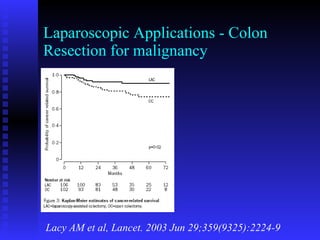
  • 134.
    Laparoscopic vs. OpenAdrenalectomy Laparoscopic adrenalectomy associated with decreased pain and pain medication use, shorter postoperative hospital stay, and a faster return to full activity and work
  • 135.
    Meta-analysis of Complicationsof Laparoscopic vs Open Adrenalectomy LA associated with significantly fewer complications than open adrenalectomy Primary differences are in fewer wound, pulmonary, and infectious complications and a lower rate of associated organ injury (eg splenectomy) Bleeding is the #1 complication of lap adrenalectomy Brunt LM Surg Endosc 2002;16:252-57
  • 136.
    Laparoscopic Applications -Adrenal The case for laparoscopic adrenalectomy Review of literature addressing the role of laparoscopy in adrenal disorders Studies comparing open versus laparoscopic adrenalectomy were evaluated Gill IS, J Urol. 2001 Aug;166(2):429-36
  • 137.
    Laparoscopic Applications -Adrenal Gill IS, J Urol. 2001 Aug;166(2):429-36
  • 138.
    Laparoscopic Applications -Adrenal Gill IS, J Urol. 2001 Aug;166(2):429-36
  • 139.
    Laparoscopic Applications -Adrenal Gill IS, J Urol. 2001 Aug;166(2):429-36
  • 140.
    Laparoscopic Applications -Adrenal The case for laparoscopic adrenalectomy Conclusions: Data from available literature indicates that laparoscopic surgery is safe and efficacious for Aldosteroma Pheochromocytoma Cushing’s disease Incidentaloma Gill IS, J Urol. 2001 Aug;166(2):429-36
  • 141.
    Laparoscopic Applications -Adrenal The case for laparoscopic adrenalectomy Conclusions, cont’d Compared to open surgery, laparoscopic adrenalectomy provides Equivalent outcomes Decreased morbidity Financial benefits The role of the laparoscopic approach to adrenal cancer demands further study Gill IS, J Urol. 2001 Aug;166(2):429-36
  • 142.
    Laparoscopic Applications -Adrenal The case for laparoscopic adrenalectomy In the majority of patients with adrenal disease, laparoscopy may now be considered the gold standard for surgical treatment Gill IS, J Urol. 2001 Aug;166(2):429-36
  • 143.
    Laparoscopic Applications -Adrenal LA is the preferred method of removal of the vast majority of adrenal tumors Complete biochemical work-up and localization pre-op Keys to a successful outcome: patient selection, surgical approach, meticulous dissection and hemostasis Avoid difficult cases during “learning curve” Lap ultrasound may be useful early in one’s experience and in difficult cases, esp. obese patients with difficult to find tumors
  • 144.
    Laparoscopic Applications -Spleen Laparoscopic splenectomy
  • 145.
    Laparoscopic Applications -Spleen Laparoscopic splenectomy: evolution and current status Review of literature addressing the role of laparoscopic splenectomy (LS) Klinger PJ et al, Surg Laparosc Endosc. 1999 Jan;9(1):1-8
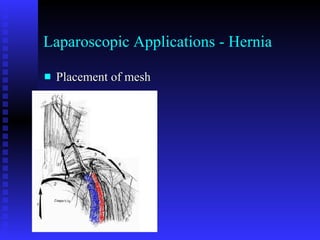
  • 146.
    Laparoscopic Applications -Spleen Laparoscopic splenectomy: evolution and current status Compared to OS, LS results in: Fewer perioperative complications Less morbidity Shorter LOS Klinger PJ et al, Surg Laparosc Endosc. 1999 Jan;9(1):1-8
  • 147.
    Laparoscopic Applications -Spleen LS has a limited role in hypersplenism and traumatic splenic injury LS is the operation of choice for spleens <20cm in diameter Klinger PJ et al, Surg Laparosc Endosc. 1999 Jan;9(1):1-8
  • 148.
    Laparoscopic Applications -Spleen Klinger PJ et al, Surg Laparosc Endosc. 1999 Jan;9(1):1-8
  • 149.
    Laparoscopic Applications -Hernia Initial trocar placement
  • 150.
    Laparoscopic Applications -Hernia Finger dissection of the preperitoneal space
  • 151.
    Laparoscopic Applications -Hernia Insufflation of per-peritoneal space
  • 152.
    Laparoscopic Applications -Hernia Trocar placement
  • 153.
    Laparoscopic Applications -Hernia Dissection of hernia spaces
  • 154.
    Laparoscopic Applications -Hernia Reduction of direct hernia sac
  • 155.
    Laparoscopic Applications -Hernia Reduction of direct hernia sac Easily identified medial to the epigastric vessels Easily reduced away from the thinned transversalis fascia
  • 156.
    Laparoscopic Applications -Hernia Reduction of indirect hernia sac In the presence of hernia: The vas deferent is not visible The sac is seen over the spermatic cord The sac has to be always separated from the cord structures prior to any attempt of reduction
  • 157.
    Laparoscopic Applications -Hernia Placement of mesh
  • 158.
    Laparoscopic Applications -Hernia Fixation of the mesh Stapler Tacker Adhesive butyl-2-cyanoacrylate * Fibrin sealant ** (fibrinogen plus thrombin) No fixation
  • 159.
    Laparoscopic Applications -Summary Yes Yes Yes Spleen No Yes Yes Hernia Yes Yes Yes Adrenal No Yes Yes Appendix Yes Yes Yes Colon – Malignancy Yes Yes Yes Colon – Diverticular Disease No Yes Yes Liver – Resection No Yes Yes Pancreas – Therapeutic No Yes Yes Pancreas – Diagnostic No Yes Yes Stomach – Cancer Yes Yes Yes Stomach – Bariatrics (RNY) Yes Yes Yes Esophagus – GERD Yes Yes Yes Esophagus – Achalasia Gold Standard? Feasible? Is if safe? Laparoscopic Application