ROBOTIC
SURGERY
By,
A. Sai Charan
INTRODUCTION
 Using

robots in the operating room to assist the
surgeon in performing surgery.
 The surgeon views the patient via a terminal and
manipulates robotic surgical instruments via a control
panel.
 Views of the organs being worked on are transmitted
from tiny cameras inserted into the body.
 We've already seen how robots have changed the
manufacturing of cars and other consumer goods by
streamlining and speeding up the assembly line.
 In the coming decades, we may see robots that have
artificial intelligence. Some, like Honda's ASIMO
robot, will resemble the human form.
 When

we talk about robots doing the tasks of
humans, we often talk about the future, but robotic
surgery is already a reality.
 Doctors around the world are using sophisticated
robots to perform surgical procedures on patients.
 While robotic surgery systems are still relatively
uncommon, several hospitals around the world
have bought robotic surgical systems.
 These systems have the potential to improve the
safety and effectiveness of surgeries.
 Three major advances aided by surgical robots
have been remote surgery, minimally invasive
surgery and unmanned surgery.
HISTORY
 In

1985 a robot, the PUMA 560, was used to place a
needle for a brain biopsy using CT guidance.
 In 1988, the PROBOT, developed at Imperial College
London.
 The ROBODOC from Integrated Surgical Systems
was introduced in 1992 for hip replacement.
 The first unmanned robotic surgery took place in May
2006 in Italy.
ROBOTIC SURGEONS


The first generation of surgical robots are already
being installed in a number of operating rooms around
the world.
 These machines still require a human surgeon to
operate them and input instructions.
 Remote control and voice activation are the methods
by which these surgical robots are controlled.
 According to one manufacturer, robotic devices could
be used in more than 3.5 million medical procedures
per year in the United States alone.


Here are three surgical robots that have been recently
developed:
da Vinci Surgical System
 ZEUS Robotic Surgical System
 AESOP Robotic System

CLASSIFICATION


Not all surgical robots are equal. There are three different kinds
of robotic surgery systems:
Supervisory-controlled systems
 Tele surgical systems
 Shared-control systems

THE DA VINCI SURGICAL SYSTEM
The basis of the dexterity experienced in open surgery relies on
the almost unlimited wrist, elbow and shoulder’s degree of
freedom.
 The surgeon has to move around these fixed ports. In order to
solve these limitations tools have been developed that have an
articulation at the tip, which increases the degrees of freedom.

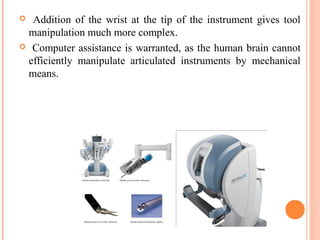
Addition of the wrist at the tip of the instrument gives tool
manipulation much more complex.
 Computer assistance is warranted, as the human brain cannot
efficiently manipulate articulated instruments by mechanical
means.

ZEUS ROBOTIC SURGICAL SYSTEM
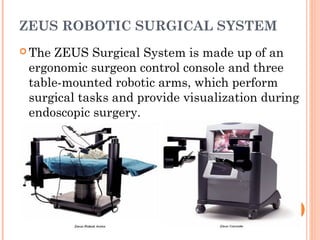
 The

ZEUS Surgical System is made up of an
ergonomic surgeon control console and three
table-mounted robotic arms, which perform
surgical tasks and provide visualization during
endoscopic surgery.
AESOP ROBOTIC SURGICAL
SYSTEM


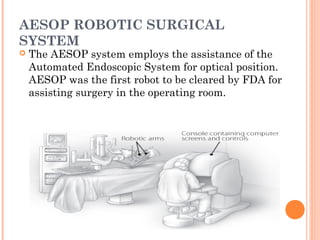
The AESOP system employs the assistance of the
Automated Endoscopic System for optical position.
AESOP was the first robot to be cleared by FDA for
assisting surgery in the operating room.
APPLICATIONS
•
•
•
•
•
•
•
•

Cardiac surgery
Gastrointestinal surgery
Gynecology
Neurosurgery
Orthopedics
Pediatrics
Radio surgery
Urology
ADVANTAGES

Post-Surgery
Less scarring
Faster recovery time
Tiny incisions
0% Transfusion rate
Shorter catheter time 5 vs. 14 days
Immediate urinary control
Significantly shorter return to normal activities
( 1-2 weeks )
Equal Cancer Cure Rate
Less post operative pain
In-Surgery
 Surgeons have enhanced view
 Easier to attach nerve endings
 Surgeons tire less easily
 Fewer doctors required in operating rooms
 In turn, cheaper for hospitals.
 Smaller risk of infection
 Less anesthesia required
 Less loss of blood
DISADVANTAGES
The Question of Safety
 The Cost

Thank
You !!!

Robotic Surgery PPT

  • 1.
  • 2.
    INTRODUCTION  Using robots inthe operating room to assist the surgeon in performing surgery.  The surgeon views the patient via a terminal and manipulates robotic surgical instruments via a control panel.  Views of the organs being worked on are transmitted from tiny cameras inserted into the body.  We've already seen how robots have changed the manufacturing of cars and other consumer goods by streamlining and speeding up the assembly line.  In the coming decades, we may see robots that have artificial intelligence. Some, like Honda's ASIMO robot, will resemble the human form.
  • 3.
     When we talkabout robots doing the tasks of humans, we often talk about the future, but robotic surgery is already a reality.  Doctors around the world are using sophisticated robots to perform surgical procedures on patients.  While robotic surgery systems are still relatively uncommon, several hospitals around the world have bought robotic surgical systems.  These systems have the potential to improve the safety and effectiveness of surgeries.  Three major advances aided by surgical robots have been remote surgery, minimally invasive surgery and unmanned surgery.
  • 4.
    HISTORY  In 1985 arobot, the PUMA 560, was used to place a needle for a brain biopsy using CT guidance.  In 1988, the PROBOT, developed at Imperial College London.  The ROBODOC from Integrated Surgical Systems was introduced in 1992 for hip replacement.  The first unmanned robotic surgery took place in May 2006 in Italy.
  • 5.
    ROBOTIC SURGEONS  The firstgeneration of surgical robots are already being installed in a number of operating rooms around the world.  These machines still require a human surgeon to operate them and input instructions.  Remote control and voice activation are the methods by which these surgical robots are controlled.  According to one manufacturer, robotic devices could be used in more than 3.5 million medical procedures per year in the United States alone.
  • 6.
     Here are threesurgical robots that have been recently developed: da Vinci Surgical System  ZEUS Robotic Surgical System  AESOP Robotic System 
  • 7.
    CLASSIFICATION  Not all surgicalrobots are equal. There are three different kinds of robotic surgery systems: Supervisory-controlled systems  Tele surgical systems  Shared-control systems 
  • 8.
    THE DA VINCISURGICAL SYSTEM The basis of the dexterity experienced in open surgery relies on the almost unlimited wrist, elbow and shoulder’s degree of freedom.  The surgeon has to move around these fixed ports. In order to solve these limitations tools have been developed that have an articulation at the tip, which increases the degrees of freedom. 
  • 9.
    Addition of thewrist at the tip of the instrument gives tool manipulation much more complex.  Computer assistance is warranted, as the human brain cannot efficiently manipulate articulated instruments by mechanical means. 
  • 10.
    ZEUS ROBOTIC SURGICALSYSTEM  The ZEUS Surgical System is made up of an ergonomic surgeon control console and three table-mounted robotic arms, which perform surgical tasks and provide visualization during endoscopic surgery.
  • 11.
    AESOP ROBOTIC SURGICAL SYSTEM  TheAESOP system employs the assistance of the Automated Endoscopic System for optical position. AESOP was the first robot to be cleared by FDA for assisting surgery in the operating room.
  • 12.
  • 13.
    ADVANTAGES Post-Surgery Less scarring Faster recoverytime Tiny incisions 0% Transfusion rate Shorter catheter time 5 vs. 14 days Immediate urinary control Significantly shorter return to normal activities ( 1-2 weeks ) Equal Cancer Cure Rate Less post operative pain
  • 14.
    In-Surgery  Surgeons haveenhanced view  Easier to attach nerve endings  Surgeons tire less easily  Fewer doctors required in operating rooms  In turn, cheaper for hospitals.  Smaller risk of infection  Less anesthesia required  Less loss of blood
  • 15.
    DISADVANTAGES The Question ofSafety  The Cost 
  • 16.