A U B H O 2 0 1 5 , B A N G K O K , T H A I L A N D
R A C H N A T . S H R O F F , M D , M S
A S S I S T A N T P R O F E S S O R ,
D E P T O F G I M E D I C A L O N C O L O G Y
M . D . A N D E R S O N C A N C E R C E N T E R
R S H R O F F @ M D A N D E R S O N . O R G
Cholangiocarcinoma:
Changing the landscape for a rare
disease
Outline
 Overview of the disease
 Second-line therapy
 Retrospective data
 Phase Ib of pazopanib and trametinib
 The role of radiation
 Retrospective data
 Next steps
 Next generation sequencing for cholangiocarcinoma
 Profiling data
 Clinical trials at MD Anderson
The Magnitude of the Problem: U.S. Data
 >7,000 cases annually in 2009
 5-year survival is <15%
 Most patients present with locally advanced or metastatic
disease
 Treatment commonly administered in the community,
at low-volume centers.
Risk factors
 Obesity, Metabolic Syndrome
 Chronic inflammation (hepatitis, ETOH, smoking,
occupational)
 Parasitic infections
 Primary sclerosing cholangitis, Crohns disease
 Cysts, anomalous pancreatobiliary ducts
 Biliary polyps (>10 mm)
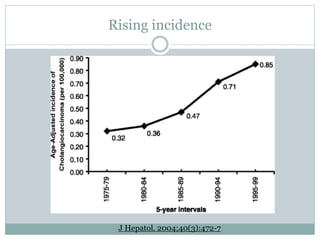
Rising incidence
J Hepatol. 2004;40(3):472-7
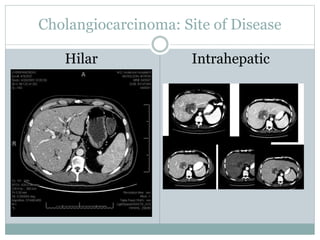
Cholangiocarcinoma: Site of Disease
Hilar Intrahepatic
Localized Cholangiocarcinoma
 Surgical resection is the standard of care
 Post operative radiation/ chemoradiation therapy improves
recurrence-free survival in R1 disease
 Role of adjuvant therapy in R0 resection is debatable
 Role of liver transplantation in unresectable hilar
cholangiocarcinoma.
NCCN Guidelines
Advanced biliary tract cancers
 Disease-related factors
 Uncommon malignancies
 Unwell, elderly population, infection/obstruction
 Histological / cytological confirmation difficult
 Lack of evidence
 Disease often not measurable
 Primarily small phase II and one phase III study of
gemcitabine-based combinations
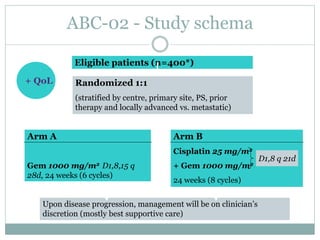
ABC-02 - Study schema
Eligible patients (n=400*)
Arm A
Gem 1000 mg/m2 D1,8,15 q
28d, 24 weeks (6 cycles)
Arm B
Cisplatin 25 mg/m2
+ Gem 1000 mg/m2
24 weeks (8 cycles)
Randomized 1:1
(stratified by centre, primary site, PS, prior
therapy and locally advanced vs. metastatic)
Upon disease progression, management will be on clinician’s
discretion (mostly best supportive care)
D1,8 q 21d
+ QoL
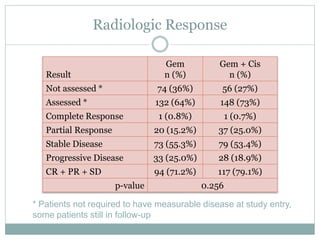
Result
Gem
n (%)
Gem + Cis
n (%)
Not assessed * 74 (36%) 56 (27%)
Assessed * 132 (64%) 148 (73%)
Complete Response 1 (0.8%) 1 (0.7%)
Partial Response 20 (15.2%) 37 (25.0%)
Stable Disease 73 (55.3%) 79 (53.4%)
Progressive Disease 33 (25.0%) 28 (18.9%)
CR + PR + SD 94 (71.2%) 117 (79.1%)
p-value 0.256
* Patients not required to have measurable disease at study entry,
some patients still in follow-up
Radiologic Response
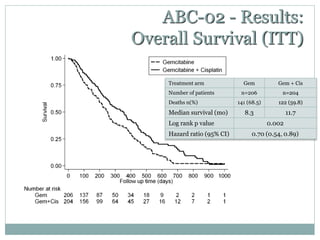
ABC-02 - Results:
Overall Survival (ITT)
Treatment arm Gem Gem + Cis
Number of patients n=206 n=204
Deaths n(%) 141 (68.5) 122 (59.8)
Median survival (mo) 8.3 11.7
Log rank p value 0.002
Hazard ratio (95% CI) 0.70 (0.54, 0.89)
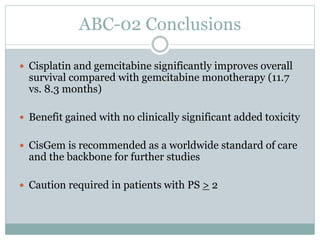
ABC-02 Conclusions
 Cisplatin and gemcitabine significantly improves overall
survival compared with gemcitabine monotherapy (11.7
vs. 8.3 months)
 Benefit gained with no clinically significant added toxicity
 CisGem is recommended as a worldwide standard of care
and the backbone for further studies
 Caution required in patients with PS > 2
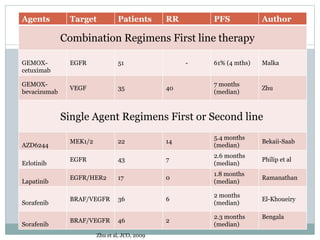
Agents Target Patients RR PFS Author
Combination Regimens First line therapy
GEMOX-
cetuximab
EGFR 51 - 61% (4 mths) Malka
GEMOX-
bevacizumab
VEGF 35 40
7 months
(median)
Zhu
Single Agent Regimens First or Second line
AZD6244
MEK1/2 22 14
5.4 months
(median)
Bekaii-Saab
Erlotinib
EGFR 43 7
2.6 months
(median)
Philip et al
Lapatinib
EGFR/HER2 17 0
1.8 months
(median)
Ramanathan
Sorafenib
BRAF/VEGFR 36 6
2 months
(median)
El-Khoueiry
Sorafenib
BRAF/VEGFR 46 2
2.3 months
(median)
Bengala
Zhu et al, JCO, 2009
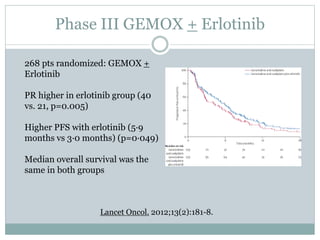
Phase III GEMOX + Erlotinib
268 pts randomized: GEMOX +
Erlotinib
PR higher in erlotinib group (40
vs. 21, p=0.005)
Higher PFS with erlotinib (5·9
months vs 3·0 months) (p=0·049)
Median overall survival was the
same in both groups
Lancet Oncol. 2012;13(2):181-8.
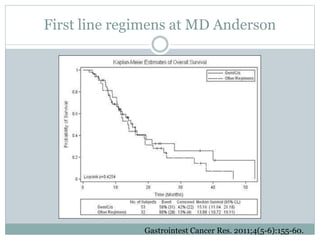
Gastrointest Cancer Res. 2011;4(5-6):155-60.
First line regimens at MD Anderson
Second-line therapy
 Retrospective review of MD Anderson experience:
 Patients with advanced cholangiocarcinoma who received 2nd
line therapy from 2009-2012
 56 patients evaluated, majority were intrahepatic
cholangiocarcinoma
 Primary objective: PFS with second-line therapy
 Secondary objectives: OS, disease control rate
 80% received gemcitabine-based first-line therapy
 Majority of patients received 5-fluorouracil in the second-line
setting
Second-line therapy
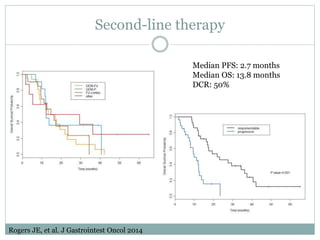
Rogers JE, et al. J Gastrointest Oncol 2014
Median PFS: 2.7 months
Median OS: 13.8 months
DCR: 50%
Pazopanib and trametinib – a phase Ib study
 Collaboration between MD Anderson and Johns
Hopkins
 Phase I showed one prolonged PR and one SD with
cholangiocarcinoma
 Expansion to 25 patients (MD Anderson n = 18)
 Primary endpoint: PFS
 Secondary endpoints: OS, RR, DCR
 Highly refractory population (median # prior
therapies: 2)
 Median follow-up: 8.9 months
Shroff RT, et al, ASCO Annual Meeting 2015
Pazopanib and trametinib – a phase Ib study
 Overall response rate – 5%
 Disease control rate – 75% (15/20 patients)
 Median PFS 4.3 months
 4-month PFS – 56%
 p<0.002 compared with a pre-specified null hypothesis rate of
25%
 Median OS was 6.7 mths
 Next steps: In development
The role of radiation
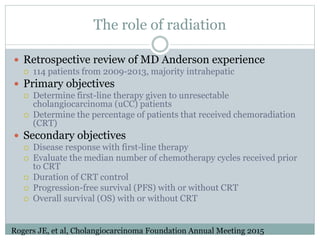
 Retrospective review of MD Anderson experience
 114 patients from 2009-2013, majority intrahepatic
 Primary objectives
 Determine first-line therapy given to unresectable
cholangiocarcinoma (uCC) patients
 Determine the percentage of patients that received chemoradiation
(CRT)
 Secondary objectives
 Disease response with first-line therapy
 Evaluate the median number of chemotherapy cycles received prior
to CRT
 Duration of CRT control
 Progression-free survival (PFS) with or without CRT
 Overall survival (OS) with or without CRT
Rogers JE, et al, Cholangiocarcinoma Foundation Annual Meeting 2015
The role of radiation
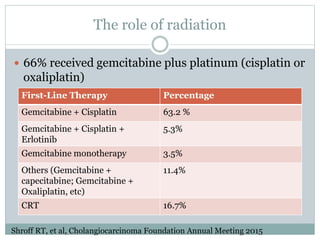
 66% received gemcitabine plus platinum (cisplatin or
oxaliplatin)
First-Line Therapy Percentage
Gemcitabine + Cisplatin 63.2 %
Gemcitabine + Cisplatin +
Erlotinib
5.3%
Gemcitabine monotherapy 3.5%
Others (Gemcitabine +
capecitabine; Gemcitabine +
Oxaliplatin, etc)
11.4%
CRT 16.7%
Shroff RT, et al, Cholangiocarcinoma Foundation Annual Meeting 2015
The role of radiation
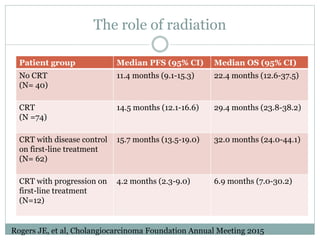
Patient group Median PFS (95% CI) Median OS (95% CI)
No CRT
(N= 40)
11.4 months (9.1-15.3) 22.4 months (12.6-37.5)
CRT
(N =74)
14.5 months (12.1-16.6) 29.4 months (23.8-38.2)
CRT with disease control
on first-line treatment
(N= 62)
15.7 months (13.5-19.0) 32.0 months (24.0-44.1)
CRT with progression on
first-line treatment
(N=12)
4.2 months (2.3-9.0) 6.9 months (7.0-30.2)
Rogers JE, et al, Cholangiocarcinoma Foundation Annual Meeting 2015
The role of radiation - PFS
0.00
0.25
0.50
0.75
1.00
0 12 24 36 48 60 72 84 96
Months
No CRT
CRT
p = 0.105
Progression-free Survival
0.00
0.25
0.50
0.75
1.00
ProportionProgression-free
0 12 24 36 48 60 72 84 96
Months
No CRT
CRT with First-line Treatment Disease Control
CRT with First-line Treatment Progression
p < 0.001
Progression-free Survival
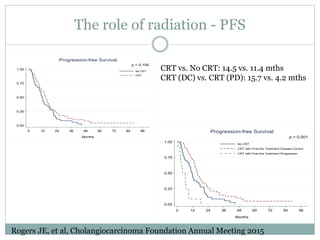
CRT vs. No CRT: 14.5 vs. 11.4 mths
CRT (DC) vs. CRT (PD): 15.7 vs. 4.2 mths
Rogers JE, et al, Cholangiocarcinoma Foundation Annual Meeting 2015
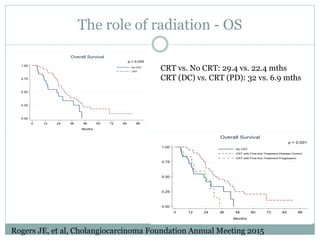
The role of radiation - OS
0.00
0.25
0.50
0.75
1.00
0 12 24 36 48 60 72 84 96
Months
No CRT
CRT
p = 0.005
Overall Survival
0.00
0.25
0.50
0.75
1.00
ProportionSurviving
0 12 24 36 48 60 72 84 96
Months
No CRT
CRT with First-line Treatment Disease Control
CRT with First-line Treatment Progression
p = 0.001
Overall Survival
CRT vs. No CRT: 29.4 vs. 22.4 mths
CRT (DC) vs. CRT (PD): 32 vs. 6.9 mths
Rogers JE, et al, Cholangiocarcinoma Foundation Annual Meeting 2015
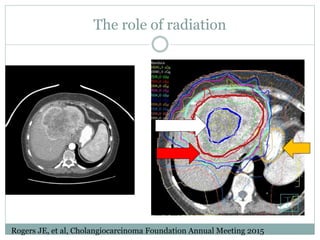
The role of radiation
Rogers JE, et al, Cholangiocarcinoma Foundation Annual Meeting 2015
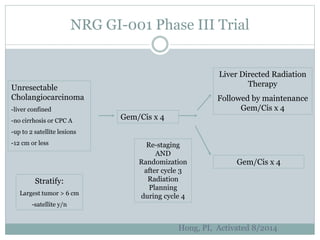
Unresectable
Cholangiocarcinoma
-liver confined
-no cirrhosis or CPC A
-up to 2 satellite lesions
-12 cm or less
Stratify:
Largest tumor > 6 cm
-satellite y/n
Gem/Cis x 4
Liver Directed Radiation
Therapy
Followed by maintenance
Gem/Cis x 4
Gem/Cis x 4
Re-staging
AND
Randomization
after cycle 3
Radiation
Planning
during cycle 4
NRG GI-001 Phase III Trial
Hong, PI, Activated 8/2014
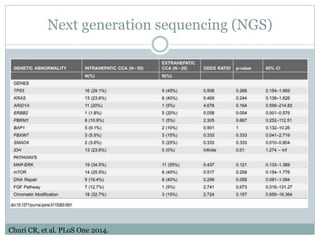
Next generation sequencing (NGS)
 NGS on all cholangiocarcinoma patients with
available tissue
 Standard practice at MD Anderson since 2013
 Important differences between intrahepatic and
extrahepatic cholangiocarcinoma
 75 patients
Churi CR, et al. PLoS One 2014.
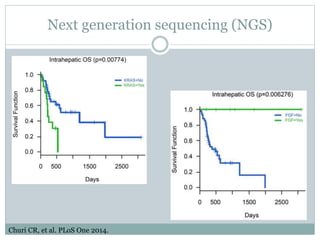
Next generation sequencing (NGS)
Churi CR, et al. PLoS One 2014.
Next generation sequencing (NGS)
Churi CR, et al. PLoS One 2014.
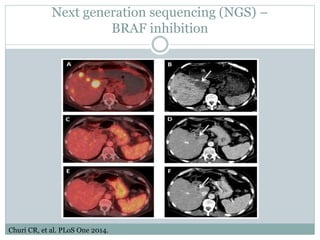
Next generation sequencing (NGS) –
BRAF inhibition
Churi CR, et al. PLoS One 2014.
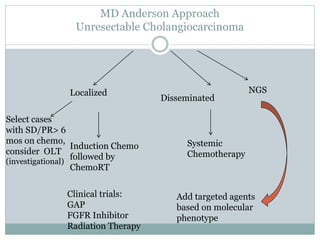
MD Anderson Approach
Unresectable Cholangiocarcinoma
Localized
Induction Chemo
followed by
ChemoRT
Disseminated
Systemic
Chemotherapy
NGS
Add targeted agents
based on molecular
phenotype
Clinical trials:
GAP
FGFR Inhibitor
Radiation Therapy
Select cases
with SD/PR> 6
mos on chemo,
consider OLT
(investigational)
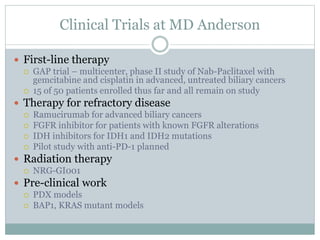
Clinical Trials at MD Anderson
 First-line therapy
 GAP trial – multicenter, phase II study of Nab-Paclitaxel with
gemcitabine and cisplatin in advanced, untreated biliary cancers
 15 of 50 patients enrolled thus far and all remain on study
 Therapy for refractory disease
 Ramucirumab for advanced biliary cancers
 FGFR inhibitor for patients with known FGFR alterations
 IDH inhibitors for IDH1 and IDH2 mutations
 Pilot study with anti-PD-1 planned
 Radiation therapy
 NRG-GI001
 Pre-clinical work
 PDX models
 BAP1, KRAS mutant models
Q U E S T I O N S ?
Thank you!

Cholangiocarcinoma

  • 1.
    A U BH O 2 0 1 5 , B A N G K O K , T H A I L A N D R A C H N A T . S H R O F F , M D , M S A S S I S T A N T P R O F E S S O R , D E P T O F G I M E D I C A L O N C O L O G Y M . D . A N D E R S O N C A N C E R C E N T E R R S H R O F F @ M D A N D E R S O N . O R G Cholangiocarcinoma: Changing the landscape for a rare disease
  • 2.
    Outline  Overview ofthe disease  Second-line therapy  Retrospective data  Phase Ib of pazopanib and trametinib  The role of radiation  Retrospective data  Next steps  Next generation sequencing for cholangiocarcinoma  Profiling data  Clinical trials at MD Anderson
  • 3.
    The Magnitude ofthe Problem: U.S. Data  >7,000 cases annually in 2009  5-year survival is <15%  Most patients present with locally advanced or metastatic disease  Treatment commonly administered in the community, at low-volume centers.
  • 4.
    Risk factors  Obesity,Metabolic Syndrome  Chronic inflammation (hepatitis, ETOH, smoking, occupational)  Parasitic infections  Primary sclerosing cholangitis, Crohns disease  Cysts, anomalous pancreatobiliary ducts  Biliary polyps (>10 mm)
  • 5.
  • 6.
    Cholangiocarcinoma: Site ofDisease Hilar Intrahepatic
  • 7.
    Localized Cholangiocarcinoma  Surgicalresection is the standard of care  Post operative radiation/ chemoradiation therapy improves recurrence-free survival in R1 disease  Role of adjuvant therapy in R0 resection is debatable  Role of liver transplantation in unresectable hilar cholangiocarcinoma. NCCN Guidelines
  • 8.
    Advanced biliary tractcancers  Disease-related factors  Uncommon malignancies  Unwell, elderly population, infection/obstruction  Histological / cytological confirmation difficult  Lack of evidence  Disease often not measurable  Primarily small phase II and one phase III study of gemcitabine-based combinations
  • 9.
    ABC-02 - Studyschema Eligible patients (n=400*) Arm A Gem 1000 mg/m2 D1,8,15 q 28d, 24 weeks (6 cycles) Arm B Cisplatin 25 mg/m2 + Gem 1000 mg/m2 24 weeks (8 cycles) Randomized 1:1 (stratified by centre, primary site, PS, prior therapy and locally advanced vs. metastatic) Upon disease progression, management will be on clinician’s discretion (mostly best supportive care) D1,8 q 21d + QoL
  • 10.
    Result Gem n (%) Gem +Cis n (%) Not assessed * 74 (36%) 56 (27%) Assessed * 132 (64%) 148 (73%) Complete Response 1 (0.8%) 1 (0.7%) Partial Response 20 (15.2%) 37 (25.0%) Stable Disease 73 (55.3%) 79 (53.4%) Progressive Disease 33 (25.0%) 28 (18.9%) CR + PR + SD 94 (71.2%) 117 (79.1%) p-value 0.256 * Patients not required to have measurable disease at study entry, some patients still in follow-up Radiologic Response
  • 11.
    ABC-02 - Results: OverallSurvival (ITT) Treatment arm Gem Gem + Cis Number of patients n=206 n=204 Deaths n(%) 141 (68.5) 122 (59.8) Median survival (mo) 8.3 11.7 Log rank p value 0.002 Hazard ratio (95% CI) 0.70 (0.54, 0.89)
  • 12.
    ABC-02 Conclusions  Cisplatinand gemcitabine significantly improves overall survival compared with gemcitabine monotherapy (11.7 vs. 8.3 months)  Benefit gained with no clinically significant added toxicity  CisGem is recommended as a worldwide standard of care and the backbone for further studies  Caution required in patients with PS > 2
  • 13.
    Agents Target PatientsRR PFS Author Combination Regimens First line therapy GEMOX- cetuximab EGFR 51 - 61% (4 mths) Malka GEMOX- bevacizumab VEGF 35 40 7 months (median) Zhu Single Agent Regimens First or Second line AZD6244 MEK1/2 22 14 5.4 months (median) Bekaii-Saab Erlotinib EGFR 43 7 2.6 months (median) Philip et al Lapatinib EGFR/HER2 17 0 1.8 months (median) Ramanathan Sorafenib BRAF/VEGFR 36 6 2 months (median) El-Khoueiry Sorafenib BRAF/VEGFR 46 2 2.3 months (median) Bengala Zhu et al, JCO, 2009
  • 14.
    Phase III GEMOX+ Erlotinib 268 pts randomized: GEMOX + Erlotinib PR higher in erlotinib group (40 vs. 21, p=0.005) Higher PFS with erlotinib (5·9 months vs 3·0 months) (p=0·049) Median overall survival was the same in both groups Lancet Oncol. 2012;13(2):181-8.
  • 15.
    Gastrointest Cancer Res.2011;4(5-6):155-60. First line regimens at MD Anderson
  • 16.
    Second-line therapy  Retrospectivereview of MD Anderson experience:  Patients with advanced cholangiocarcinoma who received 2nd line therapy from 2009-2012  56 patients evaluated, majority were intrahepatic cholangiocarcinoma  Primary objective: PFS with second-line therapy  Secondary objectives: OS, disease control rate  80% received gemcitabine-based first-line therapy  Majority of patients received 5-fluorouracil in the second-line setting
  • 17.
    Second-line therapy Rogers JE,et al. J Gastrointest Oncol 2014 Median PFS: 2.7 months Median OS: 13.8 months DCR: 50%
  • 18.
    Pazopanib and trametinib– a phase Ib study  Collaboration between MD Anderson and Johns Hopkins  Phase I showed one prolonged PR and one SD with cholangiocarcinoma  Expansion to 25 patients (MD Anderson n = 18)  Primary endpoint: PFS  Secondary endpoints: OS, RR, DCR  Highly refractory population (median # prior therapies: 2)  Median follow-up: 8.9 months Shroff RT, et al, ASCO Annual Meeting 2015
  • 19.
    Pazopanib and trametinib– a phase Ib study  Overall response rate – 5%  Disease control rate – 75% (15/20 patients)  Median PFS 4.3 months  4-month PFS – 56%  p<0.002 compared with a pre-specified null hypothesis rate of 25%  Median OS was 6.7 mths  Next steps: In development
  • 20.
    The role ofradiation  Retrospective review of MD Anderson experience  114 patients from 2009-2013, majority intrahepatic  Primary objectives  Determine first-line therapy given to unresectable cholangiocarcinoma (uCC) patients  Determine the percentage of patients that received chemoradiation (CRT)  Secondary objectives  Disease response with first-line therapy  Evaluate the median number of chemotherapy cycles received prior to CRT  Duration of CRT control  Progression-free survival (PFS) with or without CRT  Overall survival (OS) with or without CRT Rogers JE, et al, Cholangiocarcinoma Foundation Annual Meeting 2015
  • 21.
    The role ofradiation  66% received gemcitabine plus platinum (cisplatin or oxaliplatin) First-Line Therapy Percentage Gemcitabine + Cisplatin 63.2 % Gemcitabine + Cisplatin + Erlotinib 5.3% Gemcitabine monotherapy 3.5% Others (Gemcitabine + capecitabine; Gemcitabine + Oxaliplatin, etc) 11.4% CRT 16.7% Shroff RT, et al, Cholangiocarcinoma Foundation Annual Meeting 2015
  • 22.
    The role ofradiation Patient group Median PFS (95% CI) Median OS (95% CI) No CRT (N= 40) 11.4 months (9.1-15.3) 22.4 months (12.6-37.5) CRT (N =74) 14.5 months (12.1-16.6) 29.4 months (23.8-38.2) CRT with disease control on first-line treatment (N= 62) 15.7 months (13.5-19.0) 32.0 months (24.0-44.1) CRT with progression on first-line treatment (N=12) 4.2 months (2.3-9.0) 6.9 months (7.0-30.2) Rogers JE, et al, Cholangiocarcinoma Foundation Annual Meeting 2015
  • 23.
    The role ofradiation - PFS 0.00 0.25 0.50 0.75 1.00 0 12 24 36 48 60 72 84 96 Months No CRT CRT p = 0.105 Progression-free Survival 0.00 0.25 0.50 0.75 1.00 ProportionProgression-free 0 12 24 36 48 60 72 84 96 Months No CRT CRT with First-line Treatment Disease Control CRT with First-line Treatment Progression p < 0.001 Progression-free Survival CRT vs. No CRT: 14.5 vs. 11.4 mths CRT (DC) vs. CRT (PD): 15.7 vs. 4.2 mths Rogers JE, et al, Cholangiocarcinoma Foundation Annual Meeting 2015
  • 24.
    The role ofradiation - OS 0.00 0.25 0.50 0.75 1.00 0 12 24 36 48 60 72 84 96 Months No CRT CRT p = 0.005 Overall Survival 0.00 0.25 0.50 0.75 1.00 ProportionSurviving 0 12 24 36 48 60 72 84 96 Months No CRT CRT with First-line Treatment Disease Control CRT with First-line Treatment Progression p = 0.001 Overall Survival CRT vs. No CRT: 29.4 vs. 22.4 mths CRT (DC) vs. CRT (PD): 32 vs. 6.9 mths Rogers JE, et al, Cholangiocarcinoma Foundation Annual Meeting 2015
  • 25.
    The role ofradiation Rogers JE, et al, Cholangiocarcinoma Foundation Annual Meeting 2015
  • 26.
    Unresectable Cholangiocarcinoma -liver confined -no cirrhosisor CPC A -up to 2 satellite lesions -12 cm or less Stratify: Largest tumor > 6 cm -satellite y/n Gem/Cis x 4 Liver Directed Radiation Therapy Followed by maintenance Gem/Cis x 4 Gem/Cis x 4 Re-staging AND Randomization after cycle 3 Radiation Planning during cycle 4 NRG GI-001 Phase III Trial Hong, PI, Activated 8/2014
  • 27.
    Next generation sequencing(NGS)  NGS on all cholangiocarcinoma patients with available tissue  Standard practice at MD Anderson since 2013  Important differences between intrahepatic and extrahepatic cholangiocarcinoma  75 patients Churi CR, et al. PLoS One 2014.
  • 28.
    Next generation sequencing(NGS) Churi CR, et al. PLoS One 2014.
  • 29.
    Next generation sequencing(NGS) Churi CR, et al. PLoS One 2014.
  • 30.
    Next generation sequencing(NGS) – BRAF inhibition Churi CR, et al. PLoS One 2014.
  • 31.
    MD Anderson Approach UnresectableCholangiocarcinoma Localized Induction Chemo followed by ChemoRT Disseminated Systemic Chemotherapy NGS Add targeted agents based on molecular phenotype Clinical trials: GAP FGFR Inhibitor Radiation Therapy Select cases with SD/PR> 6 mos on chemo, consider OLT (investigational)
  • 32.
    Clinical Trials atMD Anderson  First-line therapy  GAP trial – multicenter, phase II study of Nab-Paclitaxel with gemcitabine and cisplatin in advanced, untreated biliary cancers  15 of 50 patients enrolled thus far and all remain on study  Therapy for refractory disease  Ramucirumab for advanced biliary cancers  FGFR inhibitor for patients with known FGFR alterations  IDH inhibitors for IDH1 and IDH2 mutations  Pilot study with anti-PD-1 planned  Radiation therapy  NRG-GI001  Pre-clinical work  PDX models  BAP1, KRAS mutant models
  • 33.
    Q U ES T I O N S ? Thank you!