Downloaded 19 times
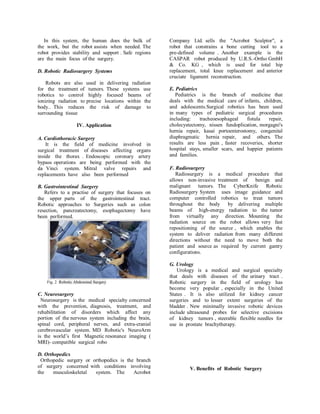
![The most significant advantage of Robotic Surgery to the patient is the decrease in pain and scaring. It reduces trauma to the patient by allowing surgery to be performed through small ports or "keyholes" rather than large incisions , resulting in shorter recovery times , fewer complications and a reduced hospital stay.
The patient may experience the following benefits
1. Reduced trauma to the body
2. Less anesthesia
3. Often less blood loss and need for transfusions
4. Less post-operative pain and discomfort
5. Less risk of infection
6. Shorter hospital stay
The surgeons have the following benefits
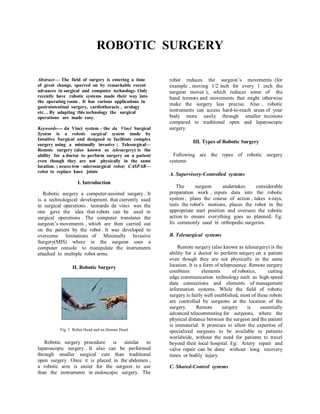
1. Enhanced 3-D Visualization
2. Greater Surgical Precision
3. Simplifies many existing MIS surgical techniques
4. Makes difficult MIS operations routine
VI. Complications of Robotic Surgery
1. Flawed design
2. Malfunction of hardware and software components
3. misinterpretation and incorrect or inadequate specification
4. increase in cost , complexity , or both
VII. Conclusion:
90% of the operation carried on by a robot is a successful. This idea is not yet famous because of high cost associated with it. Though some hospitals are implementing them in certain rare surgeries such as cardiothoracic surgery , gynecologic surgery, abdominal surgery etc… It’s a boon to the upcoming generations.
Reference :
[1] ROBODOC history. Robodoc.com. Retrieved on 29 November 2011.
[2] The Robotic Surgeon Protomag.com. Retrieved on 29 November 2011.](https://image.slidesharecdn.com/roboticsurgery-140906172538-phpapp01/85/Robotic-surgery-3-320.jpg)

Robotic surgery uses robotic systems to assist surgeons in performing minimally invasive surgery. The robotic systems allow for enhanced visualization, improved dexterity and precision, and smaller incisions compared to traditional open surgery. Some key benefits of robotic surgery for patients include less pain, shorter hospital stays, smaller scars, and faster recovery times. Common applications of robotic surgery include procedures in areas like cardiology, urology, gynecology, and orthopedics. While robotic surgery provides advantages, it also faces challenges like high costs and potential mechanical and software issues.


