A Technical Seminar
On
CONTENT
 Introduction
 History
 Working principle
 Advantages & Disadvantages
 Case Study
 Conclusion
 Reference
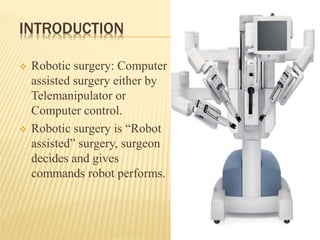
INTRODUCTION
 Robotic surgery: Computer
assisted surgery either by
Telemanipulator or
Computer control.
 Robotic surgery is “Robot
assisted” surgery, surgeon
decides and gives
commands robot performs.
LIMITATIONS OF TRADITIONAL SURGERY
 Large incisions.
 Large operation time.
 Surgical marks, scars.
 Long recovery time.
 Blood loss.
HISTORY
 In 1988 a robot, The PUMA 560, was used to
place a needle for a brain biopsy using CT
guidance.
 In 1987 robotics was used in the first
Laparoscopic surgery.
 In 1992, The PROBOT, developed at Imperial
College London, was used to perform prostatic
surgery.
HISTORY
 The ROBODOC from Integrated Surgical
Systems was introduced in 1992 to mill out
precise fittings in the femur for hip
replacement.
 The da Vinci Surgical System- 2000
 ZEUS Robotic Surgical Systems- 2001
 Neuro Arm- 2010
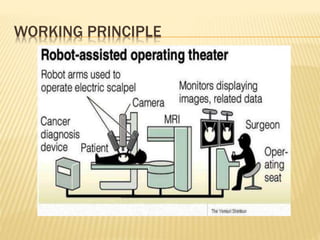
WORKING PRINCIPLE
CLASSIFICATION OF ROBOTIC SURGICAL SYSTEMS
1. Supervisory-controlled systems
2. Telesurgical system
3. Shared-control system
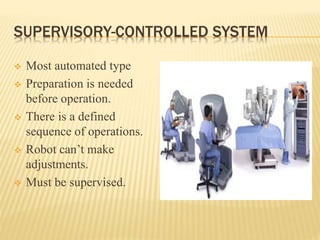
SUPERVISORY-CONTROLLED SYSTEM
 Most automated type
 Preparation is needed
before operation.
 There is a defined
sequence of operations.
 Robot can’t make
adjustments.
 Must be supervised.
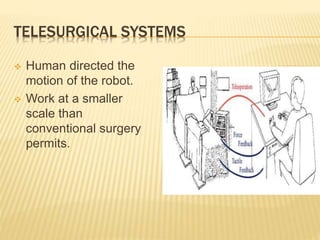
TELESURGICAL SYSTEMS
 Human directed the
motion of the robot.
 Work at a smaller
scale than
conventional surgery
permits.
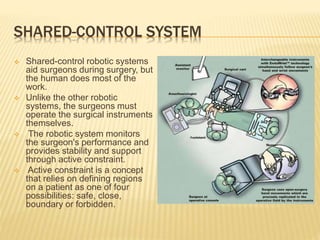
SHARED-CONTROL SYSTEM
 Shared-control robotic systems
aid surgeons during surgery, but
the human does most of the
work.
 Unlike the other robotic
systems, the surgeons must
operate the surgical instruments
themselves.
 The robotic system monitors
the surgeon's performance and
provides stability and support
through active constraint.
 Active constraint is a concept
that relies on defining regions
on a patient as one of four
possibilities: safe, close,
boundary or forbidden.
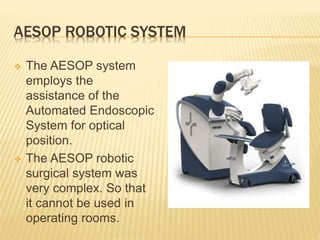
AESOP ROBOTIC SYSTEM
 The AESOP system
employs the
assistance of the
Automated Endoscopic
System for optical
position.
 The AESOP robotic
surgical system was
very complex. So that
it cannot be used in
operating rooms.
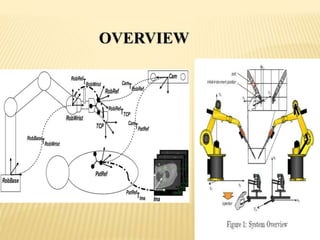
OVERVIEW
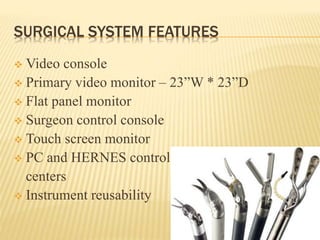
SURGICAL SYSTEM FEATURES
 Video console
 Primary video monitor – 23”W * 23”D
 Flat panel monitor
 Surgeon control console
 Touch screen monitor
 PC and HERNES control
centers
 Instrument reusability
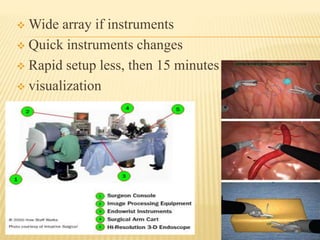
 Wide array if instruments
 Quick instruments changes
 Rapid setup less, then 15 minutes
 visualization
ADVANTAGES
IN-SURGERY
POST SURGERY
 Surgeons have enhanced view
 Easier to attach nerve endings
 Surgeons tire less easily
 Fewer doctors required in
operating rooms
 In turn, cheaper for hospitals.
 Smaller risk of infection
 Less anesthesia required
 Less loss of blood
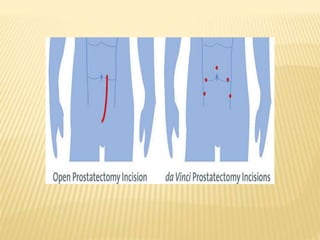
 Less scarring.
 Faster recovery time.
 Tiny incisions.
 0% Transfusion rate.
 Immediate urinary control.
 Significantly shorter return to
normal activities ( 1-2 weeks).
 Equal Cancer Cure Rate.
 Less post operative pain.
DISADVANTAGES
 The question of safety.
 The cost.
 Success of surgery depends on skill of physician.
not equipment .
 High maintenance cost.
CASE STUDY
In April 2008, Prof. pier cristoforo
giulianotti and his team performed the world’s
first minimally invasive liver resection for
“living donor transplantation”, removing 60%
of patient’s liver, with less pain than surgery
due to some five puncture holes and not scar
by a surgeon.
CONCLUSION
 Robotic systems can successfully replace
conventionally laproscopic instruments.
 Robotic Technology offers safe and effective
operations
 Cost effectiveness needs to be further evaluated.
 Safer since it eliminates possible human errors.
REFERENCE
1. Estey, EP (2009). "Robotic prostatectomy: The new standard of care or a
marketing success?". Canadian Urological Association Journal 3 (6): 488–
90. PMC2792423. PMID 2001998.
2. O'Toole, M. D.; Bouazza-Marouf, K.; Kerr, D.; Gooroochurn, M.;
Vloeberghs, M. (2009). "A methodology for design and appraisal of
surgical robotic systems". Robotica 28 (2): 297–310.
3. Weinstein, G. S.; o’Malley, B. W.; Snyder, W.; Sherman, E.; Quon, H.
(2007). "Transoral Robotic Surgery: Radical Tonsillectomy". Archives of
Otolaryngology–Head & Neck Surgery 133 (12): 1220–1226.
doi:10.1001/archotol.133.12.1220.
4. Kolata, Gina (13 February 2010). "Results Unproven, Robotic Surgery
Wins ConvertZ". The New York Times. Retrieved 11 March 2010.
5. Finkelstein J; Eckersberger E, Sadri H, Taneja SS, Lepor H, Djavan B
(2010). "Open Versus Laparoscopic Versus Robot-Assisted Laparoscopic
Prostatectomy: The European and US Experience". Reviews in Urology 12
(1): 35–43.
THANK YOU

Robotic Surgery

  • 1.
  • 2.
    CONTENT  Introduction  History Working principle  Advantages & Disadvantages  Case Study  Conclusion  Reference
  • 3.
    INTRODUCTION  Robotic surgery:Computer assisted surgery either by Telemanipulator or Computer control.  Robotic surgery is “Robot assisted” surgery, surgeon decides and gives commands robot performs.
  • 4.
    LIMITATIONS OF TRADITIONALSURGERY  Large incisions.  Large operation time.  Surgical marks, scars.  Long recovery time.  Blood loss.
  • 5.
    HISTORY  In 1988a robot, The PUMA 560, was used to place a needle for a brain biopsy using CT guidance.  In 1987 robotics was used in the first Laparoscopic surgery.  In 1992, The PROBOT, developed at Imperial College London, was used to perform prostatic surgery.
  • 6.
    HISTORY  The ROBODOCfrom Integrated Surgical Systems was introduced in 1992 to mill out precise fittings in the femur for hip replacement.  The da Vinci Surgical System- 2000  ZEUS Robotic Surgical Systems- 2001  Neuro Arm- 2010
  • 7.
  • 8.
    CLASSIFICATION OF ROBOTICSURGICAL SYSTEMS 1. Supervisory-controlled systems 2. Telesurgical system 3. Shared-control system
  • 9.
    SUPERVISORY-CONTROLLED SYSTEM  Mostautomated type  Preparation is needed before operation.  There is a defined sequence of operations.  Robot can’t make adjustments.  Must be supervised.
  • 10.
    TELESURGICAL SYSTEMS  Humandirected the motion of the robot.  Work at a smaller scale than conventional surgery permits.
  • 11.
    SHARED-CONTROL SYSTEM  Shared-controlrobotic systems aid surgeons during surgery, but the human does most of the work.  Unlike the other robotic systems, the surgeons must operate the surgical instruments themselves.  The robotic system monitors the surgeon's performance and provides stability and support through active constraint.  Active constraint is a concept that relies on defining regions on a patient as one of four possibilities: safe, close, boundary or forbidden.
  • 12.
    AESOP ROBOTIC SYSTEM The AESOP system employs the assistance of the Automated Endoscopic System for optical position.  The AESOP robotic surgical system was very complex. So that it cannot be used in operating rooms.
  • 13.
  • 14.
    SURGICAL SYSTEM FEATURES Video console  Primary video monitor – 23”W * 23”D  Flat panel monitor  Surgeon control console  Touch screen monitor  PC and HERNES control centers  Instrument reusability
  • 15.
     Wide arrayif instruments  Quick instruments changes  Rapid setup less, then 15 minutes  visualization
  • 16.
    ADVANTAGES IN-SURGERY POST SURGERY  Surgeonshave enhanced view  Easier to attach nerve endings  Surgeons tire less easily  Fewer doctors required in operating rooms  In turn, cheaper for hospitals.  Smaller risk of infection  Less anesthesia required  Less loss of blood  Less scarring.  Faster recovery time.  Tiny incisions.  0% Transfusion rate.  Immediate urinary control.  Significantly shorter return to normal activities ( 1-2 weeks).  Equal Cancer Cure Rate.  Less post operative pain.
  • 17.
    DISADVANTAGES  The questionof safety.  The cost.  Success of surgery depends on skill of physician. not equipment .  High maintenance cost.
  • 18.
    CASE STUDY In April2008, Prof. pier cristoforo giulianotti and his team performed the world’s first minimally invasive liver resection for “living donor transplantation”, removing 60% of patient’s liver, with less pain than surgery due to some five puncture holes and not scar by a surgeon.
  • 20.
    CONCLUSION  Robotic systemscan successfully replace conventionally laproscopic instruments.  Robotic Technology offers safe and effective operations  Cost effectiveness needs to be further evaluated.  Safer since it eliminates possible human errors.
  • 21.
    REFERENCE 1. Estey, EP(2009). "Robotic prostatectomy: The new standard of care or a marketing success?". Canadian Urological Association Journal 3 (6): 488– 90. PMC2792423. PMID 2001998. 2. O'Toole, M. D.; Bouazza-Marouf, K.; Kerr, D.; Gooroochurn, M.; Vloeberghs, M. (2009). "A methodology for design and appraisal of surgical robotic systems". Robotica 28 (2): 297–310. 3. Weinstein, G. S.; o’Malley, B. W.; Snyder, W.; Sherman, E.; Quon, H. (2007). "Transoral Robotic Surgery: Radical Tonsillectomy". Archives of Otolaryngology–Head & Neck Surgery 133 (12): 1220–1226. doi:10.1001/archotol.133.12.1220. 4. Kolata, Gina (13 February 2010). "Results Unproven, Robotic Surgery Wins ConvertZ". The New York Times. Retrieved 11 March 2010. 5. Finkelstein J; Eckersberger E, Sadri H, Taneja SS, Lepor H, Djavan B (2010). "Open Versus Laparoscopic Versus Robot-Assisted Laparoscopic Prostatectomy: The European and US Experience". Reviews in Urology 12 (1): 35–43.
  • 22.