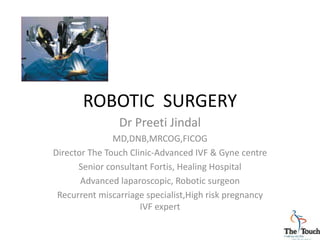
ROBOTIC SURGERY
Dr Preeti Jindal
MD,DNB,MRCOG,FICOG
Director The Touch Clinic-Advanced IVF & Gyne centre
Senior consultant Fortis, Healing Hospital
Advanced laparoscopic, Robotic surgeon
Recurrent miscarriage specialist,High risk pregnancy
IVF expert
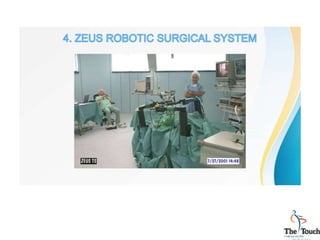
ZEUS was the first surgical robot to perform gynecological surgery when it was used in
1997 to reconnect fallopian tubes in state-of-the-art robotic surgery in Cleveland,
Ohio, USA. The company that developed the ZEUS robot was purchased by Intuitive
Surgical, Inc., and after years of attempts to upgrade the system they brought out the
da Vinci surgical robot. In 2005, the US Food and Drug Administration (FDA) approved
the use of the da Vinci robotic system in gynecological surgery.
A recent report by Intuitive Surgical, Inc. pointed out that during 2007–2013 the
number of robotic surgical systems more than doubled in the US (from 800 to
2001) and Europe (from 200 to 443). The same report stated that 1.5 million
robotic surgeries had been performed until 2013 in the world.
Robotic surgery in gynecology covers a broad spectrum of uses and is growing fast. The
da Vinci Surgical System is used for benign indications such as treatment for fibroids,
abnormal periods, endometriosis, pelvic prolapse, and ovarian growths, or for
malignancies such as endometrial cancer, cervical cancer, or ovarian cancer. The
robotic system may assist the gynecological surgeon in performing hysterectomies,
salpingectomies, oophorectomies, myomectomies, and lymph node biopsies. Thus,
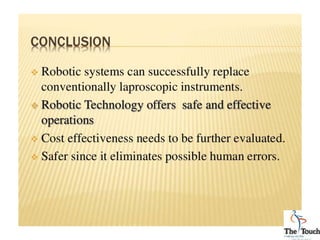
abdominal surgery may become obsolete in the future—as we said, science fiction.
Quite a few medical centers around the world have extensively studied the use of
robotic surgery and found that it improves the morbidity and mortality rates of
patients with gynecologic cancers.
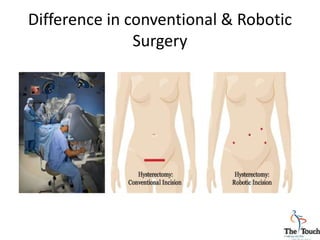
Difference in conventional & Robotic
Surgery
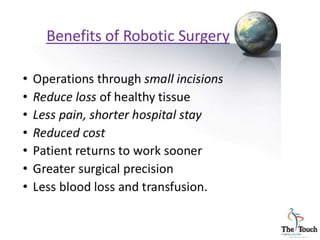
Advantages of Robotic Surgery
• Surgeon controls movements of sophesticated
instruments using console
• Much advanced
• Complex procedures done with ease ,stability,
precision
• Better reach to deep areas,less conversion to
open
• Minimal blood loss
• Quicker recovery, less hospital stay, no need of
antibiotics
Benefits to patient & society
• For patient –less pain, no scar, normal activity
• Like magic
• No long antibiotics & no harmful effects of
antibiotics
• For family-no need of leave from work, no
help required, normal life goes on
• Gynecological Surgery Endoscopic Imaging and Allied Techniques201714:5
• Conclusions
• This study compares conventional TLH with robot
assisted TLH and shows shorter operating times, less
blood loss and lower rehospitalisation and
reoperation rates in the robot TLH group.
Perioperative surgical outcome of conventional and robot-assisted total laparoscopic
hysterectomy
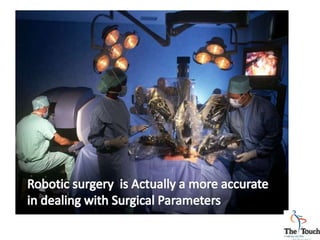
From a purely surgical point of view, the advantages of robotic surgeries over open and
even laparoscopic surgeries are quite substantial and include:
A three-dimensional surgical view as opposed to the old laparoscopic two-dimensional
view.
The ability to reduce to zero the effect of a surgeon’s tremor, adding to the precision and
finesse of surgery.
The seven degrees of freedom of the robotic arms allow finer suturing and dissection of
tissue with poor anatomic accessibility.
The ability to control three surgical instruments in addition to a camera enables the
surgeon to operate with very little assistance, not having to rely on the assistant’s
expertise.
Robotic surgery in gynecology
Rooma Sinha, Madhumati Sanjay, B. Rupa, and Samita Kumari
Department of Obstetrics and Gynecology, Apollo Health City, Hyderabad, Telangana,
India
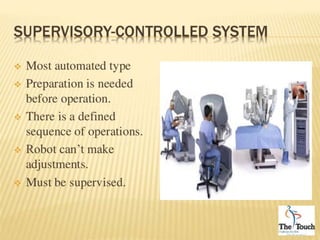
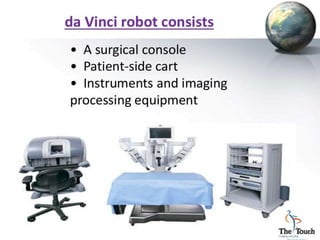
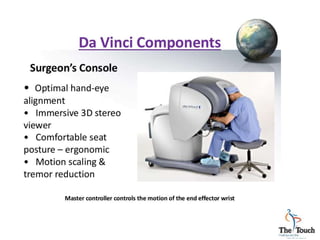
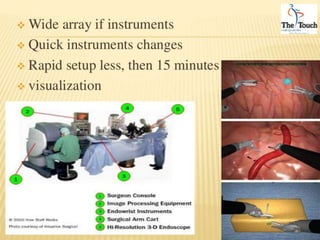
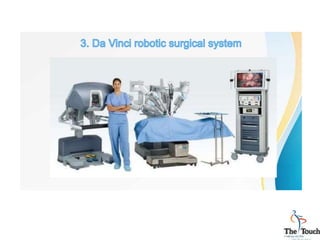
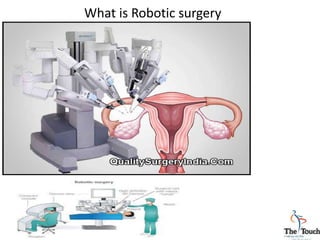
FDA approved Da Vinci Surgical System in 2005 for gynecological surgery. It has been
rapidly adopted and it has already assumed an important position at various centers
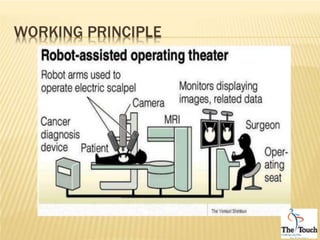
where this is available. It comprises of three components: A surgeon's console, a patient-
side cart with four robotic arms and a high-definition three-dimensional (3D) vision
system.
Robotic Surgery in Gynaecology
Recommendations
•Well-designed randomized controlled trials (RCTs) or comparably rigorous
nonrandomized prospective trials are needed to determine which patients are likely to
benefit from robot-assisted surgery and to establish the potential risks.
•Robot-assisted cases should be appropriately selected based on the available data and
expert opinion. As with any surgical procedure, repetition drives competency. In addition
to the didactic and hands-on training necessary for any new technology, ongoing quality
assurance is essential to ensure appropriate use of the technology and, most importantly,
patient safety.
•Adoption of new surgical techniques should be driven by what is best for the patient,
Contemporary OB/GYNObstetrics-Gynecology & Women's HealthACOG
Annual Meeting 2017
Robotic vs laparoscopic hysterectomy: Is there a place for both?
• Dr Advincula, who said that he’s been using robotics since 2001, stated
that the robot should be seen as one step in the evolution of the
laparoscopic procedure. When approaching the use of the robot, surgeons
should do what they do best and cautioned that no piece of surgical
technology can replace the knowledge that a surgeon brings to a
procedure. He also said that the cost of the robot is not what one would
think, as the device is not used just in the ob/gyn unit of the hospital, but
other units will use it as well. Dr Advincula said that with the negative
publicity that has surrounded the robot, attention has come to focus on
cost, the learning curve associated with the device, and experience. He
closed by pointing to a 1992 editorial in Obstetrics & Gynecology in which
the author wondered if laparoscopic surgery was more than a gimmick
and to a follow-up in 2010 in which the author said that laparoscopic
surgery had become useful.
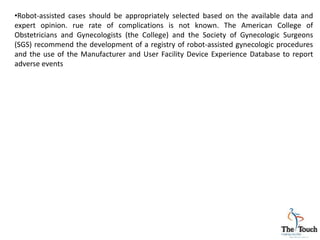
•Robot-assisted cases should be appropriately selected based on the available data and
expert opinion. rue rate of complications is not known. The American College of
Obstetricians and Gynecologists (the College) and the Society of Gynecologic Surgeons
(SGS) recommend the development of a registry of robot-assisted gynecologic procedures
and the use of the Manufacturer and User Facility Device Experience Database to report
adverse events
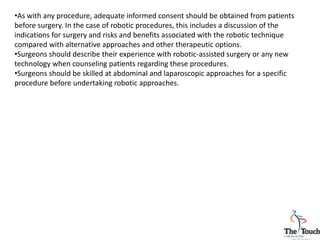
•As with any procedure, adequate informed consent should be obtained from patients
before surgery. In the case of robotic procedures, this includes a discussion of the
indications for surgery and risks and benefits associated with the robotic technique
compared with alternative approaches and other therapeutic options.
•Surgeons should describe their experience with robotic-assisted surgery or any new
technology when counseling patients regarding these procedures.
•Surgeons should be skilled at abdominal and laparoscopic approaches for a specific
procedure before undertaking robotic approaches.
What is Robotic surgery
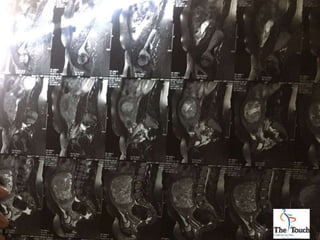
Maneka History
• 36 years,with previous 2 caesarean sections
• Very large fibroid uterus 12.3/12/9cm
• Excessive bleeding during periods
• Anemia
• Reaching 4 fingers above umbilicus
• Multiple fibroids
• Myomectomy is a surgical procedure to remove uterine fibroids.
Fibroids are noncancerous growths that appear in the uterus,
usually during childbearing years. Fibroids can cause symptoms of
heavy menstrual bleeding, pressure on the bladder, constipation,
pelvic pain and discomfort during intercourse.
• Myomectomy allows the uterus to be left in place and is the
preferred fibroid treatment for women who want to become
pregnant. Women who undergo myomectomies may experience
improvement in fibroid symptoms, including heavy menstrual
bleeding and pelvic pressure.
• Robotic myomectomies are outpatient setting procedures using
small incisions, with patients returning home the same day.
Robotic myomectomy recovery time is as quick as 2 weeks
compared to 4–6 weeks for traditional open surgery.
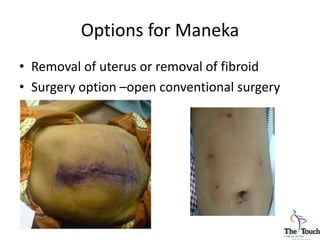
Options for Maneka
• Removal of uterus or removal of fibroid
• Surgery option –open conventional surgery
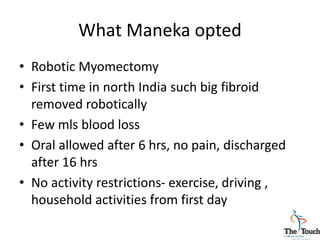
What Maneka opted
• Robotic Myomectomy
• First time in north India such big fibroid
removed robotically
• Few mls blood loss
• Oral allowed after 6 hrs, no pain, discharged
after 16 hrs
• No activity restrictions- exercise, driving ,
household activities from first day
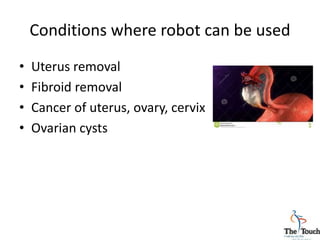
Conditions where robot can be used
• Uterus removal
• Fibroid removal
• Cancer of uterus, ovary, cervix
• Ovarian cysts
Thank you
Technology is
future

Gynaecology robotic surgery procedure

  • 1.
    ROBOTIC SURGERY Dr PreetiJindal MD,DNB,MRCOG,FICOG Director The Touch Clinic-Advanced IVF & Gyne centre Senior consultant Fortis, Healing Hospital Advanced laparoscopic, Robotic surgeon Recurrent miscarriage specialist,High risk pregnancy IVF expert
  • 6.
    ZEUS was thefirst surgical robot to perform gynecological surgery when it was used in 1997 to reconnect fallopian tubes in state-of-the-art robotic surgery in Cleveland, Ohio, USA. The company that developed the ZEUS robot was purchased by Intuitive Surgical, Inc., and after years of attempts to upgrade the system they brought out the da Vinci surgical robot. In 2005, the US Food and Drug Administration (FDA) approved the use of the da Vinci robotic system in gynecological surgery. A recent report by Intuitive Surgical, Inc. pointed out that during 2007–2013 the number of robotic surgical systems more than doubled in the US (from 800 to 2001) and Europe (from 200 to 443). The same report stated that 1.5 million robotic surgeries had been performed until 2013 in the world.
  • 7.
    Robotic surgery ingynecology covers a broad spectrum of uses and is growing fast. The da Vinci Surgical System is used for benign indications such as treatment for fibroids, abnormal periods, endometriosis, pelvic prolapse, and ovarian growths, or for malignancies such as endometrial cancer, cervical cancer, or ovarian cancer. The robotic system may assist the gynecological surgeon in performing hysterectomies, salpingectomies, oophorectomies, myomectomies, and lymph node biopsies. Thus, abdominal surgery may become obsolete in the future—as we said, science fiction. Quite a few medical centers around the world have extensively studied the use of robotic surgery and found that it improves the morbidity and mortality rates of patients with gynecologic cancers.
  • 32.
    Difference in conventional& Robotic Surgery
  • 34.
    Advantages of RoboticSurgery • Surgeon controls movements of sophesticated instruments using console • Much advanced • Complex procedures done with ease ,stability, precision • Better reach to deep areas,less conversion to open • Minimal blood loss • Quicker recovery, less hospital stay, no need of antibiotics
  • 35.
    Benefits to patient& society • For patient –less pain, no scar, normal activity • Like magic • No long antibiotics & no harmful effects of antibiotics • For family-no need of leave from work, no help required, normal life goes on
  • 38.
    • Gynecological SurgeryEndoscopic Imaging and Allied Techniques201714:5 • Conclusions • This study compares conventional TLH with robot assisted TLH and shows shorter operating times, less blood loss and lower rehospitalisation and reoperation rates in the robot TLH group. Perioperative surgical outcome of conventional and robot-assisted total laparoscopic hysterectomy
  • 39.
    From a purelysurgical point of view, the advantages of robotic surgeries over open and even laparoscopic surgeries are quite substantial and include: A three-dimensional surgical view as opposed to the old laparoscopic two-dimensional view. The ability to reduce to zero the effect of a surgeon’s tremor, adding to the precision and finesse of surgery. The seven degrees of freedom of the robotic arms allow finer suturing and dissection of tissue with poor anatomic accessibility. The ability to control three surgical instruments in addition to a camera enables the surgeon to operate with very little assistance, not having to rely on the assistant’s expertise.
  • 40.
    Robotic surgery ingynecology Rooma Sinha, Madhumati Sanjay, B. Rupa, and Samita Kumari Department of Obstetrics and Gynecology, Apollo Health City, Hyderabad, Telangana, India FDA approved Da Vinci Surgical System in 2005 for gynecological surgery. It has been rapidly adopted and it has already assumed an important position at various centers where this is available. It comprises of three components: A surgeon's console, a patient- side cart with four robotic arms and a high-definition three-dimensional (3D) vision system.
  • 41.
    Robotic Surgery inGynaecology Recommendations •Well-designed randomized controlled trials (RCTs) or comparably rigorous nonrandomized prospective trials are needed to determine which patients are likely to benefit from robot-assisted surgery and to establish the potential risks. •Robot-assisted cases should be appropriately selected based on the available data and expert opinion. As with any surgical procedure, repetition drives competency. In addition to the didactic and hands-on training necessary for any new technology, ongoing quality assurance is essential to ensure appropriate use of the technology and, most importantly, patient safety. •Adoption of new surgical techniques should be driven by what is best for the patient,
  • 42.
    Contemporary OB/GYNObstetrics-Gynecology &Women's HealthACOG Annual Meeting 2017 Robotic vs laparoscopic hysterectomy: Is there a place for both? • Dr Advincula, who said that he’s been using robotics since 2001, stated that the robot should be seen as one step in the evolution of the laparoscopic procedure. When approaching the use of the robot, surgeons should do what they do best and cautioned that no piece of surgical technology can replace the knowledge that a surgeon brings to a procedure. He also said that the cost of the robot is not what one would think, as the device is not used just in the ob/gyn unit of the hospital, but other units will use it as well. Dr Advincula said that with the negative publicity that has surrounded the robot, attention has come to focus on cost, the learning curve associated with the device, and experience. He closed by pointing to a 1992 editorial in Obstetrics & Gynecology in which the author wondered if laparoscopic surgery was more than a gimmick and to a follow-up in 2010 in which the author said that laparoscopic surgery had become useful.
  • 43.
    •Robot-assisted cases shouldbe appropriately selected based on the available data and expert opinion. rue rate of complications is not known. The American College of Obstetricians and Gynecologists (the College) and the Society of Gynecologic Surgeons (SGS) recommend the development of a registry of robot-assisted gynecologic procedures and the use of the Manufacturer and User Facility Device Experience Database to report adverse events
  • 44.
    •As with anyprocedure, adequate informed consent should be obtained from patients before surgery. In the case of robotic procedures, this includes a discussion of the indications for surgery and risks and benefits associated with the robotic technique compared with alternative approaches and other therapeutic options. •Surgeons should describe their experience with robotic-assisted surgery or any new technology when counseling patients regarding these procedures. •Surgeons should be skilled at abdominal and laparoscopic approaches for a specific procedure before undertaking robotic approaches.
  • 48.
  • 49.
    Maneka History • 36years,with previous 2 caesarean sections • Very large fibroid uterus 12.3/12/9cm • Excessive bleeding during periods • Anemia • Reaching 4 fingers above umbilicus • Multiple fibroids
  • 51.
    • Myomectomy isa surgical procedure to remove uterine fibroids. Fibroids are noncancerous growths that appear in the uterus, usually during childbearing years. Fibroids can cause symptoms of heavy menstrual bleeding, pressure on the bladder, constipation, pelvic pain and discomfort during intercourse. • Myomectomy allows the uterus to be left in place and is the preferred fibroid treatment for women who want to become pregnant. Women who undergo myomectomies may experience improvement in fibroid symptoms, including heavy menstrual bleeding and pelvic pressure. • Robotic myomectomies are outpatient setting procedures using small incisions, with patients returning home the same day. Robotic myomectomy recovery time is as quick as 2 weeks compared to 4–6 weeks for traditional open surgery.
  • 52.
    Options for Maneka •Removal of uterus or removal of fibroid • Surgery option –open conventional surgery
  • 53.
    What Maneka opted •Robotic Myomectomy • First time in north India such big fibroid removed robotically • Few mls blood loss • Oral allowed after 6 hrs, no pain, discharged after 16 hrs • No activity restrictions- exercise, driving , household activities from first day
  • 55.
    Conditions where robotcan be used • Uterus removal • Fibroid removal • Cancer of uterus, ovary, cervix • Ovarian cysts
  • 56.