Dr.Nusrat Tariq (M.Phill., Ph.D Scholar)
Associate Professor
Department of physiology
1
Dr. Alzoghaibi 2
Gastrointestinal physiology:
A branch of human physiology
that addresses the physical function of
the gastrointestinal (GI) system.
.
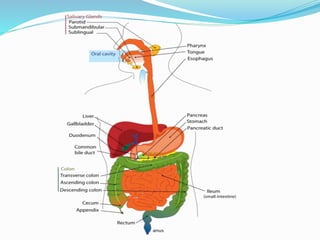
Gastrointestinal system:
1-The GIT— a series of hollow organs:
Mouth
Esophagus
stomach
small intestine
large intestine— rectum and anus.
2- Solid accessory organs:
Liver
Pancreas
Gallbladder 3
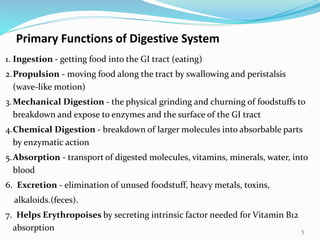
Primary Functions of Digestive System
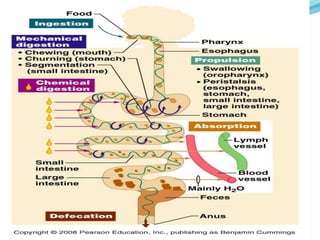
1. Ingestion - getting food into the GI tract (eating)
2.Propulsion - moving food along the tract by swallowing and peristalsis
(wave-like motion)
3.Mechanical Digestion - the physical grinding and churning of foodstuffs to
breakdown and expose to enzymes and the surface of the GI tract
4.Chemical Digestion - breakdown of larger molecules into absorbable parts
by enzymatic action
5.Absorption - transport of digested molecules, vitamins, minerals, water, into
blood
6. Excretion - elimination of unused foodstuff, heavy metals, toxins,
alkaloids.(feces).
7. Helps Erythropoises by secreting intrinsic factor needed for Vitamin B12
absorption 5
6
.
Dr. Alzoghaibi 7
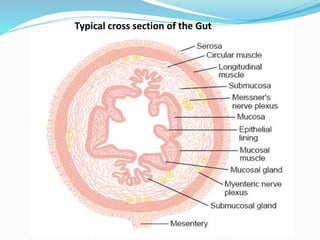
Typical cross section of the Gut
The Musculature of the Digestive
Tract
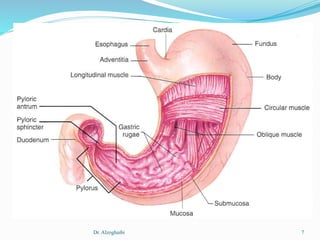
 Two Main Muscle Layers:
 Longitudinal muscle layer
 Circular muscle layer
 Oblique muscle layer (stomach only)
9
The Musculature of the Digestive Tract
Longitudinal Muscle:
 Contraction shortens the segment of the intestine and
expands the lumen
 Innervated by ENS, mainly by excitatory motor neuron
 Ca influx from out side is important.
Circular muscle:
 Thicker and more powerful than longitudinal.
 Contraction reduces the diameter of the lumen and
increases its length .
 Innervated by ENS, both excitatory and inhibitory motor
neurons.
 More gap junctions than in longitudinal muscle.
 Intracellular release of Ca is more important
10
SMOOTH MUSCLE OF G.I.T
1.Unitary type,visceral or syncytial
smooth muscle.
2.Multiunit type smooth muscle.
11
SMOOTH MUSCLE OF G.I.T
Unitary type,visceral or syncytial smooth
muscle.
Contract spontaneously in response to
stretch in the absence of neural or hormonal
influence (such as in stomach and intestine)
Cells are electrically coupled via gap junctions
so each muscle layer functions as a
syncytium.
12
SMOOTH MUSCLE OF G.I.T
Multiunit type smooth muscle.
Contract in response to neural input but
not to stretch (such as in esophagus &
gall bladder).
Composed of discrete independently
working smooth muscle fibers ,each of
which is innervated by single nerve
ending.
13
Electrical Activity in GIT
Muscles
Slow Waves &
 Spike potentials
14
15
Slow waves
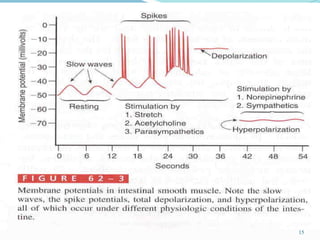
They are not action potential but are slow undulating changes
in membrane potential(-56mv)
Frequency of slow waves determines rhythm of gastrointestinal
movements.
They do not cause Ca++ to enter the smooth muscles so by
themselves cause no muscle contraction.They mainly excite
the appearance of intermittent spike potentials.
Occur at different frequency
stomach (3/min)
small intestine (duodenum, 12/min)
ileum & colon (8-9/min).
16
.
17
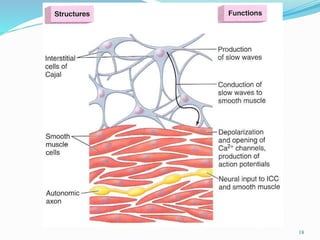
Caused by complex interactions among smooth muscle
cells and specialized cells called Interstitial Cells Of
Cajal (Electrical Pacemaker).
These interstitial cells form a network with each
other and are interposed between the smooth muscle
layers, with synaptic-like contacts to smooth muscle
cells.
The interstitial cells of Cajal undergo cyclic changes in
membrane potential due to unique ion channels that
periodically open and produce inward (pacemaker)
currents that may generate slow wave activity.
18
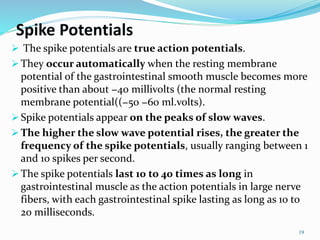
Spike Potentials
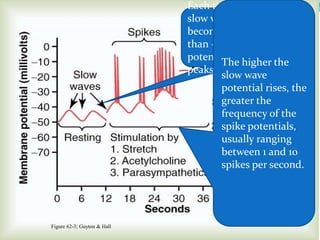
 The spike potentials are true action potentials.
They occur automatically when the resting membrane
potential of the gastrointestinal smooth muscle becomes more
positive than about −40 millivolts (the normal resting
membrane potential((−50 −60 ml.volts).
Spike potentials appear on the peaks of slow waves.
The higher the slow wave potential rises, the greater the
frequency of the spike potentials, usually ranging between 1
and 10 spikes per second.
The spike potentials last 10 to 40 times as long in
gastrointestinal muscle as the action potentials in large nerve
fibers, with each gastrointestinal spike lasting as long as 10 to
20 milliseconds.
19
20
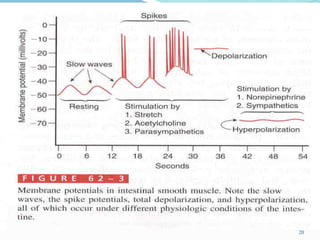
Figure 62-3; Guyton & Hall
Each time the peaks of the
slow waves temporarily
become more positive
than -40 millivolts, spike
potentials appear on these
peaks
The higher the
slow wave
potential rises, the
greater the
frequency of the
spike potentials,
usually ranging
between 1 and 10
spikes per second.
.
 Factors that depolarize the membrane:
 Stretching of the muscle
 Ach
 Parasympathetic stimulation
 Hormonal stimulation
 Factors that hyperpolarize the membrane:
 Norepinephrine
 Sympathetic stimulation
22
Contractions in Gastrointestinal Smooth Muscles
 Phasic contractions
Periodic contractions followed by relaxation; such as in gastric
antrum, small intestine and esophagus
 Tonic contractions
 Maintained contraction without relaxation; such as in orad
region of the stomach, lower esoghageal, ileocecal and
internal anal sphincter
 Not associated with slow waves .
- Caused by:
• Continuous repetitive spike potential
• Hormonal effects
• Continuous entery of Ca ions.
23

Introduction to Git Physiology

  • 1.
    Dr.Nusrat Tariq (M.Phill.,Ph.D Scholar) Associate Professor Department of physiology 1
  • 2.
    Dr. Alzoghaibi 2 Gastrointestinalphysiology: A branch of human physiology that addresses the physical function of the gastrointestinal (GI) system.
  • 3.
    . Gastrointestinal system: 1-The GIT—a series of hollow organs: Mouth Esophagus stomach small intestine large intestine— rectum and anus. 2- Solid accessory organs: Liver Pancreas Gallbladder 3
  • 5.
    Primary Functions ofDigestive System 1. Ingestion - getting food into the GI tract (eating) 2.Propulsion - moving food along the tract by swallowing and peristalsis (wave-like motion) 3.Mechanical Digestion - the physical grinding and churning of foodstuffs to breakdown and expose to enzymes and the surface of the GI tract 4.Chemical Digestion - breakdown of larger molecules into absorbable parts by enzymatic action 5.Absorption - transport of digested molecules, vitamins, minerals, water, into blood 6. Excretion - elimination of unused foodstuff, heavy metals, toxins, alkaloids.(feces). 7. Helps Erythropoises by secreting intrinsic factor needed for Vitamin B12 absorption 5
  • 6.
  • 7.
  • 8.
  • 9.
    The Musculature ofthe Digestive Tract  Two Main Muscle Layers:  Longitudinal muscle layer  Circular muscle layer  Oblique muscle layer (stomach only) 9
  • 10.
    The Musculature ofthe Digestive Tract Longitudinal Muscle:  Contraction shortens the segment of the intestine and expands the lumen  Innervated by ENS, mainly by excitatory motor neuron  Ca influx from out side is important. Circular muscle:  Thicker and more powerful than longitudinal.  Contraction reduces the diameter of the lumen and increases its length .  Innervated by ENS, both excitatory and inhibitory motor neurons.  More gap junctions than in longitudinal muscle.  Intracellular release of Ca is more important 10
  • 11.
    SMOOTH MUSCLE OFG.I.T 1.Unitary type,visceral or syncytial smooth muscle. 2.Multiunit type smooth muscle. 11
  • 12.
    SMOOTH MUSCLE OFG.I.T Unitary type,visceral or syncytial smooth muscle. Contract spontaneously in response to stretch in the absence of neural or hormonal influence (such as in stomach and intestine) Cells are electrically coupled via gap junctions so each muscle layer functions as a syncytium. 12
  • 13.
    SMOOTH MUSCLE OFG.I.T Multiunit type smooth muscle. Contract in response to neural input but not to stretch (such as in esophagus & gall bladder). Composed of discrete independently working smooth muscle fibers ,each of which is innervated by single nerve ending. 13
  • 14.
    Electrical Activity inGIT Muscles Slow Waves &  Spike potentials 14
  • 15.
  • 16.
    Slow waves They arenot action potential but are slow undulating changes in membrane potential(-56mv) Frequency of slow waves determines rhythm of gastrointestinal movements. They do not cause Ca++ to enter the smooth muscles so by themselves cause no muscle contraction.They mainly excite the appearance of intermittent spike potentials. Occur at different frequency stomach (3/min) small intestine (duodenum, 12/min) ileum & colon (8-9/min). 16
  • 17.
    . 17 Caused by complexinteractions among smooth muscle cells and specialized cells called Interstitial Cells Of Cajal (Electrical Pacemaker). These interstitial cells form a network with each other and are interposed between the smooth muscle layers, with synaptic-like contacts to smooth muscle cells. The interstitial cells of Cajal undergo cyclic changes in membrane potential due to unique ion channels that periodically open and produce inward (pacemaker) currents that may generate slow wave activity.
  • 18.
  • 19.
    Spike Potentials  Thespike potentials are true action potentials. They occur automatically when the resting membrane potential of the gastrointestinal smooth muscle becomes more positive than about −40 millivolts (the normal resting membrane potential((−50 −60 ml.volts). Spike potentials appear on the peaks of slow waves. The higher the slow wave potential rises, the greater the frequency of the spike potentials, usually ranging between 1 and 10 spikes per second. The spike potentials last 10 to 40 times as long in gastrointestinal muscle as the action potentials in large nerve fibers, with each gastrointestinal spike lasting as long as 10 to 20 milliseconds. 19
  • 20.
  • 21.
    Figure 62-3; Guyton& Hall Each time the peaks of the slow waves temporarily become more positive than -40 millivolts, spike potentials appear on these peaks The higher the slow wave potential rises, the greater the frequency of the spike potentials, usually ranging between 1 and 10 spikes per second.
  • 22.
    .  Factors thatdepolarize the membrane:  Stretching of the muscle  Ach  Parasympathetic stimulation  Hormonal stimulation  Factors that hyperpolarize the membrane:  Norepinephrine  Sympathetic stimulation 22
  • 23.
    Contractions in GastrointestinalSmooth Muscles  Phasic contractions Periodic contractions followed by relaxation; such as in gastric antrum, small intestine and esophagus  Tonic contractions  Maintained contraction without relaxation; such as in orad region of the stomach, lower esoghageal, ileocecal and internal anal sphincter  Not associated with slow waves . - Caused by: • Continuous repetitive spike potential • Hormonal effects • Continuous entery of Ca ions. 23