Copyright © 2006 Pearson Education, Inc., publishing as Benjamin Cummings
The Digestive System
Dr. Ali Ebneshahidi
Copyright © 2006 Pearson Education, Inc., publishing as Benjamin Cummings
Functions of the Digestive System
 ingestion – the oral cavity allows food to enter the digestive
tract and have mastication (chewing) occurs , and the resulting
food bolus is swallowed .
 Digestion:
 Mechanical digestion – muscular movement of the digestive
tract (mainly in the oral cavity and stomach) physically break
down food into smaller particles .
 chemical digestion – hydrolysis reactions aided by
enzymes (mainly in the stomach and small intestine)
chemically break down food particles into nutrient
molecules , small enough to be absorbed . .
Copyright © 2006 Pearson Education, Inc., publishing as Benjamin Cummings
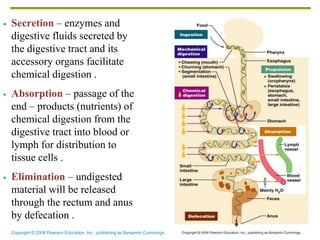
 Secretion – enzymes and
digestive fluids secreted by
the digestive tract and its
accessory organs facilitate
chemical digestion .
 Absorption – passage of the
end – products (nutrients) of
chemical digestion from the
digestive tract into blood or
lymph for distribution to
tissue cells .
 Elimination – undigested
material will be released
through the rectum and anus
by defecation .
Copyright © 2006 Pearson Education, Inc., publishing as Benjamin Cummings
Organization of The Digestive System
 Organs of the digestive system are divided into 2 main
group : the gastrointestinal tract (GI tract) and
accessory structures .
 GI tract is a continuous tube extending through the
ventral cavity from the mouth to the anus – it consists
of the mouth , oral cavity , oropharynx , esophagus ,
stomach , small intestine , large intestine , rectum , and
anus .
 Accessory structures include the teeth, tongue (in oral
cavity) , salivary glands , liver , gallbladder , and
pancreas .
Copyright © 2006 Pearson Education, Inc., publishing as Benjamin Cummings Figure 23.1
Copyright © 2006 Pearson Education, Inc., publishing as Benjamin Cummings
Muscular movement of the GI tract
 Peristalsis – wavelike movement that occurs from the
oropharynx to the rectum , allowing GI tract to push
food particles toward the anus .
 Mixing—mixing motion in the oral cavity and
stomach that allows the GI tract to repeatedly break
down food into smaller particles , using mechanical
digestion .
 Segmentation – regions of the small intestine
contracting and relaxing independently , allowing the
small intestine to digestive and absorb more efficiently
.
Copyright © 2006 Pearson Education, Inc., publishing as Benjamin Cummings
Histology of the Alimentary Canal
Figure 23.6
Copyright © 2006 Pearson Education, Inc., publishing as Benjamin Cummings
Peristalsis and Segmentation
Figure 23.3
Copyright © 2006 Pearson Education, Inc., publishing as Benjamin Cummings
Regulation of GI Tract Activities
 Autonomic nervous system
 - parasympathetic nerves stimulate GI tract activities .
 - sympathetic nerves inhibit GI tract activities .
 Hormonal control
 - hormones from endocrine gland and from GI tract itself
help regulate GI tract activities .
 Reflex mechanism
 - regions of the GI tract (especially the stomach and small
intestine) use reflexes to stimulate or inhibit one another .
Copyright © 2006 Pearson Education, Inc., publishing as Benjamin Cummings
Nervous Control of the GI Tract
Copyright © 2006 Pearson Education, Inc., publishing as Benjamin Cummings
Mouth & Oral Cavity
 Food enters the GI tract by ingestion .
 Food is broken down by mechanical digestion , using
mastication .
 One chemical digestive process occur where amylase
enzyme in saliva breaks down polysaccharide into
disaccharides .
 The tongue , made of skeletal muscle, manipulates the food
during mastication . it also contains taste buds to detect
taste sensations(intrinsic) .
 Food particles are mixed with saliva during mastication ,
resulting in a moist lump called bolus for easier passage
into or pharynx .
Copyright © 2006 Pearson Education, Inc., publishing as Benjamin Cummings
Teeth
 Adapted for mechanical
digestion (mastication) in the
oral cavity .
 20 deciduous or primary
teeth before the age of 6.
 By age 7, 32 permanent or
secondary teeth are
developed & are divided into
4 types: incisors (for cutting)
, Canines (for tearing) ,
Premolars (for crushing),
and Molars (for grinding).
these teeth follow the human
dental formula of 2-1-2-3.
Copyright © 2006 Pearson Education, Inc., publishing as Benjamin Cummings
Salivary Glands
 3 pairs of salivary glands called parotid , submandibular ,
and sublingual gland secrete most of the saliva in the oral
cavity , using salivary ducts .
 Saliva helps moisten the food during mastication , dissolve
the food in forming the bolus , and help cleanse the teeth.
 Saliva consists of 99.5% water , the remaining 0.5% is
dissolved substances including amylase enzyme (for
chemically digesting carbohydrate ), bicarbonate ion
(HCO3
-; maintains pH of saliva at 6.5-7.5) , and many
electrolytes.
Copyright © 2006 Pearson Education, Inc., publishing as Benjamin Cummings
Salivary Glands
Figure 23.9a
Copyright © 2006 Pearson Education, Inc., publishing as Benjamin Cummings
Stomach
 A pouch-like organ primarily designed for food storage (for 2-4
hours) , some mechanical and chemical digestion also occur .
 Contains two sphincters at both ends to regulate food movement
– cardiac sphincter near the esophagus ,and pyloric sphincter
near the small intestine .
 Divided into 4 regions : cardiac stomach (or cardiac), fundic
stomach (or funded) , body of stomach , and pyloric stomach
(or Pylorus).
 Contain thick folds called rugae at its layer , for providing
larger surface area for expansion , secretion , digestion , and
some absorption.
Copyright © 2006 Pearson Education, Inc., publishing as Benjamin Cummings
Stomach
Copyright © 2006 Pearson Education, Inc., publishing as Benjamin Cummings
Gastric Secretory Cells
 -Chief cells: secrete pepsinogen (an inactive enzyme).
 -Parietal cells: secrete hydrochloric and (HCl) and
"intrinsic factor" (which helps absorption of vitamin
B12 in the intestines).
 - Mucous cells: secrete mucus and alkaline substances
to help neutralize HCl in the gastric juice .
 -G cells: secrete a hormone called gastrin , which
stimulates the parietal cells and overall gastric
secretion .
Copyright © 2006 Pearson Education, Inc., publishing as Benjamin Cummings
Gastric Cells
Copyright © 2006 Pearson Education, Inc., publishing as Benjamin Cummings
Chemical digestion & absorption in the stomach
 - Carbohydrate digestion is continued with gastric amylase ,
resulting in disaccharides .
 - Protein digestion begins with pepsin (activation of pepsinogen
by HCl) , resulting in peptides (small chains of protein).
 - Lipid digestion begins with gastric lipases which can only
break down certain lipids such as butterfat , resulting in fatty
acids .
 Absorption in the stomach is limited, where only small and fat-
soluble substances can be absorbed—water , alcohol, aspirin ,
and certain drugs .
 The result of all these mixing , chemical digestion , secretion,
and absorption is a yellowish paste called chyme , which will
be passed on to the small intestine .
Copyright © 2006 Pearson Education, Inc., publishing as Benjamin Cummings
Regulation of Gastric Secretion
 Regulation of gastric secretion and activities is by both nervous
and hormonal mechanisms – food moving along the oral cavity
and esophagus stimulates the parasympathetic nerves to
activate the secretion in gastric glands , the gastric hormone
from G cells in turn stimulates the gastric glands for more
activities ("positive feedback").
 On the other hand , when food is emptying from the stomach ,
sympathetic nerves inhibit the gastric glands and gastric , and
a hormone called intestinal gastrin (released by small
intestine) inhibits other gastric activities.
 The above regulations occur in 3 overlapping phases:
 Cephalic Phase, Gastric Phase, & Intestinal Phase.
Copyright © 2006 Pearson Education, Inc., publishing as Benjamin Cummings
Cephalic phase
 Cephalic phase: involves special senses detect food
and uses parasympathetic nerves in the vagus nerve to
stimulate gastric activities.
 1. Sight, Smell , and Taste of food cause stimulation
of vagus nuclei in brain.
 2. Vagus stimulates acid secretion.
 a. Direct stimulation of parietal cells (major effect).
 b. Stimulation of Gastrin secretion (lesser effect).
Copyright © 2006 Pearson Education, Inc., publishing as Benjamin Cummings
Gastric phase
 Gastric phase involves the distention of stomach and
stimulates its own activities by the vagus nerve. Distension of
stomach (stretch - receptors) stimulates vagus nerve ; vagus
stimulates acid secretion .
 Amino acids and peptides in stomach lumen srimulates acid
secretion (chemo - receptors)
 Direct stimulation of parietal cells (lesser effect)
 Stimulation of gastrin secretion ; gastrin stimulates acid
secretion (major effect)
 Gastrin secretion inhibited when PH of gastric juice falls
below 2.5.
Copyright © 2006 Pearson Education, Inc., publishing as Benjamin Cummings
Intestinal Phase
 intestinal phase involves acidic chyme passing into the small
intestine which secretes intestinal gastrin hormone to inhibit gastric
activates.
 Neural inhibition of gastric emptying and acid secretion. Arrival of
chyme in duodenum causes distension & an increase in osmotic
pressure. These stimuli activate a neural reflex that inhibits gastric
activity.
 In response to fat in chyme , duodenum secretes the hormone,
secretin that inhibits gastric acid secretion.
 The enterogastric reflex: This reflex begins in the small intestine
(entero) and ends in the stomach (gastro).
 Duodenum fills with chyme. Sensory stretch receptors are stimulated.
Sensory nerve impulses travel to CNS. Nerve impulses from CNS
(vagus) inhibit peristalsis in stomach wall.
Copyright © 2006 Pearson Education, Inc., publishing as Benjamin Cummings
Stomach: Neural & Hormonal Mechanisms
Copyright © 2006 Pearson Education, Inc., publishing as Benjamin Cummings
Pancreas
 Pancreas : most pancreatic enzymes are produced as inactivate
molecules , or zymogens , so that the risk of self – digestion within the
pancreas is minimized .
 More than 98% of the pancreas mass is devoted to its exocrine
function: the secretion of pancreatic juice by the pancreatic acini and
their ductile cells. Ductile cells produce Sodium bicarbonate which
helps neutralize the acidic gastric contents .
 Acinar cells of the exocrine pancreas produce a variety of digestive
enzymes to break down food substances into smaller absorbable
molecules .
 Only 2% of pancreas mass is devoted to the islets of langerham , which
produce insulin and glucagon , hormones that regulate blood sugar
and carbohydrate metabolism (they have opposite effects) .
Copyright © 2006 Pearson Education, Inc., publishing as Benjamin Cummings
Major pancreatic Enzymes
 -pancreatic amylase: digest polysaccharides into disaccharides
 - pancreatic lipases digest triglycerides into fatty acids .
 - pancreatic nucleases digest nucleic acids into nucleotides .
 -Pancreatic proteinases (all secreted in their inactive forms) digest
peptides into amino acids:
Trypsinogen is activated by enterokinase (secreted by duodenum)
into trypsin , which in turn activates the other 3 enzymes – chymo-
trypsinogen becomes chymotrypisn , proaminopeptidase
becomes aminopeptidase, and procarboxypeptidase becomes
carboxypeptidase.
Copyright © 2006 Pearson Education, Inc., publishing as Benjamin Cummings
Activation of pancreatic proteases in the small intestine
Copyright © 2006 Pearson Education, Inc., publishing as Benjamin Cummings
Pancreatic Secretion
 1.The parasympathetic nervous system increases
pancreatic secretion
 2. Two duodenual hormones also influence
pancreatic secretion: Secretin and Cholecystokinin.
 3. Food entering the small intestine stimulates the
secretion of both hormones.
 4. Secretin stimulates the secretion of pancreatic
electrolyte – rich fluid , while CCK enhances the
enzymatic secretions of the pancreas .
Copyright © 2006 Pearson Education, Inc., publishing as Benjamin Cummings
Regulation of pancreatic Juice
 1. Acidic chyme enters duodenum.
 2. Secretin is released into blood stream from
intestinal mucosa.
 3. Secretin stimulates pancreas.
 4. Pancreas secretes pancreatic juice.
 5. Pancreatic juice , high in bicarbonate ions ,
neutralizes acidic chyme.
Copyright © 2006 Pearson Education, Inc., publishing as Benjamin Cummings
Functions of The Liver
 Important in carbohydrate metabolism where hepatic cells conduct
glycogenesis (converting glucose into glycogen) , and
glycogenolysis (breaking glycogen down to glucose).
 Also is critical in lipid metabolism where hepatic cells produce bile
(for fat emulsification), oxidize fatty acids , synthesize various
forms of lipids ,and convert glucose to fatty acids (lipogenesis) .
 Other functions of the liver include :
 - Storage of glycogen, iron , and vitamins A,D,B12.
 -Contains phagocytes to destroy damaged erythrocytes and foreign
substances, using phagocytosis .
 -Detoxifies harmful substances in the blood .
 -Serves as a blood reservoir (contains 7% of blood volume).
Copyright © 2006 Pearson Education, Inc., publishing as Benjamin Cummings
Liver
Copyright © 2006 Pearson Education, Inc., publishing as Benjamin Cummings
Gall Bladder
 A small sac located on the inferior , visceral surface of the liver.
 Stores and concentrates bile secreted by the liver.
 Regulation of Bile Release:
 1. Chyme with fat enters small intestine.
 2. Cells of intestinal mucosa secrete the hormone Cholecystokinin
(CCK) into the blood stream.
 3. CCK stimulates muscular layer of gallbladder wall to contract.
 4. Bile passes down the cystic duct and common bile duct to
duodenum .
 5. Hepatopancreatic sphincter relaxes and bile enters duodenum.
Copyright © 2006 Pearson Education, Inc., publishing as Benjamin Cummings
Small Intestine
 A long tube, with a small diameter (about 1 inch), extending from
pyloric sphincter to the ileocecal valve .
 Divided into Duodenum, Jejunum, and ileum.
 1. Secretions of small intestine:
 a. Intestinal glands secrete a watery fluid that lack digestive
enzymes but provides a vehicle for moving chyme to villi
.Intestinal enzymes include : maltase digests maltose into glucose.
sucrose digests sucrose into glucose and fructose . lactase digests
sucrose into glucose and glucose. peptidases digest peptides into
amino acids . lipases digest triglycerides into fatty acids and
glycerol . Nucleases digest nucleotides into nitrogenous bases.
Enterokinase converts trypsinogen into trypsin.
Copyright © 2006 Pearson Education, Inc., publishing as Benjamin Cummings
 b. Digestive enzymes embedded in the surfaces of microvilli split
molecules of sugars, proteins and fats .
 c. Regulation of small intestine secretions: secretion is stimulated by
gastric juice , chyme , and reflex stimulated by distension of the
small intestinal wall .
Copyright © 2006 Pearson Education, Inc., publishing as Benjamin Cummings
 d. Each villus contains blood capillaries to absorb water , glucose ,
amino acids , vitamins , minerals , and short-chain fatty acids , and also
contains lymphatic capillaries called lacteals to absorb long – chain
fatty acids in the forms of micelles .
 e. Water is absorbed by osmosis , fatty acids are absorbed by diffusion
(since they are fat-soluble), and most other nutrients (glucose, amino
acids, & minerals) are absorbed by active transport.
Copyright © 2006 Pearson Education, Inc., publishing as Benjamin Cummings
Large intestine
 The last segment of
the GI tract , with a
large diameter (2-3
inches) , extending
from the ileocecal
valve to the anus .
 Divided into cecum ,
ascending colon ,
transverse colon ,
descending colon ,
sigmoid colon ,
rectum , anal canal
, and anus.
Copyright © 2006 Pearson Education, Inc., publishing as Benjamin Cummings
 The large intestine has little or no digestive function , although it
secretes mucus. Its mucosa has no villa or microvillus , but cotains
numerous goblet cells for secreting mucus to aid in the formation
of feces and maintain an alkaline condition .
 mechanical stimulation and parasympathetic impulses control the
rate of mucus secretion .
 The large intestine only absorbs water, electrolytes and some
vitamins .
 Many bacteria inhabit the large intestine , where they break down
certain indigestible substances and synthesize certain vitamins .
 feces are formed and stored in the large intestine . Defecation
involves a reflex mechanism aided by voluntary contraction of the
diaphragm , abdominal muscles ,and the external anal sphincter .
Copyright © 2006 Pearson Education, Inc., publishing as Benjamin Cummings
Major Hormones of The Digestive Tract
 1. Gastrin : (Gastric & intestinal) : released by Gastric cells , in
response to the presence of food. Causes Gastric glands to increase
their secretory activity.
 2. Somatostatin : (Gastric inhibitory peptides - GIP): Inhibits
secretion of acid by parietal cells.
 3. Cholecystokinin : released by intestinal wall cells , in response to
the presence of proteins and fats in the small intestine. It causes
gastric glands to decrease their secretory activity and inhibits gastric
motility ; stimulation of pancreas to secrete digestive enzyme;
stimulates gall – bladder to contract and release bile.
 4. Secretin: released by cells in the duodenal wall, in response to
acidic chyme entering the small intestine.
Copyright © 2006 Pearson Education, Inc., publishing as Benjamin Cummings
Major Digestive Enzyme
 Salivary enzyme: Begins carbohydrates digestion by breaking down
starch and glycogen to disaccharides
 Gastric enzymes: Pepsin , from Gastric glands – Begins protein
digestion . Lipase, from Gastric glands – Begins fat digestion .
 Pancreatic enzymes: Amylase , from pancreas – breaks down starch
and glycogen into disaccharides. Lipase, from pancreas – breaks down
fats into fatty acids and glycerol .
 Proteolytic enzymes :
 Trypsin, Chymotrypsin, and Carboxypeptidase from pancreas
breaks down peptides into amino acids . Nucleases, from pancreas-
breaks down nucleic acids into nucleotides.
Copyright © 2006 Pearson Education, Inc., publishing as Benjamin Cummings
 Intestinal Enzymes: Peptidase, from mucosal cells, breaks down
peptides into amino acids. Sucrase, maltase, and lactase , from
mucosal cells, breaks down disaccharides into monosaccharides.
Lipase, from mucosal cells, breaks down fats into fatty acid and
glycerol. Enterokinase , from mucosal cells, (breaks down) converts
trypsinogen into trypsin .
Copyright © 2006 Pearson Education, Inc., publishing as Benjamin Cummings
Fat digestion & Absorption
Copyright © 2006 Pearson Education, Inc., publishing as Benjamin Cummings
Clinical Terms
 Achalasia : failure of the smooth muscle to relax at some
junction in the digestive tube.
 Cholecystitis : Inflammation of the gallbladder.
 Chloelithiasis : stones in the gallbladder.
 Cholestasis : Blockage in bile flow from the gallbladder.
 Cirrhosis : liver cells degenerate and the surrounding
connective tissue thicken.
 Diverticulitis : Inflammation of small pouches that sometimes
form in the lining and wall of the colon.
 Dysentery : Intestinal infection.
Copyright © 2006 Pearson Education, Inc., publishing as Benjamin Cummings
Clinical terms
 Dyspepsia: Indigestion
 Dysphasia: Difficulty in swallowing
 Enteritis: Inflammation of the intestine .

Digestive System - MyPharmaGuide

  • 1.
    Copyright © 2006Pearson Education, Inc., publishing as Benjamin Cummings The Digestive System Dr. Ali Ebneshahidi
  • 2.
    Copyright © 2006Pearson Education, Inc., publishing as Benjamin Cummings Functions of the Digestive System  ingestion – the oral cavity allows food to enter the digestive tract and have mastication (chewing) occurs , and the resulting food bolus is swallowed .  Digestion:  Mechanical digestion – muscular movement of the digestive tract (mainly in the oral cavity and stomach) physically break down food into smaller particles .  chemical digestion – hydrolysis reactions aided by enzymes (mainly in the stomach and small intestine) chemically break down food particles into nutrient molecules , small enough to be absorbed . .
  • 3.
    Copyright © 2006Pearson Education, Inc., publishing as Benjamin Cummings  Secretion – enzymes and digestive fluids secreted by the digestive tract and its accessory organs facilitate chemical digestion .  Absorption – passage of the end – products (nutrients) of chemical digestion from the digestive tract into blood or lymph for distribution to tissue cells .  Elimination – undigested material will be released through the rectum and anus by defecation .
  • 4.
    Copyright © 2006Pearson Education, Inc., publishing as Benjamin Cummings Organization of The Digestive System  Organs of the digestive system are divided into 2 main group : the gastrointestinal tract (GI tract) and accessory structures .  GI tract is a continuous tube extending through the ventral cavity from the mouth to the anus – it consists of the mouth , oral cavity , oropharynx , esophagus , stomach , small intestine , large intestine , rectum , and anus .  Accessory structures include the teeth, tongue (in oral cavity) , salivary glands , liver , gallbladder , and pancreas .
  • 5.
    Copyright © 2006Pearson Education, Inc., publishing as Benjamin Cummings Figure 23.1
  • 6.
    Copyright © 2006Pearson Education, Inc., publishing as Benjamin Cummings Muscular movement of the GI tract  Peristalsis – wavelike movement that occurs from the oropharynx to the rectum , allowing GI tract to push food particles toward the anus .  Mixing—mixing motion in the oral cavity and stomach that allows the GI tract to repeatedly break down food into smaller particles , using mechanical digestion .  Segmentation – regions of the small intestine contracting and relaxing independently , allowing the small intestine to digestive and absorb more efficiently .
  • 7.
    Copyright © 2006Pearson Education, Inc., publishing as Benjamin Cummings Histology of the Alimentary Canal Figure 23.6
  • 8.
    Copyright © 2006Pearson Education, Inc., publishing as Benjamin Cummings Peristalsis and Segmentation Figure 23.3
  • 9.
    Copyright © 2006Pearson Education, Inc., publishing as Benjamin Cummings Regulation of GI Tract Activities  Autonomic nervous system  - parasympathetic nerves stimulate GI tract activities .  - sympathetic nerves inhibit GI tract activities .  Hormonal control  - hormones from endocrine gland and from GI tract itself help regulate GI tract activities .  Reflex mechanism  - regions of the GI tract (especially the stomach and small intestine) use reflexes to stimulate or inhibit one another .
  • 10.
    Copyright © 2006Pearson Education, Inc., publishing as Benjamin Cummings Nervous Control of the GI Tract
  • 11.
    Copyright © 2006Pearson Education, Inc., publishing as Benjamin Cummings Mouth & Oral Cavity  Food enters the GI tract by ingestion .  Food is broken down by mechanical digestion , using mastication .  One chemical digestive process occur where amylase enzyme in saliva breaks down polysaccharide into disaccharides .  The tongue , made of skeletal muscle, manipulates the food during mastication . it also contains taste buds to detect taste sensations(intrinsic) .  Food particles are mixed with saliva during mastication , resulting in a moist lump called bolus for easier passage into or pharynx .
  • 12.
    Copyright © 2006Pearson Education, Inc., publishing as Benjamin Cummings Teeth  Adapted for mechanical digestion (mastication) in the oral cavity .  20 deciduous or primary teeth before the age of 6.  By age 7, 32 permanent or secondary teeth are developed & are divided into 4 types: incisors (for cutting) , Canines (for tearing) , Premolars (for crushing), and Molars (for grinding). these teeth follow the human dental formula of 2-1-2-3.
  • 13.
    Copyright © 2006Pearson Education, Inc., publishing as Benjamin Cummings Salivary Glands  3 pairs of salivary glands called parotid , submandibular , and sublingual gland secrete most of the saliva in the oral cavity , using salivary ducts .  Saliva helps moisten the food during mastication , dissolve the food in forming the bolus , and help cleanse the teeth.  Saliva consists of 99.5% water , the remaining 0.5% is dissolved substances including amylase enzyme (for chemically digesting carbohydrate ), bicarbonate ion (HCO3 -; maintains pH of saliva at 6.5-7.5) , and many electrolytes.
  • 14.
    Copyright © 2006Pearson Education, Inc., publishing as Benjamin Cummings Salivary Glands Figure 23.9a
  • 15.
    Copyright © 2006Pearson Education, Inc., publishing as Benjamin Cummings Stomach  A pouch-like organ primarily designed for food storage (for 2-4 hours) , some mechanical and chemical digestion also occur .  Contains two sphincters at both ends to regulate food movement – cardiac sphincter near the esophagus ,and pyloric sphincter near the small intestine .  Divided into 4 regions : cardiac stomach (or cardiac), fundic stomach (or funded) , body of stomach , and pyloric stomach (or Pylorus).  Contain thick folds called rugae at its layer , for providing larger surface area for expansion , secretion , digestion , and some absorption.
  • 16.
    Copyright © 2006Pearson Education, Inc., publishing as Benjamin Cummings Stomach
  • 17.
    Copyright © 2006Pearson Education, Inc., publishing as Benjamin Cummings Gastric Secretory Cells  -Chief cells: secrete pepsinogen (an inactive enzyme).  -Parietal cells: secrete hydrochloric and (HCl) and "intrinsic factor" (which helps absorption of vitamin B12 in the intestines).  - Mucous cells: secrete mucus and alkaline substances to help neutralize HCl in the gastric juice .  -G cells: secrete a hormone called gastrin , which stimulates the parietal cells and overall gastric secretion .
  • 18.
    Copyright © 2006Pearson Education, Inc., publishing as Benjamin Cummings Gastric Cells
  • 19.
    Copyright © 2006Pearson Education, Inc., publishing as Benjamin Cummings Chemical digestion & absorption in the stomach  - Carbohydrate digestion is continued with gastric amylase , resulting in disaccharides .  - Protein digestion begins with pepsin (activation of pepsinogen by HCl) , resulting in peptides (small chains of protein).  - Lipid digestion begins with gastric lipases which can only break down certain lipids such as butterfat , resulting in fatty acids .  Absorption in the stomach is limited, where only small and fat- soluble substances can be absorbed—water , alcohol, aspirin , and certain drugs .  The result of all these mixing , chemical digestion , secretion, and absorption is a yellowish paste called chyme , which will be passed on to the small intestine .
  • 20.
    Copyright © 2006Pearson Education, Inc., publishing as Benjamin Cummings Regulation of Gastric Secretion  Regulation of gastric secretion and activities is by both nervous and hormonal mechanisms – food moving along the oral cavity and esophagus stimulates the parasympathetic nerves to activate the secretion in gastric glands , the gastric hormone from G cells in turn stimulates the gastric glands for more activities ("positive feedback").  On the other hand , when food is emptying from the stomach , sympathetic nerves inhibit the gastric glands and gastric , and a hormone called intestinal gastrin (released by small intestine) inhibits other gastric activities.  The above regulations occur in 3 overlapping phases:  Cephalic Phase, Gastric Phase, & Intestinal Phase.
  • 21.
    Copyright © 2006Pearson Education, Inc., publishing as Benjamin Cummings Cephalic phase  Cephalic phase: involves special senses detect food and uses parasympathetic nerves in the vagus nerve to stimulate gastric activities.  1. Sight, Smell , and Taste of food cause stimulation of vagus nuclei in brain.  2. Vagus stimulates acid secretion.  a. Direct stimulation of parietal cells (major effect).  b. Stimulation of Gastrin secretion (lesser effect).
  • 22.
    Copyright © 2006Pearson Education, Inc., publishing as Benjamin Cummings Gastric phase  Gastric phase involves the distention of stomach and stimulates its own activities by the vagus nerve. Distension of stomach (stretch - receptors) stimulates vagus nerve ; vagus stimulates acid secretion .  Amino acids and peptides in stomach lumen srimulates acid secretion (chemo - receptors)  Direct stimulation of parietal cells (lesser effect)  Stimulation of gastrin secretion ; gastrin stimulates acid secretion (major effect)  Gastrin secretion inhibited when PH of gastric juice falls below 2.5.
  • 23.
    Copyright © 2006Pearson Education, Inc., publishing as Benjamin Cummings Intestinal Phase  intestinal phase involves acidic chyme passing into the small intestine which secretes intestinal gastrin hormone to inhibit gastric activates.  Neural inhibition of gastric emptying and acid secretion. Arrival of chyme in duodenum causes distension & an increase in osmotic pressure. These stimuli activate a neural reflex that inhibits gastric activity.  In response to fat in chyme , duodenum secretes the hormone, secretin that inhibits gastric acid secretion.  The enterogastric reflex: This reflex begins in the small intestine (entero) and ends in the stomach (gastro).  Duodenum fills with chyme. Sensory stretch receptors are stimulated. Sensory nerve impulses travel to CNS. Nerve impulses from CNS (vagus) inhibit peristalsis in stomach wall.
  • 24.
    Copyright © 2006Pearson Education, Inc., publishing as Benjamin Cummings Stomach: Neural & Hormonal Mechanisms
  • 25.
    Copyright © 2006Pearson Education, Inc., publishing as Benjamin Cummings Pancreas  Pancreas : most pancreatic enzymes are produced as inactivate molecules , or zymogens , so that the risk of self – digestion within the pancreas is minimized .  More than 98% of the pancreas mass is devoted to its exocrine function: the secretion of pancreatic juice by the pancreatic acini and their ductile cells. Ductile cells produce Sodium bicarbonate which helps neutralize the acidic gastric contents .  Acinar cells of the exocrine pancreas produce a variety of digestive enzymes to break down food substances into smaller absorbable molecules .  Only 2% of pancreas mass is devoted to the islets of langerham , which produce insulin and glucagon , hormones that regulate blood sugar and carbohydrate metabolism (they have opposite effects) .
  • 26.
    Copyright © 2006Pearson Education, Inc., publishing as Benjamin Cummings
  • 27.
    Copyright © 2006Pearson Education, Inc., publishing as Benjamin Cummings Major pancreatic Enzymes  -pancreatic amylase: digest polysaccharides into disaccharides  - pancreatic lipases digest triglycerides into fatty acids .  - pancreatic nucleases digest nucleic acids into nucleotides .  -Pancreatic proteinases (all secreted in their inactive forms) digest peptides into amino acids: Trypsinogen is activated by enterokinase (secreted by duodenum) into trypsin , which in turn activates the other 3 enzymes – chymo- trypsinogen becomes chymotrypisn , proaminopeptidase becomes aminopeptidase, and procarboxypeptidase becomes carboxypeptidase.
  • 28.
    Copyright © 2006Pearson Education, Inc., publishing as Benjamin Cummings Activation of pancreatic proteases in the small intestine
  • 29.
    Copyright © 2006Pearson Education, Inc., publishing as Benjamin Cummings Pancreatic Secretion  1.The parasympathetic nervous system increases pancreatic secretion  2. Two duodenual hormones also influence pancreatic secretion: Secretin and Cholecystokinin.  3. Food entering the small intestine stimulates the secretion of both hormones.  4. Secretin stimulates the secretion of pancreatic electrolyte – rich fluid , while CCK enhances the enzymatic secretions of the pancreas .
  • 30.
    Copyright © 2006Pearson Education, Inc., publishing as Benjamin Cummings Regulation of pancreatic Juice  1. Acidic chyme enters duodenum.  2. Secretin is released into blood stream from intestinal mucosa.  3. Secretin stimulates pancreas.  4. Pancreas secretes pancreatic juice.  5. Pancreatic juice , high in bicarbonate ions , neutralizes acidic chyme.
  • 31.
    Copyright © 2006Pearson Education, Inc., publishing as Benjamin Cummings
  • 32.
    Copyright © 2006Pearson Education, Inc., publishing as Benjamin Cummings Functions of The Liver  Important in carbohydrate metabolism where hepatic cells conduct glycogenesis (converting glucose into glycogen) , and glycogenolysis (breaking glycogen down to glucose).  Also is critical in lipid metabolism where hepatic cells produce bile (for fat emulsification), oxidize fatty acids , synthesize various forms of lipids ,and convert glucose to fatty acids (lipogenesis) .  Other functions of the liver include :  - Storage of glycogen, iron , and vitamins A,D,B12.  -Contains phagocytes to destroy damaged erythrocytes and foreign substances, using phagocytosis .  -Detoxifies harmful substances in the blood .  -Serves as a blood reservoir (contains 7% of blood volume).
  • 33.
    Copyright © 2006Pearson Education, Inc., publishing as Benjamin Cummings Liver
  • 34.
    Copyright © 2006Pearson Education, Inc., publishing as Benjamin Cummings Gall Bladder  A small sac located on the inferior , visceral surface of the liver.  Stores and concentrates bile secreted by the liver.  Regulation of Bile Release:  1. Chyme with fat enters small intestine.  2. Cells of intestinal mucosa secrete the hormone Cholecystokinin (CCK) into the blood stream.  3. CCK stimulates muscular layer of gallbladder wall to contract.  4. Bile passes down the cystic duct and common bile duct to duodenum .  5. Hepatopancreatic sphincter relaxes and bile enters duodenum.
  • 35.
    Copyright © 2006Pearson Education, Inc., publishing as Benjamin Cummings
  • 36.
    Copyright © 2006Pearson Education, Inc., publishing as Benjamin Cummings Small Intestine  A long tube, with a small diameter (about 1 inch), extending from pyloric sphincter to the ileocecal valve .  Divided into Duodenum, Jejunum, and ileum.  1. Secretions of small intestine:  a. Intestinal glands secrete a watery fluid that lack digestive enzymes but provides a vehicle for moving chyme to villi .Intestinal enzymes include : maltase digests maltose into glucose. sucrose digests sucrose into glucose and fructose . lactase digests sucrose into glucose and glucose. peptidases digest peptides into amino acids . lipases digest triglycerides into fatty acids and glycerol . Nucleases digest nucleotides into nitrogenous bases. Enterokinase converts trypsinogen into trypsin.
  • 37.
    Copyright © 2006Pearson Education, Inc., publishing as Benjamin Cummings  b. Digestive enzymes embedded in the surfaces of microvilli split molecules of sugars, proteins and fats .  c. Regulation of small intestine secretions: secretion is stimulated by gastric juice , chyme , and reflex stimulated by distension of the small intestinal wall .
  • 38.
    Copyright © 2006Pearson Education, Inc., publishing as Benjamin Cummings  d. Each villus contains blood capillaries to absorb water , glucose , amino acids , vitamins , minerals , and short-chain fatty acids , and also contains lymphatic capillaries called lacteals to absorb long – chain fatty acids in the forms of micelles .  e. Water is absorbed by osmosis , fatty acids are absorbed by diffusion (since they are fat-soluble), and most other nutrients (glucose, amino acids, & minerals) are absorbed by active transport.
  • 39.
    Copyright © 2006Pearson Education, Inc., publishing as Benjamin Cummings Large intestine  The last segment of the GI tract , with a large diameter (2-3 inches) , extending from the ileocecal valve to the anus .  Divided into cecum , ascending colon , transverse colon , descending colon , sigmoid colon , rectum , anal canal , and anus.
  • 40.
    Copyright © 2006Pearson Education, Inc., publishing as Benjamin Cummings  The large intestine has little or no digestive function , although it secretes mucus. Its mucosa has no villa or microvillus , but cotains numerous goblet cells for secreting mucus to aid in the formation of feces and maintain an alkaline condition .  mechanical stimulation and parasympathetic impulses control the rate of mucus secretion .  The large intestine only absorbs water, electrolytes and some vitamins .  Many bacteria inhabit the large intestine , where they break down certain indigestible substances and synthesize certain vitamins .  feces are formed and stored in the large intestine . Defecation involves a reflex mechanism aided by voluntary contraction of the diaphragm , abdominal muscles ,and the external anal sphincter .
  • 41.
    Copyright © 2006Pearson Education, Inc., publishing as Benjamin Cummings Major Hormones of The Digestive Tract  1. Gastrin : (Gastric & intestinal) : released by Gastric cells , in response to the presence of food. Causes Gastric glands to increase their secretory activity.  2. Somatostatin : (Gastric inhibitory peptides - GIP): Inhibits secretion of acid by parietal cells.  3. Cholecystokinin : released by intestinal wall cells , in response to the presence of proteins and fats in the small intestine. It causes gastric glands to decrease their secretory activity and inhibits gastric motility ; stimulation of pancreas to secrete digestive enzyme; stimulates gall – bladder to contract and release bile.  4. Secretin: released by cells in the duodenal wall, in response to acidic chyme entering the small intestine.
  • 42.
    Copyright © 2006Pearson Education, Inc., publishing as Benjamin Cummings Major Digestive Enzyme  Salivary enzyme: Begins carbohydrates digestion by breaking down starch and glycogen to disaccharides  Gastric enzymes: Pepsin , from Gastric glands – Begins protein digestion . Lipase, from Gastric glands – Begins fat digestion .  Pancreatic enzymes: Amylase , from pancreas – breaks down starch and glycogen into disaccharides. Lipase, from pancreas – breaks down fats into fatty acids and glycerol .  Proteolytic enzymes :  Trypsin, Chymotrypsin, and Carboxypeptidase from pancreas breaks down peptides into amino acids . Nucleases, from pancreas- breaks down nucleic acids into nucleotides.
  • 43.
    Copyright © 2006Pearson Education, Inc., publishing as Benjamin Cummings  Intestinal Enzymes: Peptidase, from mucosal cells, breaks down peptides into amino acids. Sucrase, maltase, and lactase , from mucosal cells, breaks down disaccharides into monosaccharides. Lipase, from mucosal cells, breaks down fats into fatty acid and glycerol. Enterokinase , from mucosal cells, (breaks down) converts trypsinogen into trypsin .
  • 44.
    Copyright © 2006Pearson Education, Inc., publishing as Benjamin Cummings Fat digestion & Absorption
  • 45.
    Copyright © 2006Pearson Education, Inc., publishing as Benjamin Cummings Clinical Terms  Achalasia : failure of the smooth muscle to relax at some junction in the digestive tube.  Cholecystitis : Inflammation of the gallbladder.  Chloelithiasis : stones in the gallbladder.  Cholestasis : Blockage in bile flow from the gallbladder.  Cirrhosis : liver cells degenerate and the surrounding connective tissue thicken.  Diverticulitis : Inflammation of small pouches that sometimes form in the lining and wall of the colon.  Dysentery : Intestinal infection.
  • 46.
    Copyright © 2006Pearson Education, Inc., publishing as Benjamin Cummings Clinical terms  Dyspepsia: Indigestion  Dysphasia: Difficulty in swallowing  Enteritis: Inflammation of the intestine .