2015
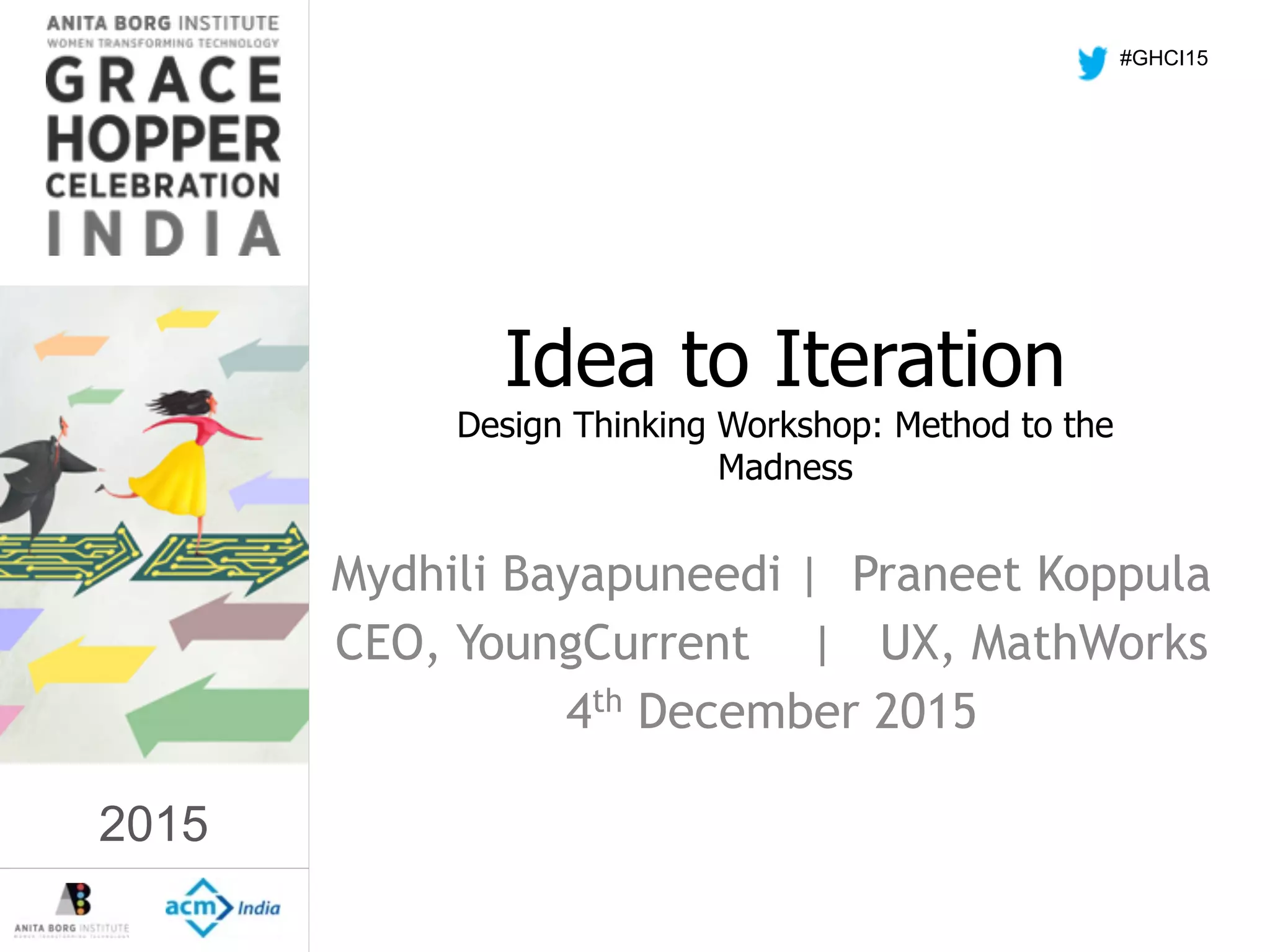
Idea to Iteration

Design Thinking Workshop: Method to the
Madness
Mydhili Bayapuneedi | Praneet Koppula
CEO, YoungCurrent | UX, MathWorks
4th December 2015
#GHCI15
2015
2015
About Us
Mydhili B
@myd
EdTech, Startups,
Design, Product
Previously
Google, YouTube, Harvard, MIT,
Microsoft Research, Startups…
Praneet K
@mphaxise
UX, Product,
Enterprise, Customer
Experience
Previously
HFI, GrameenPhone, Samsung,
Stanford, Startups…
2015
Purpose
Empower you with the 5 step Design
Thinking process in order to create
meaningful products/services for your users.
2015
Expectations
▪ What are somethings that you expect
from this workshop?
2015
Take Aways
▪ Human-Centered Design: Establishing User Empathy
▪ Prototyping: Enlightened trial-and-error as a companion to
intelligent planning
▪ Radical Collaboration: Project teams, Management and
Customers
▪ Integrated Solutions: Technology, Business and Human Values
▪ Process Mindfulness: A reliable sequence of creative tools
2015
Agenda
▪ Design Thinking Workshop
▪ Feedback + Reflections
▪ Wrap Up
2015
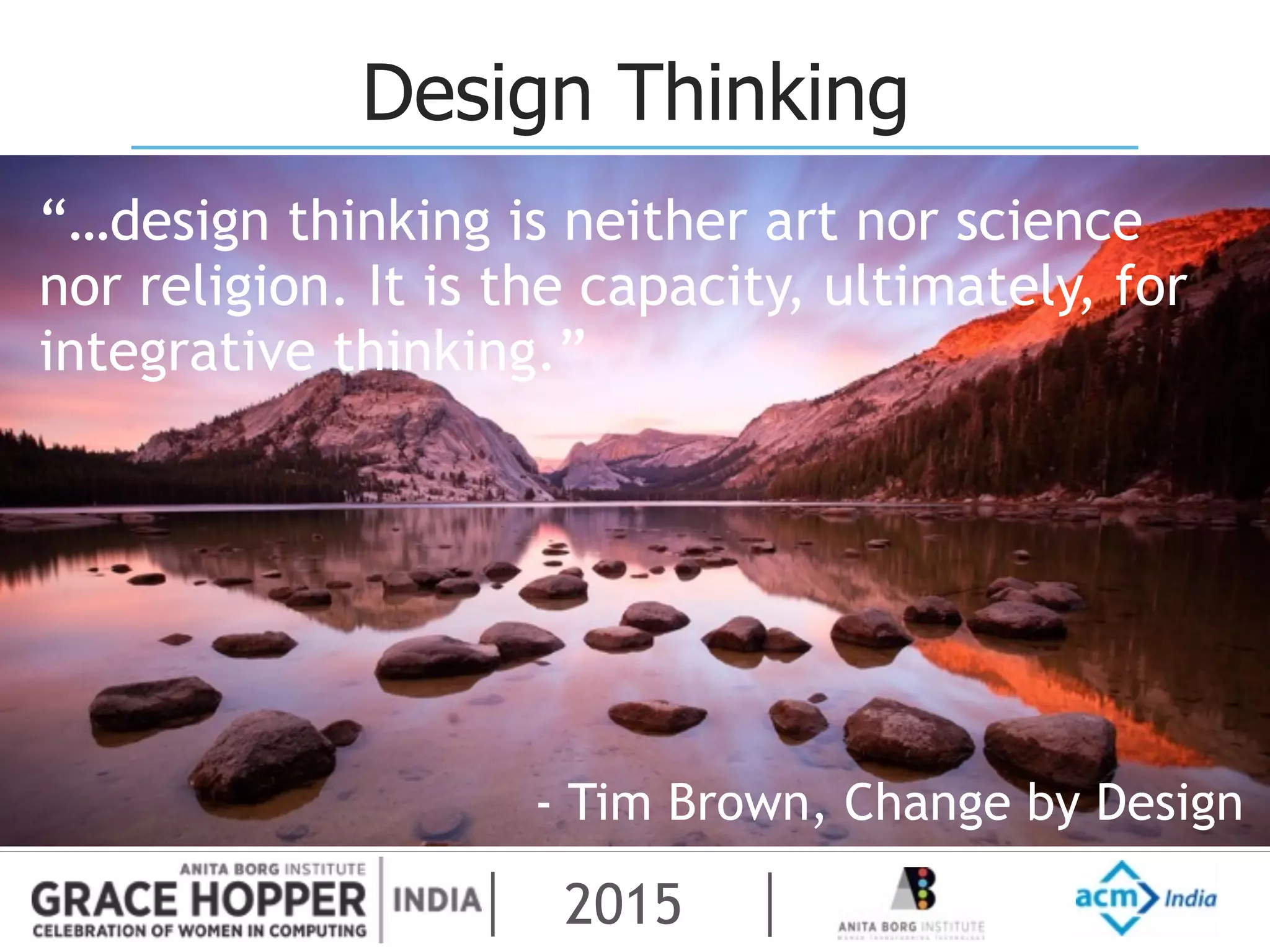
Design Thinking
“…design thinking is neither art nor science
nor religion. It is the capacity, ultimately, for
integrative thinking.”
- Tim Brown, Change by Design
2015
2015
Teams for the Workshop
▪ Find a complete stranger in the room. You
are both now a Pair for the rest of the
workshop.
▪ Amongst yourselves decide who will be
‘the User’ for the rest of the workshop.
2015
Teams for the Workshop
▪ Try to find team of 2 people who you are
both fairly unfamiliar with. The four of
you are now a group for the rest of the
workshop.
▪ The user from each group will be
interviewed
2015
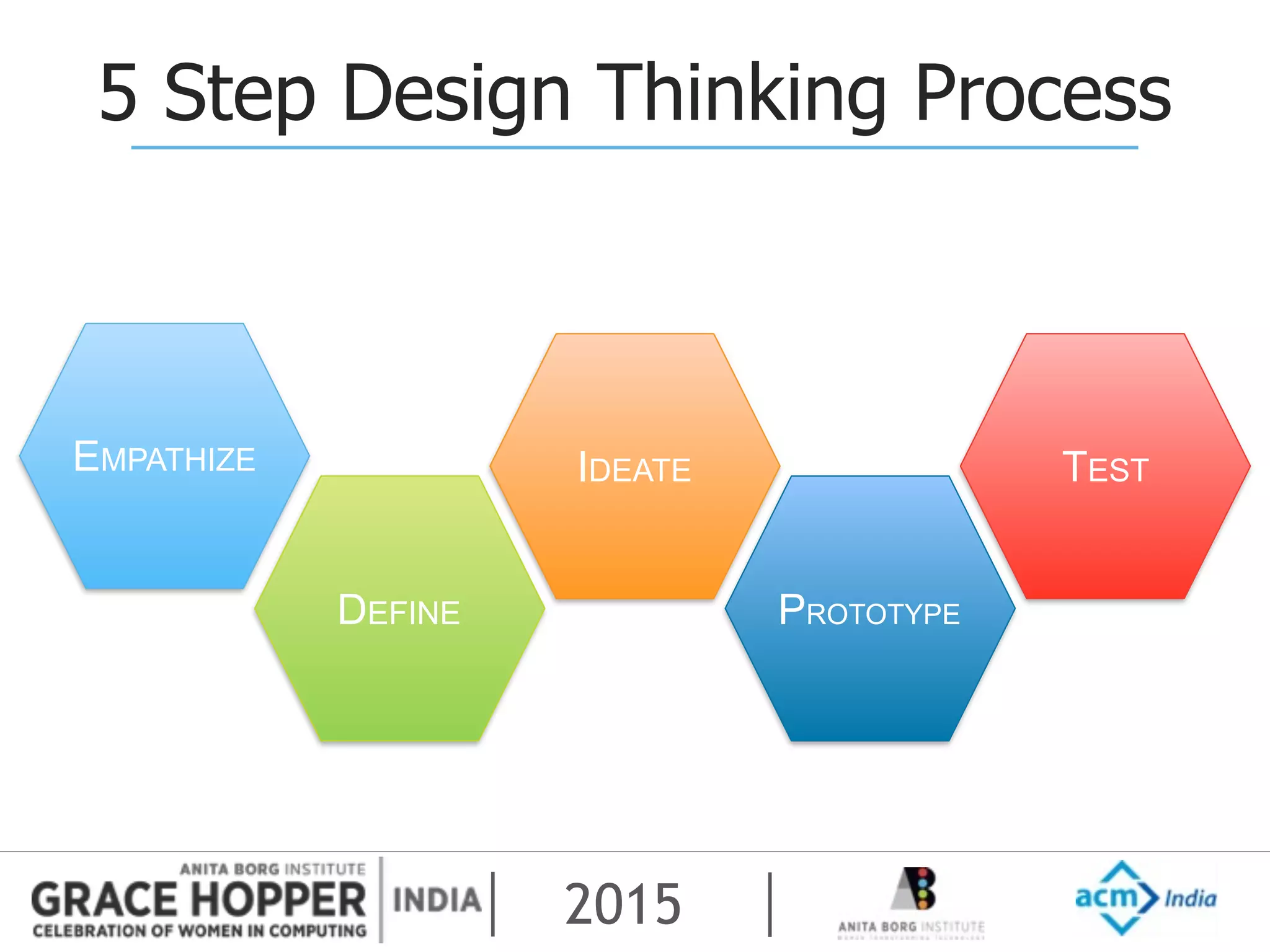
5 Step Design Thinking Process
EMPATHIZE
DEFINE
IDEATE
PROTOTYPE
TEST
2015
Empathize
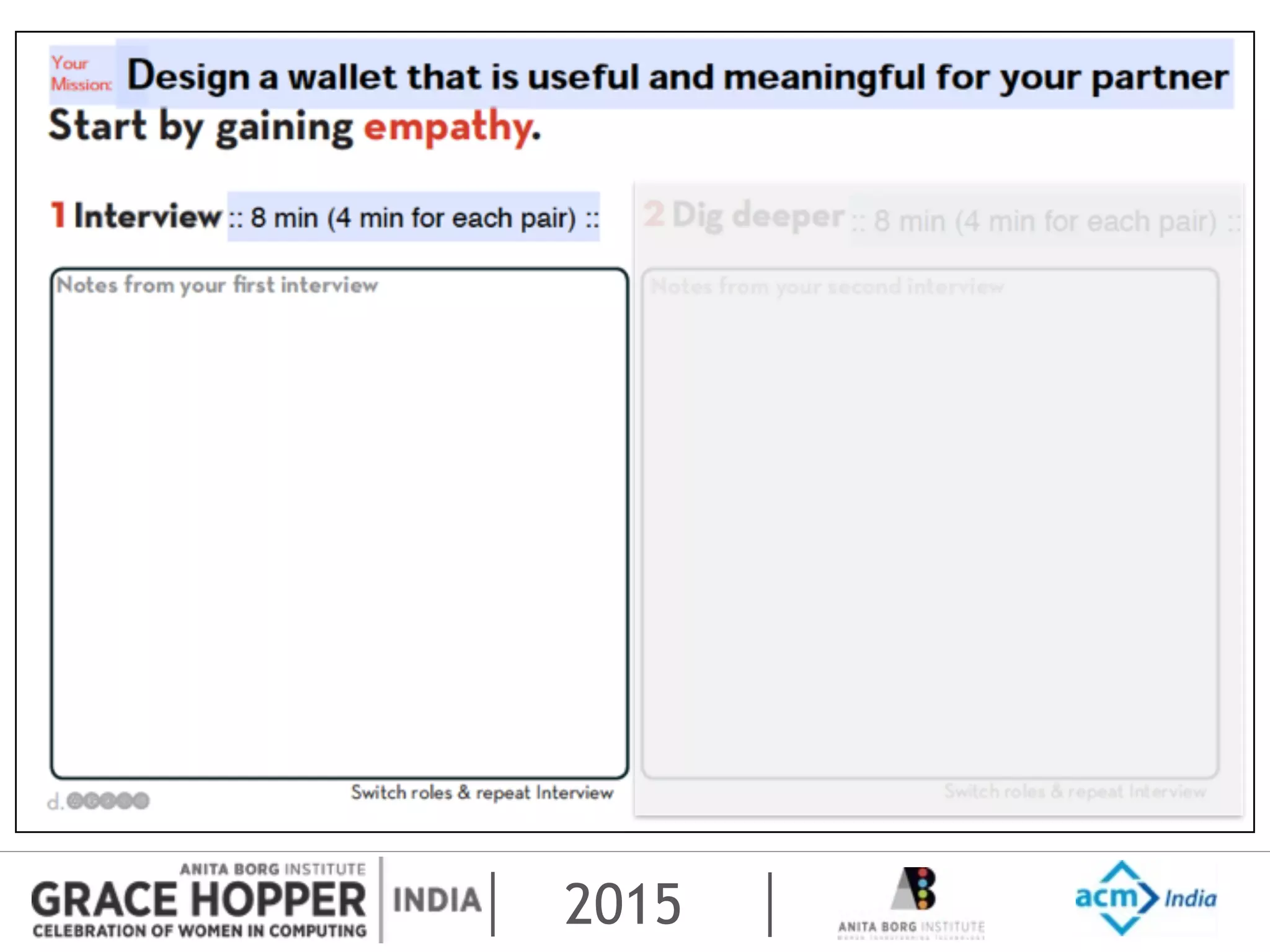
Interview:
▪ Keep your questions Open Ended
▪ To understand habits, avoid ‘on average’ or ‘usually’. Choose ‘Tell me
about the the last time….’
▪ Encourage stories
▪ Don’t fill the pauses with suggesting answers to their questions.
▪ Don’t ask leading questions.
Take a minute and think as a pair about the questions you
want to ask your user.
2015
2015
Empathize
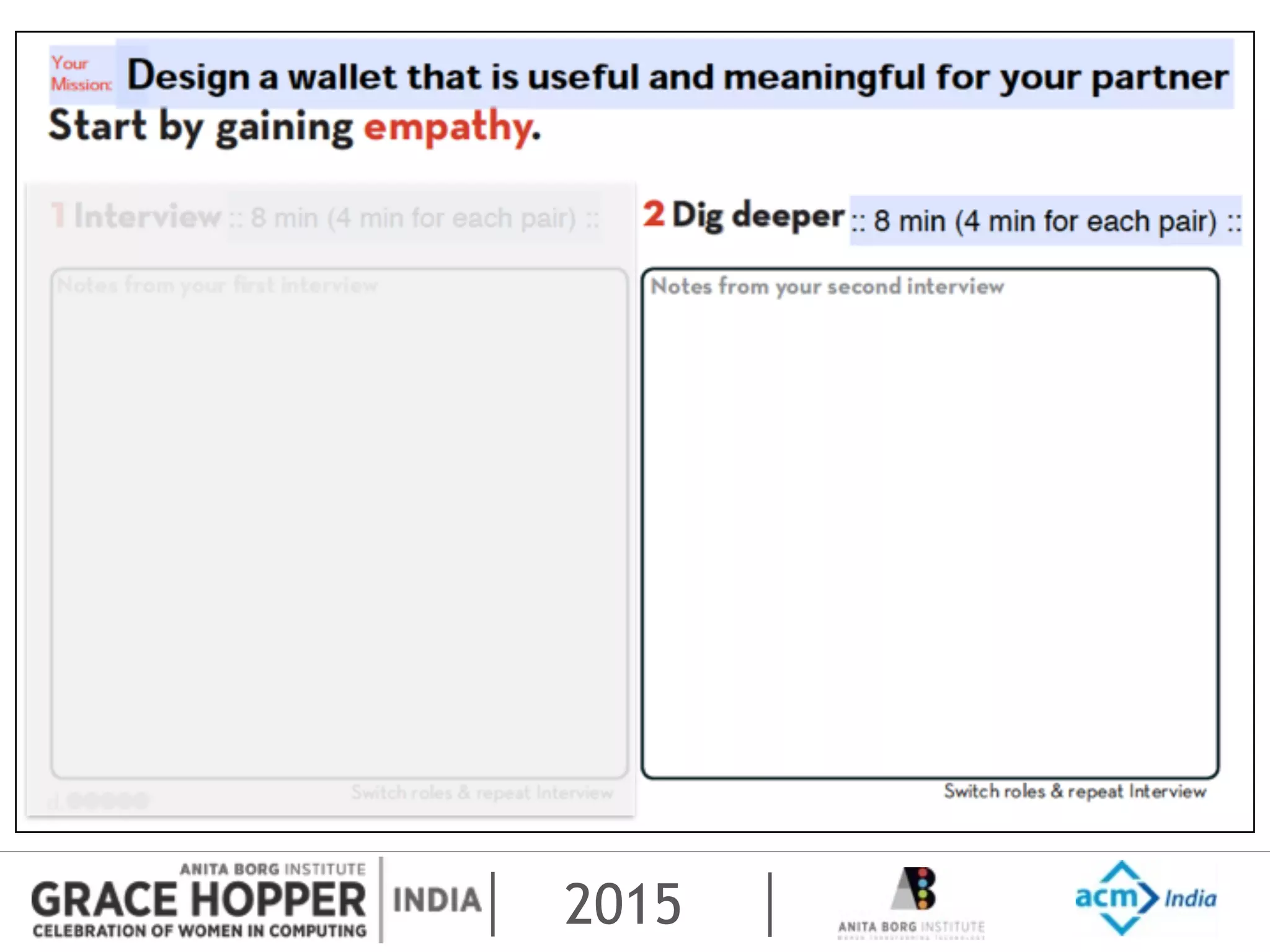
Dig Deeper
▪ Probe by asking a ’why’ question.
▪ For a few minutes forget about the wallet, find out more about your user.
2015
2015
Define
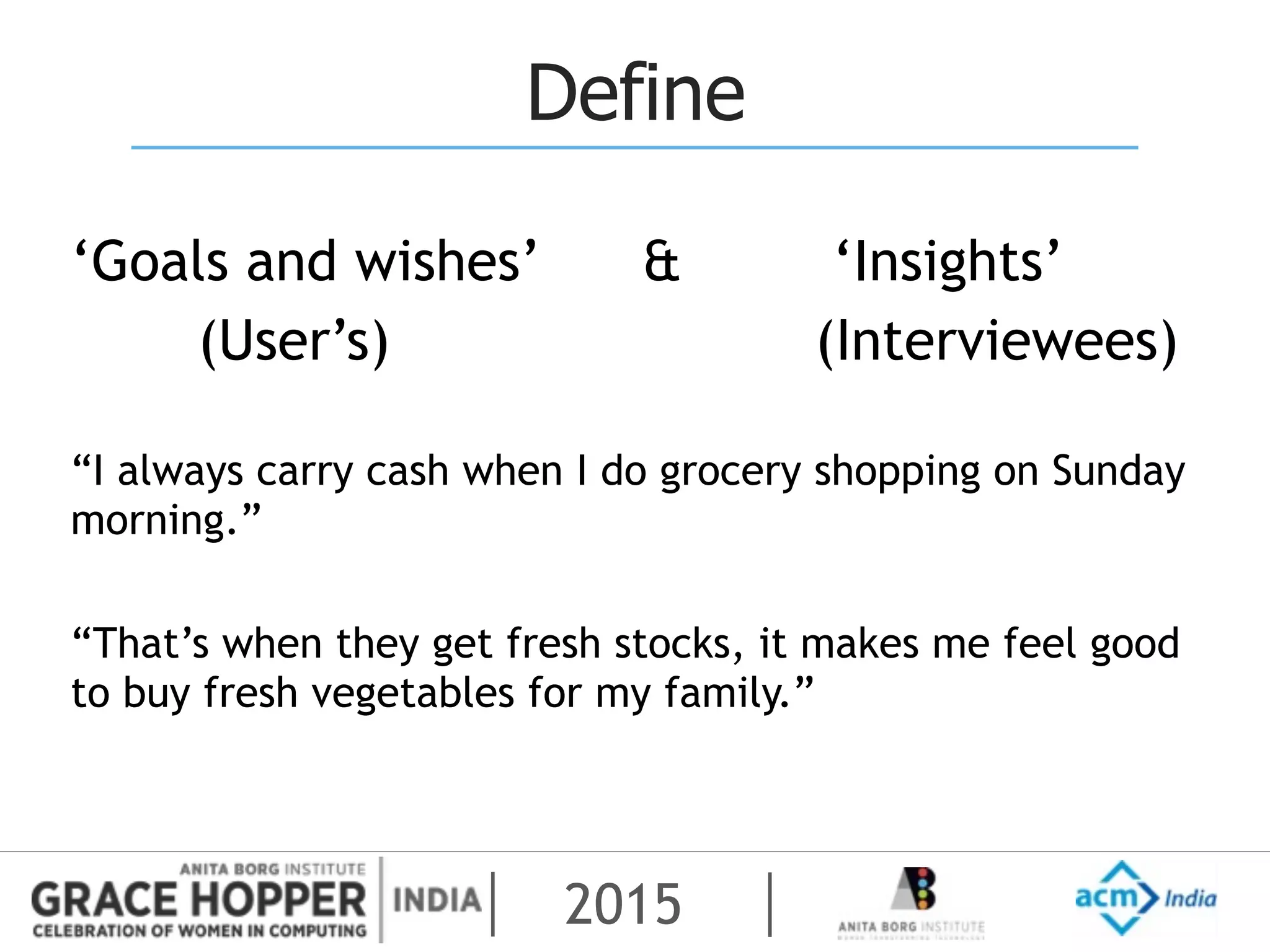
‘Goals and wishes’ & ‘Insights’
(User’s) (Interviewees)
“I always carry cash when I do grocery shopping on Sunday
morning.”
“That’s when they get fresh stocks, it makes me feel good
to buy fresh vegetables for my family.”
2015
2015
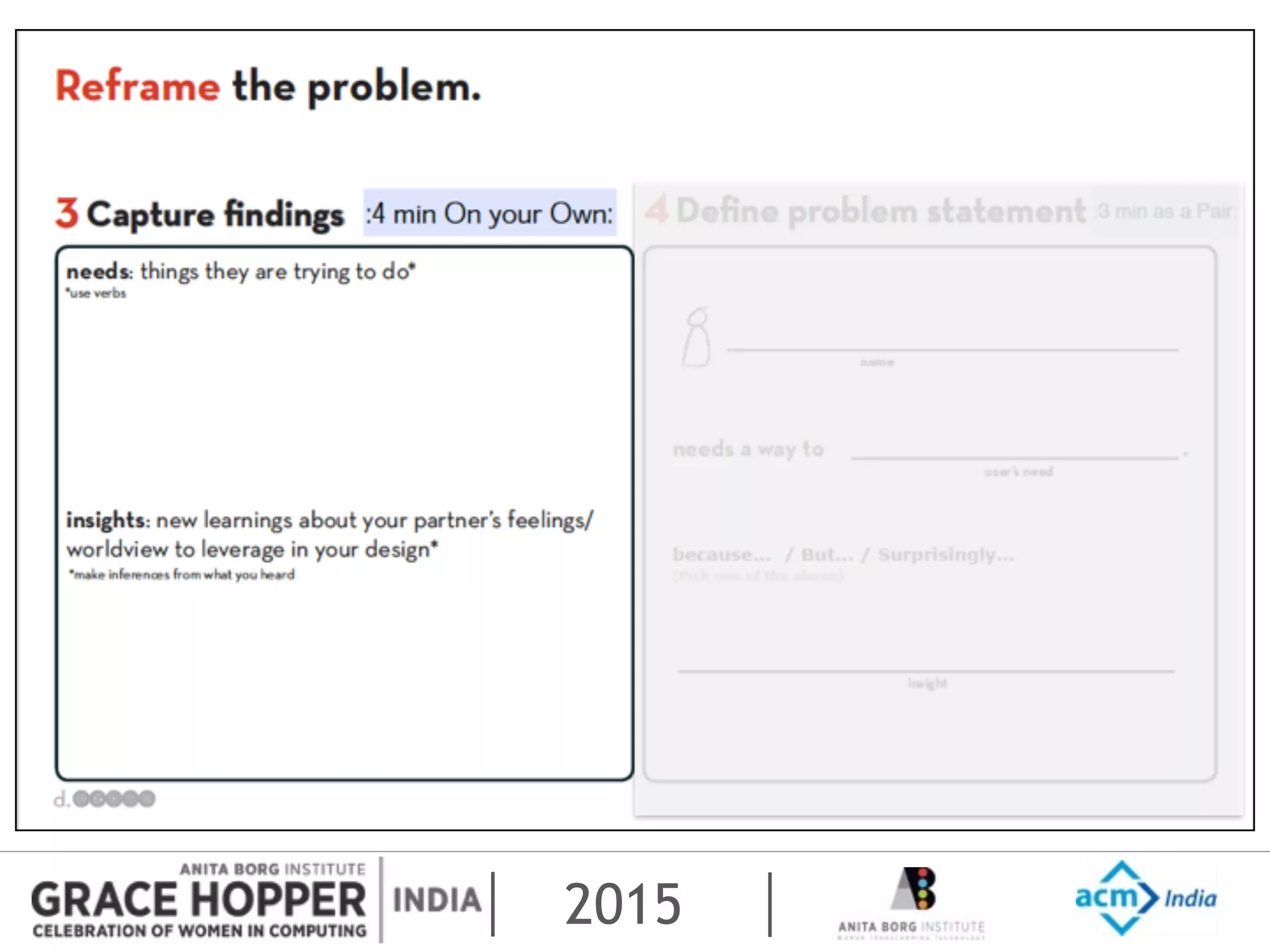
Define
“Point of View” [problem statement, sort of- not really.]
▪ YOUR point of view of what your user needs.
▪ Be aware of the contradictions, surprises, tensions.
2015
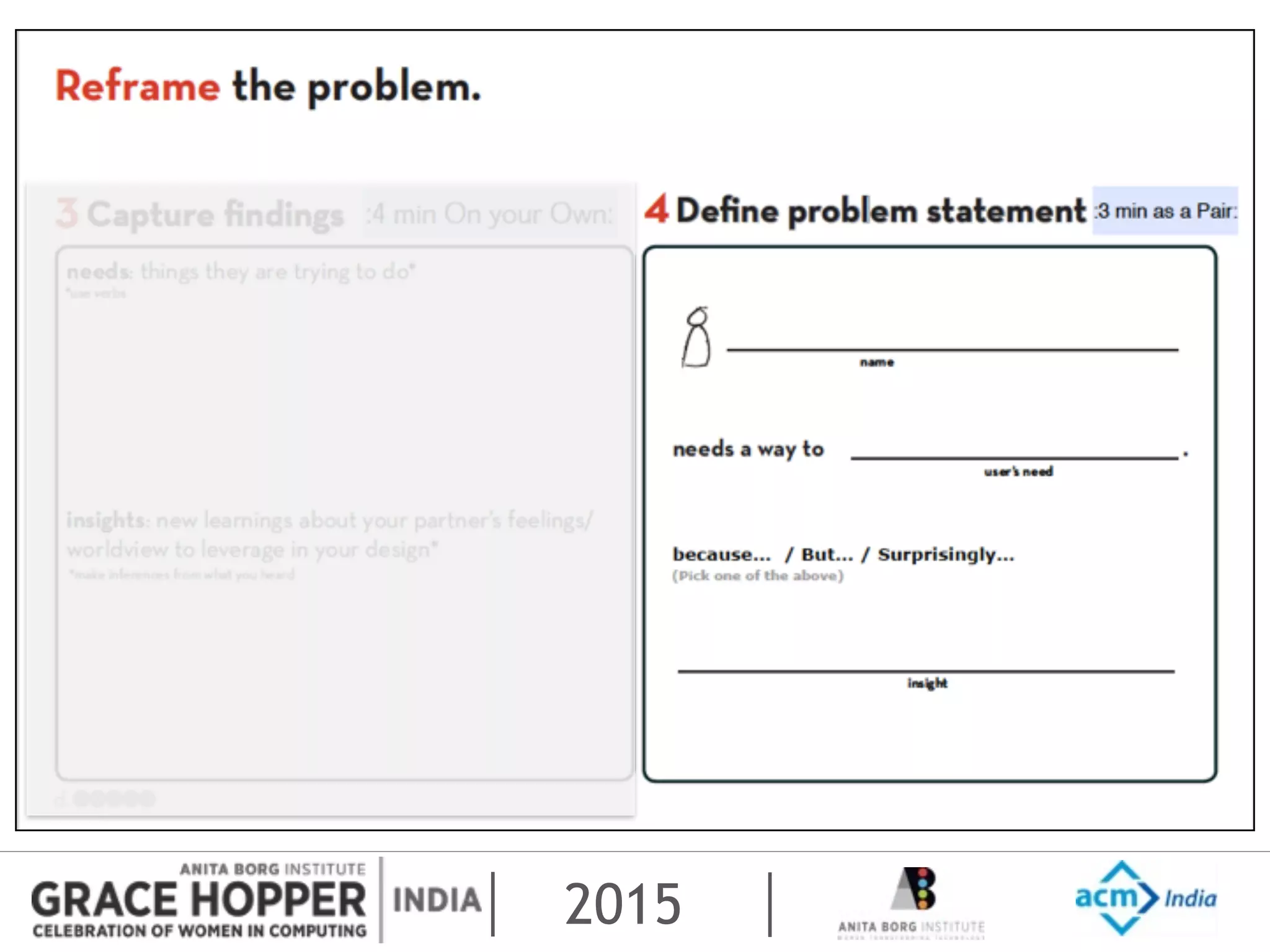
Define
“Point of View” [problem statement, sort of- not really.]
▪ YOUR point of view of what your user needs.
▪ Be aware of the contradictions, surprises, tensions.
Praneet
needs
a way to easily know how much cash is left in his wallet
because
he shops in crowded marketplaces.
2015
2015
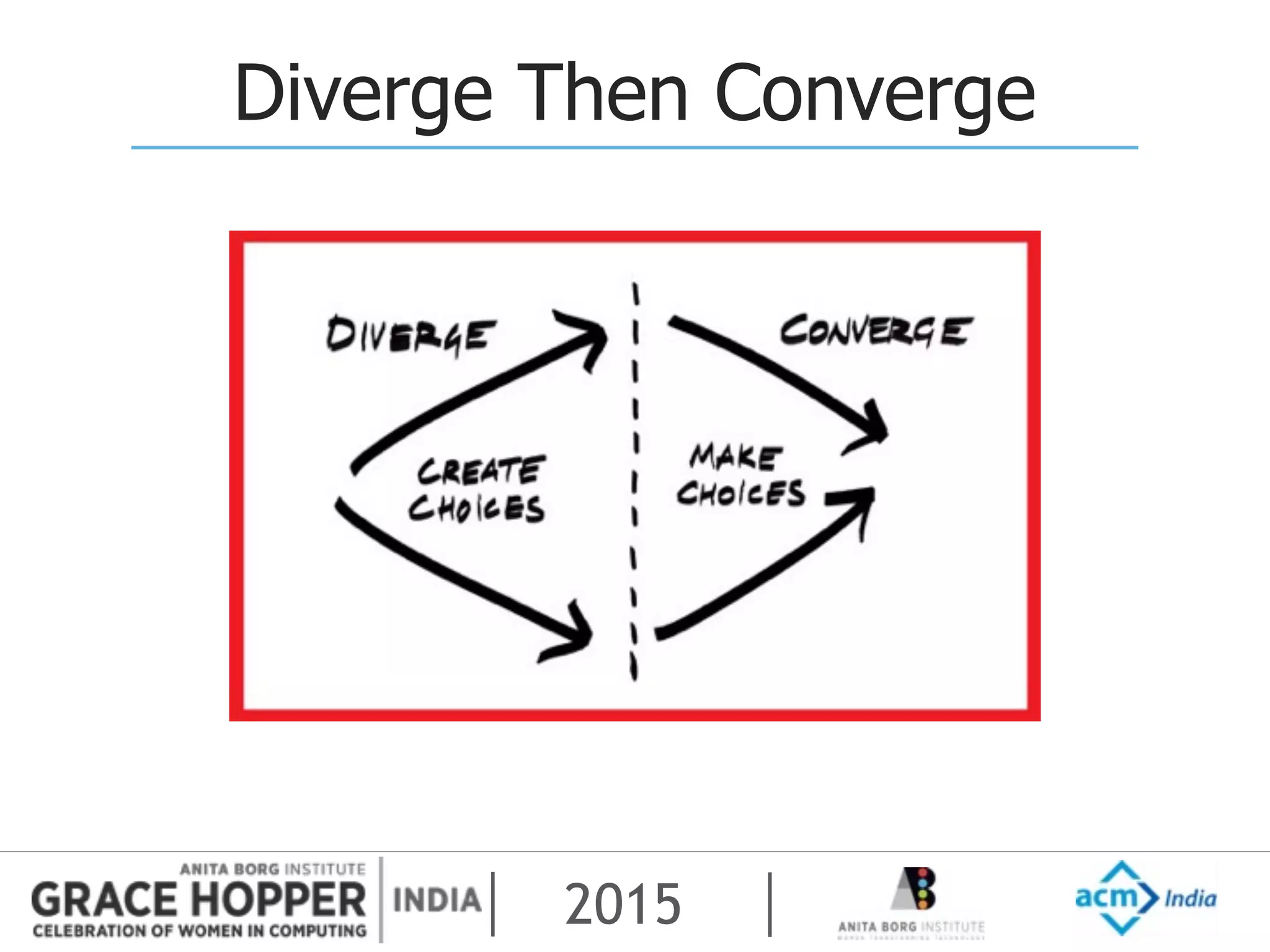
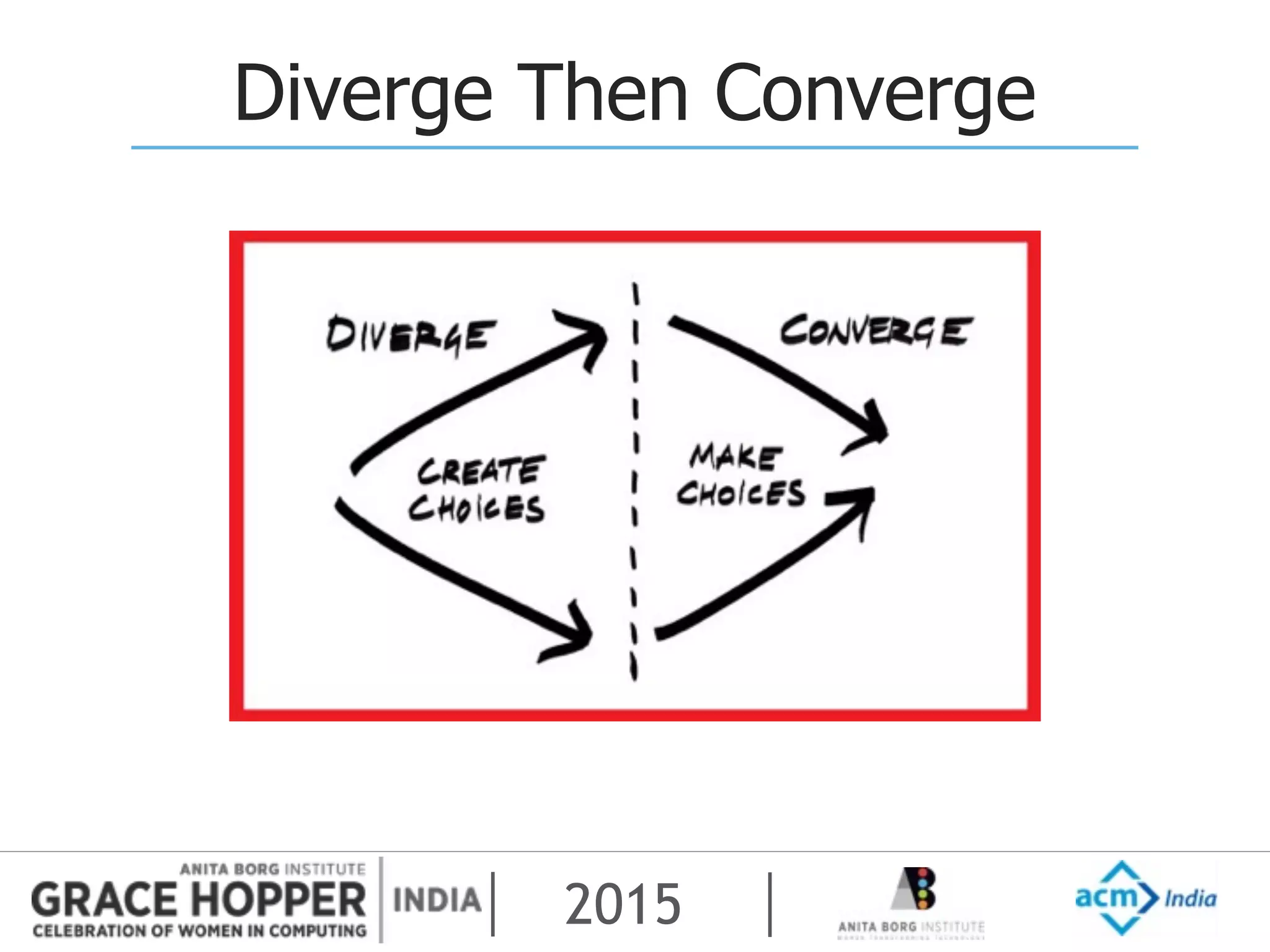
Diverge Then Converge
2015
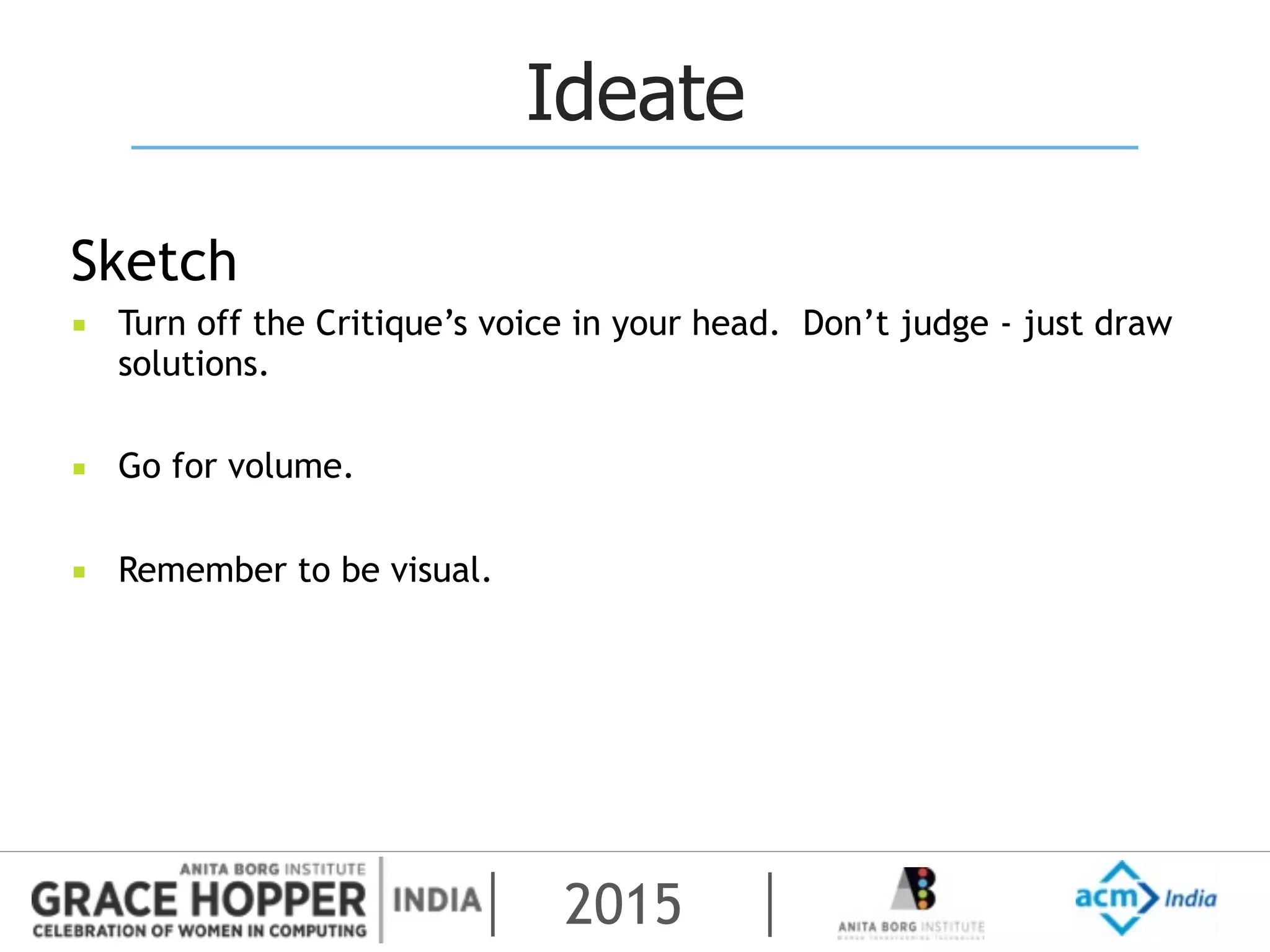
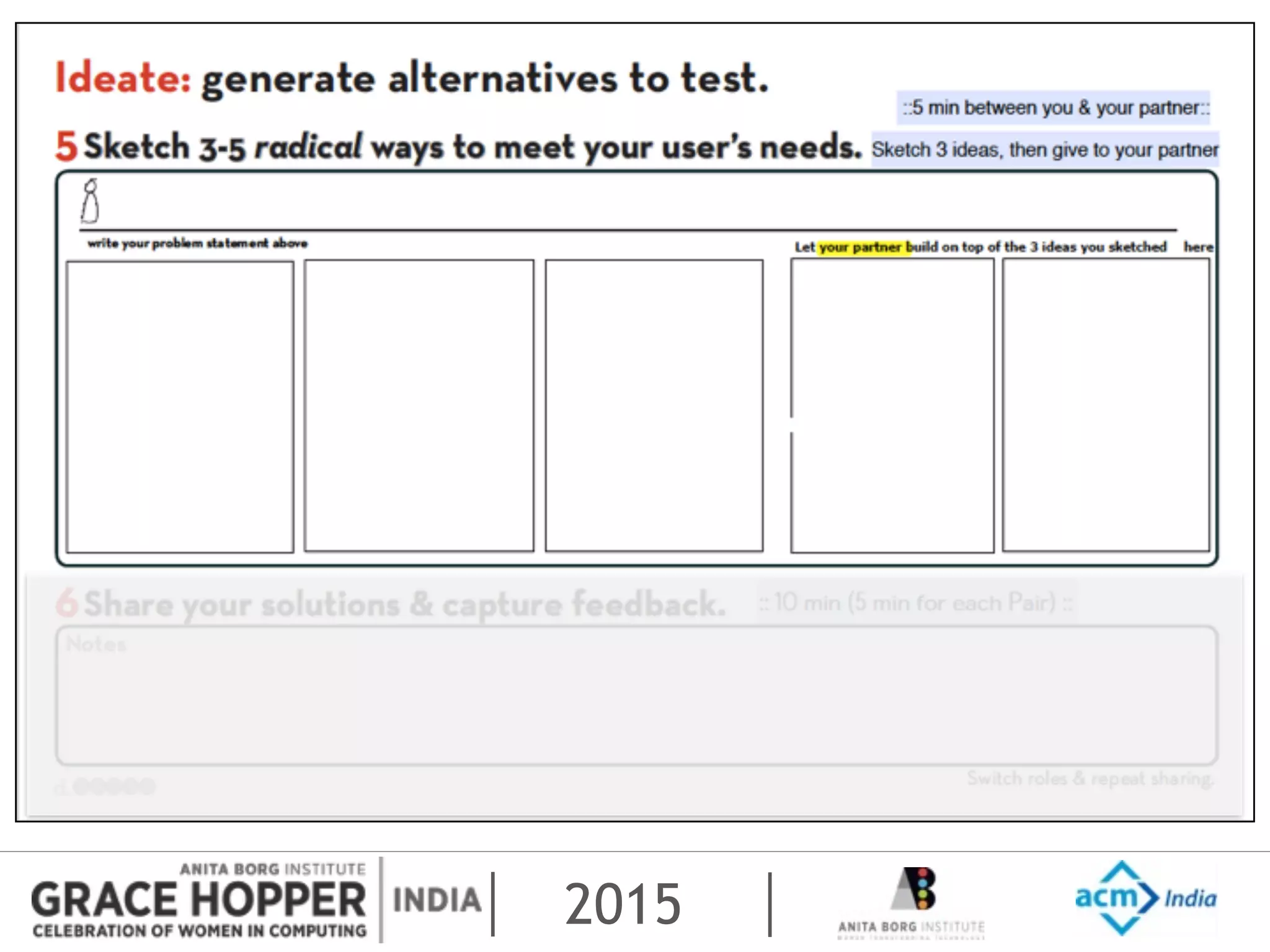
Ideate
Sketch
▪ Turn off the Critique’s voice in your head. Don’t judge - just draw
solutions.
▪ Go for volume.
▪ Remember to be visual.
2015
2015
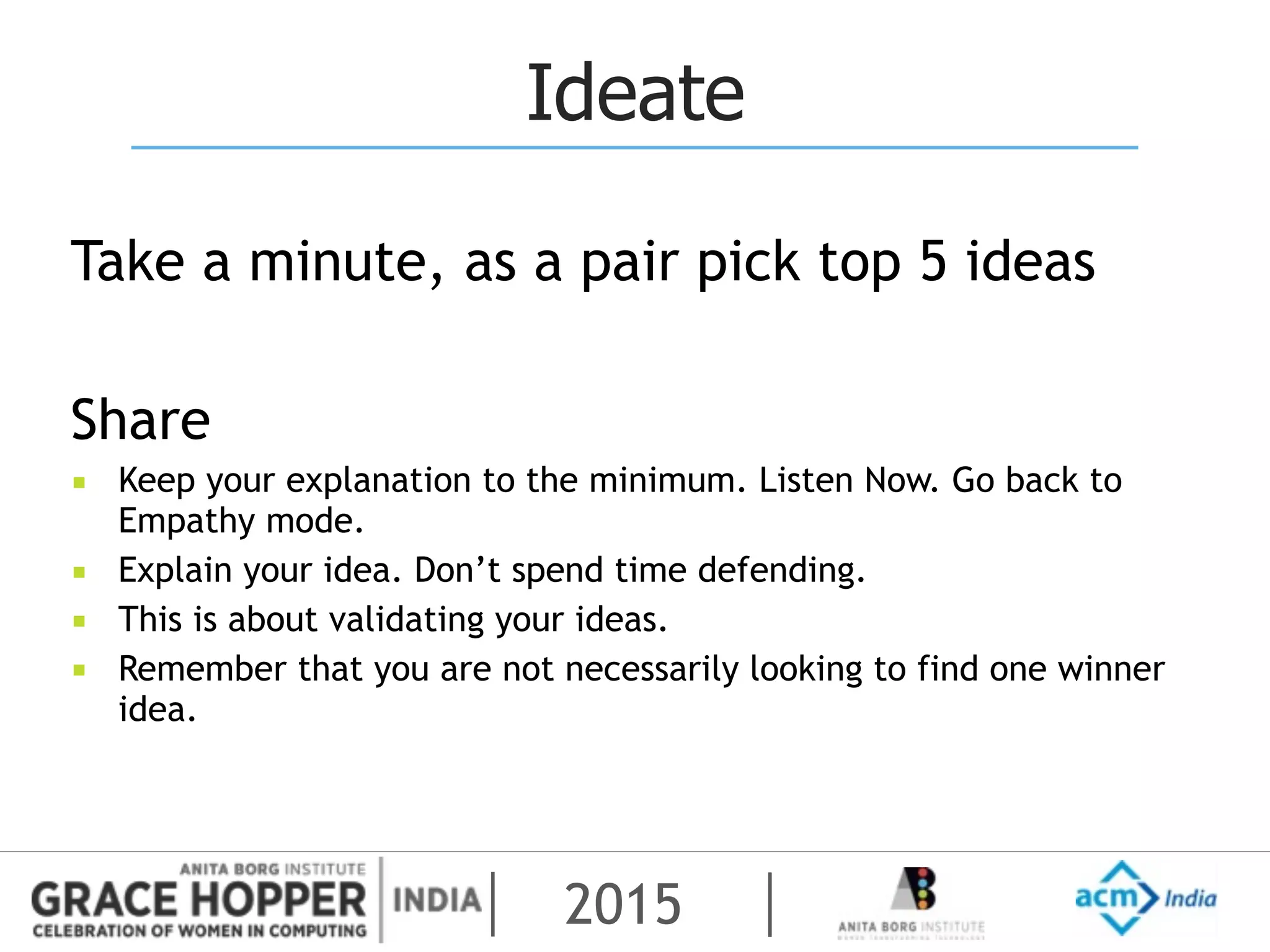
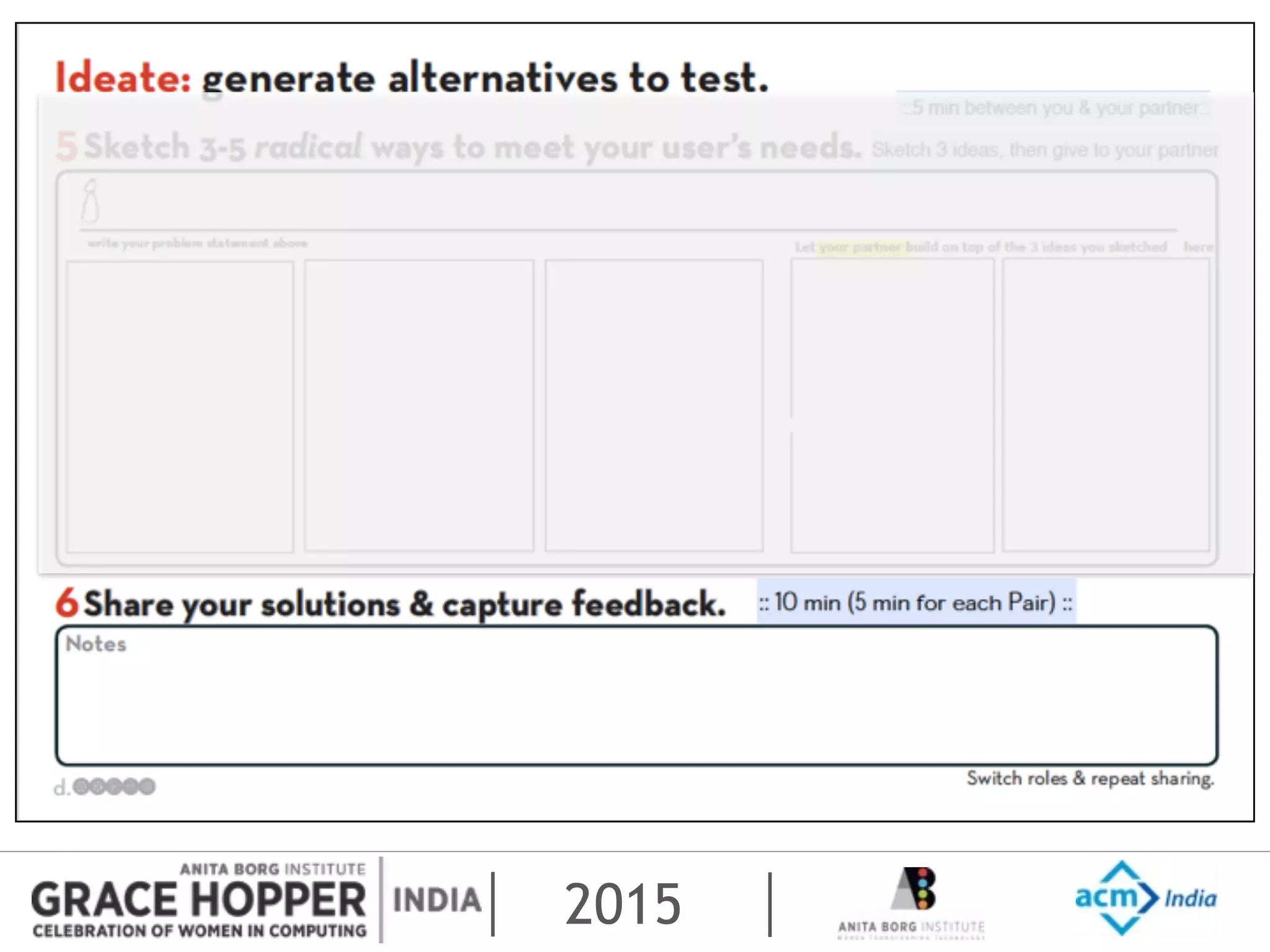
Ideate
Take a minute, as a pair pick top 5 ideas
Share
▪ Keep your explanation to the minimum. Listen Now. Go back to
Empathy mode.
▪ Explain your idea. Don’t spend time defending.
▪ This is about validating your ideas.
▪ Remember that you are not necessarily looking to find one winner
idea.
2015
2015
Diverge Then Converge
2015
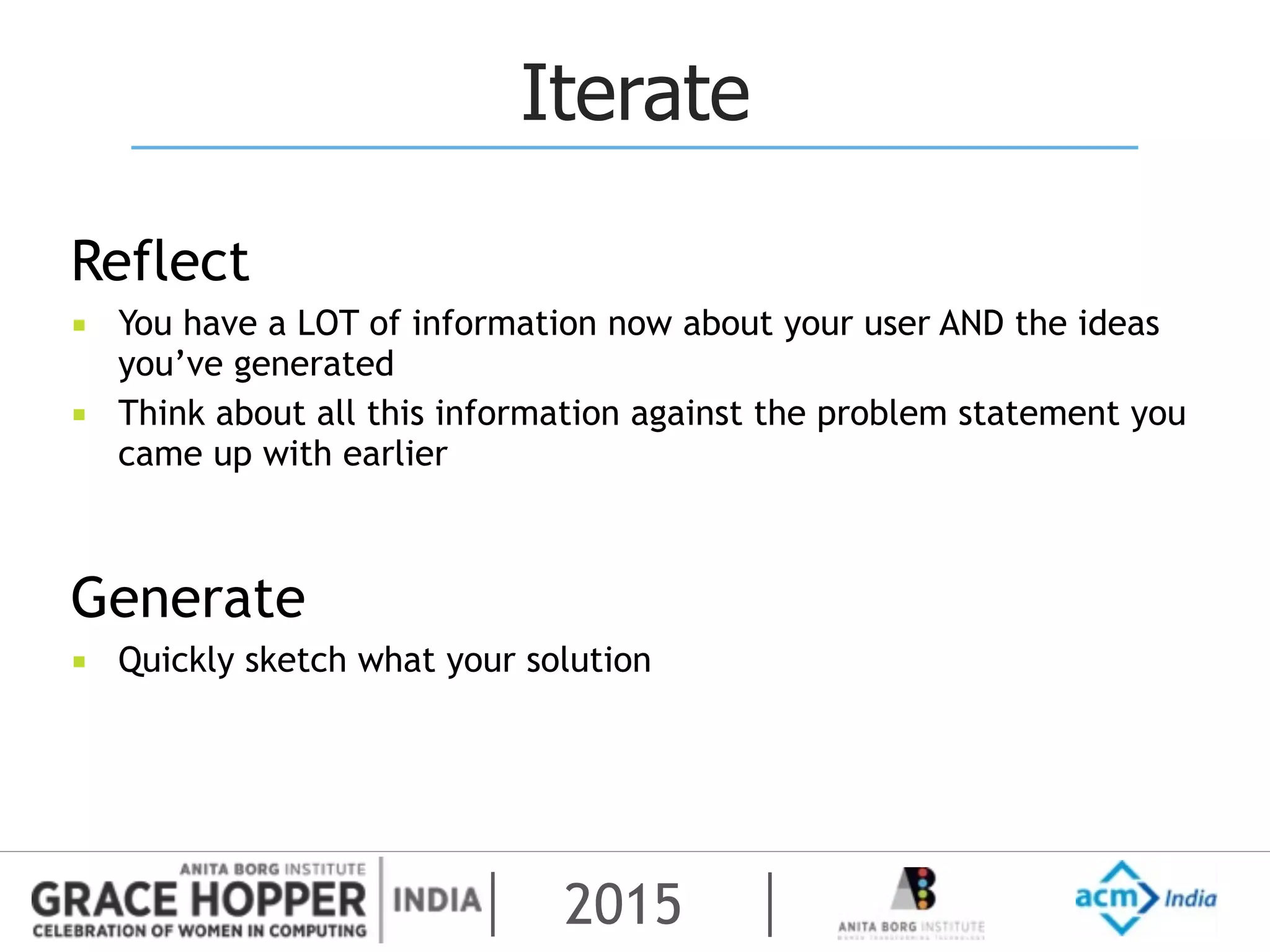
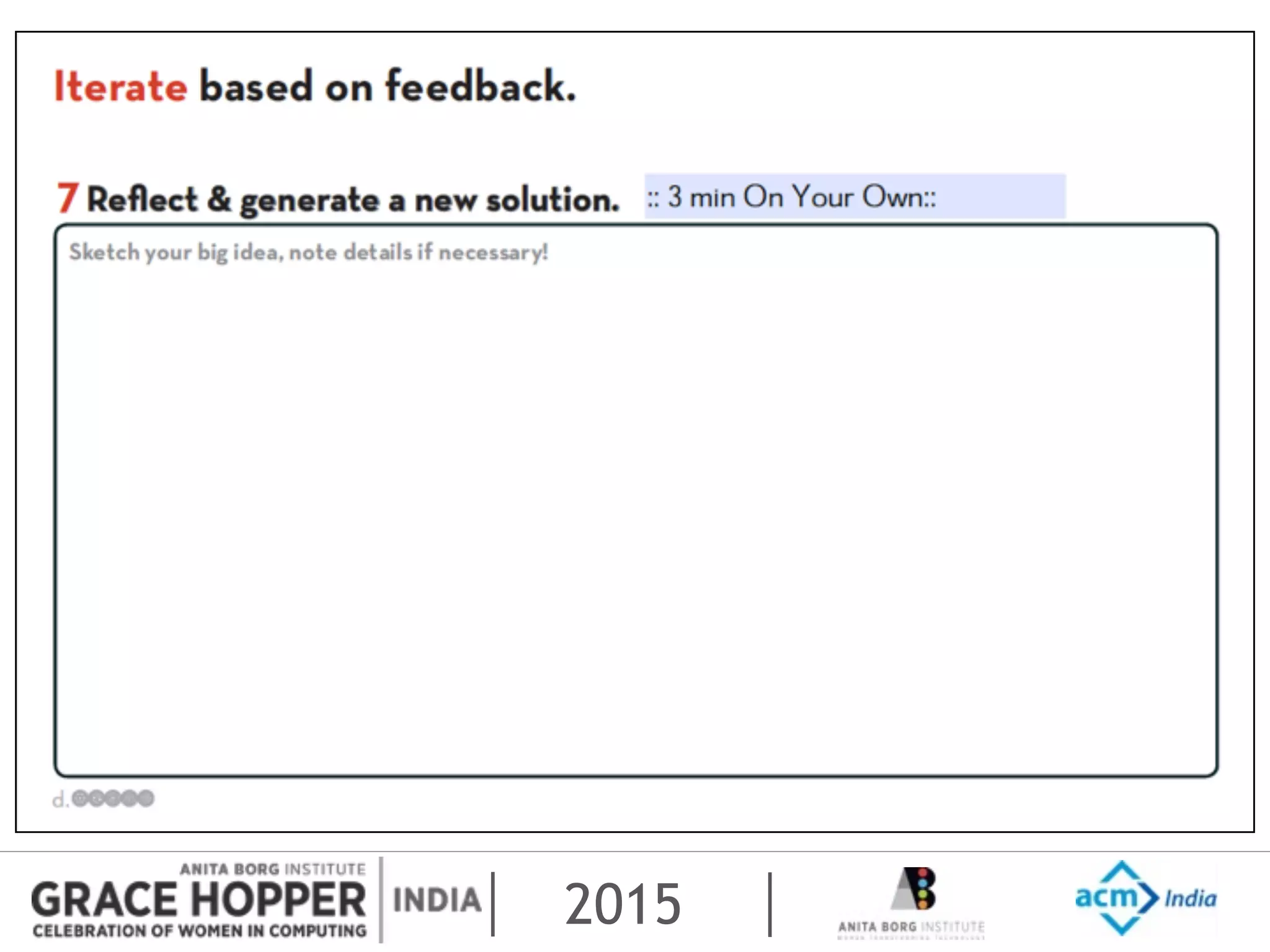
Iterate
Reflect
▪ You have a LOT of information now about your user AND the ideas
you’ve generated
▪ Think about all this information against the problem statement you
came up with earlier
Generate
▪ Quickly sketch what your solution
2015
2015
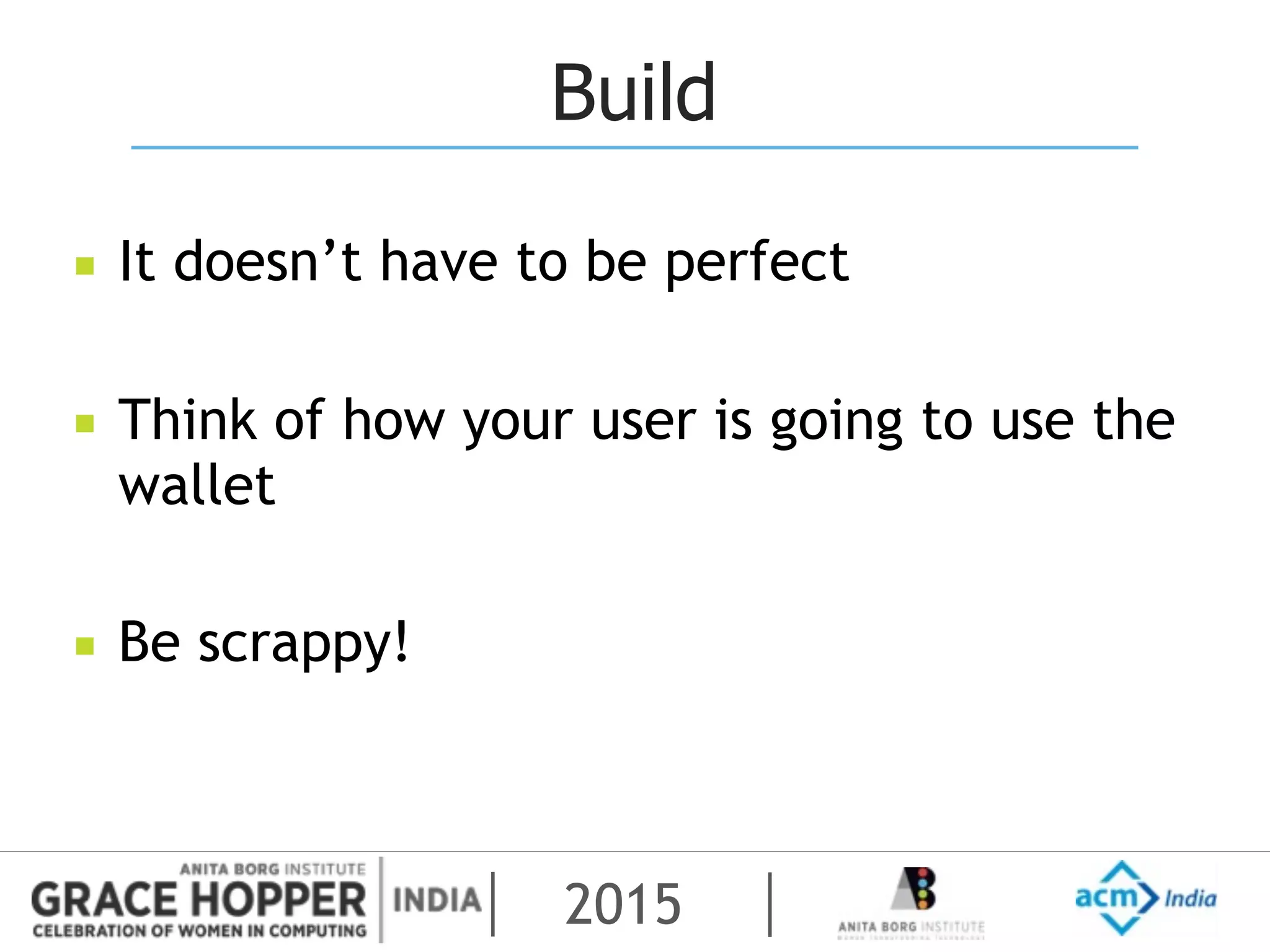
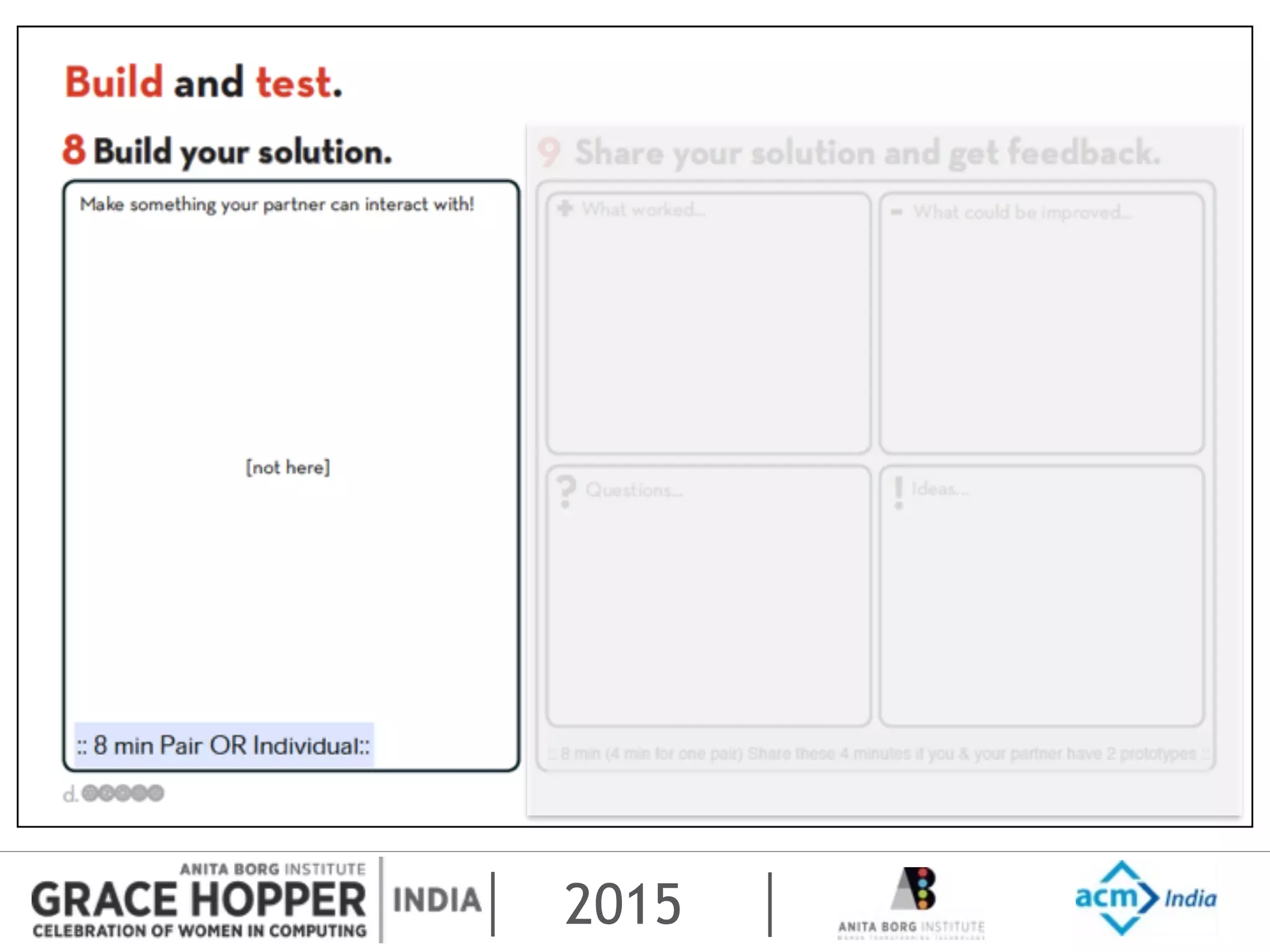
Build
▪ It doesn’t have to be perfect
▪ Think of how your user is going to use the
wallet
▪ Be scrappy!
2015
2015
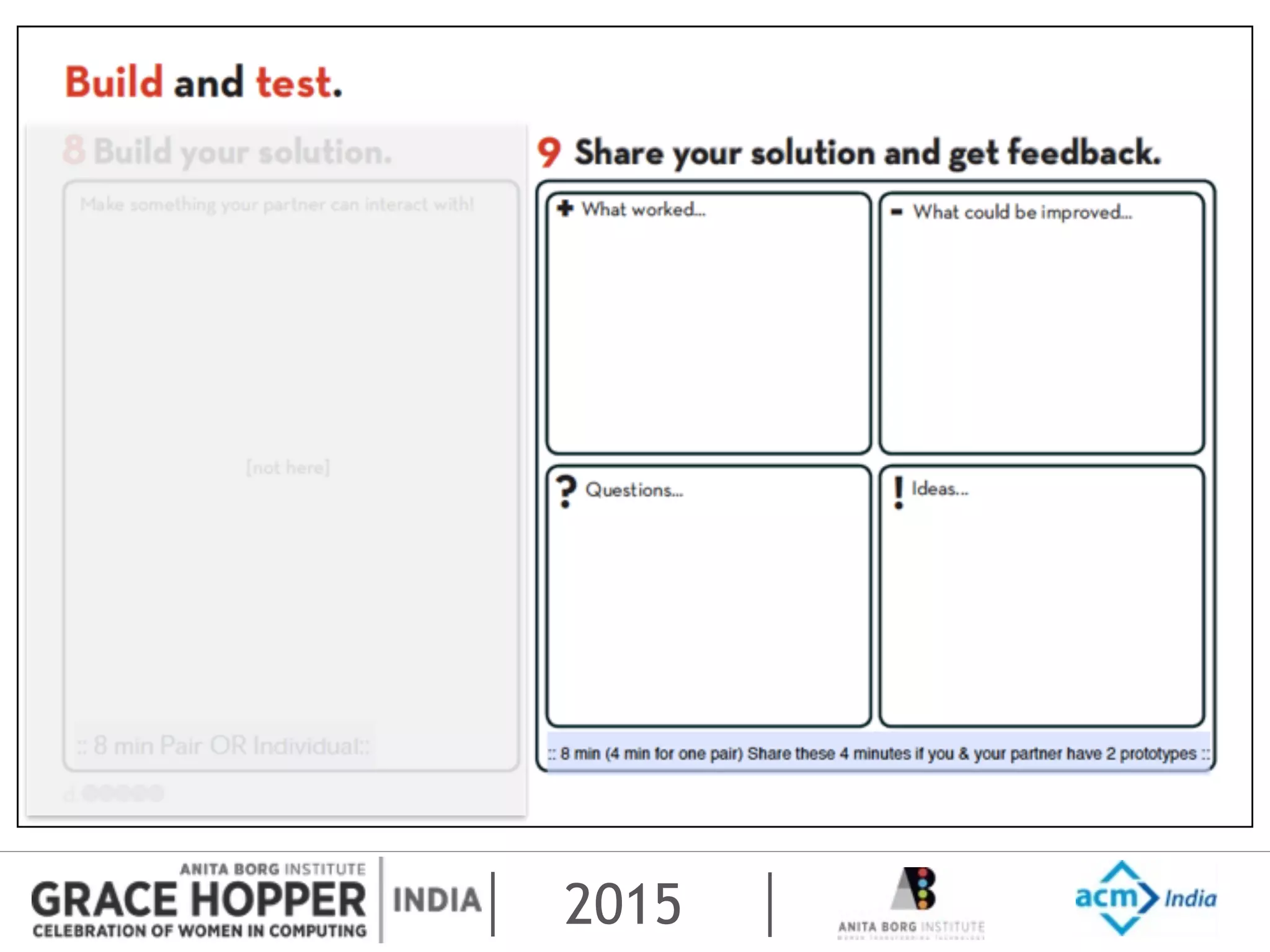
Testing & Getting Feedback
▪ Let Go!
▪ Your Prototype is not important. The feedback is.
▪ Observe for a bit how the user uses OR misuses it.
▪ Make notes on how your user interacts and their
reactions.
▪ Now, ask them what worked and what didn’t.
2015
2015
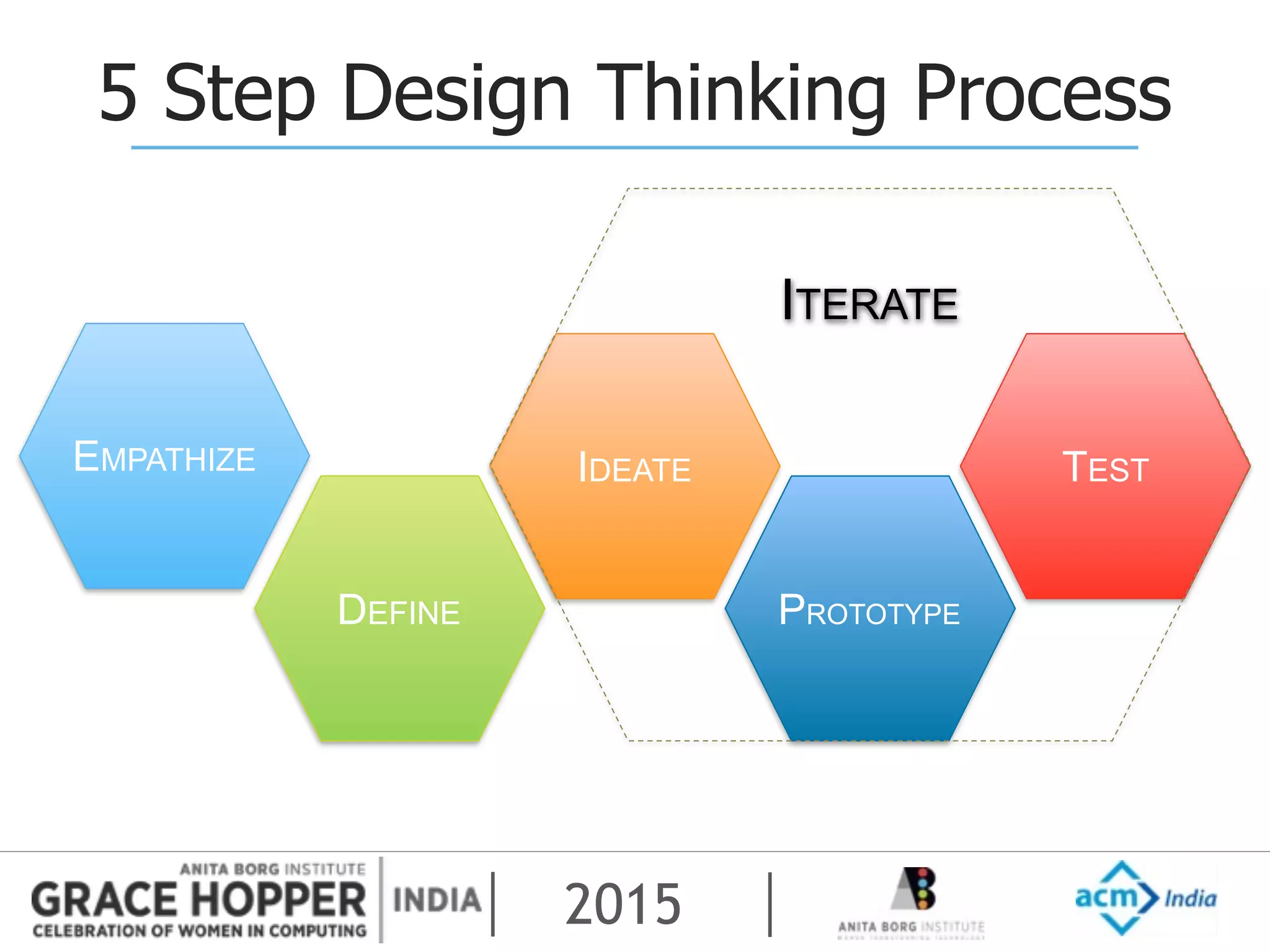
5 Step Design Thinking Process
EMPATHIZE
DEFINE
IDEATE
PROTOTYPE
TEST
ITERATE
2015
Reflections
Did you as a user find a great
wallet designed for you?
Design Thinking Process:
▪ Plus
▪ Delta
▪ Puzzle
2015
Got Feedback?
Rate and review the session on our mobile app – Convene
For all details visit: http://ghcindia.anitaborg.org

GHCI '15 Idea to Iteration: Method to the Madness - Design Thinking Workshop

  • 1.
    2015 Idea to Iteration
 DesignThinking Workshop: Method to the Madness Mydhili Bayapuneedi | Praneet Koppula CEO, YoungCurrent | UX, MathWorks 4th December 2015 #GHCI15 2015
  • 2.
    2015 About Us Mydhili B @myd EdTech,Startups, Design, Product Previously Google, YouTube, Harvard, MIT, Microsoft Research, Startups… Praneet K @mphaxise UX, Product, Enterprise, Customer Experience Previously HFI, GrameenPhone, Samsung, Stanford, Startups…
  • 3.
    2015 Purpose Empower you withthe 5 step Design Thinking process in order to create meaningful products/services for your users.
  • 4.
    2015 Expectations ▪ What aresomethings that you expect from this workshop?
  • 5.
    2015 Take Aways ▪ Human-CenteredDesign: Establishing User Empathy ▪ Prototyping: Enlightened trial-and-error as a companion to intelligent planning ▪ Radical Collaboration: Project teams, Management and Customers ▪ Integrated Solutions: Technology, Business and Human Values ▪ Process Mindfulness: A reliable sequence of creative tools
  • 6.
    2015 Agenda ▪ Design ThinkingWorkshop ▪ Feedback + Reflections ▪ Wrap Up
  • 7.
    2015 Design Thinking “…design thinkingis neither art nor science nor religion. It is the capacity, ultimately, for integrative thinking.” - Tim Brown, Change by Design
  • 8.
  • 9.
    2015 Teams for theWorkshop ▪ Find a complete stranger in the room. You are both now a Pair for the rest of the workshop. ▪ Amongst yourselves decide who will be ‘the User’ for the rest of the workshop.
  • 10.
    2015 Teams for theWorkshop ▪ Try to find team of 2 people who you are both fairly unfamiliar with. The four of you are now a group for the rest of the workshop. ▪ The user from each group will be interviewed
  • 11.
    2015 5 Step DesignThinking Process EMPATHIZE DEFINE IDEATE PROTOTYPE TEST
  • 12.
    2015 Empathize Interview: ▪ Keep yourquestions Open Ended ▪ To understand habits, avoid ‘on average’ or ‘usually’. Choose ‘Tell me about the the last time….’ ▪ Encourage stories ▪ Don’t fill the pauses with suggesting answers to their questions. ▪ Don’t ask leading questions. Take a minute and think as a pair about the questions you want to ask your user.
  • 13.
  • 14.
    2015 Empathize Dig Deeper ▪ Probeby asking a ’why’ question. ▪ For a few minutes forget about the wallet, find out more about your user.
  • 15.
  • 16.
    2015 Define ‘Goals and wishes’& ‘Insights’ (User’s) (Interviewees) “I always carry cash when I do grocery shopping on Sunday morning.” “That’s when they get fresh stocks, it makes me feel good to buy fresh vegetables for my family.”
  • 17.
  • 18.
    2015 Define “Point of View”[problem statement, sort of- not really.] ▪ YOUR point of view of what your user needs. ▪ Be aware of the contradictions, surprises, tensions.
  • 19.
    2015 Define “Point of View”[problem statement, sort of- not really.] ▪ YOUR point of view of what your user needs. ▪ Be aware of the contradictions, surprises, tensions. Praneet needs a way to easily know how much cash is left in his wallet because he shops in crowded marketplaces.
  • 20.
  • 21.
  • 22.
    2015 Ideate Sketch ▪ Turn offthe Critique’s voice in your head. Don’t judge - just draw solutions. ▪ Go for volume. ▪ Remember to be visual.
  • 23.
  • 24.
    2015 Ideate Take a minute,as a pair pick top 5 ideas Share ▪ Keep your explanation to the minimum. Listen Now. Go back to Empathy mode. ▪ Explain your idea. Don’t spend time defending. ▪ This is about validating your ideas. ▪ Remember that you are not necessarily looking to find one winner idea.
  • 25.
  • 26.
  • 27.
    2015 Iterate Reflect ▪ You havea LOT of information now about your user AND the ideas you’ve generated ▪ Think about all this information against the problem statement you came up with earlier Generate ▪ Quickly sketch what your solution
  • 28.
  • 29.
    2015 Build ▪ It doesn’thave to be perfect ▪ Think of how your user is going to use the wallet ▪ Be scrappy!
  • 30.
  • 31.
    2015 Testing & GettingFeedback ▪ Let Go! ▪ Your Prototype is not important. The feedback is. ▪ Observe for a bit how the user uses OR misuses it. ▪ Make notes on how your user interacts and their reactions. ▪ Now, ask them what worked and what didn’t.
  • 32.
  • 33.
    2015 5 Step DesignThinking Process EMPATHIZE DEFINE IDEATE PROTOTYPE TEST ITERATE
  • 34.
    2015 Reflections Did you asa user find a great wallet designed for you? Design Thinking Process: ▪ Plus ▪ Delta ▪ Puzzle
  • 35.
    2015 Got Feedback? Rate andreview the session on our mobile app – Convene For all details visit: http://ghcindia.anitaborg.org