i
Introduction to Empathy
and Design Research
Prepared for DT:DC Summer of Design, 2014
JULY 22. 2014
i
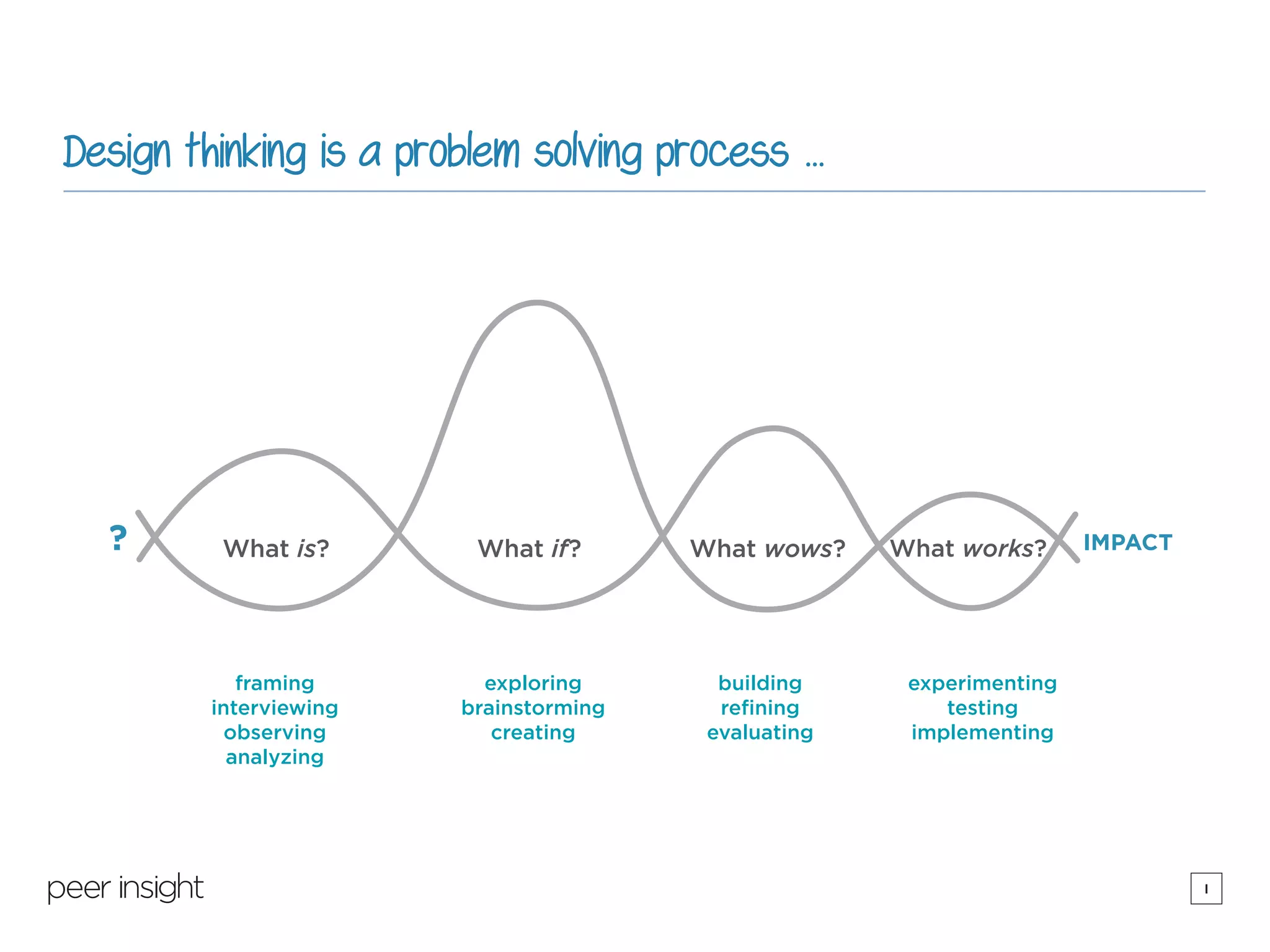
Design thinking is a problem solving process ...
What is? What if? What wows? What works?? $
EMPATHIZE
framing
interviewing
observing
analyzing
VISUALIZE
exploring
brainstorming
creating
CO-CREATE
building
refining
evaluating
ITERATE
experimenting
testing
implementing
IMPACTWhat is? What if? What wows? What works?? $
EMPATHIZE
framing
interviewing
observing
analyzing
VISUALIZE
exploring
brainstorming
creating
CO-CREATE
building
refining
evaluating
ITERATE
experimenting
testing
implementing
ii
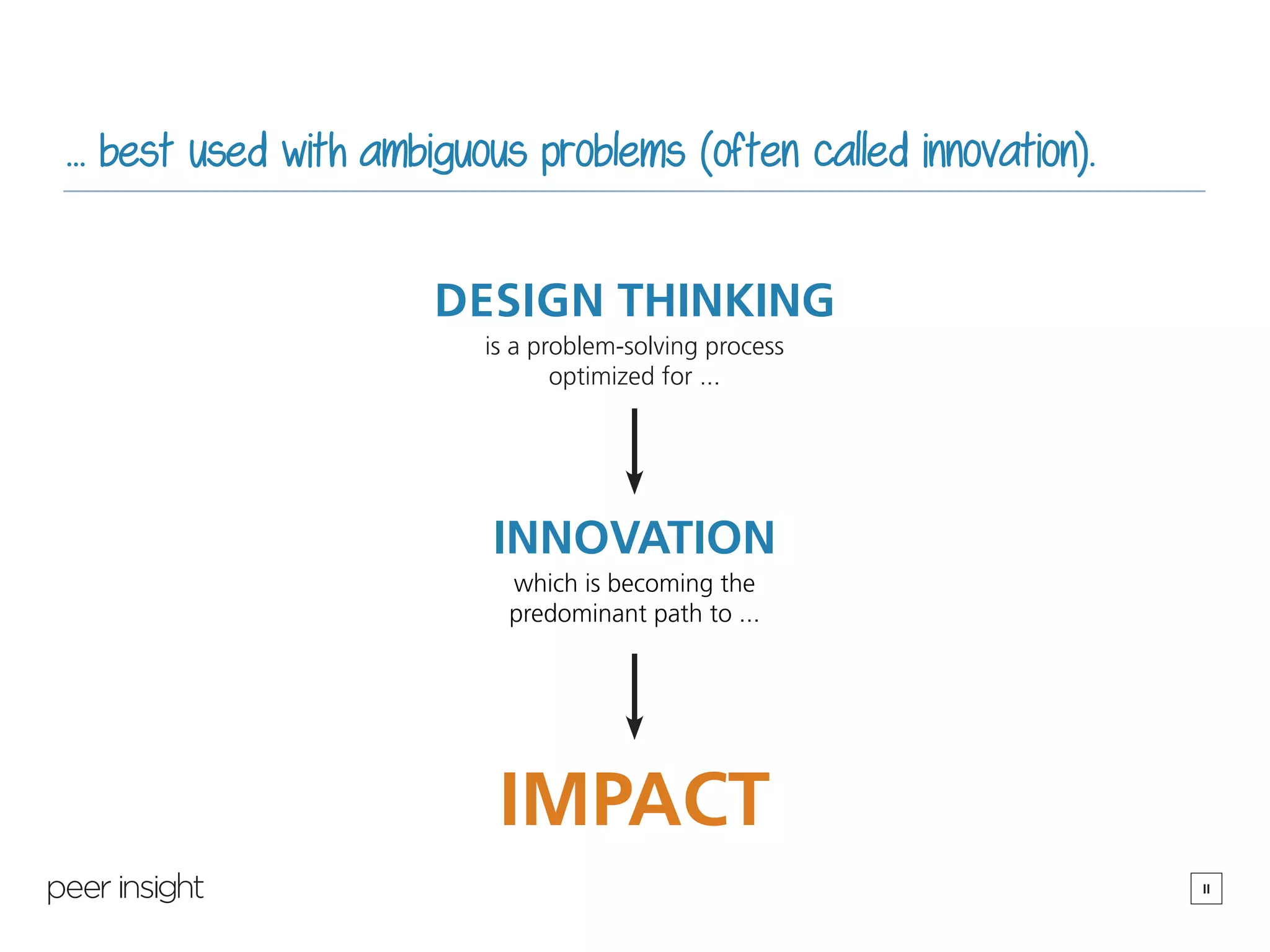
... best used with ambiguous problems (often called innovation).
DESIGN THINKING
is a problem-solving process
optimized for ...
INNOVATION
which is becoming the
predominant path to ...
IMPACT
iii
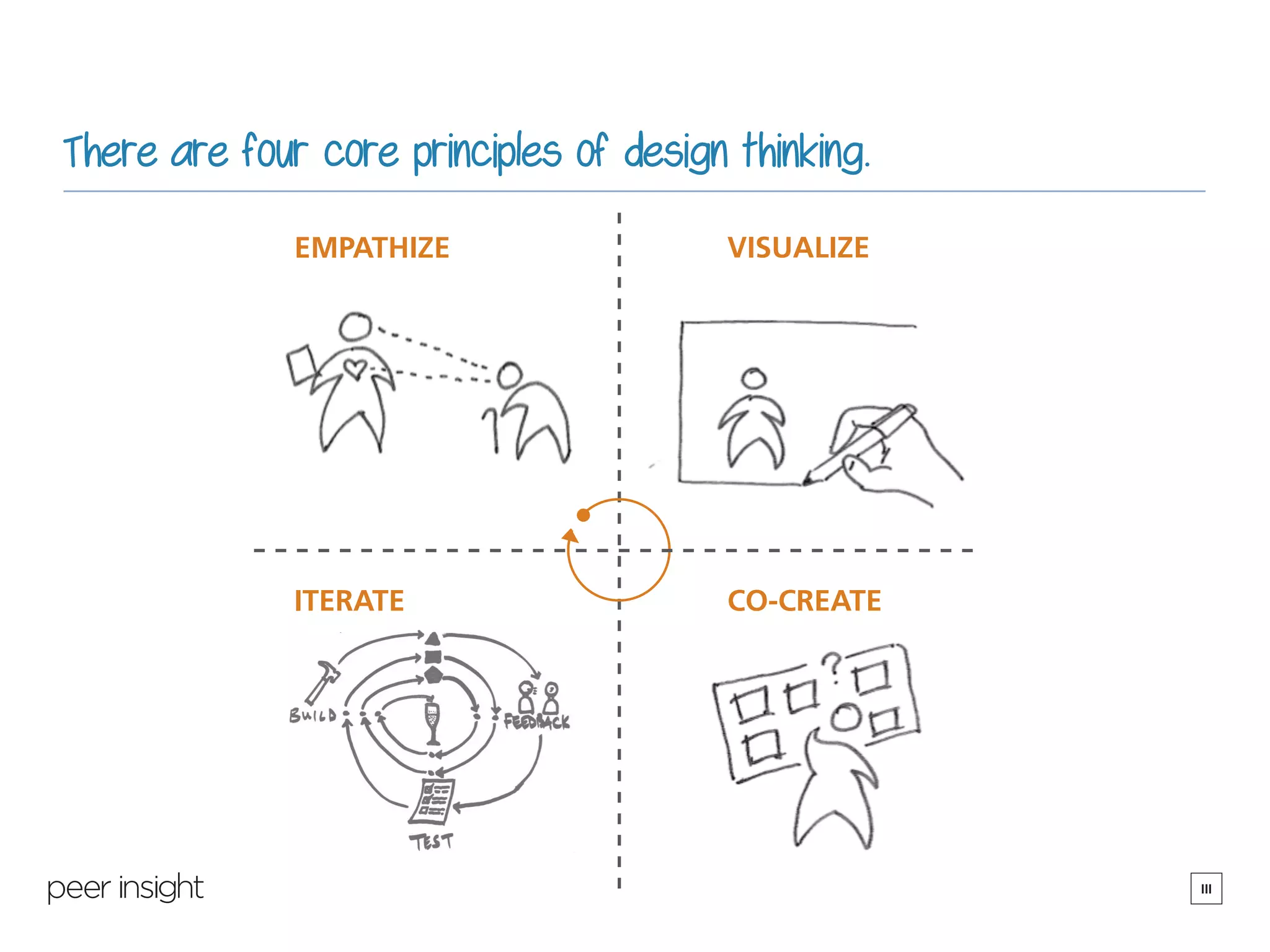
There are four core principles of design thinking.
EMPATHIZE VISUALIZE
ITERATE CO-CREATE
EMPATHIZE
iv
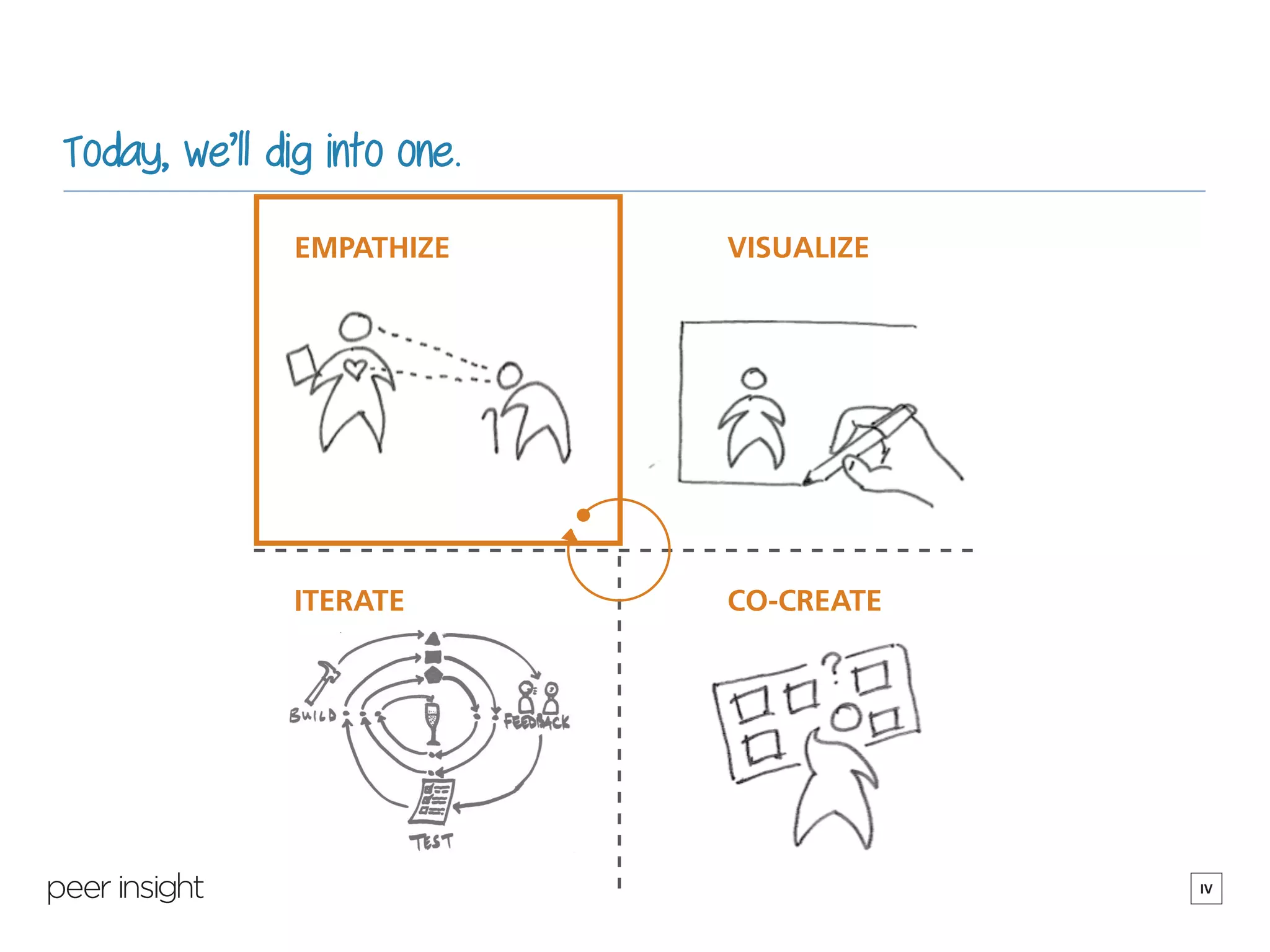
Today, we’ll dig into one.
EMPATHIZE VISUALIZE
ITERATE CO-CREATE
EMPATHIZE
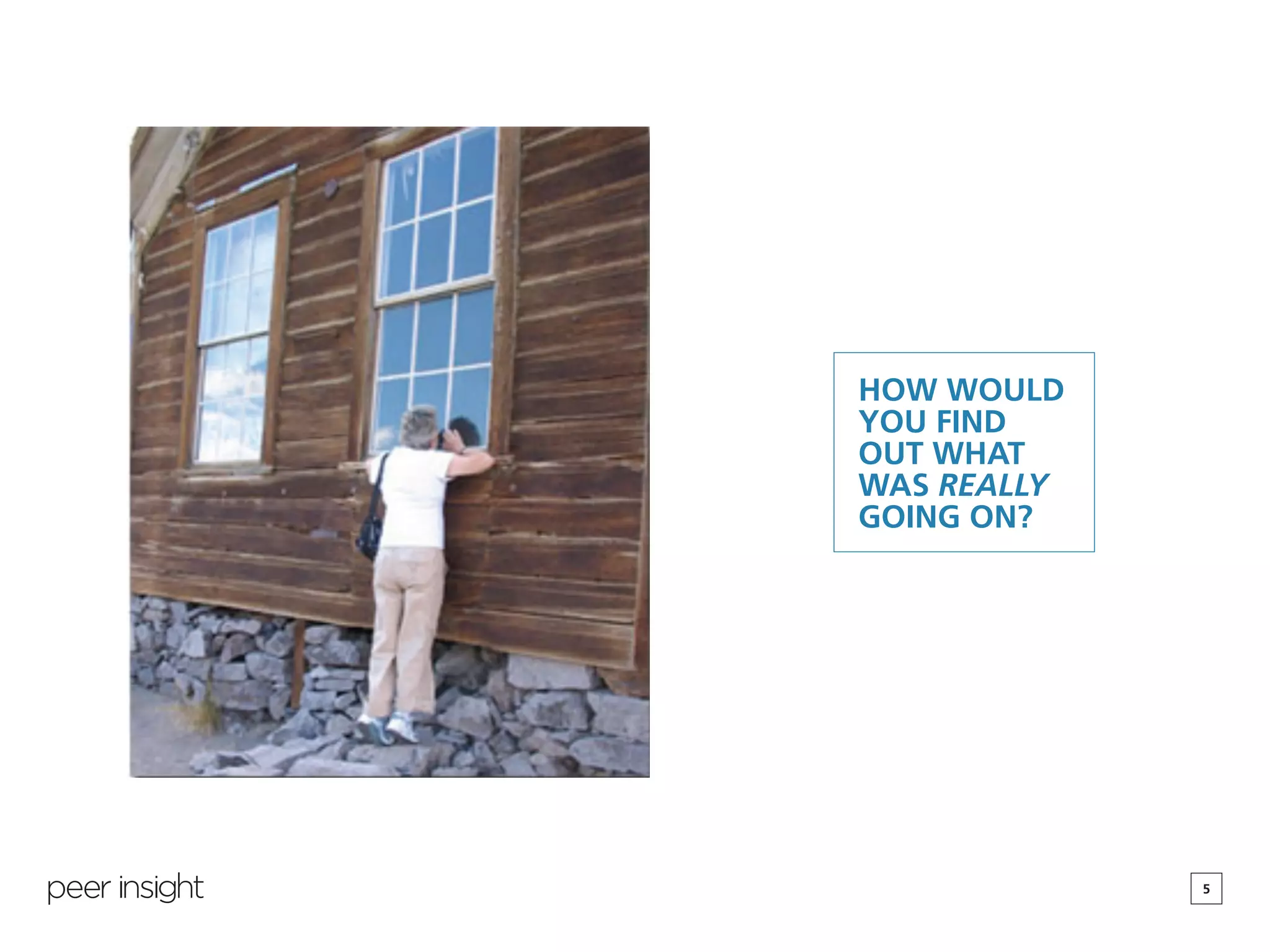
1
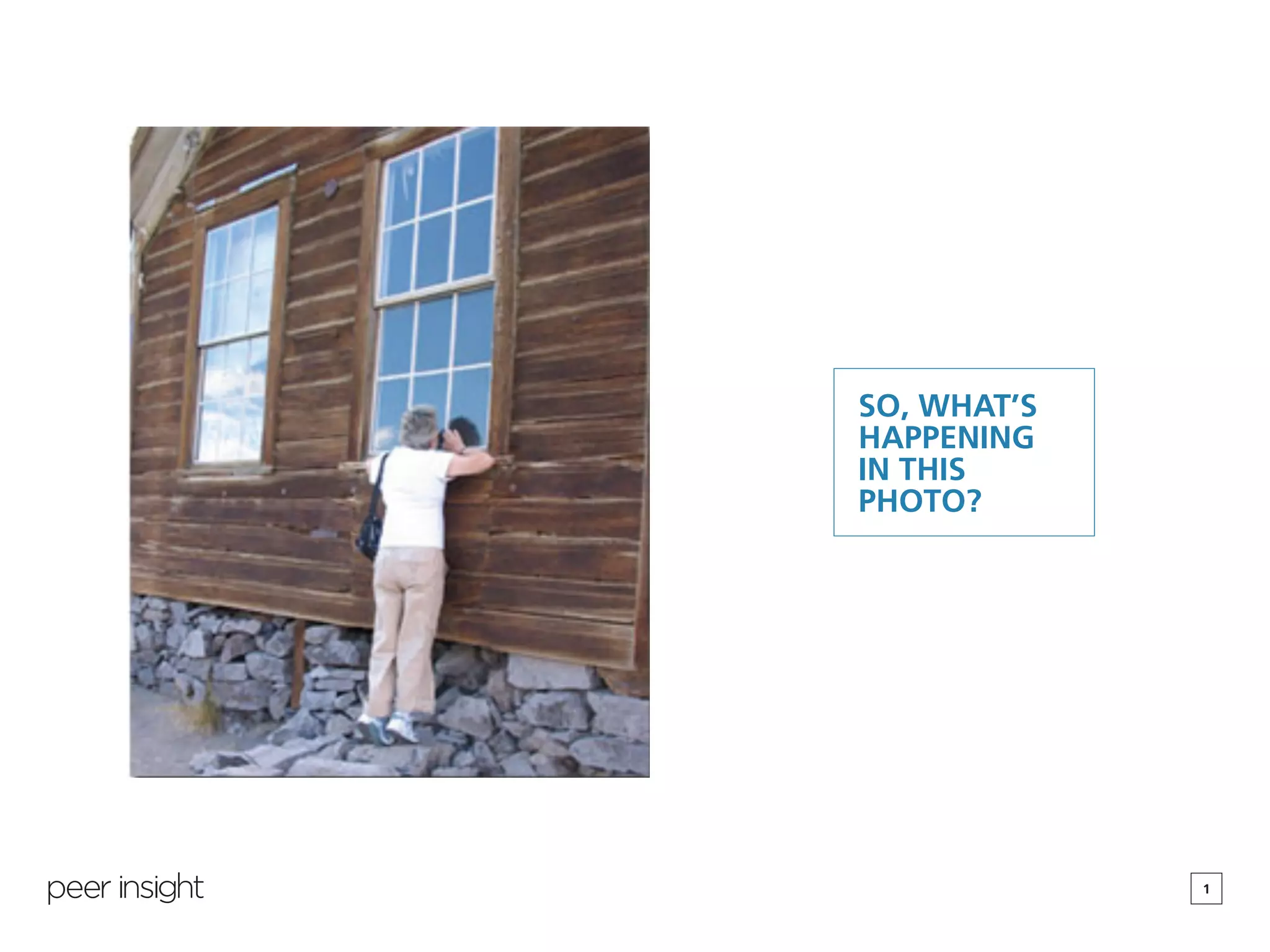
SO, WHAT’S
HAPPENING
IN THIS
PHOTO?
2
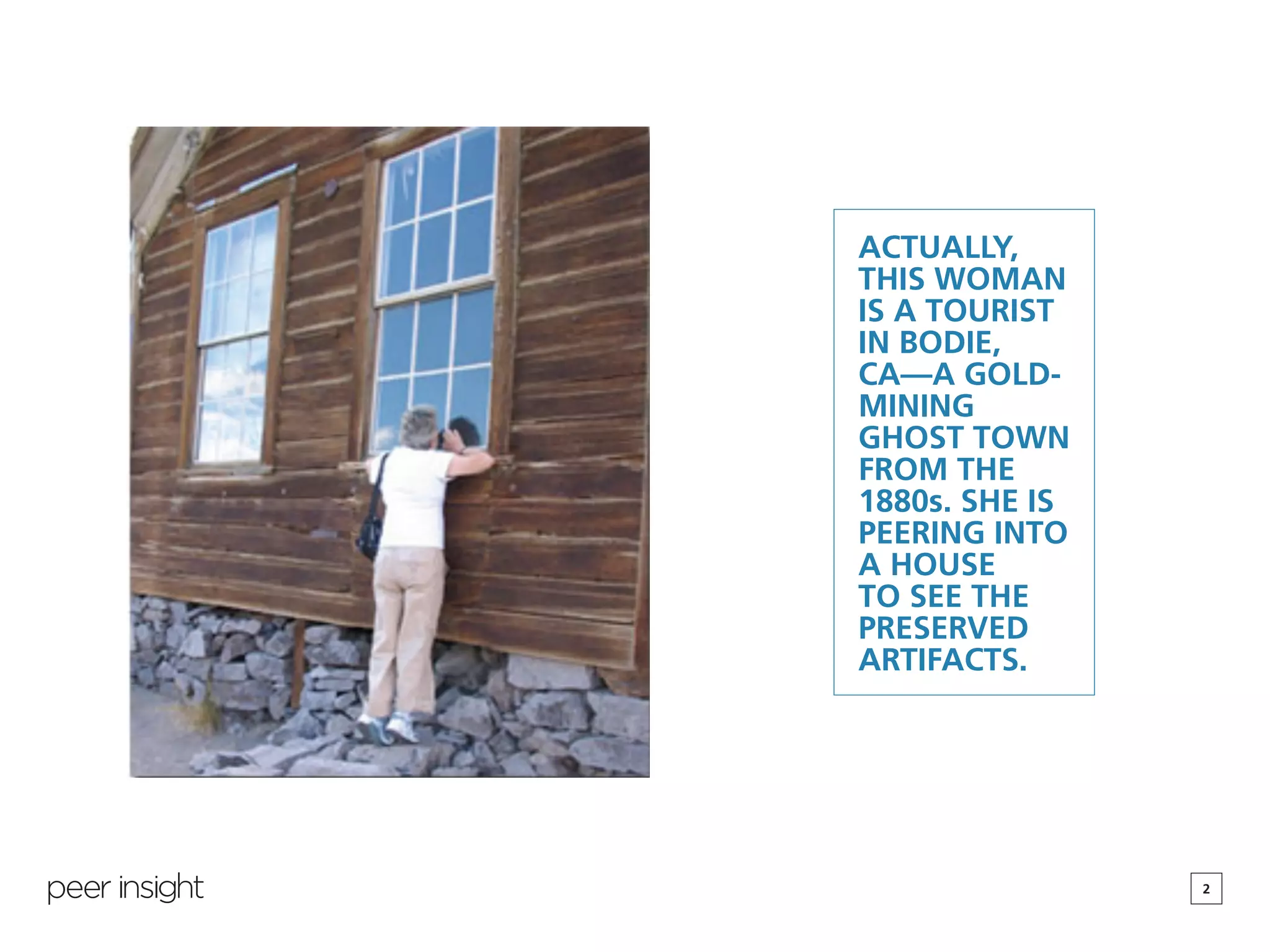
ACTUALLY,
THIS WOMAN
IS A TOURIST
IN BODIE,
CA—A GOLD-
MINING
GHOST TOWN
FROM THE
1880s. SHE IS
PEERING INTO
A HOUSE
TO SEE THE
PRESERVED
ARTIFACTS.
3
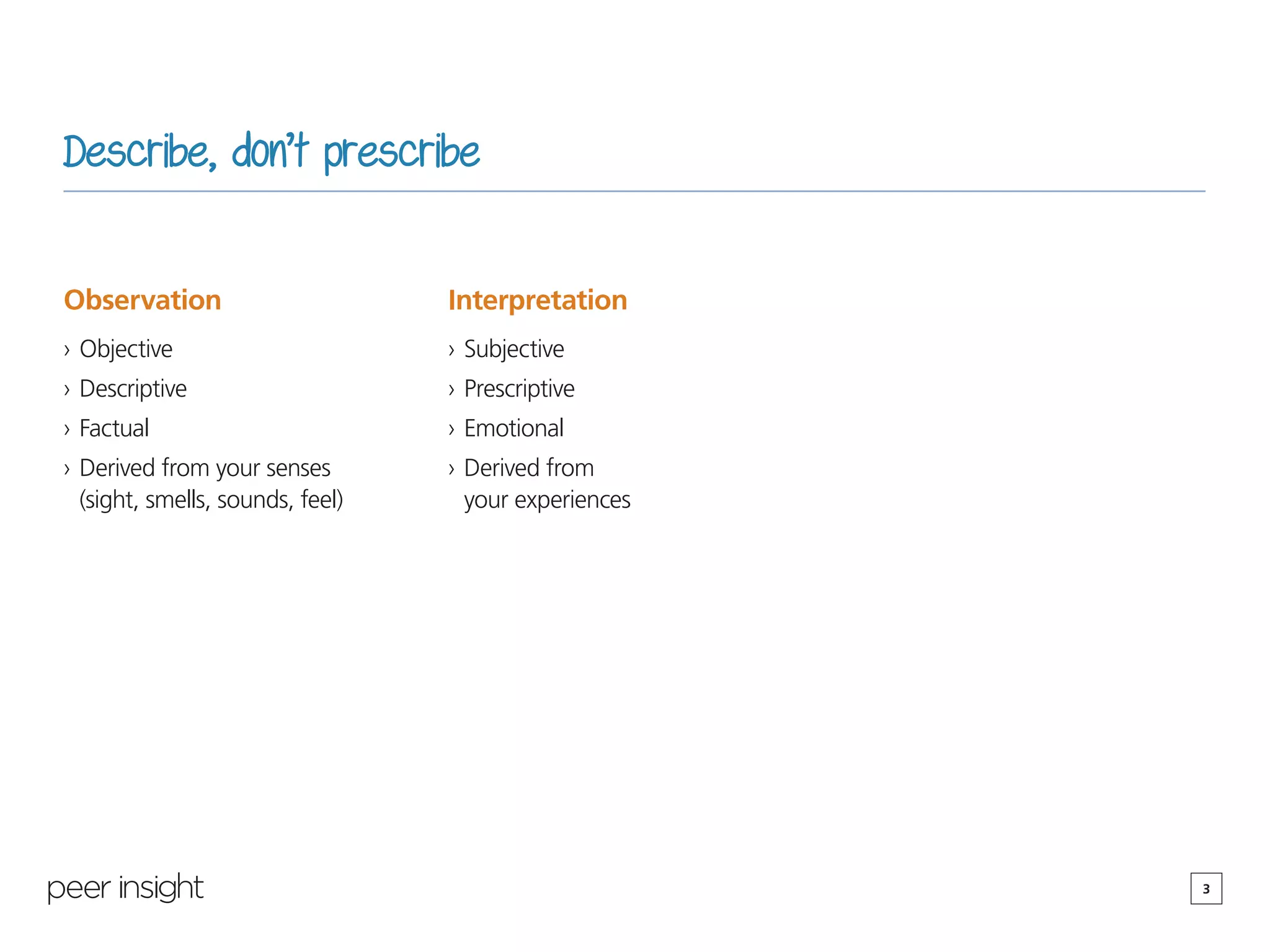
Describe, don’t prescribe
Observation
›› Objective
›› Descriptive
›› Factual
›› Derived from your senses
(sight, smells, sounds, feel)
Interpretation
›› Subjective
›› Prescriptive
›› Emotional
›› Derived from
your experiences
4
Let’s cover the basics of design research
Agenda
›› Overview of Design Thinking
›› The Design Research Process
›› Tips For Building Empathy
& Conducting Interviews
›› Creating A Discussion Guide
›› Running An Empathy-building Activity
›› Debriefing Your Data
›› Reflection
›› Q&A
5
HOW WOULD
YOU FIND
OUT WHAT
WAS REALLY
GOING ON?
6
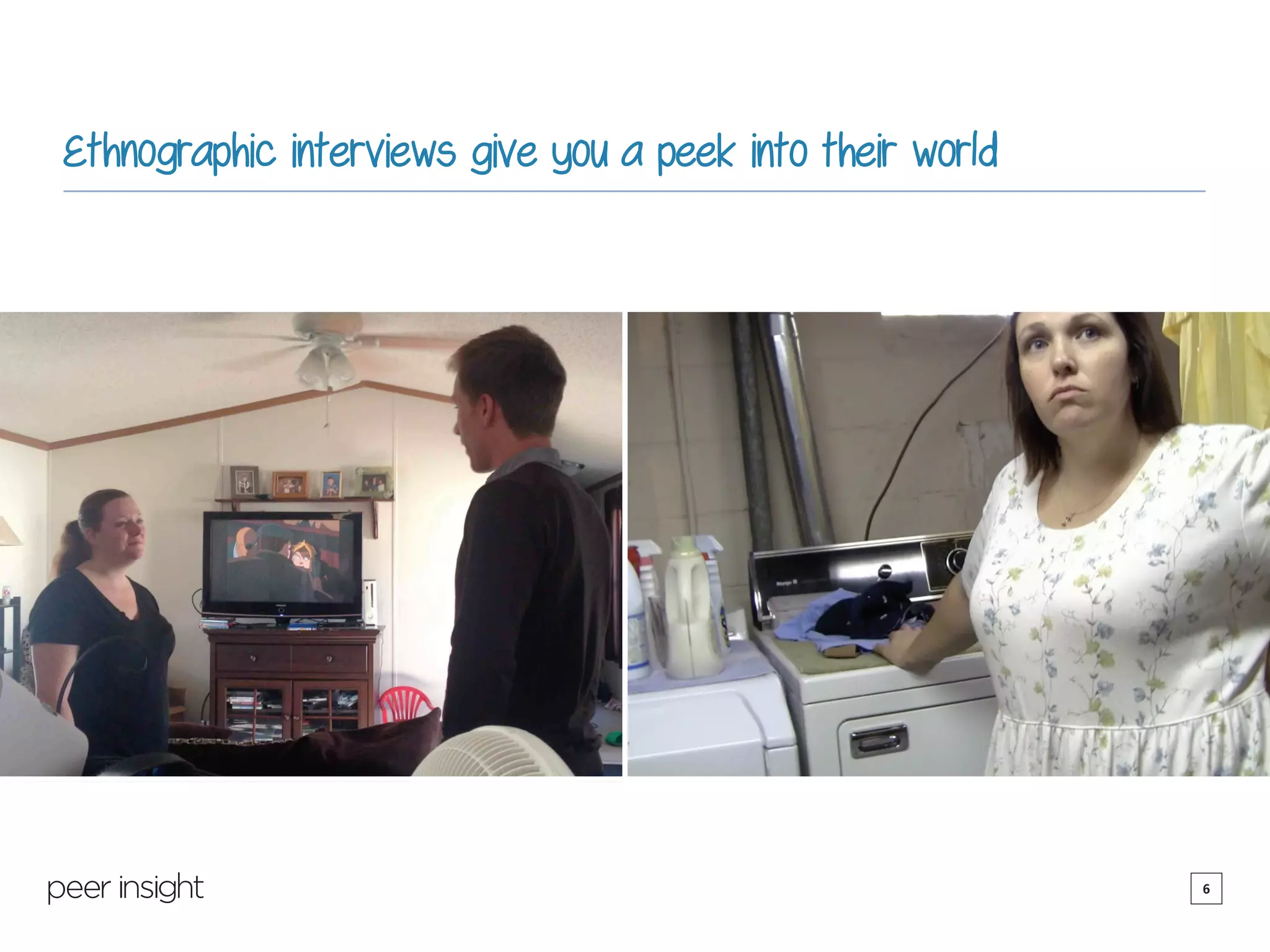
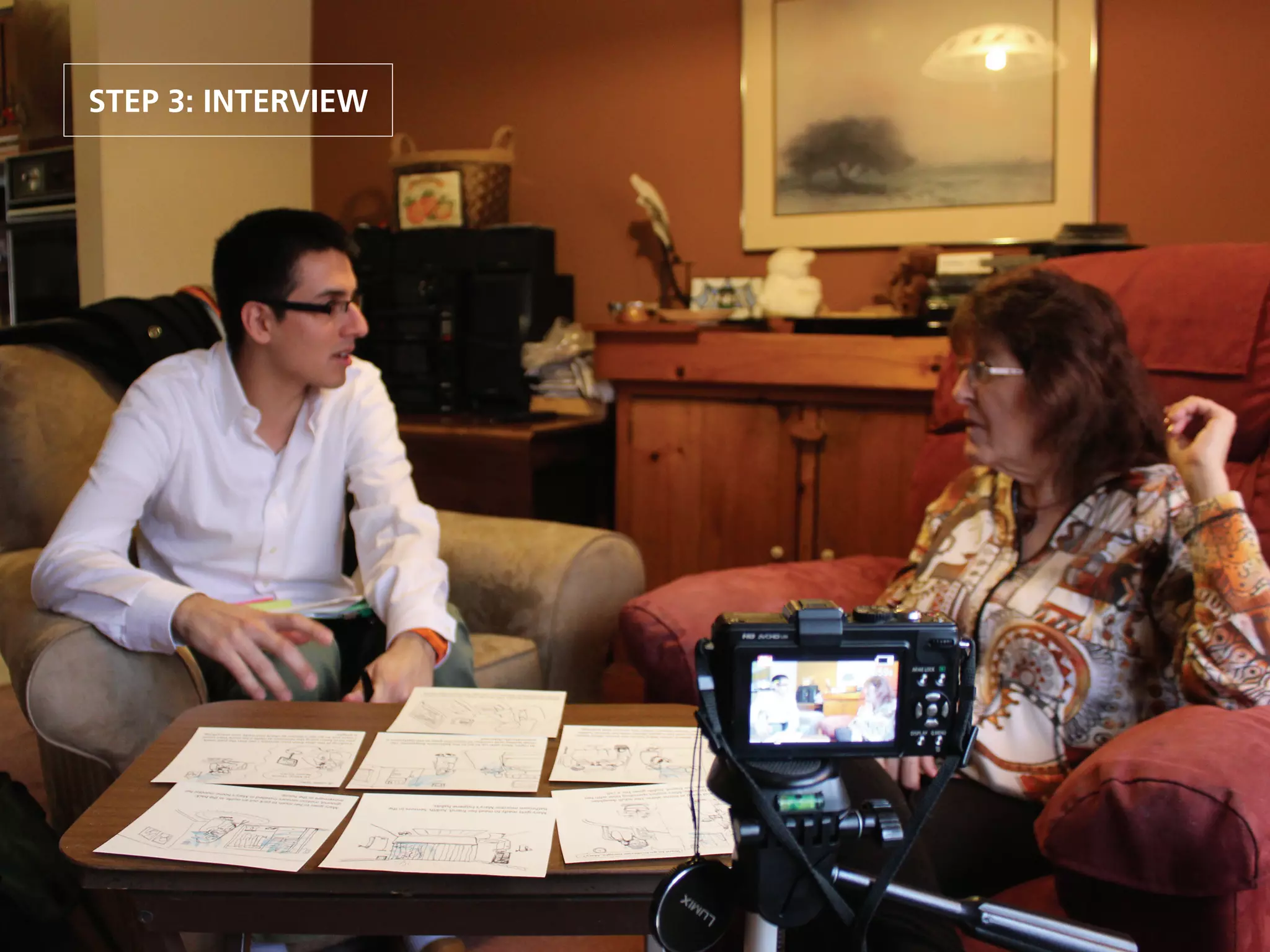
Ethnographic interviews give you a peek into their world
7
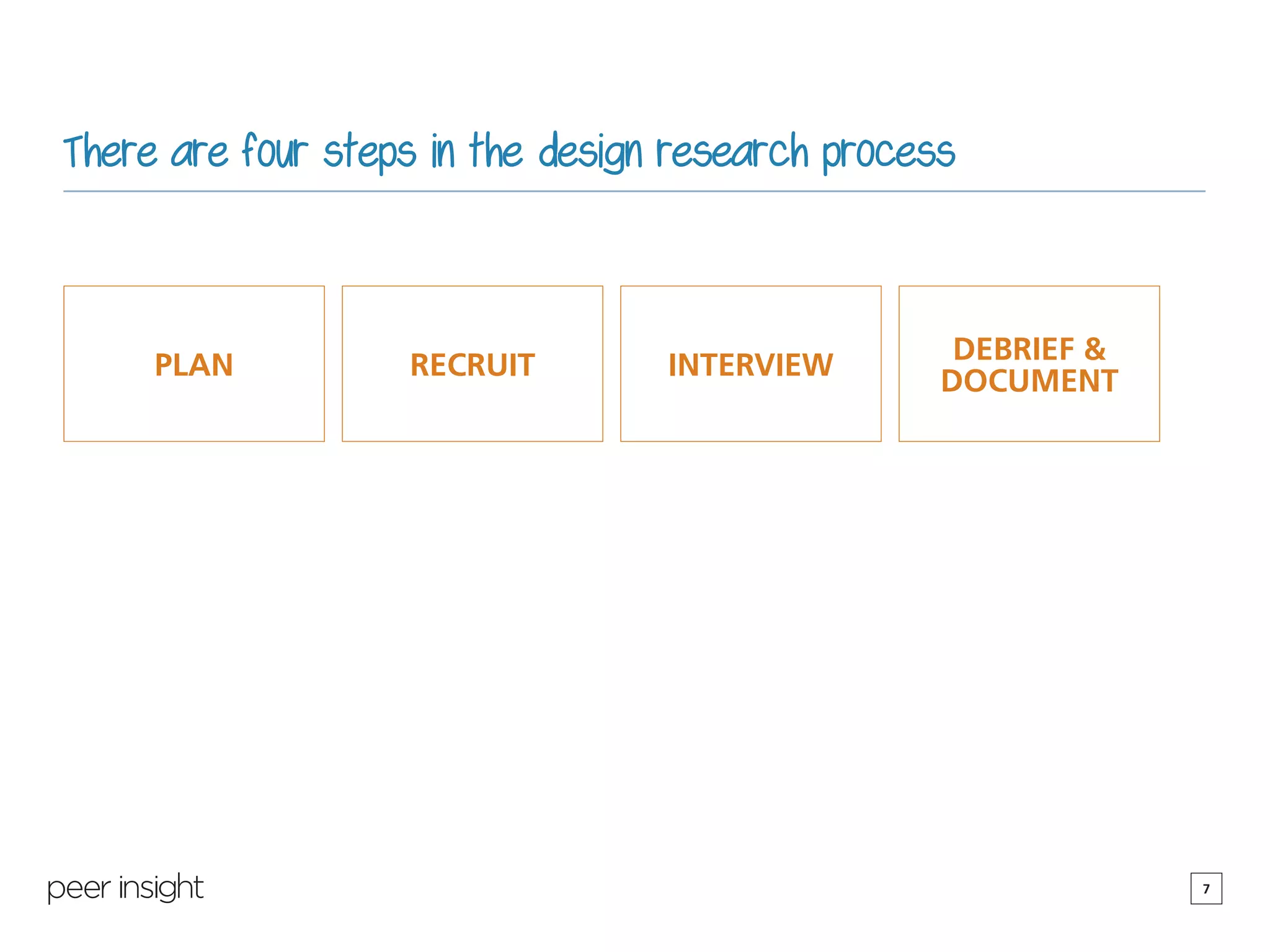
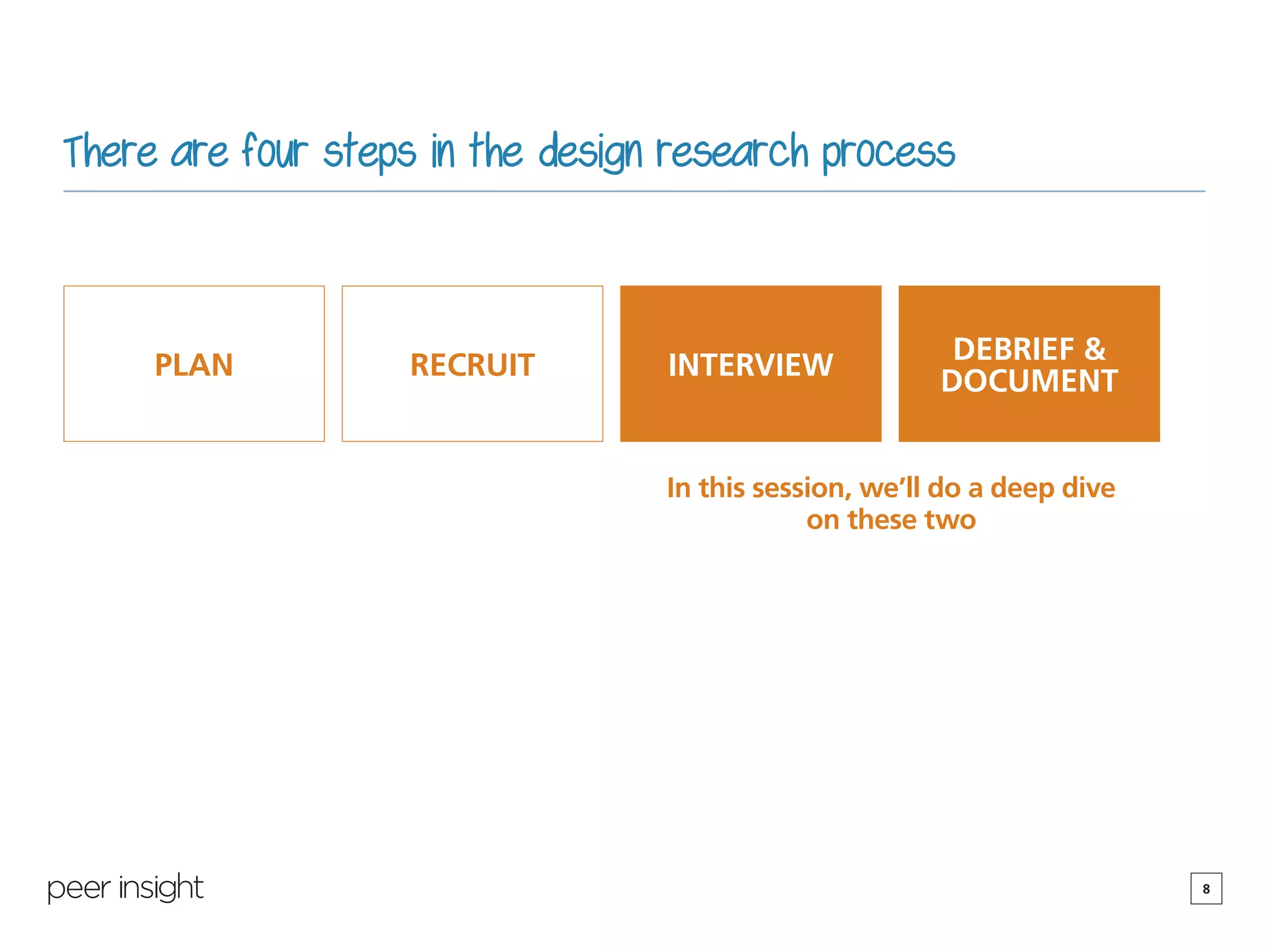
There are four steps in the design research process
PLAN RECRUIT INTERVIEW
DEBRIEF &
DOCUMENT
8
There are four steps in the design research process
PLAN RECRUIT INTERVIEW
DEBRIEF &
DOCUMENT
In this session, we’ll do a deep dive
on these two
9
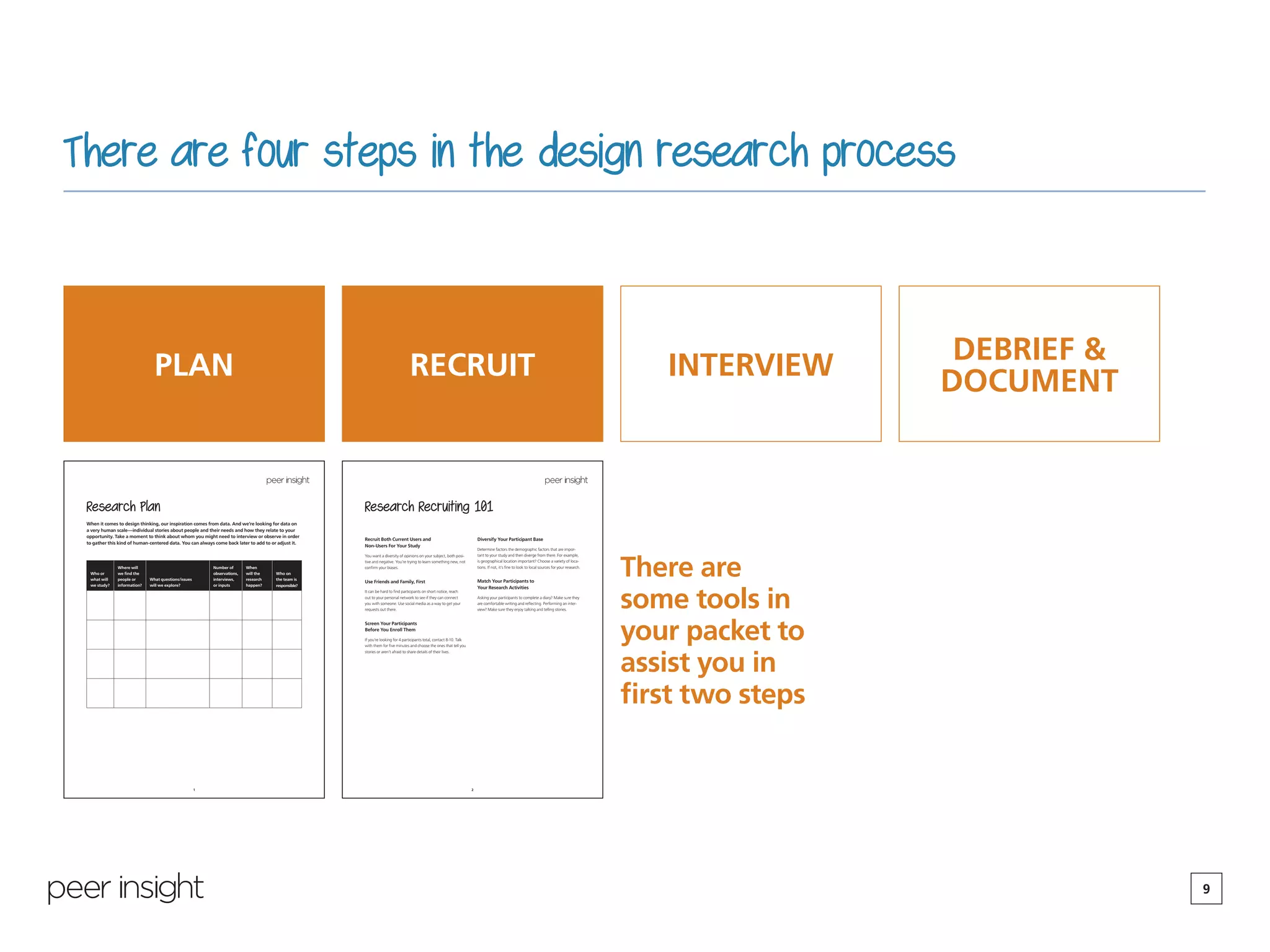
There are four steps in the design research process
PLAN RECRUIT INTERVIEW
DEBRIEF &
DOCUMENT
1
Research Plan
When it comes to design thinking, our inspiration comes from data. And we’re looking for data on
a very human scale—individual stories about people and their needs and how they relate to your
opportunity. Take a moment to think about whom you might need to interview or observe in order
to gather this kind of human-centered data. You can always come back later to add to or adjust it.
Who or
what will
we study?
Where will
we find the
people or
information?
What questions/issues
will we explore?
Number of
observations,
interviews,
or inputs
When
will the
research
happen?
Who on
the team is
responsible?
2
Research Recruiting 101
Recruit Both Current Users and
Non-Users For Your Study
You want a diversity of opinions on your subject, both posi-
tive and negative. You’re trying to learn something new, not
confirm your biases.
Use Friends and Family, First
It can be hard to find participants on short notice, reach
out to your personal network to see if they can connect
you with someone. Use social media as a way to get your
requests out there.
Screen Your Participants
Before You Enroll Them
If you’re looking for 4 participants total, contact 8-10. Talk
with them for five minutes and choose the ones that tell you
stories or aren’t afraid to share details of their lives.
Diversify Your Participant Base
Determine factors the demographic factors that are impor-
tant to your study and then diverge from there. For example,
is geographical location important? Choose a variety of loca-
tions. If not, it’s fine to look to local sources for your research.
Match Your Participants to
Your Research Activities
Asking your participants to complete a diary? Make sure they
are comfortable writing and reflecting. Performing an inter-
view? Make sure they enjoy talking and telling stories.
There are
some tools in
your packet to
assist you in
first two steps
10
STEP 3: INTERVIEW
11
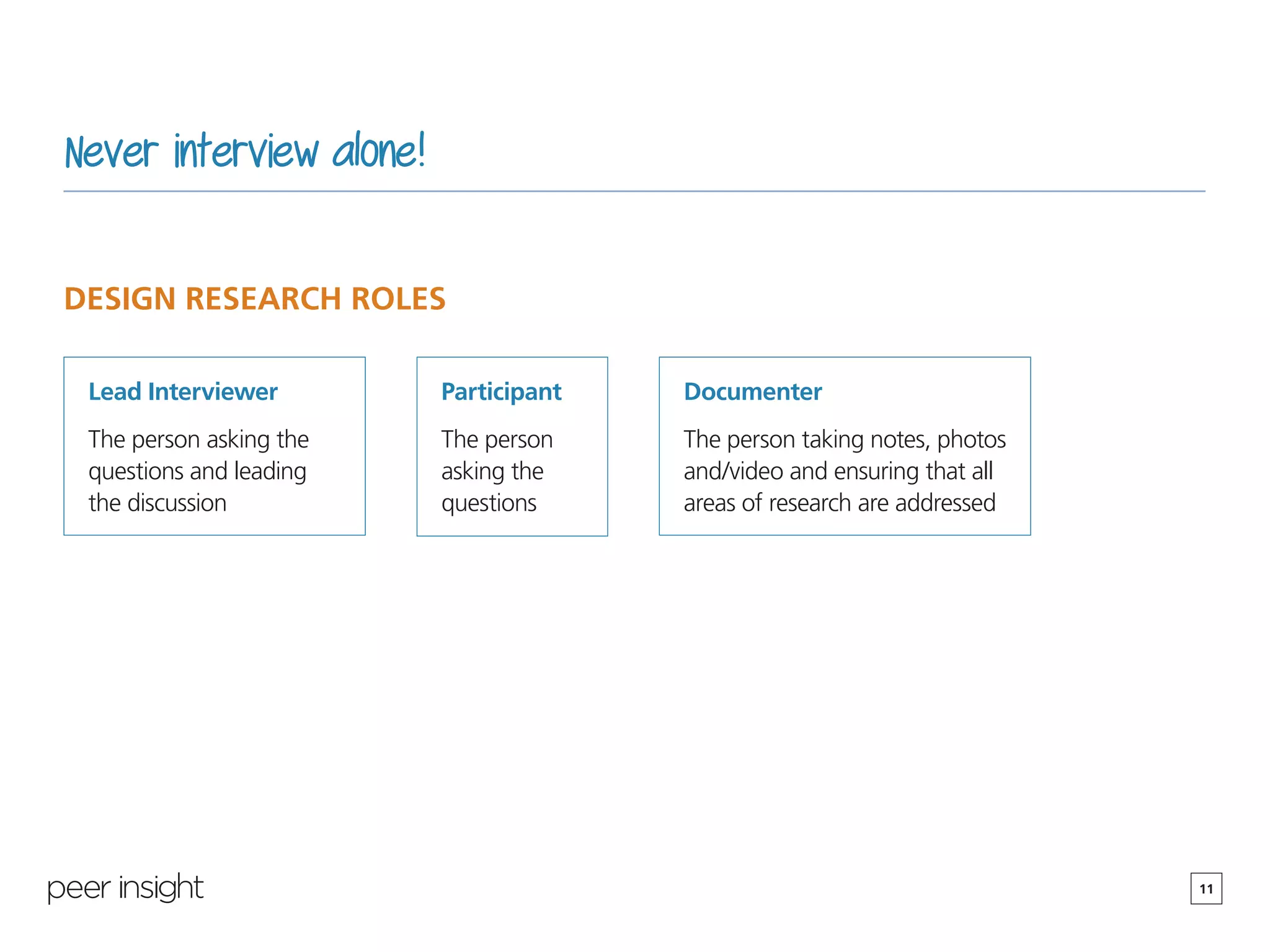
Never interview alone!
DESIGN RESEARCH ROLES
Lead Interviewer
The person asking the
questions and leading
the discussion
Participant
The person
asking the
questions
Documenter
The person taking notes, photos
and/video and ensuring that all
areas of research are addressed
12
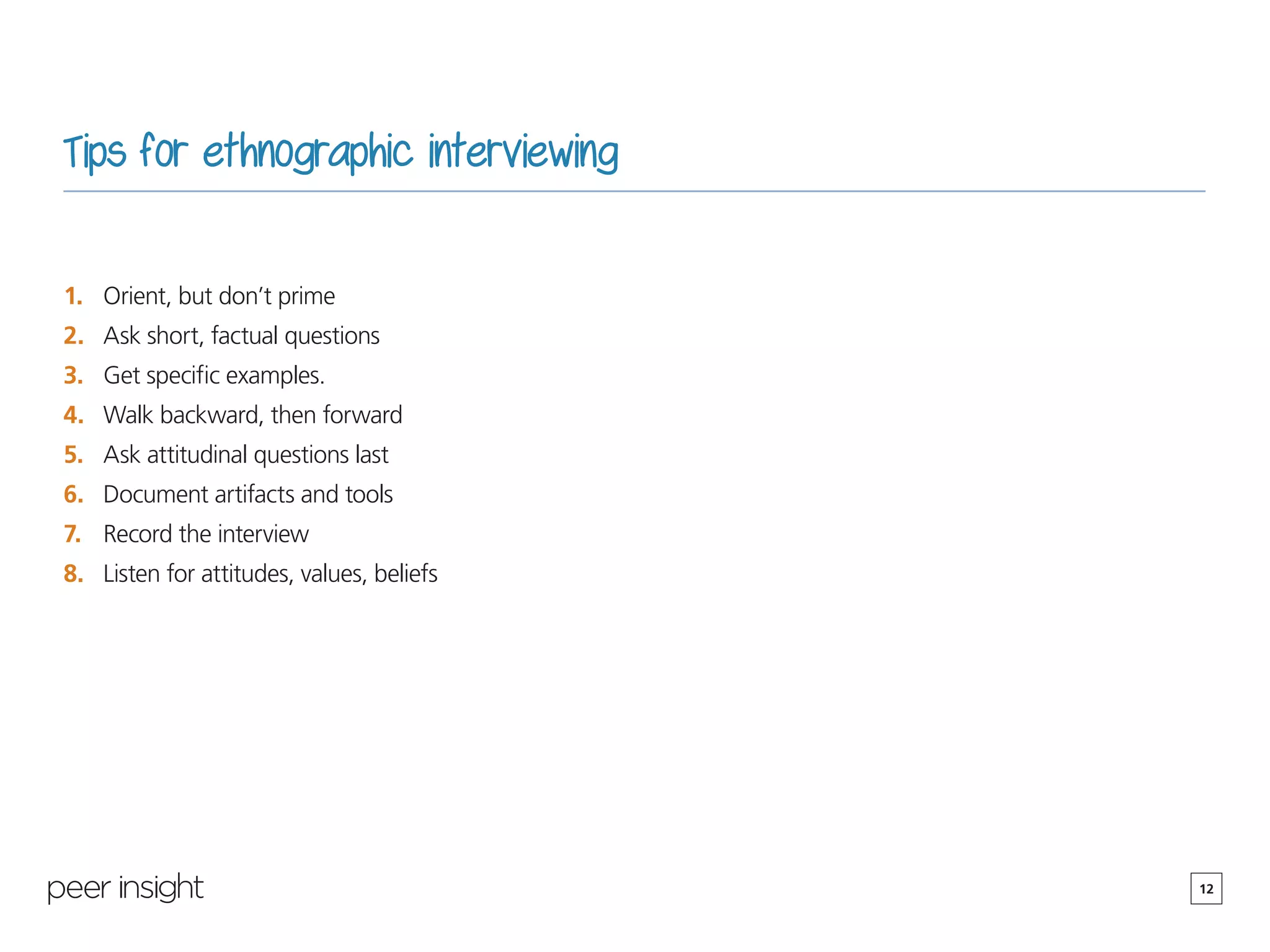
Tips for ethnographic interviewing
1.	 Orient, but don’t prime
2.	 Ask short, factual questions
3.	 Get specific examples.
4.	 Walk backward, then forward
5.	 Ask attitudinal questions last
6.	 Document artifacts and tools
7.	 Record the interview
8.	 Listen for attitudes, values, beliefs
13
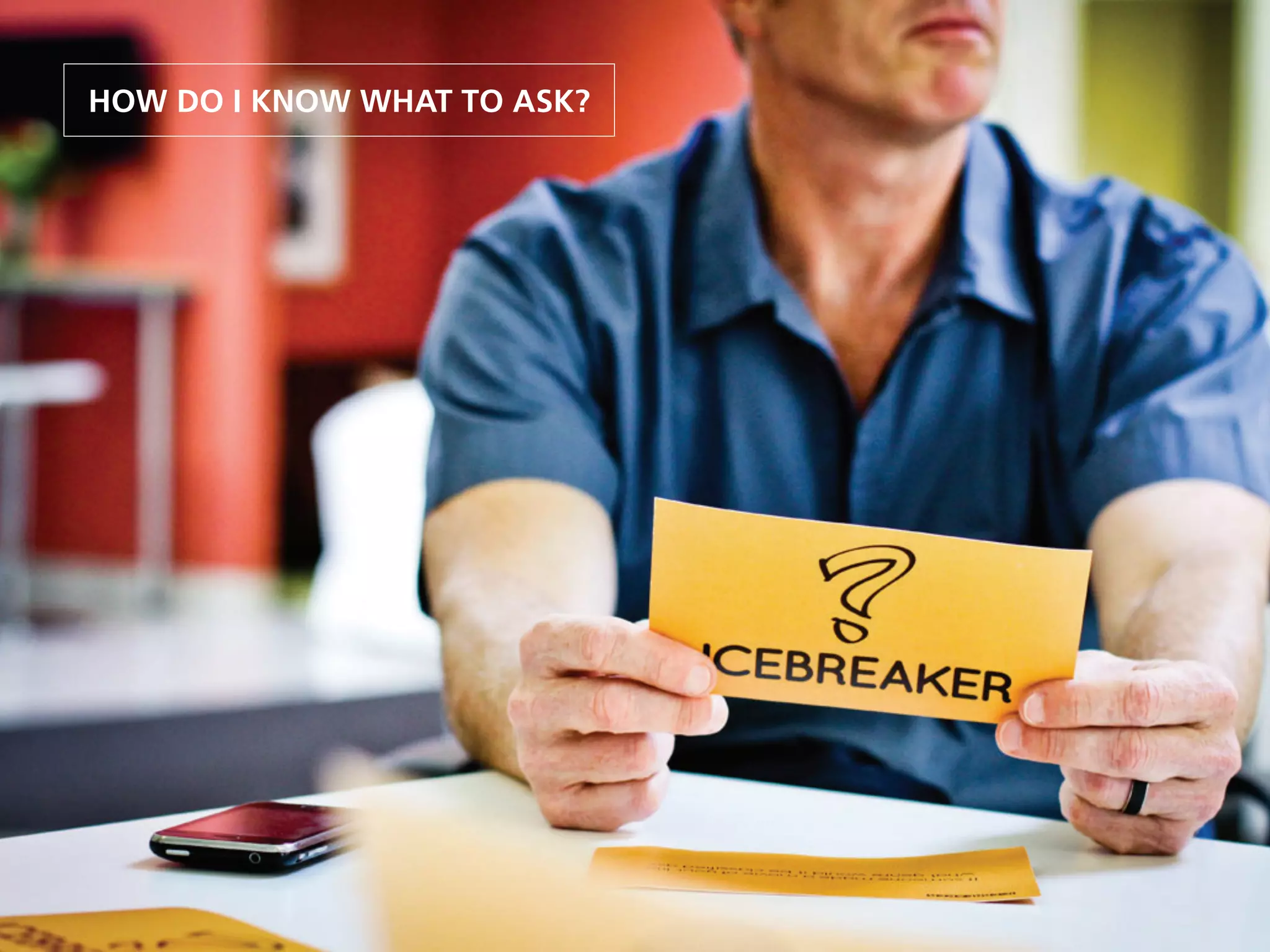
HOW DO I KNOW WHAT TO ASK?
14
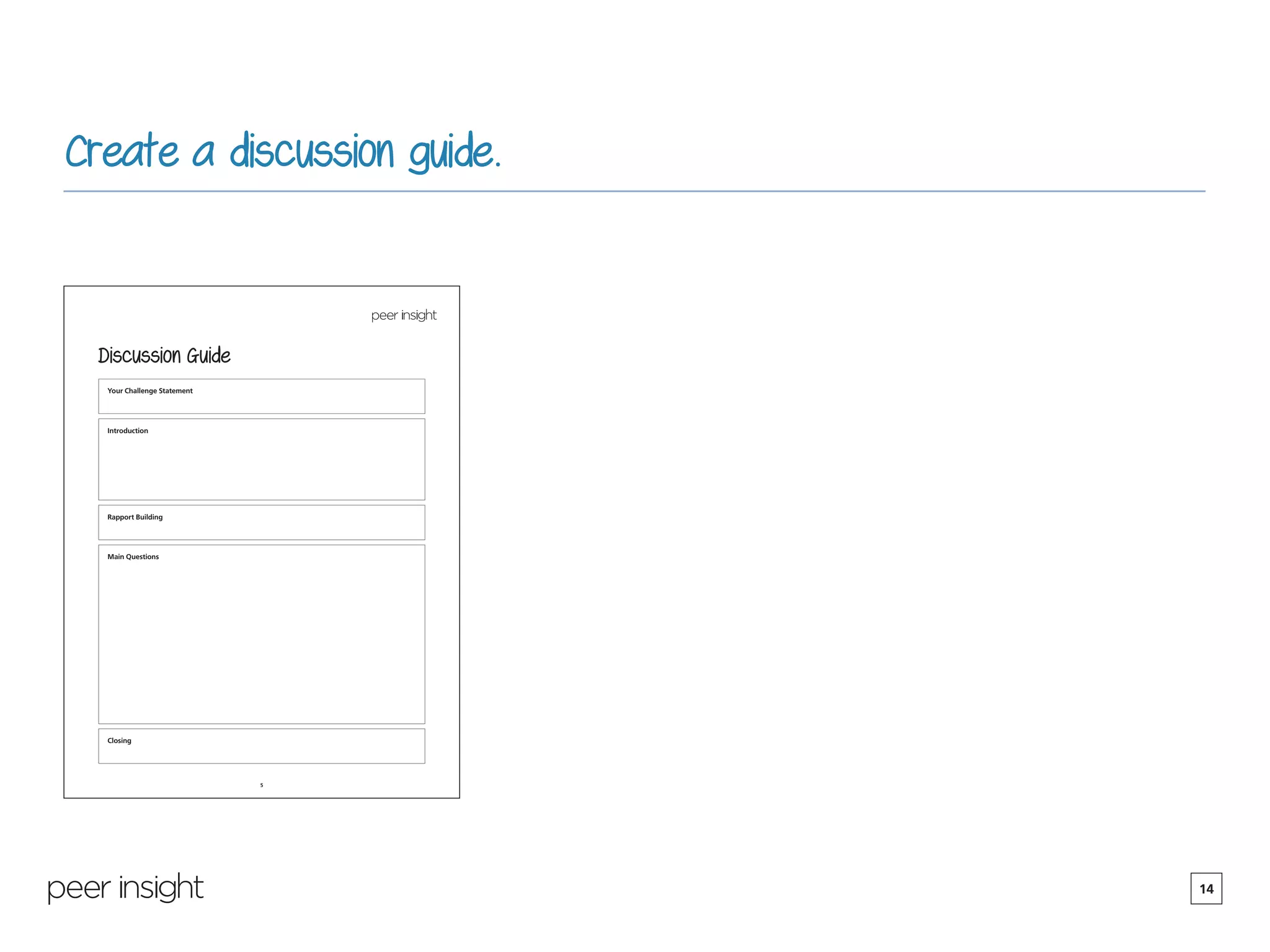
Create a discussion guide.
5
Discussion Guide
Your Challenge Statement
Introduction
Main Questions
Rapport Building
Closing
15
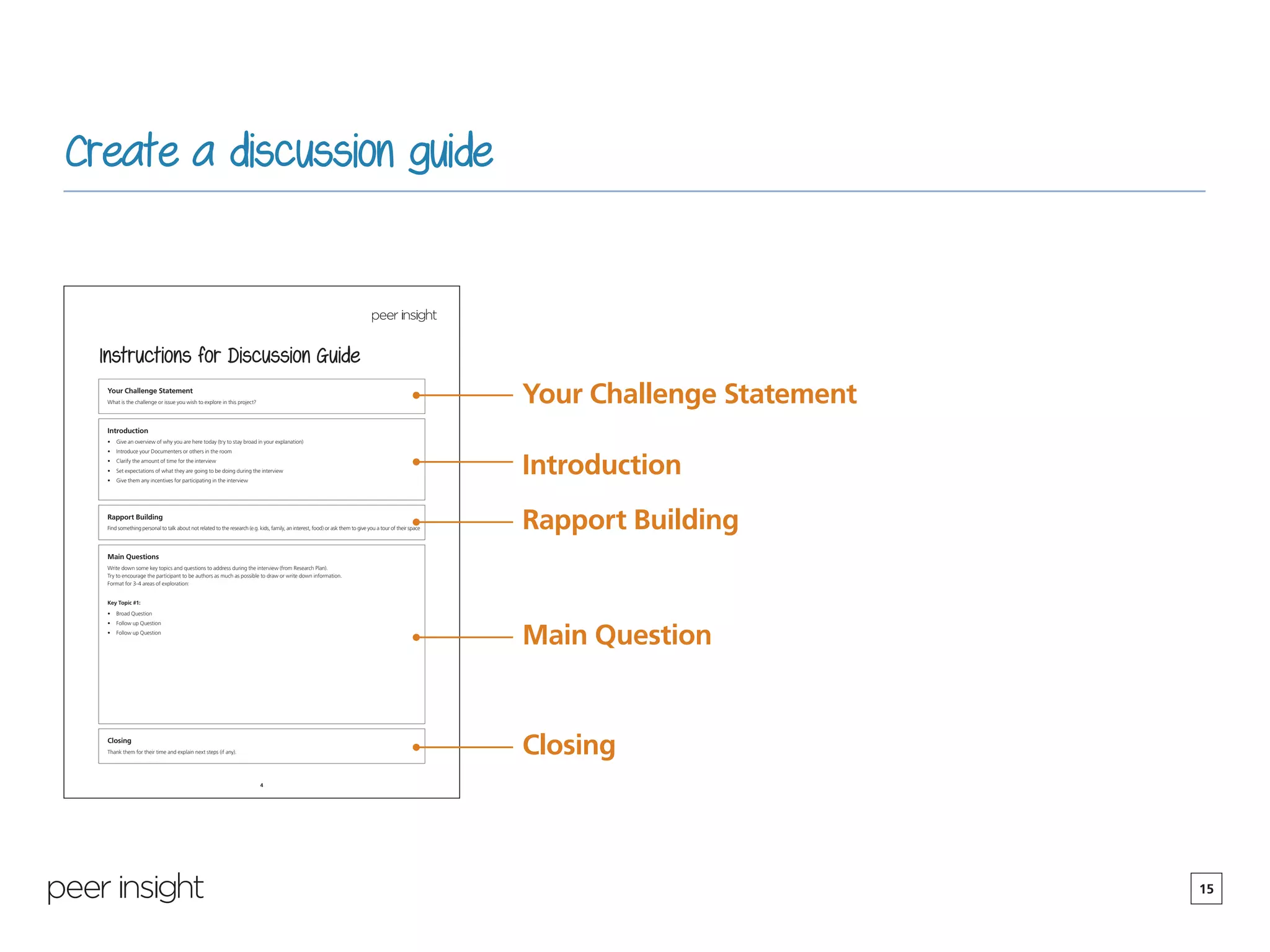
Create a discussion guide
4
Instructions for Discussion Guide
Your Challenge Statement
What is the challenge or issue you wish to explore in this project?
Introduction
• Give an overview of why you are here today (try to stay broad in your explanation)
• Introduce your Documenters or others in the room
• Clarify the amount of time for the interview
• Set expectations of what they are going to be doing during the interview
• Give them any incentives for participating in the interview
Main Questions
Write down some key topics and questions to address during the interview (from Research Plan).
Try to encourage the participant to be authors as much as possible to draw or write down information.
Format for 3-4 areas of exploration:
Key Topic #1:
• Broad Question
• Follow up Question
Rapport Building
Find something personal to talk about not related to the research (e.g. kids, family, an interest, food) or ask them to give you a tour of their space
Closing
Thank them for their time and explain next steps (if any).
Introduction
Rapport Building
Main Question
Closing
Your Challenge Statement
16
Now it’s your turn!
Your Challenge Statement
Design a solution to improve your
participant’s daily commuting experience.
17
Now it’s your turn!
Fill out your
Discussion Guide
(5 min)
Round One
(7 min)
›› Partner A:
Lead Interviewer
›› Partner B: Participant
›› Partner C: Documenter
Round Two
(7 min)
›› Partner C:
Lead Interviewer
›› Partner A: Participant
›› Partner B: Documenter
Round Three
(7 min)
›› Partner B:
Lead Interviewer
›› Partner C: Participant
›› Partner A: Documenter
18
Remember: Be a better ethnographic researcher
1.	 Orient, but don’t prime
2.	 Ask short, factual questions
3.	 Get specific examples.
4.	 Walk backward, then forward
5.	 Ask attitudinal questions last
6.	 Document artifacts and tools
7.	 Record the interview
8.	 Listen for attitudes, values, beliefs
19
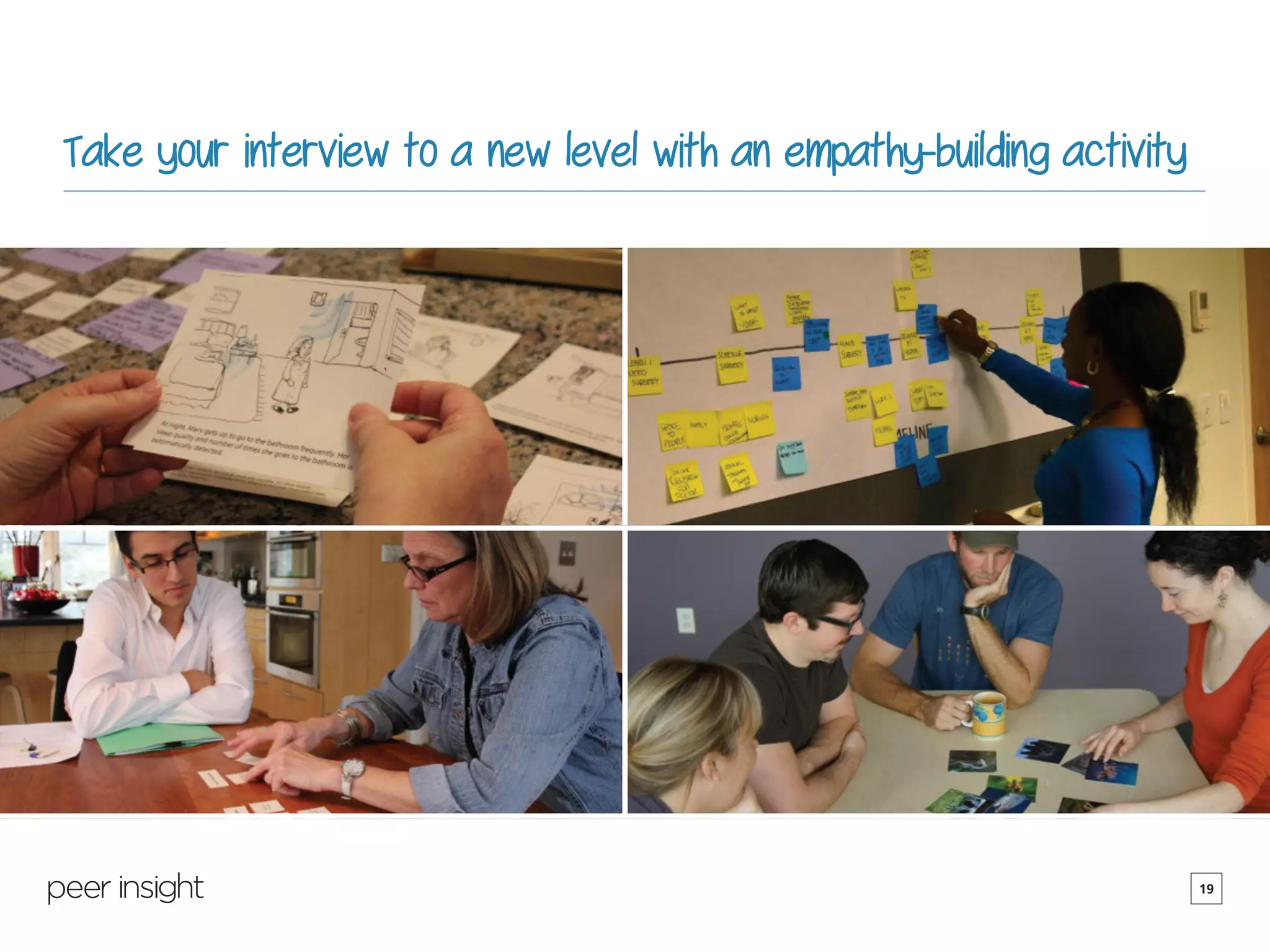
Take your interview to a new level with an empathy-building activity
20
Take your interview to a new level with an empathy-building activity
Visual-based activities make
ideas tangible and concrete ...
›› We experience pictures differently
than we experience words
›› Visualizing is a pre-cursor to doing;
it’s mapped to our motor skills
›› We understand pictures at a visceral
level, the same as emotions
… and reduce the risk of failure
›› Ensures we’re all working from
the same mental model
›› Builds commitment to the idea
21
You try it!
Round One
(5 min)
›› Partner B:
Lead Interviewer
›› Partner C: Participant
›› Partner A: Documenter
Round Two
(5 min)
›› Partner A:
Lead Interviewer
›› Partner B: Participant
›› Partner C: Documenter
Round Three
(5 min)
›› Partner C:
Lead Interviewer
›› Partner A: Participant
›› Partner B: Documenter
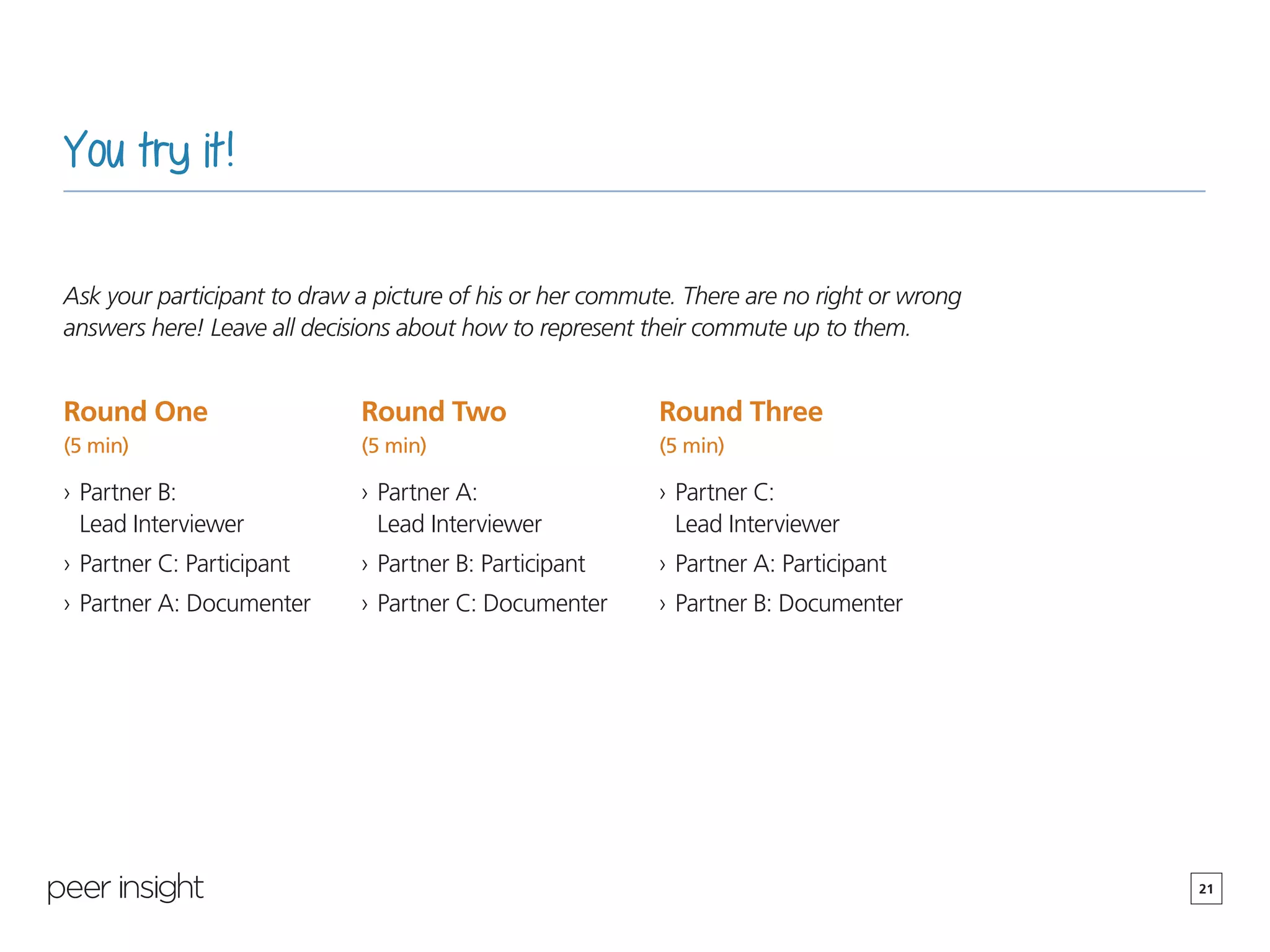
Ask your participant to draw a picture of his or her commute. There are no right or wrong
answers here! Leave all decisions about how to represent their commute up to them.
22
6
Interview Debrief
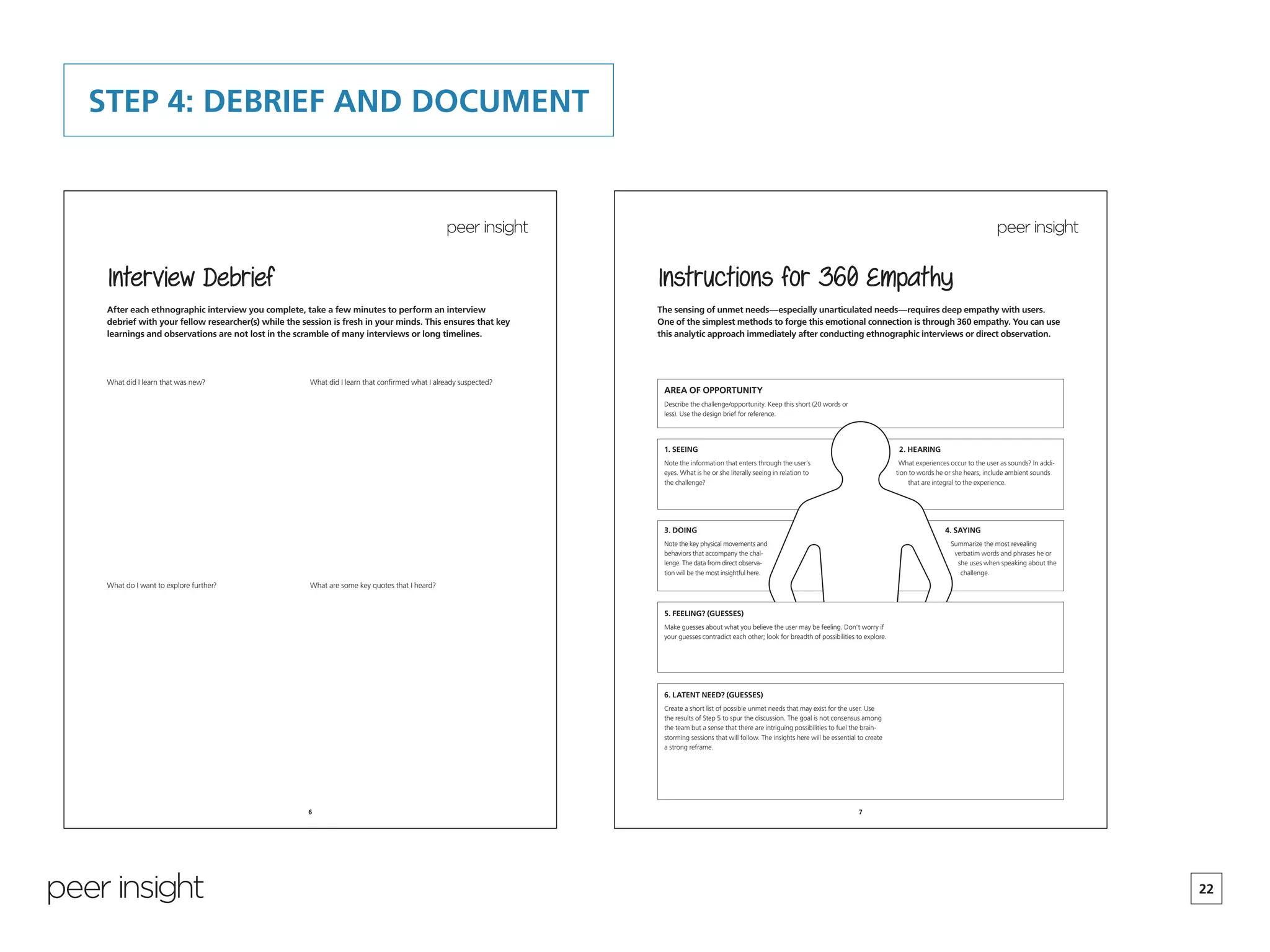
After each ethnographic interview you complete, take a few minutes to perform an interview
debrief with your fellow researcher(s) while the session is fresh in your minds. This ensures that key
learnings and observations are not lost in the scramble of many interviews or long timelines.
What did I learn that was new? What did I learn that confirmed what I already suspected?
What do I want to explore further? What are some key quotes that I heard?
STEP 4: DEBRIEF AND DOCUMENT
7
Instructions for 360 Empathy
The sensing of unmet needs—especially unarticulated needs—requires deep empathy with users.
One of the simplest methods to forge this emotional connection is through 360 empathy. You can use
this analytic approach immediately after conducting ethnographic interviews or direct observation.
AREA OF OPPORTUNITY
Describe the challenge/opportunity. Keep this short (20 words or
less). Use the design brief for reference.
1. SEEING
Note the information that enters through the user’s
eyes. What is he or she literally seeing in relation to
the challenge?
3. DOING
Note the key physical movements and
behaviors that accompany the chal-
lenge. The data from direct observa-
tion will be the most insightful here.
5. FEELING? (GUESSES)
Make guesses about what you believe the user may be feeling. Don’t worry if
your guesses contradict each other; look for breadth of possibilities to explore.
6. LATENT NEED? (GUESSES)
Create a short list of possible unmet needs that may exist for the user. Use
the results of Step 5 to spur the discussion. The goal is not consensus among
the team but a sense that there are intriguing possibilities to fuel the brain-
storming sessions that will follow. The insights here will be essential to create
a strong reframe.
2. HEARING
What experiences occur to the user as sounds? In addi-
tion to words he or she hears, include ambient sounds
that are integral to the experience.
4. SAYING
Summarize the most revealing
verbatim words and phrases he or
she uses when speaking about the
challenge.
23
7
Instructions for 360 Empathy
The sensing of unmet needs—especially unarticulated needs—requires deep empathy with users.
One of the simplest methods to forge this emotional connection is through 360 empathy. You can use
this analytic approach immediately after conducting ethnographic interviews or direct observation.
AREA OF OPPORTUNITY
Describe the challenge/opportunity. Keep this short (20 words or
less). Use the design brief for reference.
1. SEEING
Note the information that enters through the user’s
eyes. What is he or she literally seeing in relation to
the challenge?
3. DOING
Note the key physical movements and
behaviors that accompany the chal-
lenge. The data from direct observa-
tion will be the most insightful here.
5. FEELING? (GUESSES)
Make guesses about what you believe the user may be feeling. Don’t worry if
your guesses contradict each other; look for breadth of possibilities to explore.
6. LATENT NEED? (GUESSES)
Create a short list of possible unmet needs that may exist for the user. Use
the results of Step 5 to spur the discussion. The goal is not consensus among
the team but a sense that there are intriguing possibilities to fuel the brain-
storming sessions that will follow. The insights here will be essential to create
a strong reframe.
2. HEARING
What experiences occur to the user as sounds? In addi-
tion to words he or she hears, include ambient sounds
that are integral to the experience.
4. SAYING
Summarize the most revealing
verbatim words and phrases he or
she uses when speaking about the
challenge.
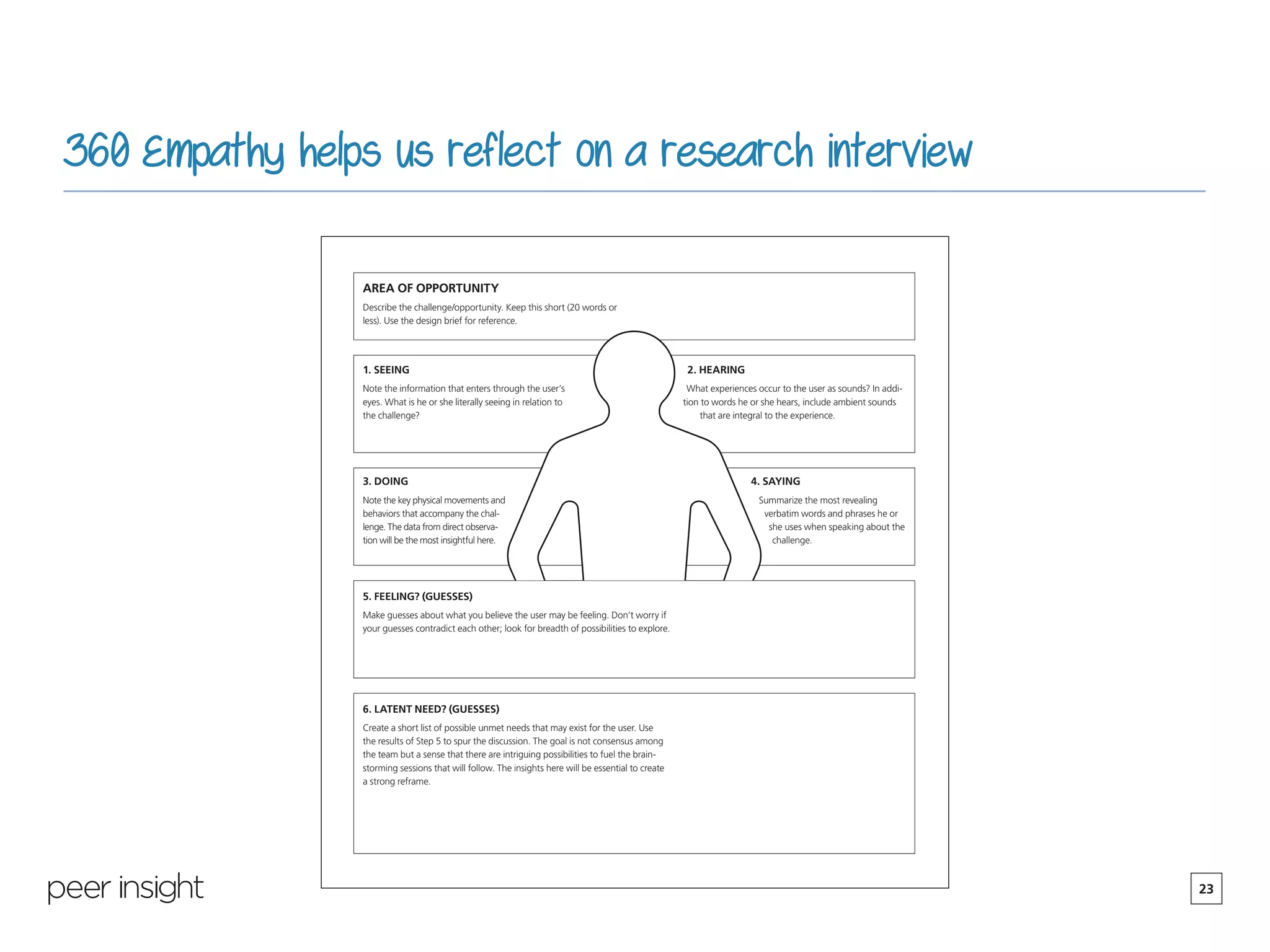
360 Empathy helps us reflect on a research interview
24
Now it’s your turn!
On your own,
fill out the
360 Empathy
template for
the person you
documented
(6 min)
Round One
(2 min)
›› Partner C shares
with team
Round Two
(2 min)
›› Partner B shares
with team
Round Three
(2 min)
›› Partner A shares
with team
25
What was it like to be a designer researcher?
As a table, discuss the following:
1.	 At what point when you were interviewing
did you feel it was going the best?
2.	 Which of the interviewing tips did you find
most difficult to follow?
3.	 In what ways was using stimulus similar to or
different from using only interview questions?
4.	 When did you feel most comfortable as
a participant? Was there anything your
interviewer did to make you feel that way?
5.	 What questions do you still have about
conducting ethnographic interviews?
1.	 Orient, but don’t prime
2.	 Ask short, factual questions
3.	 Get specific examples.
4.	 Walk backward, then forward
5.	 Ask attitudinal questions last
6.	 Document artifacts and tools
7.	 Record the interview
8.	 Listen for attitudes, values, beliefs
26
QUESTIONS?
27
THANK YOU!
JESSICA DUGAN
Director, Design Strategy and Innovation
jdugan@peerinsight.com | 312.532.8729
BREE GROFF
Design Strategist
bgroff@peerinsight.com

Introduction to Empathy and Design Research

  • 1.
    i Introduction to Empathy andDesign Research Prepared for DT:DC Summer of Design, 2014 JULY 22. 2014
  • 2.
    i Design thinking isa problem solving process ... What is? What if? What wows? What works?? $ EMPATHIZE framing interviewing observing analyzing VISUALIZE exploring brainstorming creating CO-CREATE building refining evaluating ITERATE experimenting testing implementing IMPACTWhat is? What if? What wows? What works?? $ EMPATHIZE framing interviewing observing analyzing VISUALIZE exploring brainstorming creating CO-CREATE building refining evaluating ITERATE experimenting testing implementing
  • 3.
    ii ... best usedwith ambiguous problems (often called innovation). DESIGN THINKING is a problem-solving process optimized for ... INNOVATION which is becoming the predominant path to ... IMPACT
  • 4.
    iii There are fourcore principles of design thinking. EMPATHIZE VISUALIZE ITERATE CO-CREATE EMPATHIZE
  • 5.
    iv Today, we’ll diginto one. EMPATHIZE VISUALIZE ITERATE CO-CREATE EMPATHIZE
  • 6.
  • 7.
    2 ACTUALLY, THIS WOMAN IS ATOURIST IN BODIE, CA—A GOLD- MINING GHOST TOWN FROM THE 1880s. SHE IS PEERING INTO A HOUSE TO SEE THE PRESERVED ARTIFACTS.
  • 8.
    3 Describe, don’t prescribe Observation ››Objective ›› Descriptive ›› Factual ›› Derived from your senses (sight, smells, sounds, feel) Interpretation ›› Subjective ›› Prescriptive ›› Emotional ›› Derived from your experiences
  • 9.
    4 Let’s cover thebasics of design research Agenda ›› Overview of Design Thinking ›› The Design Research Process ›› Tips For Building Empathy & Conducting Interviews ›› Creating A Discussion Guide ›› Running An Empathy-building Activity ›› Debriefing Your Data ›› Reflection ›› Q&A
  • 10.
    5 HOW WOULD YOU FIND OUTWHAT WAS REALLY GOING ON?
  • 11.
    6 Ethnographic interviews giveyou a peek into their world
  • 12.
    7 There are foursteps in the design research process PLAN RECRUIT INTERVIEW DEBRIEF & DOCUMENT
  • 13.
    8 There are foursteps in the design research process PLAN RECRUIT INTERVIEW DEBRIEF & DOCUMENT In this session, we’ll do a deep dive on these two
  • 14.
    9 There are foursteps in the design research process PLAN RECRUIT INTERVIEW DEBRIEF & DOCUMENT 1 Research Plan When it comes to design thinking, our inspiration comes from data. And we’re looking for data on a very human scale—individual stories about people and their needs and how they relate to your opportunity. Take a moment to think about whom you might need to interview or observe in order to gather this kind of human-centered data. You can always come back later to add to or adjust it. Who or what will we study? Where will we find the people or information? What questions/issues will we explore? Number of observations, interviews, or inputs When will the research happen? Who on the team is responsible? 2 Research Recruiting 101 Recruit Both Current Users and Non-Users For Your Study You want a diversity of opinions on your subject, both posi- tive and negative. You’re trying to learn something new, not confirm your biases. Use Friends and Family, First It can be hard to find participants on short notice, reach out to your personal network to see if they can connect you with someone. Use social media as a way to get your requests out there. Screen Your Participants Before You Enroll Them If you’re looking for 4 participants total, contact 8-10. Talk with them for five minutes and choose the ones that tell you stories or aren’t afraid to share details of their lives. Diversify Your Participant Base Determine factors the demographic factors that are impor- tant to your study and then diverge from there. For example, is geographical location important? Choose a variety of loca- tions. If not, it’s fine to look to local sources for your research. Match Your Participants to Your Research Activities Asking your participants to complete a diary? Make sure they are comfortable writing and reflecting. Performing an inter- view? Make sure they enjoy talking and telling stories. There are some tools in your packet to assist you in first two steps
  • 15.
  • 16.
    11 Never interview alone! DESIGNRESEARCH ROLES Lead Interviewer The person asking the questions and leading the discussion Participant The person asking the questions Documenter The person taking notes, photos and/video and ensuring that all areas of research are addressed
  • 17.
    12 Tips for ethnographicinterviewing 1. Orient, but don’t prime 2. Ask short, factual questions 3. Get specific examples. 4. Walk backward, then forward 5. Ask attitudinal questions last 6. Document artifacts and tools 7. Record the interview 8. Listen for attitudes, values, beliefs
  • 18.
    13 HOW DO IKNOW WHAT TO ASK?
  • 19.
    14 Create a discussionguide. 5 Discussion Guide Your Challenge Statement Introduction Main Questions Rapport Building Closing
  • 20.
    15 Create a discussionguide 4 Instructions for Discussion Guide Your Challenge Statement What is the challenge or issue you wish to explore in this project? Introduction • Give an overview of why you are here today (try to stay broad in your explanation) • Introduce your Documenters or others in the room • Clarify the amount of time for the interview • Set expectations of what they are going to be doing during the interview • Give them any incentives for participating in the interview Main Questions Write down some key topics and questions to address during the interview (from Research Plan). Try to encourage the participant to be authors as much as possible to draw or write down information. Format for 3-4 areas of exploration: Key Topic #1: • Broad Question • Follow up Question • Follow up Question Rapport Building Find something personal to talk about not related to the research (e.g. kids, family, an interest, food) or ask them to give you a tour of their space Closing Thank them for their time and explain next steps (if any). Introduction Rapport Building Main Question Closing Your Challenge Statement
  • 21.
    16 Now it’s yourturn! Your Challenge Statement Design a solution to improve your participant’s daily commuting experience.
  • 22.
    17 Now it’s yourturn! Fill out your Discussion Guide (5 min) Round One (7 min) ›› Partner A: Lead Interviewer ›› Partner B: Participant ›› Partner C: Documenter Round Two (7 min) ›› Partner C: Lead Interviewer ›› Partner A: Participant ›› Partner B: Documenter Round Three (7 min) ›› Partner B: Lead Interviewer ›› Partner C: Participant ›› Partner A: Documenter
  • 23.
    18 Remember: Be abetter ethnographic researcher 1. Orient, but don’t prime 2. Ask short, factual questions 3. Get specific examples. 4. Walk backward, then forward 5. Ask attitudinal questions last 6. Document artifacts and tools 7. Record the interview 8. Listen for attitudes, values, beliefs
  • 24.
    19 Take your interviewto a new level with an empathy-building activity
  • 25.
    20 Take your interviewto a new level with an empathy-building activity Visual-based activities make ideas tangible and concrete ... ›› We experience pictures differently than we experience words ›› Visualizing is a pre-cursor to doing; it’s mapped to our motor skills ›› We understand pictures at a visceral level, the same as emotions … and reduce the risk of failure ›› Ensures we’re all working from the same mental model ›› Builds commitment to the idea
  • 26.
    21 You try it! RoundOne (5 min) ›› Partner B: Lead Interviewer ›› Partner C: Participant ›› Partner A: Documenter Round Two (5 min) ›› Partner A: Lead Interviewer ›› Partner B: Participant ›› Partner C: Documenter Round Three (5 min) ›› Partner C: Lead Interviewer ›› Partner A: Participant ›› Partner B: Documenter Ask your participant to draw a picture of his or her commute. There are no right or wrong answers here! Leave all decisions about how to represent their commute up to them.
  • 27.
    22 6 Interview Debrief After eachethnographic interview you complete, take a few minutes to perform an interview debrief with your fellow researcher(s) while the session is fresh in your minds. This ensures that key learnings and observations are not lost in the scramble of many interviews or long timelines. What did I learn that was new? What did I learn that confirmed what I already suspected? What do I want to explore further? What are some key quotes that I heard? STEP 4: DEBRIEF AND DOCUMENT 7 Instructions for 360 Empathy The sensing of unmet needs—especially unarticulated needs—requires deep empathy with users. One of the simplest methods to forge this emotional connection is through 360 empathy. You can use this analytic approach immediately after conducting ethnographic interviews or direct observation. AREA OF OPPORTUNITY Describe the challenge/opportunity. Keep this short (20 words or less). Use the design brief for reference. 1. SEEING Note the information that enters through the user’s eyes. What is he or she literally seeing in relation to the challenge? 3. DOING Note the key physical movements and behaviors that accompany the chal- lenge. The data from direct observa- tion will be the most insightful here. 5. FEELING? (GUESSES) Make guesses about what you believe the user may be feeling. Don’t worry if your guesses contradict each other; look for breadth of possibilities to explore. 6. LATENT NEED? (GUESSES) Create a short list of possible unmet needs that may exist for the user. Use the results of Step 5 to spur the discussion. The goal is not consensus among the team but a sense that there are intriguing possibilities to fuel the brain- storming sessions that will follow. The insights here will be essential to create a strong reframe. 2. HEARING What experiences occur to the user as sounds? In addi- tion to words he or she hears, include ambient sounds that are integral to the experience. 4. SAYING Summarize the most revealing verbatim words and phrases he or she uses when speaking about the challenge.
  • 28.
    23 7 Instructions for 360Empathy The sensing of unmet needs—especially unarticulated needs—requires deep empathy with users. One of the simplest methods to forge this emotional connection is through 360 empathy. You can use this analytic approach immediately after conducting ethnographic interviews or direct observation. AREA OF OPPORTUNITY Describe the challenge/opportunity. Keep this short (20 words or less). Use the design brief for reference. 1. SEEING Note the information that enters through the user’s eyes. What is he or she literally seeing in relation to the challenge? 3. DOING Note the key physical movements and behaviors that accompany the chal- lenge. The data from direct observa- tion will be the most insightful here. 5. FEELING? (GUESSES) Make guesses about what you believe the user may be feeling. Don’t worry if your guesses contradict each other; look for breadth of possibilities to explore. 6. LATENT NEED? (GUESSES) Create a short list of possible unmet needs that may exist for the user. Use the results of Step 5 to spur the discussion. The goal is not consensus among the team but a sense that there are intriguing possibilities to fuel the brain- storming sessions that will follow. The insights here will be essential to create a strong reframe. 2. HEARING What experiences occur to the user as sounds? In addi- tion to words he or she hears, include ambient sounds that are integral to the experience. 4. SAYING Summarize the most revealing verbatim words and phrases he or she uses when speaking about the challenge. 360 Empathy helps us reflect on a research interview
  • 29.
    24 Now it’s yourturn! On your own, fill out the 360 Empathy template for the person you documented (6 min) Round One (2 min) ›› Partner C shares with team Round Two (2 min) ›› Partner B shares with team Round Three (2 min) ›› Partner A shares with team
  • 30.
    25 What was itlike to be a designer researcher? As a table, discuss the following: 1. At what point when you were interviewing did you feel it was going the best? 2. Which of the interviewing tips did you find most difficult to follow? 3. In what ways was using stimulus similar to or different from using only interview questions? 4. When did you feel most comfortable as a participant? Was there anything your interviewer did to make you feel that way? 5. What questions do you still have about conducting ethnographic interviews? 1. Orient, but don’t prime 2. Ask short, factual questions 3. Get specific examples. 4. Walk backward, then forward 5. Ask attitudinal questions last 6. Document artifacts and tools 7. Record the interview 8. Listen for attitudes, values, beliefs
  • 31.
  • 32.
    27 THANK YOU! JESSICA DUGAN Director,Design Strategy and Innovation jdugan@peerinsight.com | 312.532.8729 BREE GROFF Design Strategist bgroff@peerinsight.com