A DESIGN THINKING EXPERINECE
2017
TinkerLabs workshop
RASHID ALI
A bit about me
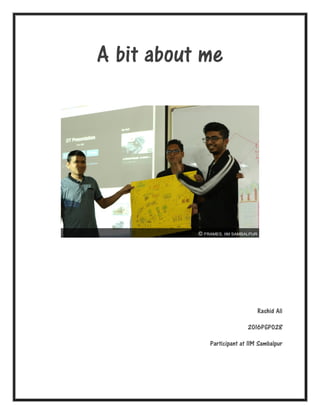
Rashid Ali
2016PGP028
Participant at IIM Sambalpur
Design is not an Asthetics
Design is not an event
Design is not a product
Design is not an experience…..
But…..
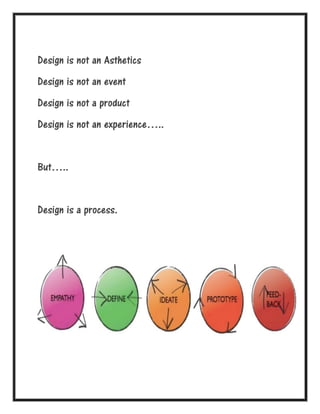
Design is a process.
What Is Design Thinking?
 A Design Methodology
 A Problem-Solving Approach or Process
 A Creativity Approach
 A User-Centered Approach That Brings Design into the Business World
Design Thinking is all about building of ideas. There should be no early judgements about
the quality of ideas, which will reduce the chance of failure. Design thinking used to
explore and define business problems and brings the design approach into the business
world.
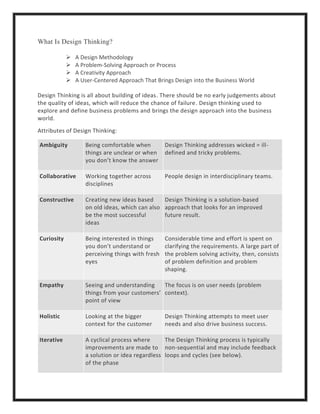
Attributes of Design Thinking:
Ambiguity Being comfortable when
things are unclear or when
you don’t know the answer
Design Thinking addresses wicked = ill-
defined and tricky problems.
Collaborative Working together across
disciplines
People design in interdisciplinary teams.
Constructive Creating new ideas based
on old ideas, which can also
be the most successful
ideas
Design Thinking is a solution-based
approach that looks for an improved
future result.
Curiosity Being interested in things
you don’t understand or
perceiving things with fresh
eyes
Considerable time and effort is spent on
clarifying the requirements. A large part of
the problem solving activity, then, consists
of problem definition and problem
shaping.
Empathy Seeing and understanding
things from your customers’
point of view
The focus is on user needs (problem
context).
Holistic Looking at the bigger
context for the customer
Design Thinking attempts to meet user
needs and also drive business success.
Iterative A cyclical process where
improvements are made to
a solution or idea regardless
of the phase
The Design Thinking process is typically
non-sequential and may include feedback
loops and cycles (see below).
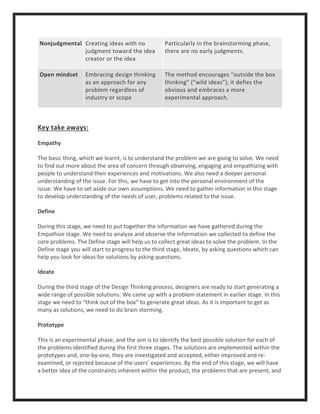
Nonjudgmental Creating ideas with no
judgment toward the idea
creator or the idea
Particularly in the brainstorming phase,
there are no early judgments.
Open mindset Embracing design thinking
as an approach for any
problem regardless of
industry or scope
The method encourages “outside the box
thinking” (“wild ideas”); it defies the
obvious and embraces a more
experimental approach.
Key take aways:
Empathy
The basic thing, which we learnt, is to understand the problem we are going to solve. We need
to find out more about the area of concern through observing, engaging and empathizing with
people to understand their experiences and motivations. We also need a deeper personal
understanding of the issue. For this, we have to get into the personal environment of the
issue. We have to set aside our own assumptions. We need to gather information in this stage
to develop understanding of the needs of user, problems related to the issue.
Define
During this stage, we need to put together the information we have gathered during the
Empathize stage. We need to analyze and observe the information we collected to define the
core problems. The Define stage will help us to collect great ideas to solve the problem. In the
Define stage you will start to progress to the third stage, Ideate, by asking questions which can
help you look for ideas for solutions by asking questions.
Ideate
During the third stage of the Design Thinking process, designers are ready to start generating a
wide range of possible solutions. We came up with a problem statement in earlier stage. In this
stage we need to “think out of the box” to generate great ideas. As it is important to get as
many as solutions, we need to do brain storming.
Prototype
This is an experimental phase, and the aim is to identify the best possible solution for each of
the problems identified during the first three stages. The solutions are implemented within the
prototypes and, one-by-one, they are investigated and accepted, either improved and re-
examined, or rejected because of the users’ experiences. By the end of this stage, we will have
a better idea of the constraints inherent within the product, the problems that are present, and
have a better/more informed perspective of how real users would behave, think, and feel when
interacting with the problem.
Test
We need to transform our ideas into a physical form so that we can interact with them and, in
the process, learn and develop more empathy. We need to test the problem using the best
solutions identified during the prototyping phase. The results generated during the testing
phase are often used to redefine one or more problems and inform the understanding of the
users, the conditions of use, how people think, behave, and feel, and to empathize. During this
phase, modification in solutions are made in order to rule out problem solutions and derive as
deep understanding of the problem and its users as possible.
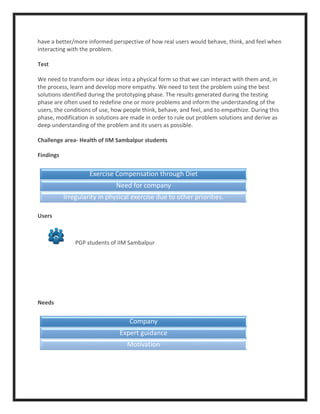
Challenge area- Health of IIM Sambalpur students
Findings
Users
PGP students of IIM Sambalpur
Needs
Exercise Compensation through Diet
Need for company
Irregularity in physical exercise due to other priorities.
Company
Expert guidance
Motivation
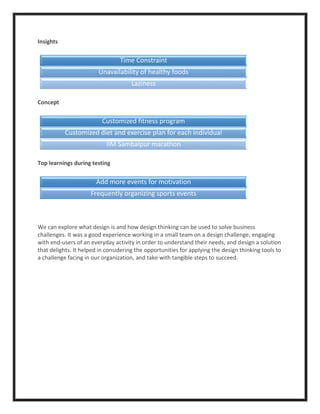
Insights
Concept
Top learnings during testing
We can explore what design is and how design thinking can be used to solve business
challenges. It was a good experience working in a small team on a design challenge, engaging
with end-users of an everyday activity in order to understand their needs, and design a solution
that delights. It helped in considering the opportunities for applying the design thinking tools to
a challenge facing in our organization, and take with tangible steps to succeed.
Time Constraint
Unavailability of healthy foods
Laziness
Customized fitness program
Customized diet and exercise plan for each individual
IIM Sambalpur marathon
Add more events for motivation
Frequently organizing sports events

Rashid ali

  • 1.
    A DESIGN THINKINGEXPERINECE 2017 TinkerLabs workshop RASHID ALI
  • 2.
    A bit aboutme Rashid Ali 2016PGP028 Participant at IIM Sambalpur
  • 3.
    Design is notan Asthetics Design is not an event Design is not a product Design is not an experience….. But….. Design is a process.
  • 5.
    What Is DesignThinking?  A Design Methodology  A Problem-Solving Approach or Process  A Creativity Approach  A User-Centered Approach That Brings Design into the Business World Design Thinking is all about building of ideas. There should be no early judgements about the quality of ideas, which will reduce the chance of failure. Design thinking used to explore and define business problems and brings the design approach into the business world. Attributes of Design Thinking: Ambiguity Being comfortable when things are unclear or when you don’t know the answer Design Thinking addresses wicked = ill- defined and tricky problems. Collaborative Working together across disciplines People design in interdisciplinary teams. Constructive Creating new ideas based on old ideas, which can also be the most successful ideas Design Thinking is a solution-based approach that looks for an improved future result. Curiosity Being interested in things you don’t understand or perceiving things with fresh eyes Considerable time and effort is spent on clarifying the requirements. A large part of the problem solving activity, then, consists of problem definition and problem shaping. Empathy Seeing and understanding things from your customers’ point of view The focus is on user needs (problem context). Holistic Looking at the bigger context for the customer Design Thinking attempts to meet user needs and also drive business success. Iterative A cyclical process where improvements are made to a solution or idea regardless of the phase The Design Thinking process is typically non-sequential and may include feedback loops and cycles (see below).
  • 6.
    Nonjudgmental Creating ideaswith no judgment toward the idea creator or the idea Particularly in the brainstorming phase, there are no early judgments. Open mindset Embracing design thinking as an approach for any problem regardless of industry or scope The method encourages “outside the box thinking” (“wild ideas”); it defies the obvious and embraces a more experimental approach. Key take aways: Empathy The basic thing, which we learnt, is to understand the problem we are going to solve. We need to find out more about the area of concern through observing, engaging and empathizing with people to understand their experiences and motivations. We also need a deeper personal understanding of the issue. For this, we have to get into the personal environment of the issue. We have to set aside our own assumptions. We need to gather information in this stage to develop understanding of the needs of user, problems related to the issue. Define During this stage, we need to put together the information we have gathered during the Empathize stage. We need to analyze and observe the information we collected to define the core problems. The Define stage will help us to collect great ideas to solve the problem. In the Define stage you will start to progress to the third stage, Ideate, by asking questions which can help you look for ideas for solutions by asking questions. Ideate During the third stage of the Design Thinking process, designers are ready to start generating a wide range of possible solutions. We came up with a problem statement in earlier stage. In this stage we need to “think out of the box” to generate great ideas. As it is important to get as many as solutions, we need to do brain storming. Prototype This is an experimental phase, and the aim is to identify the best possible solution for each of the problems identified during the first three stages. The solutions are implemented within the prototypes and, one-by-one, they are investigated and accepted, either improved and re- examined, or rejected because of the users’ experiences. By the end of this stage, we will have a better idea of the constraints inherent within the product, the problems that are present, and
  • 7.
    have a better/moreinformed perspective of how real users would behave, think, and feel when interacting with the problem. Test We need to transform our ideas into a physical form so that we can interact with them and, in the process, learn and develop more empathy. We need to test the problem using the best solutions identified during the prototyping phase. The results generated during the testing phase are often used to redefine one or more problems and inform the understanding of the users, the conditions of use, how people think, behave, and feel, and to empathize. During this phase, modification in solutions are made in order to rule out problem solutions and derive as deep understanding of the problem and its users as possible. Challenge area- Health of IIM Sambalpur students Findings Users PGP students of IIM Sambalpur Needs Exercise Compensation through Diet Need for company Irregularity in physical exercise due to other priorities. Company Expert guidance Motivation
  • 8.
    Insights Concept Top learnings duringtesting We can explore what design is and how design thinking can be used to solve business challenges. It was a good experience working in a small team on a design challenge, engaging with end-users of an everyday activity in order to understand their needs, and design a solution that delights. It helped in considering the opportunities for applying the design thinking tools to a challenge facing in our organization, and take with tangible steps to succeed. Time Constraint Unavailability of healthy foods Laziness Customized fitness program Customized diet and exercise plan for each individual IIM Sambalpur marathon Add more events for motivation Frequently organizing sports events