The Design Thinking Process
(for Insights Professionals)
Designed by
Sophie Grieve-Williams
© FlexMR 2019
Design thinking is not exclusive to designers. Great innovators
across all industries have practiced it. So, why call it design thinking?
What’s special about design thinking is that designers’ work
processes can help us systematically extract, teach, learn and apply
these human-centered techniques to solve problems in creative and
innovative ways, and this can help in our market research!
Research your users needs. You should gain an empathetic
understanding of the problem you’re trying to solve, typically
through user research.
Design thinking’s value is a world-improving, driving force in
business. With design thinking, teams have the freedom to
generate ground-breaking solutions. Using it, your team can get
behind hard-to-access insights and apply a collection of hands-on
methods to help find innovative answers.
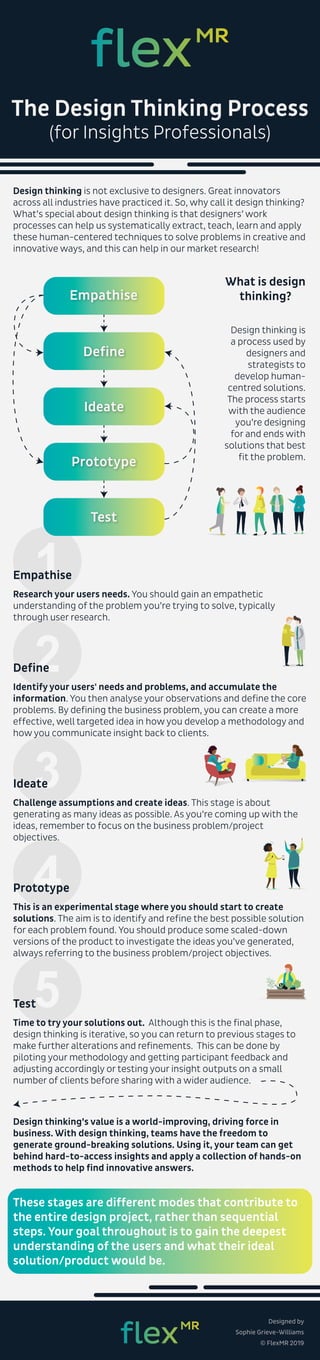
These stages are different modes that contribute to
the entire design project, rather than sequential
steps. Your goal throughout is to gain the deepest
understanding of the users and what their ideal
solution/product would be.
Empathise
What is design
thinking?
Identify your users' needs and problems, and accumulate the
information. You then analyse your observations and define the core
problems. By defining the business problem, you can create a more
effective, well targeted idea in how you develop a methodology and
how you communicate insight back to clients.
Define
Challenge assumptions and create ideas. This stage is about
generating as many ideas as possible. As you’re coming up with the
ideas, remember to focus on the business problem/project
objectives.
Ideate
This is an experimental stage where you should start to create
solutions. The aim is to identify and refine the best possible solution
for each problem found. You should produce some scaled-down
versions of the product to investigate the ideas you’ve generated,
always referring to the business problem/project objectives.
Prototype
Time to try your solutions out. Although this is the final phase,
design thinking is iterative, so you can return to previous stages to
make further alterations and refinements. This can be done by
piloting your methodology and getting participant feedback and
adjusting accordingly or testing your insight outputs on a small
number of clients before sharing with a wider audience.
Test
Design thinking is
a process used by
designers and
strategists to
develop human-
centred solutions.
The process starts
with the audience
you’re designing
for and ends with
solutions that best
fit the problem.
Empathise

The Design Thinking Process (for Insights Professionals)

  • 1.
    The Design ThinkingProcess (for Insights Professionals) Designed by Sophie Grieve-Williams © FlexMR 2019 Design thinking is not exclusive to designers. Great innovators across all industries have practiced it. So, why call it design thinking? What’s special about design thinking is that designers’ work processes can help us systematically extract, teach, learn and apply these human-centered techniques to solve problems in creative and innovative ways, and this can help in our market research! Research your users needs. You should gain an empathetic understanding of the problem you’re trying to solve, typically through user research. Design thinking’s value is a world-improving, driving force in business. With design thinking, teams have the freedom to generate ground-breaking solutions. Using it, your team can get behind hard-to-access insights and apply a collection of hands-on methods to help find innovative answers. These stages are different modes that contribute to the entire design project, rather than sequential steps. Your goal throughout is to gain the deepest understanding of the users and what their ideal solution/product would be. Empathise What is design thinking? Identify your users' needs and problems, and accumulate the information. You then analyse your observations and define the core problems. By defining the business problem, you can create a more effective, well targeted idea in how you develop a methodology and how you communicate insight back to clients. Define Challenge assumptions and create ideas. This stage is about generating as many ideas as possible. As you’re coming up with the ideas, remember to focus on the business problem/project objectives. Ideate This is an experimental stage where you should start to create solutions. The aim is to identify and refine the best possible solution for each problem found. You should produce some scaled-down versions of the product to investigate the ideas you’ve generated, always referring to the business problem/project objectives. Prototype Time to try your solutions out. Although this is the final phase, design thinking is iterative, so you can return to previous stages to make further alterations and refinements. This can be done by piloting your methodology and getting participant feedback and adjusting accordingly or testing your insight outputs on a small number of clients before sharing with a wider audience. Test Design thinking is a process used by designers and strategists to develop human- centred solutions. The process starts with the audience you’re designing for and ends with solutions that best fit the problem. Empathise