marwabenabdallah22@gmail.com
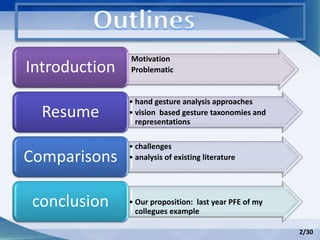
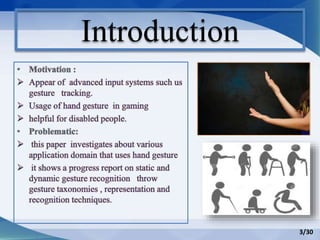
• Motivation
• ProblematicIntroduction
• hand gesture analysis approaches
• vision based gesture taxonomies and
representations
Resume
• challenges
• analysis of existing literatureComparisons
• Our proposition: last year PFE of my
collegues example
conclusion
2/30
Introduction
3/30
Hand gesture
analysis approaches
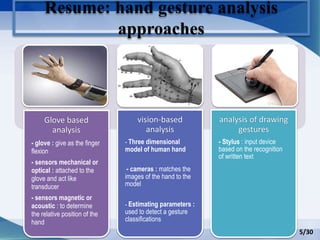
Glove based
analysis
- glove : give as the finger
flexion
- sensors mechanical or
optical : attached to the
glove and act like
transducer
- sensors magnetic or
acoustic : to determine
the relative position of the
hand
vision-based
analysis
- Three dimensional
model of human hand
- cameras : matches the
images of the hand to the
model
- Estimating parameters :
used to detect a gesture
classifications
analysis of drawing
gestures
- Stylus : input device
based on the recognition
of written text
Resume: hand gesture analysis
approaches
5/30
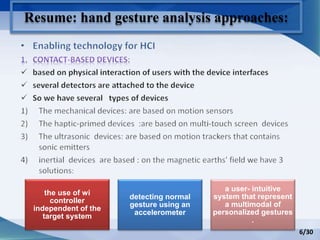
the use of wi
controller
independent of the
target system
detecting normal
gesture using an
accelerometer
a user- intuitive
system that represent
a multimodal of
personalized gestures
.
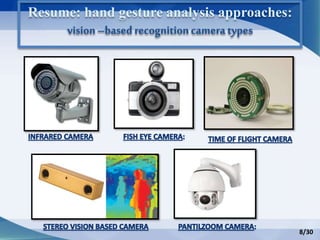
Resume: hand gesture analysis approaches:
6/30
7/30
Resume: hand gesture analysis approaches:
8/30
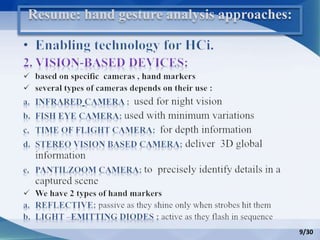
Resume: hand gesture analysis approaches:
9/30
Hand vision
based gesture
taxonomies
and
representations
11/30
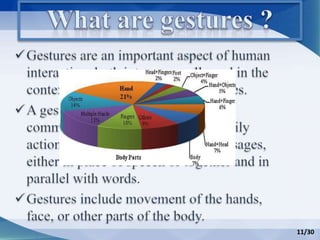
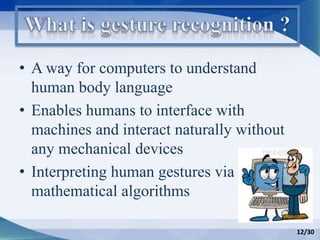
• A way for computers to understand
human body language
• Enables humans to interface with
machines and interact naturally without
any mechanical devices
• Interpreting human gestures via
mathematical algorithms
12/30
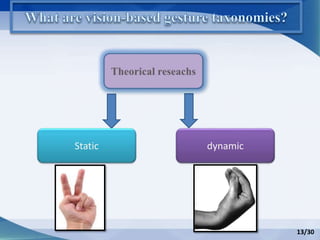
dynamicStatic
13/30
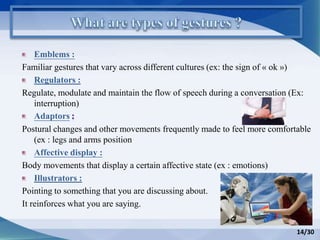
Emblems :
Familiar gestures that vary across different cultures (ex: the sign of « ok »)
Regulators :
Regulate, modulate and maintain the flow of speech during a conversation (Ex:
interruption)
Adaptors
Postural changes and other movements frequently made to feel more comfortable
(ex : legs and arms position
Affective display :
Body movements that display a certain affective state (ex : emotions)
Illustrators :
Pointing to something that you are discussing about.
It reinforces what you are saying.
14/30
15/30
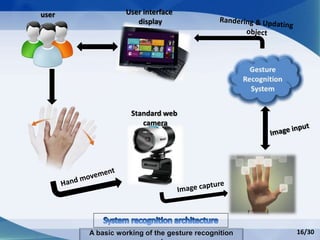
User interface
display
Standard web
camera
user
A basic working of the gesture recognition 16/30
17/30
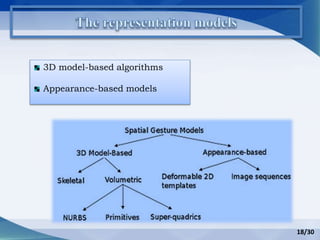
3D model-based algorithms
Appearance-based models
18/30
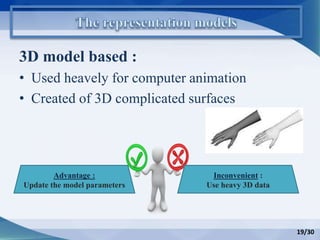
3D model based :
• Used heavely for computer animation
• Created of 3D complicated surfaces
Inconvenient :
Use heavy 3D data
Advantage :
Update the model parameters
19/30
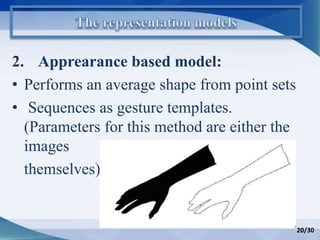
2. Apprearance based model:
• Performs an average shape from point sets
• Sequences as gesture templates.
(Parameters for this method are either the
images
themselves)
20/30
• Hidden Markov Model (HMM) : is a joint
statistical model for an ordered sequence of
variables.
• Finite-state machine (FSM) : development tool
for approaching and solving problems and as a
formal way of describing solutions for later
developers
21/30
• K-means : This classification searches for statistically
similar groups in multi-spectral space.
• K-nearest neighbors (K-NN) : classify objects according
to the closest training examples in the feature space.
• Template matching : determine similarities between two
entities (points, cures, or shapes)
• Support vector machine (SVM) : to nonlinearly map
input data to where the data to separate them.
• Dynamic time warping (DTW) : used to find the
optimal alignment of two signals by calculating the
distance between each possible pair of points out of two
signals
22/30
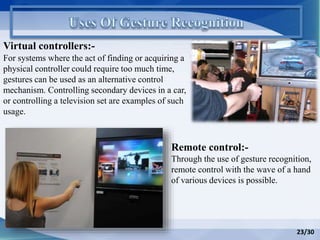
Virtual controllers:-
Remote control:-
Through the use of gesture recognition,
remote control with the wave of a hand
of various devices is possible.
For systems where the act of finding or acquiring a
physical controller could require too much time,
gestures can be used as an alternative control
mechanism. Controlling secondary devices in a car,
or controlling a television set are examples of such
usage.
23/30
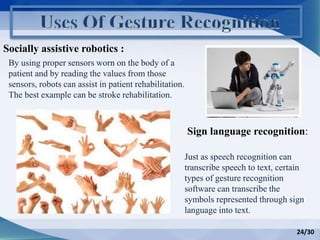
Socially assistive robotics :
Sign language recognition:
By using proper sensors worn on the body of a
patient and by reading the values from those
sensors, robots can assist in patient rehabilitation.
The best example can be stroke rehabilitation.
Just as speech recognition can
transcribe speech to text, certain
types of gesture recognition
software can transcribe the
symbols represented through sign
language into text.
24/30
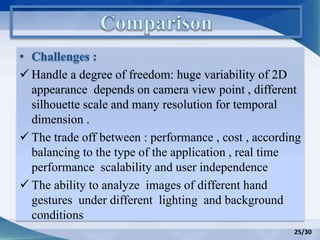
 Handle a degree of freedom: huge variability of 2D
appearance depends on camera view point , different
silhouette scale and many resolution for temporal
dimension .
 The trade off between : performance , cost , according
balancing to the type of the application , real time
performance scalability and user independence
 The ability to analyze images of different hand
gestures under different lighting and background
conditions
25/30
26/30
27/30
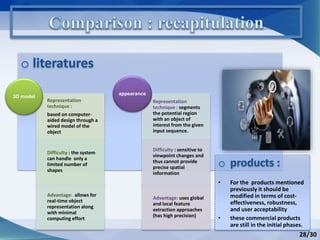
Representation
technique :
based on computer-
aided design through a
wired model of the
object
Difficulty : the system
can handle only a
limited number of
shapes
Advantage: allows for
real-time object
representation along
with minimal
computing effort
3D model
Representation
technique : segments
the potential region
with an object of
interest from the given
input sequence.
Difficulty : sensitive to
viewpoint changes and
thus cannot provide
precise spatial
information
Advantage: uses global
and local feature
extraction approaches
(has high precision)
appearance
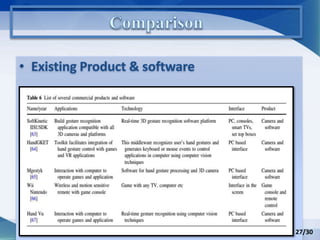
• For the products mentioned
previously it should be
modified in terms of cost-
effectiveness, robustness,
and user acceptability
• these commercial products
are still in the initial phases.
28/30
29/30
Gesture recognition systems

Gesture recognition systems

  • 1.
  • 2.
    • Motivation • ProblematicIntroduction •hand gesture analysis approaches • vision based gesture taxonomies and representations Resume • challenges • analysis of existing literatureComparisons • Our proposition: last year PFE of my collegues example conclusion 2/30
  • 3.
  • 4.
  • 5.
    Glove based analysis - glove: give as the finger flexion - sensors mechanical or optical : attached to the glove and act like transducer - sensors magnetic or acoustic : to determine the relative position of the hand vision-based analysis - Three dimensional model of human hand - cameras : matches the images of the hand to the model - Estimating parameters : used to detect a gesture classifications analysis of drawing gestures - Stylus : input device based on the recognition of written text Resume: hand gesture analysis approaches 5/30
  • 6.
    the use ofwi controller independent of the target system detecting normal gesture using an accelerometer a user- intuitive system that represent a multimodal of personalized gestures . Resume: hand gesture analysis approaches: 6/30
  • 7.
  • 8.
    Resume: hand gestureanalysis approaches: 8/30
  • 9.
    Resume: hand gestureanalysis approaches: 9/30
  • 10.
  • 11.
  • 12.
    • A wayfor computers to understand human body language • Enables humans to interface with machines and interact naturally without any mechanical devices • Interpreting human gestures via mathematical algorithms 12/30
  • 13.
  • 14.
    Emblems : Familiar gesturesthat vary across different cultures (ex: the sign of « ok ») Regulators : Regulate, modulate and maintain the flow of speech during a conversation (Ex: interruption) Adaptors Postural changes and other movements frequently made to feel more comfortable (ex : legs and arms position Affective display : Body movements that display a certain affective state (ex : emotions) Illustrators : Pointing to something that you are discussing about. It reinforces what you are saying. 14/30
  • 15.
  • 16.
    User interface display Standard web camera user Abasic working of the gesture recognition 16/30
  • 17.
  • 18.
  • 19.
    3D model based: • Used heavely for computer animation • Created of 3D complicated surfaces Inconvenient : Use heavy 3D data Advantage : Update the model parameters 19/30
  • 20.
    2. Apprearance basedmodel: • Performs an average shape from point sets • Sequences as gesture templates. (Parameters for this method are either the images themselves) 20/30
  • 21.
    • Hidden MarkovModel (HMM) : is a joint statistical model for an ordered sequence of variables. • Finite-state machine (FSM) : development tool for approaching and solving problems and as a formal way of describing solutions for later developers 21/30
  • 22.
    • K-means :This classification searches for statistically similar groups in multi-spectral space. • K-nearest neighbors (K-NN) : classify objects according to the closest training examples in the feature space. • Template matching : determine similarities between two entities (points, cures, or shapes) • Support vector machine (SVM) : to nonlinearly map input data to where the data to separate them. • Dynamic time warping (DTW) : used to find the optimal alignment of two signals by calculating the distance between each possible pair of points out of two signals 22/30
  • 23.
    Virtual controllers:- Remote control:- Throughthe use of gesture recognition, remote control with the wave of a hand of various devices is possible. For systems where the act of finding or acquiring a physical controller could require too much time, gestures can be used as an alternative control mechanism. Controlling secondary devices in a car, or controlling a television set are examples of such usage. 23/30
  • 24.
    Socially assistive robotics: Sign language recognition: By using proper sensors worn on the body of a patient and by reading the values from those sensors, robots can assist in patient rehabilitation. The best example can be stroke rehabilitation. Just as speech recognition can transcribe speech to text, certain types of gesture recognition software can transcribe the symbols represented through sign language into text. 24/30
  • 25.
     Handle adegree of freedom: huge variability of 2D appearance depends on camera view point , different silhouette scale and many resolution for temporal dimension .  The trade off between : performance , cost , according balancing to the type of the application , real time performance scalability and user independence  The ability to analyze images of different hand gestures under different lighting and background conditions 25/30
  • 26.
  • 27.
  • 28.
    Representation technique : based oncomputer- aided design through a wired model of the object Difficulty : the system can handle only a limited number of shapes Advantage: allows for real-time object representation along with minimal computing effort 3D model Representation technique : segments the potential region with an object of interest from the given input sequence. Difficulty : sensitive to viewpoint changes and thus cannot provide precise spatial information Advantage: uses global and local feature extraction approaches (has high precision) appearance • For the products mentioned previously it should be modified in terms of cost- effectiveness, robustness, and user acceptability • these commercial products are still in the initial phases. 28/30
  • 29.