INTRODUCTION TO “ISO” 
 WHAT IS ISO? 
 ISO BACKGROUND 
 ISO MISSION 
 ISO STANDARDS & TYPES
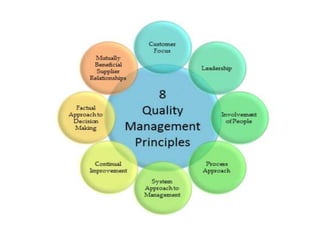
What is ISO 9000 family? 
 ISO 9000:2005 – Fundamentals and Vocabulary 
 ISO 9001:2008 – Quality Management Systems – Requirements 
 ISO 9004:2009 – Quality Management Systems – Guidelines for performance 
improvements 
 ISO 19011: 2011 – Guidelines for quality and/or environmental management 
systems auditing 
What is ISO 9001:2008? 
 It sets out the criteria for a quality management system and is the only 
standard in the family that can be certified to (although this is not a 
requirement). 
 ISO over one million companies and organizations in over 170 countries 
implement 9001:2008.
Why should a company pursue ISO 9001 
registration? 
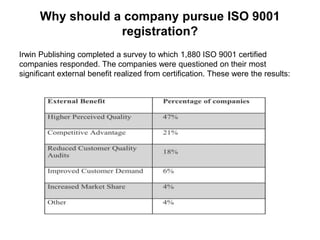
Irwin Publishing completed a survey to which 1,880 ISO 9001 certified 
companies responded. The companies were questioned on their most 
significant external benefit realized from certification. These were the results:
In that same Irwin Publishing/ McGraw-Hill survey, the companies responded 
that their most significant internal benefit realized was: 
Insert internal benefits chart
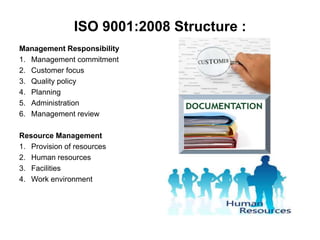
ISO 9001:2008 Structure : 
Management Responsibility 
1. Management commitment 
2. Customer focus 
3. Quality policy 
4. Planning 
5. Administration 
6. Management review 
Resource Management 
1. Provision of resources 
2. Human resources 
3. Facilities 
4. Work environment
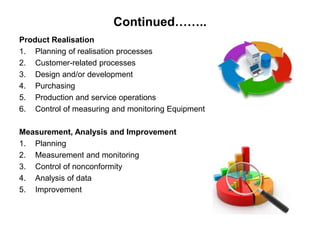
Continued…….. 
Product Realisation 
1. Planning of realisation processes 
2. Customer-related processes 
3. Design and/or development 
4. Purchasing 
5. Production and service operations 
6. Control of measuring and monitoring Equipment 
Measurement, Analysis and Improvement 
1. Planning 
2. Measurement and monitoring 
3. Control of nonconformity 
4. Analysis of data 
5. Improvement
How to begin with the implementation process 
1. Identify the people who need to be involved. 
2. Review or formulate the element/section policy. 
3. Gather all existing, relevant paperwork, such as, data, forms, tags 
(project leader arranges for this to be done prior to the group 
meeting). 
4. Flowchart the existing process, using the paperwork to help identify 
the steps. 
5. Assess the process to the company's needs. 
6. Assess the process to ISO 9001 requirements. 
7. Complete a draft of the procedure and review / revise to create a 
synthesis of company needs and ISO 9001 requirements. 
8. Complete a smooth draft of all documentation. 
9. Obtain appropriate internal approval. 
10. Release the approved documentation (as outlined in your 
Documentation procedure). 
11. Implement (educate the people involved in the process).
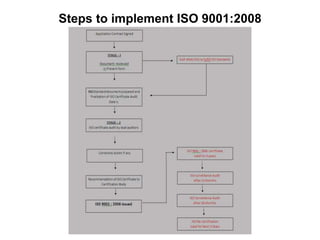
Steps to implement ISO 9001:2008
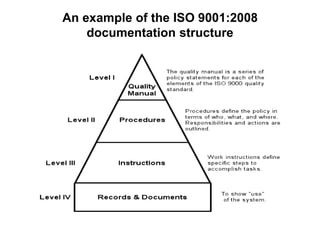
An example of the ISO 9001:2008 
documentation structure
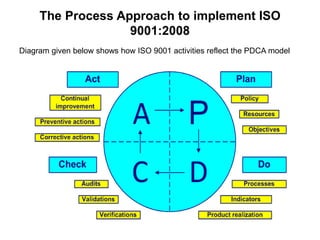
The Process Approach to implement ISO 
9001:2008 
Diagram given below shows how ISO 9001 activities reflect the PDCA model
Certification 
 The various accreditation bodies have mutual there to ensure that 
certificates issued by one of the accredited certification bodies (CB) are 
accepted worldwide. 
 An organization applying for ISO 9001 certification is audited based on an 
extensive sample of its sites, functions, products, services and processes. 
 The certificate is limited by a certain scope (e.g., production of golf balls) 
and will display the addresses to which the certificate refers. 
 An ISO 9001 certificate is not a once-and-for-all award, but must be 
renewed at regular intervals recommended by the certification body, usually 
once every three years.
Key Benefits of ISO 9001:2008 
 Carefully planned improvements, based on documentation and analysis 
 Improves and establishes training processes 
 Defines roles and responsibilities 
 Greatly increases operational efficiency 
 Increases ability to troubleshoot 
 Develops and builds relationships that help to retain existing customers 
 Provides advantages over competitors that aren't certified ISO 9001:2008 
 Builds opportunities for global commerce with international recognition 
 Improves customer relations 
 Improves relationships with suppliers due to clear, concise production 
standards. Provides basis for consistent and fact-based decision making 
 Carefully planned improvements, based on documentation and analysis 
 Provides for regular audits/reviews of performance
Key Learning Points observed in the study: 
We observed the needs, procedure of implementation of ISO 9001:2008 and 
benefits for the educational institute Dr. V.N.BRIMS. The observation were: 
 The need for the organization to go for ISO certification was to maintain and 
improve the quality of service they provide. 
 For implementing the ISO standards, the approach of the institute was Plan- 
Do-Check-Act. 
 Benefits of the ISO implementation were limited. It helped them to improve 
their internal environment.
The suggestions for the Institute from our 
study 
 We suggest the institute to implement ISO 26000:2010. 
 ISO 26000:2010 provides guidance rather than requirements, so it cannot 
be certified to unlike some other well-known ISO standards. 
 Instead, it helps clarify what social responsibility is, helps businesses and 
organizations translate principles into effective actions and shares best 
practices relating to social responsibility, globally. 
 Institute is already involved in CSR activities. 
 Also, it might help to increase the Brand Value of the Institute

ISO 9001 - It sets out the criteria for a quality management system and is the only standard in the family that can be certified to (although this is not a requirement).

  • 1.
    INTRODUCTION TO “ISO”  WHAT IS ISO?  ISO BACKGROUND  ISO MISSION  ISO STANDARDS & TYPES
  • 2.
    What is ISO9000 family?  ISO 9000:2005 – Fundamentals and Vocabulary  ISO 9001:2008 – Quality Management Systems – Requirements  ISO 9004:2009 – Quality Management Systems – Guidelines for performance improvements  ISO 19011: 2011 – Guidelines for quality and/or environmental management systems auditing What is ISO 9001:2008?  It sets out the criteria for a quality management system and is the only standard in the family that can be certified to (although this is not a requirement).  ISO over one million companies and organizations in over 170 countries implement 9001:2008.
  • 3.
    Why should acompany pursue ISO 9001 registration? Irwin Publishing completed a survey to which 1,880 ISO 9001 certified companies responded. The companies were questioned on their most significant external benefit realized from certification. These were the results:
  • 4.
    In that sameIrwin Publishing/ McGraw-Hill survey, the companies responded that their most significant internal benefit realized was: Insert internal benefits chart
  • 6.
    ISO 9001:2008 Structure: Management Responsibility 1. Management commitment 2. Customer focus 3. Quality policy 4. Planning 5. Administration 6. Management review Resource Management 1. Provision of resources 2. Human resources 3. Facilities 4. Work environment
  • 7.
    Continued…….. Product Realisation 1. Planning of realisation processes 2. Customer-related processes 3. Design and/or development 4. Purchasing 5. Production and service operations 6. Control of measuring and monitoring Equipment Measurement, Analysis and Improvement 1. Planning 2. Measurement and monitoring 3. Control of nonconformity 4. Analysis of data 5. Improvement
  • 8.
    How to beginwith the implementation process 1. Identify the people who need to be involved. 2. Review or formulate the element/section policy. 3. Gather all existing, relevant paperwork, such as, data, forms, tags (project leader arranges for this to be done prior to the group meeting). 4. Flowchart the existing process, using the paperwork to help identify the steps. 5. Assess the process to the company's needs. 6. Assess the process to ISO 9001 requirements. 7. Complete a draft of the procedure and review / revise to create a synthesis of company needs and ISO 9001 requirements. 8. Complete a smooth draft of all documentation. 9. Obtain appropriate internal approval. 10. Release the approved documentation (as outlined in your Documentation procedure). 11. Implement (educate the people involved in the process).
  • 9.
    Steps to implementISO 9001:2008
  • 10.
    An example ofthe ISO 9001:2008 documentation structure
  • 11.
    The Process Approachto implement ISO 9001:2008 Diagram given below shows how ISO 9001 activities reflect the PDCA model
  • 12.
    Certification  Thevarious accreditation bodies have mutual there to ensure that certificates issued by one of the accredited certification bodies (CB) are accepted worldwide.  An organization applying for ISO 9001 certification is audited based on an extensive sample of its sites, functions, products, services and processes.  The certificate is limited by a certain scope (e.g., production of golf balls) and will display the addresses to which the certificate refers.  An ISO 9001 certificate is not a once-and-for-all award, but must be renewed at regular intervals recommended by the certification body, usually once every three years.
  • 13.
    Key Benefits ofISO 9001:2008  Carefully planned improvements, based on documentation and analysis  Improves and establishes training processes  Defines roles and responsibilities  Greatly increases operational efficiency  Increases ability to troubleshoot  Develops and builds relationships that help to retain existing customers  Provides advantages over competitors that aren't certified ISO 9001:2008  Builds opportunities for global commerce with international recognition  Improves customer relations  Improves relationships with suppliers due to clear, concise production standards. Provides basis for consistent and fact-based decision making  Carefully planned improvements, based on documentation and analysis  Provides for regular audits/reviews of performance
  • 14.
    Key Learning Pointsobserved in the study: We observed the needs, procedure of implementation of ISO 9001:2008 and benefits for the educational institute Dr. V.N.BRIMS. The observation were:  The need for the organization to go for ISO certification was to maintain and improve the quality of service they provide.  For implementing the ISO standards, the approach of the institute was Plan- Do-Check-Act.  Benefits of the ISO implementation were limited. It helped them to improve their internal environment.
  • 15.
    The suggestions forthe Institute from our study  We suggest the institute to implement ISO 26000:2010.  ISO 26000:2010 provides guidance rather than requirements, so it cannot be certified to unlike some other well-known ISO standards.  Instead, it helps clarify what social responsibility is, helps businesses and organizations translate principles into effective actions and shares best practices relating to social responsibility, globally.  Institute is already involved in CSR activities.  Also, it might help to increase the Brand Value of the Institute