
Gestures Technology
 Interface with computers using gestures of the human body,
typically hand movements.
 In gesture recognition technology, a camera reads the movements
of the human body and communicates the data to a computer that
uses the gestures as input to control devices or applications.
 Gesture recognition is a topic in computer science and language
technology with the goal of interpreting human gestures via
mathematical algorithms.
 Gestures can originate from any bodily motion or state but
commonly originate from the face or hand.
What is Gestures ?
 Current focuses in the field include emotion recognition from the face
and hand gesture recognition. Many approaches have been made using
cameras and computer vision algorithms to interpret sign language.
 Gesture recognition can be conducted with techniques from computer
vision and image processing.
 The literature includes ongoing work in the computer vision field on
capturing gestures or more general human pose and movements by
cameras connected to a computer.
 A primary goal of gesture recognition research is to create a system which
can identify specific human gestures and use them to convey information
or for device control.
Overview
 This computing not only going to reduce the hardware impact of the system
but also it increases the range of usage of physical world object instead of
digital object like keyboards, mouse.
 Using this we can implement and can create a new thesis of creating of new
hardware no requirement of monitors too.
 This idea may lead us to the creation of holographic display.
 The term gesture recognition has been used to refer more narrowly to non-
text-input handwriting symbols, such as inking on a graphics tablet, multi-
touch gestures, and mouse gesture recognition. This is computer interaction
through the drawing of symbols with a pointing device cursor.
Gesture Recognition and Pen Computing
 Offline gestures :
Those gestures that are processed after the user interaction with the
object. An example is the gesture to activate a menu.
 Online gestures :
 Direct manipulation gestures. They are used to scale or rotate a tangible
object.
Two types of gestures are distinguished :
Gesture Types
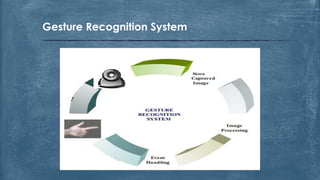
Gesture Recognition System
 Sign language recognition
 For socially assistive robotics
 Directional indication through pointing
 Control through facial gestures
 Alternative computer interfaces
 Immersive game technology
 Virtual controllers
 Affective computing and Remote
control
Uses :
 Wired Gloves
Depth-aware cameras
Stereo Cameras
Controller-based gestures
Single camera
Input devices :
Which Algorithms Used in Gesture ?
 3D model-based algorithms
 Skeletal-based algorithms
 Appearance-based models
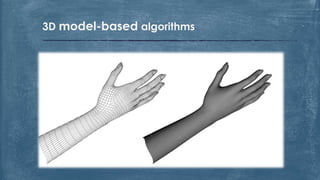
3D model-based algorithms
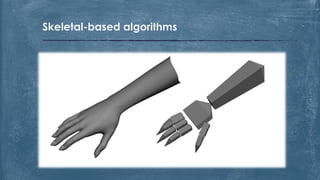
Skeletal-based algorithms
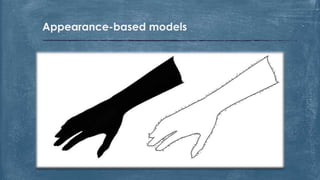
Appearance-based models
THANK YOU

Part 1 - Gesture Recognition Technology

  • 1.
  • 2.
     Interface withcomputers using gestures of the human body, typically hand movements.  In gesture recognition technology, a camera reads the movements of the human body and communicates the data to a computer that uses the gestures as input to control devices or applications.  Gesture recognition is a topic in computer science and language technology with the goal of interpreting human gestures via mathematical algorithms.  Gestures can originate from any bodily motion or state but commonly originate from the face or hand. What is Gestures ?
  • 3.
     Current focusesin the field include emotion recognition from the face and hand gesture recognition. Many approaches have been made using cameras and computer vision algorithms to interpret sign language.  Gesture recognition can be conducted with techniques from computer vision and image processing.  The literature includes ongoing work in the computer vision field on capturing gestures or more general human pose and movements by cameras connected to a computer.  A primary goal of gesture recognition research is to create a system which can identify specific human gestures and use them to convey information or for device control. Overview
  • 4.
     This computingnot only going to reduce the hardware impact of the system but also it increases the range of usage of physical world object instead of digital object like keyboards, mouse.  Using this we can implement and can create a new thesis of creating of new hardware no requirement of monitors too.  This idea may lead us to the creation of holographic display.  The term gesture recognition has been used to refer more narrowly to non- text-input handwriting symbols, such as inking on a graphics tablet, multi- touch gestures, and mouse gesture recognition. This is computer interaction through the drawing of symbols with a pointing device cursor. Gesture Recognition and Pen Computing
  • 5.
     Offline gestures: Those gestures that are processed after the user interaction with the object. An example is the gesture to activate a menu.  Online gestures :  Direct manipulation gestures. They are used to scale or rotate a tangible object. Two types of gestures are distinguished : Gesture Types
  • 6.
  • 7.
     Sign languagerecognition  For socially assistive robotics  Directional indication through pointing  Control through facial gestures  Alternative computer interfaces  Immersive game technology  Virtual controllers  Affective computing and Remote control Uses :
  • 8.
     Wired Gloves Depth-awarecameras Stereo Cameras Controller-based gestures Single camera Input devices :
  • 9.
    Which Algorithms Usedin Gesture ?  3D model-based algorithms  Skeletal-based algorithms  Appearance-based models
  • 10.
  • 11.
  • 12.
  • 13.