A REAL-TIME HAND GESTURE
RECOGNITION METHOD
SUBMITTED BY,
JAISON THOMAS
S7 ECE-A
ROLL NO : 48
GUIDED BY,
SUNITHA S PILLAI
ASST. PROFESSOR
DEPT. OF ECE
SJCET
Contents
• Introduction
• Features of gesture recognition
• Algorithms of hand gesture recognition
• Different process of gesture recognition
• Advantages
• Applications
• Conclusion
• Future work
2
Introduction
 Vision based hand gesture interface has been attracting
more attentions due to no extra hardware requirement
except camera, which is very suitable for emerging
applications.
 This method is not confined by aspect ratio of hand image
and can deal with cluttered background.
 Its also immune to camera movement in virtue of stable
hand tracking.
3
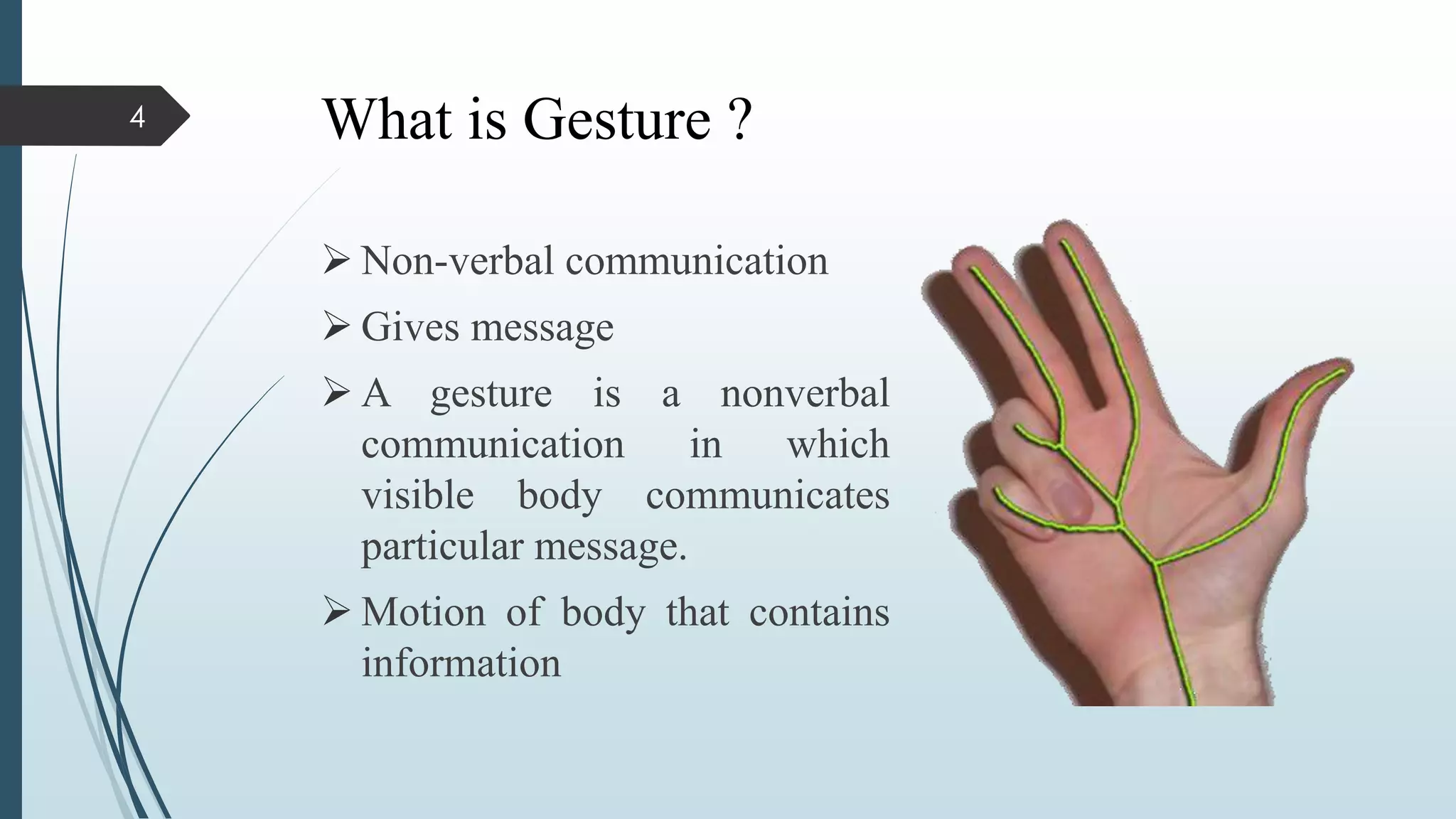
What is Gesture ?
 Non-verbal communication
 Gives message
 A gesture is a nonverbal
communication in which
visible body communicates
particular message.
 Motion of body that contains
information
4
Features of gesture recognition
 Human computer interaction
 Gesture provides a way for computers to understand
human body language.
 Deals with the goal of interpreting human gestures via
mathematical algorithms.
 Enables humans to interface with the machine (HMI) and
interact naturally without any mechanical devices.
5
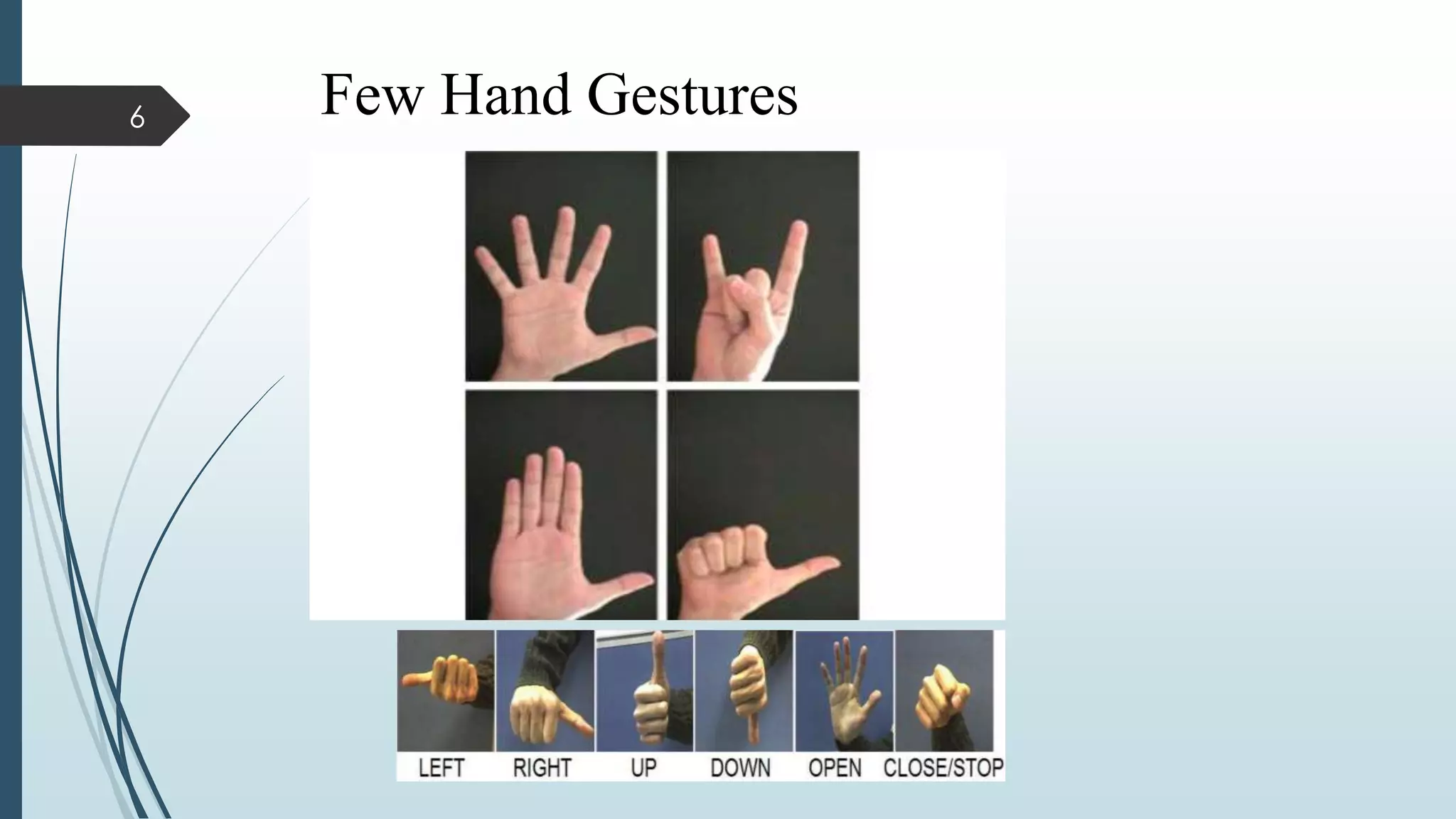
Few Hand Gestures6
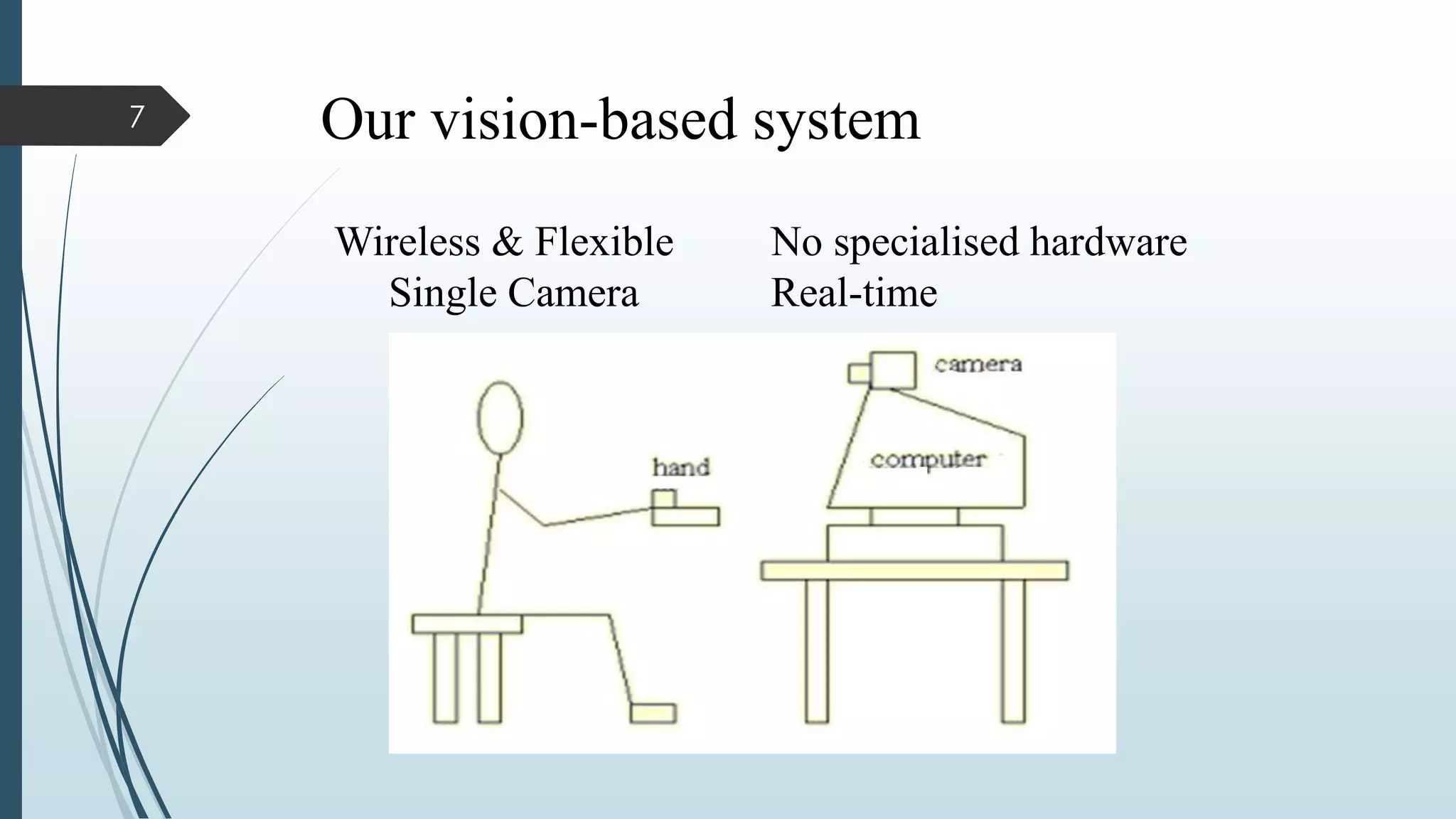
Our vision-based system
Wireless & Flexible No specialised hardware
Single Camera Real-time
7
Algorithms of hand gesture recognition
1. 3D model-based algorithms
2. Skeletal-based algorithms
3. Appearance-based models
8
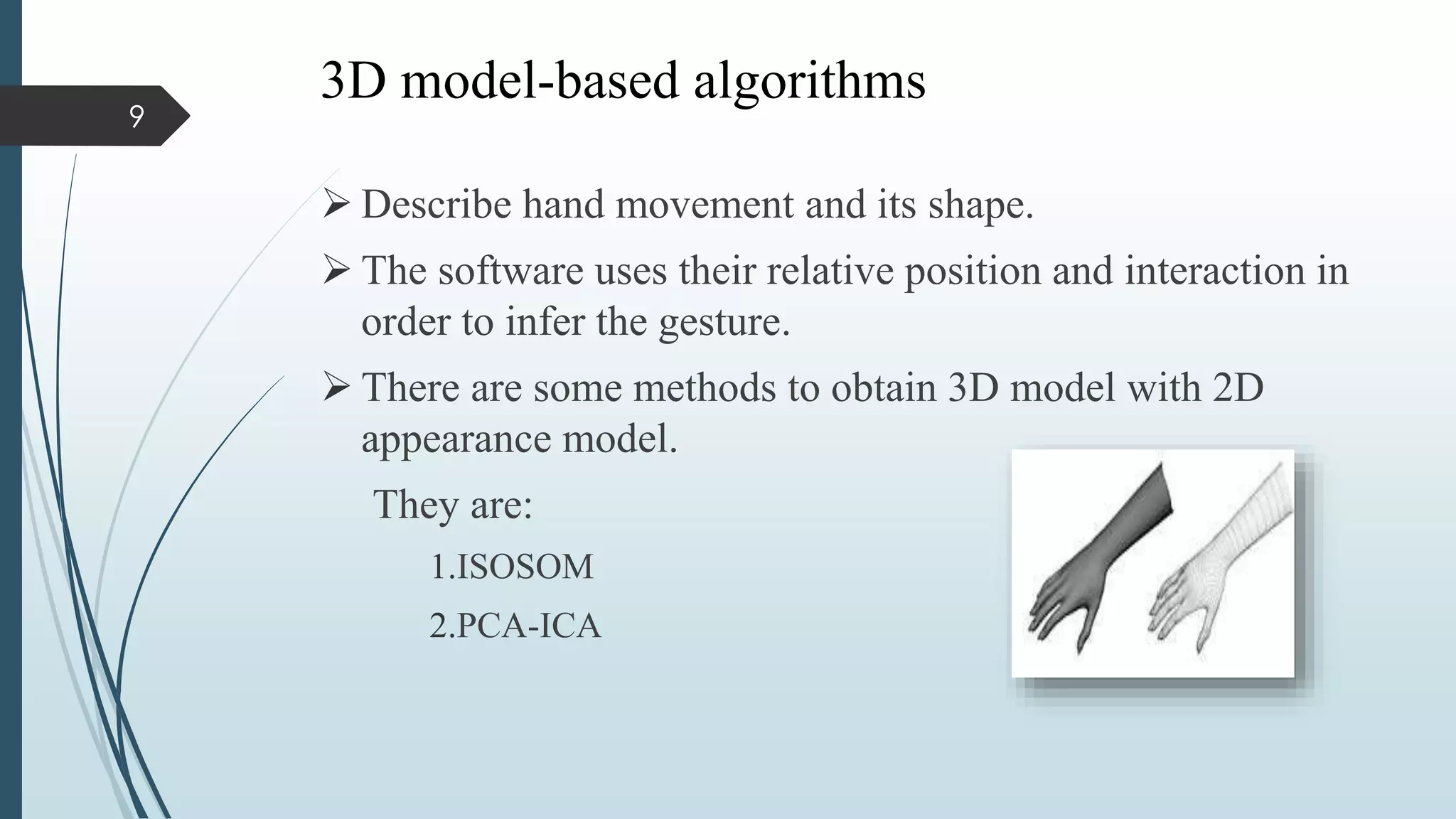
3D model-based algorithms
 Describe hand movement and its shape.
 The software uses their relative position and interaction in
order to infer the gesture.
 There are some methods to obtain 3D model with 2D
appearance model.
They are:
1.ISOSOM
2.PCA-ICA
9
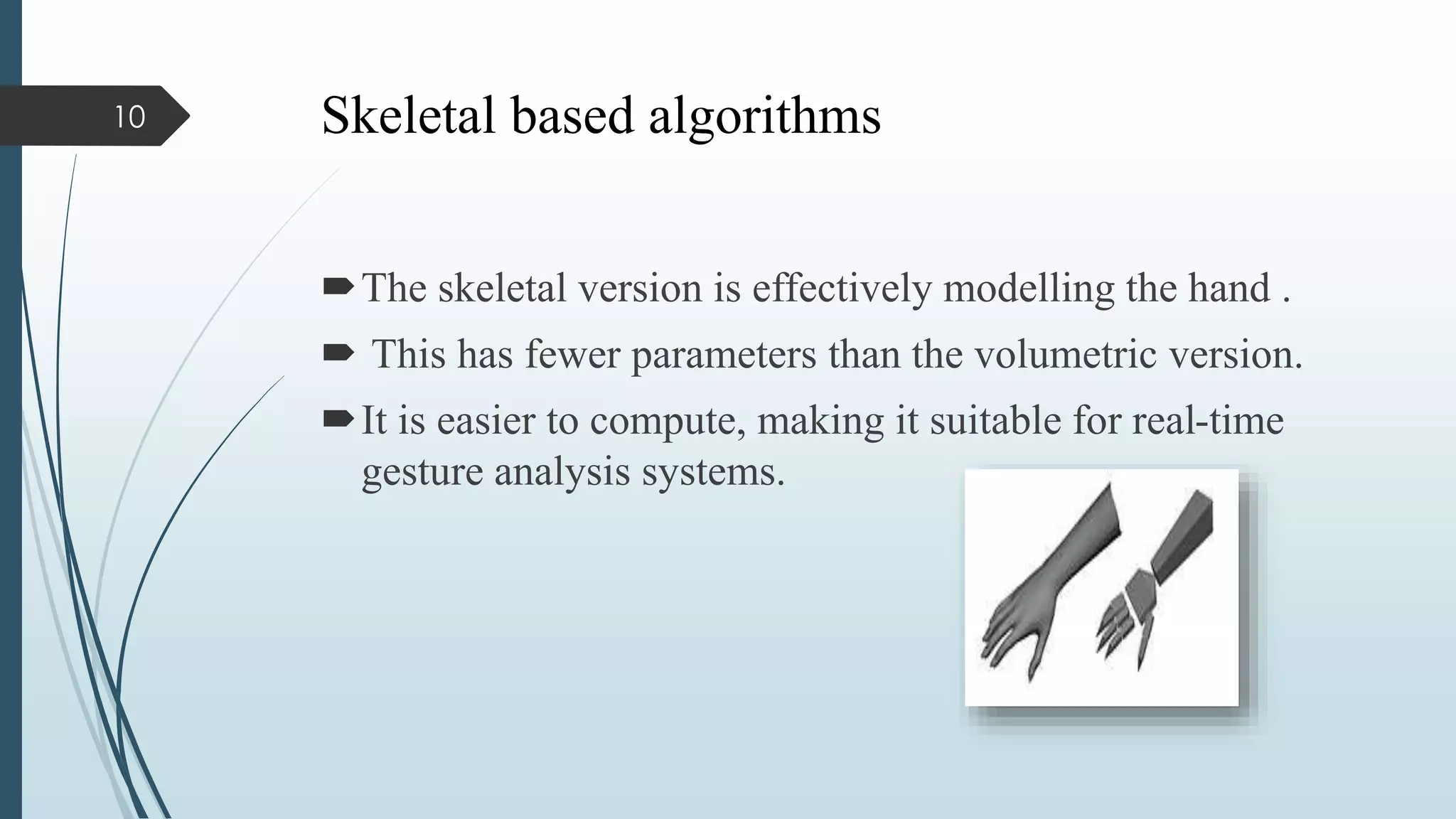
Skeletal based algorithms
The skeletal version is effectively modelling the hand .
 This has fewer parameters than the volumetric version.
It is easier to compute, making it suitable for real-time
gesture analysis systems.
10
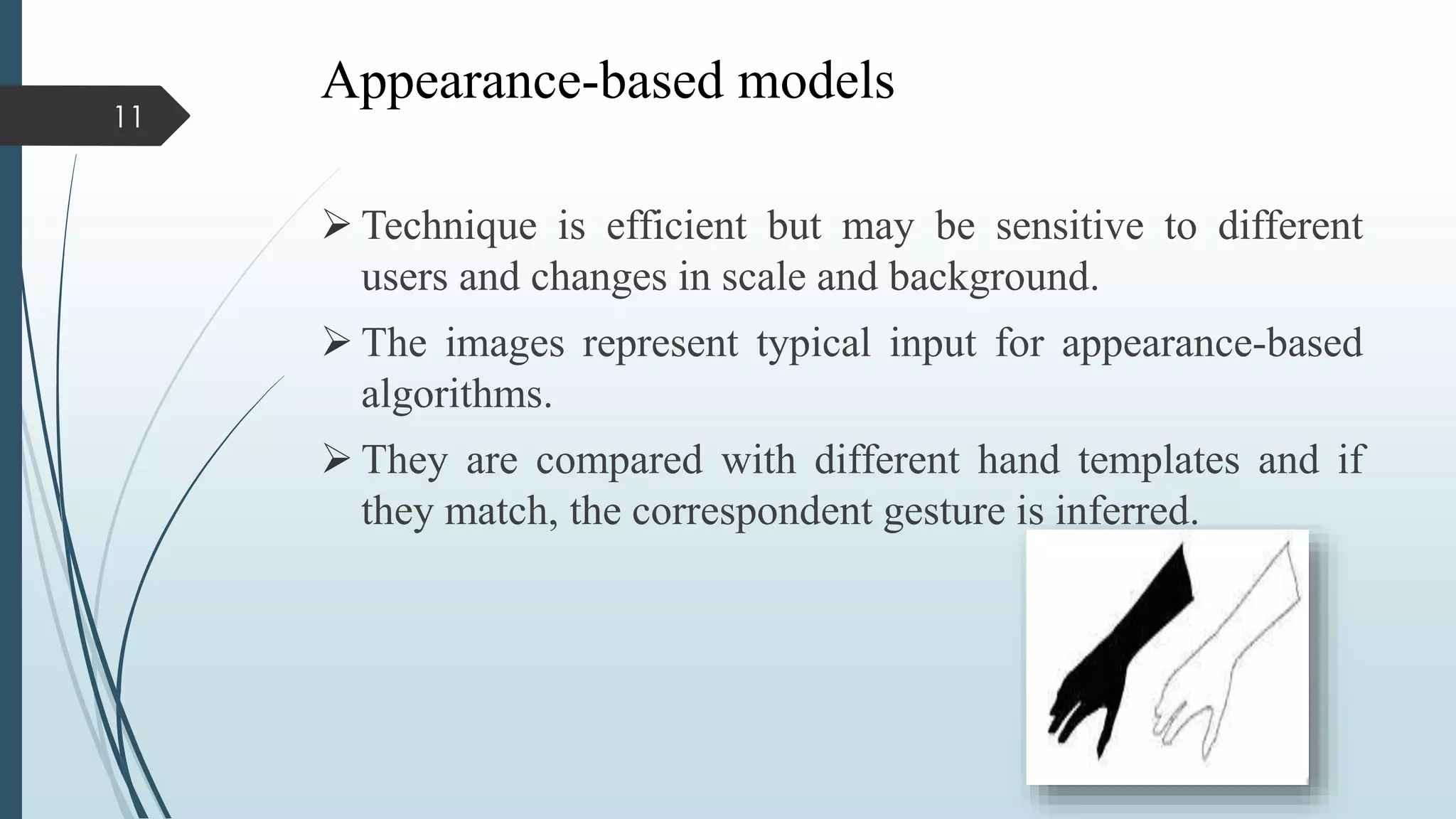
Appearance-based models
 Technique is efficient but may be sensitive to different
users and changes in scale and background.
 The images represent typical input for appearance-based
algorithms.
 They are compared with different hand templates and if
they match, the correspondent gesture is inferred.
11
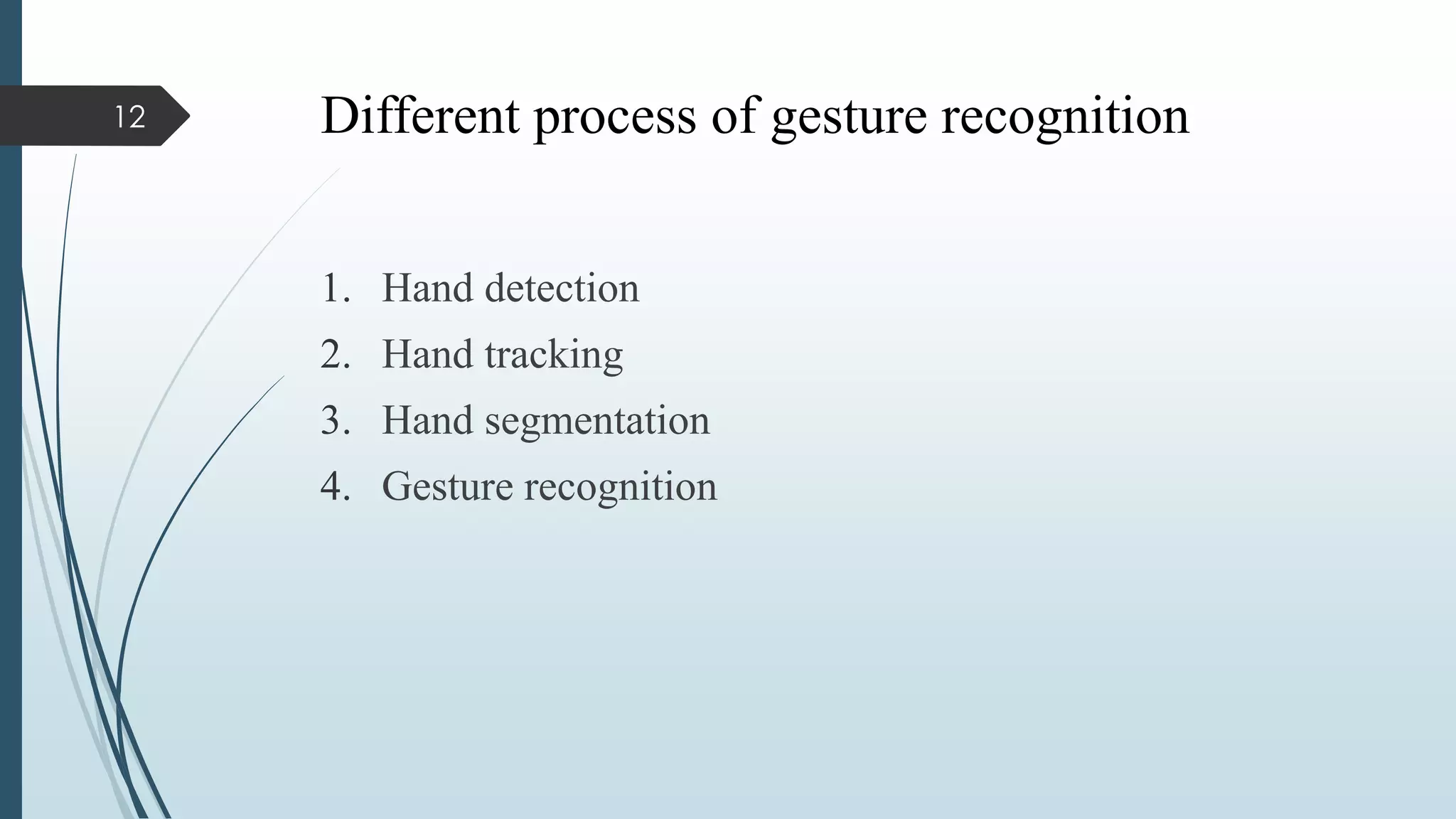
Different process of gesture recognition
1. Hand detection
2. Hand tracking
3. Hand segmentation
4. Gesture recognition
12
Hand detection
 Hand detection is important for a gesture interface as it
functions as a switch to turn on the interface.
 Hand detection methods are sensitive to complicated
background.
 Hand detection uses extended Adaboost method.
13
Hand tracking
 Texture or appearance based methods have been improved
to be more robust for the non-rigid objects.
 In this method, we use a multi-modal technique which
combines optical flow and color cue to obtain stable hand
tracking.
 Flock of features method feasible in the articulated object
tracking.
14
Hand segmentation
 We use a single Gaussian model to describe hand colour in
HSV colour space.
 Histogram method is based on the assumption that no
other exposed skin colour part of user in the certain area
around the hand.
 Wooden objects passing through the area, the histogram
will deviate and segmentation results will be rapidly
degraded. In that case our method can get better results.
15
Skin colour collect
method
Hand segmentation results
16
Gesture recognition
 Hand gestures using local oriental histogram feature
distribution model, but background in experiments are
quite simple and sleeve colour and texture are restricted.
 Scale-space features detection have been widely applied in
object recognition, image registering.
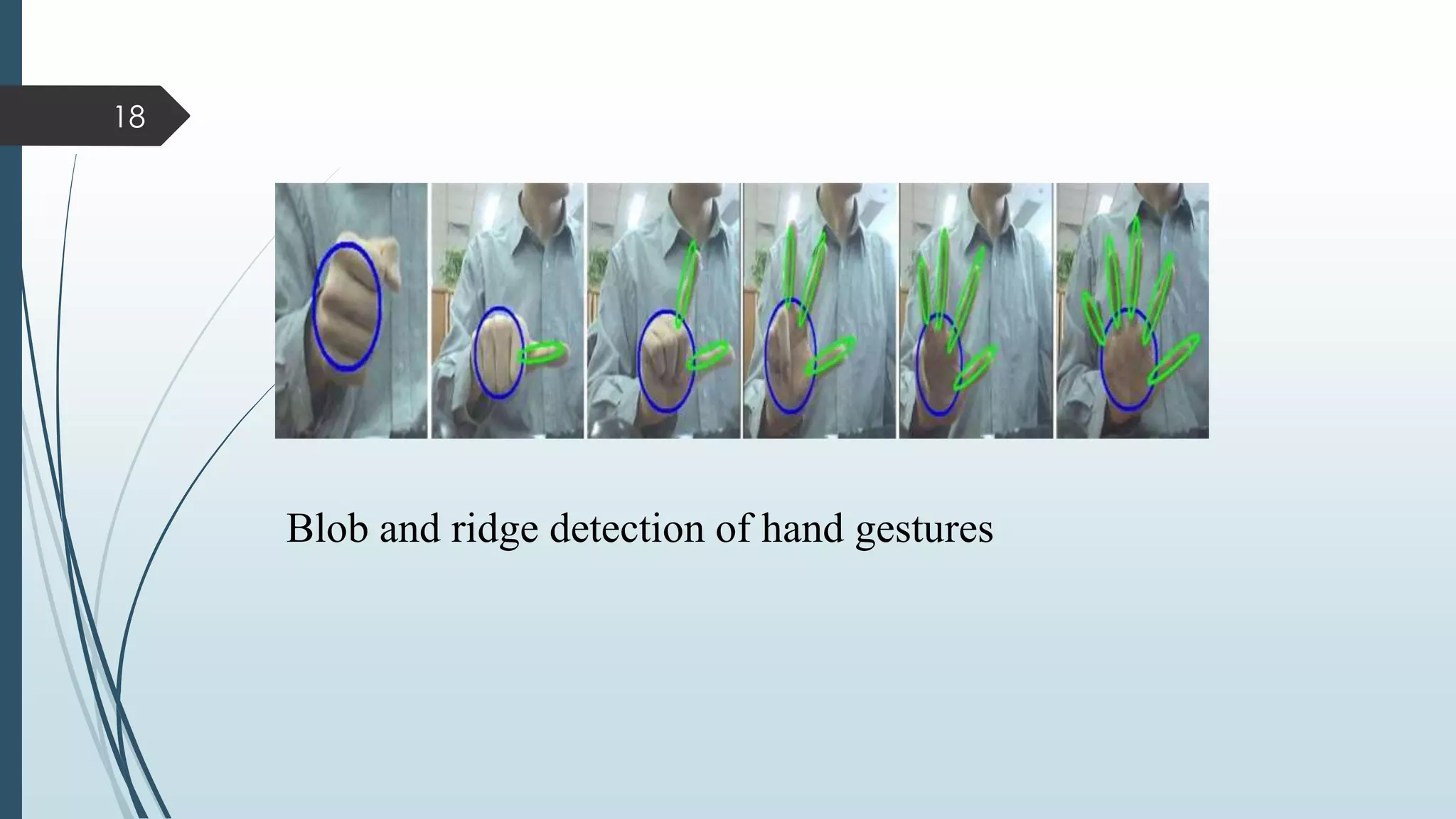
 For planar hand shape, the scale-space feature detection
can be used to detect blob and ridge structures, i.e. palm
and finger structures.
 In this method multi-scale feature detection with hand
tracking and segmentation is used.
17
18
Blob and ridge detection of hand gestures
Advantages
 Replace mouse and keyboard
 Pointing gestures
 Navigate in a virtual environment
 Pick up and manipulate virtual objects
 Interact with a 3D world
 No physical contact with computer
 Communicate at a distance
19
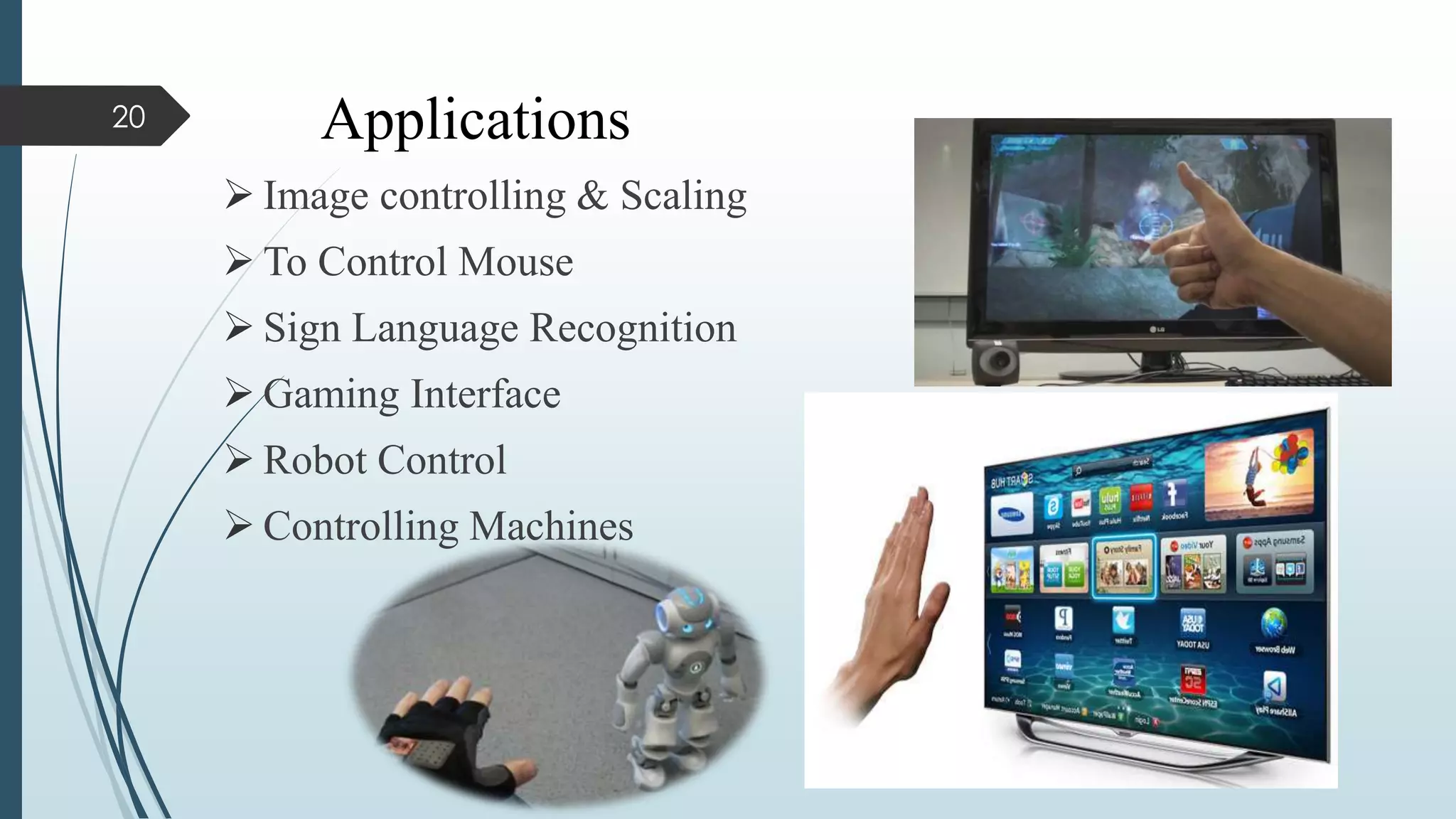
Applications
 Image controlling & Scaling
 To Control Mouse
 Sign Language Recognition
 Gaming Interface
 Robot Control
 Controlling Machines
20
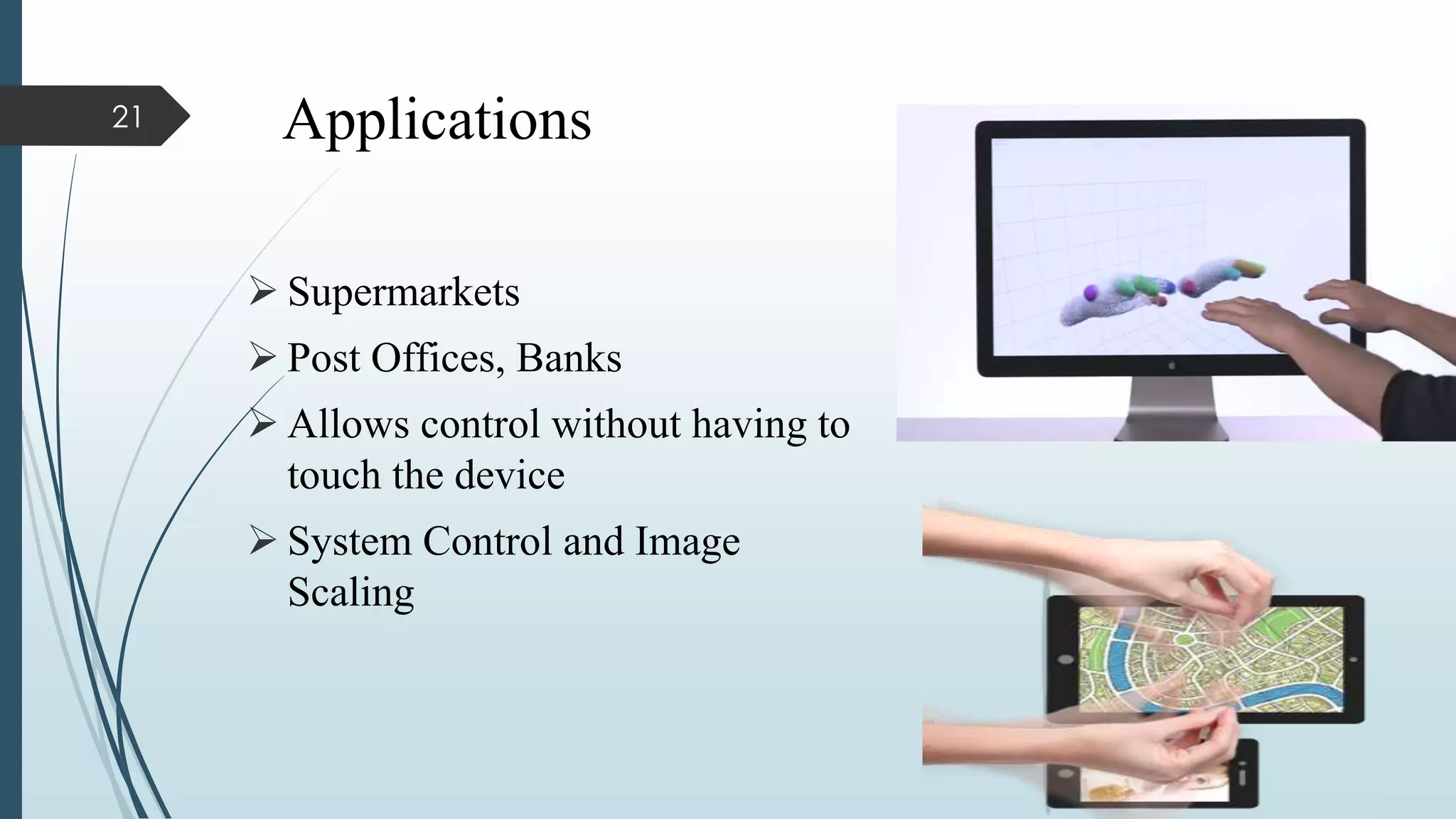
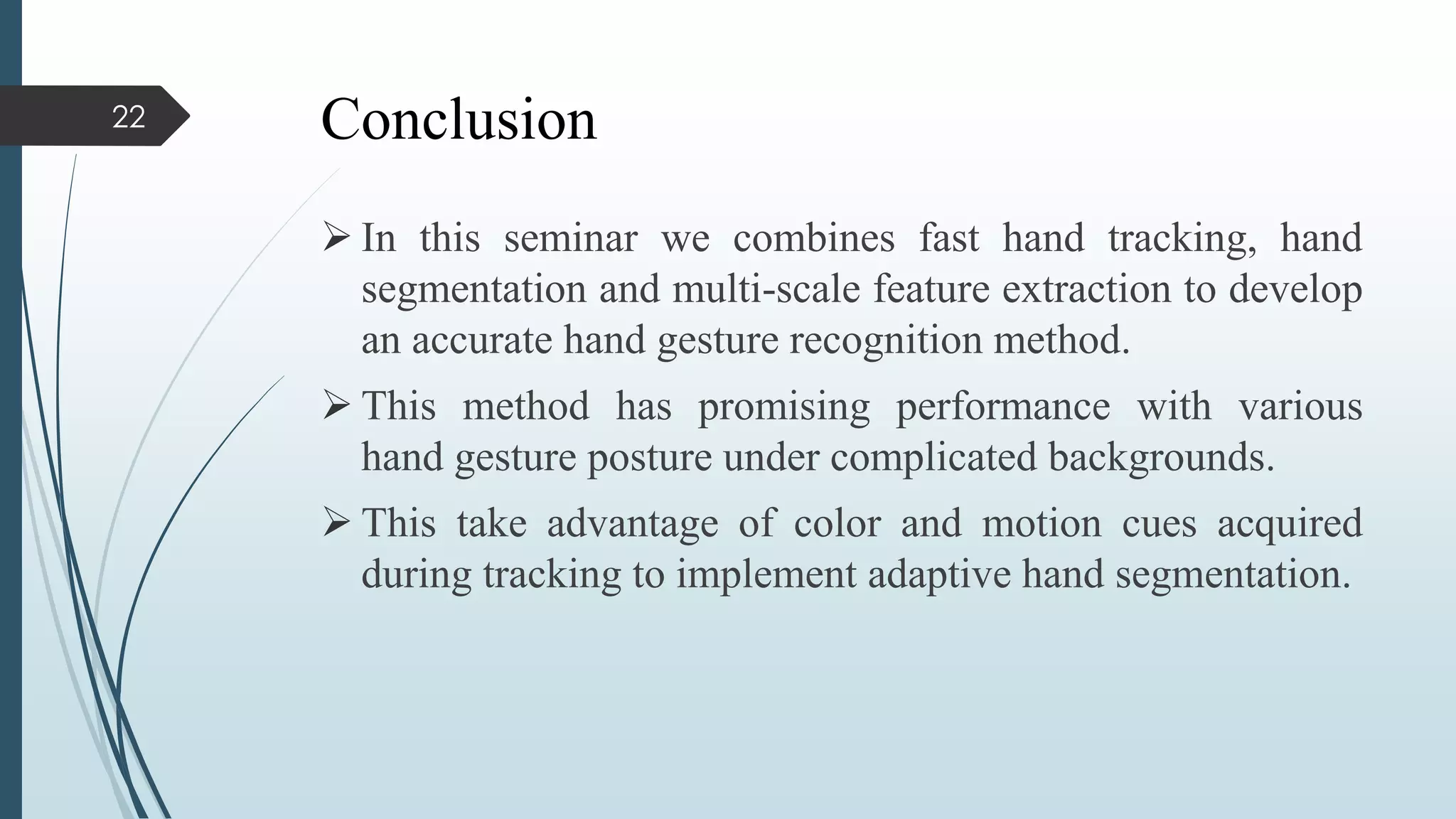
Applications
 Supermarkets
 Post Offices, Banks
 Allows control without having to
touch the device
 System Control and Image
Scaling
21
Conclusion
 In this seminar we combines fast hand tracking, hand
segmentation and multi-scale feature extraction to develop
an accurate hand gesture recognition method.
 This method has promising performance with various
hand gesture posture under complicated backgrounds.
 This take advantage of color and motion cues acquired
during tracking to implement adaptive hand segmentation.
22
Future work
 Current collaboration with Assistive Technology
researchers and members of the Deaf community for
continued design work should be considered for continued
progress.
 This system can be implemented in many application areas
examples include accessing government websites whereby
no video clip for deaf and mute is available or filling out
forms online whereby no interpreter may be present to
help.
23
References
 Yikai Fang, Kongqiao Wang, Jian Cheng and Hanqing Lu, ‘Real-
time hand gesture recognition method’ for National Lab of
Automation, Chinese Academy of Sciences, Beijing (IEEE paper).
 Y. Cui and J. Weng, “View-based hand segmentation and hand
sequence recognition with complex backgrounds,” in Proceedings of
13th ICPR. Vienna, Austria, Aug. 1996, vol. 3, pp. 617– 621.
 Mathias Kolsch, “Vision based hand gesture interfaces for wearable
computing and virtual environments,” PHD Dissertation,UCSB,
2005.
24
25

Real time gesture recognition

  • 1.
    A REAL-TIME HANDGESTURE RECOGNITION METHOD SUBMITTED BY, JAISON THOMAS S7 ECE-A ROLL NO : 48 GUIDED BY, SUNITHA S PILLAI ASST. PROFESSOR DEPT. OF ECE SJCET
  • 2.
    Contents • Introduction • Featuresof gesture recognition • Algorithms of hand gesture recognition • Different process of gesture recognition • Advantages • Applications • Conclusion • Future work 2
  • 3.
    Introduction  Vision basedhand gesture interface has been attracting more attentions due to no extra hardware requirement except camera, which is very suitable for emerging applications.  This method is not confined by aspect ratio of hand image and can deal with cluttered background.  Its also immune to camera movement in virtue of stable hand tracking. 3
  • 4.
    What is Gesture?  Non-verbal communication  Gives message  A gesture is a nonverbal communication in which visible body communicates particular message.  Motion of body that contains information 4
  • 5.
    Features of gesturerecognition  Human computer interaction  Gesture provides a way for computers to understand human body language.  Deals with the goal of interpreting human gestures via mathematical algorithms.  Enables humans to interface with the machine (HMI) and interact naturally without any mechanical devices. 5
  • 6.
  • 7.
    Our vision-based system Wireless& Flexible No specialised hardware Single Camera Real-time 7
  • 8.
    Algorithms of handgesture recognition 1. 3D model-based algorithms 2. Skeletal-based algorithms 3. Appearance-based models 8
  • 9.
    3D model-based algorithms Describe hand movement and its shape.  The software uses their relative position and interaction in order to infer the gesture.  There are some methods to obtain 3D model with 2D appearance model. They are: 1.ISOSOM 2.PCA-ICA 9
  • 10.
    Skeletal based algorithms Theskeletal version is effectively modelling the hand .  This has fewer parameters than the volumetric version. It is easier to compute, making it suitable for real-time gesture analysis systems. 10
  • 11.
    Appearance-based models  Techniqueis efficient but may be sensitive to different users and changes in scale and background.  The images represent typical input for appearance-based algorithms.  They are compared with different hand templates and if they match, the correspondent gesture is inferred. 11
  • 12.
    Different process ofgesture recognition 1. Hand detection 2. Hand tracking 3. Hand segmentation 4. Gesture recognition 12
  • 13.
    Hand detection  Handdetection is important for a gesture interface as it functions as a switch to turn on the interface.  Hand detection methods are sensitive to complicated background.  Hand detection uses extended Adaboost method. 13
  • 14.
    Hand tracking  Textureor appearance based methods have been improved to be more robust for the non-rigid objects.  In this method, we use a multi-modal technique which combines optical flow and color cue to obtain stable hand tracking.  Flock of features method feasible in the articulated object tracking. 14
  • 15.
    Hand segmentation  Weuse a single Gaussian model to describe hand colour in HSV colour space.  Histogram method is based on the assumption that no other exposed skin colour part of user in the certain area around the hand.  Wooden objects passing through the area, the histogram will deviate and segmentation results will be rapidly degraded. In that case our method can get better results. 15
  • 16.
    Skin colour collect method Handsegmentation results 16
  • 17.
    Gesture recognition  Handgestures using local oriental histogram feature distribution model, but background in experiments are quite simple and sleeve colour and texture are restricted.  Scale-space features detection have been widely applied in object recognition, image registering.  For planar hand shape, the scale-space feature detection can be used to detect blob and ridge structures, i.e. palm and finger structures.  In this method multi-scale feature detection with hand tracking and segmentation is used. 17
  • 18.
    18 Blob and ridgedetection of hand gestures
  • 19.
    Advantages  Replace mouseand keyboard  Pointing gestures  Navigate in a virtual environment  Pick up and manipulate virtual objects  Interact with a 3D world  No physical contact with computer  Communicate at a distance 19
  • 20.
    Applications  Image controlling& Scaling  To Control Mouse  Sign Language Recognition  Gaming Interface  Robot Control  Controlling Machines 20
  • 21.
    Applications  Supermarkets  PostOffices, Banks  Allows control without having to touch the device  System Control and Image Scaling 21
  • 22.
    Conclusion  In thisseminar we combines fast hand tracking, hand segmentation and multi-scale feature extraction to develop an accurate hand gesture recognition method.  This method has promising performance with various hand gesture posture under complicated backgrounds.  This take advantage of color and motion cues acquired during tracking to implement adaptive hand segmentation. 22
  • 23.
    Future work  Currentcollaboration with Assistive Technology researchers and members of the Deaf community for continued design work should be considered for continued progress.  This system can be implemented in many application areas examples include accessing government websites whereby no video clip for deaf and mute is available or filling out forms online whereby no interpreter may be present to help. 23
  • 24.
    References  Yikai Fang,Kongqiao Wang, Jian Cheng and Hanqing Lu, ‘Real- time hand gesture recognition method’ for National Lab of Automation, Chinese Academy of Sciences, Beijing (IEEE paper).  Y. Cui and J. Weng, “View-based hand segmentation and hand sequence recognition with complex backgrounds,” in Proceedings of 13th ICPR. Vienna, Austria, Aug. 1996, vol. 3, pp. 617– 621.  Mathias Kolsch, “Vision based hand gesture interfaces for wearable computing and virtual environments,” PHD Dissertation,UCSB, 2005. 24
  • 25.