Contents
Introduction
Architecture of Gesture Recognition System
Input Device’s
Benefits of Gesture Recognition
Application of Gesture Recognition System
Gesture Based Technology
Advantages & Disadvantages
Challenges
Conclusion
Introduction
 Gesture recognition can be seen as a way for computers to
understand human body language, thus building a richer bridge
between machines and humans than primitive text user interfaces
or even GUIs (graphical user interfaces), which still limit the
majority of input to keyboard and mouse.
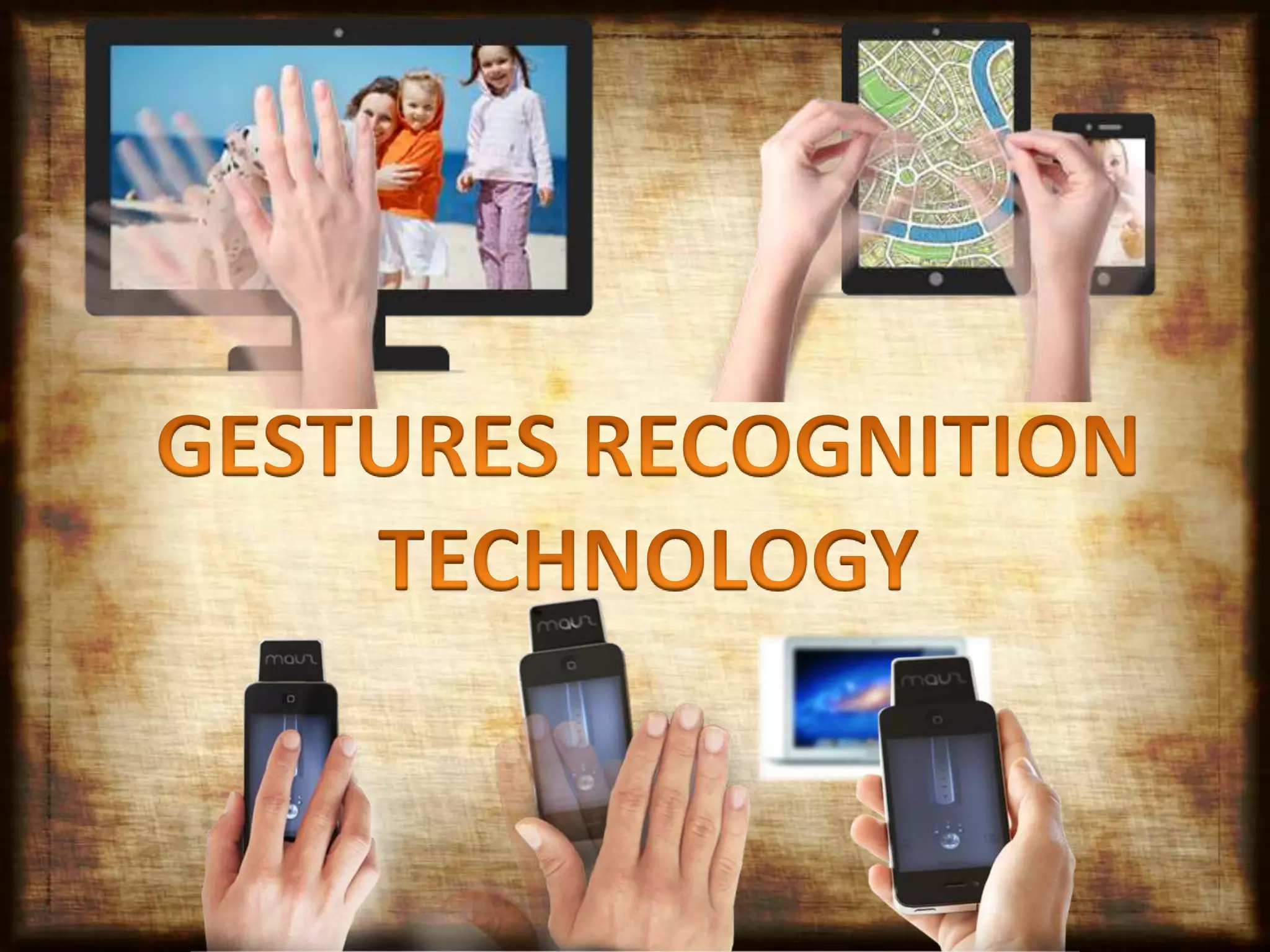
Gesture recognition enables humans to interface with the
machine and interact naturally without any mechanical devices.
Using the concept of gesture recognition, it is possible to point a
finger at the computer screen so that the cursor will move
accordingly.
Gesture recognition can be conducted with techniques from
computer vision and image processing
ARCHITECTURE OF GESTURE
RECOGNITION SYSTEM
ARCHITECTURE-
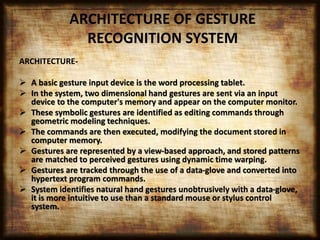
 A basic gesture input device is the word processing tablet.
 In the system, two dimensional hand gestures are sent via an input
device to the computer's memory and appear on the computer monitor.
 These symbolic gestures are identified as editing commands through
geometric modeling techniques.
 The commands are then executed, modifying the document stored in
computer memory.
 Gestures are represented by a view-based approach, and stored patterns
are matched to perceived gestures using dynamic time warping.
 Gestures are tracked through the use of a data-glove and converted into
hypertext program commands.
 System identifies natural hand gestures unobtrusively with a data-glove,
it is more intuitive to use than a standard mouse or stylus control
system.
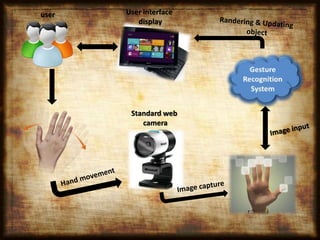
User interface
display
Standard web
camera
user
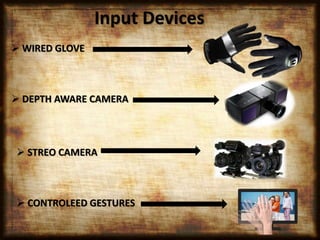
Input Devices
 WIRED GLOVE
 DEPTH AWARE CAMERA
 STREO CAMERA
 CONTROLEED GESTURES
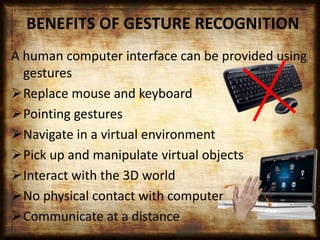
BENEFITS OF GESTURE RECOGNITION
A human computer interface can be provided using
gestures
Replace mouse and keyboard
Pointing gestures
Navigate in a virtual environment
Pick up and manipulate virtual objects
Interact with the 3D world
No physical contact with computer
Communicate at a distance
Application of Gesture Recognition
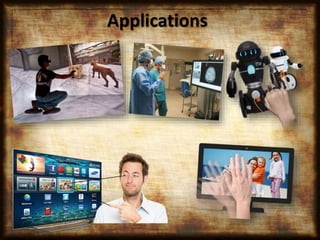
Gesture recognition has wide ranging applications such as the following
 Enabling very young children to interact with computers
 Medically monitoring patients’ emotional states or stress levels
 Navigating and/or manipulating in virtual environments
 Communicating in video conferencing
 Public Display Screens: Information display screens inSupermarkets,
Post Offices, Banks that allows control without having to touch the
device.
 Robots: Controlling robots without any physical contact between
human and computer.
Applications
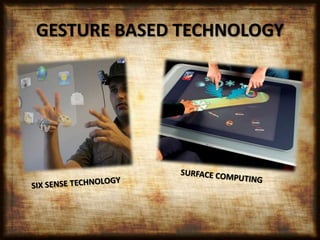
GESTURE BASED TECHNOLOGY
ADVANTAGES & DISADVANTAGES
ADVANTAGES
 Speed and sufficient reliable for
recognition system. Good
performance system with
complex background.
 The system successfully
recognized static and dynamic
gestures. Could be applied on a
mobile robot control.
 Simple, fast, and easy to
implement. Can be applied on
real system and play games.
 No Training is required.
DISADVANTAGES
 Irrelevant object might overlap
with the hand. Wrong object
extraction appeared if the
objects larger than the hand.
 Performance recognition
algorithm decreases when the
distance is greater than 1.5
meters between the user and the
camera.
 System limitations restrict the
applications such as the arm
must be vertical, the palm is
facing the camera and the finger
colour must be basic colour such
as either red or green or blue.
 Ambient light affects the colour
detection threshold
CHALLENGES
There are many challenges associated with the accuracy and usefulness of
gesture recognition software.
 For image-based gesture recognition there are limitations on the
equipment used and image noise.
 Images or video may not be under consistent lighting,or in the same
location.
 Items in the background or distinct features of the users may make
recognition more difficult.
 The amount of background noise also causes tracking and recognition
difficulties, especially when occlusions (partial and full)occur.
 Furthermore, the distance from the camera, and the camera's resolution
and quality, also cause variations in recognition accuracy.
 In order to capture human gestures by visual sensors, robust computer
vision methods are also required, for example for hand tracking and
hand posture recognition or for capturing movements of the head, facial
expressions or gaze direction.
Conclusion
• The importance of gesture recognition lies in building efficient human
machine interaction. Its applications range from sign language recognition
through medical rehabilitation to virtual reality. Gesture recognition 35 Soft
computing tools pose another promising application to static hand gesture
identification.. Thus, gesture recognition promises wide-ranging
applications in fields from photojournalism through medical technology to
biometrics.
Thank you
Presented By:-
Aditya Verma
0903cs121007

Gesture recognition adi

  • 2.
    Contents Introduction Architecture of GestureRecognition System Input Device’s Benefits of Gesture Recognition Application of Gesture Recognition System Gesture Based Technology Advantages & Disadvantages Challenges Conclusion
  • 3.
    Introduction  Gesture recognitioncan be seen as a way for computers to understand human body language, thus building a richer bridge between machines and humans than primitive text user interfaces or even GUIs (graphical user interfaces), which still limit the majority of input to keyboard and mouse. Gesture recognition enables humans to interface with the machine and interact naturally without any mechanical devices. Using the concept of gesture recognition, it is possible to point a finger at the computer screen so that the cursor will move accordingly. Gesture recognition can be conducted with techniques from computer vision and image processing
  • 4.
    ARCHITECTURE OF GESTURE RECOGNITIONSYSTEM ARCHITECTURE-  A basic gesture input device is the word processing tablet.  In the system, two dimensional hand gestures are sent via an input device to the computer's memory and appear on the computer monitor.  These symbolic gestures are identified as editing commands through geometric modeling techniques.  The commands are then executed, modifying the document stored in computer memory.  Gestures are represented by a view-based approach, and stored patterns are matched to perceived gestures using dynamic time warping.  Gestures are tracked through the use of a data-glove and converted into hypertext program commands.  System identifies natural hand gestures unobtrusively with a data-glove, it is more intuitive to use than a standard mouse or stylus control system.
  • 5.
  • 6.
    Input Devices  WIREDGLOVE  DEPTH AWARE CAMERA  STREO CAMERA  CONTROLEED GESTURES
  • 7.
    BENEFITS OF GESTURERECOGNITION A human computer interface can be provided using gestures Replace mouse and keyboard Pointing gestures Navigate in a virtual environment Pick up and manipulate virtual objects Interact with the 3D world No physical contact with computer Communicate at a distance
  • 8.
    Application of GestureRecognition Gesture recognition has wide ranging applications such as the following  Enabling very young children to interact with computers  Medically monitoring patients’ emotional states or stress levels  Navigating and/or manipulating in virtual environments  Communicating in video conferencing  Public Display Screens: Information display screens inSupermarkets, Post Offices, Banks that allows control without having to touch the device.  Robots: Controlling robots without any physical contact between human and computer.
  • 9.
  • 10.
  • 11.
    ADVANTAGES & DISADVANTAGES ADVANTAGES Speed and sufficient reliable for recognition system. Good performance system with complex background.  The system successfully recognized static and dynamic gestures. Could be applied on a mobile robot control.  Simple, fast, and easy to implement. Can be applied on real system and play games.  No Training is required. DISADVANTAGES  Irrelevant object might overlap with the hand. Wrong object extraction appeared if the objects larger than the hand.  Performance recognition algorithm decreases when the distance is greater than 1.5 meters between the user and the camera.  System limitations restrict the applications such as the arm must be vertical, the palm is facing the camera and the finger colour must be basic colour such as either red or green or blue.  Ambient light affects the colour detection threshold
  • 12.
    CHALLENGES There are manychallenges associated with the accuracy and usefulness of gesture recognition software.  For image-based gesture recognition there are limitations on the equipment used and image noise.  Images or video may not be under consistent lighting,or in the same location.  Items in the background or distinct features of the users may make recognition more difficult.  The amount of background noise also causes tracking and recognition difficulties, especially when occlusions (partial and full)occur.  Furthermore, the distance from the camera, and the camera's resolution and quality, also cause variations in recognition accuracy.  In order to capture human gestures by visual sensors, robust computer vision methods are also required, for example for hand tracking and hand posture recognition or for capturing movements of the head, facial expressions or gaze direction.
  • 13.
    Conclusion • The importanceof gesture recognition lies in building efficient human machine interaction. Its applications range from sign language recognition through medical rehabilitation to virtual reality. Gesture recognition 35 Soft computing tools pose another promising application to static hand gesture identification.. Thus, gesture recognition promises wide-ranging applications in fields from photojournalism through medical technology to biometrics.
  • 14.