GESTURE
RECOGNITION
TECHNOLOGY
PRESENTED BY :-
Suraj Kumar Rai
Roll:-
GUIDED BY :-
1
Contents
 Introduction
 Motivation
 Gesture types
 Input devices
 Challenges
 Uses
 References
2
Introduction
 What are Gestures?
 A form of non-verbal communication.
 Movement of the hands, face, or other parts of the body.
 What is Gesture Recognition?
 Interpreting human gestures via mathematical algorithms.
 Gestures as input to control devices or applications.
3
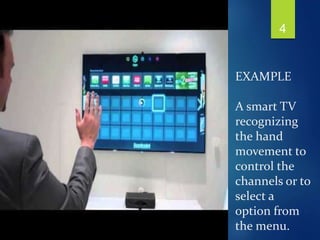
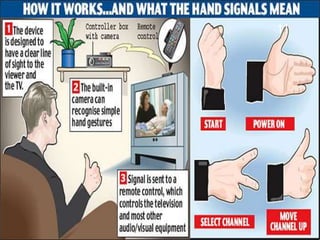
EXAMPLE
A smart TV
recognizing
the hand
movement to
control the
channels or to
select a
option from
the menu.
4
 Gesturing is a natural form of communication
 Gesture naturally while talking
 Babies gesture before they can talk
 Interaction problems with the mouse
 Have to locate cursor
 Hard for some to control (Parkinsons or people on a train)
 Limited forms of input from the mouse
5
Motivation
Gesture types
 In computer interfaces, two types of gestures are
distinguished.
 Offline gestures
 Processed after the user’s interaction with the object.
Ex:- gesture to activate a menu.
 Online gestures
 Direct manipulations like scaling and rotating.
6
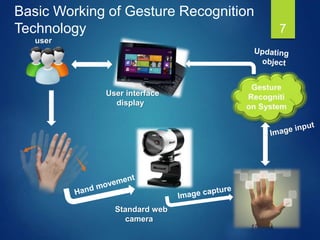
Basic Working of Gesture Recognition
Technology
User interface
display
Standard web
camera
user
7
Input devices
 Tools to track a person's movements
 Wired gloves
 Depth aware cameras
 Stereo cameras
 Gestures based Controller
 Single camera
8
Technology Behind it..
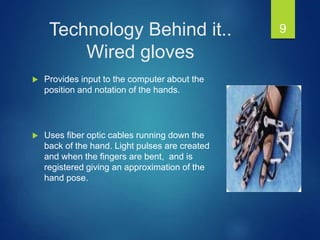
Wired gloves
 Provides input to the computer about the
position and notation of the hands.
 Uses fiber optic cables running down the
back of the hand. Light pulses are created
and when the fingers are bent, and is
registered giving an approximation of the
hand pose.
9
Technology Behind it..
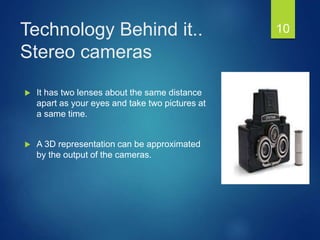
Stereo cameras
 It has two lenses about the same distance
apart as your eyes and take two pictures at
a same time.
 A 3D representation can be approximated
by the output of the cameras.
10
11
Challenges
 Lack of Gesture Language
 Different users make gestures differently,
causing difficulty in identifying motions
 Robustness
 Many gesture recognition systems do not read
motions accurately or optimally due to factors
like insufficient background light, high
background noise etc.
12
Uses
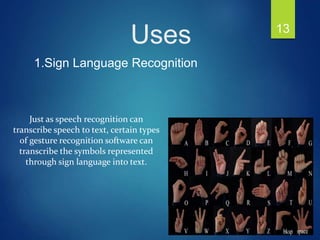
1.Sign Language Recognition
13
Just as speech recognition can
transcribe speech to text, certain types
of gesture recognition software can
transcribe the symbols represented
through sign language into text.
14
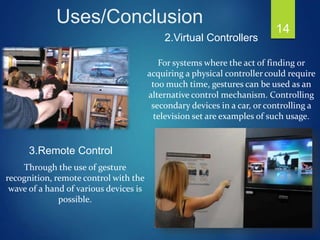
2.Virtual Controllers
For systems where the act of finding or
acquiring a physical controller could require
too much time, gestures can be used as an
alternative control mechanism. Controlling
secondary devices in a car, or controlling a
television set are examples of such usage.
3.Remote Control
Through the use of gesture
recognition, remote control with the
wave of a hand of various devices is
possible.
Uses/Conclusion
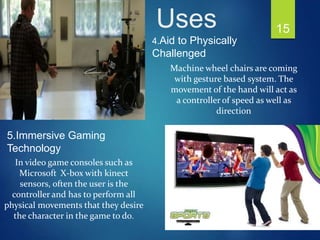
Machine wheel chairs are coming
with gesture based system. The
movement of the hand will act as
a controller of speed as well as
direction
In video game consoles such as
Microsoft X-box with kinect
sensors, often the user is the
controller and has to perform all
physical movements that they desire
the character in the game to do.
4.Aid to Physically
Challenged
5.Immersive Gaming
Technology
15Uses
References
 Ying Wu and Thomas S. Huang, "Vision-Based Gesture
Recognition: A Review", In: Gesture-Based Communication in
Human-Computer Interaction, Volume 1739 of Springer Lecture
Notes in Computer Science, pages 103-115,
 Matthias Rehm, Nikolaus Bee, Elisabeth André, Wave Like an
Egyptian - Accelerometer Based Gesture Recognition for
Culture Specific Interactions, British Computer Society, 2007
 Pavlovic, V., Sharma, R. & Huang, T. (1997), "Visual
interpretation of hand gestures for human-computer interaction:
A review", IEEE Trans. Pattern Analysis and Machine
Intelligence., July, 1997. Vol. 19(7), pp. 677 -695
16
17
Any Questions??

Gesture Recognition Technology-Seminar PPT

  • 1.
  • 2.
    Contents  Introduction  Motivation Gesture types  Input devices  Challenges  Uses  References 2
  • 3.
    Introduction  What areGestures?  A form of non-verbal communication.  Movement of the hands, face, or other parts of the body.  What is Gesture Recognition?  Interpreting human gestures via mathematical algorithms.  Gestures as input to control devices or applications. 3
  • 4.
    EXAMPLE A smart TV recognizing thehand movement to control the channels or to select a option from the menu. 4
  • 5.
     Gesturing isa natural form of communication  Gesture naturally while talking  Babies gesture before they can talk  Interaction problems with the mouse  Have to locate cursor  Hard for some to control (Parkinsons or people on a train)  Limited forms of input from the mouse 5 Motivation
  • 6.
    Gesture types  Incomputer interfaces, two types of gestures are distinguished.  Offline gestures  Processed after the user’s interaction with the object. Ex:- gesture to activate a menu.  Online gestures  Direct manipulations like scaling and rotating. 6
  • 7.
    Basic Working ofGesture Recognition Technology User interface display Standard web camera user 7
  • 8.
    Input devices  Toolsto track a person's movements  Wired gloves  Depth aware cameras  Stereo cameras  Gestures based Controller  Single camera 8
  • 9.
    Technology Behind it.. Wiredgloves  Provides input to the computer about the position and notation of the hands.  Uses fiber optic cables running down the back of the hand. Light pulses are created and when the fingers are bent, and is registered giving an approximation of the hand pose. 9
  • 10.
    Technology Behind it.. Stereocameras  It has two lenses about the same distance apart as your eyes and take two pictures at a same time.  A 3D representation can be approximated by the output of the cameras. 10
  • 11.
  • 12.
    Challenges  Lack ofGesture Language  Different users make gestures differently, causing difficulty in identifying motions  Robustness  Many gesture recognition systems do not read motions accurately or optimally due to factors like insufficient background light, high background noise etc. 12
  • 13.
    Uses 1.Sign Language Recognition 13 Justas speech recognition can transcribe speech to text, certain types of gesture recognition software can transcribe the symbols represented through sign language into text.
  • 14.
    14 2.Virtual Controllers For systemswhere the act of finding or acquiring a physical controller could require too much time, gestures can be used as an alternative control mechanism. Controlling secondary devices in a car, or controlling a television set are examples of such usage. 3.Remote Control Through the use of gesture recognition, remote control with the wave of a hand of various devices is possible. Uses/Conclusion
  • 15.
    Machine wheel chairsare coming with gesture based system. The movement of the hand will act as a controller of speed as well as direction In video game consoles such as Microsoft X-box with kinect sensors, often the user is the controller and has to perform all physical movements that they desire the character in the game to do. 4.Aid to Physically Challenged 5.Immersive Gaming Technology 15Uses
  • 16.
    References  Ying Wuand Thomas S. Huang, "Vision-Based Gesture Recognition: A Review", In: Gesture-Based Communication in Human-Computer Interaction, Volume 1739 of Springer Lecture Notes in Computer Science, pages 103-115,  Matthias Rehm, Nikolaus Bee, Elisabeth André, Wave Like an Egyptian - Accelerometer Based Gesture Recognition for Culture Specific Interactions, British Computer Society, 2007  Pavlovic, V., Sharma, R. & Huang, T. (1997), "Visual interpretation of hand gestures for human-computer interaction: A review", IEEE Trans. Pattern Analysis and Machine Intelligence., July, 1997. Vol. 19(7), pp. 677 -695 16
  • 17.