DR.V.N.BEDEKAR INSTITUTE MANAGEMENT 
STUDIES 
MMS I DIV B 
SUBJECT : FINANCIAL ACCOUNTING 
TOPIC : RATIO ANALYSIS OF ASIAN PAINTS 
SUBMITTED TO : PROF. SMITA JAPE MA’AM
Group Members 
Sonali Sakpal 48 
Sayali Phatak 44 
Tanvi Pawar 43 
Nikita Rathod 46 
Nikita Watve 55 
Tushar Sadhye 47 
Vikrant Pokharkar 45
RATIO ANALYSIS 
Ratio analysis is the process of determining and 
interpreting numerical relationship based on 
financial statements. It is the technique of 
interpretation of financial statements with the 
help of accounting ratios derived from the 
balance sheet and profit and loss account.
Basis Of Comparision 
 Trend Analysis involves comparison of a firm over 
a period of time, that is, present ratios are compared 
with past ratios for the same firm. It indicates the 
direction of change in the performance – 
improvement, deterioration or constancy – over the 
years. 
 Interfirm Comparison involves comparing the ratios 
of a firm with those of others in the same lines of 
business or for the industry as a whole. It reflects the 
firm’s performance in relation to its competitors. 
 Comparison with standards or industry average
Ways To Interpret Accounting 
Ratios 
 Single absolute ratio. 
 Group ratio. 
 Historical comparison. 
 Inter-firm comparison. 
 Projected ratios.
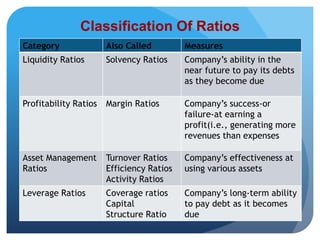
Classification Of Ratios 
Category Also Called Measures 
Liquidity Ratios Solvency Ratios Company’s ability in the 
near future to pay its debts 
as they become due 
Profitability Ratios Margin Ratios Company’s success-or 
failure-at earning a 
profit(i.e., generating more 
revenues than expenses 
Asset Management 
Ratios 
Turnover Ratios 
Efficiency Ratios 
Activity Ratios 
Company’s effectiveness at 
using various assets 
Leverage Ratios Coverage ratios 
Capital 
Structure Ratio 
Company’s long-term ability 
to pay debt as it becomes 
due
Topic for observation
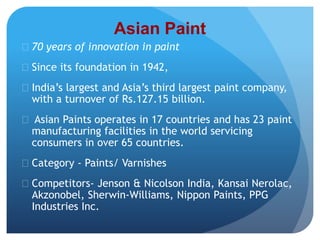
Asian Paint 
 70 years of innovation in paint 
 Since its foundation in 1942, 
 India’s largest and Asia’s third largest paint company, 
with a turnover of Rs.127.15 billion. 
 Asian Paints operates in 17 countries and has 23 paint 
manufacturing facilities in the world servicing 
consumers in over 65 countries. 
 Category - Paints/ Varnishes 
 Competitors- Jenson & Nicolson India, Kansai Nerolac, 
Akzonobel, Sherwin-Williams, Nippon Paints, PPG 
Industries Inc.
BALANCE SHEET RATIOS 
 CURRENT RATIO 
 QUICK RATIO 
 DEBT EQUITY RATIO
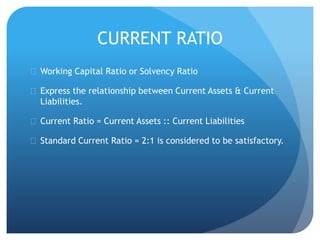
CURRENT RATIO 
 Working Capital Ratio or Solvency Ratio 
 Express the relationship between Current Assets & Current 
Liabilities. 
 Current Ratio = Current Assets :: Current Liabilities 
 Standard Current Ratio = 2:1 is considered to be satisfactory.
SIGNIFICANCE & PURPOSE 
Significance 
 Test of Credit strength & solvency of an organization. 
 Indicates the strength of the working capital (CA-CL). 
 Company’s ability to meet its day-to-day financial obligation. 
Purpose 
 Serves index of short–term solvency. 
 Index of the strength of working capital of an organization.
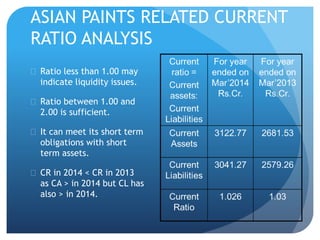
ASIAN PAINTS RELATED CURRENT 
RATIO ANALYSIS 
 Ratio less than 1.00 may 
indicate liquidity issues. 
 Ratio between 1.00 and 
2.00 is sufficient. 
 It can meet its short term 
obligations with short 
term assets. 
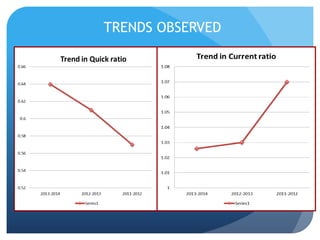
 CR in 2014 < CR in 2013 
as CA > in 2014 but CL has 
also > in 2014.
QUICK RATIO 
Acid Test Ratio 
 Measures the ability of a company to 
use its near cash or quick assets to 
pay off its debts 
 An indicator of a company’s short-term 
liquidity
Significance of Quick Ratio 
 Measure of a company's ability to settle its current 
liabilities on a very short notice. 
 May provide a misleading indication of a company's 
liquidity position 
 More reliable measure of liquidity for manufacturing 
companies and construction firms that have relatively high 
levels of inventory, work in progress and receivables 
 More conservative version of current ratio. 
 More rigorous assessment of a company's ability to pay 
its current liabilities
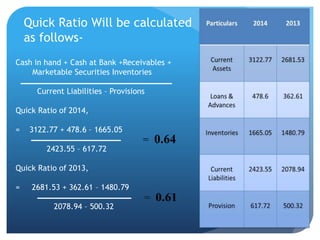
Quick Ratio Will be calculated 
as follows- 
Cash in hand + Cash at Bank +Receivables + 
Marketable Securities Inventories 
Current Liabilities – Provisions 
Quick Ratio of 2014, 
= 3122.77 + 478.6 – 1665.05 
2423.55 – 617.72 
Quick Ratio of 2013, 
= 2681.53 + 362.61 – 1480.79 
2078.94 – 500.32
Analysis 
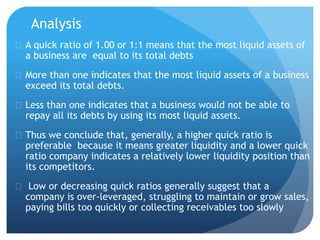
 A quick ratio of 1.00 or 1:1 means that the most liquid assets of 
a business are equal to its total debts 
 More than one indicates that the most liquid assets of a business 
exceed its total debts. 
 Less than one indicates that a business would not be able to 
repay all its debts by using its most liquid assets. 
 Thus we conclude that, generally, a higher quick ratio is 
preferable because it means greater liquidity and a lower quick 
ratio company indicates a relatively lower liquidity position than 
its competitors. 
 Low or decreasing quick ratios generally suggest that a 
company is over-leveraged, struggling to maintain or grow sales, 
paying bills too quickly or collecting receivables too slowly
Debt Equity ratio 
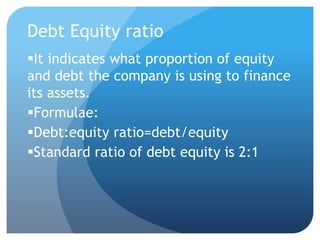
It indicates what proportion of equity 
and debt the company is using to finance 
its assets. 
Formulae: 
Debt:equity ratio=debt/equity 
Standard ratio of debt equity is 2:1
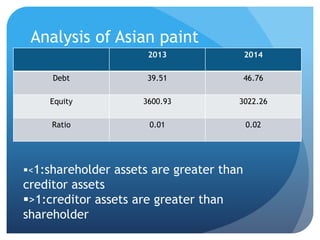
Analysis of Asian paint 
2013 2014 
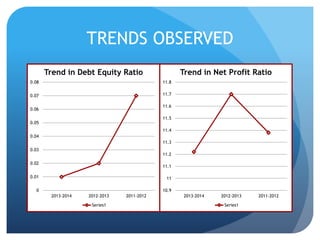
Debt 39.51 46.76 
Equity 3600.93 3022.26 
Ratio 0.01 0.02 
<1:shareholder assets are greater than 
creditor assets 
>1:creditor assets are greater than 
shareholder
Profitability Ratio 
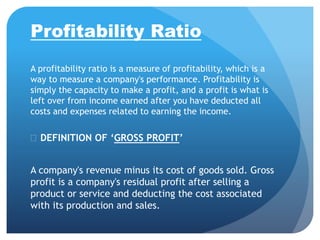
A profitability ratio is a measure of profitability, which is a 
way to measure a company's performance. Profitability is 
simply the capacity to make a profit, and a profit is what is 
left over from income earned after you have deducted all 
costs and expenses related to earning the income. 
 DEFINITION OF ‘GROSS PROFIT’ 
A company's revenue minus its cost of goods sold. Gross 
profit is a company's residual profit after selling a 
product or service and deducting the cost associated 
with its production and sales.
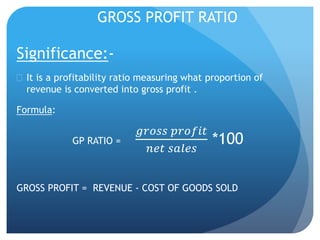
GROSS PROFIT RATIO 
Significance:- 
 It is a profitability ratio measuring what proportion of 
revenue is converted into gross profit . 
Formula: 
GP RATIO = 
푔푟표푠푠 푝푟표푓푖푡 
푛푒푡 푠푎푙푒푠 
*100 
GROSS PROFIT = REVENUE - COST OF GOODS SOLD
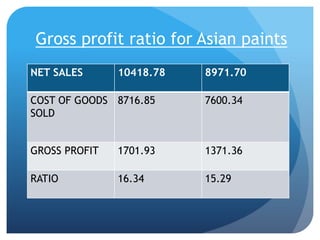
Gross profit ratio for Asian paints 
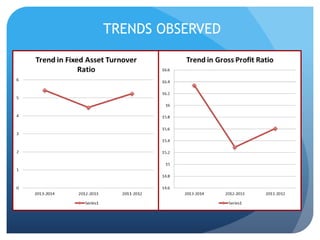
NET SALES 10418.78 8971.70 
COST OF GOODS 
SOLD 
8716.85 7600.34 
GROSS PROFIT 1701.93 1371.36 
RATIO 16.34 15.29
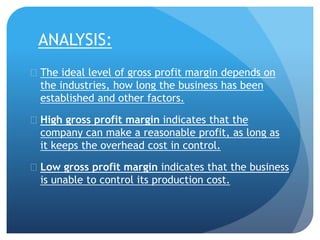
ANALYSIS: 
 The ideal level of gross profit margin depends on 
the industries, how long the business has been 
established and other factors. 
 High gross profit margin indicates that the 
company can make a reasonable profit, as long as 
it keeps the overhead cost in control. 
 Low gross profit margin indicates that the business 
is unable to control its production cost.
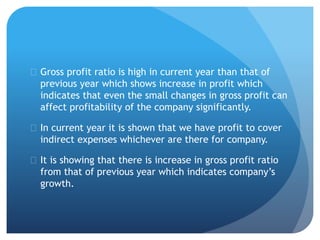
 Gross profit ratio is high in current year than that of 
previous year which shows increase in profit which 
indicates that even the small changes in gross profit can 
affect profitability of the company significantly. 
 In current year it is shown that we have profit to cover 
indirect expenses whichever are there for company. 
 It is showing that there is increase in gross profit ratio 
from that of previous year which indicates company’s 
growth.
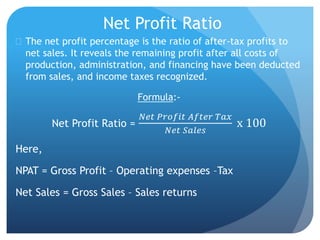
Net Profit Ratio 
 The net profit percentage is the ratio of after-tax profits to 
net sales. It reveals the remaining profit after all costs of 
production, administration, and financing have been deducted 
from sales, and income taxes recognized. 
Formula:- 
Net Profit Ratio = 
푁푒푡 푃푟표푓푖푡 퐴푓푡푒푟 푇푎푥 
푁푒푡 푆푎푙푒푠 
x 100 
Here, 
NPAT = Gross Profit – Operating expenses –Tax 
Net Sales = Gross Sales – Sales returns
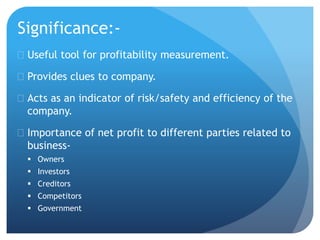
Significance:- 
 Useful tool for profitability measurement. 
 Provides clues to company. 
 Acts as an indicator of risk/safety and efficiency of the 
company. 
 Importance of net profit to different parties related to 
business- 
 Owners 
 Investors 
 Creditors 
 Competitors 
 Government
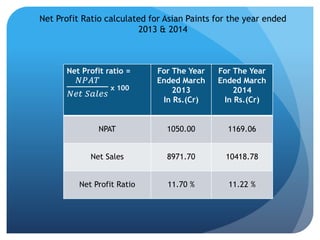
Net Profit Ratio calculated for Asian Paints for the year ended 
Net Profit ratio = 
푁푃퐴푇 
x 100 
푁푒푡 푆푎푙푒푠 
2013 & 2014 
For The Year 
Ended March 
2013 
In Rs.(Cr) 
For The Year 
Ended March 
2014 
In Rs.(Cr) 
NPAT 1050.00 1169.06 
Net Sales 8971.70 10418.78 
Net Profit Ratio 11.70 % 11.22 %
Analysis:- 
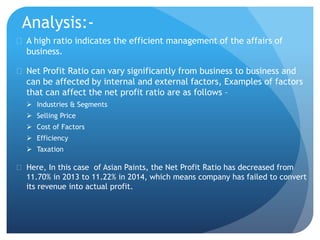
 A high ratio indicates the efficient management of the affairs of 
business. 
 Net Profit Ratio can vary significantly from business to business and 
can be affected by internal and external factors, Examples of factors 
that can affect the net profit ratio are as follows – 
 Industries & Segments 
 Selling Price 
 Cost of Factors 
 Efficiency 
 Taxation 
 Here, In this case of Asian Paints, the Net Profit Ratio has decreased from 
11.70% in 2013 to 11.22% in 2014, which means company has failed to convert 
its revenue into actual profit.
FIXED ASSET TURNOVER RATIO 
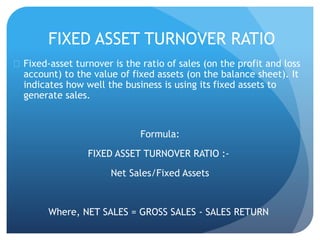
 Fixed-asset turnover is the ratio of sales (on the profit and loss 
account) to the value of fixed assets (on the balance sheet). It 
indicates how well the business is using its fixed assets to 
generate sales. 
Formula: 
FIXED ASSET TURNOVER RATIO :- 
Net Sales/Fixed Assets 
Where, NET SALES = GROSS SALES - SALES RETURN
Purpose of FATR 
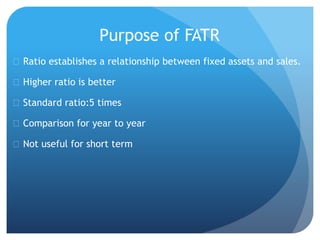
 Ratio establishes a relationship between fixed assets and sales. 
 Higher ratio is better 
 Standard ratio:5 times 

 Comparison for year to year 
 Not useful for short term
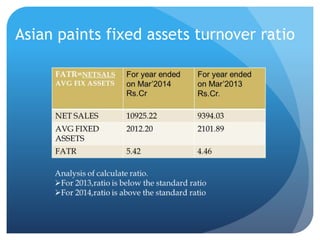
Asian paints fixed assets turnover ratio
TRENDS OBSERVED
TRENDS OBSERVED
TRENDS OBSERVED 
0.08 
0.07 
0.06 
0.05 
0.04 
0.03 
0.02 
0.01 
0 
Trend in Debt Equity Ratio 
2013-2014 2012-2013 2011-2012 
Series1 
11.8 
11.7 
11.6 
11.5 
11.4 
11.3 
11.2 
11.1 
11 
10.9 
Trend in Net Profit Ratio 
2013-2014 2012-2013 2011-2012 
Series1
THANK 
YOU

Financial Ratio analysis asian paints

  • 1.
    DR.V.N.BEDEKAR INSTITUTE MANAGEMENT STUDIES MMS I DIV B SUBJECT : FINANCIAL ACCOUNTING TOPIC : RATIO ANALYSIS OF ASIAN PAINTS SUBMITTED TO : PROF. SMITA JAPE MA’AM
  • 2.
    Group Members SonaliSakpal 48 Sayali Phatak 44 Tanvi Pawar 43 Nikita Rathod 46 Nikita Watve 55 Tushar Sadhye 47 Vikrant Pokharkar 45
  • 3.
    RATIO ANALYSIS Ratioanalysis is the process of determining and interpreting numerical relationship based on financial statements. It is the technique of interpretation of financial statements with the help of accounting ratios derived from the balance sheet and profit and loss account.
  • 4.
    Basis Of Comparision  Trend Analysis involves comparison of a firm over a period of time, that is, present ratios are compared with past ratios for the same firm. It indicates the direction of change in the performance – improvement, deterioration or constancy – over the years.  Interfirm Comparison involves comparing the ratios of a firm with those of others in the same lines of business or for the industry as a whole. It reflects the firm’s performance in relation to its competitors.  Comparison with standards or industry average
  • 5.
    Ways To InterpretAccounting Ratios  Single absolute ratio.  Group ratio.  Historical comparison.  Inter-firm comparison.  Projected ratios.
  • 6.
    Classification Of Ratios Category Also Called Measures Liquidity Ratios Solvency Ratios Company’s ability in the near future to pay its debts as they become due Profitability Ratios Margin Ratios Company’s success-or failure-at earning a profit(i.e., generating more revenues than expenses Asset Management Ratios Turnover Ratios Efficiency Ratios Activity Ratios Company’s effectiveness at using various assets Leverage Ratios Coverage ratios Capital Structure Ratio Company’s long-term ability to pay debt as it becomes due
  • 7.
  • 8.
    Asian Paint 70 years of innovation in paint  Since its foundation in 1942,  India’s largest and Asia’s third largest paint company, with a turnover of Rs.127.15 billion.  Asian Paints operates in 17 countries and has 23 paint manufacturing facilities in the world servicing consumers in over 65 countries.  Category - Paints/ Varnishes  Competitors- Jenson & Nicolson India, Kansai Nerolac, Akzonobel, Sherwin-Williams, Nippon Paints, PPG Industries Inc.
  • 9.
    BALANCE SHEET RATIOS  CURRENT RATIO  QUICK RATIO  DEBT EQUITY RATIO
  • 10.
    CURRENT RATIO Working Capital Ratio or Solvency Ratio  Express the relationship between Current Assets & Current Liabilities.  Current Ratio = Current Assets :: Current Liabilities  Standard Current Ratio = 2:1 is considered to be satisfactory.
  • 11.
    SIGNIFICANCE & PURPOSE Significance  Test of Credit strength & solvency of an organization.  Indicates the strength of the working capital (CA-CL).  Company’s ability to meet its day-to-day financial obligation. Purpose  Serves index of short–term solvency.  Index of the strength of working capital of an organization.
  • 12.
    ASIAN PAINTS RELATEDCURRENT RATIO ANALYSIS  Ratio less than 1.00 may indicate liquidity issues.  Ratio between 1.00 and 2.00 is sufficient.  It can meet its short term obligations with short term assets.  CR in 2014 < CR in 2013 as CA > in 2014 but CL has also > in 2014.
  • 13.
    QUICK RATIO AcidTest Ratio  Measures the ability of a company to use its near cash or quick assets to pay off its debts  An indicator of a company’s short-term liquidity
  • 14.
    Significance of QuickRatio  Measure of a company's ability to settle its current liabilities on a very short notice.  May provide a misleading indication of a company's liquidity position  More reliable measure of liquidity for manufacturing companies and construction firms that have relatively high levels of inventory, work in progress and receivables  More conservative version of current ratio.  More rigorous assessment of a company's ability to pay its current liabilities
  • 15.
    Quick Ratio Willbe calculated as follows- Cash in hand + Cash at Bank +Receivables + Marketable Securities Inventories Current Liabilities – Provisions Quick Ratio of 2014, = 3122.77 + 478.6 – 1665.05 2423.55 – 617.72 Quick Ratio of 2013, = 2681.53 + 362.61 – 1480.79 2078.94 – 500.32
  • 16.
    Analysis  Aquick ratio of 1.00 or 1:1 means that the most liquid assets of a business are equal to its total debts  More than one indicates that the most liquid assets of a business exceed its total debts.  Less than one indicates that a business would not be able to repay all its debts by using its most liquid assets.  Thus we conclude that, generally, a higher quick ratio is preferable because it means greater liquidity and a lower quick ratio company indicates a relatively lower liquidity position than its competitors.  Low or decreasing quick ratios generally suggest that a company is over-leveraged, struggling to maintain or grow sales, paying bills too quickly or collecting receivables too slowly
  • 17.
    Debt Equity ratio It indicates what proportion of equity and debt the company is using to finance its assets. Formulae: Debt:equity ratio=debt/equity Standard ratio of debt equity is 2:1
  • 18.
    Analysis of Asianpaint 2013 2014 Debt 39.51 46.76 Equity 3600.93 3022.26 Ratio 0.01 0.02 <1:shareholder assets are greater than creditor assets >1:creditor assets are greater than shareholder
  • 19.
    Profitability Ratio Aprofitability ratio is a measure of profitability, which is a way to measure a company's performance. Profitability is simply the capacity to make a profit, and a profit is what is left over from income earned after you have deducted all costs and expenses related to earning the income.  DEFINITION OF ‘GROSS PROFIT’ A company's revenue minus its cost of goods sold. Gross profit is a company's residual profit after selling a product or service and deducting the cost associated with its production and sales.
  • 20.
    GROSS PROFIT RATIO Significance:-  It is a profitability ratio measuring what proportion of revenue is converted into gross profit . Formula: GP RATIO = 푔푟표푠푠 푝푟표푓푖푡 푛푒푡 푠푎푙푒푠 *100 GROSS PROFIT = REVENUE - COST OF GOODS SOLD
  • 21.
    Gross profit ratiofor Asian paints NET SALES 10418.78 8971.70 COST OF GOODS SOLD 8716.85 7600.34 GROSS PROFIT 1701.93 1371.36 RATIO 16.34 15.29
  • 22.
    ANALYSIS:  Theideal level of gross profit margin depends on the industries, how long the business has been established and other factors.  High gross profit margin indicates that the company can make a reasonable profit, as long as it keeps the overhead cost in control.  Low gross profit margin indicates that the business is unable to control its production cost.
  • 23.
     Gross profitratio is high in current year than that of previous year which shows increase in profit which indicates that even the small changes in gross profit can affect profitability of the company significantly.  In current year it is shown that we have profit to cover indirect expenses whichever are there for company.  It is showing that there is increase in gross profit ratio from that of previous year which indicates company’s growth.
  • 24.
    Net Profit Ratio  The net profit percentage is the ratio of after-tax profits to net sales. It reveals the remaining profit after all costs of production, administration, and financing have been deducted from sales, and income taxes recognized. Formula:- Net Profit Ratio = 푁푒푡 푃푟표푓푖푡 퐴푓푡푒푟 푇푎푥 푁푒푡 푆푎푙푒푠 x 100 Here, NPAT = Gross Profit – Operating expenses –Tax Net Sales = Gross Sales – Sales returns
  • 25.
    Significance:-  Usefultool for profitability measurement.  Provides clues to company.  Acts as an indicator of risk/safety and efficiency of the company.  Importance of net profit to different parties related to business-  Owners  Investors  Creditors  Competitors  Government
  • 26.
    Net Profit Ratiocalculated for Asian Paints for the year ended Net Profit ratio = 푁푃퐴푇 x 100 푁푒푡 푆푎푙푒푠 2013 & 2014 For The Year Ended March 2013 In Rs.(Cr) For The Year Ended March 2014 In Rs.(Cr) NPAT 1050.00 1169.06 Net Sales 8971.70 10418.78 Net Profit Ratio 11.70 % 11.22 %
  • 27.
    Analysis:-  Ahigh ratio indicates the efficient management of the affairs of business.  Net Profit Ratio can vary significantly from business to business and can be affected by internal and external factors, Examples of factors that can affect the net profit ratio are as follows –  Industries & Segments  Selling Price  Cost of Factors  Efficiency  Taxation  Here, In this case of Asian Paints, the Net Profit Ratio has decreased from 11.70% in 2013 to 11.22% in 2014, which means company has failed to convert its revenue into actual profit.
  • 28.
    FIXED ASSET TURNOVERRATIO  Fixed-asset turnover is the ratio of sales (on the profit and loss account) to the value of fixed assets (on the balance sheet). It indicates how well the business is using its fixed assets to generate sales. Formula: FIXED ASSET TURNOVER RATIO :- Net Sales/Fixed Assets Where, NET SALES = GROSS SALES - SALES RETURN
  • 29.
    Purpose of FATR  Ratio establishes a relationship between fixed assets and sales.  Higher ratio is better  Standard ratio:5 times  Comparison for year to year  Not useful for short term
  • 30.
    Asian paints fixedassets turnover ratio
  • 31.
  • 32.
  • 33.
    TRENDS OBSERVED 0.08 0.07 0.06 0.05 0.04 0.03 0.02 0.01 0 Trend in Debt Equity Ratio 2013-2014 2012-2013 2011-2012 Series1 11.8 11.7 11.6 11.5 11.4 11.3 11.2 11.1 11 10.9 Trend in Net Profit Ratio 2013-2014 2012-2013 2011-2012 Series1
  • 34.