
Balanced Scorecard
Group Members:
Nikita Rathode ( B-46 )
Tushar Sadhye ( B-47 )
Sonali Sakpal ( B-48 )
What is Balanced Scorecard?
• Balanced Scorecards tell you the knowledge, skills and systems
that your employees will need (learning and growth) to innovate
and build the right strategic capabilities and efficiencies
(internal processes) that deliver specific value to the market
(customer) which will eventually lead to higher shareholder
value (financial).
Where it started . . .
• Introduced in 1992, by Robert Kaplan and David Norton, the
Balanced Scorecard is the most commonly used framework for
ensuring that agencies execute their strategies.
• The research study was motivated by the inadequacy of
traditional performance management systems, which relied
almost exclusively on financial and business results.
• Today, about 70% of the Fortune 1,000 companies utilize the
Balanced Scorecard to help manage performance.
• Balanced Scorecards are used as the roadmap for creating the
“Strategic Management System”. And this drives overall
organizational performance!
Purpose of Balanced Scorecard:
A method of implementing a business strategy by translating it
into a set of performance measures derived from strategic goals
that allocate rewards to executives and managers based on their
success at meeting or exceeding the performance measures.
Reasons for the Need of a Balanced Scorecard
Focus on traditional financial accounting measures such as ROA, ROE, EPS
gives misleading signals to executives with regards to quality and
innovation.
Executive performance needs to be judged on success at meeting a mix of
both financial and non-financial measures to effectively operate a business
Some non-financial measures are drivers of financial outcome measures
which give managers more control to take corrective actions quickly.
(Example: controls in jet cockpit for pilot)
Too many measures, such as hundreds of possible cost accounting index
measures, can confuse and distract an executive from focusing on important
strategic priorities.
The balanced scorecard disciplines an executive to focus on several
important measures that drive the strategy.
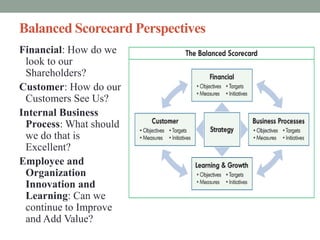
Balanced Scorecard Perspectives
Financial: How do we
look to our
Shareholders?
Customer: How do our
Customers See Us?
Internal Business
Process: What should
we do that is
Excellent?
Employee and
Organization
Innovation and
Learning: Can we
continue to Improve
and Add Value?
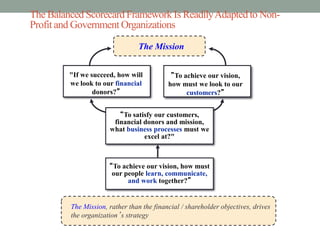
The Balanced ScorecardFramework Is ReadilyAdaptedto Non-
Profit and Government Organizations
The Mission, rather than the financial / shareholder objectives, drives
the organization’s strategy
"If we succeed, how will
we look to our financial
donors?”
“To achieve our vision, how must
our people learn, communicate,
and work together?”
The Mission
“To satisfy our customers,
financial donors and mission,
what business processes must we
excel at?"
”To achieve our vision,
how must we look to our
customers?”
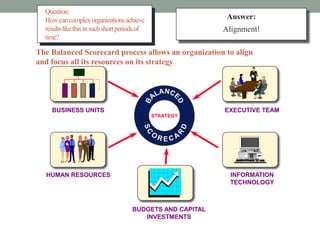
STRATEGY
HUMAN RESOURCES
BUSINESS UNITS EXECUTIVE TEAM
INFORMATION
TECHNOLOGY
BUDGETS AND CAPITAL
INVESTMENTS
The Balanced Scorecard process allows an organization to align
and focus all its resources on its strategy
Question:
Howcancomplexorganizationsachieve
resultslikethisinsuchshortperiodsof
time?
Answer:
Alignment!
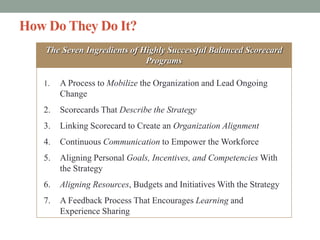
How Do They Do It?
1. A Process to Mobilize the Organization and Lead Ongoing
Change
2. Scorecards That Describe the Strategy
3. Linking Scorecard to Create an Organization Alignment
4. Continuous Communication to Empower the Workforce
5. Aligning Personal Goals, Incentives, and Competencies With
the Strategy
6. Aligning Resources, Budgets and Initiatives With the Strategy
7. A Feedback Process That Encourages Learning and
Experience Sharing
The Seven Ingredients of Highly Successful Balanced Scorecard
Programs
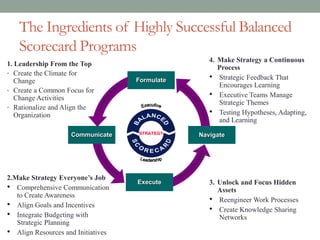
1. Leadership From the Top
• Create the Climate for
Change
• Create a Common Focus for
Change Activities
• Rationalize and Align the
Organization
3. Unlock and Focus Hidden
Assets
• Reengineer Work Processes
• Create Knowledge Sharing
Networks
2.Make Strategy Everyone’s Job
• Comprehensive Communication
to Create Awareness
• Align Goals and Incentives
• Integrate Budgeting with
Strategic Planning
• Align Resources and Initiatives
4. Make Strategy a Continuous
Process
• Strategic Feedback That
Encourages Learning
• Executive Teams Manage
Strategic Themes
• Testing Hypotheses, Adapting,
and Learning
The Ingredients of Highly Successful Balanced
Scorecard Programs
STRATEGY
Formulate
NavigateCommunicate
Execute
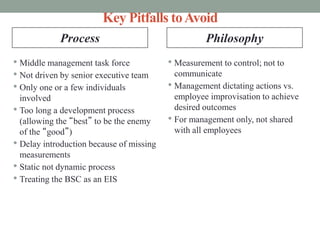
Key Pitfalls toAvoid
• Middle management task force
• Not driven by senior executive team
• Only one or a few individuals
involved
• Too long a development process
(allowing the “best” to be the enemy
of the “good”)
• Delay introduction because of missing
measurements
• Static not dynamic process
• Treating the BSC as an EIS
• Measurement to control; not to
communicate
• Management dictating actions vs.
employee improvisation to achieve
desired outcomes
• For management only, not shared
with all employees
Process Philosophy
What are the Key Benefits of using Balanced
Scorecards?
Better Strategic Planning
Improved Strategy Communication & Execution
Better Management Information
Improved Performance Reporting
Better Strategic Alignment
Better Organizational Alignment

Balanced scorecard

  • 1.
    Balanced Scorecard Group Members: NikitaRathode ( B-46 ) Tushar Sadhye ( B-47 ) Sonali Sakpal ( B-48 )
  • 2.
    What is BalancedScorecard? • Balanced Scorecards tell you the knowledge, skills and systems that your employees will need (learning and growth) to innovate and build the right strategic capabilities and efficiencies (internal processes) that deliver specific value to the market (customer) which will eventually lead to higher shareholder value (financial).
  • 3.
    Where it started. . . • Introduced in 1992, by Robert Kaplan and David Norton, the Balanced Scorecard is the most commonly used framework for ensuring that agencies execute their strategies. • The research study was motivated by the inadequacy of traditional performance management systems, which relied almost exclusively on financial and business results. • Today, about 70% of the Fortune 1,000 companies utilize the Balanced Scorecard to help manage performance. • Balanced Scorecards are used as the roadmap for creating the “Strategic Management System”. And this drives overall organizational performance!
  • 4.
    Purpose of BalancedScorecard: A method of implementing a business strategy by translating it into a set of performance measures derived from strategic goals that allocate rewards to executives and managers based on their success at meeting or exceeding the performance measures.
  • 5.
    Reasons for theNeed of a Balanced Scorecard Focus on traditional financial accounting measures such as ROA, ROE, EPS gives misleading signals to executives with regards to quality and innovation. Executive performance needs to be judged on success at meeting a mix of both financial and non-financial measures to effectively operate a business Some non-financial measures are drivers of financial outcome measures which give managers more control to take corrective actions quickly. (Example: controls in jet cockpit for pilot) Too many measures, such as hundreds of possible cost accounting index measures, can confuse and distract an executive from focusing on important strategic priorities. The balanced scorecard disciplines an executive to focus on several important measures that drive the strategy.
  • 6.
    Balanced Scorecard Perspectives Financial:How do we look to our Shareholders? Customer: How do our Customers See Us? Internal Business Process: What should we do that is Excellent? Employee and Organization Innovation and Learning: Can we continue to Improve and Add Value?
  • 7.
    The Balanced ScorecardFrameworkIs ReadilyAdaptedto Non- Profit and Government Organizations The Mission, rather than the financial / shareholder objectives, drives the organization’s strategy "If we succeed, how will we look to our financial donors?” “To achieve our vision, how must our people learn, communicate, and work together?” The Mission “To satisfy our customers, financial donors and mission, what business processes must we excel at?" ”To achieve our vision, how must we look to our customers?”
  • 8.
    STRATEGY HUMAN RESOURCES BUSINESS UNITSEXECUTIVE TEAM INFORMATION TECHNOLOGY BUDGETS AND CAPITAL INVESTMENTS The Balanced Scorecard process allows an organization to align and focus all its resources on its strategy Question: Howcancomplexorganizationsachieve resultslikethisinsuchshortperiodsof time? Answer: Alignment!
  • 9.
    How Do TheyDo It? 1. A Process to Mobilize the Organization and Lead Ongoing Change 2. Scorecards That Describe the Strategy 3. Linking Scorecard to Create an Organization Alignment 4. Continuous Communication to Empower the Workforce 5. Aligning Personal Goals, Incentives, and Competencies With the Strategy 6. Aligning Resources, Budgets and Initiatives With the Strategy 7. A Feedback Process That Encourages Learning and Experience Sharing The Seven Ingredients of Highly Successful Balanced Scorecard Programs
  • 10.
    1. Leadership Fromthe Top • Create the Climate for Change • Create a Common Focus for Change Activities • Rationalize and Align the Organization 3. Unlock and Focus Hidden Assets • Reengineer Work Processes • Create Knowledge Sharing Networks 2.Make Strategy Everyone’s Job • Comprehensive Communication to Create Awareness • Align Goals and Incentives • Integrate Budgeting with Strategic Planning • Align Resources and Initiatives 4. Make Strategy a Continuous Process • Strategic Feedback That Encourages Learning • Executive Teams Manage Strategic Themes • Testing Hypotheses, Adapting, and Learning The Ingredients of Highly Successful Balanced Scorecard Programs STRATEGY Formulate NavigateCommunicate Execute
  • 13.
    Key Pitfalls toAvoid •Middle management task force • Not driven by senior executive team • Only one or a few individuals involved • Too long a development process (allowing the “best” to be the enemy of the “good”) • Delay introduction because of missing measurements • Static not dynamic process • Treating the BSC as an EIS • Measurement to control; not to communicate • Management dictating actions vs. employee improvisation to achieve desired outcomes • For management only, not shared with all employees Process Philosophy
  • 14.
    What are theKey Benefits of using Balanced Scorecards? Better Strategic Planning Improved Strategy Communication & Execution Better Management Information Improved Performance Reporting Better Strategic Alignment Better Organizational Alignment

Editor's Notes