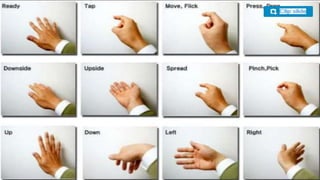

GESTURE
RECOGNITION
TECHNOLOGY
Presented By:
Muhammad Zeeshan
Registration #: 14-NTU-0122
Introduction
Gesture recognition is a topic in computer science and language
technology which interpret human gestures via mathematical
algorithms.
Gestures can originate from any bodily motion or state but commonly
originate from the face or hand.
Gesture recognition enables humans to communicate with the
machine (HMI) and interact naturally without any mechanical
devices.
How it Works?
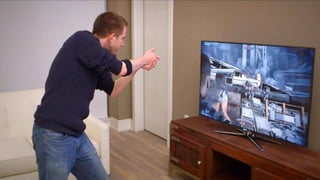
In Gesture Recognition Technology, a camera reads the movement of
human body and communicates the data to a computer that uses the
gestures as input to control devices.
Gesture recognition can be conducted with techniques from computer
vision and image processing.
Computer Vision Image Processing
Computer vision is a field that includes methods for processing,
analyzing, and understanding images
 Image processing is processing of images using mathematical
operations by using any form of signal processing for which the input
is an image.
Input Devices
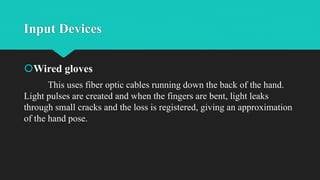
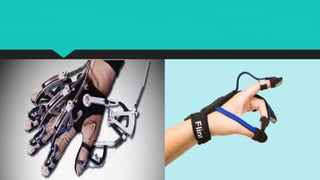
Wired gloves
This uses fiber optic cables running down the back of the hand.
Light pulses are created and when the fingers are bent, light leaks
through small cracks and the loss is registered, giving an approximation
of the hand pose.
Input Devices
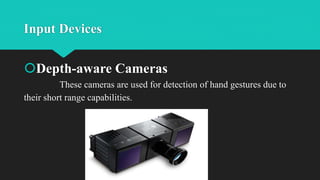
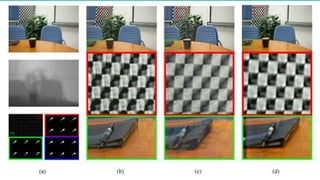
Depth-aware Cameras
These cameras are used for detection of hand gestures due to
their short range capabilities.
Input Devices
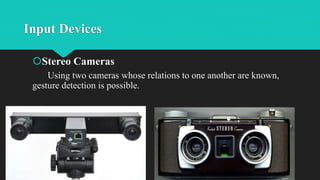
Stereo Cameras
Using two cameras whose relations to one another are known,
gesture detection is possible.
Input Devices
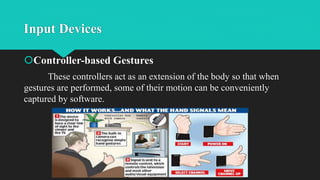
Controller-based Gestures
These controllers act as an extension of the body so that when
gestures are performed, some of their motion can be conveniently
captured by software.
Input Devices
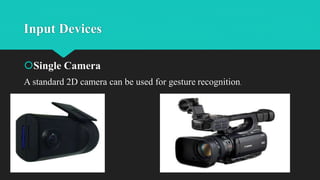
Single Camera
A standard 2D camera can be used for gesture recognition.
Uses
Sign Language Recognition
Robotics
Game Technology
Remote Control
Automated Homes
Draw Backs
Gorilla arm
Gorilla arm was a side-effect of vertically oriented touch-screen
or light-pen use. In periods of prolonged use, users' arms began to feel
fatigue and/or discomfort. This effect contributed to the decline of
touch-screen input despite initial popularity in the 1980s.
Fails to detect when the legs and hands of human are completely
covered .
Conclusion
Gesture Recognition Technology interpret human gestures and actions
via mathematical algorithms.
Cameras detect gestures and computer do process to interpret them.
This technology is very useful in robotic and gaming zone and makes
the control more easier.

Gesture Recognition Technology

  • 1.
  • 3.
    Introduction Gesture recognition isa topic in computer science and language technology which interpret human gestures via mathematical algorithms. Gestures can originate from any bodily motion or state but commonly originate from the face or hand. Gesture recognition enables humans to communicate with the machine (HMI) and interact naturally without any mechanical devices.
  • 4.
    How it Works? InGesture Recognition Technology, a camera reads the movement of human body and communicates the data to a computer that uses the gestures as input to control devices. Gesture recognition can be conducted with techniques from computer vision and image processing.
  • 5.
    Computer Vision ImageProcessing Computer vision is a field that includes methods for processing, analyzing, and understanding images  Image processing is processing of images using mathematical operations by using any form of signal processing for which the input is an image.
  • 6.
    Input Devices Wired gloves Thisuses fiber optic cables running down the back of the hand. Light pulses are created and when the fingers are bent, light leaks through small cracks and the loss is registered, giving an approximation of the hand pose.
  • 8.
    Input Devices Depth-aware Cameras Thesecameras are used for detection of hand gestures due to their short range capabilities.
  • 10.
    Input Devices Stereo Cameras Usingtwo cameras whose relations to one another are known, gesture detection is possible.
  • 11.
    Input Devices Controller-based Gestures Thesecontrollers act as an extension of the body so that when gestures are performed, some of their motion can be conveniently captured by software.
  • 13.
    Input Devices Single Camera Astandard 2D camera can be used for gesture recognition.
  • 14.
    Uses Sign Language Recognition Robotics GameTechnology Remote Control Automated Homes
  • 15.
    Draw Backs Gorilla arm Gorillaarm was a side-effect of vertically oriented touch-screen or light-pen use. In periods of prolonged use, users' arms began to feel fatigue and/or discomfort. This effect contributed to the decline of touch-screen input despite initial popularity in the 1980s. Fails to detect when the legs and hands of human are completely covered .
  • 16.
    Conclusion Gesture Recognition Technologyinterpret human gestures and actions via mathematical algorithms. Cameras detect gestures and computer do process to interpret them. This technology is very useful in robotic and gaming zone and makes the control more easier.

Editor's Notes

  • #4 HMI: human–machine interface
  • #7 This uses fiber optic cables running down the back of the hand. Light pulses are created and when the fingers are bent, light leaks through small cracks and the loss is registered, giving an approximation of the hand pose.
  • #9  time-of-flight cameras, detection of hand gestures due to their short range capabilities
  • #11  Using two cameras whose relations to one another are known
  • #12 These controllers act as an extension of the body so that when gestures are performed, some of their motion can be conveniently captured by software.
  • #14 . A standard 2D camera can be used for gesture recognition