
UNIT 2.5 REASONING INUNIT 2.5 REASONING IN
ALGEBRAAND GEOMETRYALGEBRAAND GEOMETRY
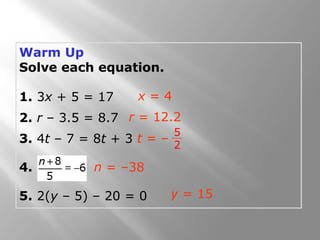
Warm Up
Solve each equation.
1. 3x + 5 = 17
2. r – 3.5 = 8.7
3. 4t – 7 = 8t + 3
4.
5. 2(y – 5) – 20 = 0
x = 4
r = 12.2
n = –38
y = 15
t = –
5
2
Review properties of equality and use
them to write algebraic proofs.
Identify properties of equality and
congruence.
Objectives
proof
Vocabulary
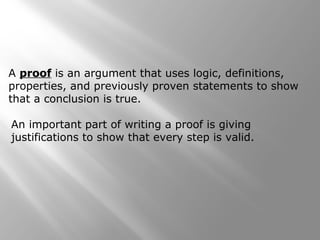
A proof is an argument that uses logic, definitions,
properties, and previously proven statements to show
that a conclusion is true.
An important part of writing a proof is giving
justifications to show that every step is valid.
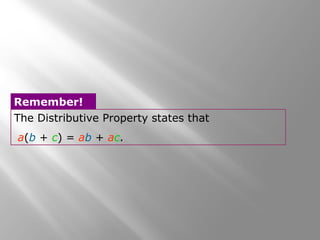
The Distributive Property states that
a(b + c) = ab + ac.
Remember!
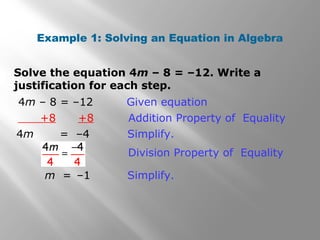
Solve the equation 4m – 8 = –12. Write a
justification for each step.
Example 1: Solving an Equation in Algebra
4m – 8 = –12 Given equation
+8 +8 Addition Property of Equality
4m = –4 Simplify.
m = –1 Simplify.
Division Property of Equality
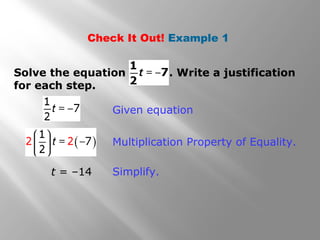
Check It Out! Example 1
t = –14 Simplify.
Solve the equation . Write a justification
for each step.
Given equation
Multiplication Property of Equality.
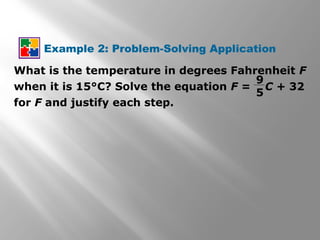
Example 2: Problem-Solving Application
What is the temperature in degrees Fahrenheit F
when it is 15°C? Solve the equation F = C + 32
for F and justify each step.
9
5
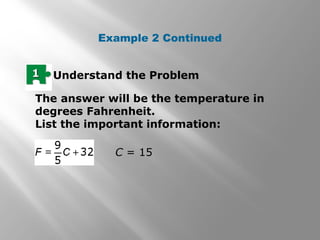
Example 2 Continued
11 Understand the Problem
The answer will be the temperature in
degrees Fahrenheit.
List the important information:
C = 15
22 Make a Plan
Substitute the given information into the
formula and solve.
Example 2 Continued
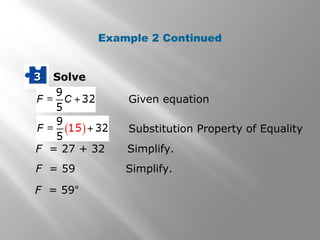
Solve33
F = 27 + 32 Simplify.
F = 59 Simplify.
Given equation
Substitution Property of Equality
F = 59°
Example 2 Continued
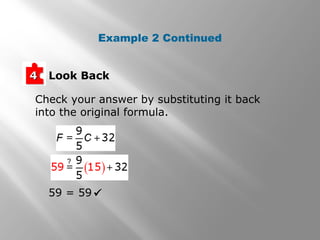
Look Back44
Check your answer by substituting it back
into the original formula.
59 = 59
?
Example 2 Continued
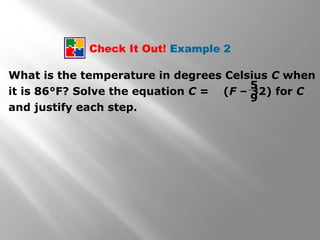
Check It Out! Example 2
What is the temperature in degrees Celsius C when
it is 86°F? Solve the equation C = (F – 32) for C
and justify each step.
5
9
11 Understand the Problem
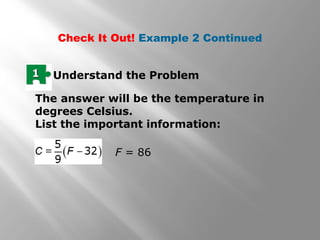
The answer will be the temperature in
degrees Celsius.
List the important information:
F = 86
Check It Out! Example 2 Continued
22 Make a Plan
Substitute the given information into the
formula and solve.
Check It Out! Example 2 Continued
Solve33
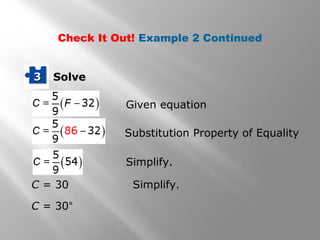
C = 30 Simplify.
Given equation
Substitution Property of Equality
Simplify.
Check It Out! Example 2 Continued
C = 30°
Look Back44
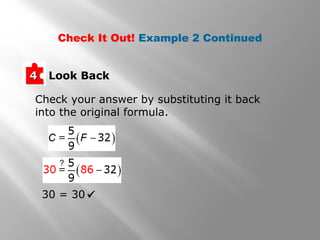
Check your answer by substituting it back
into the original formula.
30 = 30 
Check It Out! Example 2 Continued
?
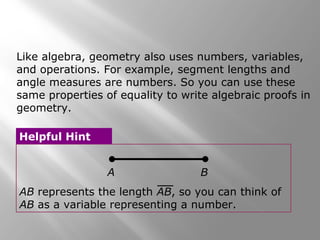
Like algebra, geometry also uses numbers, variables,
and operations. For example, segment lengths and
angle measures are numbers. So you can use these
same properties of equality to write algebraic proofs in
geometry.
A B
AB represents the length AB, so you can think of
AB as a variable representing a number.
Helpful Hint
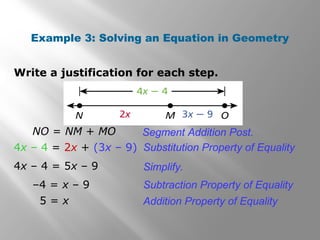
Write a justification for each step.
Example 3: Solving an Equation in Geometry
NO = NM + MO
4x – 4 = 2x + (3x – 9) Substitution Property of Equality
Segment Addition Post.
4x – 4 = 5x – 9 Simplify.
–4 = x – 9
5 = x Addition Property of Equality
Subtraction Property of Equality
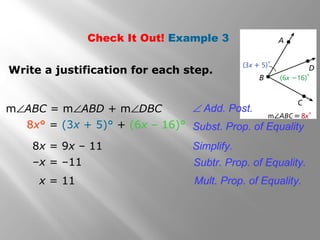
Check It Out! Example 3
Write a justification for each step.
x = 11
Subst. Prop. of Equality8x° = (3x + 5)° + (6x – 16)°
8x = 9x – 11 Simplify.
–x = –11 Subtr. Prop. of Equality.
Mult. Prop. of Equality.
∠ Add. Post.m∠ABC = m∠ABD + m∠DBC
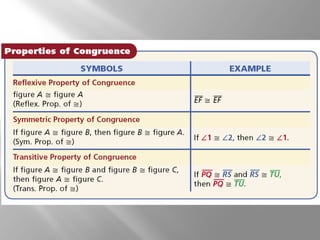
You learned in Chapter 1 that segments with
equal lengths are congruent and that angles with
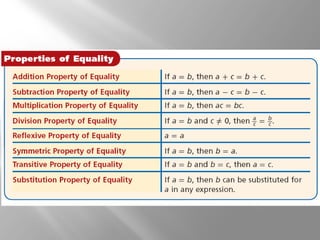
equal measures are congruent. So the Reflexive,
Symmetric, and Transitive Properties of Equality
have corresponding properties of congruence.
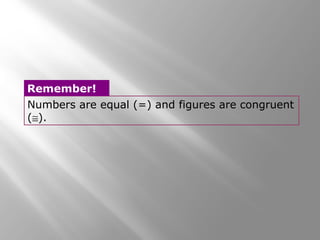
Numbers are equal (=) and figures are congruent
(≅).
Remember!
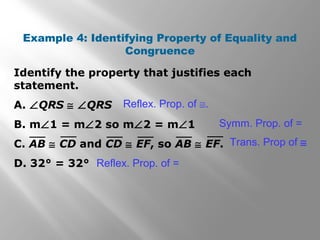
Identify the property that justifies each
statement.
A. ∠QRS ≅ ∠QRS
B. m∠1 = m∠2 so m∠2 = m∠1
C. AB ≅ CD and CD ≅ EF, so AB ≅ EF.
D. 32° = 32°
Example 4: Identifying Property of Equality and
Congruence
Symm. Prop. of =
Trans. Prop of ≅
Reflex. Prop. of =
Reflex. Prop. of ≅.
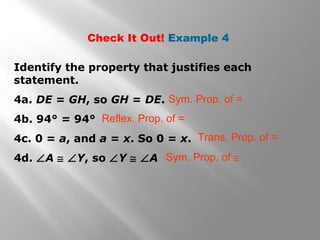
Check It Out! Example 4
Identify the property that justifies each
statement.
4a. DE = GH, so GH = DE.
4b. 94° = 94°
4c. 0 = a, and a = x. So 0 = x.
4d. ∠A ≅ ∠Y, so ∠Y ≅ ∠A
Sym. Prop. of =
Reflex. Prop. of =
Trans. Prop. of =
Sym. Prop. of ≅
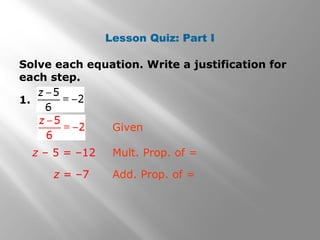
Lesson Quiz: Part I
Solve each equation. Write a justification for
each step.
1.
z – 5 = –12 Mult. Prop. of =
z = –7 Add. Prop. of =
Given
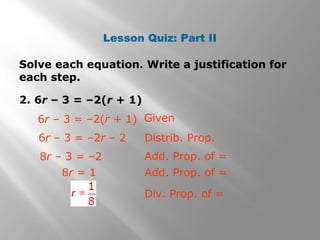
Lesson Quiz: Part II
Solve each equation. Write a justification for
each step.
2. 6r – 3 = –2(r + 1)
Given
6r – 3 = –2r – 2
8r – 3 = –2
Distrib. Prop.
Add. Prop. of =
6r – 3 = –2(r + 1)
8r = 1 Add. Prop. of =
Div. Prop. of =
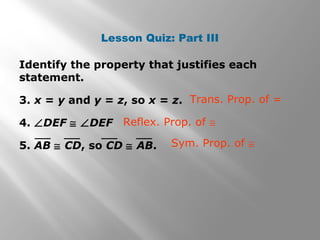
Lesson Quiz: Part III
Identify the property that justifies each
statement.
3. x = y and y = z, so x = z.
4. ∠DEF ≅ ∠DEF
5. AB ≅ CD, so CD ≅ AB.
Trans. Prop. of =
Reflex. Prop. of ≅
Sym. Prop. of ≅
All rights belong to their respective
owners.
Copyright Disclaimer Under Section 107
of the Copyright Act 1976, allowance is
made for "fair use" for purposes such
as criticism, comment, news reporting,
TEACHING, scholarship, and research.
Fair use is a use permitted by copyright
statute that might otherwise be
infringing.
Non-profit, EDUCATIONAL or personal
use tips the balance in favor of fair use.

Geometry 201 unit 2.5

  • 1.
    UNIT 2.5 REASONINGINUNIT 2.5 REASONING IN ALGEBRAAND GEOMETRYALGEBRAAND GEOMETRY
  • 2.
    Warm Up Solve eachequation. 1. 3x + 5 = 17 2. r – 3.5 = 8.7 3. 4t – 7 = 8t + 3 4. 5. 2(y – 5) – 20 = 0 x = 4 r = 12.2 n = –38 y = 15 t = – 5 2
  • 3.
    Review properties ofequality and use them to write algebraic proofs. Identify properties of equality and congruence. Objectives
  • 4.
  • 5.
    A proof isan argument that uses logic, definitions, properties, and previously proven statements to show that a conclusion is true. An important part of writing a proof is giving justifications to show that every step is valid.
  • 7.
    The Distributive Propertystates that a(b + c) = ab + ac. Remember!
  • 8.
    Solve the equation4m – 8 = –12. Write a justification for each step. Example 1: Solving an Equation in Algebra 4m – 8 = –12 Given equation +8 +8 Addition Property of Equality 4m = –4 Simplify. m = –1 Simplify. Division Property of Equality
  • 9.
    Check It Out!Example 1 t = –14 Simplify. Solve the equation . Write a justification for each step. Given equation Multiplication Property of Equality.
  • 10.
    Example 2: Problem-SolvingApplication What is the temperature in degrees Fahrenheit F when it is 15°C? Solve the equation F = C + 32 for F and justify each step. 9 5
  • 11.
    Example 2 Continued 11Understand the Problem The answer will be the temperature in degrees Fahrenheit. List the important information: C = 15
  • 12.
    22 Make aPlan Substitute the given information into the formula and solve. Example 2 Continued
  • 13.
    Solve33 F = 27+ 32 Simplify. F = 59 Simplify. Given equation Substitution Property of Equality F = 59° Example 2 Continued
  • 14.
    Look Back44 Check youranswer by substituting it back into the original formula. 59 = 59 ? Example 2 Continued
  • 15.
    Check It Out!Example 2 What is the temperature in degrees Celsius C when it is 86°F? Solve the equation C = (F – 32) for C and justify each step. 5 9
  • 16.
    11 Understand theProblem The answer will be the temperature in degrees Celsius. List the important information: F = 86 Check It Out! Example 2 Continued
  • 17.
    22 Make aPlan Substitute the given information into the formula and solve. Check It Out! Example 2 Continued
  • 18.
    Solve33 C = 30Simplify. Given equation Substitution Property of Equality Simplify. Check It Out! Example 2 Continued C = 30°
  • 19.
    Look Back44 Check youranswer by substituting it back into the original formula. 30 = 30  Check It Out! Example 2 Continued ?
  • 20.
    Like algebra, geometryalso uses numbers, variables, and operations. For example, segment lengths and angle measures are numbers. So you can use these same properties of equality to write algebraic proofs in geometry. A B AB represents the length AB, so you can think of AB as a variable representing a number. Helpful Hint
  • 21.
    Write a justificationfor each step. Example 3: Solving an Equation in Geometry NO = NM + MO 4x – 4 = 2x + (3x – 9) Substitution Property of Equality Segment Addition Post. 4x – 4 = 5x – 9 Simplify. –4 = x – 9 5 = x Addition Property of Equality Subtraction Property of Equality
  • 22.
    Check It Out!Example 3 Write a justification for each step. x = 11 Subst. Prop. of Equality8x° = (3x + 5)° + (6x – 16)° 8x = 9x – 11 Simplify. –x = –11 Subtr. Prop. of Equality. Mult. Prop. of Equality. ∠ Add. Post.m∠ABC = m∠ABD + m∠DBC
  • 23.
    You learned inChapter 1 that segments with equal lengths are congruent and that angles with equal measures are congruent. So the Reflexive, Symmetric, and Transitive Properties of Equality have corresponding properties of congruence.
  • 25.
    Numbers are equal(=) and figures are congruent (≅). Remember!
  • 26.
    Identify the propertythat justifies each statement. A. ∠QRS ≅ ∠QRS B. m∠1 = m∠2 so m∠2 = m∠1 C. AB ≅ CD and CD ≅ EF, so AB ≅ EF. D. 32° = 32° Example 4: Identifying Property of Equality and Congruence Symm. Prop. of = Trans. Prop of ≅ Reflex. Prop. of = Reflex. Prop. of ≅.
  • 27.
    Check It Out!Example 4 Identify the property that justifies each statement. 4a. DE = GH, so GH = DE. 4b. 94° = 94° 4c. 0 = a, and a = x. So 0 = x. 4d. ∠A ≅ ∠Y, so ∠Y ≅ ∠A Sym. Prop. of = Reflex. Prop. of = Trans. Prop. of = Sym. Prop. of ≅
  • 28.
    Lesson Quiz: PartI Solve each equation. Write a justification for each step. 1. z – 5 = –12 Mult. Prop. of = z = –7 Add. Prop. of = Given
  • 29.
    Lesson Quiz: PartII Solve each equation. Write a justification for each step. 2. 6r – 3 = –2(r + 1) Given 6r – 3 = –2r – 2 8r – 3 = –2 Distrib. Prop. Add. Prop. of = 6r – 3 = –2(r + 1) 8r = 1 Add. Prop. of = Div. Prop. of =
  • 30.
    Lesson Quiz: PartIII Identify the property that justifies each statement. 3. x = y and y = z, so x = z. 4. ∠DEF ≅ ∠DEF 5. AB ≅ CD, so CD ≅ AB. Trans. Prop. of = Reflex. Prop. of ≅ Sym. Prop. of ≅
  • 31.
    All rights belongto their respective owners. Copyright Disclaimer Under Section 107 of the Copyright Act 1976, allowance is made for "fair use" for purposes such as criticism, comment, news reporting, TEACHING, scholarship, and research. Fair use is a use permitted by copyright statute that might otherwise be infringing. Non-profit, EDUCATIONAL or personal use tips the balance in favor of fair use.