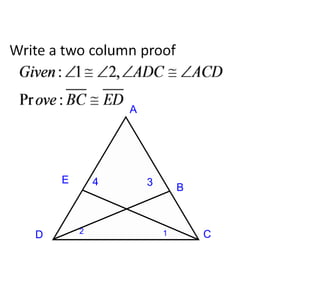
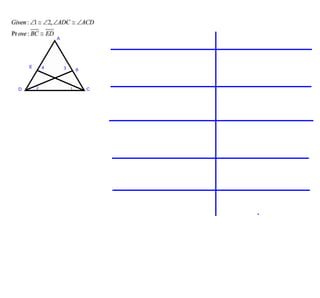
Warm Up
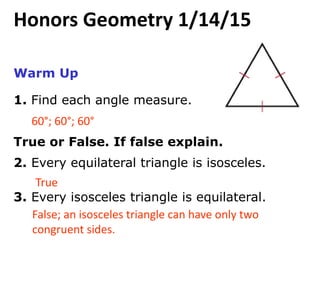
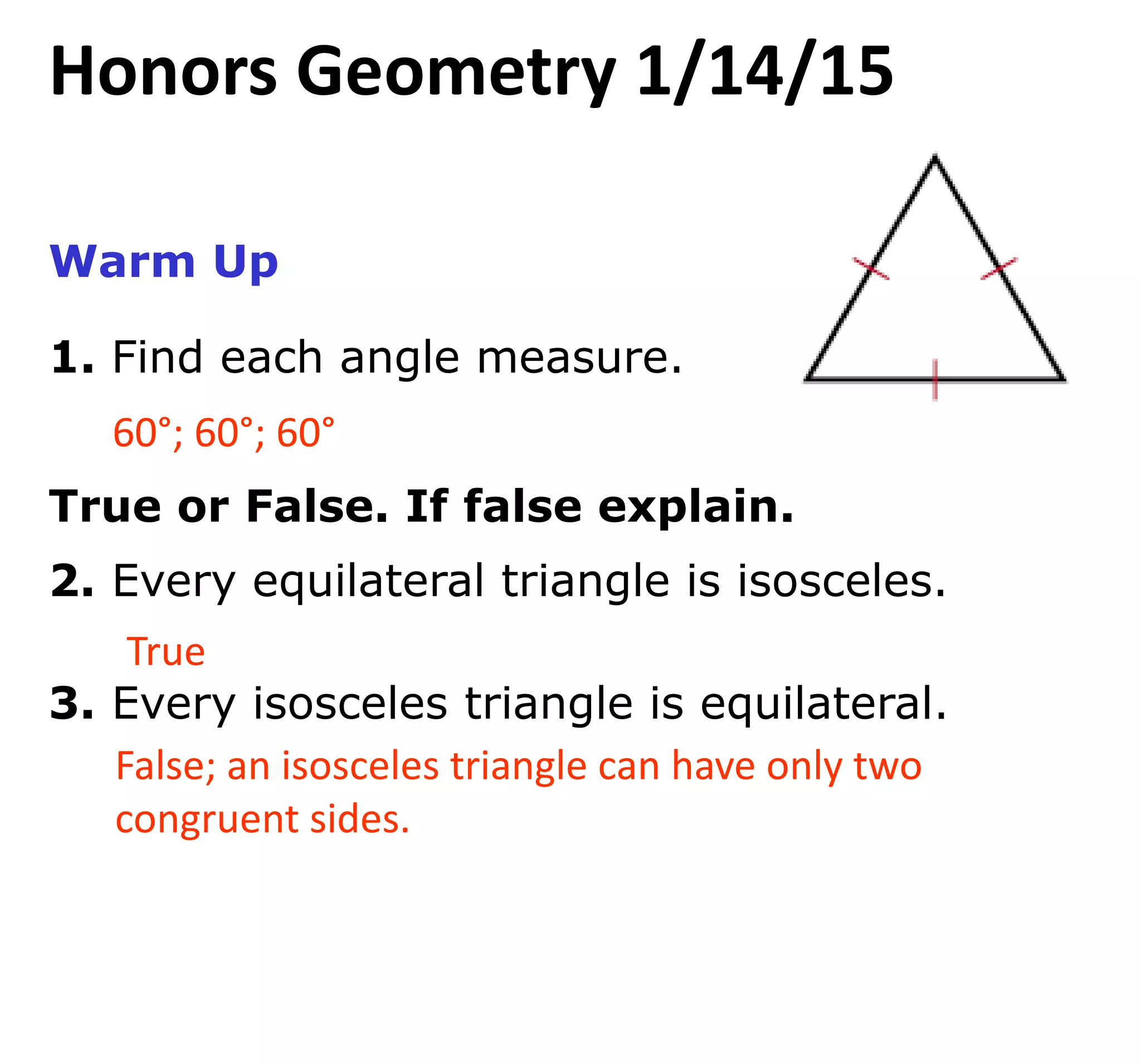
1. Find each angle measure.
True or False. If false explain.
2. Every equilateral triangle is isosceles.
3. Every isosceles triangle is equilateral.
60°; 60°; 60°
True
False; an isosceles triangle can have only two
congruent sides.
Honors Geometry 1/14/15
Hot Potato!
Prove theorems about isosceles and
equilateral triangles.
Apply properties of isosceles and
equilateral triangles.
Objectives
legs of an isosceles triangle
vertex angle
base
base angles
Vocabulary
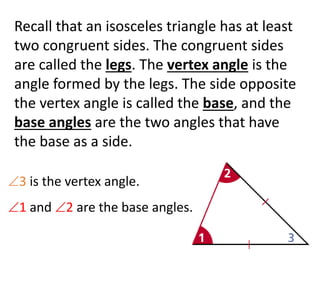
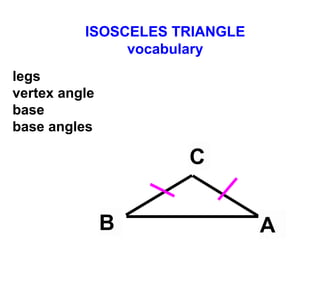
Recall that an isosceles triangle has at least
two congruent sides. The congruent sides
are called the legs. The vertex angle is the
angle formed by the legs. The side opposite
the vertex angle is called the base, and the
base angles are the two angles that have
the base as a side.
3 is the vertex angle.
1 and 2 are the base angles.
The Isosceles Triangle Theorem is sometimes stated
as “Base angles of an isosceles triangle are
congruent.”
Reading Math
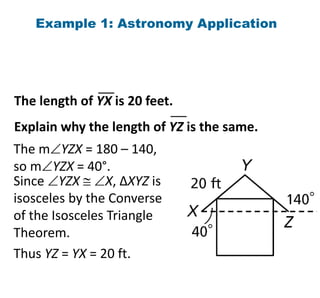
Example 1: Astronomy Application
The length of YX is 20 feet.
Explain why the length of YZ is the same.
Since YZX  X, ∆XYZ is
isosceles by the Converse
of the Isosceles Triangle
Theorem.
The mYZX = 180 – 140,
so mYZX = 40°.
Thus YZ = YX = 20 ft.
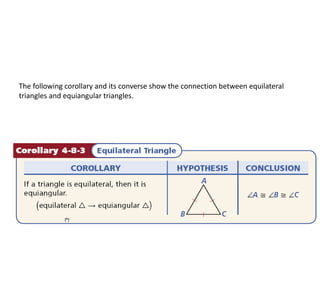
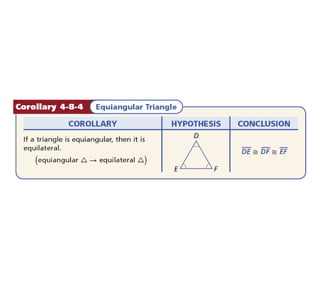
The following corollary and its converse show the connection between equilateral
triangles and equiangular triangles.
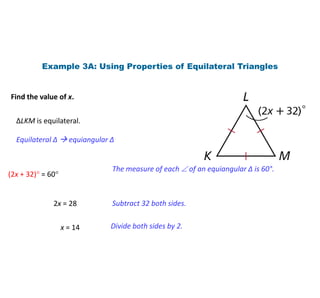
Example 3A: Using Properties of Equilateral Triangles
Find the value of x.
∆LKM is equilateral.
(2x + 32) = 60
The measure of each  of an equiangular ∆ is 60°.
2x = 28 Subtract 32 both sides.
x = 14 Divide both sides by 2.
Equilateral ∆  equiangular ∆
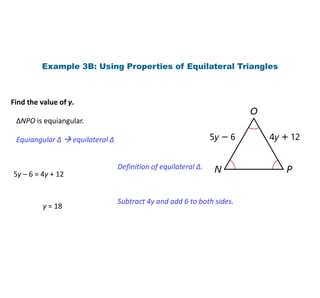
Example 3B: Using Properties of Equilateral Triangles
Find the value of y.
∆NPO is equiangular.
Equiangular ∆  equilateral ∆
5y – 6 = 4y + 12
Definition of equilateral ∆.
y = 18
Subtract 4y and add 6 to both sides.
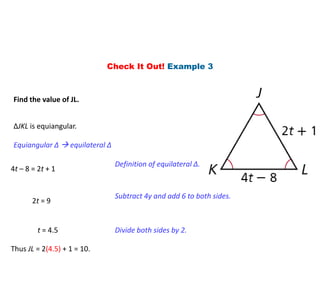
Check It Out! Example 3
Find the value of JL.
∆JKL is equiangular.
Equiangular ∆  equilateral ∆
4t – 8 = 2t + 1
Definition of equilateral ∆.
2t = 9
Subtract 4y and add 6 to both sides.
t = 4.5 Divide both sides by 2.
Thus JL = 2(4.5) + 1 = 10.
ISOSCELES TRIANGLE
vocabulary
legs
vertex angle
base
base angles
C
B A
C
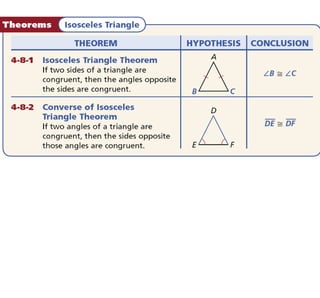
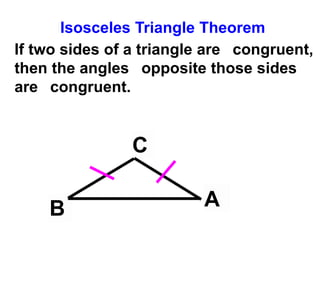
Isosceles Triangle Theorem
If two sides of a triangle are congruent,
then the angles opposite those sides
are congruent.
B A
???????????????????????
Is the converse true?
Converse Isosceles
Triangle Theorem
If two angles of a triangle are
congruent, then the sides
opposite those angles are
congruent.
CPCTC is an abbreviation for the
phrase “Corresponding Parts of
Congruent Triangles are Congruent.”
It can be used as a justification in a
proof after you have proven two
triangles congruent.
·Corresponding
·Parts of
·Congruent
·Triangles are
·Congruent
CPCTC
SSS, SAS, ASA, AAS, and HL use corresponding parts
to prove triangles congruent. CPCTC uses congruent
triangles to prove corresponding parts congruent.
Remember!
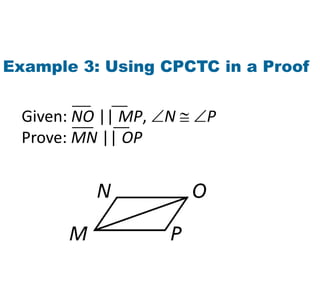
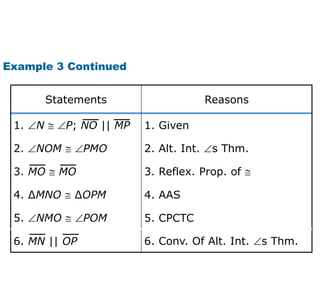
Example 3: Using CPCTC in a Proof
Prove: MN || OP
Given: NO || MP, N  P
5. CPCTC5. NMO  POM
6. Conv. Of Alt. Int. s Thm.
4. AAS4. ∆MNO  ∆OPM
3. Reflex. Prop. of 
2. Alt. Int. s Thm.2. NOM  PMO
1. Given
ReasonsStatements
3. MO  MO
6. MN || OP
1. N  P; NO || MP
Example 3 Continued
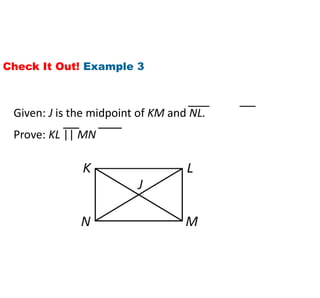
Check It Out! Example 3
Prove: KL || MN
Given: J is the midpoint of KM and NL.
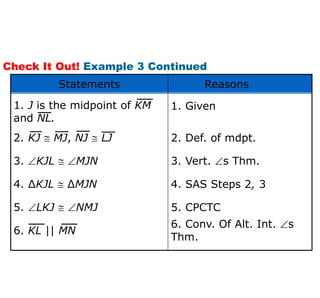
Check It Out! Example 3 Continued
5. CPCTC5. LKJ  NMJ
6. Conv. Of Alt. Int. s
Thm.
4. SAS Steps 2, 34. ∆KJL  ∆MJN
3. Vert. s Thm.3. KJL  MJN
2. Def. of mdpt.
1. Given
ReasonsStatements
6. KL || MN
1. J is the midpoint of KM
and NL.
2. KJ  MJ, NJ  LJ
Eyes on Isosceles
Triangles
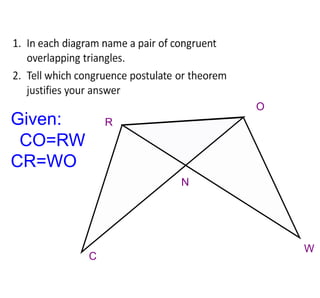
R
O
N
C
W
Given:
CO=RW
CR=WO
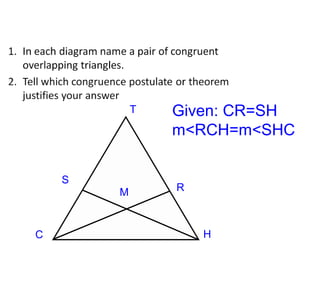
S
T
RM
C H
Given: CR=SH
m<RCH=m<SHC
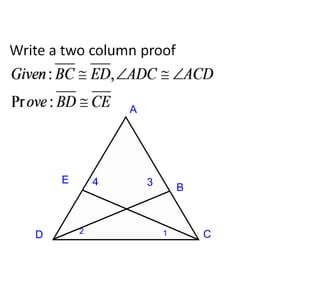
E
A
B
4
D C
3
2 1
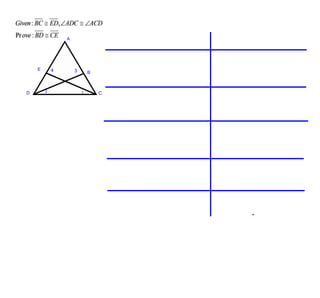
E
A
B4
D C
3
2 1
E
A
B
4
D C
3
2 1
E
A
B
4
D C
3
2 1
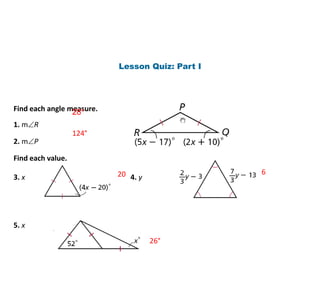
Lesson Quiz: Part I
Find each angle measure.
1. mR
2. mP
Find each value.
3. x 4. y
5. x
124°
28°
20 6
26°
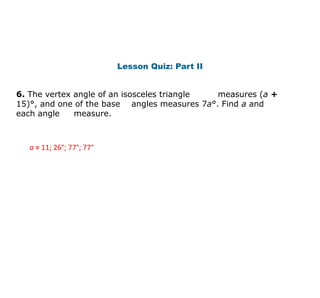
Lesson Quiz: Part II
6. The vertex angle of an isosceles triangle measures (a +
15)°, and one of the base angles measures 7a°. Find a and
each angle measure.
a = 11; 26°; 77°; 77°
STW review all types of
triangles & triangle congruency
to prepare for Chapter test

Overlapping triangle drill

  • 1.
    Warm Up 1. Findeach angle measure. True or False. If false explain. 2. Every equilateral triangle is isosceles. 3. Every isosceles triangle is equilateral. 60°; 60°; 60° True False; an isosceles triangle can have only two congruent sides. Honors Geometry 1/14/15
  • 2.
  • 3.
    Prove theorems aboutisosceles and equilateral triangles. Apply properties of isosceles and equilateral triangles. Objectives
  • 4.
    legs of anisosceles triangle vertex angle base base angles Vocabulary
  • 5.
    Recall that anisosceles triangle has at least two congruent sides. The congruent sides are called the legs. The vertex angle is the angle formed by the legs. The side opposite the vertex angle is called the base, and the base angles are the two angles that have the base as a side. 3 is the vertex angle. 1 and 2 are the base angles.
  • 7.
    The Isosceles TriangleTheorem is sometimes stated as “Base angles of an isosceles triangle are congruent.” Reading Math
  • 8.
    Example 1: AstronomyApplication The length of YX is 20 feet. Explain why the length of YZ is the same. Since YZX  X, ∆XYZ is isosceles by the Converse of the Isosceles Triangle Theorem. The mYZX = 180 – 140, so mYZX = 40°. Thus YZ = YX = 20 ft.
  • 9.
    The following corollaryand its converse show the connection between equilateral triangles and equiangular triangles.
  • 11.
    Example 3A: UsingProperties of Equilateral Triangles Find the value of x. ∆LKM is equilateral. (2x + 32) = 60 The measure of each  of an equiangular ∆ is 60°. 2x = 28 Subtract 32 both sides. x = 14 Divide both sides by 2. Equilateral ∆  equiangular ∆
  • 12.
    Example 3B: UsingProperties of Equilateral Triangles Find the value of y. ∆NPO is equiangular. Equiangular ∆  equilateral ∆ 5y – 6 = 4y + 12 Definition of equilateral ∆. y = 18 Subtract 4y and add 6 to both sides.
  • 13.
    Check It Out!Example 3 Find the value of JL. ∆JKL is equiangular. Equiangular ∆  equilateral ∆ 4t – 8 = 2t + 1 Definition of equilateral ∆. 2t = 9 Subtract 4y and add 6 to both sides. t = 4.5 Divide both sides by 2. Thus JL = 2(4.5) + 1 = 10.
  • 14.
  • 15.
    C Isosceles Triangle Theorem Iftwo sides of a triangle are congruent, then the angles opposite those sides are congruent. B A
  • 16.
  • 17.
    Converse Isosceles Triangle Theorem Iftwo angles of a triangle are congruent, then the sides opposite those angles are congruent.
  • 22.
    CPCTC is anabbreviation for the phrase “Corresponding Parts of Congruent Triangles are Congruent.” It can be used as a justification in a proof after you have proven two triangles congruent.
  • 23.
  • 24.
    SSS, SAS, ASA,AAS, and HL use corresponding parts to prove triangles congruent. CPCTC uses congruent triangles to prove corresponding parts congruent. Remember!
  • 25.
    Example 3: UsingCPCTC in a Proof Prove: MN || OP Given: NO || MP, N  P
  • 26.
    5. CPCTC5. NMO POM 6. Conv. Of Alt. Int. s Thm. 4. AAS4. ∆MNO  ∆OPM 3. Reflex. Prop. of  2. Alt. Int. s Thm.2. NOM  PMO 1. Given ReasonsStatements 3. MO  MO 6. MN || OP 1. N  P; NO || MP Example 3 Continued
  • 27.
    Check It Out!Example 3 Prove: KL || MN Given: J is the midpoint of KM and NL.
  • 28.
    Check It Out!Example 3 Continued 5. CPCTC5. LKJ  NMJ 6. Conv. Of Alt. Int. s Thm. 4. SAS Steps 2, 34. ∆KJL  ∆MJN 3. Vert. s Thm.3. KJL  MJN 2. Def. of mdpt. 1. Given ReasonsStatements 6. KL || MN 1. J is the midpoint of KM and NL. 2. KJ  MJ, NJ  LJ
  • 29.
  • 30.
  • 31.
  • 32.
  • 33.
  • 34.
  • 35.
  • 36.
    Lesson Quiz: PartI Find each angle measure. 1. mR 2. mP Find each value. 3. x 4. y 5. x 124° 28° 20 6 26°
  • 37.
    Lesson Quiz: PartII 6. The vertex angle of an isosceles triangle measures (a + 15)°, and one of the base angles measures 7a°. Find a and each angle measure. a = 11; 26°; 77°; 77°
  • 38.
    STW review alltypes of triangles & triangle congruency to prepare for Chapter test