Chapter1: Triangle Midpoint Theorem
       and Intercept Theorem


Outline
•Basic concepts and facts
•Proof and presentation
•Midpoint Theorem
•Intercept Theorem
1.1. Basic concepts and facts
In-Class-Activity 1.
(a) State the definition of the following
  terms:
Parallel lines,


Congruent triangles,


Similar triangles:
•Two lines are parallel if they do not meet
at any point

•Two triangles are congruent if their
corresponding angles and corresponding
sides equal
•Two triangles are similar if their
Corresponding angles equal and their
corresponding sides are in proportion.
[Figure1]
(b) List as many sufficient conditions as
  possible for

• two lines to be parallel,

• two triangles to be congruent,

• two triangles to be similar
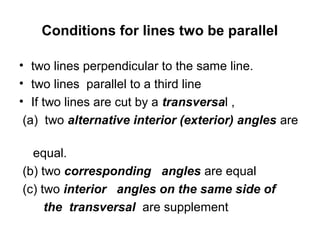
Conditions for lines two be parallel

• two lines perpendicular to the same line.
• two lines parallel to a third line
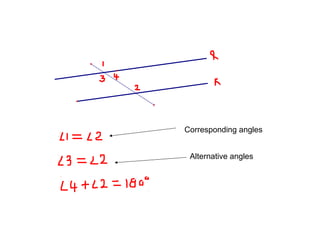
• If two lines are cut by a transversal ,
 (a) two alternative interior (exterior) angles are

  equal.
(b) two corresponding angles are equal
(c) two interior angles on the same side of
     the transversal are supplement
Corresponding angles


 Alternative angles
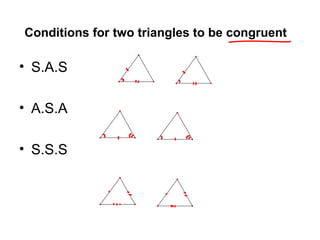
Conditions for two triangles to be congruent

• S.A.S

• A.S.A

• S.S.S
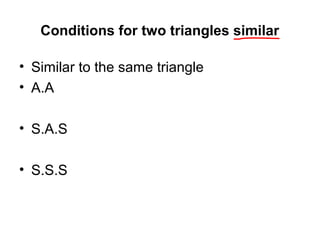
Conditions for two triangles similar

• Similar to the same triangle
• A.A

• S.A.S

• S.S.S
1.2. Proofs and presentation
What is a proof? How to present a proof?
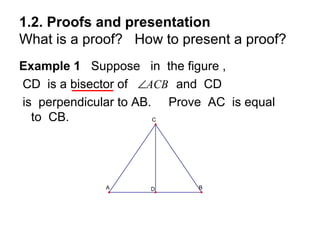
Example 1 Suppose in the figure ,
CD is a bisector of ∠ACB and CD
is perpendicular to AB. Prove AC is equal
  to CB.               C


             A       D      B
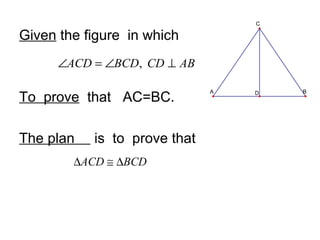
C

Given the figure in which
      ∠ACD = ∠BCD, CD ⊥ AB

                              A       B
To prove that AC=BC.              D


The plan   is to prove that
        ∆ACD ≅ ∆BCD
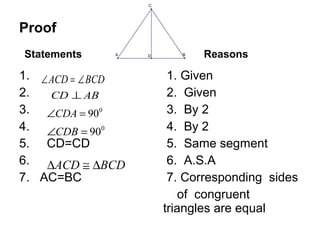
C


Proof
Statements    A    D      B   Reasons

1. ∠ ACD = ∠ BCD        1. Given
2.   CD ⊥ AB            2. Given
3. ∠CDA = 900           3. By 2
4. ∠CDB = 900           4. By 2
5. CD=CD                5. Same segment
6. ∆ACD ≅ ∆BCD          6. A.S.A
7. AC=BC                7. Corresponding sides
                           of congruent
                       triangles are equal
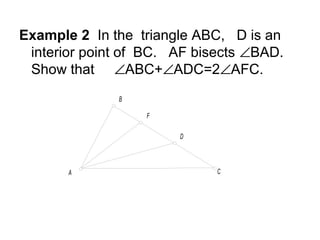
Example 2 In the triangle ABC, D is an
 interior point of BC. AF bisects ∠BAD.
 Show that ∠ABC+∠ADC=2∠AFC.
              B

                  F

                       D


       A                     C
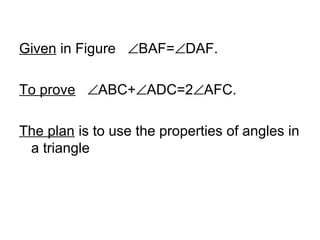
Given in Figure ∠BAF=∠DAF.

To prove ∠ABC+∠ADC=2∠AFC.

The plan is to use the properties of angles in
 a triangle
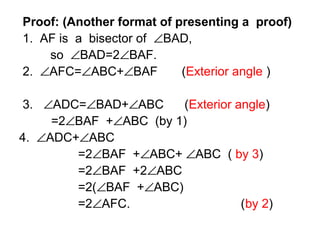
Proof: (Another format of presenting a proof)
1. AF is a bisector of ∠BAD,
    so ∠BAD=2∠BAF.
2. ∠AFC=∠ABC+∠BAF          (Exterior angle )

 3. ∠ADC=∠BAD+∠ABC     (Exterior angle)
     =2∠BAF +∠ABC (by 1)
4. ∠ADC+∠ABC
        =2∠BAF +∠ABC+ ∠ABC ( by 3)
        =2∠BAF +2∠ABC
        =2(∠BAF +∠ABC)
        =2∠AFC.                   (by 2)
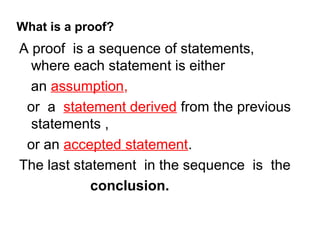
What is a proof?
A proof is a sequence of statements,
  where each statement is either
  an assumption,
 or a statement derived from the previous
  statements ,
 or an accepted statement.
The last statement in the sequence is the
            conclusion.
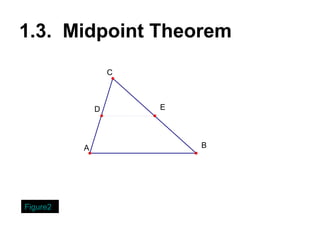
1.3. Midpoint Theorem
                  C


              D       E


          A               B


Figure2
1.3. Midpoint Theorem
Theorem 1 [ Triangle Midpoint Theorem]
The line segment connecting the midpoints
 of two sides of a triangle
  is parallel to the third side
and
  is half as long as the third side.
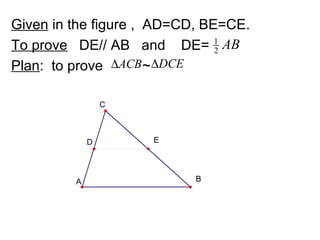
Given in the figure , AD=CD, BE=CE.
To prove DE// AB and DE= 2 AB  1


Plan: to prove ∆ACB ~ ∆DCE

                 C


             D       E


         A                 B
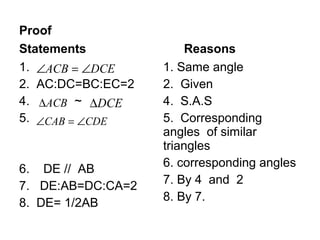
Proof
Statements              Reasons
1. ∠ACB = ∠DCE     1. Same angle
2. AC:DC=BC:EC=2   2. Given
4. ∆ACB ~ ∆DCE     4. S.A.S
5. ∠CAB = ∠CDE     5. Corresponding
                   angles of similar
                   triangles
                   6. corresponding angles
6. DE // AB
                   7. By 4 and 2
7. DE:AB=DC:CA=2
8. DE= 1/2AB       8. By 7.
In-Class Activity 2 (Generalization and
extension)
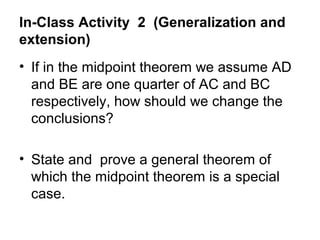
• If in the midpoint theorem we assume AD
  and BE are one quarter of AC and BC
  respectively, how should we change the
  conclusions?

• State and prove a general theorem of
  which the midpoint theorem is a special
  case.
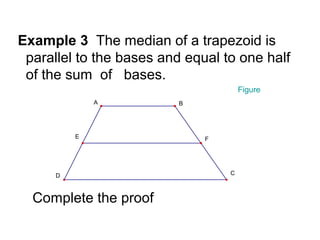
Example 3 The median of a trapezoid is
 parallel to the bases and equal to one half
 of the sum of bases.
                                      Figure
              A           B


          E                   F


      D                           C


  Complete the proof
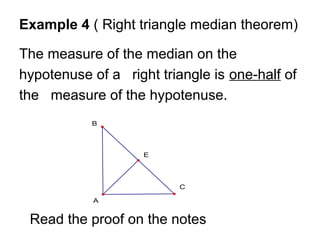
Example 4 ( Right triangle median theorem)

The measure of the median on the
hypotenuse of a right triangle is one-half of
the measure of the hypotenuse.
           B


                    E


                          C

            A


 Read the proof on the notes
In-Class-Activity 4
 (posing the converse problem)

Suppose in a triangle the measure of a
median on a side is one-half of the measure
of that side. Is the triangle a right
triangle?
1.4 Triangle Intercept Theorem
Theorem 2 [Triangle Intercept Theorem]
If a line is parallel to one side of a triangle
it divides the other two sides proportionally.
 Also converse(?) .               C


 Figure
                              D       E


Write down the complete   A               B
proof
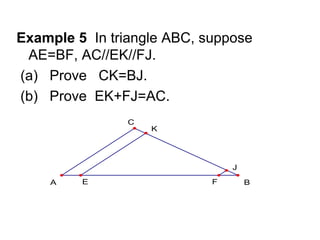
Example 5 In triangle ABC, suppose
 AE=BF, AC//EK//FJ.
(a) Prove CK=BJ.
(b) Prove EK+FJ=AC.
                C
                    K


                                J

    A    E                  F       B
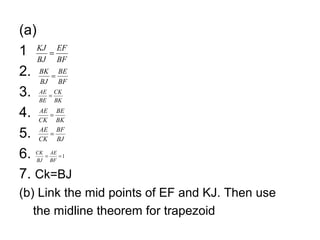
(a)
1 KJ = EF
    BJ BF
2. BK = BE
     BJ BF
3. BE = CK
    AE
        BK

4. CK = BK
    AE BE


5. CK = BF
     AE
         BJ

6. CK AE
     =
   BJ BF
         =1


7. Ck=BJ
(b) Link the mid points of EF and KJ. Then use
   the midline theorem for trapezoid
In-Class-Exercise
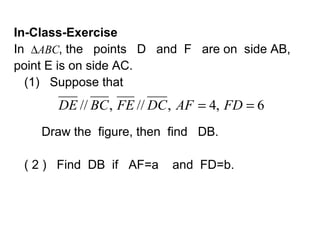
In ∆ABC, the points D and F are on side AB,
point E is on side AC.
  (1) Suppose that
      DE // BC , FE // DC , AF = 4, FD = 6
    Draw the figure, then find DB.

 ( 2 ) Find DB if AF=a    and FD=b.
Please submit the solutions of
  (1) In –class-exercise on pg 7
   (2) another 4 problems in
         Tutorial 1
    next time.
         THANK YOU
            Zhao Dongsheng
            MME/NIE
            Tel: 67903893
            E-mail: dszhao@nie.edu.sg

midpoint theorem &intersept theorm

  • 1.
    Chapter1: Triangle MidpointTheorem and Intercept Theorem Outline •Basic concepts and facts •Proof and presentation •Midpoint Theorem •Intercept Theorem
  • 2.
    1.1. Basic conceptsand facts In-Class-Activity 1. (a) State the definition of the following terms: Parallel lines, Congruent triangles, Similar triangles:
  • 3.
    •Two lines areparallel if they do not meet at any point •Two triangles are congruent if their corresponding angles and corresponding sides equal •Two triangles are similar if their Corresponding angles equal and their corresponding sides are in proportion. [Figure1]
  • 4.
    (b) List asmany sufficient conditions as possible for • two lines to be parallel, • two triangles to be congruent, • two triangles to be similar
  • 5.
    Conditions for linestwo be parallel • two lines perpendicular to the same line. • two lines parallel to a third line • If two lines are cut by a transversal , (a) two alternative interior (exterior) angles are equal. (b) two corresponding angles are equal (c) two interior angles on the same side of the transversal are supplement
  • 6.
  • 7.
    Conditions for twotriangles to be congruent • S.A.S • A.S.A • S.S.S
  • 8.
    Conditions for twotriangles similar • Similar to the same triangle • A.A • S.A.S • S.S.S
  • 9.
    1.2. Proofs andpresentation What is a proof? How to present a proof? Example 1 Suppose in the figure , CD is a bisector of ∠ACB and CD is perpendicular to AB. Prove AC is equal to CB. C A D B
  • 10.
    C Given the figurein which ∠ACD = ∠BCD, CD ⊥ AB A B To prove that AC=BC. D The plan is to prove that ∆ACD ≅ ∆BCD
  • 11.
    C Proof Statements A D B Reasons 1. ∠ ACD = ∠ BCD 1. Given 2. CD ⊥ AB 2. Given 3. ∠CDA = 900 3. By 2 4. ∠CDB = 900 4. By 2 5. CD=CD 5. Same segment 6. ∆ACD ≅ ∆BCD 6. A.S.A 7. AC=BC 7. Corresponding sides of congruent triangles are equal
  • 12.
    Example 2 Inthe triangle ABC, D is an interior point of BC. AF bisects ∠BAD. Show that ∠ABC+∠ADC=2∠AFC. B F D A C
  • 13.
    Given in Figure∠BAF=∠DAF. To prove ∠ABC+∠ADC=2∠AFC. The plan is to use the properties of angles in a triangle
  • 14.
    Proof: (Another formatof presenting a proof) 1. AF is a bisector of ∠BAD, so ∠BAD=2∠BAF. 2. ∠AFC=∠ABC+∠BAF (Exterior angle ) 3. ∠ADC=∠BAD+∠ABC (Exterior angle) =2∠BAF +∠ABC (by 1) 4. ∠ADC+∠ABC =2∠BAF +∠ABC+ ∠ABC ( by 3) =2∠BAF +2∠ABC =2(∠BAF +∠ABC) =2∠AFC. (by 2)
  • 15.
    What is aproof? A proof is a sequence of statements, where each statement is either an assumption, or a statement derived from the previous statements , or an accepted statement. The last statement in the sequence is the conclusion.
  • 16.
    1.3. Midpoint Theorem C D E A B Figure2
  • 17.
    1.3. Midpoint Theorem Theorem1 [ Triangle Midpoint Theorem] The line segment connecting the midpoints of two sides of a triangle is parallel to the third side and is half as long as the third side.
  • 18.
    Given in thefigure , AD=CD, BE=CE. To prove DE// AB and DE= 2 AB 1 Plan: to prove ∆ACB ~ ∆DCE C D E A B
  • 19.
    Proof Statements Reasons 1. ∠ACB = ∠DCE 1. Same angle 2. AC:DC=BC:EC=2 2. Given 4. ∆ACB ~ ∆DCE 4. S.A.S 5. ∠CAB = ∠CDE 5. Corresponding angles of similar triangles 6. corresponding angles 6. DE // AB 7. By 4 and 2 7. DE:AB=DC:CA=2 8. DE= 1/2AB 8. By 7.
  • 20.
    In-Class Activity 2(Generalization and extension) • If in the midpoint theorem we assume AD and BE are one quarter of AC and BC respectively, how should we change the conclusions? • State and prove a general theorem of which the midpoint theorem is a special case.
  • 21.
    Example 3 Themedian of a trapezoid is parallel to the bases and equal to one half of the sum of bases. Figure A B E F D C Complete the proof
  • 22.
    Example 4 (Right triangle median theorem) The measure of the median on the hypotenuse of a right triangle is one-half of the measure of the hypotenuse. B E C A Read the proof on the notes
  • 23.
    In-Class-Activity 4 (posingthe converse problem) Suppose in a triangle the measure of a median on a side is one-half of the measure of that side. Is the triangle a right triangle?
  • 24.
    1.4 Triangle InterceptTheorem Theorem 2 [Triangle Intercept Theorem] If a line is parallel to one side of a triangle it divides the other two sides proportionally. Also converse(?) . C Figure D E Write down the complete A B proof
  • 25.
    Example 5 Intriangle ABC, suppose AE=BF, AC//EK//FJ. (a) Prove CK=BJ. (b) Prove EK+FJ=AC. C K J A E F B
  • 26.
    (a) 1 KJ =EF BJ BF 2. BK = BE BJ BF 3. BE = CK AE BK 4. CK = BK AE BE 5. CK = BF AE BJ 6. CK AE = BJ BF =1 7. Ck=BJ (b) Link the mid points of EF and KJ. Then use the midline theorem for trapezoid
  • 27.
    In-Class-Exercise In ∆ABC, thepoints D and F are on side AB, point E is on side AC. (1) Suppose that DE // BC , FE // DC , AF = 4, FD = 6 Draw the figure, then find DB. ( 2 ) Find DB if AF=a and FD=b.
  • 28.
    Please submit thesolutions of (1) In –class-exercise on pg 7 (2) another 4 problems in Tutorial 1 next time. THANK YOU Zhao Dongsheng MME/NIE Tel: 67903893 E-mail: dszhao@nie.edu.sg