Isosceles and Equilateral Triangles
The student is able to (I can):
• Identify isosceles and equilateral triangles by side length
and angle measure
• Use the Isosceles Triangle Theorem to solve problems
• Use the Equilateral Triangle Corollary to solve problems
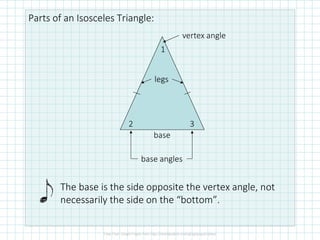
Parts of an Isosceles Triangle:
The base is the side opposite the vertex angle, not
necessarily the side on the “bottom”.
1
2 3
legs
base
base angles
vertex angle
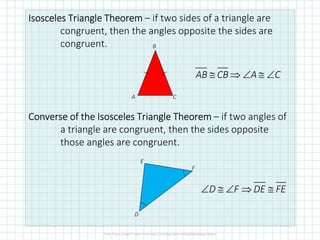
Isosceles TriangleIsosceles TriangleIsosceles TriangleIsosceles Triangle TheoremTheoremTheoremTheorem – if two sides of a triangle are
congruent, then the angles opposite the sides are
congruent.
ConverseConverseConverseConverse of the Isosceles Triangleof the Isosceles Triangleof the Isosceles Triangleof the Isosceles Triangle TheoremTheoremTheoremTheorem – if two angles of
a triangle are congruent, then the sides opposite
those angles are congruent.
C
B
A
AB CB A C≅ ⇒ ∠ ≅ ∠
F
E
D
D F DE FE∠ ≅ ∠ ⇒ ≅
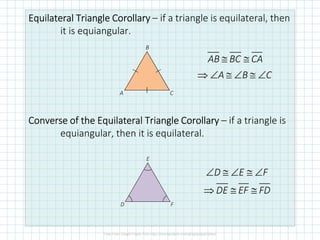
Equilateral TriangleEquilateral TriangleEquilateral TriangleEquilateral Triangle CorollaryCorollaryCorollaryCorollary – if a triangle is equilateral, then
it is equiangular.
Converse of the Equilateral TriangleConverse of the Equilateral TriangleConverse of the Equilateral TriangleConverse of the Equilateral Triangle CorollaryCorollaryCorollaryCorollary – if a triangle is
equiangular, then it is equilateral.
C
B
A
≅ ≅
⇒ ∠ ≅ ∠ ≅ ∠
AB BC CA
A B C
D E F
DE EF FD
∠ ≅ ∠ ≅ ∠
⇒ ≅ ≅
F
E
D
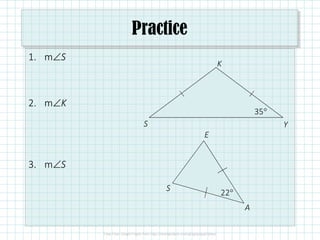
Practice
1. m∠S
2. m∠K
3. m∠S
35°
S
K
Y
S
E
A
22°
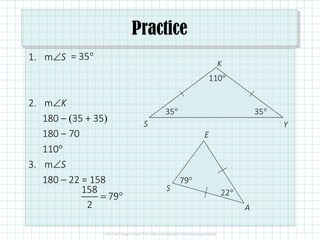
Practice
1. m∠S
2. m∠K
180 – (35 + 35)
180 – 70
110°
3. m∠S
180 – 22 = 158
35°
S
K
Y
S
E
A
22°
= 35°
35°
110°
158
79
2
= °
79°

6.5 Isosceles and Equilateral Triangles

  • 1.
    Isosceles and EquilateralTriangles The student is able to (I can): • Identify isosceles and equilateral triangles by side length and angle measure • Use the Isosceles Triangle Theorem to solve problems • Use the Equilateral Triangle Corollary to solve problems
  • 2.
    Parts of anIsosceles Triangle: The base is the side opposite the vertex angle, not necessarily the side on the “bottom”. 1 2 3 legs base base angles vertex angle
  • 3.
    Isosceles TriangleIsosceles TriangleIsoscelesTriangleIsosceles Triangle TheoremTheoremTheoremTheorem – if two sides of a triangle are congruent, then the angles opposite the sides are congruent. ConverseConverseConverseConverse of the Isosceles Triangleof the Isosceles Triangleof the Isosceles Triangleof the Isosceles Triangle TheoremTheoremTheoremTheorem – if two angles of a triangle are congruent, then the sides opposite those angles are congruent. C B A AB CB A C≅ ⇒ ∠ ≅ ∠ F E D D F DE FE∠ ≅ ∠ ⇒ ≅
  • 4.
    Equilateral TriangleEquilateral TriangleEquilateralTriangleEquilateral Triangle CorollaryCorollaryCorollaryCorollary – if a triangle is equilateral, then it is equiangular. Converse of the Equilateral TriangleConverse of the Equilateral TriangleConverse of the Equilateral TriangleConverse of the Equilateral Triangle CorollaryCorollaryCorollaryCorollary – if a triangle is equiangular, then it is equilateral. C B A ≅ ≅ ⇒ ∠ ≅ ∠ ≅ ∠ AB BC CA A B C D E F DE EF FD ∠ ≅ ∠ ≅ ∠ ⇒ ≅ ≅ F E D
  • 5.
    Practice 1. m∠S 2. m∠K 3.m∠S 35° S K Y S E A 22°
  • 6.
    Practice 1. m∠S 2. m∠K 180– (35 + 35) 180 – 70 110° 3. m∠S 180 – 22 = 158 35° S K Y S E A 22° = 35° 35° 110° 158 79 2 = ° 79°