Introduction to Trigonometry
• Trigonometry is the science of relationships
between the sides and angles of a right-angled
triangle.
• Trigonometric Ratios: Ratios of sides of right
triangle are called trigonometric ratios.
Consider triangle ABC right-angled at B. These
ratios are always defined with respect to acute
angle ‘A’ or angle ‘C.
• If one of the trigonometric ratios of an acute
angle is known, the remaining trigonometric
ratios of an angle can be easily determined.
• How to identify sides: Identify the angle with
respect to which the t-ratios have to be
calculated. Sides are always labelled with
respect to the ‘θ’ being considered.
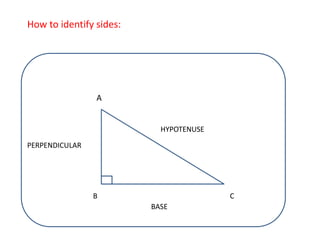
How to identify sides:
A
CB
HYPOTENUSE
PERPENDICULAR
BASE
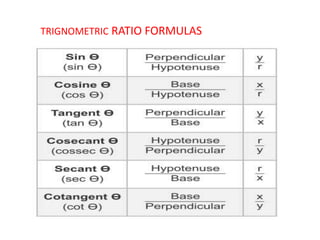
TRIGNOMETRIC RATIO FORMULAS
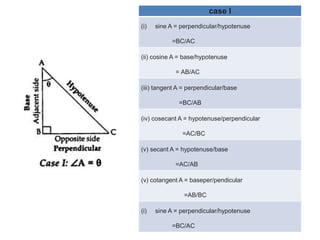
case I
(i) sine A = perpendicular/hypotenuse
=BC/AC
(ii) cosine A = base/hypotenuse
= AB/AC
(iii) tangent A = perpendicular/base
=BC/AB
(iv) cosecant A = hypotenuse/perpendicular
=AC/BC
(v) secant A = hypotenuse/base
=AC/AB
(v) cotangent A = baseper/pendicular
=AB/BC
(i) sine A = perpendicular/hypotenuse
=BC/AC
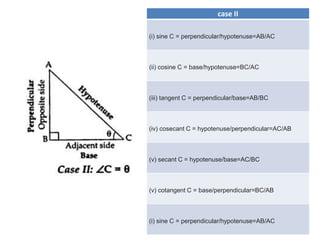
case II
(i) sine C = perpendicular/hypotenuse=AB/AC
(ii) cosine C = base/hypotenuse=BC/AC
(iii) tangent C = perpendicular/base=AB/BC
(iv) cosecant C = hypotenuse/perpendicular=AC/AB
(v) secant C = hypotenuse/base=AC/BC
(v) cotangent C = base/perpendicular=BC/AB
(i) sine C = perpendicular/hypotenuse=AB/AC
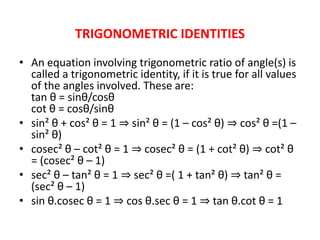
TRIGONOMETRIC IDENTITIES
• An equation involving trigonometric ratio of angle(s) is
called a trigonometric identity, if it is true for all values
of the angles involved. These are:
tan θ = sinθ/cosθ
cot θ = cosθ/sinθ
• sin² θ + cos² θ = 1 ⇒ sin² θ = (1 – cos² θ) ⇒ cos² θ =(1 –
sin² θ)
• cosec² θ – cot² θ = 1 ⇒ cosec² θ = (1 + cot² θ) ⇒ cot² θ
= (cosec² θ – 1)
• sec² θ – tan² θ = 1 ⇒ sec² θ =( 1 + tan² θ) ⇒ tan² θ =
(sec² θ – 1)
• sin θ.cosec θ = 1 ⇒ cos θ.sec θ = 1 ⇒ tan θ.cot θ = 1
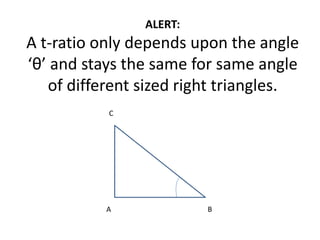
ALERT:
A t-ratio only depends upon the angle
‘θ’ and stays the same for same angle
of different sized right triangles.
A B
C
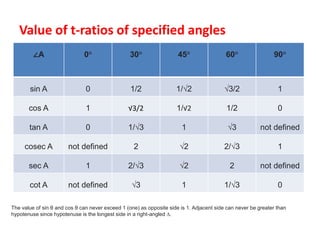
Value of t-ratios of specified angles
∠A 0° 30° 45° 60° 90°
sin A 0 1/2 1/√2 √3/2 1
cos A 1 √3/2 1/√2 1/2 0
tan A 0 1/√3 1 √3 not defined
cosec A not defined 2 √2 2/√3 1
sec A 1 2/√3 √2 2 not defined
cot A not defined √3 1 1/√3 0
The value of sin θ and cos θ can never exceed 1 (one) as opposite side is 1. Adjacent side can never be greater than
hypotenuse since hypotenuse is the longest side in a right-angled ∆.
‘t-RATIOS’ OF COMPLEMENTARY ANGLES
∠A and ∠C are known as complementary angles and are related by the
Following relationships:
GIVEN:- IN ∆ABC,
∠A and ∠C Are complementary angles .
sin (90° -A) = cos A ; cosec (90° – A) = sec A
cos (90° – A) = sin A ; sec (90° – A) = cosec A
tan (90° – A) = cot A ; cot (90° – A) = tan A
Solution:-∆ABC is a right-angled triangle, right-angled at B, then
∠A + ∠C = 90° [∵ ∠A + ∠B + ∠C = 180° angle-sum-property]
or ∠C = (90° – ∠A)
A
B C
END THE LESSON

INTRODUCTION TO TRIGNOMETRY ppt

  • 1.
    Introduction to Trigonometry •Trigonometry is the science of relationships between the sides and angles of a right-angled triangle. • Trigonometric Ratios: Ratios of sides of right triangle are called trigonometric ratios. Consider triangle ABC right-angled at B. These ratios are always defined with respect to acute angle ‘A’ or angle ‘C.
  • 2.
    • If oneof the trigonometric ratios of an acute angle is known, the remaining trigonometric ratios of an angle can be easily determined. • How to identify sides: Identify the angle with respect to which the t-ratios have to be calculated. Sides are always labelled with respect to the ‘θ’ being considered.
  • 3.
    How to identifysides: A CB HYPOTENUSE PERPENDICULAR BASE
  • 4.
  • 5.
    case I (i) sineA = perpendicular/hypotenuse =BC/AC (ii) cosine A = base/hypotenuse = AB/AC (iii) tangent A = perpendicular/base =BC/AB (iv) cosecant A = hypotenuse/perpendicular =AC/BC (v) secant A = hypotenuse/base =AC/AB (v) cotangent A = baseper/pendicular =AB/BC (i) sine A = perpendicular/hypotenuse =BC/AC
  • 6.
    case II (i) sineC = perpendicular/hypotenuse=AB/AC (ii) cosine C = base/hypotenuse=BC/AC (iii) tangent C = perpendicular/base=AB/BC (iv) cosecant C = hypotenuse/perpendicular=AC/AB (v) secant C = hypotenuse/base=AC/BC (v) cotangent C = base/perpendicular=BC/AB (i) sine C = perpendicular/hypotenuse=AB/AC
  • 7.
    TRIGONOMETRIC IDENTITIES • Anequation involving trigonometric ratio of angle(s) is called a trigonometric identity, if it is true for all values of the angles involved. These are: tan θ = sinθ/cosθ cot θ = cosθ/sinθ • sin² θ + cos² θ = 1 ⇒ sin² θ = (1 – cos² θ) ⇒ cos² θ =(1 – sin² θ) • cosec² θ – cot² θ = 1 ⇒ cosec² θ = (1 + cot² θ) ⇒ cot² θ = (cosec² θ – 1) • sec² θ – tan² θ = 1 ⇒ sec² θ =( 1 + tan² θ) ⇒ tan² θ = (sec² θ – 1) • sin θ.cosec θ = 1 ⇒ cos θ.sec θ = 1 ⇒ tan θ.cot θ = 1
  • 8.
    ALERT: A t-ratio onlydepends upon the angle ‘θ’ and stays the same for same angle of different sized right triangles. A B C
  • 9.
    Value of t-ratiosof specified angles ∠A 0° 30° 45° 60° 90° sin A 0 1/2 1/√2 √3/2 1 cos A 1 √3/2 1/√2 1/2 0 tan A 0 1/√3 1 √3 not defined cosec A not defined 2 √2 2/√3 1 sec A 1 2/√3 √2 2 not defined cot A not defined √3 1 1/√3 0 The value of sin θ and cos θ can never exceed 1 (one) as opposite side is 1. Adjacent side can never be greater than hypotenuse since hypotenuse is the longest side in a right-angled ∆.
  • 10.
    ‘t-RATIOS’ OF COMPLEMENTARYANGLES ∠A and ∠C are known as complementary angles and are related by the Following relationships: GIVEN:- IN ∆ABC, ∠A and ∠C Are complementary angles . sin (90° -A) = cos A ; cosec (90° – A) = sec A cos (90° – A) = sin A ; sec (90° – A) = cosec A tan (90° – A) = cot A ; cot (90° – A) = tan A Solution:-∆ABC is a right-angled triangle, right-angled at B, then ∠A + ∠C = 90° [∵ ∠A + ∠B + ∠C = 180° angle-sum-property] or ∠C = (90° – ∠A) A B C
  • 11.