Trapezoids and Kites
Essential Questions
How do I use properties of trapezoids?
How do I use properties of kites?
Vocabulary
Trapezoid – a quadrilateral with exactly one
pair of parallel sides.
A trapezoid has two pairs of base angles. In
this example the base angles are A & B
and C & D
A
D C
B
leg leg
base
base
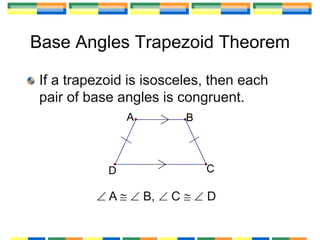
Base Angles Trapezoid Theorem
If a trapezoid is isosceles, then each
pair of base angles is congruent.
A
D C
B
 A   B,  C   D
Diagonals of a Trapezoid Theorem
A trapezoid is isosceles if and only if its
diagonals are congruent.
A
D C
B
BD
AC
if
only
and
if
isosceles
is
ABCD 
Example 1
PQRS is an isosceles trapezoid. Find m P,
m Q and mR.
50
S R
P Q
m R = 50 since base angles are congruent
mP = 130 and mQ = 130 (consecutive angles
of parallel lines cut by a transversal are )
Definition
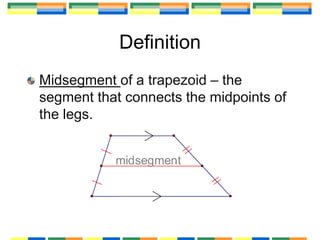
Midsegment of a trapezoid – the
segment that connects the midpoints of
the legs.
midsegment
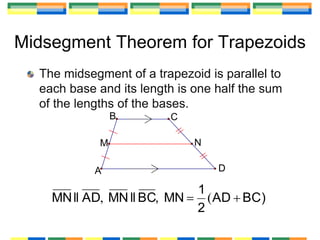
Midsegment Theorem for Trapezoids
The midsegment of a trapezoid is parallel to
each base and its length is one half the sum
of the lengths of the bases.
N
M
A D
B C
BC)
AD
2
1
MN
,
BC
ll
MN
AD
ll
MN (
, 

A B
C
D
F G
For trapezoid ABCD, F and G
Are midpoints of the legs.
If AB = 12 and DC = 24,
Find FG.
DC)
AB
2
1
FG ( 

12
24
A B
C
D
F G
For trapezoid ABCD, F and G
Are midpoints of the legs.
If AB = 7 and FG = 21,
Find DC.
DC)
AB
2
1
FG ( 

7
21
42 = 12 +DC
30 = DC
Multiply both sides by 2 to get rid of fraction:
Definition
Kite – a quadrilateral that has two pairs of
consecutive congruent sides, but opposite
sides are not congruent.
Theorem: Perpendicular
Diagonals of a Kite
If a quadrilateral is a kite, then its diagonals
are perpendicular.
D
C
A
B
BD
AC 
Theorem:
Opposite Angles of a Kite
If a quadrilateral is a kite, then exactly one
pair of opposite angles are congruent
D
C
A
B
A  C, B  D
Example 2
Find the side lengths of the kite.
20
12
12
12
U
W
Z
Y
X
Example 2 Continued
WX = 4 34
likewise WZ = 4 34
20
12
12
12
U
W
Z
Y
X
We can use the Pythagorean Theorem to
find the side lengths.
122 + 202 = (WX)2
144 + 400 = (WX)2
544 = (WX)2
122 + 122 = (XY)2
144 + 144 = (XY)2
288 = (XY)2
XY =12 2
likewise ZY =12 2
Example 3
Find mG and mJ.
60
132
J
G
H K
Since GHJK is a kite G  J
So 2(mG) + 132 + 60 = 360
2(mG) =168
mG = 84 and mJ = 84
Try This!
RSTU is a kite. Find mR, mS and mT.
x
125
x+30
S
U
R T
x +30 + 125 + 125 + x = 360
2x + 280 = 360
2x = 80
x = 40
So mR = 70, mT = 40 and mS = 125
125
TEST ON FRIDAY!
QUADRILATERALS!
OH MY!

8_5 trapezoids-and-kites.ppt

  • 1.
  • 2.
    Essential Questions How doI use properties of trapezoids? How do I use properties of kites?
  • 3.
    Vocabulary Trapezoid – aquadrilateral with exactly one pair of parallel sides. A trapezoid has two pairs of base angles. In this example the base angles are A & B and C & D A D C B leg leg base base
  • 4.
    Base Angles TrapezoidTheorem If a trapezoid is isosceles, then each pair of base angles is congruent. A D C B  A   B,  C   D
  • 5.
    Diagonals of aTrapezoid Theorem A trapezoid is isosceles if and only if its diagonals are congruent. A D C B BD AC if only and if isosceles is ABCD 
  • 6.
    Example 1 PQRS isan isosceles trapezoid. Find m P, m Q and mR. 50 S R P Q m R = 50 since base angles are congruent mP = 130 and mQ = 130 (consecutive angles of parallel lines cut by a transversal are )
  • 7.
    Definition Midsegment of atrapezoid – the segment that connects the midpoints of the legs. midsegment
  • 8.
    Midsegment Theorem forTrapezoids The midsegment of a trapezoid is parallel to each base and its length is one half the sum of the lengths of the bases. N M A D B C BC) AD 2 1 MN , BC ll MN AD ll MN ( ,  
  • 9.
    A B C D F G Fortrapezoid ABCD, F and G Are midpoints of the legs. If AB = 12 and DC = 24, Find FG. DC) AB 2 1 FG (   12 24
  • 10.
    A B C D F G Fortrapezoid ABCD, F and G Are midpoints of the legs. If AB = 7 and FG = 21, Find DC. DC) AB 2 1 FG (   7 21 42 = 12 +DC 30 = DC Multiply both sides by 2 to get rid of fraction:
  • 11.
    Definition Kite – aquadrilateral that has two pairs of consecutive congruent sides, but opposite sides are not congruent.
  • 12.
    Theorem: Perpendicular Diagonals ofa Kite If a quadrilateral is a kite, then its diagonals are perpendicular. D C A B BD AC 
  • 13.
    Theorem: Opposite Angles ofa Kite If a quadrilateral is a kite, then exactly one pair of opposite angles are congruent D C A B A  C, B  D
  • 14.
    Example 2 Find theside lengths of the kite. 20 12 12 12 U W Z Y X
  • 15.
    Example 2 Continued WX= 4 34 likewise WZ = 4 34 20 12 12 12 U W Z Y X We can use the Pythagorean Theorem to find the side lengths. 122 + 202 = (WX)2 144 + 400 = (WX)2 544 = (WX)2 122 + 122 = (XY)2 144 + 144 = (XY)2 288 = (XY)2 XY =12 2 likewise ZY =12 2
  • 16.
    Example 3 Find mGand mJ. 60 132 J G H K Since GHJK is a kite G  J So 2(mG) + 132 + 60 = 360 2(mG) =168 mG = 84 and mJ = 84
  • 17.
    Try This! RSTU isa kite. Find mR, mS and mT. x 125 x+30 S U R T x +30 + 125 + 125 + x = 360 2x + 280 = 360 2x = 80 x = 40 So mR = 70, mT = 40 and mS = 125 125
  • 18.