Today, we will learn to…
> identify, name, and describe
polygons
> use the sum of the interior
angles of a quadrilateral
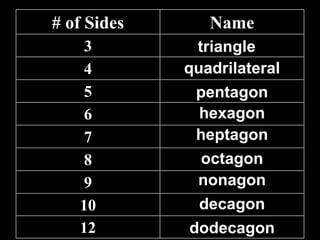
# of Sides Name
3
4
5
6
7
8
9
10
12
triangle
quadrilateral
pentagon
hexagon
heptagon
octagon
nonagon
decagon
dodecagon
Theorem 6.1
Interior Angles of a
Quadrilateral
The sum of the measures
of the interior angles of a
quadrilateral is ______360°
Section 6.1 Vocabulary
Convex
Concave
Equilateral
Equiangular
Regular
Diagonal
Sides:
Vertices:
Diagonals:
S
T
U
DY
ST TU UD DY YS
S, T, U, D, Y
SU SD TD TY UY
S
T
U
DY
There are 10 possible
names of this pentagon.
STUDY
SYDUT
TUDYS
TSYDU
UDYST
UTSYD
DYSTU
DUTSY
YSTUD
YDUTS
How many diagonals can
be drawn from N?
N M
O
PQ
R
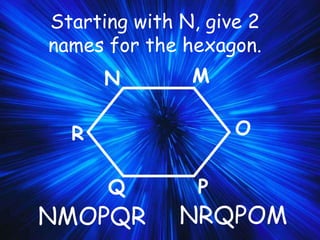
Starting with N, give 2
names for the hexagon.
N M
O
PQ
R
NMOPQR NRQPOM
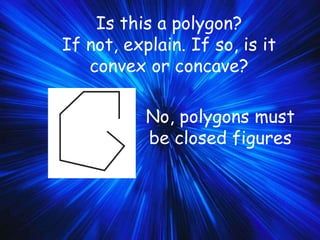
Is this a polygon?
If not, explain. If so, is it
convex or concave?
Yes, it’s a
convex
pentagon
Is this a polygon?
If not, explain. If so, is it
convex or concave?
No, polygons must
be made of
segments
Is this a polygon?
If not, explain. If so, is it
convex or concave?
Yes, it’s a
concave
dodecagon
Is this a polygon?
If not, explain. If so, is it
convex or concave?
No, polygons must
be closed figures
Find x.
90 + 87 + 93 + x = 360
x = 90
Find x.
3x + 3x + 2x + 2x = 360
x = 36
Lesson 6.2
Properties of
Parallelograms
RULERS AND PROTRACTORS
Today, we will learn to…
> use properties of parallelograms
A quad is a parallelogram
if and only if two pairs of
opposite sides are parallel
parallelogram
Draw a Parallelogram.
Measure each angle.
Measure each side in
centimeters.
Theorems 6.2-6.5
If a quadrilateral is a
parallelogram, then…
1) 6.2
2) 6.3
3) 6.4
4) 6.5
… opposite sides are
__________congruent
… opposite angles are
__________.congruent
… consecutive angles are
__________.supplementary
1 2
34
m m m m
m m m m
         
         
1 2 180 1 4 180
3 2 180 3 4 180
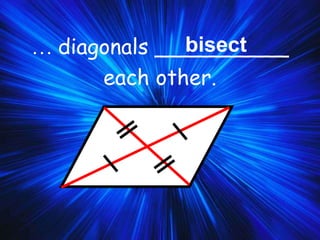
… diagonals __________
each other.
bisect
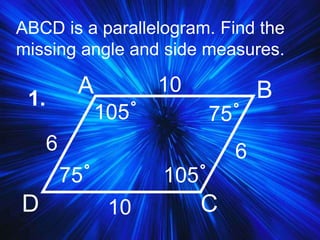
ABCD is a parallelogram. Find the
missing angle and side measures.
1.
A B
CD
105˚
10
66
10
75˚
75˚
105˚
ABCD is a parallelogram.
Find AC and DB.
2. A
CD
8
85
B
5
AC = 10 DB = 16
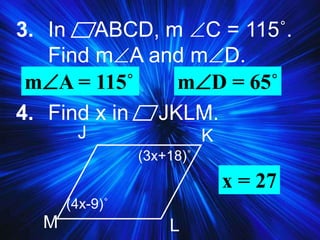
3. In ABCD, m C = 115˚.
Find mA and mD.
4. Find x in JKLM.
J K
LM
(4x-9)˚
(3x+18)˚
mA = 115˚ mD = 65˚
x = 27
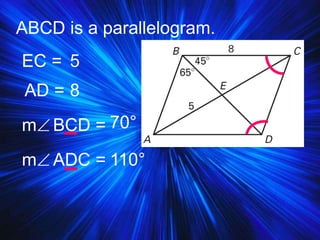
ABCD is a parallelogram.
EC =
m BCD =
m ADC =
AD =
5
8
70°
110°
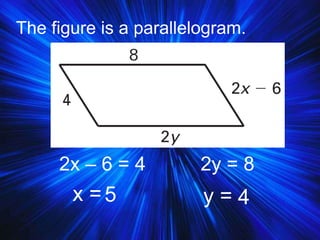
The figure is a parallelogram.
x = y =5 4
2x – 6 = 4 2y = 8
The figure is a parallelogram.
x = y =30 6
4x + 2x = 180 2y + 3 = y + 9
The figure is a parallelogram.
x = y =3 6
y
y
3x + 1 = 10 2y – 1 = y + 5
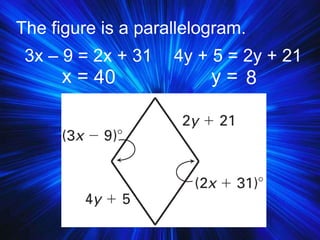
The figure is a parallelogram.
x = y =40 8
3x – 9 = 2x + 31 4y + 5 = 2y + 21
Lesson 6.3
Proving that Quadrilaterals
are Parallelograms
What is a converse?
Today, we will learn to…
> prove that a quadrilateral is a
parallelogram
Theorem 6.6
If both pairs of opposite
sides are __________,
then it is a parallelogram.
congruent
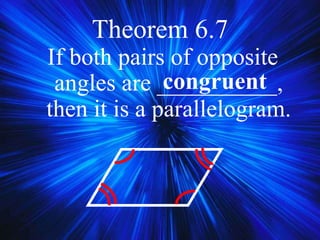
Theorem 6.7
If both pairs of opposite
angles are __________,
then it is a parallelogram.
congruent
Is ABCD a parallelogram? Explain.
1. 2.
A B
CD
10
6
10
6
A B
CD
yes
no
Theorem 6.8
If an angle is
_______________ to both
of its consecutive angles,
then it is a parallelogram.
supplementary
1
2
3
m1 + m3 = 180˚
m1 + m2 = 180˚
Theorem 6.9
If the diagonals
__________________,
then it is a parallelogram.
bisect each other
AE = EC
and
DE = EB
A
D
B
C
E
Is ABCD a parallelogram? Explain.
3. 4. A B
CD
A B
CD
104˚
86˚ 104˚
no yes
Theorem 6.10
If one pair of opposite
sides are ___________
and __________, then it
is a parallelogram.
congruent
parallel
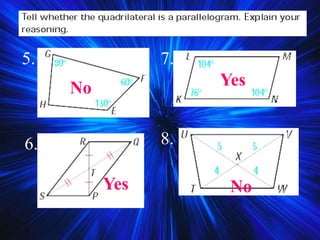
5.
8.
7.
6.
No Yes
Yes No
9. List 3 ways to prove that a
quadrilateral is a parallelogram
1) prove that both pairs of opposite
sides are __________
2) prove that both pairs of opposite
sides are __________
3) prove that one pair of opposite sides
are both ________ and ________
parallel
congruent
parallel congruent
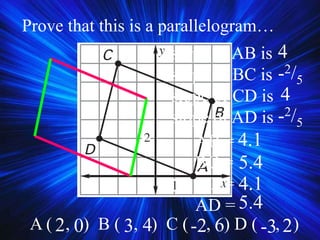
A ( , ) B ( , ) C ( , ) D ( , )
Prove that this is a parallelogram…
slope of AB is
slope of BC is
slope of CD is
slope of AD is
0
4
-2/5
-2/5
AB =
BC =
CD =
AD =
4.1
5.4
4.1
5.4
2 3 4 -2 6 -3 2
4
Lesson 6.4
Special
Parallelograms
Today, we will learn to…
> use properties of a rectangle,
a rhombus, and a square
A square is a parallelogram with
four congruent sides and four right angles.
A rhombus is a
parallelogram with
four congruent sides.
A rectangle is a
parallelogram with
four right angles.four congruent sides. four right angles.
four congruent sides four right angles
parallelograms
rhombuses rectangles
squares
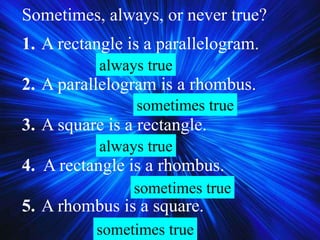
Sometimes, always, or never true?
1. A rectangle is a parallelogram.
2. A parallelogram is a rhombus.
3. A square is a rectangle.
4. A rectangle is a rhombus.
5. A rhombus is a square.
always true
sometimes true
always true
sometimes true
sometimes true
Geometer’s Sketchpad
mAEB = 90
CD = 4.48 cm
BC = 4.48 cm
AD = 4.48 cm
AB = 4.48 cm
E
C
A B
D
What do we know about the
diagonals in a rhombus?
The diagonals of a rhombus are
_____________.perpendicular
Theorem 6.11
What do we know about the
diagonals in a rhombus?
mECD = 40
mEDA = 50
mEDC = 50
mEAD = 40
mEAB = 40
mECB = 40
mEBC = 50
mEBA = 50
E
C
A B
D
The diagonals of a rhombus
_____________________.bisect opposite angles
Theorem 6.12
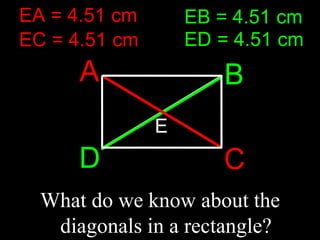
What do we know about the
diagonals in a rectangle?
ED = 4.51 cm
EB = 4.51 cm
EC = 4.51 cm
EA = 4.51 cm
E
C
A B
D
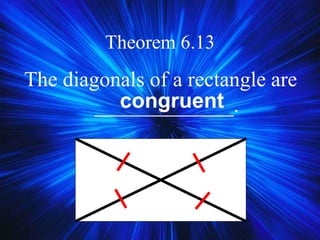
The diagonals of a rectangle are
_____________.congruent
Theorem 6.13
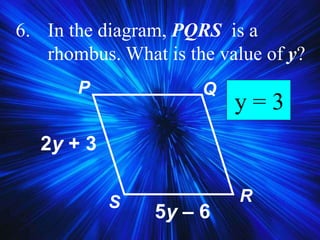
6. In the diagram, PQRS is a
rhombus. What is the value of y?
2y + 3
5y – 6
P Q
RS
y = 3
Find x.
7. rhombus
A
B
C
D
xº
52º
x = 38º
Find mCDB.
8. rhombus
A
B
C
D
32º
mCDB =32º
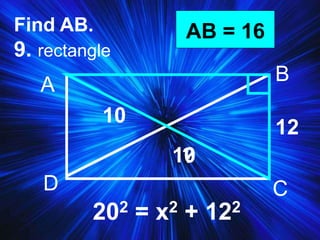
Find AB.
9. rectangle
A
B
CD
10
12
AB = 16
?
202 = x2 + 122
10
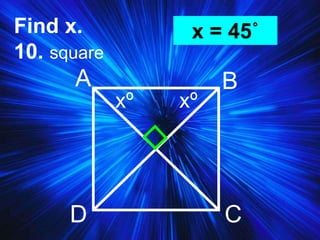
Find x.
10. square
A B
CD
xº xº
x = 45˚
Find EA & AB.
11. square
EA =
A B
CD
4
E
AB = 5.7
x2 = 42 + 42
x2 = 16 + 16
x2 = 32
x = 5.7
4
4
Lesson 6.5
Trapezoids
& Kites
Today, we will learn to…
> use properties of trapezoids
and kites
A trapezoid is a
quadrilateral with only
one pair of parallel sides.
A B
D C
base
base
leg leg
B A
D
C
Compare leg angles.
Geometer’s Sketchpad
mC = 65
mD = 115
mA = 90
mB = 90
In ALL trapezoids,
leg angles are
_______________supplementary
A trapezoid is an
isosceles trapezoid
if its legs are congruent.
Geometer’s Sketchpad
Compare base angles.Compare leg angles.How do you know it is isosceles?
mA = 67
mD = 67
mC = 113 
mB = 113 
CD = 3.7 cm
AB = 3.7 cm
A D
B C
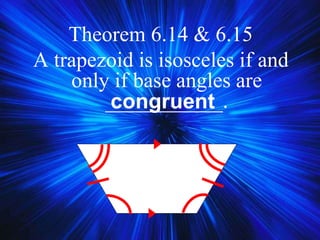
Theorem 6.14 & 6.15
A trapezoid is isosceles if and
only if base angles are
___________.congruent
Base angles are congruent.
A B
CD
AC  BD
The trapezoid is isosceles.
The triangles share CD.
ADC  BCD by SAS
CPCTC
Theorem 6.16
A trapezoid is isosceles if
and only if its diagonals
are __________.congruent
AC  BD
A B
CD
ABCD is an isosceles trapezoid.
Find the missing angle measures.
1. A B
CD
100°
80° 80°
100°
2. The vertices of ABCD are
A(-1,2), B(-4,1), C(4,-3), and
D(3,0). Show that ABCD is an
isosceles trapezoid.
Figure is graphed on next slide.
3
2
1
-1
-2
-3
-4
-6 -4 -2 2 4 6
D(3, 0)
C(4, -3)
B(-4, 1)
A(-1, 2)
AD || BC ?
AB =
CD =
- ½
- ½
Legs are  ? Diagonals are  ?
AC=
BD =
5010
10 50
OR?
Slope of AD is
Slope of BC is
x = 118Find x.
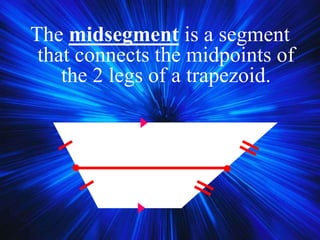
The midsegment is a segment
that connects the midpoints of
the 2 legs of a trapezoid.
Geometer’s SketchPad
EF = 8 cm
CD = 12 cm
AB = 4 cm
EF = 7 cm
CD = 11 cm
AB = 3 cm
A
EF = 5 cm
CD = 6 cm
AB = 4 cm
EF = 7 cm
CD = 9 cm
AB = 5 cm
FE
A B
D C
Theorem 6.17
Midsegment Theorem for
Trapezoids
The midsegment of a
trapezoid is _________ to
each base and its length is
______________ of the
bases.
parallel
the average
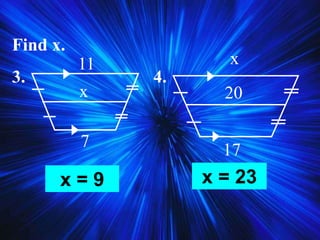
Find x.
3. 4.
7
11
x
x
17
20
x = 9 x = 23
KITE
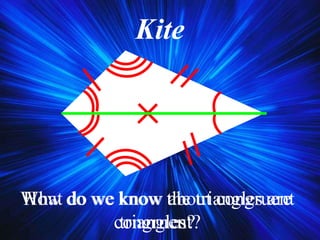
A kite has two pairs of
consecutive congruent
sides but opposite sides are
not congruent and no sides
are parallel.
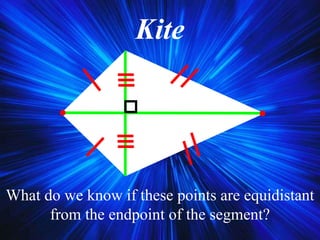
Kite
What do we know if these points are equidistant
from the endpoint of the segment?
Theorem 6.18
In a kite, the longer
diagonal is the
_________________
of the shorter diagonal.
perpendicular bisector
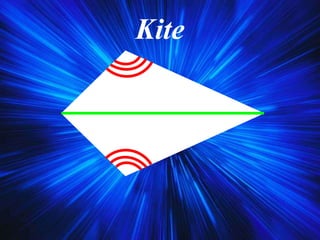
Kite
What do we know about congruent
triangles?
How do we know the triangles are
congruent?
Kite
Theorem 6.19
In a kite, exactly one
pair of opposite angles
are ________.congruent
The congruent angles are formed
by the noncongruent sides.
Find x and y.
5. 6.
5
x y
x˚ 125˚
y˚
(y+30)˚
29
x = 2 y = 2
x = 125
y = 40
Theorem 6.19*
In a kite, the longer
diagonal
________________.bisects opposite angles
mJ =70°
mL = 70°
Find the missing angles.
x =35
Find x.
Find x.
x = 110
Find x.
x = 5
Based on our theorems, list all of
the properties that must be true
for the quadrilateral.
1. Parallelogram
(definition plus 4 facts)
2. Rhombus (plus 3 facts)
3. Rectangle (plus 2 facts)
4. Square (plus 5 facts)
Parallelogram
1) opposite sides are parallel
2) opposite sides are congruent
3) opposite angles are congruent
4) consecutive angles are
supplementary
5) diagonals bisect each other
Rhombus
1) equilateral
2) diagonals are perpendicular
3) diagonals bisect opposite angles
Rectangle
1) equiangular
2) diagonals are congruent
Square
1) equilateral
2) equiangular
3) diagonals are perpendicular
4) diagonals bisect opposite angles
5) diagonals are congruent
Lesson 6.6
Identifying Special
Quadrilaterals
Complete the chart of characteristics of special quadrilaterals.
Today, we will learn to…
> identify special quadrilaterals
with limited information
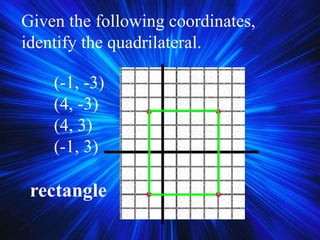
Given the following coordinates,
identify the quadrilateral.
(-2, 1)
(-2, 3)
(3, 6)
(0, 1)
kite
Given the following coordinates,
identify the quadrilateral.
(0, 0)
(4, 0)
(3, 7)
(1, 7)
trapezoid
Given the following coordinates,
identify the quadrilateral.
rectangle
(-1, -3)
(4, -3)
(4, 3)
(-1, 3)
Given the following coordinates,
identify the quadrilateral.
rhombus
(-2, 0)
(3, 0)
(6, 4)
(1, 4)
In quadrilateral
WXYZ, WX = 15,
YZ = 20, XY = 15,
ZW = 20. What is it?
It is a kite!
Lesson 6.7
Areas of Triangles
and Quadrilaterals
Today, we will learn to…
> find the area of triangles and
quadrilaterals
Postulate 22
Area of a Square
Area = side2
A=s2
Postulate 23
Area Congruence Postulate
If two polygons are congruent,
then they have the same area.
Theorem 6.20
Area of a Rectangle
Area = base ( height )
A = bh
1. Find the area of the polygon
made up of rectangles.
4 m
10 m
2 m
9 m
11 m
7 m
11(2) = 22 m2
8(4)
=
32m2
5(4)=
20 m2
74 m2
?
?
?
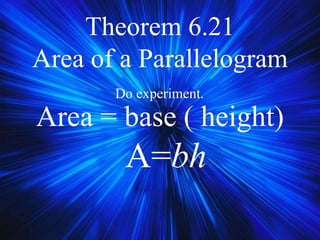
Theorem 6.21
Area of a Parallelogram
Area = base ( height)
A=bh
Do experiment.
Theorem 6.22
Area of a Triangle
A=½ bh
Area of a Trapezoid
hh
b2
A = ½ h b1 + ½ h b2
b1
A = ½ h (b1 + b2)
A = ½ h b1 + ½ h b2
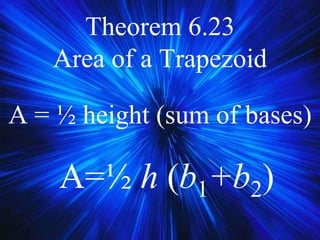
Theorem 6.23
Area of a Trapezoid
A = ½ height (sum of bases)
A=½ h (b1+b2)
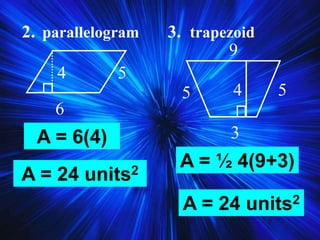
2. parallelogram 3. trapezoid
6
4 5
5 5
3
4
9
A = 6(4)
A = 24 units2
A = ½ 4(9+3)
A = 24 units2
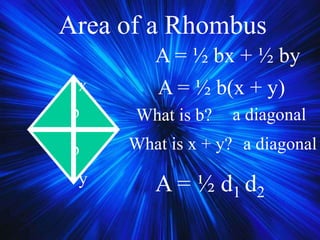
Area of a Kite
b
b
x
y
A = ½ bx + ½ by
A = ½ b (x + y)
What is b? a diagonal
What is x + y? a diagonal
A = ½ d1 d2
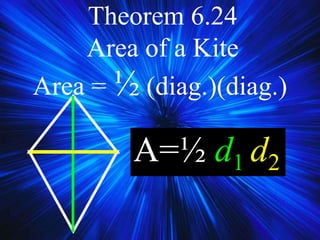
Theorem 6.24
Area of a Kite
Area = ½ (diag.)(diag.)
A=½ d1 d2
Area of a Rhombus
A = ½ bx + ½ by
A = ½ b(x + y)
What is b? a diagonal
What is x + y? a diagonal
A = ½ d1 d2
b
b
x
y
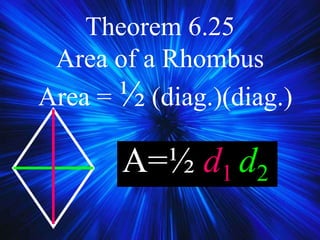
Theorem 6.25
Area of a Rhombus
Area = ½ (diag.)(diag.)
A=½ d1 d2
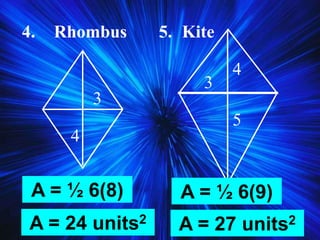
4. Rhombus 5. Kite
4
3
5
3
4
A = ½ 6(8)
A = 24 units2
A = ½ 6(9)
A = 27 units2
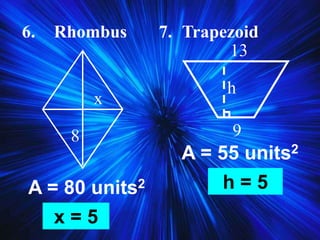
6. Rhombus 7. Trapezoid
8
x
A = 80 units2
x = 5
A = 55 units2
h = 5
h
13
9
8. Find the total area.
15
8 A = ½(10)(8+20)
A = 440 units2
20
25
A = 140
A = 20(15)
A = 300
?10
A = 12(11)
blue A = ½ (12)(5)
11
12
A = 132
132 = 122 + x2
x = 513
just blue?
blue A = 30
pink A = 132 – 60
pink A = 72
2 blue regions A = 60
?5
9. Find the areas of the blue and
pink regions.
Ch 6 quadrilaterals

Ch 6 quadrilaterals

  • 1.
    Today, we willlearn to… > identify, name, and describe polygons > use the sum of the interior angles of a quadrilateral
  • 2.
    # of SidesName 3 4 5 6 7 8 9 10 12 triangle quadrilateral pentagon hexagon heptagon octagon nonagon decagon dodecagon
  • 3.
    Theorem 6.1 Interior Anglesof a Quadrilateral The sum of the measures of the interior angles of a quadrilateral is ______360°
  • 4.
  • 5.
    Sides: Vertices: Diagonals: S T U DY ST TU UDDY YS S, T, U, D, Y SU SD TD TY UY
  • 6.
    S T U DY There are 10possible names of this pentagon. STUDY SYDUT TUDYS TSYDU UDYST UTSYD DYSTU DUTSY YSTUD YDUTS
  • 7.
    How many diagonalscan be drawn from N? N M O PQ R
  • 8.
    Starting with N,give 2 names for the hexagon. N M O PQ R NMOPQR NRQPOM
  • 9.
    Is this apolygon? If not, explain. If so, is it convex or concave? Yes, it’s a convex pentagon
  • 10.
    Is this apolygon? If not, explain. If so, is it convex or concave? No, polygons must be made of segments
  • 11.
    Is this apolygon? If not, explain. If so, is it convex or concave? Yes, it’s a concave dodecagon
  • 12.
    Is this apolygon? If not, explain. If so, is it convex or concave? No, polygons must be closed figures
  • 13.
    Find x. 90 +87 + 93 + x = 360 x = 90
  • 14.
    Find x. 3x +3x + 2x + 2x = 360 x = 36
  • 15.
    Lesson 6.2 Properties of Parallelograms RULERSAND PROTRACTORS Today, we will learn to… > use properties of parallelograms
  • 16.
    A quad isa parallelogram if and only if two pairs of opposite sides are parallel parallelogram
  • 17.
    Draw a Parallelogram. Measureeach angle. Measure each side in centimeters.
  • 18.
    Theorems 6.2-6.5 If aquadrilateral is a parallelogram, then… 1) 6.2 2) 6.3 3) 6.4 4) 6.5
  • 19.
    … opposite sidesare __________congruent
  • 20.
    … opposite anglesare __________.congruent
  • 21.
    … consecutive anglesare __________.supplementary 1 2 34 m m m m m m m m                     1 2 180 1 4 180 3 2 180 3 4 180
  • 22.
  • 23.
    ABCD is aparallelogram. Find the missing angle and side measures. 1. A B CD 105˚ 10 66 10 75˚ 75˚ 105˚
  • 24.
    ABCD is aparallelogram. Find AC and DB. 2. A CD 8 85 B 5 AC = 10 DB = 16
  • 25.
    3. In ABCD,m C = 115˚. Find mA and mD. 4. Find x in JKLM. J K LM (4x-9)˚ (3x+18)˚ mA = 115˚ mD = 65˚ x = 27
  • 26.
    ABCD is aparallelogram. EC = m BCD = m ADC = AD = 5 8 70° 110°
  • 27.
    The figure isa parallelogram. x = y =5 4 2x – 6 = 4 2y = 8
  • 28.
    The figure isa parallelogram. x = y =30 6 4x + 2x = 180 2y + 3 = y + 9
  • 29.
    The figure isa parallelogram. x = y =3 6 y y 3x + 1 = 10 2y – 1 = y + 5
  • 30.
    The figure isa parallelogram. x = y =40 8 3x – 9 = 2x + 31 4y + 5 = 2y + 21
  • 32.
    Lesson 6.3 Proving thatQuadrilaterals are Parallelograms What is a converse? Today, we will learn to… > prove that a quadrilateral is a parallelogram
  • 33.
    Theorem 6.6 If bothpairs of opposite sides are __________, then it is a parallelogram. congruent
  • 34.
    Theorem 6.7 If bothpairs of opposite angles are __________, then it is a parallelogram. congruent
  • 35.
    Is ABCD aparallelogram? Explain. 1. 2. A B CD 10 6 10 6 A B CD yes no
  • 36.
    Theorem 6.8 If anangle is _______________ to both of its consecutive angles, then it is a parallelogram. supplementary 1 2 3 m1 + m3 = 180˚ m1 + m2 = 180˚
  • 37.
    Theorem 6.9 If thediagonals __________________, then it is a parallelogram. bisect each other AE = EC and DE = EB A D B C E
  • 38.
    Is ABCD aparallelogram? Explain. 3. 4. A B CD A B CD 104˚ 86˚ 104˚ no yes
  • 39.
    Theorem 6.10 If onepair of opposite sides are ___________ and __________, then it is a parallelogram. congruent parallel
  • 40.
  • 41.
    9. List 3ways to prove that a quadrilateral is a parallelogram 1) prove that both pairs of opposite sides are __________ 2) prove that both pairs of opposite sides are __________ 3) prove that one pair of opposite sides are both ________ and ________ parallel congruent parallel congruent
  • 42.
    A ( ,) B ( , ) C ( , ) D ( , ) Prove that this is a parallelogram… slope of AB is slope of BC is slope of CD is slope of AD is 0 4 -2/5 -2/5 AB = BC = CD = AD = 4.1 5.4 4.1 5.4 2 3 4 -2 6 -3 2 4
  • 43.
    Lesson 6.4 Special Parallelograms Today, wewill learn to… > use properties of a rectangle, a rhombus, and a square
  • 44.
    A square isa parallelogram with four congruent sides and four right angles. A rhombus is a parallelogram with four congruent sides. A rectangle is a parallelogram with four right angles.four congruent sides. four right angles. four congruent sides four right angles
  • 45.
  • 46.
    Sometimes, always, ornever true? 1. A rectangle is a parallelogram. 2. A parallelogram is a rhombus. 3. A square is a rectangle. 4. A rectangle is a rhombus. 5. A rhombus is a square. always true sometimes true always true sometimes true sometimes true
  • 47.
    Geometer’s Sketchpad mAEB =90 CD = 4.48 cm BC = 4.48 cm AD = 4.48 cm AB = 4.48 cm E C A B D What do we know about the diagonals in a rhombus?
  • 48.
    The diagonals ofa rhombus are _____________.perpendicular Theorem 6.11
  • 49.
    What do weknow about the diagonals in a rhombus? mECD = 40 mEDA = 50 mEDC = 50 mEAD = 40 mEAB = 40 mECB = 40 mEBC = 50 mEBA = 50 E C A B D
  • 50.
    The diagonals ofa rhombus _____________________.bisect opposite angles Theorem 6.12
  • 51.
    What do weknow about the diagonals in a rectangle? ED = 4.51 cm EB = 4.51 cm EC = 4.51 cm EA = 4.51 cm E C A B D
  • 52.
    The diagonals ofa rectangle are _____________.congruent Theorem 6.13
  • 53.
    6. In thediagram, PQRS is a rhombus. What is the value of y? 2y + 3 5y – 6 P Q RS y = 3
  • 54.
  • 55.
  • 56.
    Find AB. 9. rectangle A B CD 10 12 AB= 16 ? 202 = x2 + 122 10
  • 57.
    Find x. 10. square AB CD xº xº x = 45˚
  • 58.
    Find EA &AB. 11. square EA = A B CD 4 E AB = 5.7 x2 = 42 + 42 x2 = 16 + 16 x2 = 32 x = 5.7 4 4
  • 60.
    Lesson 6.5 Trapezoids & Kites Today,we will learn to… > use properties of trapezoids and kites
  • 61.
    A trapezoid isa quadrilateral with only one pair of parallel sides. A B D C base base leg leg
  • 62.
    B A D C Compare legangles. Geometer’s Sketchpad mC = 65 mD = 115 mA = 90 mB = 90
  • 63.
    In ALL trapezoids, legangles are _______________supplementary
  • 64.
    A trapezoid isan isosceles trapezoid if its legs are congruent.
  • 65.
    Geometer’s Sketchpad Compare baseangles.Compare leg angles.How do you know it is isosceles? mA = 67 mD = 67 mC = 113  mB = 113  CD = 3.7 cm AB = 3.7 cm A D B C
  • 66.
    Theorem 6.14 &6.15 A trapezoid is isosceles if and only if base angles are ___________.congruent
  • 67.
    Base angles arecongruent. A B CD AC  BD The trapezoid is isosceles. The triangles share CD. ADC  BCD by SAS CPCTC
  • 68.
    Theorem 6.16 A trapezoidis isosceles if and only if its diagonals are __________.congruent AC  BD A B CD
  • 69.
    ABCD is anisosceles trapezoid. Find the missing angle measures. 1. A B CD 100° 80° 80° 100°
  • 70.
    2. The verticesof ABCD are A(-1,2), B(-4,1), C(4,-3), and D(3,0). Show that ABCD is an isosceles trapezoid. Figure is graphed on next slide.
  • 71.
    3 2 1 -1 -2 -3 -4 -6 -4 -22 4 6 D(3, 0) C(4, -3) B(-4, 1) A(-1, 2) AD || BC ? AB = CD = - ½ - ½ Legs are  ? Diagonals are  ? AC= BD = 5010 10 50 OR? Slope of AD is Slope of BC is
  • 72.
  • 73.
    The midsegment isa segment that connects the midpoints of the 2 legs of a trapezoid.
  • 74.
    Geometer’s SketchPad EF =8 cm CD = 12 cm AB = 4 cm EF = 7 cm CD = 11 cm AB = 3 cm A EF = 5 cm CD = 6 cm AB = 4 cm EF = 7 cm CD = 9 cm AB = 5 cm FE A B D C
  • 75.
    Theorem 6.17 Midsegment Theoremfor Trapezoids The midsegment of a trapezoid is _________ to each base and its length is ______________ of the bases. parallel the average
  • 76.
  • 77.
    KITE A kite hastwo pairs of consecutive congruent sides but opposite sides are not congruent and no sides are parallel.
  • 78.
    Kite What do weknow if these points are equidistant from the endpoint of the segment?
  • 79.
    Theorem 6.18 In akite, the longer diagonal is the _________________ of the shorter diagonal. perpendicular bisector
  • 80.
    Kite What do weknow about congruent triangles? How do we know the triangles are congruent?
  • 81.
  • 82.
    Theorem 6.19 In akite, exactly one pair of opposite angles are ________.congruent The congruent angles are formed by the noncongruent sides.
  • 83.
    Find x andy. 5. 6. 5 x y x˚ 125˚ y˚ (y+30)˚ 29 x = 2 y = 2 x = 125 y = 40
  • 84.
    Theorem 6.19* In akite, the longer diagonal ________________.bisects opposite angles
  • 85.
    mJ =70° mL =70° Find the missing angles.
  • 86.
  • 87.
  • 88.
  • 90.
    Based on ourtheorems, list all of the properties that must be true for the quadrilateral. 1. Parallelogram (definition plus 4 facts) 2. Rhombus (plus 3 facts) 3. Rectangle (plus 2 facts) 4. Square (plus 5 facts)
  • 91.
    Parallelogram 1) opposite sidesare parallel 2) opposite sides are congruent 3) opposite angles are congruent 4) consecutive angles are supplementary 5) diagonals bisect each other
  • 92.
    Rhombus 1) equilateral 2) diagonalsare perpendicular 3) diagonals bisect opposite angles
  • 93.
  • 94.
    Square 1) equilateral 2) equiangular 3)diagonals are perpendicular 4) diagonals bisect opposite angles 5) diagonals are congruent
  • 95.
    Lesson 6.6 Identifying Special Quadrilaterals Completethe chart of characteristics of special quadrilaterals. Today, we will learn to… > identify special quadrilaterals with limited information
  • 96.
    Given the followingcoordinates, identify the quadrilateral. (-2, 1) (-2, 3) (3, 6) (0, 1) kite
  • 97.
    Given the followingcoordinates, identify the quadrilateral. (0, 0) (4, 0) (3, 7) (1, 7) trapezoid
  • 98.
    Given the followingcoordinates, identify the quadrilateral. rectangle (-1, -3) (4, -3) (4, 3) (-1, 3)
  • 99.
    Given the followingcoordinates, identify the quadrilateral. rhombus (-2, 0) (3, 0) (6, 4) (1, 4)
  • 100.
    In quadrilateral WXYZ, WX= 15, YZ = 20, XY = 15, ZW = 20. What is it? It is a kite!
  • 102.
    Lesson 6.7 Areas ofTriangles and Quadrilaterals Today, we will learn to… > find the area of triangles and quadrilaterals
  • 103.
    Postulate 22 Area ofa Square Area = side2 A=s2
  • 104.
    Postulate 23 Area CongruencePostulate If two polygons are congruent, then they have the same area.
  • 105.
    Theorem 6.20 Area ofa Rectangle Area = base ( height ) A = bh
  • 106.
    1. Find thearea of the polygon made up of rectangles. 4 m 10 m 2 m 9 m 11 m 7 m 11(2) = 22 m2 8(4) = 32m2 5(4)= 20 m2 74 m2 ? ? ?
  • 107.
    Theorem 6.21 Area ofa Parallelogram Area = base ( height) A=bh Do experiment.
  • 108.
    Theorem 6.22 Area ofa Triangle A=½ bh
  • 109.
    Area of aTrapezoid hh b2 A = ½ h b1 + ½ h b2 b1 A = ½ h (b1 + b2) A = ½ h b1 + ½ h b2
  • 110.
    Theorem 6.23 Area ofa Trapezoid A = ½ height (sum of bases) A=½ h (b1+b2)
  • 111.
    2. parallelogram 3.trapezoid 6 4 5 5 5 3 4 9 A = 6(4) A = 24 units2 A = ½ 4(9+3) A = 24 units2
  • 112.
    Area of aKite b b x y A = ½ bx + ½ by A = ½ b (x + y) What is b? a diagonal What is x + y? a diagonal A = ½ d1 d2
  • 113.
    Theorem 6.24 Area ofa Kite Area = ½ (diag.)(diag.) A=½ d1 d2
  • 114.
    Area of aRhombus A = ½ bx + ½ by A = ½ b(x + y) What is b? a diagonal What is x + y? a diagonal A = ½ d1 d2 b b x y
  • 115.
    Theorem 6.25 Area ofa Rhombus Area = ½ (diag.)(diag.) A=½ d1 d2
  • 116.
    4. Rhombus 5.Kite 4 3 5 3 4 A = ½ 6(8) A = 24 units2 A = ½ 6(9) A = 27 units2
  • 117.
    6. Rhombus 7.Trapezoid 8 x A = 80 units2 x = 5 A = 55 units2 h = 5 h 13 9
  • 118.
    8. Find thetotal area. 15 8 A = ½(10)(8+20) A = 440 units2 20 25 A = 140 A = 20(15) A = 300 ?10
  • 119.
    A = 12(11) blueA = ½ (12)(5) 11 12 A = 132 132 = 122 + x2 x = 513 just blue? blue A = 30 pink A = 132 – 60 pink A = 72 2 blue regions A = 60 ?5 9. Find the areas of the blue and pink regions.