TRIANGLES
TRIANGLE:-
A closed Geometrical figure formed by joining non collinear three
points,with the help of straight lines is called as “triangle”.
In a triangle we are having three
vertices,three sides and three angles.
CONGRUENCY OF TRIANGLES:-
If any two triangles are having same shape and same size
they are called as congruent triangles.
SIMILARITY OF FIGURES:-
These are similar photographs of Sachin Tendulkar,but of different sizes.
SIMILARITY OF FIGURES:-
These are Indian currency notes of similar denomination,but of different sizes.
SIMILARITY OF FIGURES:-
Two figures having the same shape and not necessarily the same size
are called as similar figures.
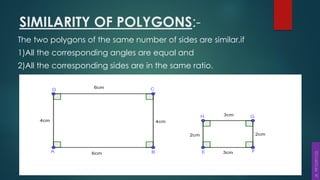
SIMILARITY OF POLYGONS:-
The two polygons of the same number of sides are similar,if
1)All the corresponding angles are equal and
2)All the corresponding sides are in the same ratio.
EXERCISE 2.1
1.Fill in the blanks using correct word given in brackets:
i)All circles are_____________(congruent,similar)
similar
ii)All squares are___________(similar,congruent)
similar
iii)All ______________triangles are similar.(isocles,equilateral)
equilateral
iv)Two polygons of the same number of sides are similar,if (a)their
corresponding angles are_____and(b)their corresponding sides are
____________.(equal,proportional)
equal,proportional
2.Give two different examples of pair of of
i)Similar figures.
a)any two circle
b)any two rectangles
c)any two squares .
ii)non-similar figures.
a)circle and a triangle
b)square and a rectangle
c)pentagon and a rhombus
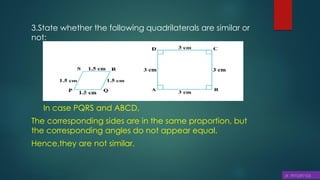
3.State whether the following quadrilaterals are similar or
not:
In case PQRS and ABCD,
The corresponding sides are in the same proportion, but
the corresponding angles do not appear equal.
Hence,they are not similar.
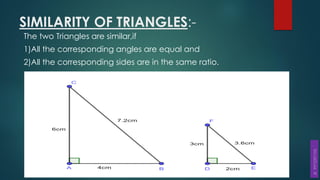
SIMILARITY OF TRIANGLES:-
The two Triangles are similar,if
1)All the corresponding angles are equal and
2)All the corresponding sides are in the same ratio.
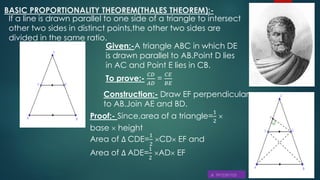
BASIC PROPORTIONALITY THEOREM(THALES THEOREM):-
If a line is drawn parallel to one side of a triangle to intersect
other two sides in distinct points,the other two sides are
divided in the same ratio.
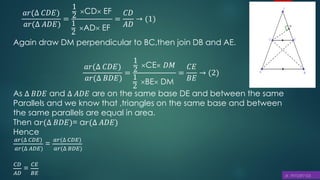
Given:-A triangle ABC in which DE
is drawn parallel to AB.Point D lies
in AC and Point E lies in CB.
To prove:-
𝐶𝐷
𝐴𝐷
=
𝐶𝐸
𝐵𝐸
Construction:- Draw EF perpendicular
to AB.Join AE and BD.
Proof:- Since,area of a triangle=
1
2

base  height
Area of ∆ CDE=
1
2
CD EF and
Area of ∆ ADE=
1
2
AD EF
Again draw DM perpendicular to BC,then join DB and AE.
𝑎𝑟(∆ 𝐶𝐷𝐸)
𝑎𝑟(∆ 𝐵𝐷𝐸)
=
1
2
CE 𝐷𝑀
1
2
BE DM
=
𝐶𝐸
𝐵𝐸
→ (2)
As ∆ 𝐵𝐷𝐸 and ∆ 𝐴𝐷𝐸 are on the same base DE and between the same
Parallels and we know that ,triangles on the same base and between
the same parallels are equal in area.
Then a𝑟(∆ 𝐵𝐷𝐸)= a𝑟(∆ 𝐴𝐷𝐸)
Hence
𝑎𝑟(∆ 𝐶𝐷𝐸)
𝑎𝑟(∆ 𝐴𝐷𝐸)
=
𝑎𝑟(∆ 𝐶𝐷𝐸)
𝑎𝑟(∆ 𝐵𝐷𝐸)
𝐶𝐷
𝐴𝐷
=
𝐶𝐸
𝐵𝐸
𝑎𝑟(∆ 𝐶𝐷𝐸)
𝑎𝑟(∆ 𝐴𝐷𝐸)
=
1
2
CD EF
1
2
AD EF
=
𝐶𝐷
𝐴𝐷
→ (1)
CONVERSE OF BASIC PROPORTIONALITY THEOREM :-
If a line divides any two sides of a triangle in the same
ratio,the line must be parallel to the third side.
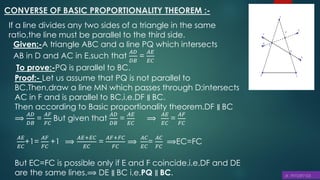
Given:-A triangle ABC and a line PQ which intersects
AB in D and AC in E,such that
𝐴𝐷
𝐷𝐵
=
𝐴𝐸
𝐸𝐶
To prove:-PQ is parallel to BC.
Proof:- Let us assume that PQ is not parallel to
BC.Then,draw a line MN which passes through D;intersects
AC in F and is parallel to BC,i.e.DF ∥ BC.
Then according to Basic proportionality theorem.DF ∥ BC
⟹
𝐴𝐷
𝐷𝐵
=
𝐴𝐹
𝐹𝐶
But given that
𝐴𝐷
𝐷𝐵
=
𝐴𝐸
𝐸𝐶
⟹
𝐴𝐸
𝐸𝐶
=
𝐴𝐹
𝐹𝐶
𝐴𝐸
𝐸𝐶
+1=
𝐴𝐹
𝐹𝐶
+1 ⟹
𝐴𝐸+𝐸𝐶
𝐸𝐶
=
𝐴𝐹+𝐹𝐶
𝐹𝐶
⟹
𝐴𝐶
𝐸𝐶
=
𝐴𝐶
𝐹𝐶
⟹EC=FC
But EC=FC is possible only if E and F coincide.i.e.DF and DE
are the same lines.⟹ DE ∥ BC i.e,PQ ∥ BC.
EXERCISE 2.2
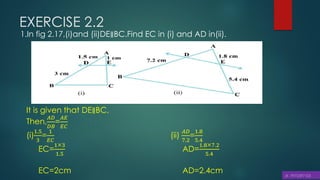
1.In fig 2.17,(i)and (ii)DE∥BC.Find EC in (i) and AD in(ii).
It is given that DE∥BC,
Then,
𝐴𝐷
𝐷𝐵
=
𝐴𝐸
𝐸𝐶
(i)
1.5
3
=
1
𝐸𝐶
(ii)
𝐴𝐷
7.2
=
1.8
5.4
EC=
13
1.5
AD=
1.87.2
5.4
EC=2cm AD=2.4cm
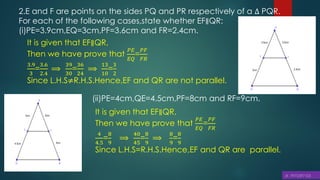
2.E and F are points on the sides PQ and PR respectively of a ∆ PQR.
For each of the following cases,state whether EF∥QR:
(i)PE=3.9cm,EQ=3cm,PF=3.6cm and FR=2.4cm.
It is given that EF∥QR,
Then we have prove that
𝑃𝐸
𝐸𝑄
=
𝑃𝐹
𝐹𝑅
3.9
3
=
3.6
2.4
⟹
39
30
=
36
24
⟹
13
10
=
3
2
Since L.H.S≠R.H.S.Hence,EF and QR are not parallel.
(ii)PE=4cm,QE=4.5cm,PF=8cm and RF=9cm.
It is given that EF∥QR,
Then we have prove that
𝑃𝐸
𝐸𝑄
=
𝑃𝐹
𝐹𝑅
4
4.5
=
8
9
⟹
40
45
=
8
9
⟹
8
9
=
8
9
Since L.H.S=R.H.S.Hence,EF and QR are parallel.
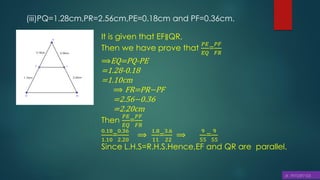
(iii)PQ=1.28cm,PR=2.56cm,PE=0.18cm and PF=0.36cm.
It is given that EF∥QR,
Then we have prove that
𝑃𝐸
𝐸𝑄
=
𝑃𝐹
𝐹𝑅
⟹EQ=PQ-PE
=1.28-0.18
=1.10cm
⟹ FR=PR−PF
=2.56−0.36
=2.20cm
Then
𝑃𝐸
𝐸𝑄
=
𝑃𝐹
𝐹𝑅
0.18
1.10
=
0.36
2.20
⟹
1.8
11
=
3.6
22
⟹
9
55
=
9
55
Since L.H.S=R.H.S.Hence,EF and QR are parallel.
3.In Fig.2.18,if LM∥CB and LN∥CD,prove that
𝐴𝑀
𝐴𝐵
=
𝐴𝑁
𝐴𝐷
.
In ∆ACB, LM∥CB,
Then,
𝐴𝐿
𝐿𝐶
=
𝐴𝑀
𝑀𝐵
⇢ (1)
In ∆ACD, LN∥CD,
Then,
𝐴𝐿
𝐿𝐶
=
𝐴𝑁
𝑁𝐷
⇢ (2)
From (1) and (2)
𝐴𝑀
𝑀𝐵
=
𝐴𝑁
𝑁𝐷
Then,
𝑀𝐵
𝐴𝑀
=
𝑁𝐷
𝐴𝑁
Adding 1 on both sides
𝑀𝐵
𝐴𝑀
+1=
𝑁𝐷
𝐴𝑁
+1 ⇒
𝑀𝐵+𝐴𝑀
𝐴𝑀
=
𝑁𝐷+𝐴𝑁
𝐴𝑁
𝐴𝐵
𝐴𝑀
=
𝐴𝐷
𝐴𝑁
⇒
𝐴𝑀
𝐴𝐵
=
𝐴𝑁
𝐴𝐷
4.In Fig.2.19,if DE∥ AC and DF∥ AE,prove that
𝐵𝐹
𝐹𝐸
=
𝐵𝐸
𝐴𝐸
.
In ∆ABC, DE∥AC,Then,
𝐵𝐸
𝐸𝐶
=
𝐵𝐷
𝐷𝐴
⇢ (1)
In ∆AEB, DF∥ AE,Then,
𝐵𝐹
𝐹𝐸
=
𝐵𝐷
𝐷𝐴
⇢ (2)
From (1) and (2)
𝐵𝐹
𝐹𝐸
=
𝐵𝐸
𝐸𝐶
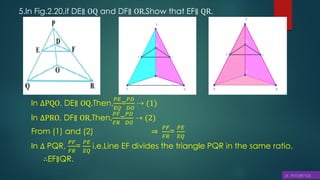
5.In Fig.2.20,if DE∥ OQ and DF∥ OR.Show that EF∥ QR.
In ∆PQO, DE∥ OQ,Then,
𝑃𝐸
𝐸𝑄
=
𝑃𝐷
𝐷𝑂
⇢ (1)
In ∆PRO, DF∥ OR,Then,
𝑃𝐹
𝐹𝑅
=
𝑃𝐷
𝐷𝑂
⇢ (2)
From (1) and (2) ⇒
𝑃𝐹
𝐹𝑅
=
𝑃𝐸
𝐸𝑄
In ∆ PQR,
𝑃𝐹
𝐹𝑅
=
𝑃𝐸
𝐸𝑄
i.e.Line EF divides the triangle PQR in the same ratio.
∴EF∥QR.
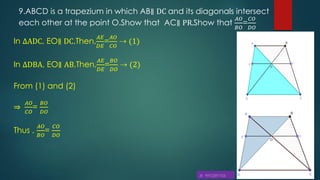
9.ABCD is a trapezium in which AB∥ DC and its diagonals intersect
each other at the point O.Show that AC∥ PR.Show that
𝐴𝑂
𝐵𝑂
=
𝐶𝑂
𝐷𝑂
In ∆ADC, EO∥ DC,Then,
𝐴𝐸
𝐷𝐸
=
𝐴𝑂
𝐶𝑂
⇢ (1)
In ∆DBA, EO∥ AB,Then,
𝐴𝐸
𝐷𝐸
=
𝐵𝑂
𝐷𝑂
⇢ (2)
From (1) and (2)
⇒
𝐴𝑂
𝐶𝑂
=
𝐵𝑂
𝐷𝑂
Thus ,
𝐴𝑂
𝐵𝑂
=
𝐶𝑂
𝐷𝑂
10.The diagonals of a quadrilateral ABCD intersect each other at the
point O such that
𝐴𝑂
𝐵𝑂
=
𝐶𝑂
𝐷𝑂
.Show that ABCD is a trapezium.
Let us draw a line EF∥ 𝐴𝐵 passing through point o.
Given
𝐴𝑂
𝐵𝑂
=
𝐶𝑂
𝐷𝑂
⟹
𝐴𝑂
𝐶𝑂
=
𝐵𝑂
𝐷𝑂
⇢ (1)
In ∆ADB, EO∥ AB,Then,
𝐴𝐸
𝐷𝐸
=
𝐵𝑂
𝐷𝑂
⇒
𝐴𝐸
𝐷𝐸
=
𝐴𝑂
𝐶𝑂
[from (1)]
In ∆ADC.
Line EO divides the triangle in the same ratio.
∴ EO∥ DC.
Now, EO∥ DC.But we know that EO∥ AB. ⇒ EO∥ D𝐶 ∥AB
⇒ AB∥ D𝐶.One pair of opposite sides of ABCD are
parallel.
∴ ABCD is a trapezium.
CRITERIA FOR SIMILARITY OF TRIANGLES:-
A-A-A CRITERION FOR SIMILARITY OF 2 TRIANGLES:-
If in two triangles,corresponding angles are
equal,then their corresponding sides are in the
same ratio and hence the two triangles are
similar.
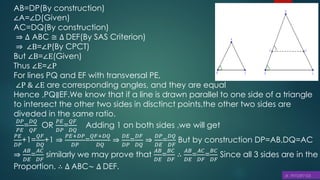
Given:-Two triangles∆ ABC and ∆ DEF such that
∠A=∠D,∠B=∠E & ∠C=∠F.
To prove:- ∆ ABC~ ∆ DEF.
Construction:-Draw P and Q on DE & DF such that
DP=AB and DQ=AC respectively and join PQ.
Proof:-
In ∆ ABC and ∆ DEF
AB=DP(By construction)
∠A=∠D(Given)
AC=DQ(By construction)
⇒ ∆ ABC ≅ ∆ DEF(By SAS Criterion)
⇒ ∠B=∠P(By CPCT)
But ∠B=∠E(Given)
Thus ∠E=∠P
For lines PQ and EF with transversal PE,
∠P & ∠E are corresponding angles, and they are equal
Hence ,PQ∥EF.We know that if a line is drawn parallel to one side of a triangle
to intersect the other two sides in disctinct points,the other two sides are
diveded in the same ratio.
𝐷𝑃
𝑃𝐸
=
𝐷𝑄
𝑄𝐹
OR
𝑃𝐸
𝐷𝑃
=
𝑄𝐹
𝐷𝑄
Adding 1 on both sides ,we will get
𝑃𝐸
𝐷𝑃
+1=
𝑄𝐹
𝐷𝑄
+1 ⇒
𝑃𝐸+𝐷𝑃
𝐷𝑃
=
𝑄𝐹+𝐷𝑄
𝐷𝑄
⇒
𝐷𝐸
𝐷𝑃
=
𝐷𝐹
𝐷𝑄
⇒
𝐷𝑃
𝐷𝐸
=
𝐷𝑄
𝐷𝐹
But by construction DP=AB,DQ=AC
⇒
𝐴𝐵
𝐷𝐸
=
𝐴𝐶
𝐷𝐹
similarly we may prove that
𝐴𝐵
𝐷𝐸
=
𝐵𝐶
𝐷𝐹
∴
𝐴𝐵
𝐷𝐸
=
𝐴𝐶
𝐷𝐹
=
𝐵𝐶
𝐷𝐹
Since all 3 sides are in the
Proportion. ∴ ∆ ABC~ ∆ DEF.
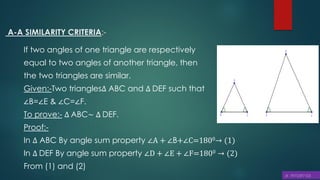
A-A SIMILARITY CRITERIA:-
If two angles of one triangle are respectively
equal to two angles of another triangle, then
the two triangles are similar.
Given:-Two triangles∆ ABC and ∆ DEF such that
∠B=∠E & ∠C=∠F.
To prove:- ∆ ABC~ ∆ DEF.
Proof:-
In ∆ ABC By angle sum property ∠A + ∠B+∠C=1800→ (1)
In ∆ DEF By angle sum property ∠D + ∠E + ∠F=1800 → (2)
From (1) and (2)
∠A + ∠B+∠C= ∠D + ∠E + ∠F
∠A + ∠E + ∠F= ∠D + ∠E + ∠F(Given ∠B= ∠E & ∠C = ∠F)
∠A = ∠D → (3)
Thus in ∆ ABC & ∆ DEF
∠A = ∠D 𝐹𝑟0𝑚 3
∠B= ∠E(Given)
∠C = ∠F(Given)
∴ ∆ ABC~ ∆ DEF.(AAA Similarity criteria)
S-S-S CRITERION FOR SIMILARITY OF 2 TRIANGLES:-
If in two triangles,sides of one triangle are proportional to the sides of
other triangle,then their corresponding angles are equal and hence the
two triangles are similar.
If one angle of a triangle is equal to one angle of the other triangle and
the sides including these angles are proportional, then the two triangles
are similar.
S-A-S CRITERION FOR SIMILARITY OF 2 TRIANGLES:-
EXERCISE 2.3
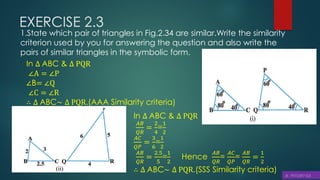
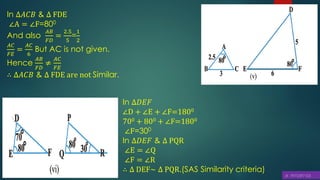
1.State which pair of triangles in Fig.2.34 are similar.Write the similarity
criterion used by you for answering the question and also write the
pairs of similar triangles in the symbolic form.
In ∆ ABC & ∆ PQR
∠A = ∠P
∠B= ∠Q
∠C = ∠R
∴ ∆ ABC~ ∆ PQR.(AAA Similarity criteria)
In ∆ ABC & ∆ PQR
𝐴𝐵
𝑄𝑅
=
2
4
=
1
2
𝐴𝐶
𝑄𝑃
=
3
6
=
1
2
𝐴𝐵
𝑄𝑅
=
2.5
5
=
1
2
Hence
𝐴𝐵
𝑄𝑅
=
𝐴𝐶
𝑄𝑃
=
𝐴𝐵
𝑄𝑅
=
1
2
∴ ∆ ABC~ ∆ PQR.(SSS Similarity criteria)
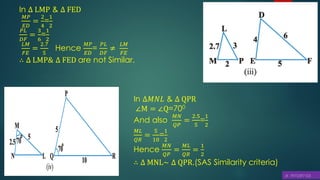
In ∆𝑀𝑁𝐿 & ∆ QPR
∠M = ∠Q=700
And also
𝑀𝑁
𝑄𝑃
=
2.5
5
=
1
2
𝑀𝐿
𝑄𝑅
=
5
10
=
1
2
Hence
𝑀𝑁
𝑄𝑃
=
𝑀𝐿
𝑄𝑅
=
1
2
∴ ∆ MNL~ ∆ QPR.(SAS Similarity criteria)
In ∆ LMP & ∆ FED
𝑀𝑃
𝐸𝐷
=
2
4
=
1
2
𝑃𝐿
𝐷𝐹
=
3
6
=
1
2
𝐿𝑀
𝐹𝐸
=
2.7
5
Hence
𝑀𝑃
𝐸𝐷
=
𝑃𝐿
𝐷𝐹
≠
𝐿𝑀
𝐹𝐸
∴ ∆ LMP& ∆ FED are not Similar.
In ∆𝐷𝐸𝐹
∠D + ∠E + ∠F=1800
700 + 800 + ∠F=1800
∠F=300
In ∆𝐷𝐸𝐹 & ∆ PQR
∠E = ∠Q
∠F = ∠R
∴ ∆ DEF~ ∆ PQR.(SAS Similarity criteria)
In ∆𝐴𝐶𝐵 & ∆ FDE
∠A = ∠F=800
And also
𝐴𝐵
𝐹𝐷
=
2.5
5
=
1
2
𝐴𝐶
𝐹𝐸
=
𝐴𝐶
6
But AC is not given.
Hence
𝐴𝐵
𝐹𝐷
≠
𝐴𝐶
𝐹𝐸
∴ ∆𝐴𝐶𝐵 & ∆ FDE are not Similar.
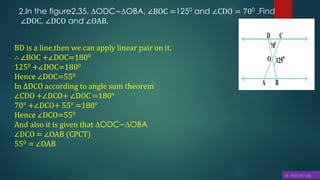
2.In the figure2.35, ∆ODC∼∆OBA, ∠BOC =1250 and ∠CDO = 700 .Find
∠DOC, ∠DCO and ∠OAB.
BD is a line,then we can apply linear pair on it.
∴ ∠BOC +∠DOC=1800
1250 +∠DOC=1800
Hence ∠DOC=550
In ∆DCO according to angle sum theorem
∠CDO +∠DCO+ ∠DOC =180°
70° +∠DCO+ 55° =180°
Hence ∠DCO=550
And also it is given that ∆ODC∼∆OBA
∠DCO = ∠OAB (CPCT)
550 = ∠OAB
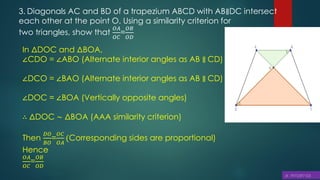
3. Diagonals AC and BD of a trapezium ABCD with AB∥DC intersect
each other at the point O. Using a similarity criterion for
two triangles, show that
𝑂𝐴
𝑂𝐶
=
𝑂𝐵
𝑂𝐷
In ΔDOC and ΔBOA,
∠CDO = ∠ABO (Alternate interior angles as AB ∥ CD)
∠DCO = ∠BAO (Alternate interior angles as AB ∥ CD)
∠DOC = ∠BOA (Vertically opposite angles)
∴ ΔDOC ∼ ΔBOA (AAA similarity criterion)
Then
𝐷𝑂
𝐵𝑂
=
𝑂𝐶
𝑂𝐴
(Corresponding sides are proportional)
Hence
𝑂𝐴
𝑂𝐶
=
𝑂𝐵
𝑂𝐷
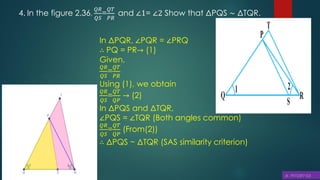
4. In the figure 2.36,
𝑄𝑅
𝑄𝑆
=
𝑄𝑇
𝑃𝑅
and ∠1= ∠2 Show that ΔPQS ∼ ΔTQR.
In ΔPQR, ∠PQR = ∠PRQ
∴ PQ = PR→ (1)
Given,
𝑄𝑅
𝑄𝑆
=
𝑄𝑇
𝑃𝑅
Using (1), we obtain
𝑄𝑅
𝑄𝑆
=
𝑄𝑇
𝑄𝑃
→ (2)
In ΔPQS and ΔTQR,
∠PQS = ∠TQR (Both angles common)
𝑄𝑅
𝑄𝑆
=
𝑄𝑇
𝑄𝑃
(From(2))
∴ ΔPQS ~ ΔTQR (SAS similarity criterion)
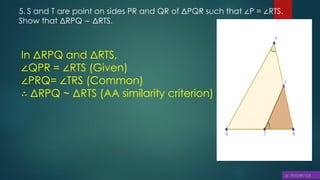
5. S and T are point on sides PR and QR of ΔPQR such that ∠P = ∠RTS.
Show that ΔRPQ ∼ ΔRTS.
In ΔRPQ and ΔRTS,
∠QPR = ∠RTS (Given)
∠PRQ= ∠TRS (Common)
∴ ΔRPQ ~ ΔRTS (AA similarity criterion)
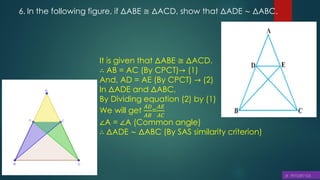
6. In the following figure, if ΔABE ≅ ΔACD, show that ΔADE ∼ ΔABC.
It is given that ΔABE ≅ ΔACD.
∴ AB = AC (By CPCT)→ (1)
And, AD = AE (By CPCT) → (2)
In ΔADE and ΔABC,
By Dividing equation (2) by (1)
We will get
𝐴𝐷
𝐴𝐵
=
𝐴𝐸
𝐴𝐶
∠A = ∠A (Common angle)
∴ ΔADE ∼ ΔABC (By SAS similarity criterion)
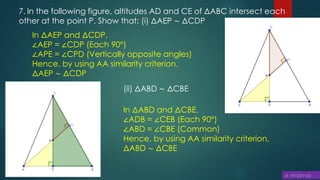
7. In the following figure, altitudes AD and CE of ΔABC intersect each
other at the point P. Show that: (i) ΔAEP ∼ ΔCDP
In ΔAEP and ΔCDP,
∠AEP = ∠CDP (Each 90°)
∠APE = ∠CPD (Vertically opposite angles)
Hence, by using AA similarity criterion,
ΔAEP ∼ ΔCDP
(ii) ΔABD ∼ ΔCBE
In ΔABD and ΔCBE,
∠ADB = ∠CEB (Each 90°)
∠ABD = ∠CBE (Common)
Hence, by using AA similarity criterion,
ΔABD ∼ ΔCBE
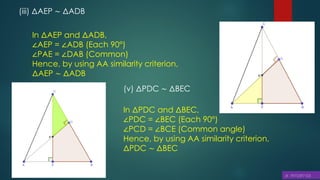
(iii) ΔAEP ∼ ΔADB
In ΔAEP and ΔADB,
∠AEP = ∠ADB (Each 90°)
∠PAE = ∠DAB (Common)
Hence, by using AA similarity criterion,
ΔAEP ∼ ΔADB
(v) ΔPDC ∼ ΔBEC
In ΔPDC and ΔBEC,
∠PDC = ∠BEC (Each 90°)
∠PCD = ∠BCE (Common angle)
Hence, by using AA similarity criterion,
ΔPDC ∼ ΔBEC
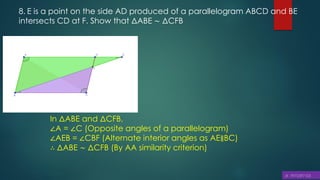
8. E is a point on the side AD produced of a parallelogram ABCD and BE
intersects CD at F. Show that ΔABE ∼ ΔCFB
In ΔABE and ΔCFB,
∠A = ∠C (Opposite angles of a parallelogram)
∠AEB = ∠CBF (Alternate interior angles as AE∥BC)
∴ ΔABE ∼ ΔCFB (By AA similarity criterion)
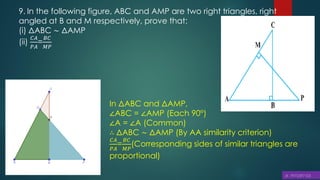
9. In the following figure, ABC and AMP are two right triangles, right
angled at B and M respectively, prove that:
(i) ΔABC ∼ ΔAMP
(ii)
𝐶𝐴
𝑃𝐴
=
𝐵𝐶
𝑀𝑃
In ΔABC and ΔAMP,
∠ABC = ∠AMP (Each 90°)
∠A = ∠A (Common)
∴ ΔABC ∼ ΔAMP (By AA similarity criterion)
𝐶𝐴
𝑃𝐴
=
𝐵𝐶
𝑀𝑃
(Corresponding sides of similar triangles are
proportional)
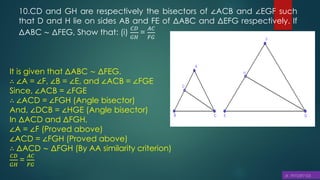
10.CD and GH are respectively the bisectors of ∠ACB and ∠EGF such
that D and H lie on sides AB and FE of ΔABC and ΔEFG respectively. If
ΔABC ∼ ΔFEG, Show that: (i)
𝐶𝐷
𝐺𝐻
=
𝐴𝐶
𝐹𝐺
It is given that ΔABC ∼ ΔFEG.
∴ ∠A = ∠F, ∠B = ∠E, and ∠ACB = ∠FGE
Since, ∠ACB = ∠FGE
∴ ∠ACD = ∠FGH (Angle bisector)
And, ∠DCB = ∠HGE (Angle bisector)
In ΔACD and ΔFGH,
∠A = ∠F (Proved above)
∠ACD = ∠FGH (Proved above)
∴ ΔACD ∼ ΔFGH (By AA similarity criterion)
𝐶𝐷
𝐺𝐻
=
𝐴𝐶
𝐹𝐺
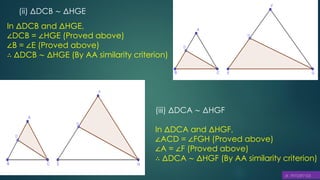
(ii) ΔDCB ∼ ΔHGE
In ΔDCB and ΔHGE,
∠DCB = ∠HGE (Proved above)
∠B = ∠E (Proved above)
∴ ΔDCB ∼ ΔHGE (By AA similarity criterion)
(iii) ΔDCA ∼ ΔHGF
In ΔDCA and ΔHGF,
∠ACD = ∠FGH (Proved above)
∠A = ∠F (Proved above)
∴ ΔDCA ∼ ΔHGF (By AA similarity criterion)
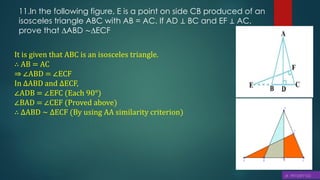
11.In the following figure, E is a point on side CB produced of an
isosceles triangle ABC with AB = AC. If AD ⊥ BC and EF ⊥ AC,
prove that ∆ABD ∼∆ECF
It is given that ABC is an isosceles triangle.
∴ AB = AC
⇒ ∠ABD = ∠ECF
In ∆ABD and ∆ECF,
∠ADB = ∠EFC (Each 90°)
∠BAD = ∠CEF (Proved above)
∴ ∆ABD ∼ ∆ECF (By using AA similarity criterion)
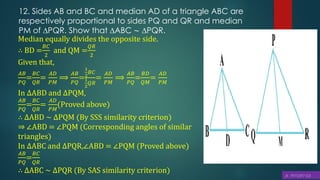
12. Sides AB and BC and median AD of a triangle ABC are
respectively proportional to sides PQ and QR and median
PM of ∆PQR. Show that ∆ABC ∼ ∆PQR.
Median equally divides the opposite side.
∴ BD =
𝐵𝐶
2
and QM =
𝑄𝑅
2
Given that,
𝐴𝐵
𝑃𝑄
=
𝐵𝐶
𝑄𝑅
=
𝐴𝐷
𝑃𝑀
⟹
𝐴𝐵
𝑃𝑄
=
1
2
𝐵𝐶
1
2
𝑄𝑅
=
𝐴𝐷
𝑃𝑀
⟹
𝐴𝐵
𝑃𝑄
=
𝐵𝐷
𝑄𝑀
=
𝐴𝐷
𝑃𝑀
In ∆ABD and ∆PQM,
𝐴𝐵
𝑃𝑄
=
𝐵𝐶
𝑄𝑅
=
𝐴𝐷
𝑃𝑀
(Proved above)
∴ ∆ABD ∼ ∆PQM (By SSS similarity criterion)
⇒ ∠ABD = ∠PQM (Corresponding angles of similar
triangles)
In ∆ABC and ∆PQR,∠ABD = ∠PQM (Proved above)
𝐴𝐵
𝑃𝑄
=
𝐵𝐶
𝑄𝑅
∴ ∆ABC ∼ ∆PQR (By SAS similarity criterion)
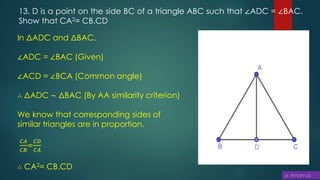
13. D is a point on the side BC of a triangle ABC such that ∠ADC = ∠BAC.
Show that CA2= CB.CD
In ΔADC and ΔBAC,
∠ADC = ∠BAC (Given)
∠ACD = ∠BCA (Common angle)
∴ ΔADC ∼ ΔBAC (By AA similarity criterion)
We know that corresponding sides of
similar triangles are in proportion.
𝐶𝐴
𝐶𝐵
=
𝐶𝐷
𝐶𝐴
∴ CA2= CB.CD
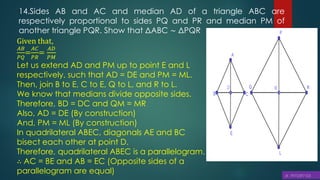
14.Sides AB and AC and median AD of a triangle ABC are
respectively proportional to sides PQ and PR and median PM of
another triangle PQR. Show that ΔABC ∼ ΔPQR
Given that,
𝐴𝐵
𝑃𝑄
=
𝐴𝐶
𝑃𝑅
=
𝐴𝐷
𝑃𝑀
Let us extend AD and PM up to point E and L
respectively, such that AD = DE and PM = ML.
Then, join B to E, C to E, Q to L, and R to L.
We know that medians divide opposite sides.
Therefore, BD = DC and QM = MR
Also, AD = DE (By construction)
And, PM = ML (By construction)
In quadrilateral ABEC, diagonals AE and BC
bisect each other at point D.
Therefore, quadrilateral ABEC is a parallelogram.
∴ AC = BE and AB = EC (Opposite sides of a
parallelogram are equal)
Similarly, we can prove that quadrilateral PQLR is a
parallelogram and PR = QL, PQ = LR
It was given that ,
𝐴𝐵
𝑃𝑄
=
𝐴𝐶
𝑃𝑅
=
𝐴𝐷
𝑃𝑀
⟹
𝐴𝐵
𝑃𝑄
=
𝐵𝐸
𝑄𝐿
=
2𝐴𝐷
2𝑃𝑀
⟹
𝐴𝐵
𝑃𝑄
=
𝐵𝐸
𝑄𝐿
=
𝐴𝐸
𝑃𝐿
∴ ΔABE ∼ ΔPQL (By SSS similarity criterion)
We know that corresponding angles of similar
triangles are equal. ∴ ∠BAE = ∠QPL⟶(1)
Similarly, it can be proved that ΔAEC ∼ ΔPLR and
∠CAE = ∠RPL ⟶(2)
Adding equation (1) and (2), we obtain
∠BAE + ∠CAE = ∠QPL + ∠RPL
⇒ ∠CAB = ∠RPQ ⟶(3)
In ΔABC and ΔPQR,
𝐴𝐵
𝑃𝑄
=
𝐴𝐶
𝑃𝑅
(Given)
∠CAB = ∠RPQ [Using equation (3)]
∴ ΔABC ∼ ΔPQR (By SAS similarity criterion)
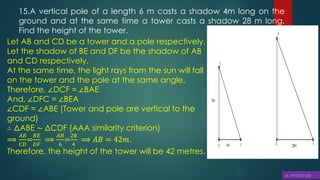
15.A vertical pole of a length 6 m casts a shadow 4m long on the
ground and at the same time a tower casts a shadow 28 m long.
Find the height of the tower.
Let AB and CD be a tower and a pole respectively.
Let the shadow of BE and DF be the shadow of AB
and CD respectively.
At the same time, the light rays from the sun will fall
on the tower and the pole at the same angle.
Therefore, ∠DCF = ∠BAE
And, ∠DFC = ∠BEA
∠CDF = ∠ABE (Tower and pole are vertical to the
ground)
∴ ΔABE ∼ ΔCDF (AAA similarity criterion)
⟹
𝐴𝐵
𝐶𝐷
=
𝐵𝐸
𝐷𝐹
⟹
𝐴𝐵
6
=
28
4
⟹ 𝐴𝐵 = 42𝑚.
Therefore, the height of the tower will be 42 metres.
16. If AD and PM are medians of triangles ABC and PQR, respectively
where ΔABC ∼ ΔPQR Prove that
𝐴𝐵
𝑃𝑄
=
𝐴𝐷
𝑃𝑀
It is given that ΔABC ∼ ΔPQR
We know that the corresponding sides of similar
triangles are in proportion. ∴
𝐴𝐵
𝑃𝑄
=
𝐴𝐶
𝑃𝑅
=
𝐵𝐶
𝑄𝑅
⟶(1)
Also, ∠A = ∠P, ∠B = ∠Q, ∠C = ∠R ⟶ (2)
Since AD and PM are medians, they will divide their
opposite sides.
∴BD=
𝐵𝐶
2
& QM=
𝑄𝑅
2
⟶(3)
From equations (1) and (3), we obtain
𝐴𝐵
𝑃𝑄
=
𝐵𝐷
𝑄𝑀
⟶(4)
In ΔABD and ΔPQM,
∠B = ∠Q [Using equation (2)]
𝐴𝐵
𝑃𝑄
=
𝐵𝐷
𝑄𝑀
[Using equation (4)]
∴ ΔABD ∼ ΔPQM (By SAS similarity criterion)
𝐴𝐵
𝑃𝑄
=
𝐵𝐷
𝑄𝑀
=
𝐴𝐷
𝑃𝑀
AREAS OF SIMILAR TRIANGLES:-
The ratio of the areas of two similar triangles is equal
to the square of the ratio of their corresponding
sides.
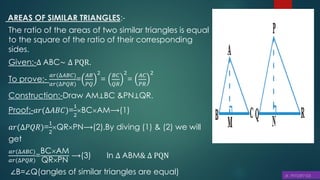
Given:-∆ ABC~ ∆ PQR.
To prove:-
𝑎𝑟(∆𝐴𝐵𝐶)
𝑎𝑟(∆𝑃𝑄𝑅)
=
𝐴𝐵
𝑃𝑄
2
=
𝐵𝐶
𝑄𝑅
2
=
𝐴𝐶
𝑃𝑅
2
Construction:-Draw AM⊥BC &PN⊥QR.
Proof:-𝑎𝑟(∆𝐴𝐵𝐶)=
1
2
BCAM⟶(1)
𝑎𝑟(∆𝑃𝑄𝑅)=
1
2
QRPN⟶(2),By diving (1) & (2) we will
get
𝑎𝑟(∆𝐴𝐵𝐶)
𝑎𝑟(∆𝑃𝑄𝑅)
=
BCAM
QRPN
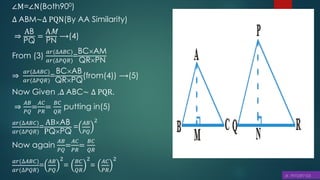
⟶(3) In ∆ ABM& ∆ PQN
∠B=∠Q(angles of similar triangles are equal)
∠M=∠N(Both900)
∆ ABM~∆ PQN(By AA Similarity)
⇒
AB
PQ
=
AM
PN
⟶(4)
From (3)
𝑎𝑟(∆𝐴𝐵𝐶)
𝑎𝑟(∆𝑃𝑄𝑅)
=
BCAM
QRPN
⇒
𝑎𝑟(∆𝐴𝐵𝐶)
𝑎𝑟(∆𝑃𝑄𝑅)
=
BCAB
QRPQ
(from(4)) ⟶(5)
Now Given ,∆ ABC~ ∆ PQR.
⇒
𝐴𝐵
𝑃𝑄
=
𝐴𝐶
𝑃𝑅
=
𝐵𝐶
𝑄𝑅
putting in(5)
𝑎𝑟(∆𝐴𝐵𝐶)
𝑎𝑟(∆𝑃𝑄𝑅)
=
ABAB
PQPQ
=
𝐴𝐵
𝑃𝑄
2
Now again
𝐴𝐵
𝑃𝑄
=
𝐴𝐶
𝑃𝑅
=
𝐵𝐶
𝑄𝑅
𝑎𝑟(∆𝐴𝐵𝐶)
𝑎𝑟(∆𝑃𝑄𝑅)
=
𝐴𝐵
𝑃𝑄
2
=
𝐵𝐶
𝑄𝑅
2
=
𝐴𝐶
𝑃𝑅
2
EXERCISE 2.4
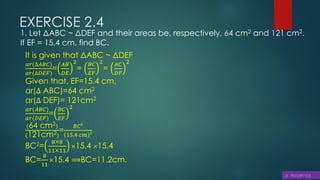
1. Let ΔABC ~ ΔDEF and their areas be, respectively, 64 cm2 and 121 cm2.
If EF = 15.4 cm, find BC.
It is given that ΔABC ~ ΔDEF
𝑎𝑟(∆𝐴𝐵𝐶)
𝑎𝑟(∆𝐷𝐸𝐹)
=
𝐴𝐵
𝐷𝐸
2
=
𝐵𝐶
𝐸𝐹
2
=
𝐴𝐶
𝐷𝐹
2
Given that, EF=15.4 cm,
ar(∆ ABC)=64 cm2
ar(∆ DEF)= 121cm2
𝑎𝑟(𝐴𝐵𝐶)
𝑎𝑟(𝐷𝐸𝐹)
=
𝐵𝐶
𝐸𝐹
2
(64 cm2)
(121cm2)
=
𝐵𝐶2
15.4 𝑐𝑚 2
BC2=
88
1111
15.4 15.4
BC=
8
11
15.4 ⟹BC=11.2cm.
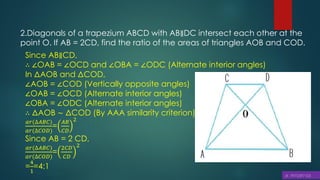
2.Diagonals of a trapezium ABCD with AB∥DC intersect each other at the
point O. If AB = 2CD, find the ratio of the areas of triangles AOB and COD.
Since AB∥CD,
∴ ∠OAB = ∠OCD and ∠OBA = ∠ODC (Alternate interior angles)
In ΔAOB and ΔCOD,
∠AOB = ∠COD (Vertically opposite angles)
∠OAB = ∠OCD (Alternate interior angles)
∠OBA = ∠ODC (Alternate interior angles)
∴ ΔAOB ∼ ΔCOD (By AAA similarity criterion)
𝑎𝑟(∆𝐴𝐵𝐶)
𝑎𝑟(∆𝐶𝑂𝐷)
=
𝐴𝐵
𝐶𝐷
2
Since AB = 2 CD,
𝑎𝑟(∆𝐴𝐵𝐶)
𝑎𝑟(∆𝐶𝑂𝐷)
=
2𝐶𝐷
𝐶𝐷
2
=
4
1
=4:1
3. In the following figure, ABC and DBC are two triangles on the same base
BC. If AD intersects BC at O, show that
𝑎𝑟(∆𝐴𝐵𝐶)
𝑎𝑟(∆𝐷𝐵𝐶)
=
𝐴𝑂
𝐷𝑂
Let us draw two perpendiculars AP and DM on line BC.
We know that area of a triangle=
1
2
BaseHeight
𝑎𝑟(∆𝐴𝐵𝐶)
𝑎𝑟(∆𝐷𝐵𝐶)
=
1
2
BCAP
1
2
BCDM
=
𝐴𝑃
𝐷𝑀
In ΔAPO and ΔDMO,
∠APO = ∠DMO (Each = 90°)
∠AOP = ∠DOM (Vertically opposite angles)
∴ ΔAPO ∼ ΔDMO (By AA similarity criterion)
Then
𝐴𝑂
𝐷𝑂
=
𝐴𝑃
𝐷𝑀
∴
𝑎𝑟(∆𝐴𝐵𝐶)
𝑎𝑟(∆𝐷𝐵𝐶)
=
𝐴𝑂
𝐷𝑂
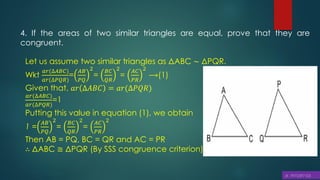
4. If the areas of two similar triangles are equal, prove that they are
congruent.
Let us assume two similar triangles as ΔABC ∼ ΔPQR.
Wkt
𝑎𝑟(∆𝐴𝐵𝐶)
𝑎𝑟(∆𝑃𝑄𝑅)
=
𝐴𝐵
𝑃𝑄
2
=
𝐵𝐶
𝑄𝑅
2
=
𝐴𝐶
𝑃𝑅
2
⟶(1)
Given that, 𝑎𝑟 ∆𝐴𝐵𝐶 = 𝑎𝑟(∆𝑃𝑄𝑅)
𝑎𝑟(∆𝐴𝐵𝐶)
𝑎𝑟(∆𝑃𝑄𝑅)
=1
Putting this value in equation (1), we obtain
1 =
𝐴𝐵
𝑃𝑄
2
=
𝐵𝐶
𝑄𝑅
2
=
𝐴𝐶
𝑃𝑅
2
Then AB = PQ, BC = QR and AC = PR
∴ ΔABC ≅ ΔPQR (By SSS congruence criterion)
5.D, E and F are respectively the mid-points of sides AB, BC and CA of
ΔABC. Find the ratio of the area of ΔDEF and ΔABC.
D and E are the mid-points of ΔABC.
∴DE∥AC and DE =
1
2
AC
In ΔBED and ΔBCA,
∠BED = ∠BCA (Corresponding angles)
∠BDE = ∠BAC (Corresponding angles)
∠EBA = ∠CBA (Common angles)
∴ ΔBED ~ ΔBCA (AAA similarity criterion)
Wkt
𝑎𝑟(∆𝐵𝐸𝐷)
𝑎𝑟(∆𝐵𝐶𝐴)
=
𝐷𝐸
𝐴𝐶
2
⇒
𝑎𝑟(∆𝐵𝐸𝐷)
𝑎𝑟(∆𝐵𝐶𝐴)
=
1
4
⇒ 𝑎𝑟(∆𝐵𝐸𝐷)=
1
4
𝑎𝑟(∆𝐵𝐶𝐴)
Similarly, 𝑎𝑟 ∆𝐶𝐹𝐸 =
1
4
𝑎𝑟(∆𝐵𝐶𝐴)
& 𝑎𝑟 ∆𝐴𝐷𝐹 =
1
4
𝑎𝑟(∆𝐵𝐶𝐴)
& Also, 𝑎𝑟 ∆𝐷𝐸𝐹 = 𝑎𝑟(∆𝐵𝐶𝐴)-[𝑎𝑟(∆𝐵𝐸𝐷)+ 𝑎𝑟 ∆𝐶𝐹𝐸 + 𝑎𝑟 ∆𝐴𝐷𝐹 ]
𝑎𝑟 ∆𝐷𝐸𝐹 = 𝑎𝑟(∆𝐵𝐶𝐴)-
3
4
𝑎𝑟(∆𝐵𝐶𝐴)=
1
4
𝑎𝑟(∆𝐵𝐶𝐴) ⇒
𝑎𝑟(∆𝐷𝐸𝐹)
𝑎𝑟(∆𝐵𝐶𝐴)
=
1
4
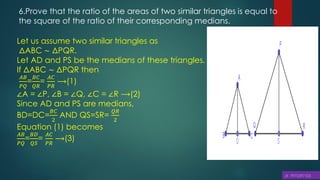
6.Prove that the ratio of the areas of two similar triangles is equal to
the square of the ratio of their corresponding medians.
Let us assume two similar triangles as
ΔABC ∼ ΔPQR.
Let AD and PS be the medians of these triangles.
If ΔABC ∼ ΔPQR then
𝐴𝐵
𝑃𝑄
=
𝐵𝐶
𝑄𝑅
=
𝐴𝐶
𝑃𝑅
⟶(1)
∠A = ∠P, ∠B = ∠Q, ∠C = ∠R ⟶(2)
Since AD and PS are medians,
BD=DC=
𝐵𝐶
2
AND QS=SR=
𝑄𝑅
2
Equation (1) becomes
𝐴𝐵
𝑃𝑄
=
𝐵𝐷
𝑄𝑆
=
𝐴𝐶
𝑃𝑅
⟶(3)
In ΔABD and ΔPQS,
∠B = ∠Q [Using equation (2)]
And,
𝐴𝐵
𝑃𝑄
=
𝐵𝐷
𝑄𝑆
[Using equation (3)]
∴ ΔABD ∼ ΔPQS (SAS similarity criterion)
Therefore, it can be said that
𝐴𝐵
𝑃𝑄
=
𝐵𝐷
𝑄𝑆
=
𝐴𝐷
𝑃𝑆
⟶(4)
𝑎𝑟(∆𝐴𝐵𝐶)
𝑎𝑟(∆𝑃𝑄𝑅)
=
𝐴𝐵
𝑃𝑄
2
=
𝐵𝐶
𝑄𝑅
2
=
𝐴𝐶
𝑃𝑅
2
From equations (1) and (4), we may find that
𝐴𝐵
𝑃𝑄
=
𝐵𝐶
𝑄𝑅
=
𝐴𝐶
𝑃𝑅
=
𝐴𝐷
𝑃𝑆
And hence,
𝑎𝑟(∆𝐴𝐵𝐶)
𝑎𝑟(∆𝑃𝑄𝑅)
=
𝐴𝐷
𝑃𝑆
2
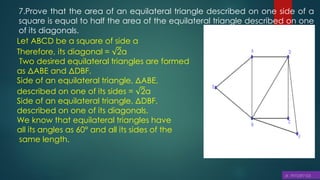
7.Prove that the area of an equilateral triangle described on one side of a
square is equal to half the area of the equilateral triangle described on one
of its diagonals.
Let ABCD be a square of side a
Therefore, its diagonal = 2a
Two desired equilateral triangles are formed
as ΔABE and ΔDBF.
Side of an equilateral triangle, ΔABE,
described on one of its sides = 2a
Side of an equilateral triangle, ΔDBF,
described on one of its diagonals.
We know that equilateral triangles have
all its angles as 60° and all its sides of the
same length.
Therefore, all equilateral triangles are similar to each other.
Hence, the ratio between the areas of these triangles will be equal to the
square of the ratio between the sides of these triangles.
𝑎𝑟(∆𝐴𝐵𝐸)
𝑎𝑟(∆𝐷𝐵𝐹)
=
𝑎
2a
2
=
1
2
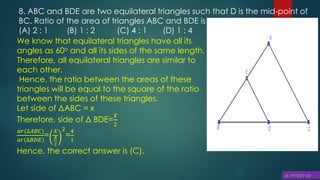
8. ABC and BDE are two equilateral triangles such that D is the mid-point of
BC. Ratio of the area of triangles ABC and BDE is
(A) 2 : 1 (B) 1 : 2 (C) 4 : 1 (D) 1 : 4
We know that equilateral triangles have all its
angles as 60o and all its sides of the same length.
Therefore, all equilateral triangles are similar to
each other.
Hence, the ratio between the areas of these
triangles will be equal to the square of the ratio
between the sides of these triangles.
Let side of ΔABC = x
Therefore, side of Δ BDE=
𝑋
2
𝑎𝑟(∆𝐴𝐵𝐶)
𝑎𝑟(∆𝐵𝐷𝐸)
=
𝑋
𝑋
2
2
=
4
1
Hence, the correct answer is (C).
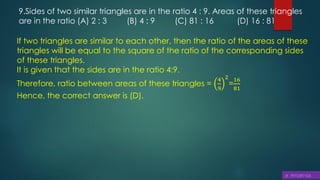
9.Sides of two similar triangles are in the ratio 4 : 9. Areas of these triangles
are in the ratio (A) 2 : 3 (B) 4 : 9 (C) 81 : 16 (D) 16 : 81
If two triangles are similar to each other, then the ratio of the areas of these
triangles will be equal to the square of the ratio of the corresponding sides
of these triangles.
It is given that the sides are in the ratio 4:9.
Therefore, ratio between areas of these triangles =
4
9
2
=
16
81
Hence, the correct answer is (D).
THEOREM 2.7:-
If a perpendicular is drawn from the vertex of the right angle of a right
triangle to the hypotenuse then triangles on both sides of the
perpendicular are similar to the whole triangle and to each other.
PYTHAGORAS THEOREM(BAUDHYAN THEOREM):-
In a right triangle, the square of the hypotenuse is equal to
the sum of the squares of the other two sides.
Given:-Triangle ABC right angled at B.
To prove:-AC2=AB2+BC2
Construction:- Draw BD⊥AC.
Proof:- Since,BD⊥AC.
We know That
If a perpendicular is drawn from the
vertex of the right angle of a right
triangle to the hypotenuse then triangles
on both sides of the perpendicular are
similar to the whole triangle and to each
other.
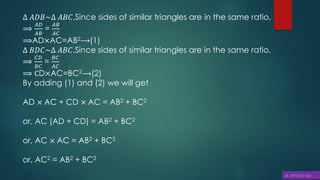
∆ 𝐴𝐷𝐵~∆ 𝐴𝐵𝐶,Since sides of similar triangles are in the same ratio,
⟹
𝐴𝐷
𝐴𝐵
=
𝐴𝐵
𝐴𝐶
⟹AD×AC=AB2⟶(1)
∆ 𝐵𝐷𝐶~∆ 𝐴𝐵𝐶,Since sides of similar triangles are in the same ratio,
⟹
𝐶𝐷
𝐵𝐶
=
𝐵𝐶
𝐴𝐶
⟹ CD×AC=BC2⟶(2)
By adding (1) and (2) we will get
AD × AC + CD × AC = AB2 + BC2
or, AC (AD + CD) = AB2 + BC2
or, AC × AC = AB2 + BC2
or, AC2 = AB2 + BC2
CONVERSE OF PYTHAGORAS THEOREM:-
In a triangle, if square of one side is equal to the sum of the
squares of the other two sides, then the angle opposite the
first side is a right angle.
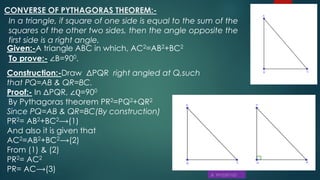
Given:-A triangle ABC in which, AC2=AB2+BC2
To prove:- ∠B=900.
Construction:-Draw ΔPQR right angled at Q,such
that PQ=AB & QR=BC.
Proof:- In ΔPQR, ∠Q=900
By Pythagoras theorem PR2=PQ2+QR2
Since PQ=AB & QR=BC(By construction)
PR2= AB2+BC2⟶(1)
And also it is given that
AC2=AB2+BC2⟶(2)
From (1) & (2)
PR2= AC2
PR= AC⟶(3)
Now, in ΔABC and ΔPQR,
AB = PQ (By construction)
BC = QR (By construction)
AC = PR [Proved in (3) above]
So, ΔABC≅ΔPQR (SSS congruence)
Therefore, ∠B = ∠Q (CPCT)
But ∠Q = 90° (By construction)
So, ∠B = 90°
EXERCISE 2.5
1.Sides of triangles are given below. Determine which of them are right
triangles? In case of a right triangle, write the length of its hypotenuse.
(i) 7 cm, 24 cm, 25 cm
It is given that the sides of the triangle are 7 cm, 24 cm, and 25 cm.
Squaring the lengths of these sides, we will obtain 49, 576, and 625.
49 + 576 = 625
Or, 72 + 242 = 252
The sides of the given triangle are satisfying Pythagoras theorem.
Therefore, it is a right triangle.
We know that the longest side of a right triangle is the hypotenuse.
Therefore, the length of the hypotenuse of this triangle is 25 cm.
(ii) 3 cm, 8 cm, 6 cm
It is given that the sides of the triangle are 3 cm, 8 cm, and 6 cm.
Squaring the lengths of these sides, we will obtain 9, 64, and 36.
However, 9 + 36 ≠ 64 Or, 32 + 62 ≠ 82 . Hence, it is not a right triangle.
(iii) 50 cm, 80 cm, 100 cm
Given that sides are 50 cm, 80 cm, and 100 cm.
Squaring the lengths of these sides, we will obtain 2500, 6400, and 10000.
However, 2500 + 6400 ≠ 10000
Or, 502 + 802 ≠ 1002
Clearly, the sum of the squares of the lengths of two sides is not equal to
the square of the length of the third side.
Therefore, the given triangle is not satisfying Pythagoras theorem.
Hence, it is not a right triangle.
(iv) 13 cm, 12 cm, 5 cm
Given that sides are 13 cm, 12 cm, and 5 cm.
Squaring the lengths of these sides, we will obtain 169, 144, and 25.
Clearly, 144 +25 = 169 Or, 122 + 52 = 132
The sides of the given triangle are satisfying Pythagoras theorem.
Therefore, it is a right triangle.
We know that the longest side of a right triangle is the hypotenuse.
Therefore, the length of the hypotenuse of this triangle is 13 cm.
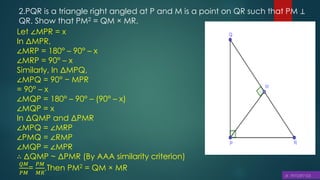
2.PQR is a triangle right angled at P and M is a point on QR such that PM ⊥
QR. Show that PM2 = QM × MR.
Let ∠MPR = x
In ΔMPR,
∠MRP = 180° – 90° – x
∠MRP = 90° – x
Similarly, In ΔMPQ,
∠MPQ = 90° − MPR
= 90° – x
∠MQP = 180° – 90° – (90° – x)
∠MQP = x
In ΔQMP and ΔPMR
∠MPQ = ∠MRP
∠PMQ = ∠RMP
∠MQP = ∠MPR
∴ ΔQMP ~ ΔPMR (By AAA similarity criterion)
𝑄𝑀
𝑃𝑀
=
𝑃𝑀
𝑀𝑅
,Then PM2 = QM × MR
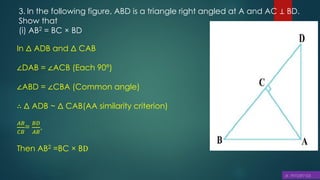
3. In the following figure, ABD is a triangle right angled at A and AC ⊥ BD.
Show that
(i) AB2 = BC × BD
In Δ ADB and Δ CAB
∠DAB = ∠ACB (Each 90°)
∠ABD = ∠CBA (Common angle)
∴ Δ ADB ~ Δ CAB(AA similarity criterion)
𝐴𝐵
𝐶𝐵
=
𝐵𝐷
𝐴𝐵
,
Then AB2 =BC × BD
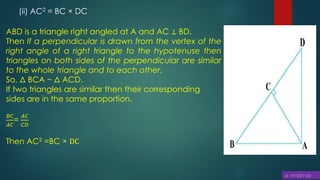
(ii) AC2 = BC × DC
ABD is a triangle right angled at A and AC ⊥ BD.
Then If a perpendicular is drawn from the vertex of the
right angle of a right triangle to the hypotenuse then
triangles on both sides of the perpendicular are similar
to the whole triangle and to each other.
So, Δ BCA ~ Δ ACD.
If two triangles are similar then their corresponding
sides are in the same proportion.
𝐵𝐶
𝐴𝐶
=
𝐴𝐶
𝐶𝐷
Then AC2 =BC × DC
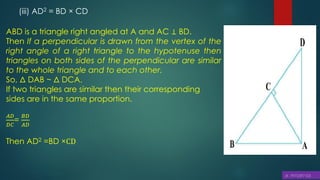
(iii) AD2 = BD × CD
ABD is a triangle right angled at A and AC ⊥ BD.
Then If a perpendicular is drawn from the vertex of the
right angle of a right triangle to the hypotenuse then
triangles on both sides of the perpendicular are similar
to the whole triangle and to each other.
So, Δ DAB ~ Δ DCA.
If two triangles are similar then their corresponding
sides are in the same proportion.
𝐴𝐷
𝐷𝐶
=
𝐵𝐷
𝐴𝐷
Then AD2 =BD ×CD
4.ABC is an isosceles triangle right angled at C. Prove that AB2 = 2 AC2.
Given that ΔABC is an isosceles right triangle.
∴ AC = CB
Applying Pythagoras theorem in ΔABC
(i.e., right-angled at point C),
we obtain
AB2=AC2+BC2
But AC = CB
Then
AB2=AC2+AC2
Hence
AB2 = 2 AC2
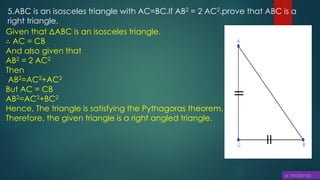
5.ABC is an isosceles triangle with AC=BC.If AB2 = 2 AC2.prove that ABC is a
right triangle.
Given that ΔABC is an isosceles triangle.
∴ AC = CB
And also given that
AB2 = 2 AC2
Then
AB2=AC2+AC2
But AC = CB
AB2=AC2+BC2
Hence, The triangle is satisfying the Pythagoras theorem.
Therefore, the given triangle is a right angled triangle.
=
=
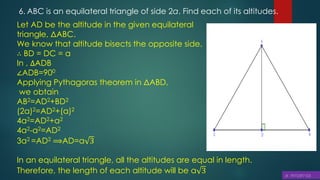
6. ABC is an equilateral triangle of side 2a. Find each of its altitudes.
Let AD be the altitude in the given equilateral
triangle, ΔABC.
We know that altitude bisects the opposite side.
∴ BD = DC = a
In , ∆ADB
∠ADB=900
Applying Pythagoras theorem in ΔABD,
we obtain
AB2=AD2+BD2
(2a)2=AD2+(a)2
4a2=AD2+a2
4a2-a2=AD2
3a2 =AD2 ⟹AD=a 3
In an equilateral triangle, all the altitudes are equal in length.
Therefore, the length of each altitude will be a 3
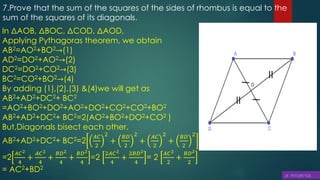
7.Prove that the sum of the squares of the sides of rhombus is equal to the
sum of the squares of its diagonals.
In ΔAOB, ΔBOC, ΔCOD, ΔAOD,
Applying Pythagoras theorem, we obtain
AB2=AO2+BO2→(1)
AD2=DO2+AO2→(2)
DC2=DO2+CO2→(3)
BC2=CO2+BO2→(4)
By adding (1),(2),(3) &(4)we will get as
AB2+AD2+DC2+ BC2
=AO2+BO2+DO2+AO2+DO2+CO2+CO2+BO2
AB2+AD2+DC2+ BC2=2(AO2+BO2+DO2+CO2 )
But,Diagonals bisect each other.
AB2+AD2+DC2+ BC2=2
𝐴𝐶
2
2
+
𝐵𝐷
2
2
+
𝐴𝐶
2
2
+
𝐵𝐷
2
2
=2
𝐴𝐶2
4
+
𝐴𝐶2
4
+
𝐵𝐷2
4
+
𝐵𝐷2
4
=2
2𝐴𝐶2
4
+
2𝐵𝐷2
4
= 2
𝐴𝐶2
2
+
𝐵𝐷2
2
= AC2+BD2
=
=
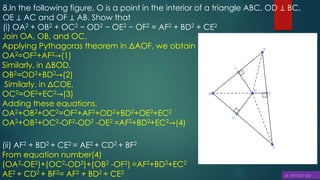
8.In the following figure, O is a point in the interior of a triangle ABC, OD ⊥ BC,
OE ⊥ AC and OF ⊥ AB. Show that
(i) OA2 + OB2 + OC2 − OD2 − OE2 − OF2 = AF2 + BD2 + CE2
Join OA, OB, and OC.
Applying Pythagoras theorem in ΔAOF, we obtain
OA2=OF2+AF2→(1)
Similarly, in ΔBOD,
OB2=OD2+BD2→(2)
Similarly, in ΔCOE,
OC2=OE2+EC2→(3)
Adding these equations,
OA2+OB2+OC2=OF2+AF2+OD2+BD2+OE2+EC2
OA2+OB2+OC2-OF2-OD2 -OE2 =AF2+BD2+EC2→(4)
(ii) AF2 + BD2 + CE2 = AE2 + CD2 + BF2
From equation number(4)
(OA2-OE2)+(OC2-OD2)+(OB2 -OF2) =AF2+BD2+EC2
AE2 + CD2 + BF2= AF2 + BD2 + CE2
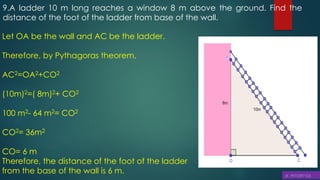
9.A ladder 10 m long reaches a window 8 m above the ground. Find the
distance of the foot of the ladder from base of the wall.
Let OA be the wall and AC be the ladder.
Therefore, by Pythagoras theorem,
AC2=OA2+CO2
(10m)2=( 8m)2+ CO2
100 m2- 64 m2= CO2
CO2= 36m2
CO= 6 m
Therefore, the distance of the foot of the ladder
from the base of the wall is 6 m.
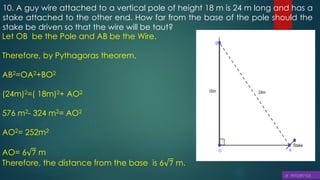
10. A guy wire attached to a vertical pole of height 18 m is 24 m long and has a
stake attached to the other end. How far from the base of the pole should the
stake be driven so that the wire will be taut?
Let OB be the Pole and AB be the Wire.
Therefore, by Pythagoras theorem,
AB2=OA2+BO2
(24m)2=( 18m)2+ AO2
576 m2- 324 m2= AO2
AO2= 252m2
AO= 6 7 m
Therefore, the distance from the base is 6 7 m.
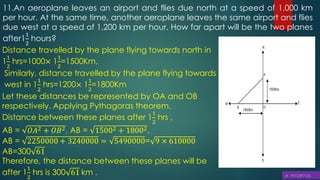
11.An aeroplane leaves an airport and flies due north at a speed of 1,000 km
per hour. At the same time, another aeroplane leaves the same airport and flies
due west at a speed of 1,200 km per hour. How far apart will be the two planes
after1
1
2
hours?
Distance travelled by the plane flying towards north in
1
1
2
hrs=1000× 1
1
2
=1500Km,
Similarly, distance travelled by the plane flying towards
west in 1
1
2
hrs=1200× 1
1
2
=1800Km
Let these distances be represented by OA and OB
respectively. Applying Pythagoras theorem,
Distance between these planes after 1
1
2
hrs ,
AB = 𝑂𝐴2 + 𝑂𝐵2, AB = 15002 + 18002,
AB = 2250000 + 3240000 = 5490000= 9 × 610000
AB=300 61
Therefore, the distance between these planes will be
after 1
1
2
hrs is 300 61 km .
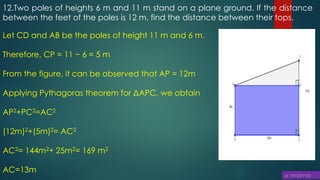
12.Two poles of heights 6 m and 11 m stand on a plane ground. If the distance
between the feet of the poles is 12 m, find the distance between their tops.
Let CD and AB be the poles of height 11 m and 6 m.
Therefore, CP = 11 − 6 = 5 m
From the figure, it can be observed that AP = 12m
Applying Pythagoras theorem for ΔAPC, we obtain
AP2+PC2=AC2
(12m)2+(5m)2= AC2
AC2= 144m2+ 25m2= 169 m2
AC=13m
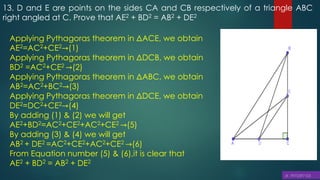
13. D and E are points on the sides CA and CB respectively of a triangle ABC
right angled at C. Prove that AE2 + BD2 = AB2 + DE2
Applying Pythagoras theorem in ΔACE, we obtain
AE2=AC2+CE2→(1)
Applying Pythagoras theorem in ΔDCB, we obtain
BD2 =AC2+CE2 →(2)
Applying Pythagoras theorem in ΔABC, we obtain
AB2=AC2+BC2→(3)
Applying Pythagoras theorem in ΔDCE, we obtain
DE2=DC2+CE2→(4)
By adding (1) & (2) we will get
AE2+BD2=AC2+CE2+AC2+CE2 →(5)
By adding (3) & (4) we will get
AB2 + DE2 =AC2+CE2+AC2+CE2 →(6)
From Equation number (5) & (6),it is clear that
AE2 + BD2 = AB2 + DE2
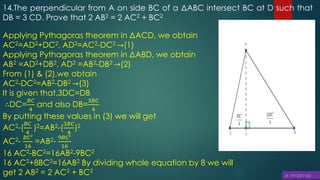
14.The perpendicular from A on side BC of a ΔABC intersect BC at D such that
DB = 3 CD. Prove that 2 AB2 = 2 AC2 + BC2
Applying Pythagoras theorem in ΔACD, we obtain
AC2=AD2+DC2, AD2=AC2-DC2 →(1)
Applying Pythagoras theorem in ΔABD, we obtain
AB2 =AD2+DB2, AD2 =AB2-DB2 →(2)
From (1) & (2),we obtain
AC2-DC2=AB2-DB2 →(3)
It is given that,3DC=DB
∴DC=
𝐵𝐶
4
and also DB=
3𝐵𝐶
4
By putting these values in (3) we will get
AC2-(
𝐵𝐶
4
)2=AB2-(
3𝐵𝐶
4
)2
AC2-
𝐵𝐶2
16
=AB2-
9𝐵𝐶2
16
16 AC2-BC2=16AB2-9BC2
16 AC2+8BC2=16AB2 By dividing whole equation by 8 we will
get 2 AB2 = 2 AC2 + BC2
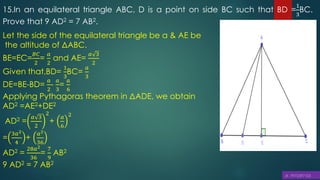
15.In an equilateral triangle ABC, D is a point on side BC such that BD =
1
3
BC.
Prove that 9 AD2 = 7 AB2.
Let the side of the equilateral triangle be a & AE be
the altitude of ΔABC.
BE=EC=
𝐵𝐶
2
=
𝑎
2
and AE=
𝑎 3
2
Given that,BD=
1
3
BC=
𝑎
3
DE=BE-BD=
𝑎
2
-
𝑎
3
=
𝑎
6
Applying Pythagoras theorem in ΔADE, we obtain
AD2 =AE2+DE2
AD2 =
𝑎 3
2
2
+
𝑎
6
2
=
3𝑎2
4
+
𝑎2
36
AD2 =
28𝑎2
36
=
7
9
AB2
9 AD2 = 7 AB2
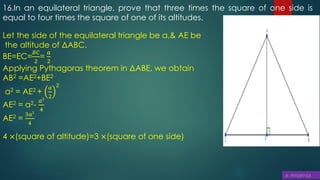
16.In an equilateral triangle, prove that three times the square of one side is
equal to four times the square of one of its altitudes.
Let the side of the equilateral triangle be a,& AE be
the altitude of ΔABC.
BE=EC=
𝐵𝐶
2
=
𝑎
2
Applying Pythagoras theorem in ΔABE, we obtain
AB2 =AE2+BE2
a2 = AE2 +
𝑎
2
2
AE2 = a2-
𝑎2
4
AE2 =
3𝑎2
4
4 ×(square of altitude)=3 ×(square of one side)
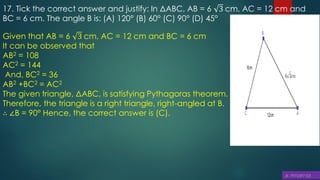
17. Tick the correct answer and justify: In ΔABC, AB = 6 3 cm, AC = 12 cm and
BC = 6 cm. The angle B is: (A) 120° (B) 60° (C) 90° (D) 45°
Given that AB = 6 3 cm, AC = 12 cm and BC = 6 cm
It can be observed that
AB2 = 108
AC2 = 144
And, BC2 = 36
AB2 +BC2 = AC2
The given triangle, ΔABC, is satisfying Pythagoras theorem.
Therefore, the triangle is a right triangle, right-angled at B.
∴ ∠B = 90° Hence, the correct answer is (C).
Triangles ppt by jk

Triangles ppt by jk

  • 1.
  • 2.
    TRIANGLE:- A closed Geometricalfigure formed by joining non collinear three points,with the help of straight lines is called as “triangle”. In a triangle we are having three vertices,three sides and three angles.
  • 3.
    CONGRUENCY OF TRIANGLES:- Ifany two triangles are having same shape and same size they are called as congruent triangles.
  • 4.
    SIMILARITY OF FIGURES:- Theseare similar photographs of Sachin Tendulkar,but of different sizes.
  • 5.
    SIMILARITY OF FIGURES:- Theseare Indian currency notes of similar denomination,but of different sizes.
  • 6.
    SIMILARITY OF FIGURES:- Twofigures having the same shape and not necessarily the same size are called as similar figures.
  • 7.
    SIMILARITY OF POLYGONS:- Thetwo polygons of the same number of sides are similar,if 1)All the corresponding angles are equal and 2)All the corresponding sides are in the same ratio.
  • 8.
    EXERCISE 2.1 1.Fill inthe blanks using correct word given in brackets: i)All circles are_____________(congruent,similar) similar ii)All squares are___________(similar,congruent) similar iii)All ______________triangles are similar.(isocles,equilateral) equilateral iv)Two polygons of the same number of sides are similar,if (a)their corresponding angles are_____and(b)their corresponding sides are ____________.(equal,proportional) equal,proportional
  • 9.
    2.Give two differentexamples of pair of of i)Similar figures. a)any two circle b)any two rectangles c)any two squares . ii)non-similar figures. a)circle and a triangle b)square and a rectangle c)pentagon and a rhombus
  • 10.
    3.State whether thefollowing quadrilaterals are similar or not: In case PQRS and ABCD, The corresponding sides are in the same proportion, but the corresponding angles do not appear equal. Hence,they are not similar.
  • 11.
    SIMILARITY OF TRIANGLES:- Thetwo Triangles are similar,if 1)All the corresponding angles are equal and 2)All the corresponding sides are in the same ratio.
  • 12.
    BASIC PROPORTIONALITY THEOREM(THALESTHEOREM):- If a line is drawn parallel to one side of a triangle to intersect other two sides in distinct points,the other two sides are divided in the same ratio. Given:-A triangle ABC in which DE is drawn parallel to AB.Point D lies in AC and Point E lies in CB. To prove:- 𝐶𝐷 𝐴𝐷 = 𝐶𝐸 𝐵𝐸 Construction:- Draw EF perpendicular to AB.Join AE and BD. Proof:- Since,area of a triangle= 1 2  base  height Area of ∆ CDE= 1 2 CD EF and Area of ∆ ADE= 1 2 AD EF
  • 13.
    Again draw DMperpendicular to BC,then join DB and AE. 𝑎𝑟(∆ 𝐶𝐷𝐸) 𝑎𝑟(∆ 𝐵𝐷𝐸) = 1 2 CE 𝐷𝑀 1 2 BE DM = 𝐶𝐸 𝐵𝐸 → (2) As ∆ 𝐵𝐷𝐸 and ∆ 𝐴𝐷𝐸 are on the same base DE and between the same Parallels and we know that ,triangles on the same base and between the same parallels are equal in area. Then a𝑟(∆ 𝐵𝐷𝐸)= a𝑟(∆ 𝐴𝐷𝐸) Hence 𝑎𝑟(∆ 𝐶𝐷𝐸) 𝑎𝑟(∆ 𝐴𝐷𝐸) = 𝑎𝑟(∆ 𝐶𝐷𝐸) 𝑎𝑟(∆ 𝐵𝐷𝐸) 𝐶𝐷 𝐴𝐷 = 𝐶𝐸 𝐵𝐸 𝑎𝑟(∆ 𝐶𝐷𝐸) 𝑎𝑟(∆ 𝐴𝐷𝐸) = 1 2 CD EF 1 2 AD EF = 𝐶𝐷 𝐴𝐷 → (1)
  • 14.
    CONVERSE OF BASICPROPORTIONALITY THEOREM :- If a line divides any two sides of a triangle in the same ratio,the line must be parallel to the third side. Given:-A triangle ABC and a line PQ which intersects AB in D and AC in E,such that 𝐴𝐷 𝐷𝐵 = 𝐴𝐸 𝐸𝐶 To prove:-PQ is parallel to BC. Proof:- Let us assume that PQ is not parallel to BC.Then,draw a line MN which passes through D;intersects AC in F and is parallel to BC,i.e.DF ∥ BC. Then according to Basic proportionality theorem.DF ∥ BC ⟹ 𝐴𝐷 𝐷𝐵 = 𝐴𝐹 𝐹𝐶 But given that 𝐴𝐷 𝐷𝐵 = 𝐴𝐸 𝐸𝐶 ⟹ 𝐴𝐸 𝐸𝐶 = 𝐴𝐹 𝐹𝐶 𝐴𝐸 𝐸𝐶 +1= 𝐴𝐹 𝐹𝐶 +1 ⟹ 𝐴𝐸+𝐸𝐶 𝐸𝐶 = 𝐴𝐹+𝐹𝐶 𝐹𝐶 ⟹ 𝐴𝐶 𝐸𝐶 = 𝐴𝐶 𝐹𝐶 ⟹EC=FC But EC=FC is possible only if E and F coincide.i.e.DF and DE are the same lines.⟹ DE ∥ BC i.e,PQ ∥ BC.
  • 15.
    EXERCISE 2.2 1.In fig2.17,(i)and (ii)DE∥BC.Find EC in (i) and AD in(ii). It is given that DE∥BC, Then, 𝐴𝐷 𝐷𝐵 = 𝐴𝐸 𝐸𝐶 (i) 1.5 3 = 1 𝐸𝐶 (ii) 𝐴𝐷 7.2 = 1.8 5.4 EC= 13 1.5 AD= 1.87.2 5.4 EC=2cm AD=2.4cm
  • 16.
    2.E and Fare points on the sides PQ and PR respectively of a ∆ PQR. For each of the following cases,state whether EF∥QR: (i)PE=3.9cm,EQ=3cm,PF=3.6cm and FR=2.4cm. It is given that EF∥QR, Then we have prove that 𝑃𝐸 𝐸𝑄 = 𝑃𝐹 𝐹𝑅 3.9 3 = 3.6 2.4 ⟹ 39 30 = 36 24 ⟹ 13 10 = 3 2 Since L.H.S≠R.H.S.Hence,EF and QR are not parallel. (ii)PE=4cm,QE=4.5cm,PF=8cm and RF=9cm. It is given that EF∥QR, Then we have prove that 𝑃𝐸 𝐸𝑄 = 𝑃𝐹 𝐹𝑅 4 4.5 = 8 9 ⟹ 40 45 = 8 9 ⟹ 8 9 = 8 9 Since L.H.S=R.H.S.Hence,EF and QR are parallel.
  • 17.
    (iii)PQ=1.28cm,PR=2.56cm,PE=0.18cm and PF=0.36cm. Itis given that EF∥QR, Then we have prove that 𝑃𝐸 𝐸𝑄 = 𝑃𝐹 𝐹𝑅 ⟹EQ=PQ-PE =1.28-0.18 =1.10cm ⟹ FR=PR−PF =2.56−0.36 =2.20cm Then 𝑃𝐸 𝐸𝑄 = 𝑃𝐹 𝐹𝑅 0.18 1.10 = 0.36 2.20 ⟹ 1.8 11 = 3.6 22 ⟹ 9 55 = 9 55 Since L.H.S=R.H.S.Hence,EF and QR are parallel.
  • 18.
    3.In Fig.2.18,if LM∥CBand LN∥CD,prove that 𝐴𝑀 𝐴𝐵 = 𝐴𝑁 𝐴𝐷 . In ∆ACB, LM∥CB, Then, 𝐴𝐿 𝐿𝐶 = 𝐴𝑀 𝑀𝐵 ⇢ (1) In ∆ACD, LN∥CD, Then, 𝐴𝐿 𝐿𝐶 = 𝐴𝑁 𝑁𝐷 ⇢ (2) From (1) and (2) 𝐴𝑀 𝑀𝐵 = 𝐴𝑁 𝑁𝐷 Then, 𝑀𝐵 𝐴𝑀 = 𝑁𝐷 𝐴𝑁 Adding 1 on both sides 𝑀𝐵 𝐴𝑀 +1= 𝑁𝐷 𝐴𝑁 +1 ⇒ 𝑀𝐵+𝐴𝑀 𝐴𝑀 = 𝑁𝐷+𝐴𝑁 𝐴𝑁 𝐴𝐵 𝐴𝑀 = 𝐴𝐷 𝐴𝑁 ⇒ 𝐴𝑀 𝐴𝐵 = 𝐴𝑁 𝐴𝐷
  • 19.
    4.In Fig.2.19,if DE∥AC and DF∥ AE,prove that 𝐵𝐹 𝐹𝐸 = 𝐵𝐸 𝐴𝐸 . In ∆ABC, DE∥AC,Then, 𝐵𝐸 𝐸𝐶 = 𝐵𝐷 𝐷𝐴 ⇢ (1) In ∆AEB, DF∥ AE,Then, 𝐵𝐹 𝐹𝐸 = 𝐵𝐷 𝐷𝐴 ⇢ (2) From (1) and (2) 𝐵𝐹 𝐹𝐸 = 𝐵𝐸 𝐸𝐶
  • 20.
    5.In Fig.2.20,if DE∥OQ and DF∥ OR.Show that EF∥ QR. In ∆PQO, DE∥ OQ,Then, 𝑃𝐸 𝐸𝑄 = 𝑃𝐷 𝐷𝑂 ⇢ (1) In ∆PRO, DF∥ OR,Then, 𝑃𝐹 𝐹𝑅 = 𝑃𝐷 𝐷𝑂 ⇢ (2) From (1) and (2) ⇒ 𝑃𝐹 𝐹𝑅 = 𝑃𝐸 𝐸𝑄 In ∆ PQR, 𝑃𝐹 𝐹𝑅 = 𝑃𝐸 𝐸𝑄 i.e.Line EF divides the triangle PQR in the same ratio. ∴EF∥QR.
  • 21.
    9.ABCD is atrapezium in which AB∥ DC and its diagonals intersect each other at the point O.Show that AC∥ PR.Show that 𝐴𝑂 𝐵𝑂 = 𝐶𝑂 𝐷𝑂 In ∆ADC, EO∥ DC,Then, 𝐴𝐸 𝐷𝐸 = 𝐴𝑂 𝐶𝑂 ⇢ (1) In ∆DBA, EO∥ AB,Then, 𝐴𝐸 𝐷𝐸 = 𝐵𝑂 𝐷𝑂 ⇢ (2) From (1) and (2) ⇒ 𝐴𝑂 𝐶𝑂 = 𝐵𝑂 𝐷𝑂 Thus , 𝐴𝑂 𝐵𝑂 = 𝐶𝑂 𝐷𝑂
  • 22.
    10.The diagonals ofa quadrilateral ABCD intersect each other at the point O such that 𝐴𝑂 𝐵𝑂 = 𝐶𝑂 𝐷𝑂 .Show that ABCD is a trapezium. Let us draw a line EF∥ 𝐴𝐵 passing through point o. Given 𝐴𝑂 𝐵𝑂 = 𝐶𝑂 𝐷𝑂 ⟹ 𝐴𝑂 𝐶𝑂 = 𝐵𝑂 𝐷𝑂 ⇢ (1) In ∆ADB, EO∥ AB,Then, 𝐴𝐸 𝐷𝐸 = 𝐵𝑂 𝐷𝑂 ⇒ 𝐴𝐸 𝐷𝐸 = 𝐴𝑂 𝐶𝑂 [from (1)] In ∆ADC. Line EO divides the triangle in the same ratio. ∴ EO∥ DC. Now, EO∥ DC.But we know that EO∥ AB. ⇒ EO∥ D𝐶 ∥AB ⇒ AB∥ D𝐶.One pair of opposite sides of ABCD are parallel. ∴ ABCD is a trapezium.
  • 23.
    CRITERIA FOR SIMILARITYOF TRIANGLES:- A-A-A CRITERION FOR SIMILARITY OF 2 TRIANGLES:- If in two triangles,corresponding angles are equal,then their corresponding sides are in the same ratio and hence the two triangles are similar. Given:-Two triangles∆ ABC and ∆ DEF such that ∠A=∠D,∠B=∠E & ∠C=∠F. To prove:- ∆ ABC~ ∆ DEF. Construction:-Draw P and Q on DE & DF such that DP=AB and DQ=AC respectively and join PQ. Proof:- In ∆ ABC and ∆ DEF
  • 24.
    AB=DP(By construction) ∠A=∠D(Given) AC=DQ(By construction) ⇒∆ ABC ≅ ∆ DEF(By SAS Criterion) ⇒ ∠B=∠P(By CPCT) But ∠B=∠E(Given) Thus ∠E=∠P For lines PQ and EF with transversal PE, ∠P & ∠E are corresponding angles, and they are equal Hence ,PQ∥EF.We know that if a line is drawn parallel to one side of a triangle to intersect the other two sides in disctinct points,the other two sides are diveded in the same ratio. 𝐷𝑃 𝑃𝐸 = 𝐷𝑄 𝑄𝐹 OR 𝑃𝐸 𝐷𝑃 = 𝑄𝐹 𝐷𝑄 Adding 1 on both sides ,we will get 𝑃𝐸 𝐷𝑃 +1= 𝑄𝐹 𝐷𝑄 +1 ⇒ 𝑃𝐸+𝐷𝑃 𝐷𝑃 = 𝑄𝐹+𝐷𝑄 𝐷𝑄 ⇒ 𝐷𝐸 𝐷𝑃 = 𝐷𝐹 𝐷𝑄 ⇒ 𝐷𝑃 𝐷𝐸 = 𝐷𝑄 𝐷𝐹 But by construction DP=AB,DQ=AC ⇒ 𝐴𝐵 𝐷𝐸 = 𝐴𝐶 𝐷𝐹 similarly we may prove that 𝐴𝐵 𝐷𝐸 = 𝐵𝐶 𝐷𝐹 ∴ 𝐴𝐵 𝐷𝐸 = 𝐴𝐶 𝐷𝐹 = 𝐵𝐶 𝐷𝐹 Since all 3 sides are in the Proportion. ∴ ∆ ABC~ ∆ DEF.
  • 25.
    A-A SIMILARITY CRITERIA:- Iftwo angles of one triangle are respectively equal to two angles of another triangle, then the two triangles are similar. Given:-Two triangles∆ ABC and ∆ DEF such that ∠B=∠E & ∠C=∠F. To prove:- ∆ ABC~ ∆ DEF. Proof:- In ∆ ABC By angle sum property ∠A + ∠B+∠C=1800→ (1) In ∆ DEF By angle sum property ∠D + ∠E + ∠F=1800 → (2) From (1) and (2)
  • 26.
    ∠A + ∠B+∠C=∠D + ∠E + ∠F ∠A + ∠E + ∠F= ∠D + ∠E + ∠F(Given ∠B= ∠E & ∠C = ∠F) ∠A = ∠D → (3) Thus in ∆ ABC & ∆ DEF ∠A = ∠D 𝐹𝑟0𝑚 3 ∠B= ∠E(Given) ∠C = ∠F(Given) ∴ ∆ ABC~ ∆ DEF.(AAA Similarity criteria)
  • 27.
    S-S-S CRITERION FORSIMILARITY OF 2 TRIANGLES:- If in two triangles,sides of one triangle are proportional to the sides of other triangle,then their corresponding angles are equal and hence the two triangles are similar. If one angle of a triangle is equal to one angle of the other triangle and the sides including these angles are proportional, then the two triangles are similar. S-A-S CRITERION FOR SIMILARITY OF 2 TRIANGLES:-
  • 28.
    EXERCISE 2.3 1.State whichpair of triangles in Fig.2.34 are similar.Write the similarity criterion used by you for answering the question and also write the pairs of similar triangles in the symbolic form. In ∆ ABC & ∆ PQR ∠A = ∠P ∠B= ∠Q ∠C = ∠R ∴ ∆ ABC~ ∆ PQR.(AAA Similarity criteria) In ∆ ABC & ∆ PQR 𝐴𝐵 𝑄𝑅 = 2 4 = 1 2 𝐴𝐶 𝑄𝑃 = 3 6 = 1 2 𝐴𝐵 𝑄𝑅 = 2.5 5 = 1 2 Hence 𝐴𝐵 𝑄𝑅 = 𝐴𝐶 𝑄𝑃 = 𝐴𝐵 𝑄𝑅 = 1 2 ∴ ∆ ABC~ ∆ PQR.(SSS Similarity criteria)
  • 29.
    In ∆𝑀𝑁𝐿 &∆ QPR ∠M = ∠Q=700 And also 𝑀𝑁 𝑄𝑃 = 2.5 5 = 1 2 𝑀𝐿 𝑄𝑅 = 5 10 = 1 2 Hence 𝑀𝑁 𝑄𝑃 = 𝑀𝐿 𝑄𝑅 = 1 2 ∴ ∆ MNL~ ∆ QPR.(SAS Similarity criteria) In ∆ LMP & ∆ FED 𝑀𝑃 𝐸𝐷 = 2 4 = 1 2 𝑃𝐿 𝐷𝐹 = 3 6 = 1 2 𝐿𝑀 𝐹𝐸 = 2.7 5 Hence 𝑀𝑃 𝐸𝐷 = 𝑃𝐿 𝐷𝐹 ≠ 𝐿𝑀 𝐹𝐸 ∴ ∆ LMP& ∆ FED are not Similar.
  • 30.
    In ∆𝐷𝐸𝐹 ∠D +∠E + ∠F=1800 700 + 800 + ∠F=1800 ∠F=300 In ∆𝐷𝐸𝐹 & ∆ PQR ∠E = ∠Q ∠F = ∠R ∴ ∆ DEF~ ∆ PQR.(SAS Similarity criteria) In ∆𝐴𝐶𝐵 & ∆ FDE ∠A = ∠F=800 And also 𝐴𝐵 𝐹𝐷 = 2.5 5 = 1 2 𝐴𝐶 𝐹𝐸 = 𝐴𝐶 6 But AC is not given. Hence 𝐴𝐵 𝐹𝐷 ≠ 𝐴𝐶 𝐹𝐸 ∴ ∆𝐴𝐶𝐵 & ∆ FDE are not Similar.
  • 31.
    2.In the figure2.35,∆ODC∼∆OBA, ∠BOC =1250 and ∠CDO = 700 .Find ∠DOC, ∠DCO and ∠OAB. BD is a line,then we can apply linear pair on it. ∴ ∠BOC +∠DOC=1800 1250 +∠DOC=1800 Hence ∠DOC=550 In ∆DCO according to angle sum theorem ∠CDO +∠DCO+ ∠DOC =180° 70° +∠DCO+ 55° =180° Hence ∠DCO=550 And also it is given that ∆ODC∼∆OBA ∠DCO = ∠OAB (CPCT) 550 = ∠OAB
  • 32.
    3. Diagonals ACand BD of a trapezium ABCD with AB∥DC intersect each other at the point O. Using a similarity criterion for two triangles, show that 𝑂𝐴 𝑂𝐶 = 𝑂𝐵 𝑂𝐷 In ΔDOC and ΔBOA, ∠CDO = ∠ABO (Alternate interior angles as AB ∥ CD) ∠DCO = ∠BAO (Alternate interior angles as AB ∥ CD) ∠DOC = ∠BOA (Vertically opposite angles) ∴ ΔDOC ∼ ΔBOA (AAA similarity criterion) Then 𝐷𝑂 𝐵𝑂 = 𝑂𝐶 𝑂𝐴 (Corresponding sides are proportional) Hence 𝑂𝐴 𝑂𝐶 = 𝑂𝐵 𝑂𝐷
  • 33.
    4. In thefigure 2.36, 𝑄𝑅 𝑄𝑆 = 𝑄𝑇 𝑃𝑅 and ∠1= ∠2 Show that ΔPQS ∼ ΔTQR. In ΔPQR, ∠PQR = ∠PRQ ∴ PQ = PR→ (1) Given, 𝑄𝑅 𝑄𝑆 = 𝑄𝑇 𝑃𝑅 Using (1), we obtain 𝑄𝑅 𝑄𝑆 = 𝑄𝑇 𝑄𝑃 → (2) In ΔPQS and ΔTQR, ∠PQS = ∠TQR (Both angles common) 𝑄𝑅 𝑄𝑆 = 𝑄𝑇 𝑄𝑃 (From(2)) ∴ ΔPQS ~ ΔTQR (SAS similarity criterion)
  • 34.
    5. S andT are point on sides PR and QR of ΔPQR such that ∠P = ∠RTS. Show that ΔRPQ ∼ ΔRTS. In ΔRPQ and ΔRTS, ∠QPR = ∠RTS (Given) ∠PRQ= ∠TRS (Common) ∴ ΔRPQ ~ ΔRTS (AA similarity criterion)
  • 35.
    6. In thefollowing figure, if ΔABE ≅ ΔACD, show that ΔADE ∼ ΔABC. It is given that ΔABE ≅ ΔACD. ∴ AB = AC (By CPCT)→ (1) And, AD = AE (By CPCT) → (2) In ΔADE and ΔABC, By Dividing equation (2) by (1) We will get 𝐴𝐷 𝐴𝐵 = 𝐴𝐸 𝐴𝐶 ∠A = ∠A (Common angle) ∴ ΔADE ∼ ΔABC (By SAS similarity criterion)
  • 36.
    7. In thefollowing figure, altitudes AD and CE of ΔABC intersect each other at the point P. Show that: (i) ΔAEP ∼ ΔCDP In ΔAEP and ΔCDP, ∠AEP = ∠CDP (Each 90°) ∠APE = ∠CPD (Vertically opposite angles) Hence, by using AA similarity criterion, ΔAEP ∼ ΔCDP (ii) ΔABD ∼ ΔCBE In ΔABD and ΔCBE, ∠ADB = ∠CEB (Each 90°) ∠ABD = ∠CBE (Common) Hence, by using AA similarity criterion, ΔABD ∼ ΔCBE
  • 37.
    (iii) ΔAEP ∼ΔADB In ΔAEP and ΔADB, ∠AEP = ∠ADB (Each 90°) ∠PAE = ∠DAB (Common) Hence, by using AA similarity criterion, ΔAEP ∼ ΔADB (v) ΔPDC ∼ ΔBEC In ΔPDC and ΔBEC, ∠PDC = ∠BEC (Each 90°) ∠PCD = ∠BCE (Common angle) Hence, by using AA similarity criterion, ΔPDC ∼ ΔBEC
  • 38.
    8. E isa point on the side AD produced of a parallelogram ABCD and BE intersects CD at F. Show that ΔABE ∼ ΔCFB In ΔABE and ΔCFB, ∠A = ∠C (Opposite angles of a parallelogram) ∠AEB = ∠CBF (Alternate interior angles as AE∥BC) ∴ ΔABE ∼ ΔCFB (By AA similarity criterion)
  • 39.
    9. In thefollowing figure, ABC and AMP are two right triangles, right angled at B and M respectively, prove that: (i) ΔABC ∼ ΔAMP (ii) 𝐶𝐴 𝑃𝐴 = 𝐵𝐶 𝑀𝑃 In ΔABC and ΔAMP, ∠ABC = ∠AMP (Each 90°) ∠A = ∠A (Common) ∴ ΔABC ∼ ΔAMP (By AA similarity criterion) 𝐶𝐴 𝑃𝐴 = 𝐵𝐶 𝑀𝑃 (Corresponding sides of similar triangles are proportional)
  • 40.
    10.CD and GHare respectively the bisectors of ∠ACB and ∠EGF such that D and H lie on sides AB and FE of ΔABC and ΔEFG respectively. If ΔABC ∼ ΔFEG, Show that: (i) 𝐶𝐷 𝐺𝐻 = 𝐴𝐶 𝐹𝐺 It is given that ΔABC ∼ ΔFEG. ∴ ∠A = ∠F, ∠B = ∠E, and ∠ACB = ∠FGE Since, ∠ACB = ∠FGE ∴ ∠ACD = ∠FGH (Angle bisector) And, ∠DCB = ∠HGE (Angle bisector) In ΔACD and ΔFGH, ∠A = ∠F (Proved above) ∠ACD = ∠FGH (Proved above) ∴ ΔACD ∼ ΔFGH (By AA similarity criterion) 𝐶𝐷 𝐺𝐻 = 𝐴𝐶 𝐹𝐺
  • 41.
    (ii) ΔDCB ∼ΔHGE In ΔDCB and ΔHGE, ∠DCB = ∠HGE (Proved above) ∠B = ∠E (Proved above) ∴ ΔDCB ∼ ΔHGE (By AA similarity criterion) (iii) ΔDCA ∼ ΔHGF In ΔDCA and ΔHGF, ∠ACD = ∠FGH (Proved above) ∠A = ∠F (Proved above) ∴ ΔDCA ∼ ΔHGF (By AA similarity criterion)
  • 42.
    11.In the followingfigure, E is a point on side CB produced of an isosceles triangle ABC with AB = AC. If AD ⊥ BC and EF ⊥ AC, prove that ∆ABD ∼∆ECF It is given that ABC is an isosceles triangle. ∴ AB = AC ⇒ ∠ABD = ∠ECF In ∆ABD and ∆ECF, ∠ADB = ∠EFC (Each 90°) ∠BAD = ∠CEF (Proved above) ∴ ∆ABD ∼ ∆ECF (By using AA similarity criterion)
  • 43.
    12. Sides ABand BC and median AD of a triangle ABC are respectively proportional to sides PQ and QR and median PM of ∆PQR. Show that ∆ABC ∼ ∆PQR. Median equally divides the opposite side. ∴ BD = 𝐵𝐶 2 and QM = 𝑄𝑅 2 Given that, 𝐴𝐵 𝑃𝑄 = 𝐵𝐶 𝑄𝑅 = 𝐴𝐷 𝑃𝑀 ⟹ 𝐴𝐵 𝑃𝑄 = 1 2 𝐵𝐶 1 2 𝑄𝑅 = 𝐴𝐷 𝑃𝑀 ⟹ 𝐴𝐵 𝑃𝑄 = 𝐵𝐷 𝑄𝑀 = 𝐴𝐷 𝑃𝑀 In ∆ABD and ∆PQM, 𝐴𝐵 𝑃𝑄 = 𝐵𝐶 𝑄𝑅 = 𝐴𝐷 𝑃𝑀 (Proved above) ∴ ∆ABD ∼ ∆PQM (By SSS similarity criterion) ⇒ ∠ABD = ∠PQM (Corresponding angles of similar triangles) In ∆ABC and ∆PQR,∠ABD = ∠PQM (Proved above) 𝐴𝐵 𝑃𝑄 = 𝐵𝐶 𝑄𝑅 ∴ ∆ABC ∼ ∆PQR (By SAS similarity criterion)
  • 44.
    13. D isa point on the side BC of a triangle ABC such that ∠ADC = ∠BAC. Show that CA2= CB.CD In ΔADC and ΔBAC, ∠ADC = ∠BAC (Given) ∠ACD = ∠BCA (Common angle) ∴ ΔADC ∼ ΔBAC (By AA similarity criterion) We know that corresponding sides of similar triangles are in proportion. 𝐶𝐴 𝐶𝐵 = 𝐶𝐷 𝐶𝐴 ∴ CA2= CB.CD
  • 45.
    14.Sides AB andAC and median AD of a triangle ABC are respectively proportional to sides PQ and PR and median PM of another triangle PQR. Show that ΔABC ∼ ΔPQR Given that, 𝐴𝐵 𝑃𝑄 = 𝐴𝐶 𝑃𝑅 = 𝐴𝐷 𝑃𝑀 Let us extend AD and PM up to point E and L respectively, such that AD = DE and PM = ML. Then, join B to E, C to E, Q to L, and R to L. We know that medians divide opposite sides. Therefore, BD = DC and QM = MR Also, AD = DE (By construction) And, PM = ML (By construction) In quadrilateral ABEC, diagonals AE and BC bisect each other at point D. Therefore, quadrilateral ABEC is a parallelogram. ∴ AC = BE and AB = EC (Opposite sides of a parallelogram are equal)
  • 46.
    Similarly, we canprove that quadrilateral PQLR is a parallelogram and PR = QL, PQ = LR It was given that , 𝐴𝐵 𝑃𝑄 = 𝐴𝐶 𝑃𝑅 = 𝐴𝐷 𝑃𝑀 ⟹ 𝐴𝐵 𝑃𝑄 = 𝐵𝐸 𝑄𝐿 = 2𝐴𝐷 2𝑃𝑀 ⟹ 𝐴𝐵 𝑃𝑄 = 𝐵𝐸 𝑄𝐿 = 𝐴𝐸 𝑃𝐿 ∴ ΔABE ∼ ΔPQL (By SSS similarity criterion) We know that corresponding angles of similar triangles are equal. ∴ ∠BAE = ∠QPL⟶(1) Similarly, it can be proved that ΔAEC ∼ ΔPLR and ∠CAE = ∠RPL ⟶(2) Adding equation (1) and (2), we obtain ∠BAE + ∠CAE = ∠QPL + ∠RPL ⇒ ∠CAB = ∠RPQ ⟶(3) In ΔABC and ΔPQR, 𝐴𝐵 𝑃𝑄 = 𝐴𝐶 𝑃𝑅 (Given) ∠CAB = ∠RPQ [Using equation (3)] ∴ ΔABC ∼ ΔPQR (By SAS similarity criterion)
  • 47.
    15.A vertical poleof a length 6 m casts a shadow 4m long on the ground and at the same time a tower casts a shadow 28 m long. Find the height of the tower. Let AB and CD be a tower and a pole respectively. Let the shadow of BE and DF be the shadow of AB and CD respectively. At the same time, the light rays from the sun will fall on the tower and the pole at the same angle. Therefore, ∠DCF = ∠BAE And, ∠DFC = ∠BEA ∠CDF = ∠ABE (Tower and pole are vertical to the ground) ∴ ΔABE ∼ ΔCDF (AAA similarity criterion) ⟹ 𝐴𝐵 𝐶𝐷 = 𝐵𝐸 𝐷𝐹 ⟹ 𝐴𝐵 6 = 28 4 ⟹ 𝐴𝐵 = 42𝑚. Therefore, the height of the tower will be 42 metres.
  • 48.
    16. If ADand PM are medians of triangles ABC and PQR, respectively where ΔABC ∼ ΔPQR Prove that 𝐴𝐵 𝑃𝑄 = 𝐴𝐷 𝑃𝑀 It is given that ΔABC ∼ ΔPQR We know that the corresponding sides of similar triangles are in proportion. ∴ 𝐴𝐵 𝑃𝑄 = 𝐴𝐶 𝑃𝑅 = 𝐵𝐶 𝑄𝑅 ⟶(1) Also, ∠A = ∠P, ∠B = ∠Q, ∠C = ∠R ⟶ (2) Since AD and PM are medians, they will divide their opposite sides. ∴BD= 𝐵𝐶 2 & QM= 𝑄𝑅 2 ⟶(3) From equations (1) and (3), we obtain 𝐴𝐵 𝑃𝑄 = 𝐵𝐷 𝑄𝑀 ⟶(4) In ΔABD and ΔPQM, ∠B = ∠Q [Using equation (2)] 𝐴𝐵 𝑃𝑄 = 𝐵𝐷 𝑄𝑀 [Using equation (4)] ∴ ΔABD ∼ ΔPQM (By SAS similarity criterion) 𝐴𝐵 𝑃𝑄 = 𝐵𝐷 𝑄𝑀 = 𝐴𝐷 𝑃𝑀
  • 49.
    AREAS OF SIMILARTRIANGLES:- The ratio of the areas of two similar triangles is equal to the square of the ratio of their corresponding sides. Given:-∆ ABC~ ∆ PQR. To prove:- 𝑎𝑟(∆𝐴𝐵𝐶) 𝑎𝑟(∆𝑃𝑄𝑅) = 𝐴𝐵 𝑃𝑄 2 = 𝐵𝐶 𝑄𝑅 2 = 𝐴𝐶 𝑃𝑅 2 Construction:-Draw AM⊥BC &PN⊥QR. Proof:-𝑎𝑟(∆𝐴𝐵𝐶)= 1 2 BCAM⟶(1) 𝑎𝑟(∆𝑃𝑄𝑅)= 1 2 QRPN⟶(2),By diving (1) & (2) we will get 𝑎𝑟(∆𝐴𝐵𝐶) 𝑎𝑟(∆𝑃𝑄𝑅) = BCAM QRPN ⟶(3) In ∆ ABM& ∆ PQN ∠B=∠Q(angles of similar triangles are equal)
  • 50.
    ∠M=∠N(Both900) ∆ ABM~∆ PQN(ByAA Similarity) ⇒ AB PQ = AM PN ⟶(4) From (3) 𝑎𝑟(∆𝐴𝐵𝐶) 𝑎𝑟(∆𝑃𝑄𝑅) = BCAM QRPN ⇒ 𝑎𝑟(∆𝐴𝐵𝐶) 𝑎𝑟(∆𝑃𝑄𝑅) = BCAB QRPQ (from(4)) ⟶(5) Now Given ,∆ ABC~ ∆ PQR. ⇒ 𝐴𝐵 𝑃𝑄 = 𝐴𝐶 𝑃𝑅 = 𝐵𝐶 𝑄𝑅 putting in(5) 𝑎𝑟(∆𝐴𝐵𝐶) 𝑎𝑟(∆𝑃𝑄𝑅) = ABAB PQPQ = 𝐴𝐵 𝑃𝑄 2 Now again 𝐴𝐵 𝑃𝑄 = 𝐴𝐶 𝑃𝑅 = 𝐵𝐶 𝑄𝑅 𝑎𝑟(∆𝐴𝐵𝐶) 𝑎𝑟(∆𝑃𝑄𝑅) = 𝐴𝐵 𝑃𝑄 2 = 𝐵𝐶 𝑄𝑅 2 = 𝐴𝐶 𝑃𝑅 2
  • 51.
    EXERCISE 2.4 1. LetΔABC ~ ΔDEF and their areas be, respectively, 64 cm2 and 121 cm2. If EF = 15.4 cm, find BC. It is given that ΔABC ~ ΔDEF 𝑎𝑟(∆𝐴𝐵𝐶) 𝑎𝑟(∆𝐷𝐸𝐹) = 𝐴𝐵 𝐷𝐸 2 = 𝐵𝐶 𝐸𝐹 2 = 𝐴𝐶 𝐷𝐹 2 Given that, EF=15.4 cm, ar(∆ ABC)=64 cm2 ar(∆ DEF)= 121cm2 𝑎𝑟(𝐴𝐵𝐶) 𝑎𝑟(𝐷𝐸𝐹) = 𝐵𝐶 𝐸𝐹 2 (64 cm2) (121cm2) = 𝐵𝐶2 15.4 𝑐𝑚 2 BC2= 88 1111 15.4 15.4 BC= 8 11 15.4 ⟹BC=11.2cm.
  • 52.
    2.Diagonals of atrapezium ABCD with AB∥DC intersect each other at the point O. If AB = 2CD, find the ratio of the areas of triangles AOB and COD. Since AB∥CD, ∴ ∠OAB = ∠OCD and ∠OBA = ∠ODC (Alternate interior angles) In ΔAOB and ΔCOD, ∠AOB = ∠COD (Vertically opposite angles) ∠OAB = ∠OCD (Alternate interior angles) ∠OBA = ∠ODC (Alternate interior angles) ∴ ΔAOB ∼ ΔCOD (By AAA similarity criterion) 𝑎𝑟(∆𝐴𝐵𝐶) 𝑎𝑟(∆𝐶𝑂𝐷) = 𝐴𝐵 𝐶𝐷 2 Since AB = 2 CD, 𝑎𝑟(∆𝐴𝐵𝐶) 𝑎𝑟(∆𝐶𝑂𝐷) = 2𝐶𝐷 𝐶𝐷 2 = 4 1 =4:1
  • 53.
    3. In thefollowing figure, ABC and DBC are two triangles on the same base BC. If AD intersects BC at O, show that 𝑎𝑟(∆𝐴𝐵𝐶) 𝑎𝑟(∆𝐷𝐵𝐶) = 𝐴𝑂 𝐷𝑂 Let us draw two perpendiculars AP and DM on line BC. We know that area of a triangle= 1 2 BaseHeight 𝑎𝑟(∆𝐴𝐵𝐶) 𝑎𝑟(∆𝐷𝐵𝐶) = 1 2 BCAP 1 2 BCDM = 𝐴𝑃 𝐷𝑀 In ΔAPO and ΔDMO, ∠APO = ∠DMO (Each = 90°) ∠AOP = ∠DOM (Vertically opposite angles) ∴ ΔAPO ∼ ΔDMO (By AA similarity criterion) Then 𝐴𝑂 𝐷𝑂 = 𝐴𝑃 𝐷𝑀 ∴ 𝑎𝑟(∆𝐴𝐵𝐶) 𝑎𝑟(∆𝐷𝐵𝐶) = 𝐴𝑂 𝐷𝑂
  • 54.
    4. If theareas of two similar triangles are equal, prove that they are congruent. Let us assume two similar triangles as ΔABC ∼ ΔPQR. Wkt 𝑎𝑟(∆𝐴𝐵𝐶) 𝑎𝑟(∆𝑃𝑄𝑅) = 𝐴𝐵 𝑃𝑄 2 = 𝐵𝐶 𝑄𝑅 2 = 𝐴𝐶 𝑃𝑅 2 ⟶(1) Given that, 𝑎𝑟 ∆𝐴𝐵𝐶 = 𝑎𝑟(∆𝑃𝑄𝑅) 𝑎𝑟(∆𝐴𝐵𝐶) 𝑎𝑟(∆𝑃𝑄𝑅) =1 Putting this value in equation (1), we obtain 1 = 𝐴𝐵 𝑃𝑄 2 = 𝐵𝐶 𝑄𝑅 2 = 𝐴𝐶 𝑃𝑅 2 Then AB = PQ, BC = QR and AC = PR ∴ ΔABC ≅ ΔPQR (By SSS congruence criterion)
  • 55.
    5.D, E andF are respectively the mid-points of sides AB, BC and CA of ΔABC. Find the ratio of the area of ΔDEF and ΔABC. D and E are the mid-points of ΔABC. ∴DE∥AC and DE = 1 2 AC In ΔBED and ΔBCA, ∠BED = ∠BCA (Corresponding angles) ∠BDE = ∠BAC (Corresponding angles) ∠EBA = ∠CBA (Common angles) ∴ ΔBED ~ ΔBCA (AAA similarity criterion) Wkt 𝑎𝑟(∆𝐵𝐸𝐷) 𝑎𝑟(∆𝐵𝐶𝐴) = 𝐷𝐸 𝐴𝐶 2 ⇒ 𝑎𝑟(∆𝐵𝐸𝐷) 𝑎𝑟(∆𝐵𝐶𝐴) = 1 4 ⇒ 𝑎𝑟(∆𝐵𝐸𝐷)= 1 4 𝑎𝑟(∆𝐵𝐶𝐴) Similarly, 𝑎𝑟 ∆𝐶𝐹𝐸 = 1 4 𝑎𝑟(∆𝐵𝐶𝐴) & 𝑎𝑟 ∆𝐴𝐷𝐹 = 1 4 𝑎𝑟(∆𝐵𝐶𝐴) & Also, 𝑎𝑟 ∆𝐷𝐸𝐹 = 𝑎𝑟(∆𝐵𝐶𝐴)-[𝑎𝑟(∆𝐵𝐸𝐷)+ 𝑎𝑟 ∆𝐶𝐹𝐸 + 𝑎𝑟 ∆𝐴𝐷𝐹 ] 𝑎𝑟 ∆𝐷𝐸𝐹 = 𝑎𝑟(∆𝐵𝐶𝐴)- 3 4 𝑎𝑟(∆𝐵𝐶𝐴)= 1 4 𝑎𝑟(∆𝐵𝐶𝐴) ⇒ 𝑎𝑟(∆𝐷𝐸𝐹) 𝑎𝑟(∆𝐵𝐶𝐴) = 1 4
  • 56.
    6.Prove that theratio of the areas of two similar triangles is equal to the square of the ratio of their corresponding medians. Let us assume two similar triangles as ΔABC ∼ ΔPQR. Let AD and PS be the medians of these triangles. If ΔABC ∼ ΔPQR then 𝐴𝐵 𝑃𝑄 = 𝐵𝐶 𝑄𝑅 = 𝐴𝐶 𝑃𝑅 ⟶(1) ∠A = ∠P, ∠B = ∠Q, ∠C = ∠R ⟶(2) Since AD and PS are medians, BD=DC= 𝐵𝐶 2 AND QS=SR= 𝑄𝑅 2 Equation (1) becomes 𝐴𝐵 𝑃𝑄 = 𝐵𝐷 𝑄𝑆 = 𝐴𝐶 𝑃𝑅 ⟶(3)
  • 57.
    In ΔABD andΔPQS, ∠B = ∠Q [Using equation (2)] And, 𝐴𝐵 𝑃𝑄 = 𝐵𝐷 𝑄𝑆 [Using equation (3)] ∴ ΔABD ∼ ΔPQS (SAS similarity criterion) Therefore, it can be said that 𝐴𝐵 𝑃𝑄 = 𝐵𝐷 𝑄𝑆 = 𝐴𝐷 𝑃𝑆 ⟶(4) 𝑎𝑟(∆𝐴𝐵𝐶) 𝑎𝑟(∆𝑃𝑄𝑅) = 𝐴𝐵 𝑃𝑄 2 = 𝐵𝐶 𝑄𝑅 2 = 𝐴𝐶 𝑃𝑅 2 From equations (1) and (4), we may find that 𝐴𝐵 𝑃𝑄 = 𝐵𝐶 𝑄𝑅 = 𝐴𝐶 𝑃𝑅 = 𝐴𝐷 𝑃𝑆 And hence, 𝑎𝑟(∆𝐴𝐵𝐶) 𝑎𝑟(∆𝑃𝑄𝑅) = 𝐴𝐷 𝑃𝑆 2
  • 58.
    7.Prove that thearea of an equilateral triangle described on one side of a square is equal to half the area of the equilateral triangle described on one of its diagonals. Let ABCD be a square of side a Therefore, its diagonal = 2a Two desired equilateral triangles are formed as ΔABE and ΔDBF. Side of an equilateral triangle, ΔABE, described on one of its sides = 2a Side of an equilateral triangle, ΔDBF, described on one of its diagonals. We know that equilateral triangles have all its angles as 60° and all its sides of the same length.
  • 59.
    Therefore, all equilateraltriangles are similar to each other. Hence, the ratio between the areas of these triangles will be equal to the square of the ratio between the sides of these triangles. 𝑎𝑟(∆𝐴𝐵𝐸) 𝑎𝑟(∆𝐷𝐵𝐹) = 𝑎 2a 2 = 1 2
  • 60.
    8. ABC andBDE are two equilateral triangles such that D is the mid-point of BC. Ratio of the area of triangles ABC and BDE is (A) 2 : 1 (B) 1 : 2 (C) 4 : 1 (D) 1 : 4 We know that equilateral triangles have all its angles as 60o and all its sides of the same length. Therefore, all equilateral triangles are similar to each other. Hence, the ratio between the areas of these triangles will be equal to the square of the ratio between the sides of these triangles. Let side of ΔABC = x Therefore, side of Δ BDE= 𝑋 2 𝑎𝑟(∆𝐴𝐵𝐶) 𝑎𝑟(∆𝐵𝐷𝐸) = 𝑋 𝑋 2 2 = 4 1 Hence, the correct answer is (C).
  • 61.
    9.Sides of twosimilar triangles are in the ratio 4 : 9. Areas of these triangles are in the ratio (A) 2 : 3 (B) 4 : 9 (C) 81 : 16 (D) 16 : 81 If two triangles are similar to each other, then the ratio of the areas of these triangles will be equal to the square of the ratio of the corresponding sides of these triangles. It is given that the sides are in the ratio 4:9. Therefore, ratio between areas of these triangles = 4 9 2 = 16 81 Hence, the correct answer is (D).
  • 62.
    THEOREM 2.7:- If aperpendicular is drawn from the vertex of the right angle of a right triangle to the hypotenuse then triangles on both sides of the perpendicular are similar to the whole triangle and to each other.
  • 63.
    PYTHAGORAS THEOREM(BAUDHYAN THEOREM):- Ina right triangle, the square of the hypotenuse is equal to the sum of the squares of the other two sides. Given:-Triangle ABC right angled at B. To prove:-AC2=AB2+BC2 Construction:- Draw BD⊥AC. Proof:- Since,BD⊥AC. We know That If a perpendicular is drawn from the vertex of the right angle of a right triangle to the hypotenuse then triangles on both sides of the perpendicular are similar to the whole triangle and to each other.
  • 64.
    ∆ 𝐴𝐷𝐵~∆ 𝐴𝐵𝐶,Sincesides of similar triangles are in the same ratio, ⟹ 𝐴𝐷 𝐴𝐵 = 𝐴𝐵 𝐴𝐶 ⟹AD×AC=AB2⟶(1) ∆ 𝐵𝐷𝐶~∆ 𝐴𝐵𝐶,Since sides of similar triangles are in the same ratio, ⟹ 𝐶𝐷 𝐵𝐶 = 𝐵𝐶 𝐴𝐶 ⟹ CD×AC=BC2⟶(2) By adding (1) and (2) we will get AD × AC + CD × AC = AB2 + BC2 or, AC (AD + CD) = AB2 + BC2 or, AC × AC = AB2 + BC2 or, AC2 = AB2 + BC2
  • 65.
    CONVERSE OF PYTHAGORASTHEOREM:- In a triangle, if square of one side is equal to the sum of the squares of the other two sides, then the angle opposite the first side is a right angle. Given:-A triangle ABC in which, AC2=AB2+BC2 To prove:- ∠B=900. Construction:-Draw ΔPQR right angled at Q,such that PQ=AB & QR=BC. Proof:- In ΔPQR, ∠Q=900 By Pythagoras theorem PR2=PQ2+QR2 Since PQ=AB & QR=BC(By construction) PR2= AB2+BC2⟶(1) And also it is given that AC2=AB2+BC2⟶(2) From (1) & (2) PR2= AC2 PR= AC⟶(3)
  • 66.
    Now, in ΔABCand ΔPQR, AB = PQ (By construction) BC = QR (By construction) AC = PR [Proved in (3) above] So, ΔABC≅ΔPQR (SSS congruence) Therefore, ∠B = ∠Q (CPCT) But ∠Q = 90° (By construction) So, ∠B = 90°
  • 67.
    EXERCISE 2.5 1.Sides oftriangles are given below. Determine which of them are right triangles? In case of a right triangle, write the length of its hypotenuse. (i) 7 cm, 24 cm, 25 cm It is given that the sides of the triangle are 7 cm, 24 cm, and 25 cm. Squaring the lengths of these sides, we will obtain 49, 576, and 625. 49 + 576 = 625 Or, 72 + 242 = 252 The sides of the given triangle are satisfying Pythagoras theorem. Therefore, it is a right triangle. We know that the longest side of a right triangle is the hypotenuse. Therefore, the length of the hypotenuse of this triangle is 25 cm. (ii) 3 cm, 8 cm, 6 cm It is given that the sides of the triangle are 3 cm, 8 cm, and 6 cm. Squaring the lengths of these sides, we will obtain 9, 64, and 36. However, 9 + 36 ≠ 64 Or, 32 + 62 ≠ 82 . Hence, it is not a right triangle.
  • 68.
    (iii) 50 cm,80 cm, 100 cm Given that sides are 50 cm, 80 cm, and 100 cm. Squaring the lengths of these sides, we will obtain 2500, 6400, and 10000. However, 2500 + 6400 ≠ 10000 Or, 502 + 802 ≠ 1002 Clearly, the sum of the squares of the lengths of two sides is not equal to the square of the length of the third side. Therefore, the given triangle is not satisfying Pythagoras theorem. Hence, it is not a right triangle. (iv) 13 cm, 12 cm, 5 cm Given that sides are 13 cm, 12 cm, and 5 cm. Squaring the lengths of these sides, we will obtain 169, 144, and 25. Clearly, 144 +25 = 169 Or, 122 + 52 = 132 The sides of the given triangle are satisfying Pythagoras theorem. Therefore, it is a right triangle. We know that the longest side of a right triangle is the hypotenuse. Therefore, the length of the hypotenuse of this triangle is 13 cm.
  • 69.
    2.PQR is atriangle right angled at P and M is a point on QR such that PM ⊥ QR. Show that PM2 = QM × MR. Let ∠MPR = x In ΔMPR, ∠MRP = 180° – 90° – x ∠MRP = 90° – x Similarly, In ΔMPQ, ∠MPQ = 90° − MPR = 90° – x ∠MQP = 180° – 90° – (90° – x) ∠MQP = x In ΔQMP and ΔPMR ∠MPQ = ∠MRP ∠PMQ = ∠RMP ∠MQP = ∠MPR ∴ ΔQMP ~ ΔPMR (By AAA similarity criterion) 𝑄𝑀 𝑃𝑀 = 𝑃𝑀 𝑀𝑅 ,Then PM2 = QM × MR
  • 70.
    3. In thefollowing figure, ABD is a triangle right angled at A and AC ⊥ BD. Show that (i) AB2 = BC × BD In Δ ADB and Δ CAB ∠DAB = ∠ACB (Each 90°) ∠ABD = ∠CBA (Common angle) ∴ Δ ADB ~ Δ CAB(AA similarity criterion) 𝐴𝐵 𝐶𝐵 = 𝐵𝐷 𝐴𝐵 , Then AB2 =BC × BD
  • 71.
    (ii) AC2 =BC × DC ABD is a triangle right angled at A and AC ⊥ BD. Then If a perpendicular is drawn from the vertex of the right angle of a right triangle to the hypotenuse then triangles on both sides of the perpendicular are similar to the whole triangle and to each other. So, Δ BCA ~ Δ ACD. If two triangles are similar then their corresponding sides are in the same proportion. 𝐵𝐶 𝐴𝐶 = 𝐴𝐶 𝐶𝐷 Then AC2 =BC × DC
  • 72.
    (iii) AD2 =BD × CD ABD is a triangle right angled at A and AC ⊥ BD. Then If a perpendicular is drawn from the vertex of the right angle of a right triangle to the hypotenuse then triangles on both sides of the perpendicular are similar to the whole triangle and to each other. So, Δ DAB ~ Δ DCA. If two triangles are similar then their corresponding sides are in the same proportion. 𝐴𝐷 𝐷𝐶 = 𝐵𝐷 𝐴𝐷 Then AD2 =BD ×CD
  • 73.
    4.ABC is anisosceles triangle right angled at C. Prove that AB2 = 2 AC2. Given that ΔABC is an isosceles right triangle. ∴ AC = CB Applying Pythagoras theorem in ΔABC (i.e., right-angled at point C), we obtain AB2=AC2+BC2 But AC = CB Then AB2=AC2+AC2 Hence AB2 = 2 AC2
  • 74.
    5.ABC is anisosceles triangle with AC=BC.If AB2 = 2 AC2.prove that ABC is a right triangle. Given that ΔABC is an isosceles triangle. ∴ AC = CB And also given that AB2 = 2 AC2 Then AB2=AC2+AC2 But AC = CB AB2=AC2+BC2 Hence, The triangle is satisfying the Pythagoras theorem. Therefore, the given triangle is a right angled triangle. = =
  • 75.
    6. ABC isan equilateral triangle of side 2a. Find each of its altitudes. Let AD be the altitude in the given equilateral triangle, ΔABC. We know that altitude bisects the opposite side. ∴ BD = DC = a In , ∆ADB ∠ADB=900 Applying Pythagoras theorem in ΔABD, we obtain AB2=AD2+BD2 (2a)2=AD2+(a)2 4a2=AD2+a2 4a2-a2=AD2 3a2 =AD2 ⟹AD=a 3 In an equilateral triangle, all the altitudes are equal in length. Therefore, the length of each altitude will be a 3
  • 76.
    7.Prove that thesum of the squares of the sides of rhombus is equal to the sum of the squares of its diagonals. In ΔAOB, ΔBOC, ΔCOD, ΔAOD, Applying Pythagoras theorem, we obtain AB2=AO2+BO2→(1) AD2=DO2+AO2→(2) DC2=DO2+CO2→(3) BC2=CO2+BO2→(4) By adding (1),(2),(3) &(4)we will get as AB2+AD2+DC2+ BC2 =AO2+BO2+DO2+AO2+DO2+CO2+CO2+BO2 AB2+AD2+DC2+ BC2=2(AO2+BO2+DO2+CO2 ) But,Diagonals bisect each other. AB2+AD2+DC2+ BC2=2 𝐴𝐶 2 2 + 𝐵𝐷 2 2 + 𝐴𝐶 2 2 + 𝐵𝐷 2 2 =2 𝐴𝐶2 4 + 𝐴𝐶2 4 + 𝐵𝐷2 4 + 𝐵𝐷2 4 =2 2𝐴𝐶2 4 + 2𝐵𝐷2 4 = 2 𝐴𝐶2 2 + 𝐵𝐷2 2 = AC2+BD2 = =
  • 77.
    8.In the followingfigure, O is a point in the interior of a triangle ABC, OD ⊥ BC, OE ⊥ AC and OF ⊥ AB. Show that (i) OA2 + OB2 + OC2 − OD2 − OE2 − OF2 = AF2 + BD2 + CE2 Join OA, OB, and OC. Applying Pythagoras theorem in ΔAOF, we obtain OA2=OF2+AF2→(1) Similarly, in ΔBOD, OB2=OD2+BD2→(2) Similarly, in ΔCOE, OC2=OE2+EC2→(3) Adding these equations, OA2+OB2+OC2=OF2+AF2+OD2+BD2+OE2+EC2 OA2+OB2+OC2-OF2-OD2 -OE2 =AF2+BD2+EC2→(4) (ii) AF2 + BD2 + CE2 = AE2 + CD2 + BF2 From equation number(4) (OA2-OE2)+(OC2-OD2)+(OB2 -OF2) =AF2+BD2+EC2 AE2 + CD2 + BF2= AF2 + BD2 + CE2
  • 78.
    9.A ladder 10m long reaches a window 8 m above the ground. Find the distance of the foot of the ladder from base of the wall. Let OA be the wall and AC be the ladder. Therefore, by Pythagoras theorem, AC2=OA2+CO2 (10m)2=( 8m)2+ CO2 100 m2- 64 m2= CO2 CO2= 36m2 CO= 6 m Therefore, the distance of the foot of the ladder from the base of the wall is 6 m.
  • 79.
    10. A guywire attached to a vertical pole of height 18 m is 24 m long and has a stake attached to the other end. How far from the base of the pole should the stake be driven so that the wire will be taut? Let OB be the Pole and AB be the Wire. Therefore, by Pythagoras theorem, AB2=OA2+BO2 (24m)2=( 18m)2+ AO2 576 m2- 324 m2= AO2 AO2= 252m2 AO= 6 7 m Therefore, the distance from the base is 6 7 m.
  • 80.
    11.An aeroplane leavesan airport and flies due north at a speed of 1,000 km per hour. At the same time, another aeroplane leaves the same airport and flies due west at a speed of 1,200 km per hour. How far apart will be the two planes after1 1 2 hours? Distance travelled by the plane flying towards north in 1 1 2 hrs=1000× 1 1 2 =1500Km, Similarly, distance travelled by the plane flying towards west in 1 1 2 hrs=1200× 1 1 2 =1800Km Let these distances be represented by OA and OB respectively. Applying Pythagoras theorem, Distance between these planes after 1 1 2 hrs , AB = 𝑂𝐴2 + 𝑂𝐵2, AB = 15002 + 18002, AB = 2250000 + 3240000 = 5490000= 9 × 610000 AB=300 61 Therefore, the distance between these planes will be after 1 1 2 hrs is 300 61 km .
  • 81.
    12.Two poles ofheights 6 m and 11 m stand on a plane ground. If the distance between the feet of the poles is 12 m, find the distance between their tops. Let CD and AB be the poles of height 11 m and 6 m. Therefore, CP = 11 − 6 = 5 m From the figure, it can be observed that AP = 12m Applying Pythagoras theorem for ΔAPC, we obtain AP2+PC2=AC2 (12m)2+(5m)2= AC2 AC2= 144m2+ 25m2= 169 m2 AC=13m
  • 82.
    13. D andE are points on the sides CA and CB respectively of a triangle ABC right angled at C. Prove that AE2 + BD2 = AB2 + DE2 Applying Pythagoras theorem in ΔACE, we obtain AE2=AC2+CE2→(1) Applying Pythagoras theorem in ΔDCB, we obtain BD2 =AC2+CE2 →(2) Applying Pythagoras theorem in ΔABC, we obtain AB2=AC2+BC2→(3) Applying Pythagoras theorem in ΔDCE, we obtain DE2=DC2+CE2→(4) By adding (1) & (2) we will get AE2+BD2=AC2+CE2+AC2+CE2 →(5) By adding (3) & (4) we will get AB2 + DE2 =AC2+CE2+AC2+CE2 →(6) From Equation number (5) & (6),it is clear that AE2 + BD2 = AB2 + DE2
  • 83.
    14.The perpendicular fromA on side BC of a ΔABC intersect BC at D such that DB = 3 CD. Prove that 2 AB2 = 2 AC2 + BC2 Applying Pythagoras theorem in ΔACD, we obtain AC2=AD2+DC2, AD2=AC2-DC2 →(1) Applying Pythagoras theorem in ΔABD, we obtain AB2 =AD2+DB2, AD2 =AB2-DB2 →(2) From (1) & (2),we obtain AC2-DC2=AB2-DB2 →(3) It is given that,3DC=DB ∴DC= 𝐵𝐶 4 and also DB= 3𝐵𝐶 4 By putting these values in (3) we will get AC2-( 𝐵𝐶 4 )2=AB2-( 3𝐵𝐶 4 )2 AC2- 𝐵𝐶2 16 =AB2- 9𝐵𝐶2 16 16 AC2-BC2=16AB2-9BC2 16 AC2+8BC2=16AB2 By dividing whole equation by 8 we will get 2 AB2 = 2 AC2 + BC2
  • 84.
    15.In an equilateraltriangle ABC, D is a point on side BC such that BD = 1 3 BC. Prove that 9 AD2 = 7 AB2. Let the side of the equilateral triangle be a & AE be the altitude of ΔABC. BE=EC= 𝐵𝐶 2 = 𝑎 2 and AE= 𝑎 3 2 Given that,BD= 1 3 BC= 𝑎 3 DE=BE-BD= 𝑎 2 - 𝑎 3 = 𝑎 6 Applying Pythagoras theorem in ΔADE, we obtain AD2 =AE2+DE2 AD2 = 𝑎 3 2 2 + 𝑎 6 2 = 3𝑎2 4 + 𝑎2 36 AD2 = 28𝑎2 36 = 7 9 AB2 9 AD2 = 7 AB2
  • 85.
    16.In an equilateraltriangle, prove that three times the square of one side is equal to four times the square of one of its altitudes. Let the side of the equilateral triangle be a,& AE be the altitude of ΔABC. BE=EC= 𝐵𝐶 2 = 𝑎 2 Applying Pythagoras theorem in ΔABE, we obtain AB2 =AE2+BE2 a2 = AE2 + 𝑎 2 2 AE2 = a2- 𝑎2 4 AE2 = 3𝑎2 4 4 ×(square of altitude)=3 ×(square of one side)
  • 86.
    17. Tick thecorrect answer and justify: In ΔABC, AB = 6 3 cm, AC = 12 cm and BC = 6 cm. The angle B is: (A) 120° (B) 60° (C) 90° (D) 45° Given that AB = 6 3 cm, AC = 12 cm and BC = 6 cm It can be observed that AB2 = 108 AC2 = 144 And, BC2 = 36 AB2 +BC2 = AC2 The given triangle, ΔABC, is satisfying Pythagoras theorem. Therefore, the triangle is a right triangle, right-angled at B. ∴ ∠B = 90° Hence, the correct answer is (C).