Naming and Measuring Angles
The student will be able to (I can):
• Correctly name an angle
• Classify angles as acute, right, or obtuse
• Use the Angle Addition Postulate to solve problems• Use the Angle Addition Postulate to solve problems
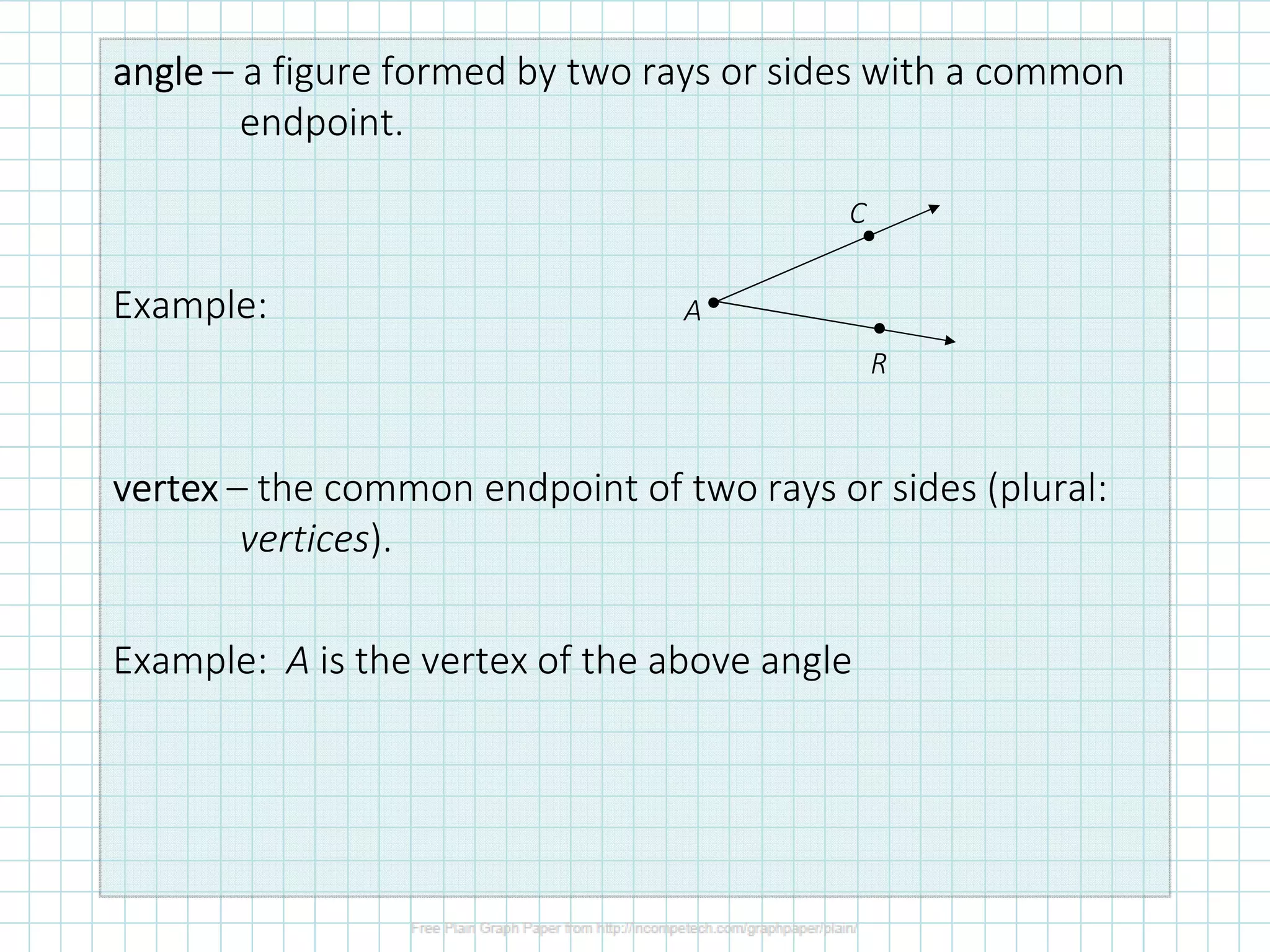
angleangleangleangle – a figure formed by two rays or sides with a common
endpoint.
Example:
vertexvertexvertexvertex – the common endpoint of two rays or sides (plural:
●
●
A
C
R
vertexvertexvertexvertex – the common endpoint of two rays or sides (plural:
vertices).
Example: A is the vertex of the above angle
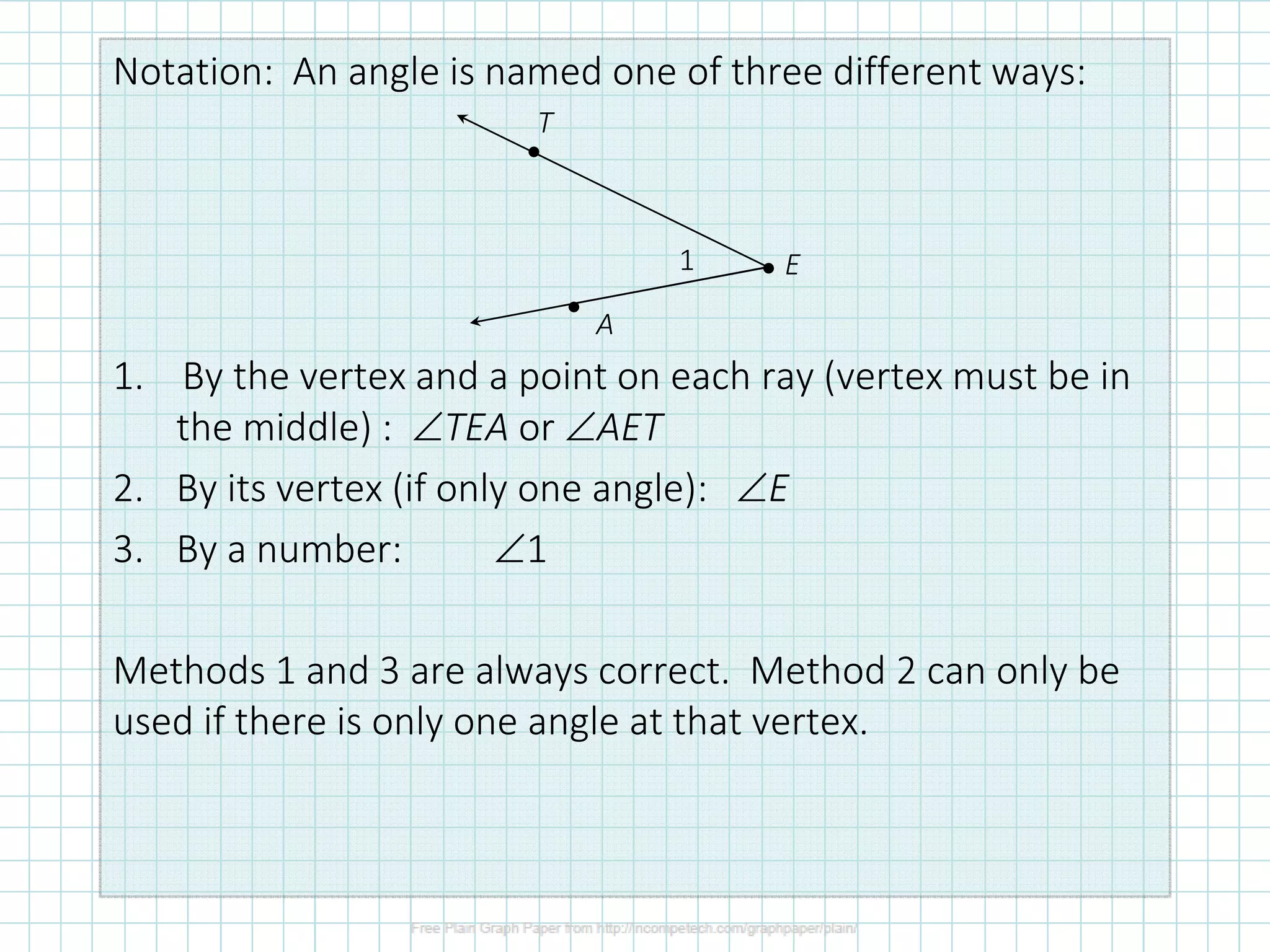
Notation: An angle is named one of three different ways:
1. By the vertex and a point on each ray (vertex must be in
the middle) : TEA or AET
2. By its vertex (if only one angle): E
●
●
● E
T
A
1
2. By its vertex (if only one angle): E
3. By a number: 1
Methods 1 and 3 are always correct. Method 2 can only be
used if there is only one angle at that vertex.
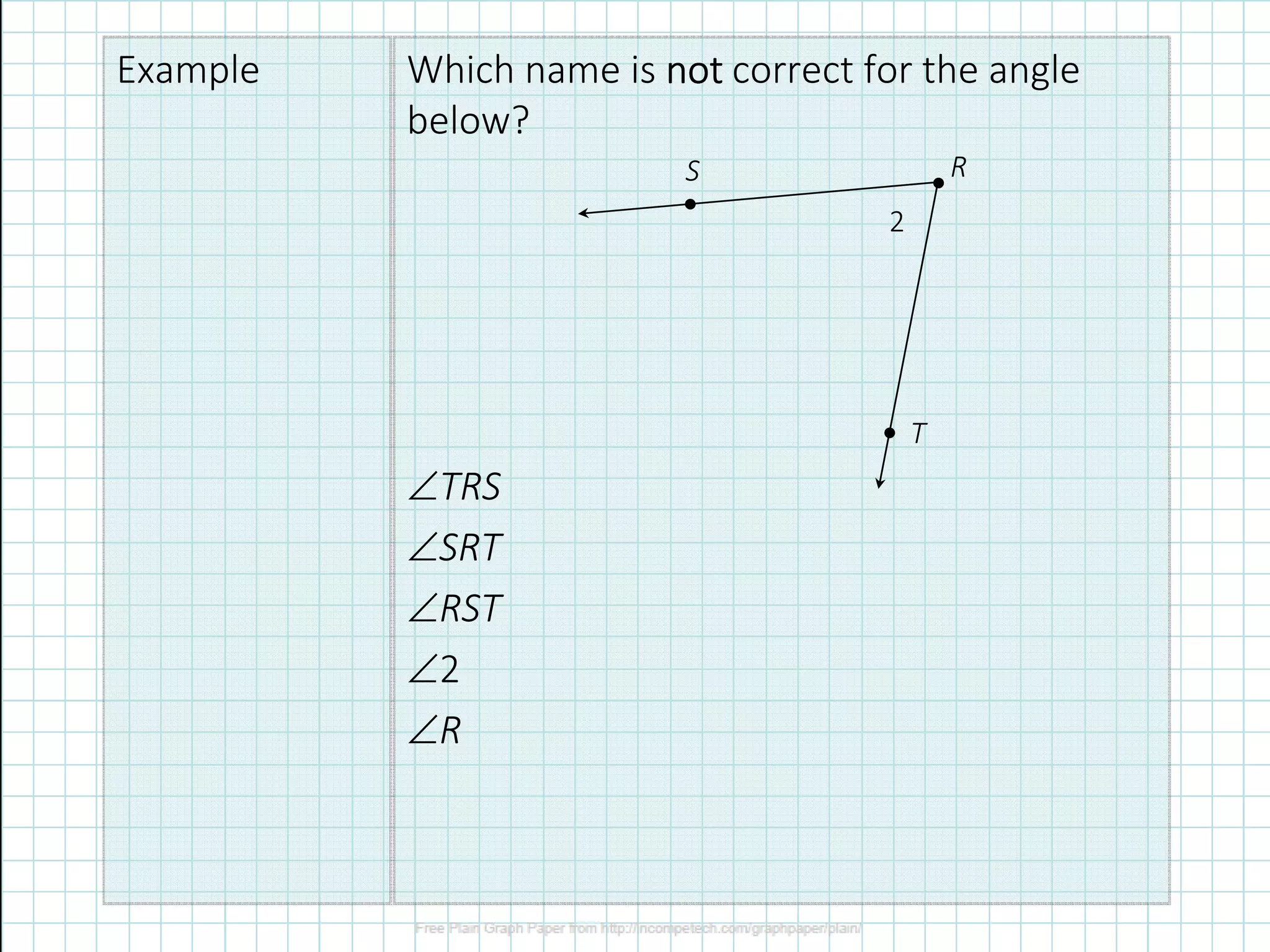
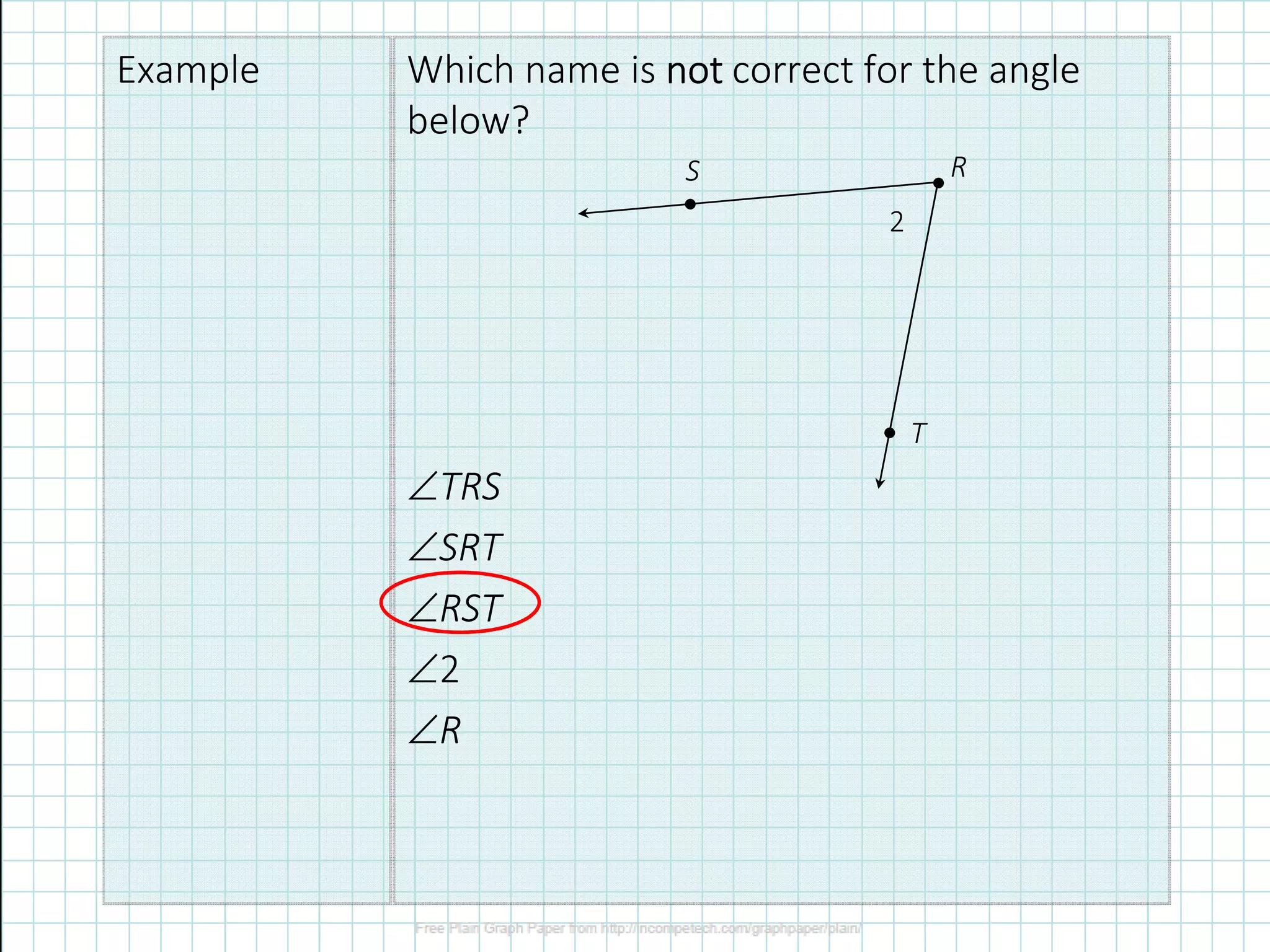
Example Which name is notnotnotnot correct for the angle
below?
TRS
●
●
●
S R
T
2
TRS
SRT
RST
2
R
Example Which name is notnotnotnot correct for the angle
below?
TRS
●
●
●
S R
T
2
TRS
SRT
RST
2
R
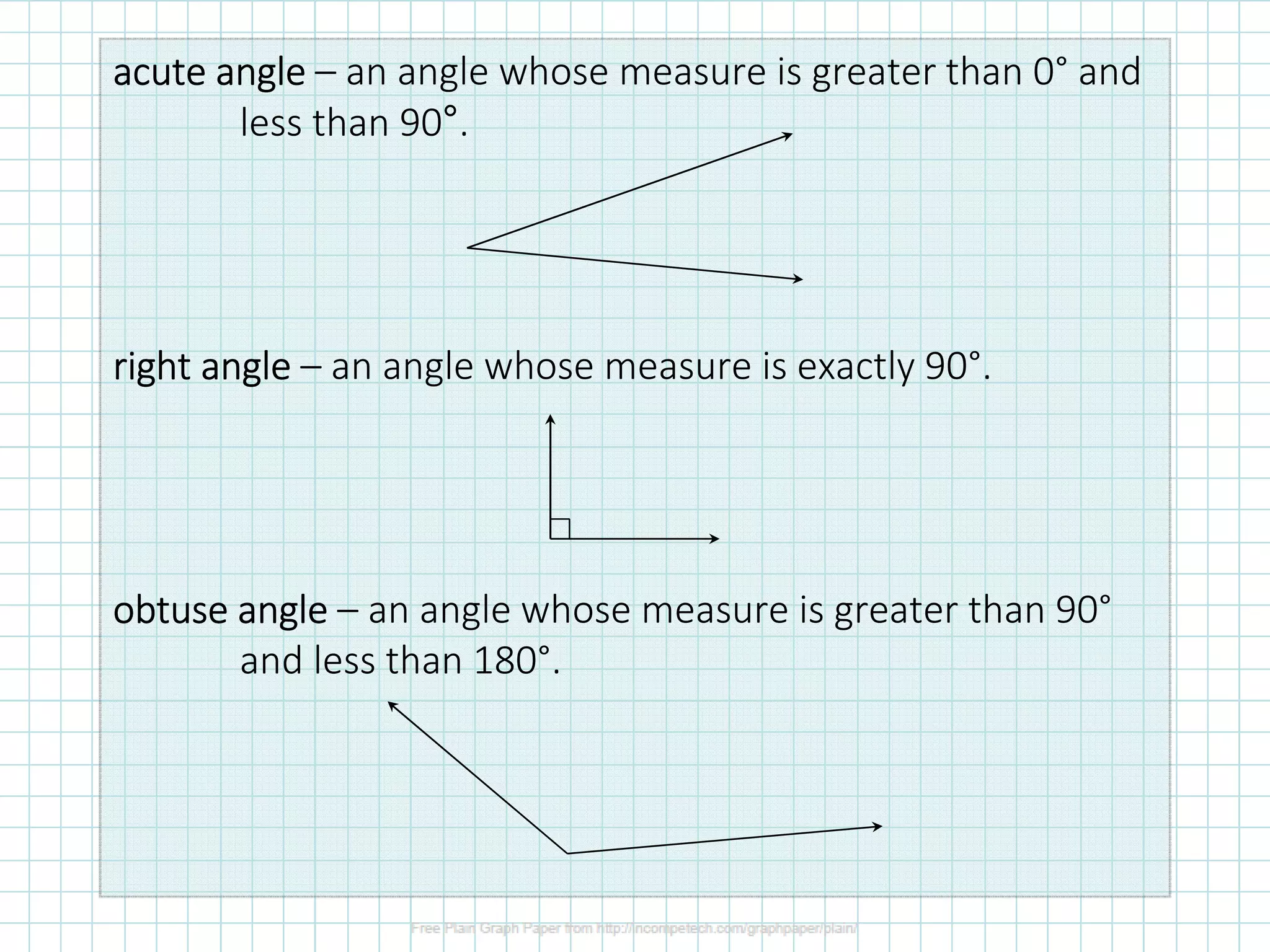
acuteacuteacuteacute angleangleangleangle – an angle whose measure is greater than 0° and
less than 90°.
rightrightrightright angleangleangleangle – an angle whose measure is exactly 90°.
obtuseobtuseobtuseobtuse angleangleangleangle – an angle whose measure is greater than 90°
and less than 180°.
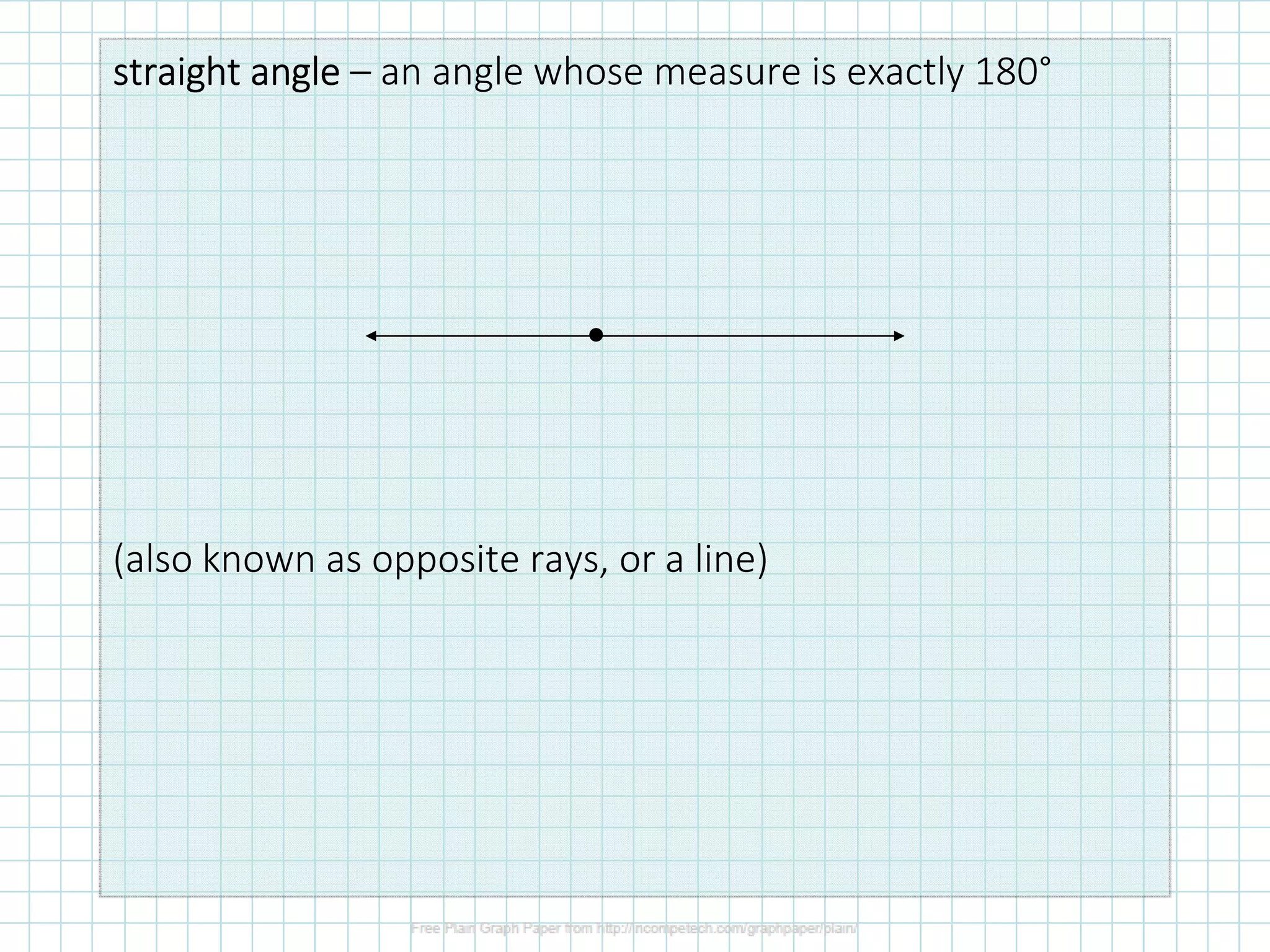
straightstraightstraightstraight angleangleangleangle – an angle whose measure is exactly 180°
●
(also known as opposite rays, or a line)
congruentcongruentcongruentcongruent anglesanglesanglesangles – angles that have the same measure.
mWIN = mLHS
WIN  LHS
●●
●
● ●
●
L
H
S
W
IN
mWIN is read “the
measure of angle WIN”
WIN  LHS
Notation: “Arc marks” indicate congruent angles.
Notation: To write the measure of an angle, put a lowercase
“m” in front of the angle bracket.
measure of angle WIN”
interior of aninterior of aninterior of aninterior of an angleangleangleangle – the set of all points between the sides
of an angle
Angle AdditionAngle AdditionAngle AdditionAngle Addition PostulatePostulatePostulatePostulate:
If D is in the interiorinteriorinteriorinterior of ABC, then
mABD + mDBC = mABC (part + part = whole)
Example: If mABD=50˚ and mABC=110˚, then
mDBC=60˚
●
●●
●
A
B
D
C
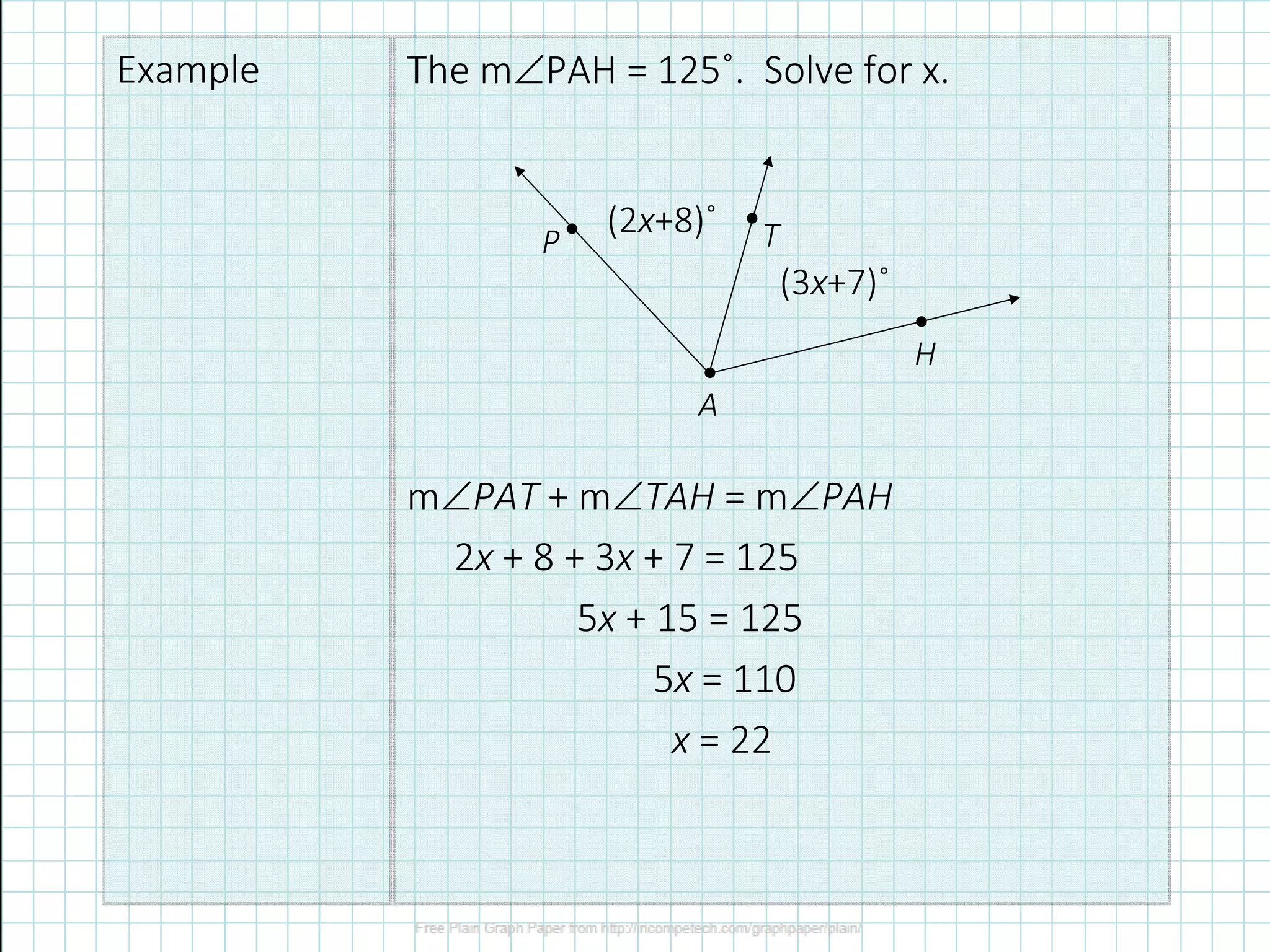
Example The mPAH = 125˚. Solve for x.
●
●●
●
P
A
T
H
(3x+7)˚
(2x+8)˚
Example The mPAH = 125˚. Solve for x.
mPAT + mTAH = mPAH
●
●●
●
P
A
T
H
(3x+7)˚
(2x+8)˚
mPAT + mTAH = mPAH
2x + 8 + 3x + 7 = 125
5x + 15 = 125
5x = 110
x = 22
angleangleangleangle bisectorbisectorbisectorbisector – a ray that divides an angle into two
congruent angles.
Example:
●
●●
●
S
U
N
Y
UY bisects SUN; thus SUY  YUN
or mSUY = mYUN
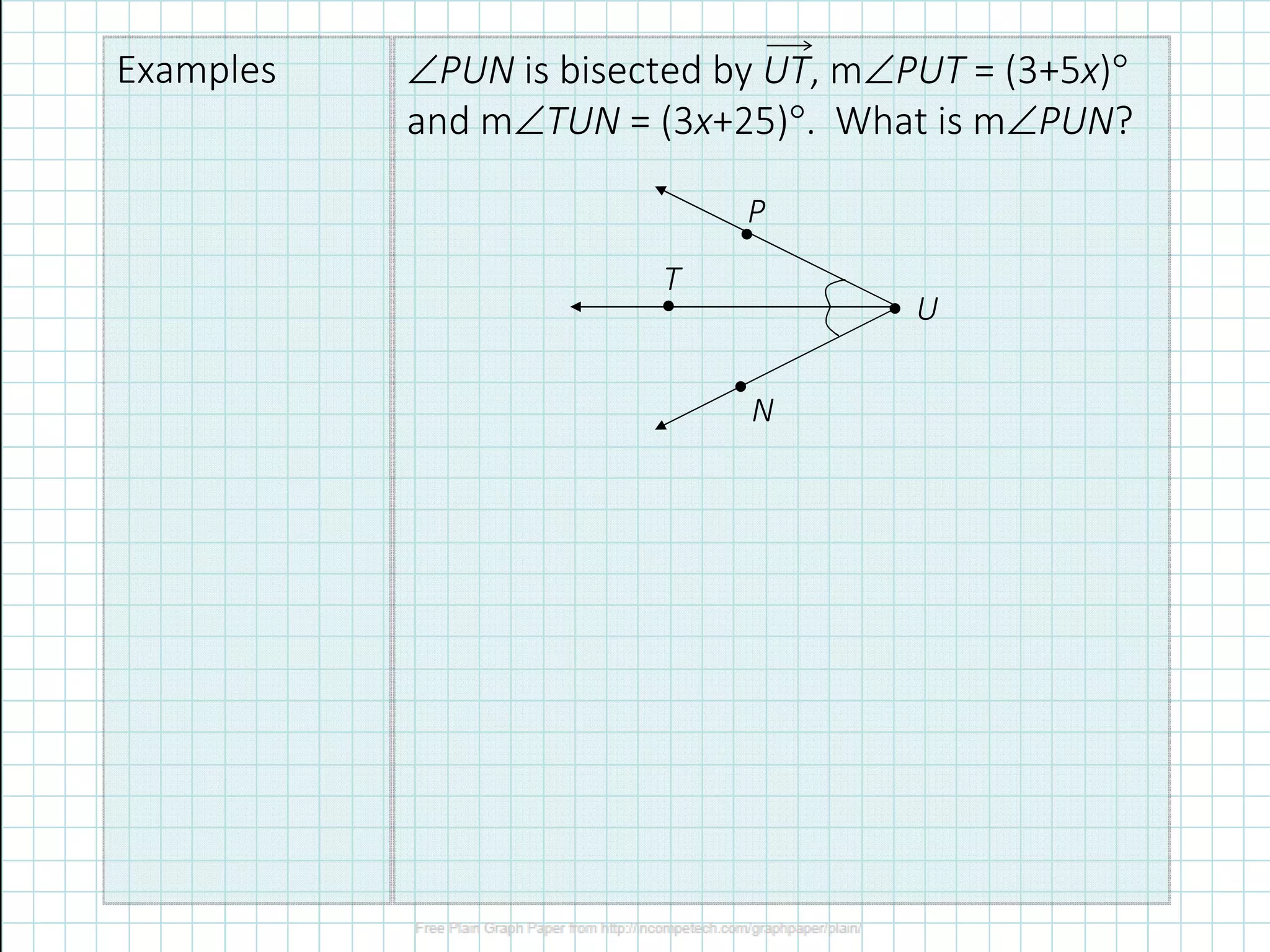
Examples PUN is bisected by UT, mPUT = (3+5x)
and mTUN = (3x+25). What is mPUN?
●
● ●
●
P
U
N
T
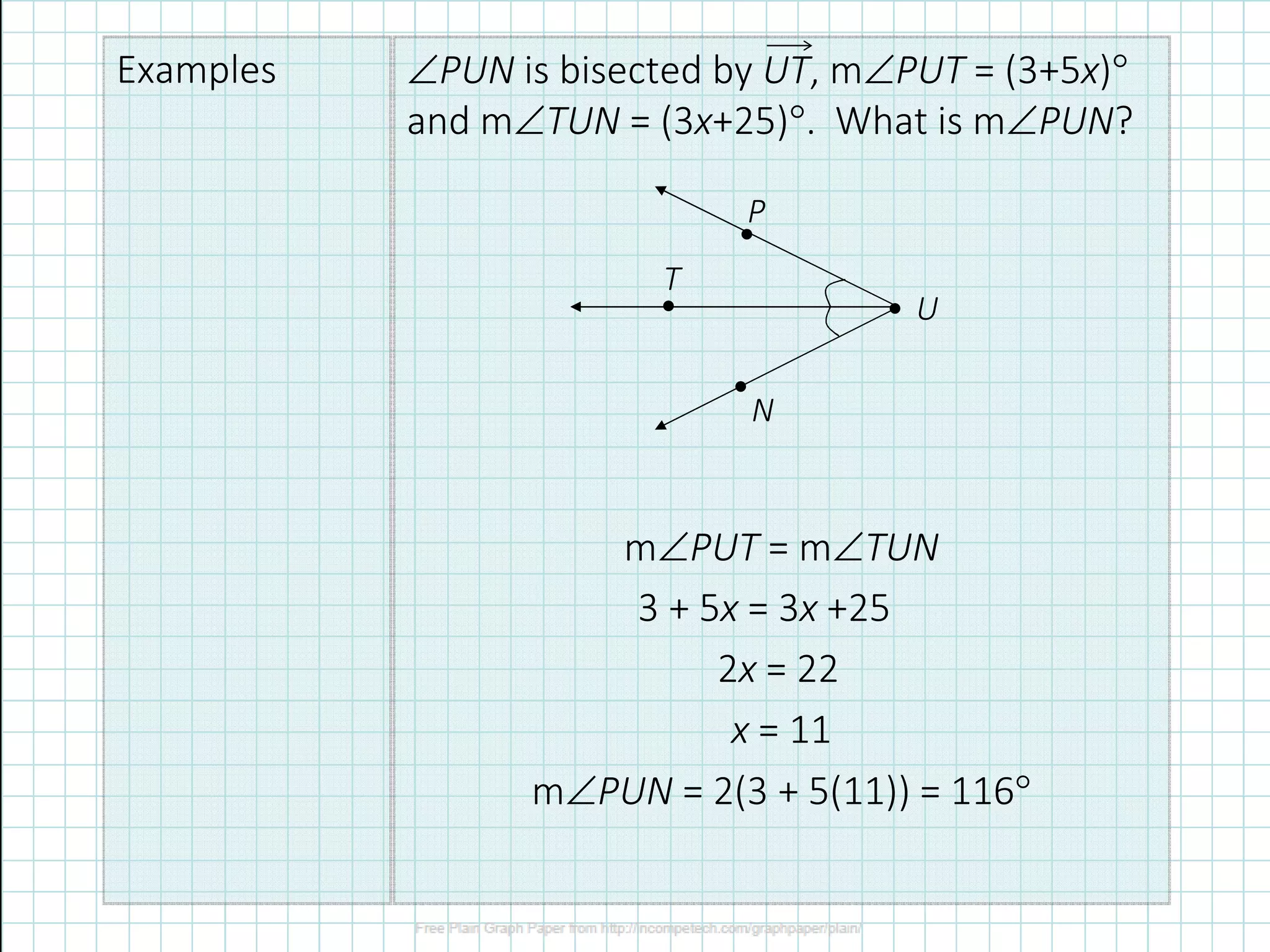
Examples PUN is bisected by UT, mPUT = (3+5x)
and mTUN = (3x+25). What is mPUN?
●
● ●
●
P
U
N
T
mPUT = mTUN
3 + 5x = 3x +25
2x = 22
x = 11
mPUN = 2(3 + 5(11)) = 116
Example Point R is in the interior of NFL. If
mNFR = (7x – 1) and mRFL = (3x+23),
what value of x would make FR an angle
bisector?
Example Point R is in the interior of NFL. If
mNFR = (7x – 1) and mRFL = (3x+23),
what value of x would make FR an angle
bisector?
If FR is going to be an angle bisector, then
mNFR = mRFLmNFR = mRFL
7x – 1 = 3x + 23
4x = 24
x = 6
Therefore, if x = 6, then FR is an angle
bisector.

2.4 Naming and Measuring Angles

  • 1.
    Naming and MeasuringAngles The student will be able to (I can): • Correctly name an angle • Classify angles as acute, right, or obtuse • Use the Angle Addition Postulate to solve problems• Use the Angle Addition Postulate to solve problems
  • 2.
    angleangleangleangle – afigure formed by two rays or sides with a common endpoint. Example: vertexvertexvertexvertex – the common endpoint of two rays or sides (plural: ● ● A C R vertexvertexvertexvertex – the common endpoint of two rays or sides (plural: vertices). Example: A is the vertex of the above angle
  • 3.
    Notation: An angleis named one of three different ways: 1. By the vertex and a point on each ray (vertex must be in the middle) : TEA or AET 2. By its vertex (if only one angle): E ● ● ● E T A 1 2. By its vertex (if only one angle): E 3. By a number: 1 Methods 1 and 3 are always correct. Method 2 can only be used if there is only one angle at that vertex.
  • 4.
    Example Which nameis notnotnotnot correct for the angle below? TRS ● ● ● S R T 2 TRS SRT RST 2 R
  • 5.
    Example Which nameis notnotnotnot correct for the angle below? TRS ● ● ● S R T 2 TRS SRT RST 2 R
  • 6.
    acuteacuteacuteacute angleangleangleangle –an angle whose measure is greater than 0° and less than 90°. rightrightrightright angleangleangleangle – an angle whose measure is exactly 90°. obtuseobtuseobtuseobtuse angleangleangleangle – an angle whose measure is greater than 90° and less than 180°.
  • 7.
    straightstraightstraightstraight angleangleangleangle –an angle whose measure is exactly 180° ● (also known as opposite rays, or a line)
  • 8.
    congruentcongruentcongruentcongruent anglesanglesanglesangles –angles that have the same measure. mWIN = mLHS WIN  LHS ●● ● ● ● ● L H S W IN mWIN is read “the measure of angle WIN” WIN  LHS Notation: “Arc marks” indicate congruent angles. Notation: To write the measure of an angle, put a lowercase “m” in front of the angle bracket. measure of angle WIN”
  • 9.
    interior of aninteriorof aninterior of aninterior of an angleangleangleangle – the set of all points between the sides of an angle Angle AdditionAngle AdditionAngle AdditionAngle Addition PostulatePostulatePostulatePostulate: If D is in the interiorinteriorinteriorinterior of ABC, then mABD + mDBC = mABC (part + part = whole) Example: If mABD=50˚ and mABC=110˚, then mDBC=60˚ ● ●● ● A B D C
  • 10.
    Example The mPAH= 125˚. Solve for x. ● ●● ● P A T H (3x+7)˚ (2x+8)˚
  • 11.
    Example The mPAH= 125˚. Solve for x. mPAT + mTAH = mPAH ● ●● ● P A T H (3x+7)˚ (2x+8)˚ mPAT + mTAH = mPAH 2x + 8 + 3x + 7 = 125 5x + 15 = 125 5x = 110 x = 22
  • 12.
    angleangleangleangle bisectorbisectorbisectorbisector –a ray that divides an angle into two congruent angles. Example: ● ●● ● S U N Y UY bisects SUN; thus SUY  YUN or mSUY = mYUN
  • 13.
    Examples PUN isbisected by UT, mPUT = (3+5x) and mTUN = (3x+25). What is mPUN? ● ● ● ● P U N T
  • 14.
    Examples PUN isbisected by UT, mPUT = (3+5x) and mTUN = (3x+25). What is mPUN? ● ● ● ● P U N T mPUT = mTUN 3 + 5x = 3x +25 2x = 22 x = 11 mPUN = 2(3 + 5(11)) = 116
  • 15.
    Example Point Ris in the interior of NFL. If mNFR = (7x – 1) and mRFL = (3x+23), what value of x would make FR an angle bisector?
  • 16.
    Example Point Ris in the interior of NFL. If mNFR = (7x – 1) and mRFL = (3x+23), what value of x would make FR an angle bisector? If FR is going to be an angle bisector, then mNFR = mRFLmNFR = mRFL 7x – 1 = 3x + 23 4x = 24 x = 6 Therefore, if x = 6, then FR is an angle bisector.