1
2
Week 1 Day 1
Illustrate and define
different angles
(right, acute, and
obtuse) using
models.
New Lesson
Daily Routine
1. Prayer
2. Greetings
3. Classroom Agreement
4. Checking of Attendance
Ask: what have you
learned about the
song?
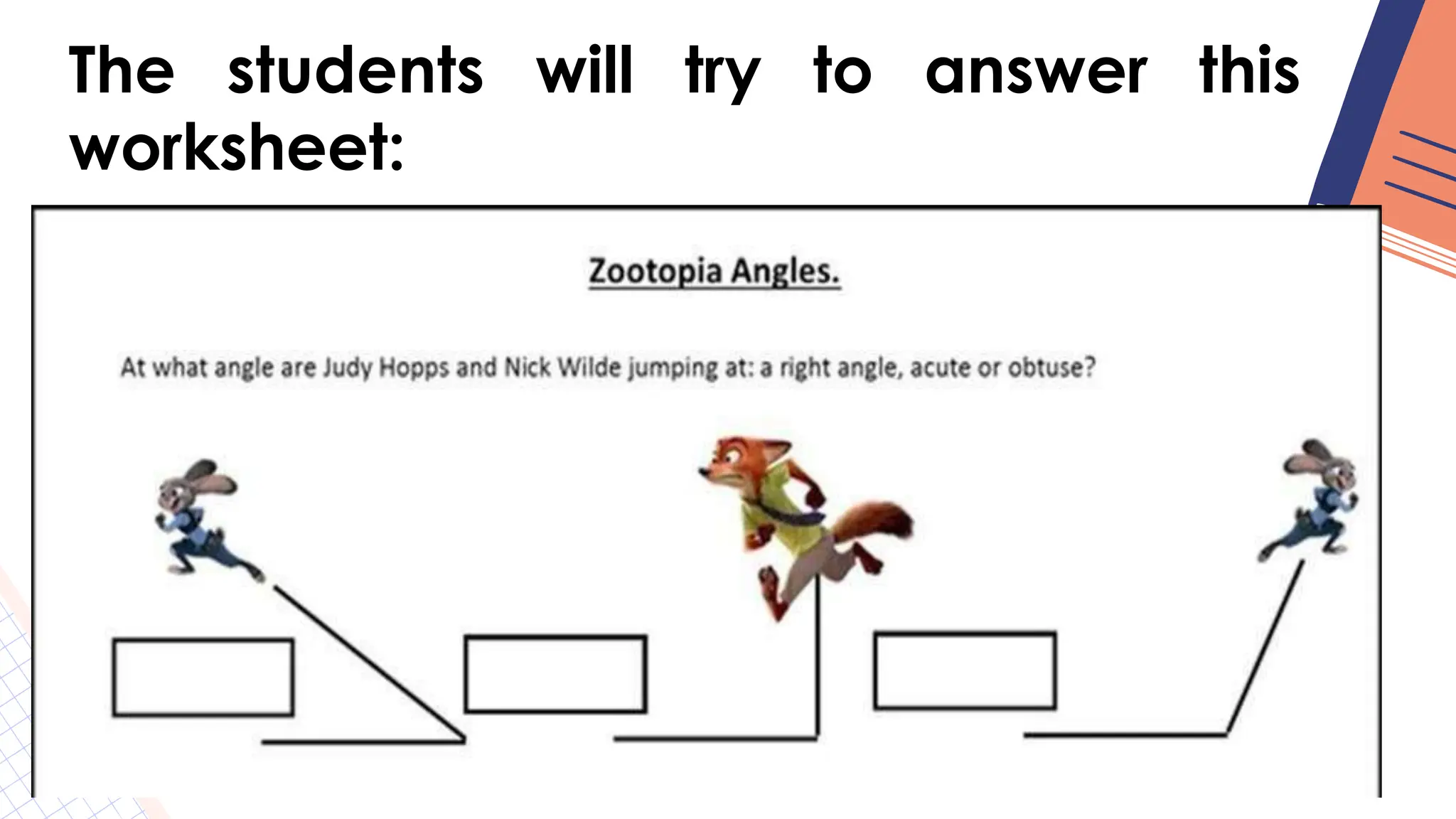
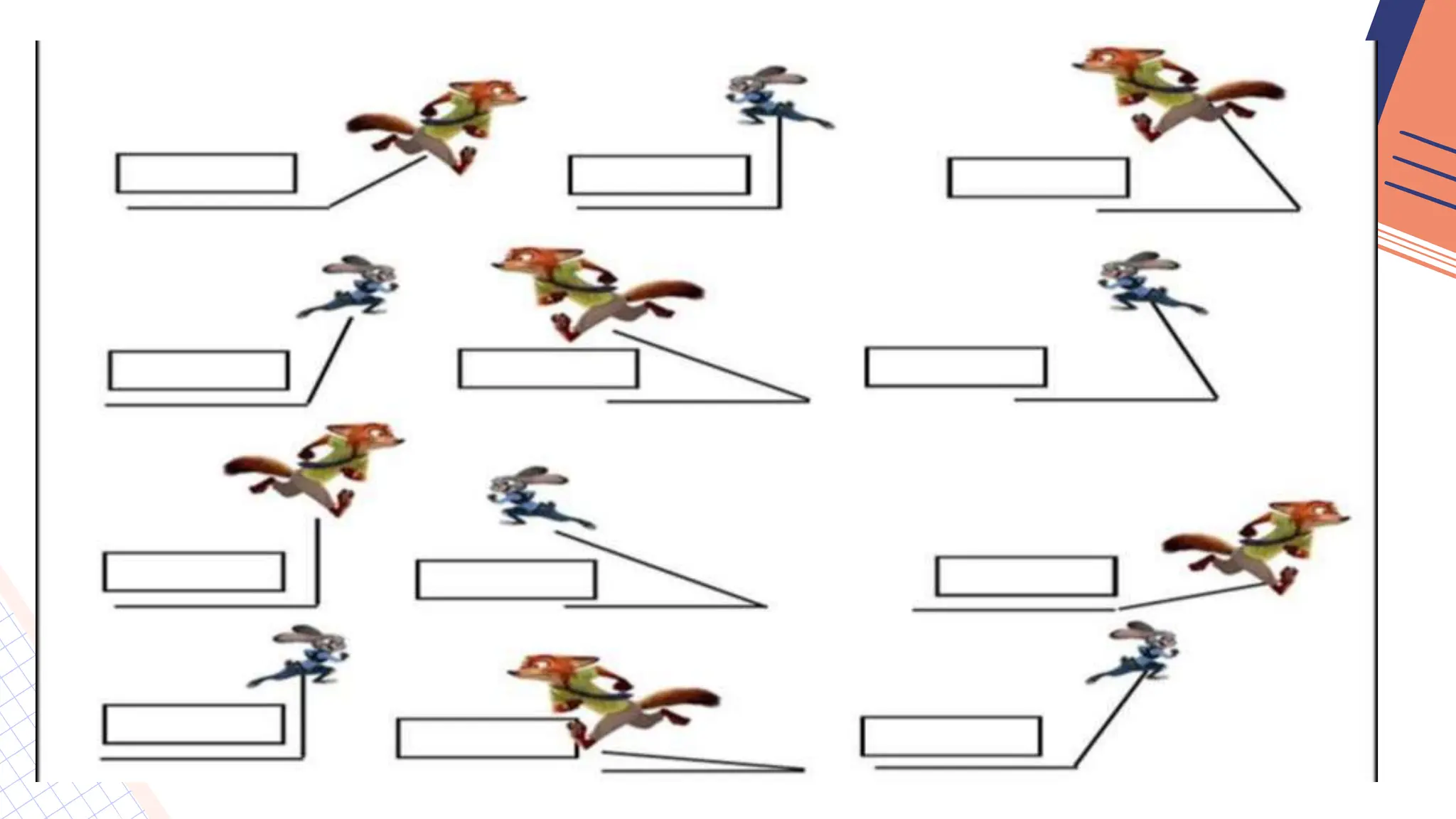
The students will try to answer this
worksheet:
This morning we
are going to learn
about angle
What is angle?
An angle is a
geometrical figure
formed when two rays
meet at a common
point called vertex.
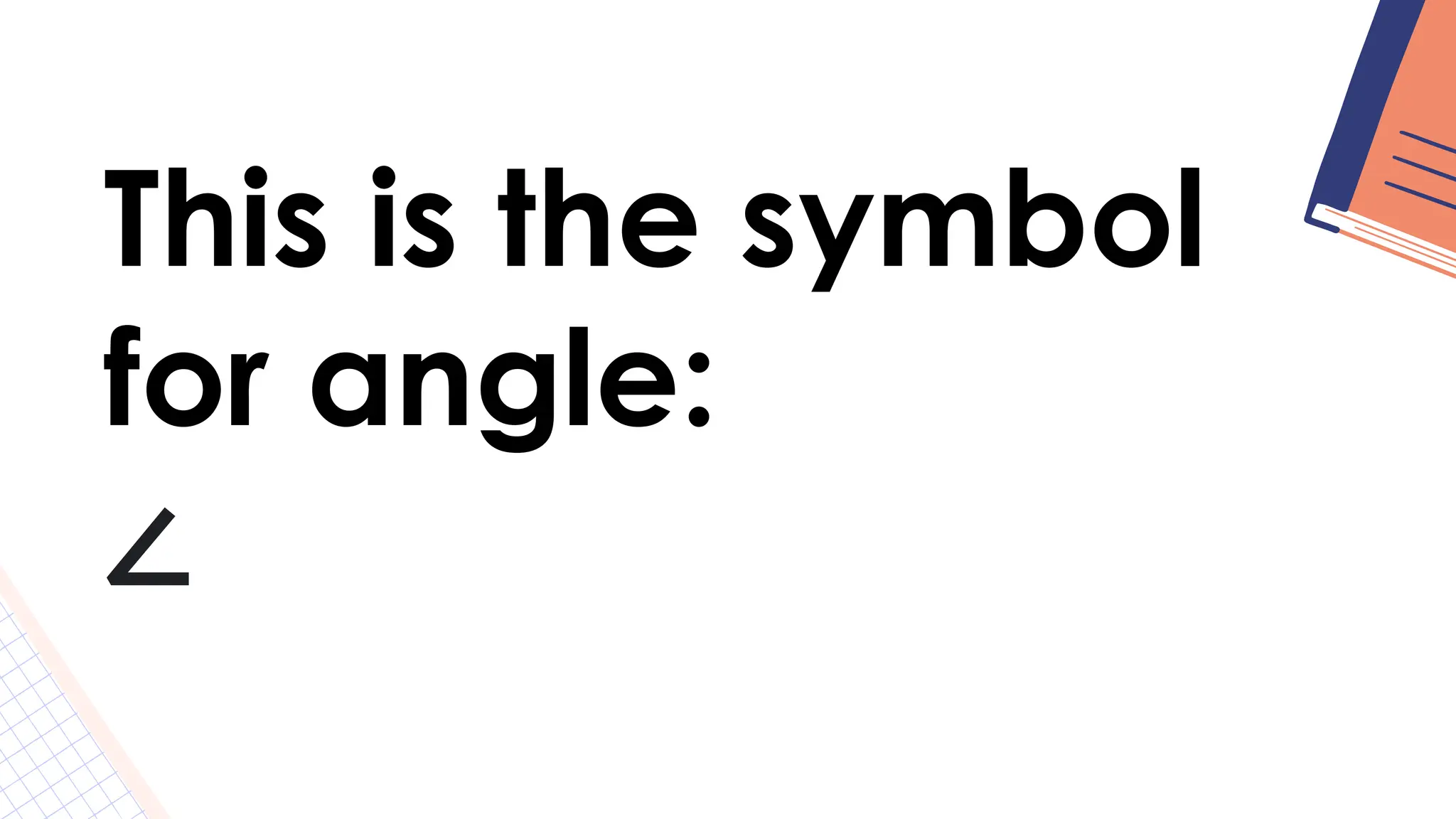
This is the symbol
for angle:
∠
There are 3 types of angle
Let’s take a look at the clocks
showing the respective times
Lola Remy, Lola Inday and Lola
Nancy take their vitamins.
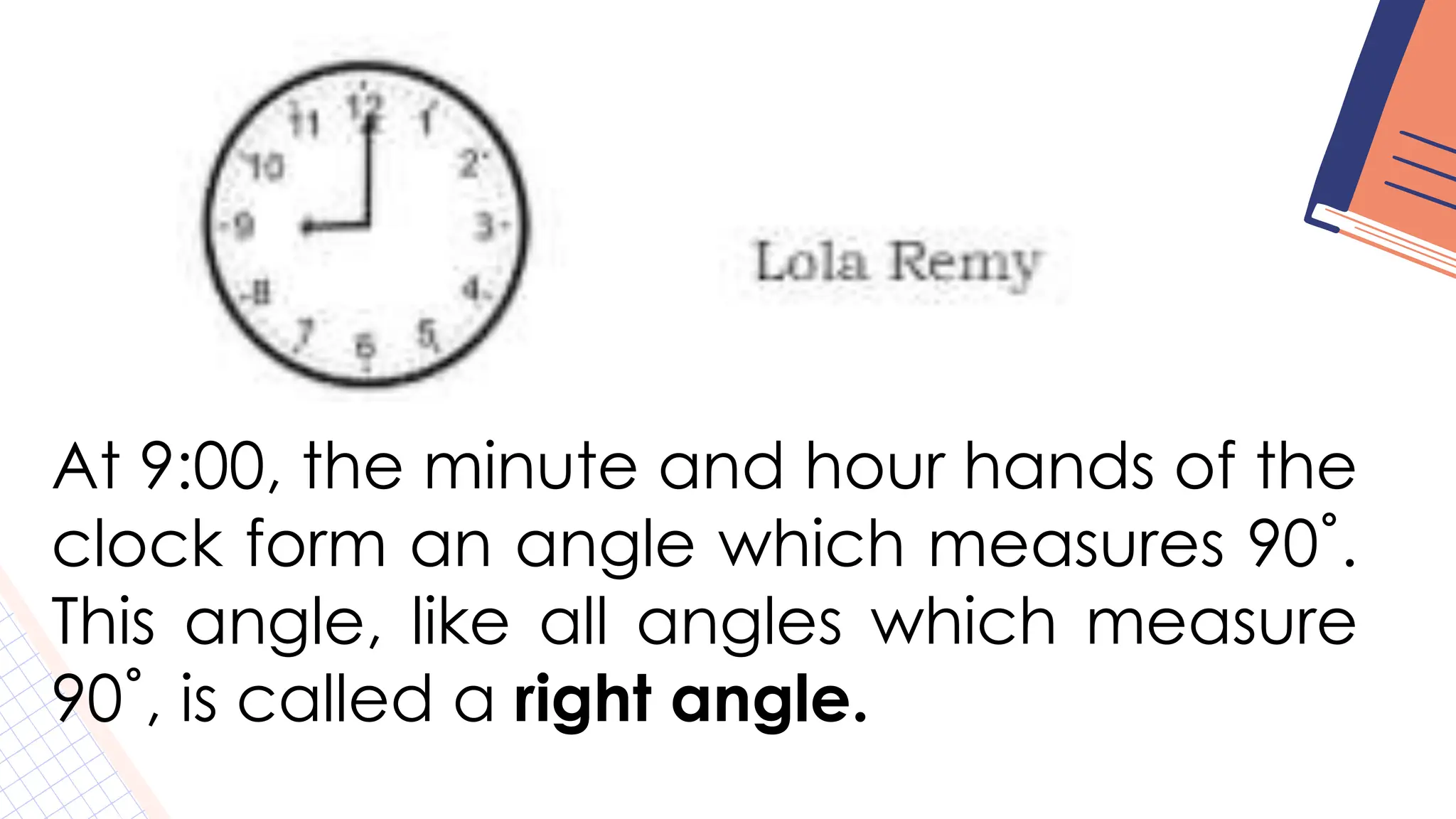
At 9:00, the minute and hour hands of the
clock form an angle which measures 90˚.
This angle, like all angles which measure
90˚, is called a right angle.
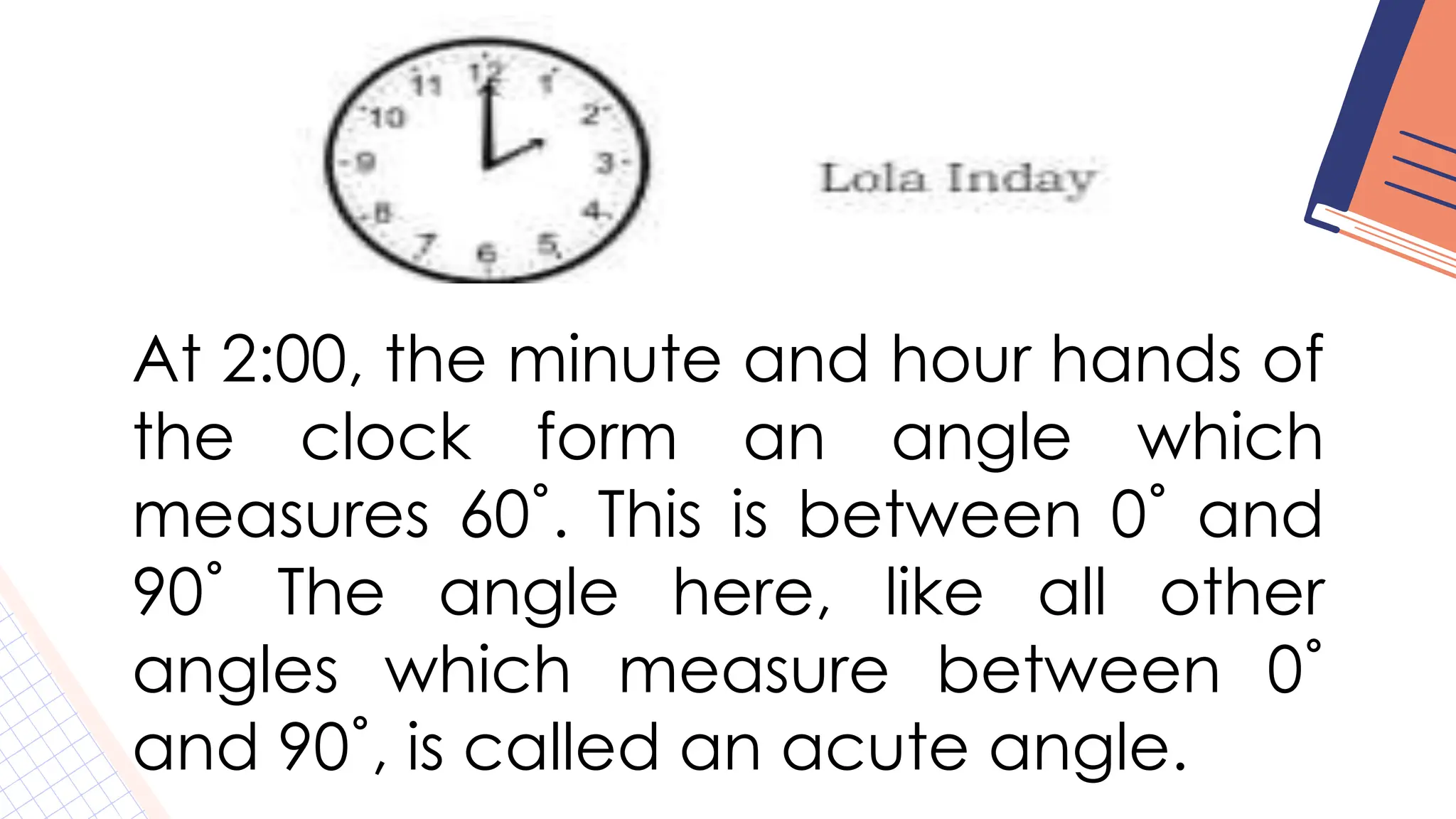
At 2:00, the minute and hour hands of
the clock form an angle which
measures 60˚. This is between 0˚ and
90˚ The angle here, like all other
angles which measure between 0˚
and 90˚, is called an acute angle.
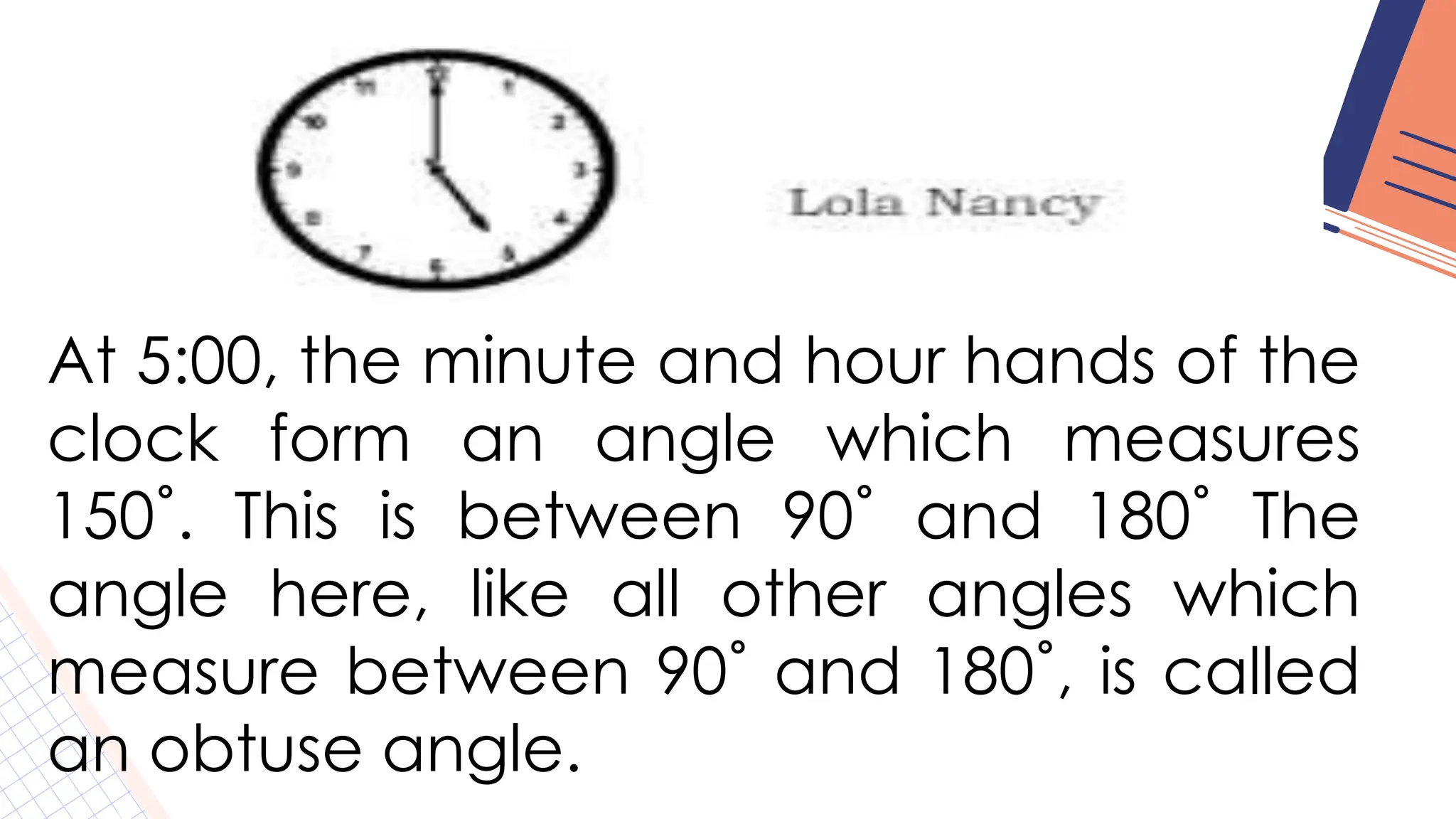
At 5:00, the minute and hour hands of the
clock form an angle which measures
150˚. This is between 90˚ and 180˚ The
angle here, like all other angles which
measure between 90˚ and 180˚, is called
an obtuse angle.
An angle is formed by
two rays with a
common endpoint.
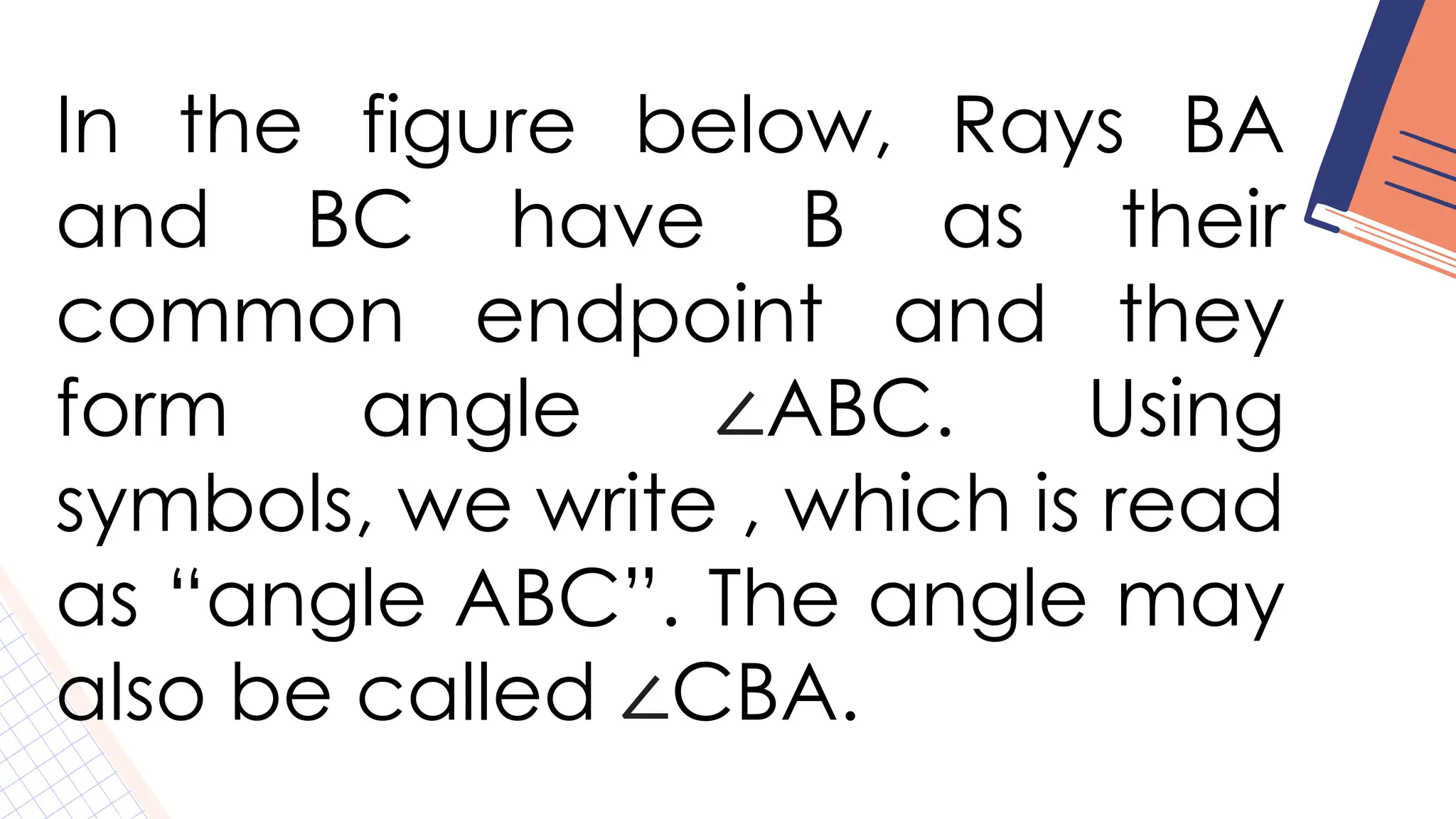
In the figure below, Rays BA
and BC have B as their
common endpoint and they
form angle ∠ABC. Using
symbols, we write , which is read
as “angle ABC”. The angle may
also be called ∠CBA.
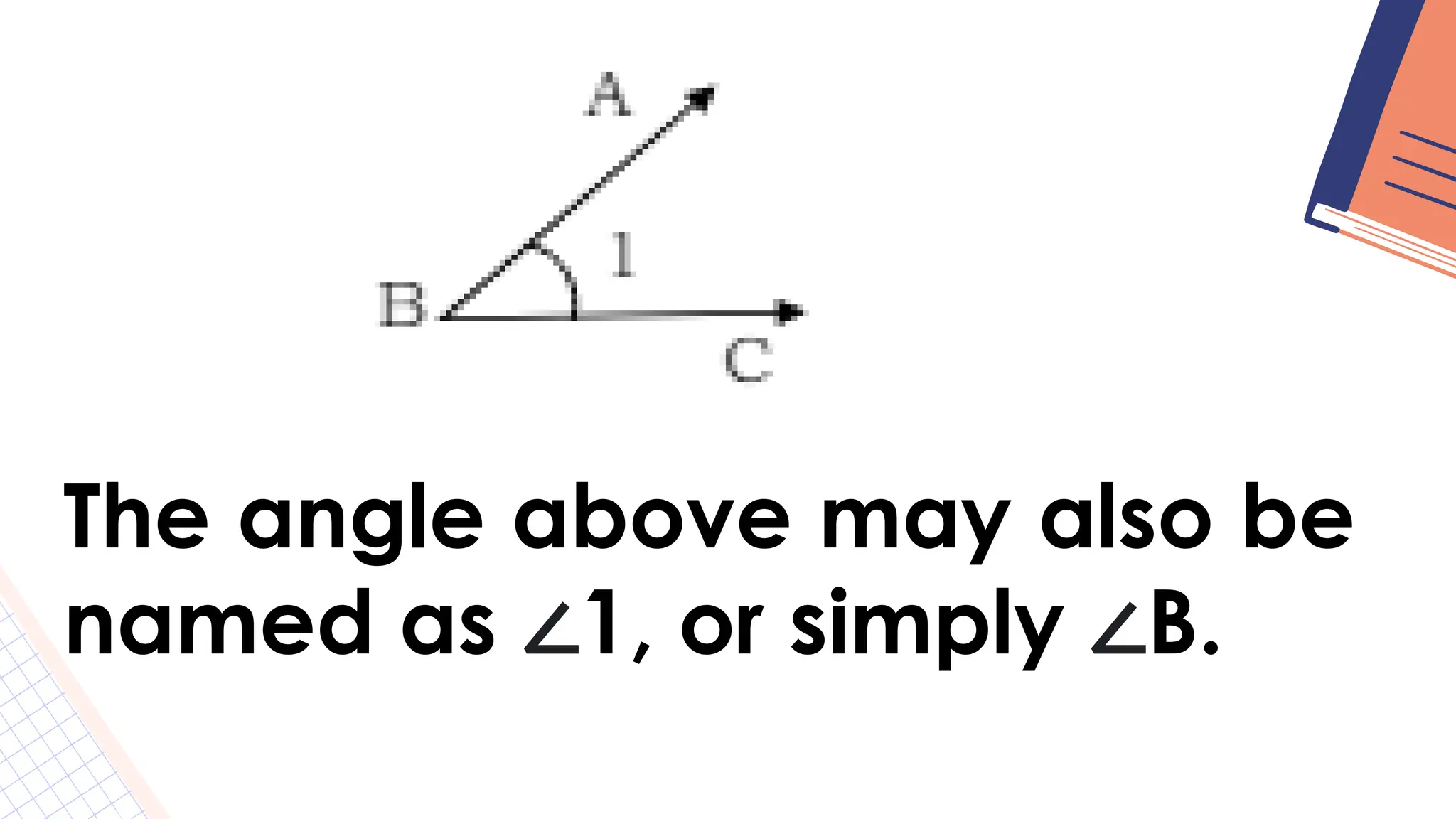
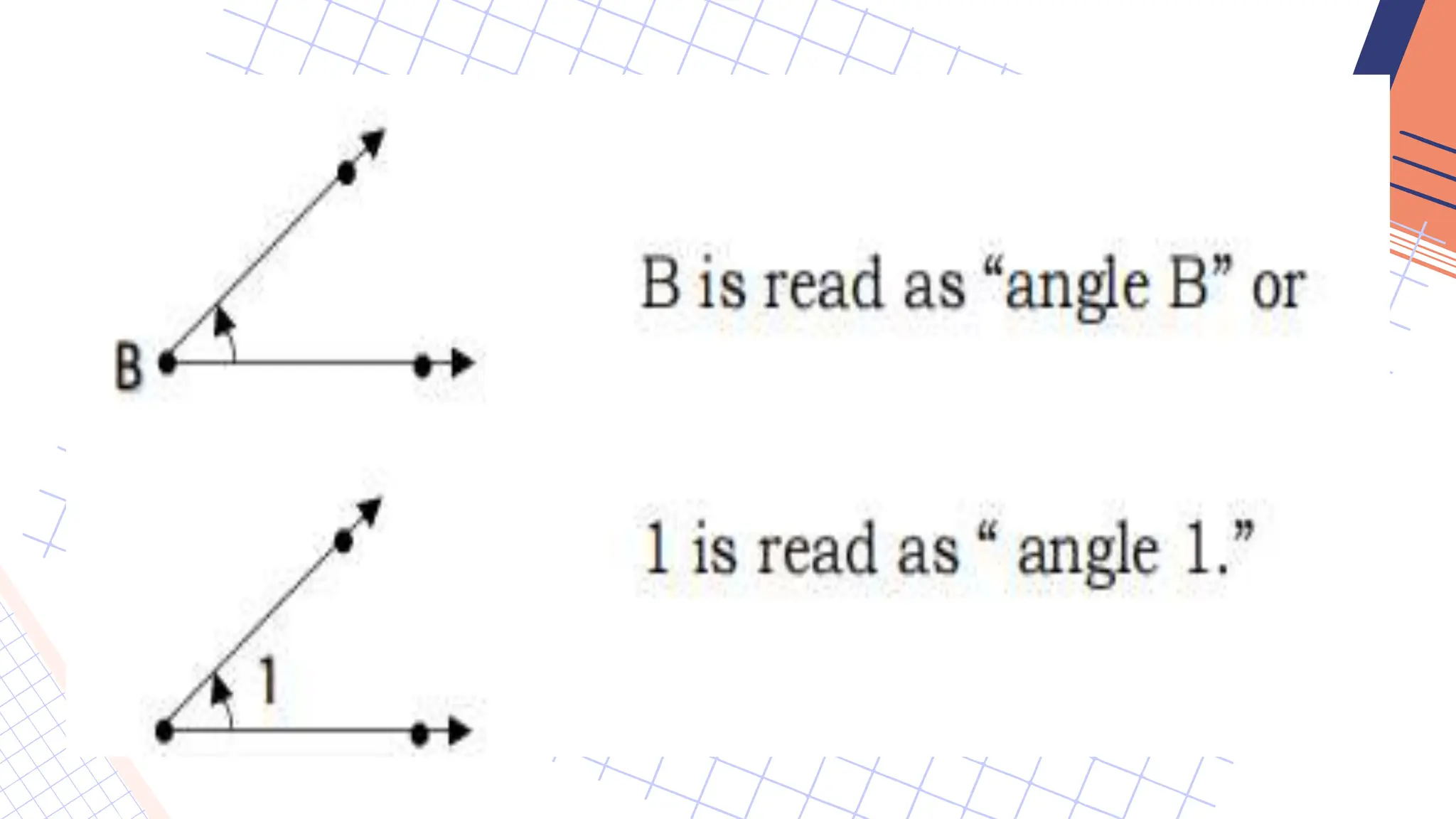
The angle above may also be
named as ∠1, or simply ∠B.
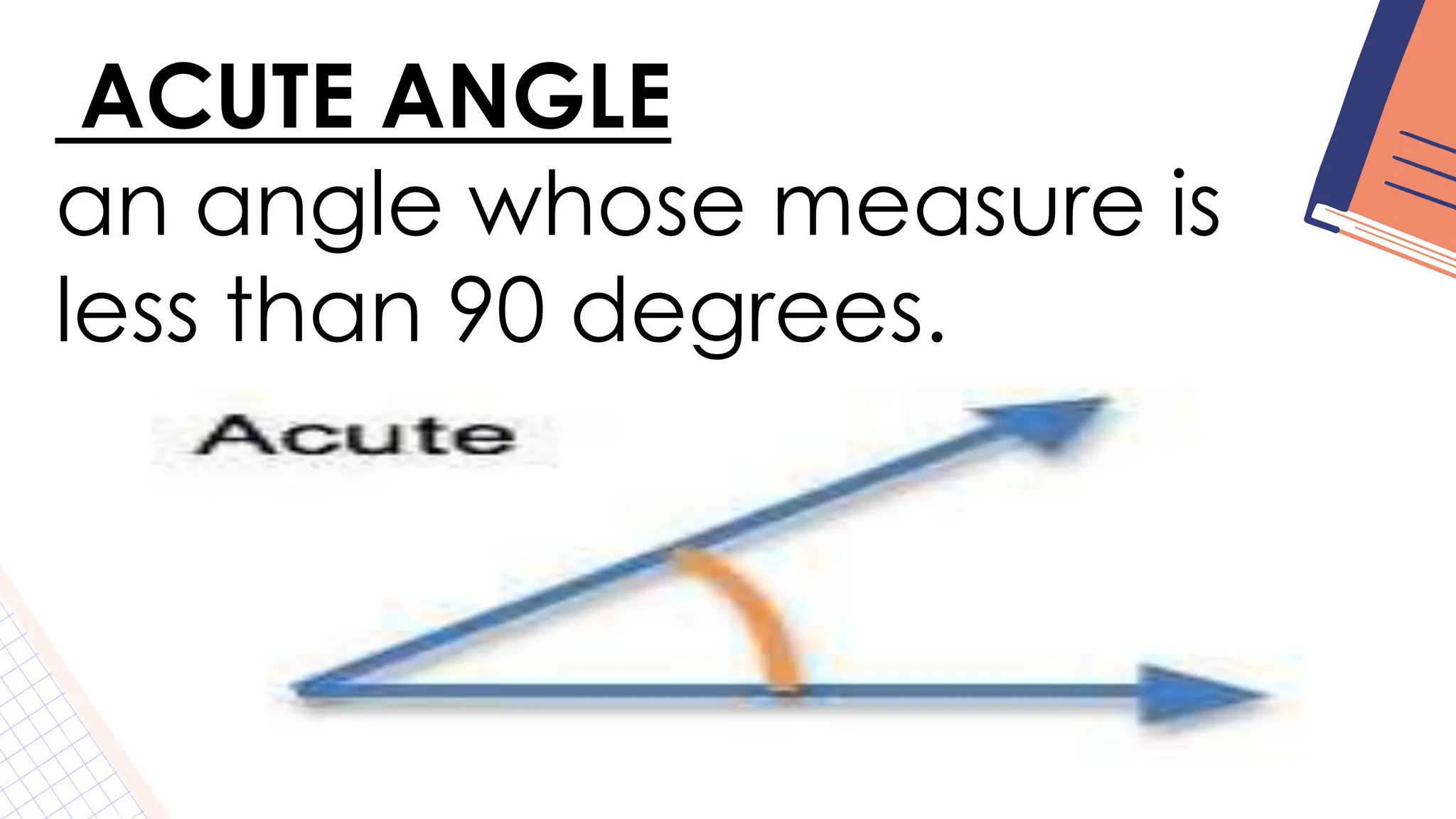
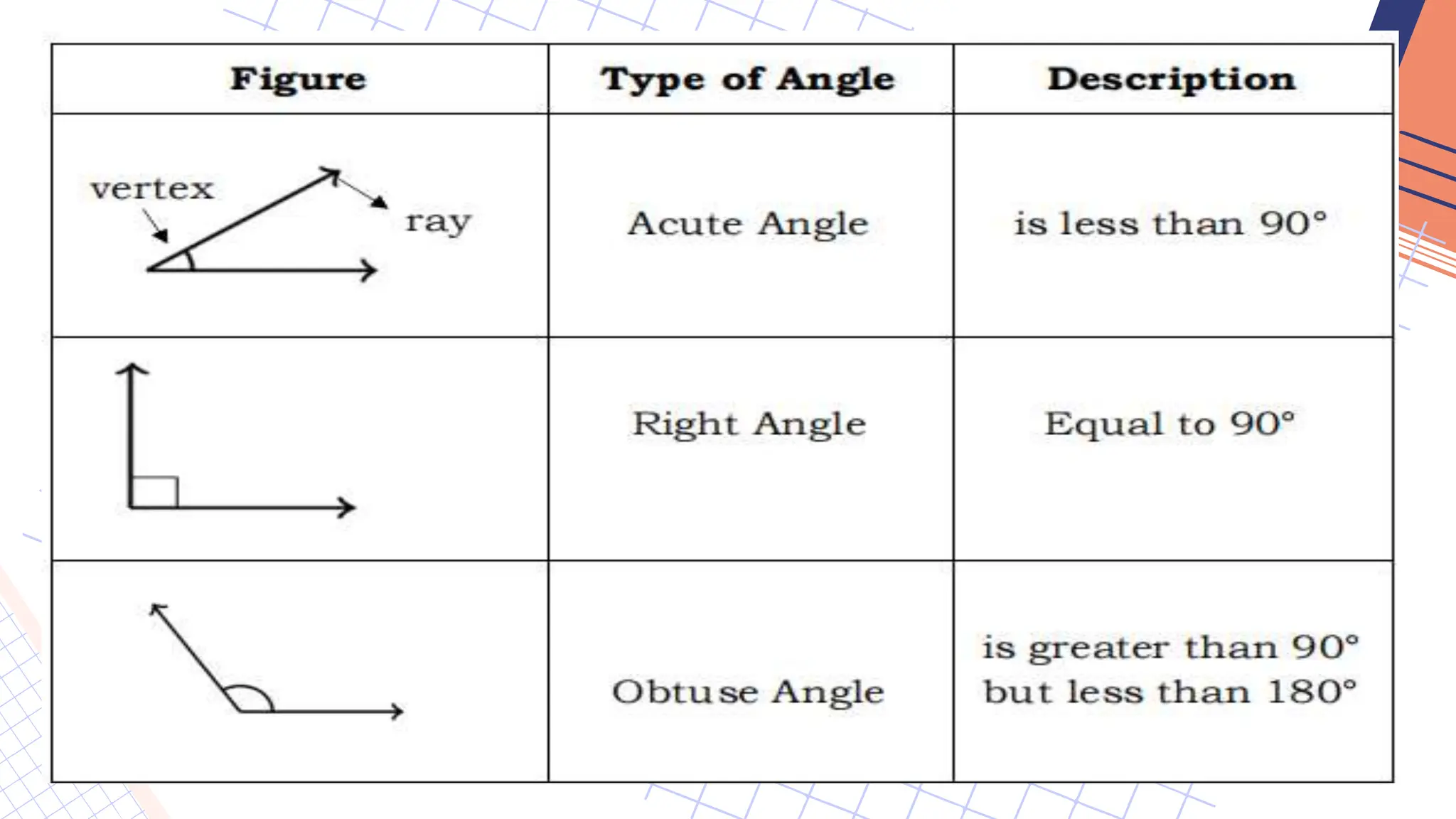
ACUTE ANGLE
an angle whose measure is
less than 90 degrees.
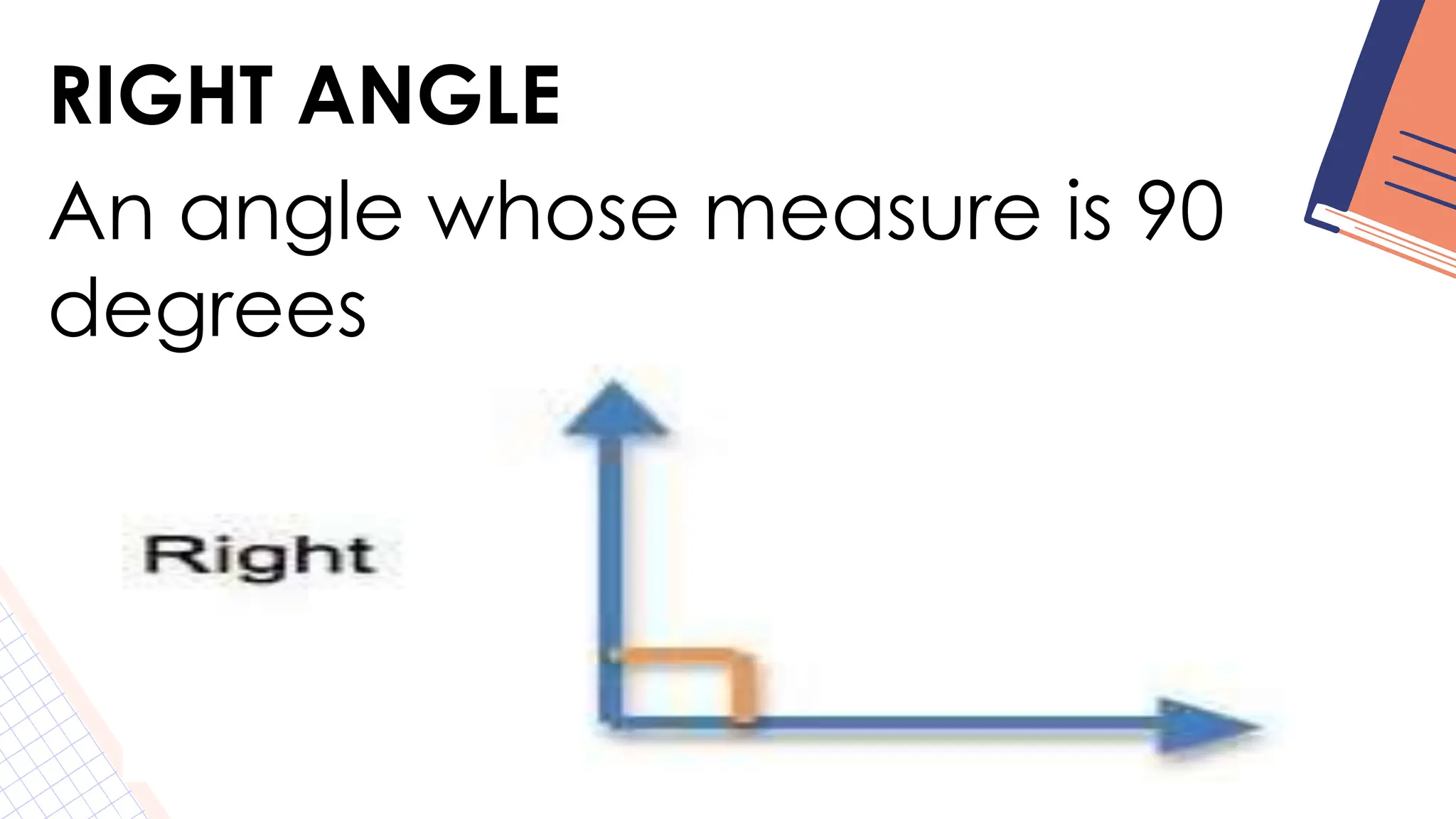
RIGHT ANGLE
An angle whose measure is 90
degrees
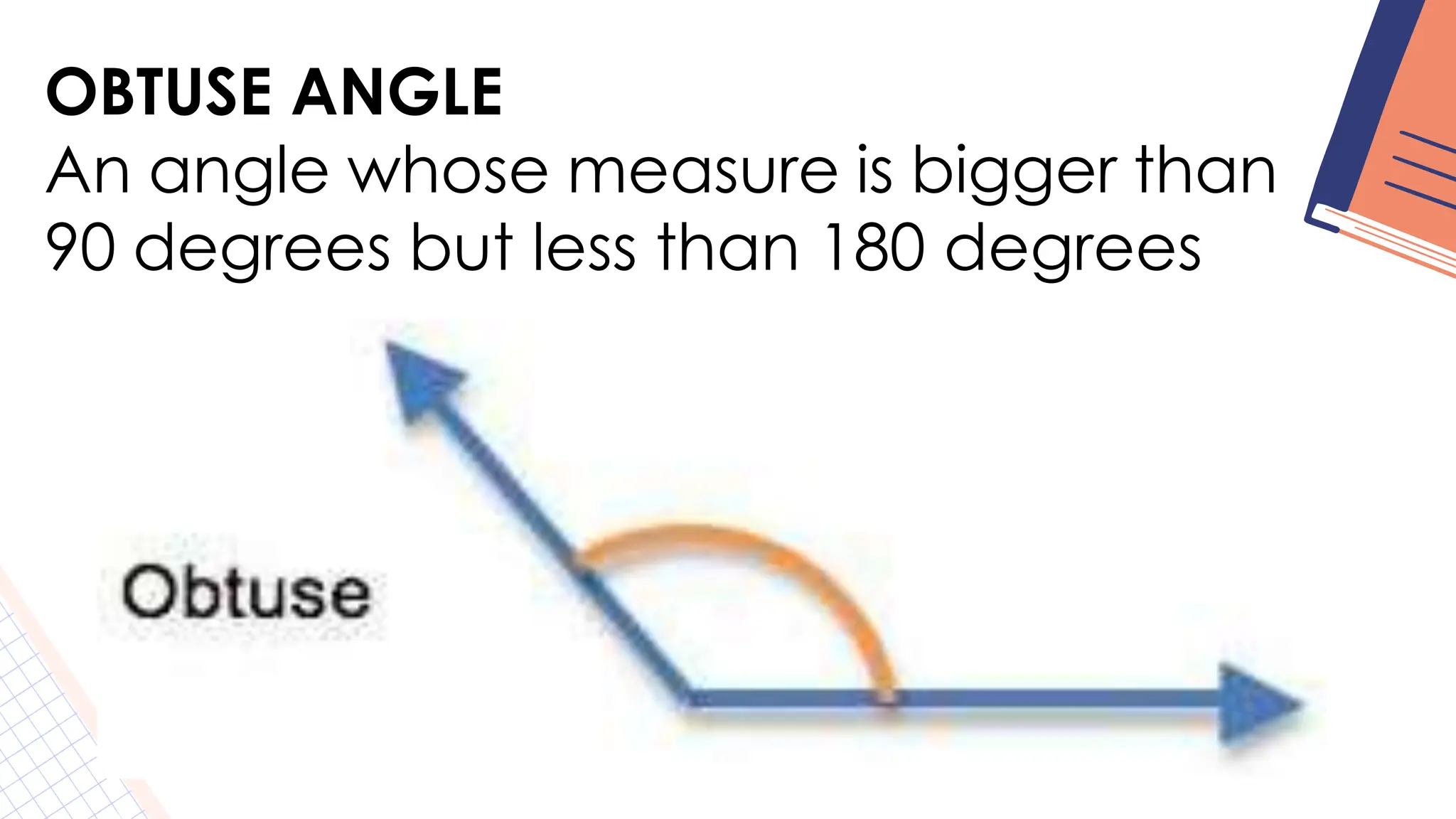
OBTUSE ANGLE
An angle whose measure is bigger than
90 degrees but less than 180 degrees
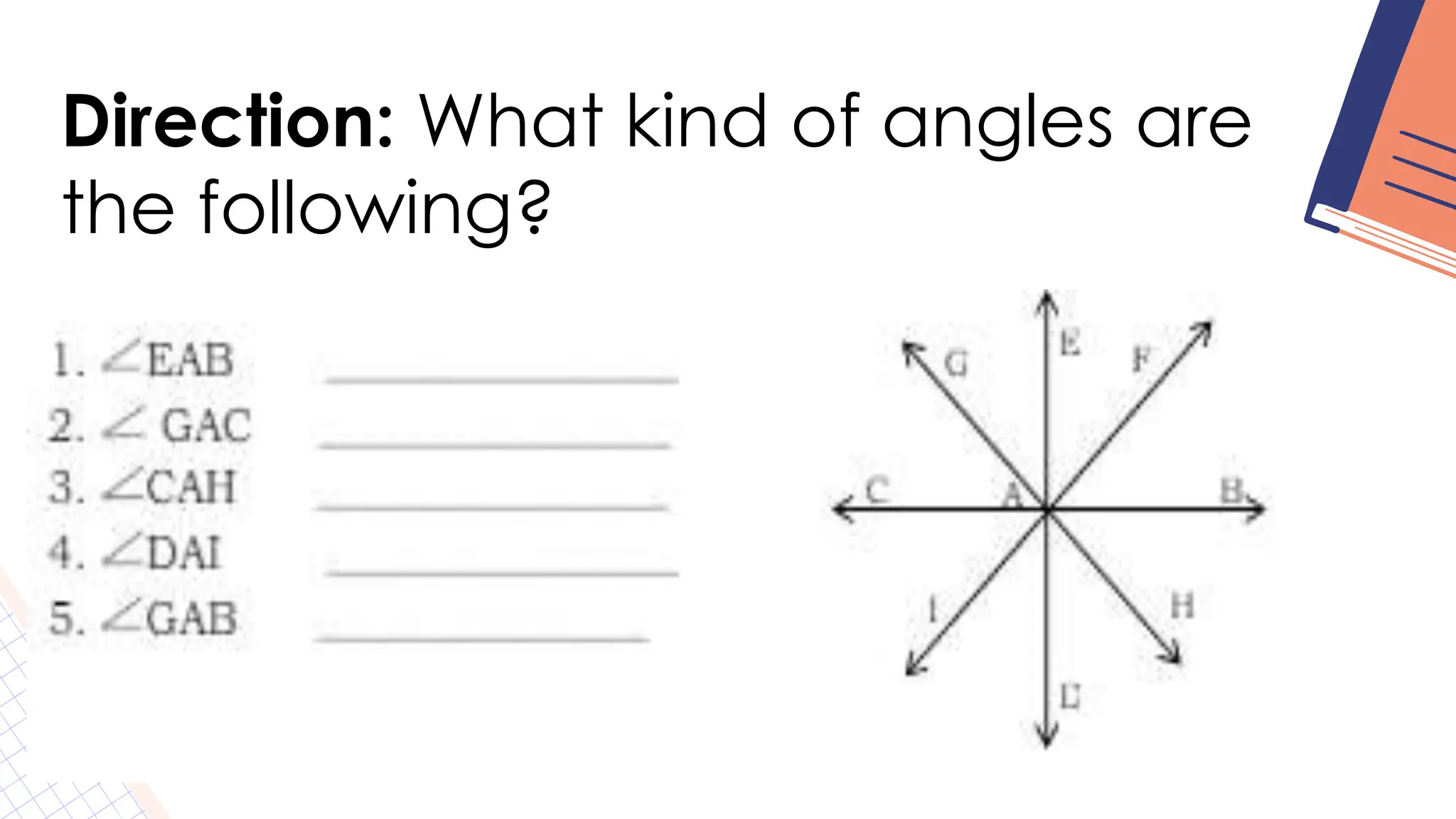
Direction: What kind of angles are
the following?
Ask the pupils
What angles measure less than
90 °?
What angles measure exactly
90°?
What angles measure more than
90 ° but less than 180°?
Directions: Answer the
following questions. Write the
letter of the correct answer
on a sheet of paper.
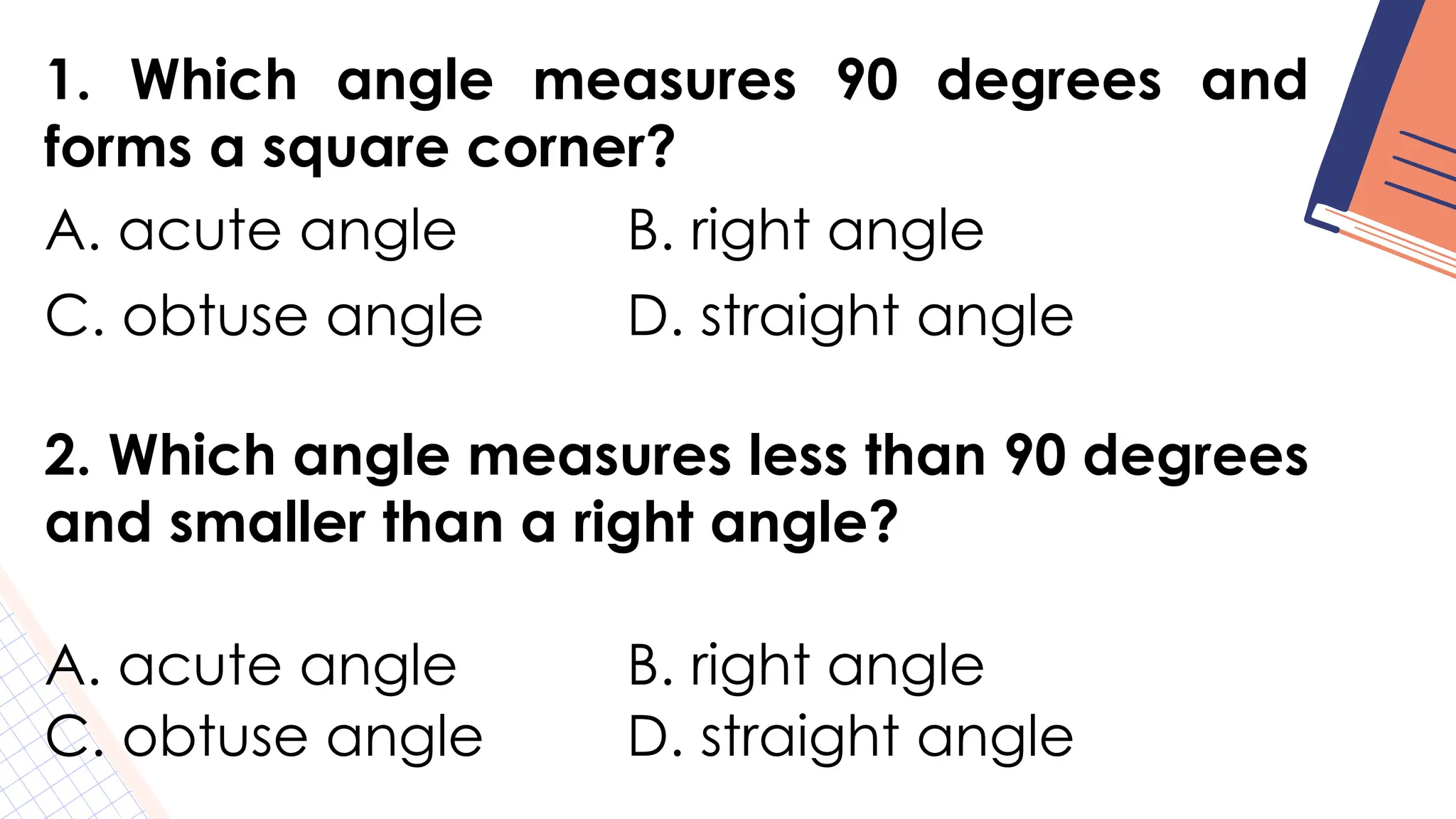
1. Which angle measures 90 degrees and
forms a square corner?
A. acute angle B. right angle
C. obtuse angle D. straight angle
2. Which angle measures less than 90 degrees
and smaller than a right angle?
A. acute angle B. right angle
C. obtuse angle D. straight angle
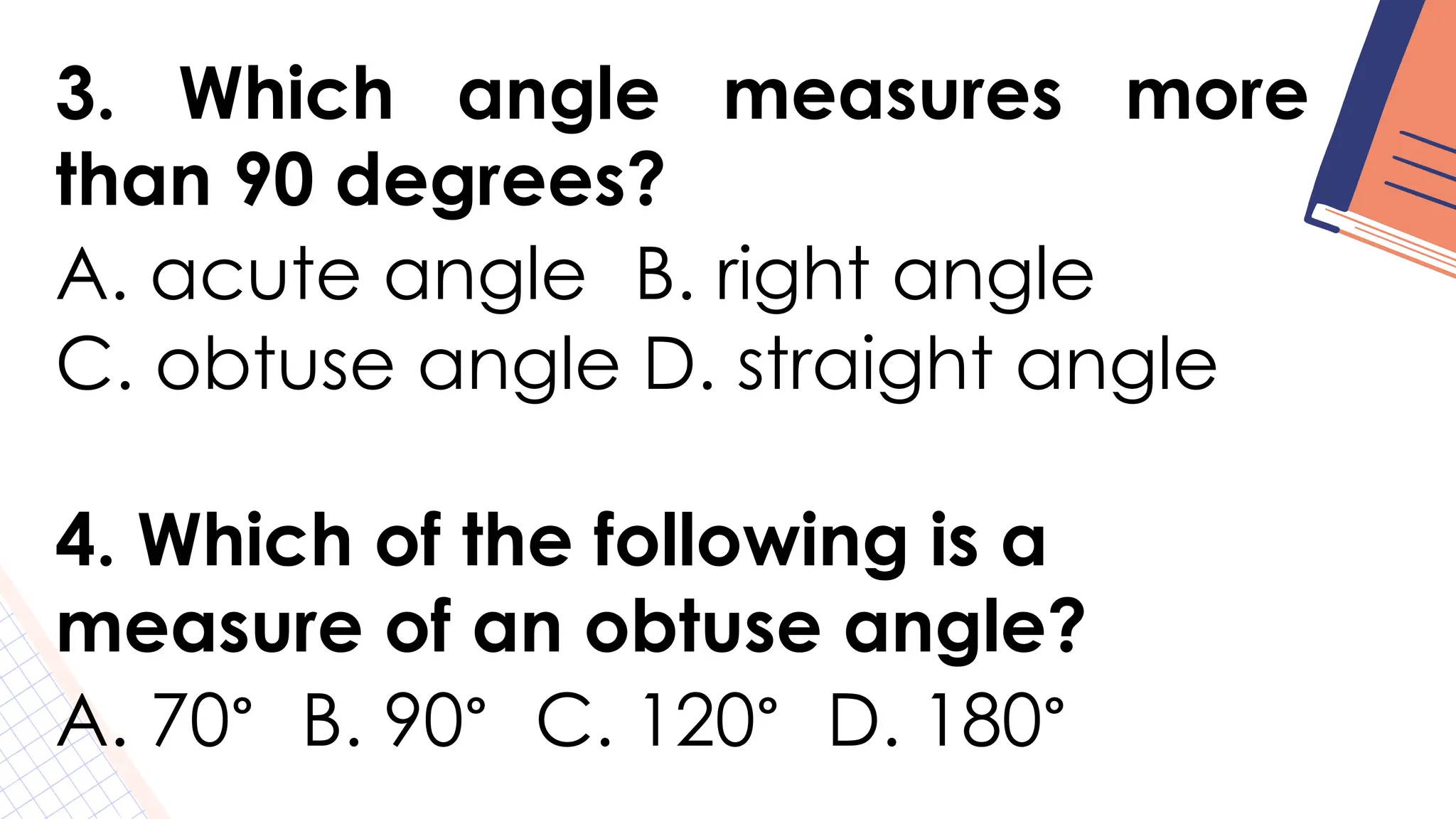
3. Which angle measures more
than 90 degrees?
A. acute angle B. right angle
C. obtuse angle D. straight angle
4. Which of the following is a
measure of an obtuse angle?
A. 70° B. 90° C. 120° D. 180°
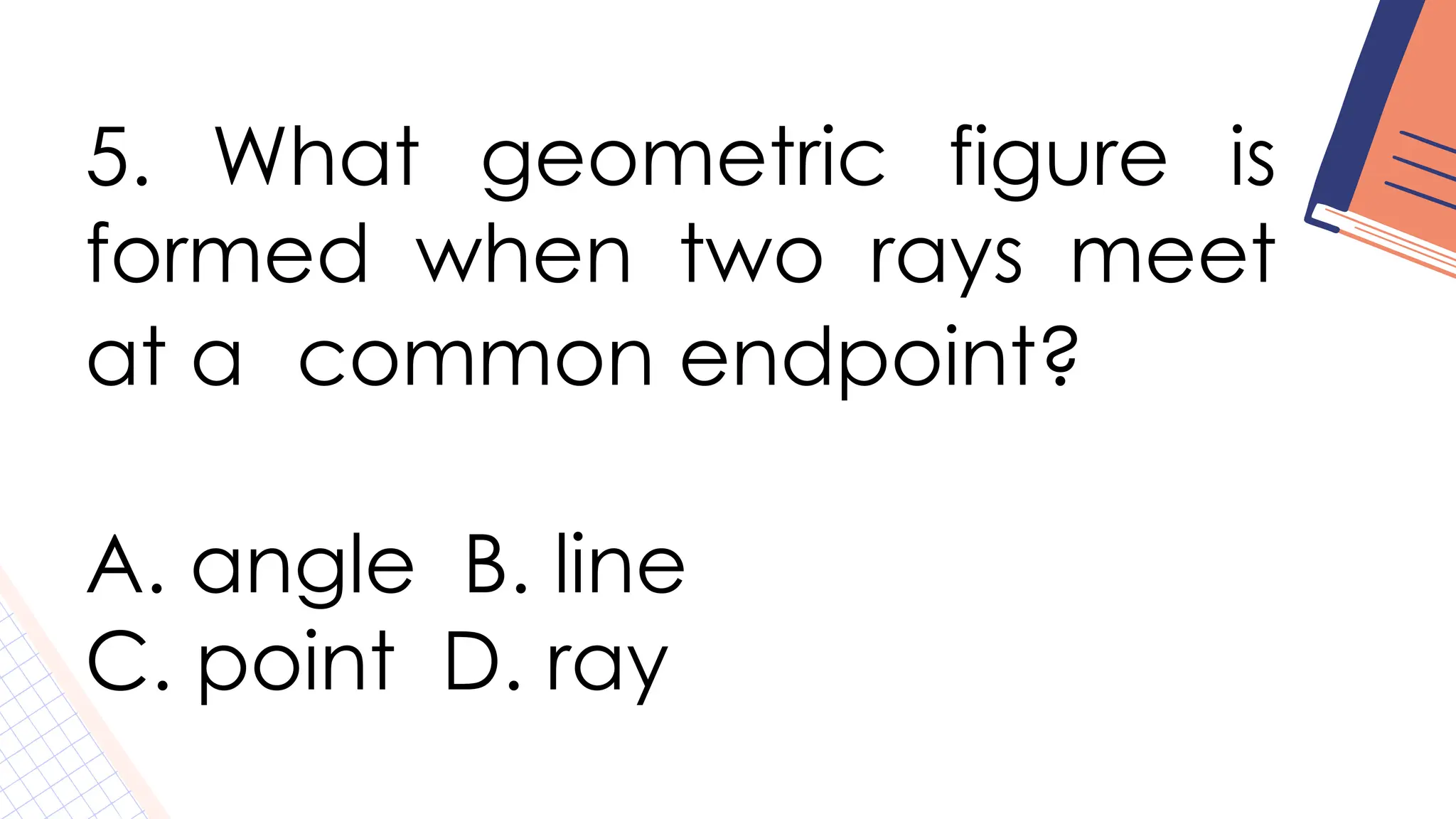
5. What geometric figure is
formed when two rays meet
at a common endpoint?
A. angle B. line
C. point D. ray
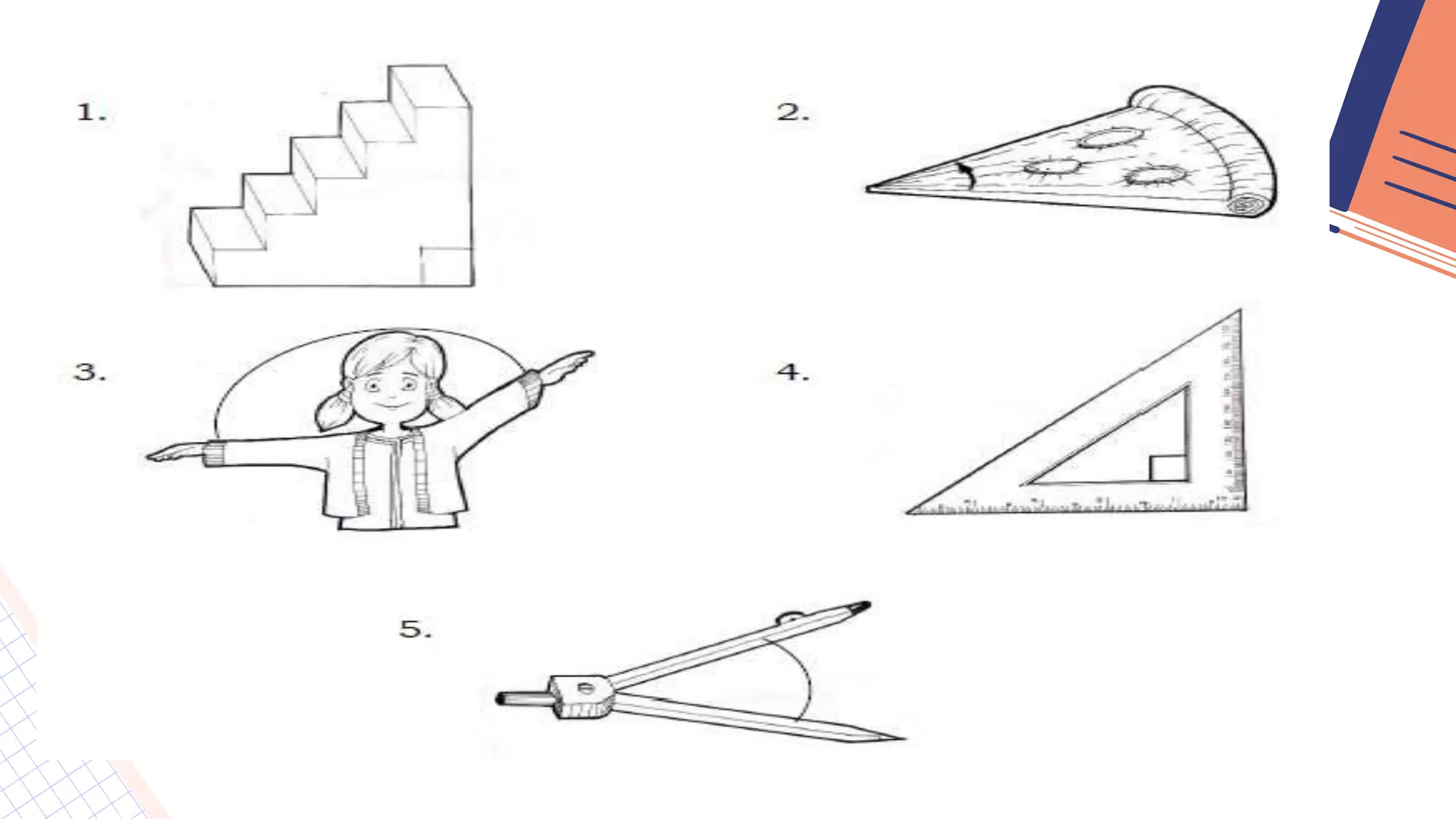
Identify the kind of angle
represented by each of
the following figure. Write
the correct answer on a
sheet of paper.
30
THANK YOU
FOR
LISTENING!
31
32
Week 1 Day 2
Identify acute,
right, and
obtuse angle.
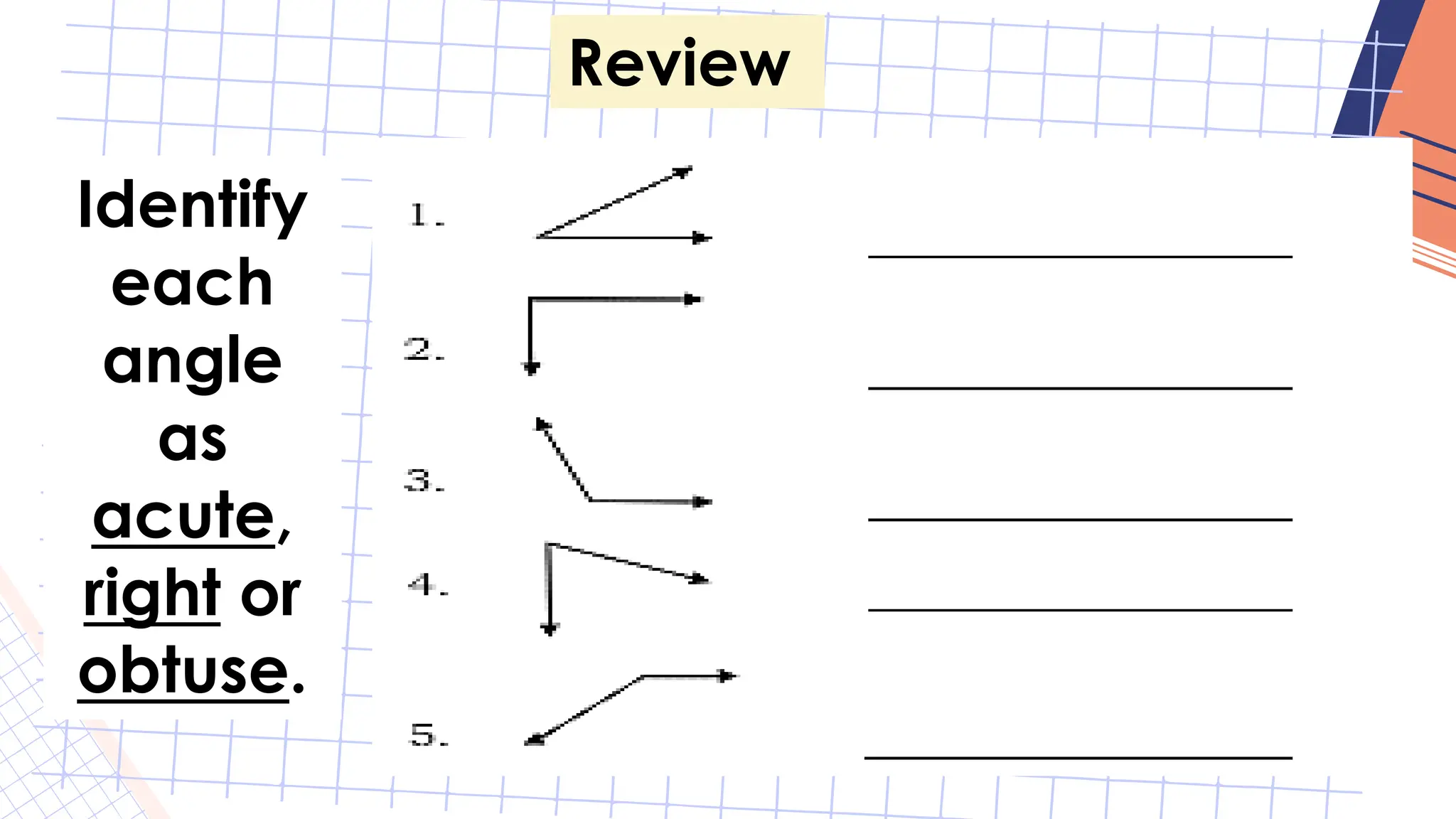
Review
Identify
each
angle
as
acute,
right or
obtuse.
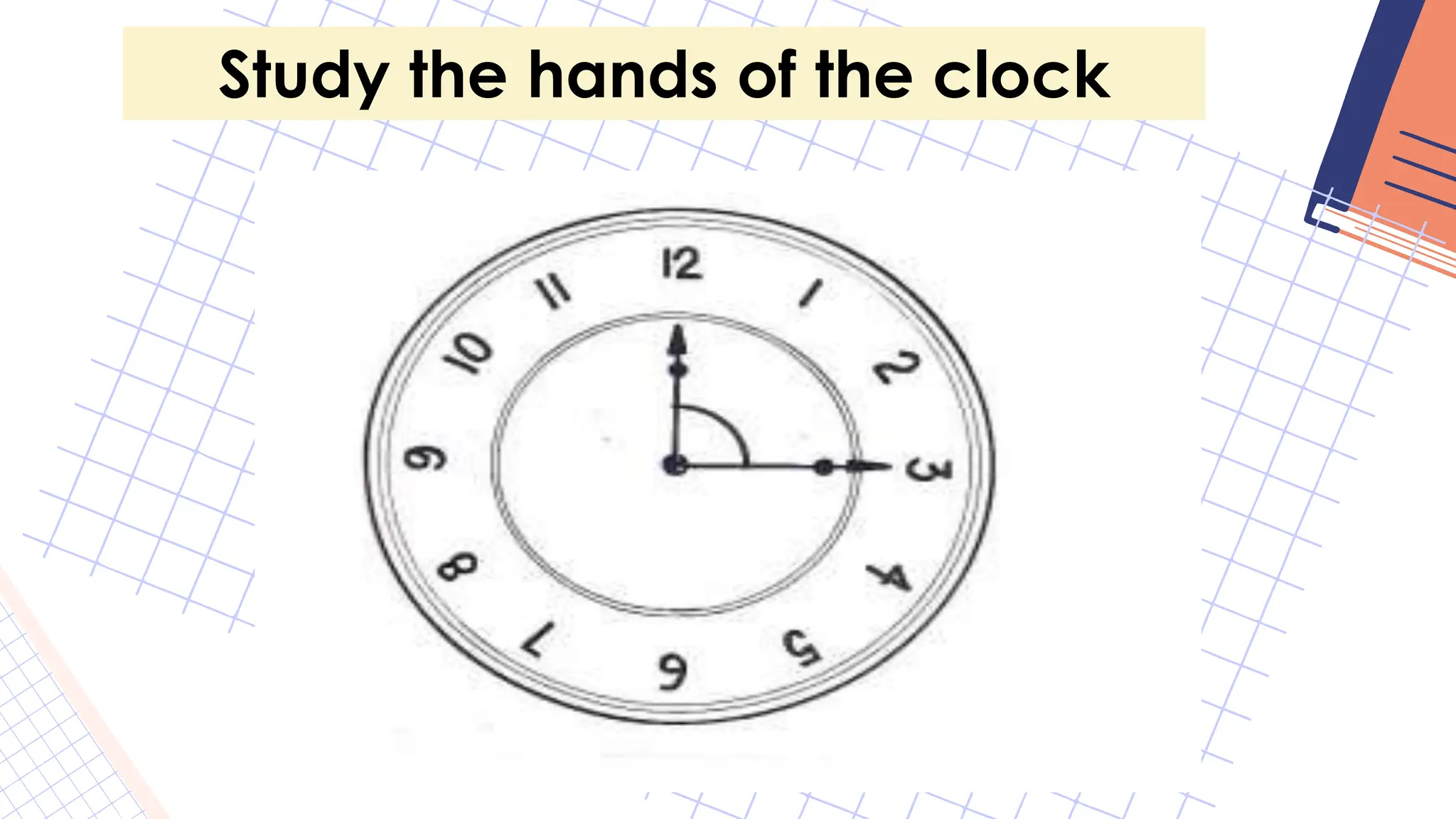
Study the hands of the clock
What kind of angle was formed?
(RIGHT ANGLE)
Can you draw 5 clocks that shows
an acute angle?
What is a right angle?
Illustrate the following using
your show me board
1. Acute angle
2. Obtuse angle
3. Right angle
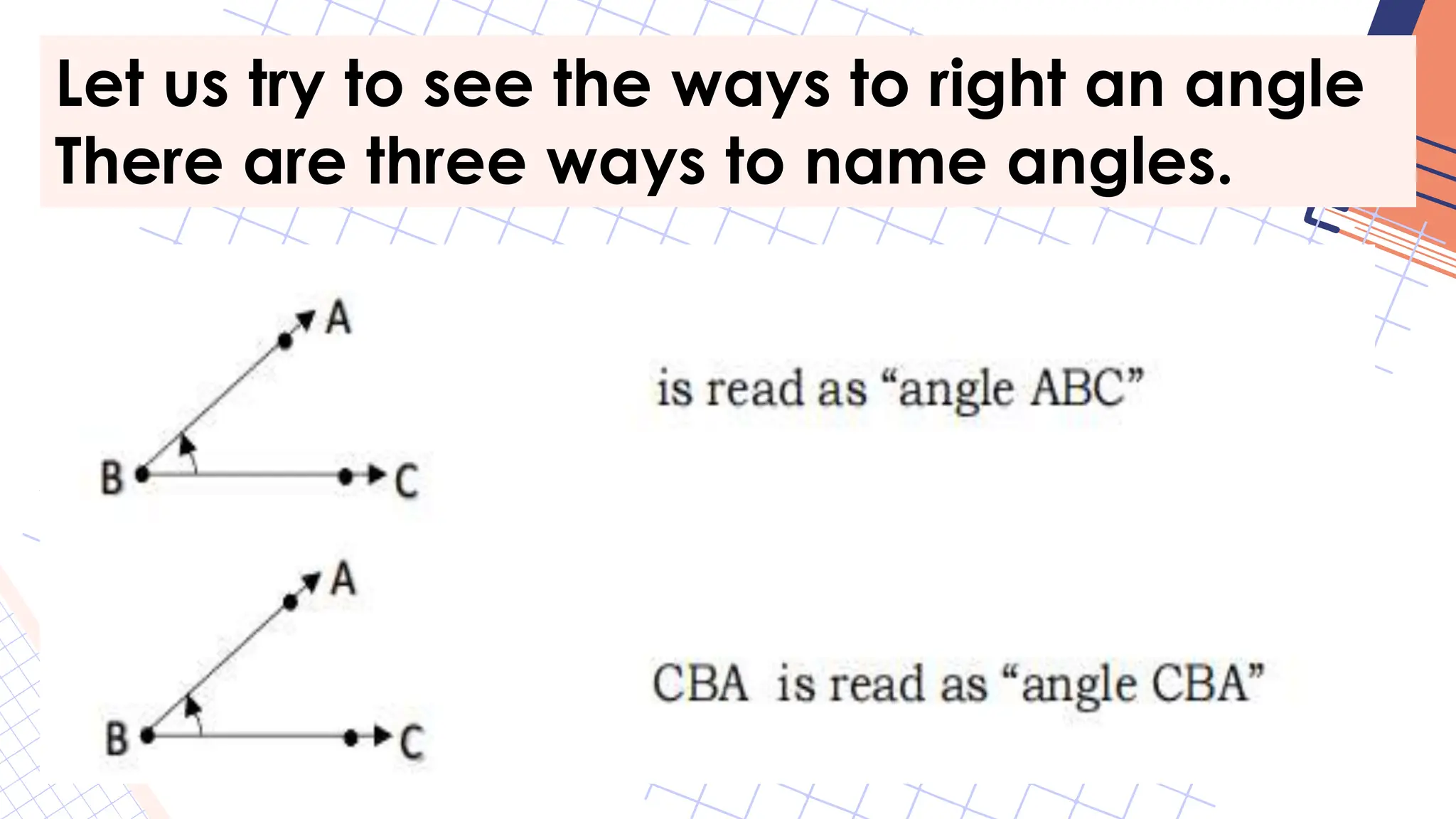
Let us try to see the ways to right an angle
There are three ways to name angles.
Degrees is a unit of measurement angles,
one three-hundred and-sixtieth (1/360) of
the circumference of a circle. The degree
symbol or degree sign, (°) is a
typographical symbol that is used,
among other things, to represent degrees
of arc.
To measure angles, we use the unit called
degrees
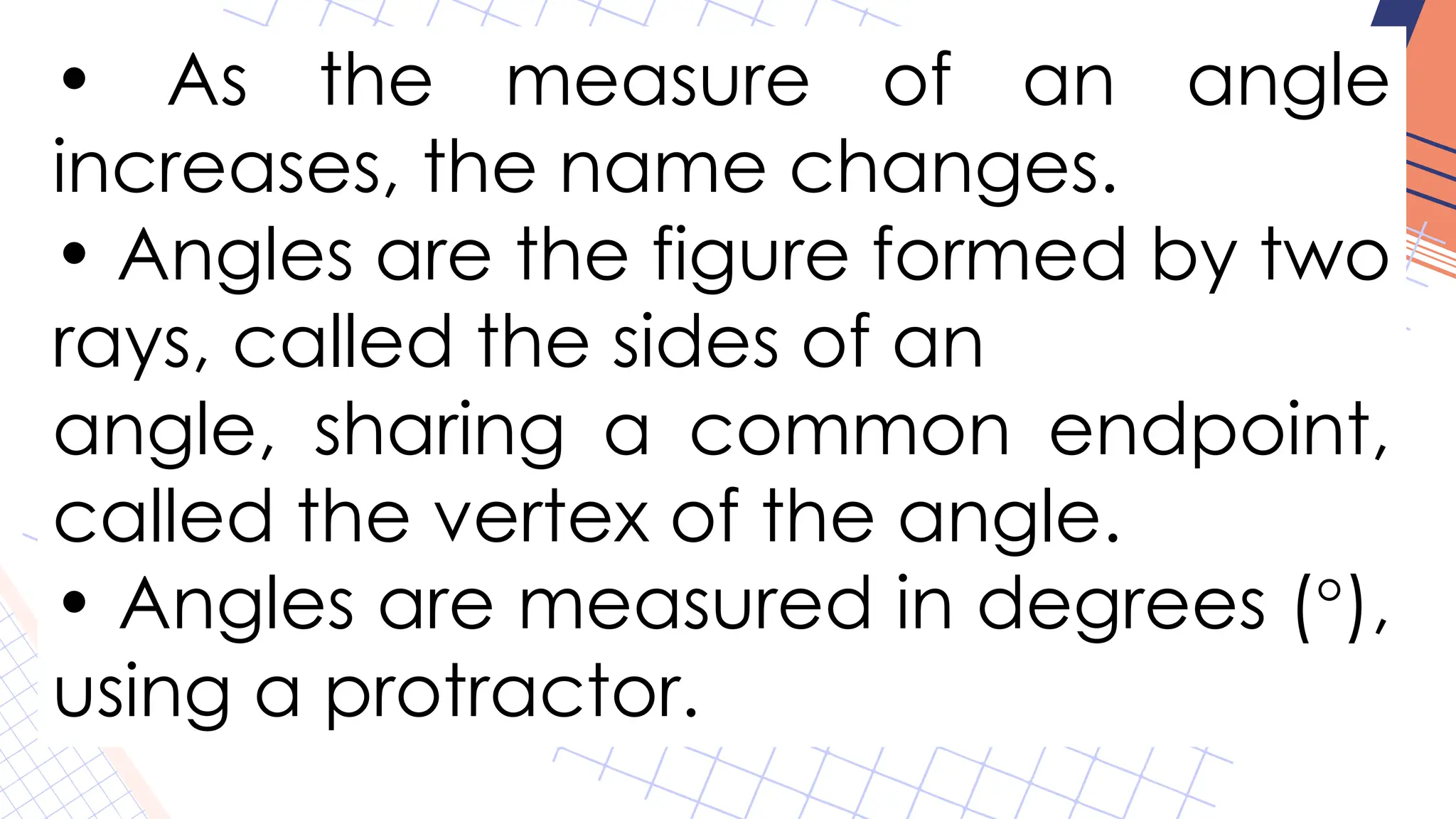
• As the measure of an angle
increases, the name changes.
• Angles are the figure formed by two
rays, called the sides of an
angle, sharing a common endpoint,
called the vertex of the angle.
• Angles are measured in degrees (°),
using a protractor.
• Angles can be classified according
to their measurements.
• An acute angle measures less than
90°. It is smaller than a right angle.
• A right angle measures 90°. It forms
a square corner.
• An obtuse angle measures more
than 90° but less than 180°.
Let us always remember that
A right angle measures exactly 90˚.
An acute angle measures between
0 ˚ and 90 ˚. An obtuse angle
measures between 90 ˚ and 180 ˚
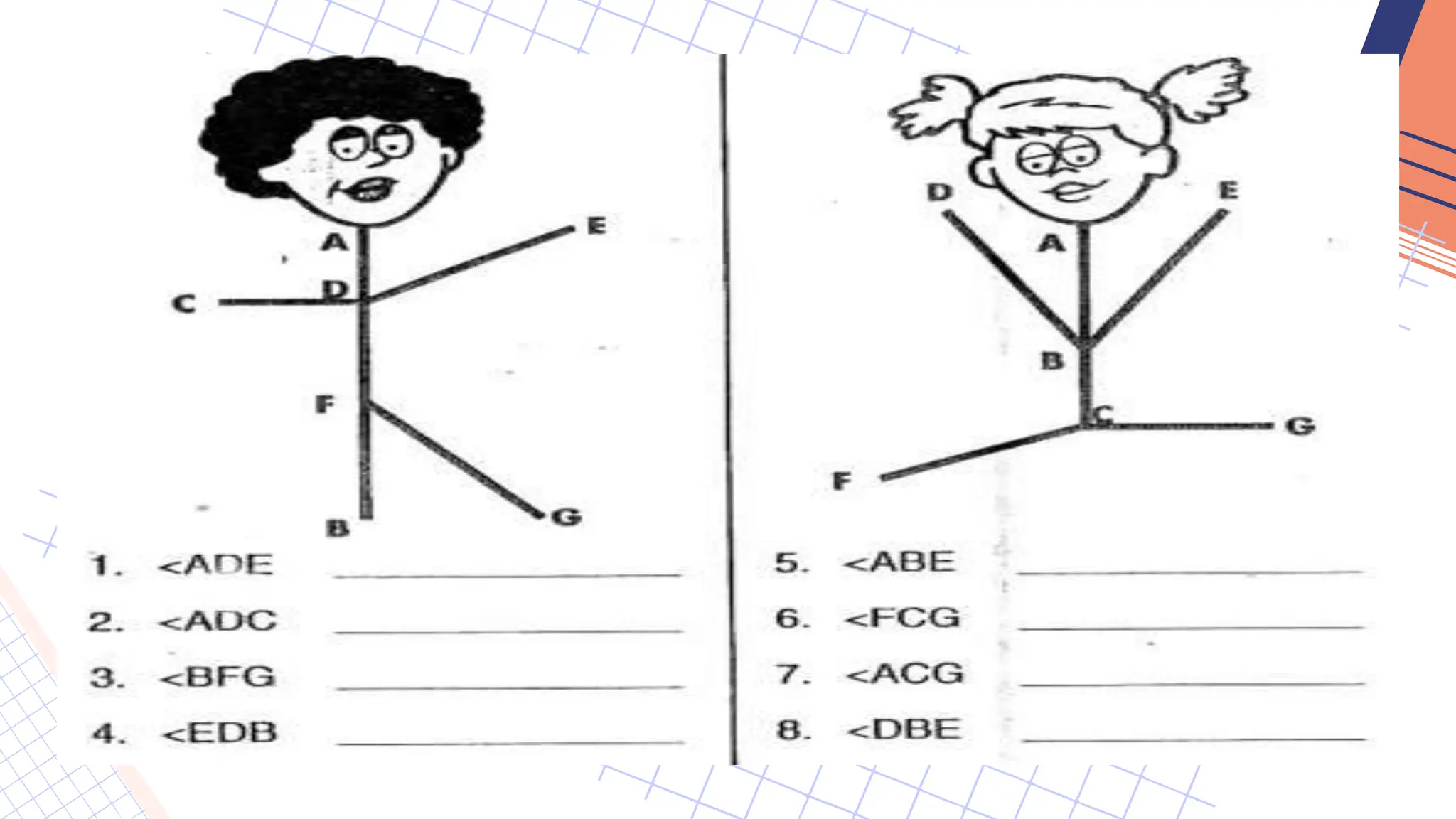
Answer
Draw and tell what kind of
angle are presented.
Ask the pupils;
What are the 3 ways in naming
angles?
What are the 3 types of angles?
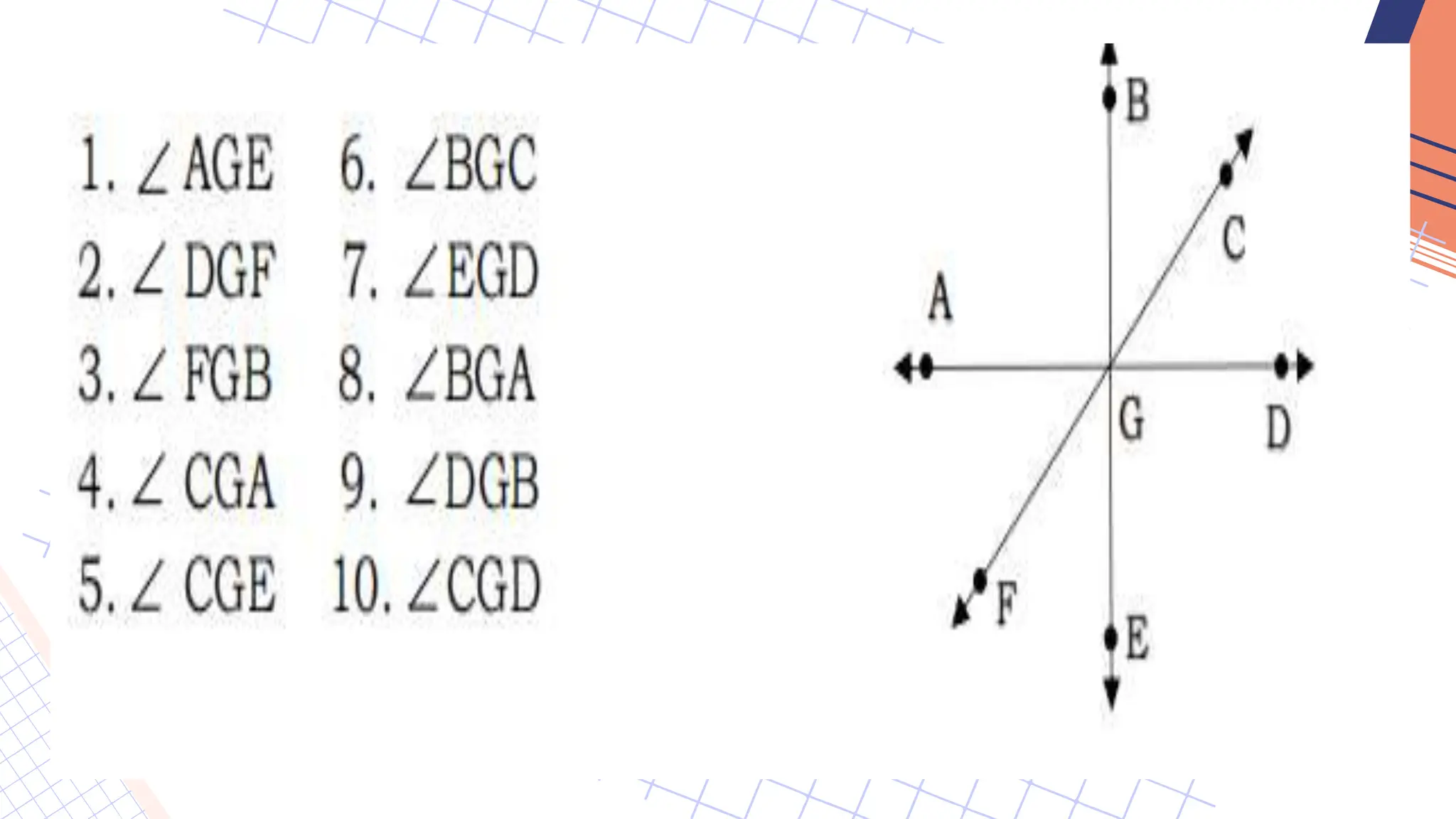
Using the figure at the right,
identify if the given angle is
acute, right or obtuse. Write
the correct answer on a
sheet of paper.
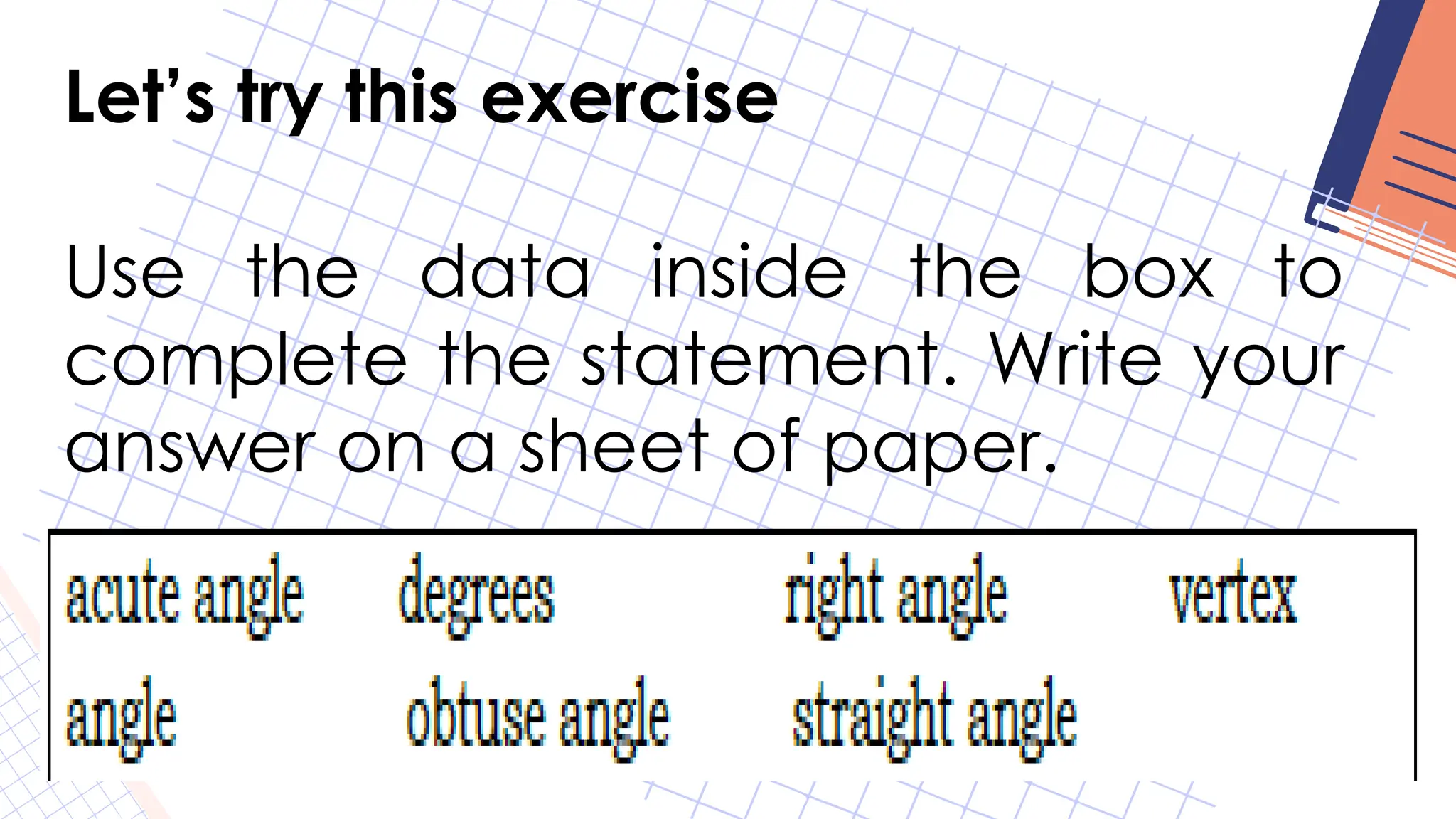
Let’s try this exercise
Use the data inside the box to
complete the statement. Write your
answer on a sheet of paper.
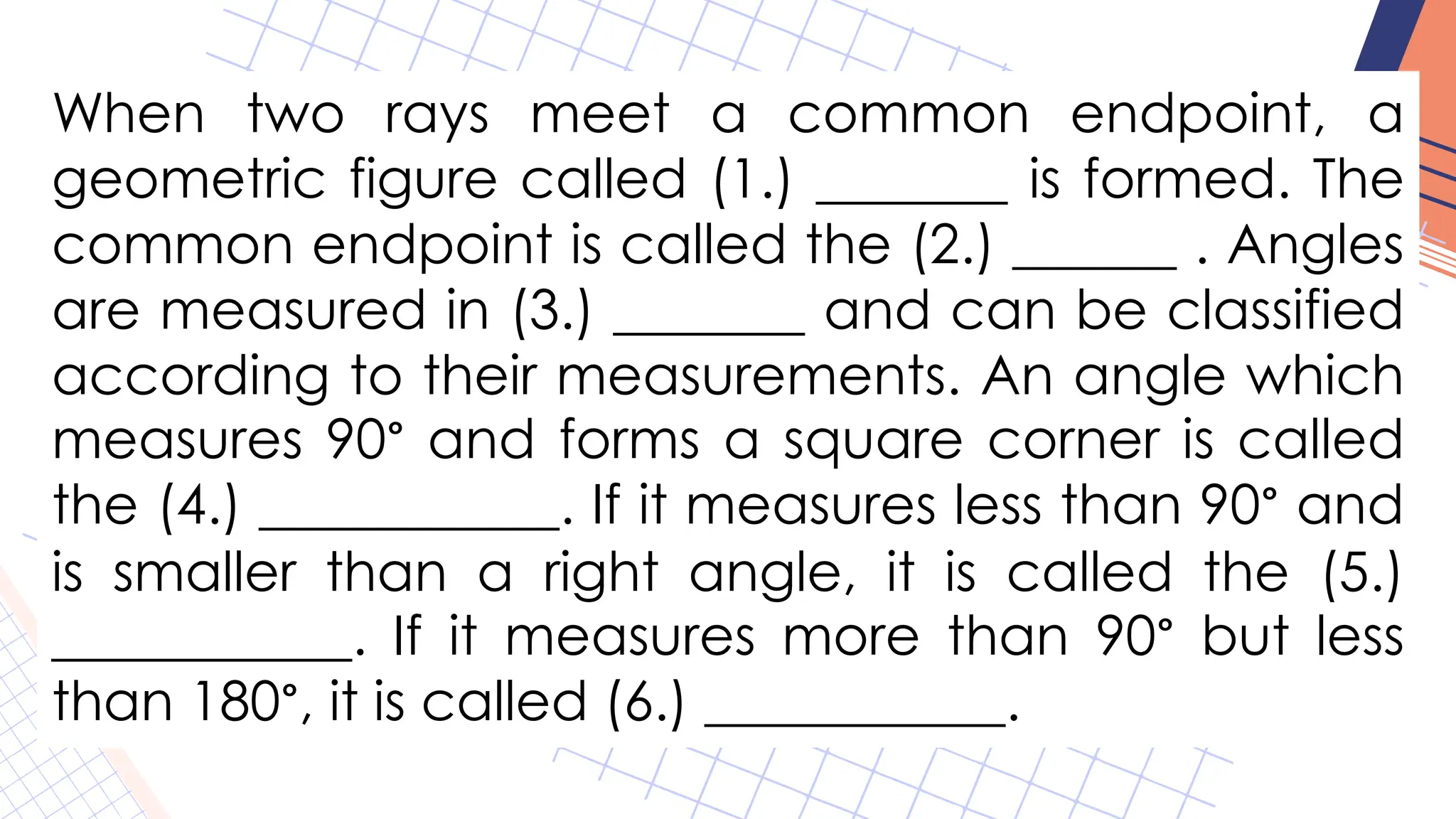
When two rays meet a common endpoint, a
geometric figure called (1.) _______ is formed. The
common endpoint is called the (2.) ______ . Angles
are measured in (3.) _______ and can be classified
according to their measurements. An angle which
measures 90° and forms a square corner is called
the (4.) ___________. If it measures less than 90° and
is smaller than a right angle, it is called the (5.)
___________. If it measures more than 90° but less
than 180°, it is called (6.) ___________.
52
THANK YOU
FOR
LISTENING!
53
54
Week 1 Day 3
Define and
identify the use
of a protractor.
Review
Ask
Can anyone tell the class why
angles are important?
Angles are important to
define and study the
polygons. There are different
types of angles based on their
measurement.
Show the pupils a
picture or a real
protractor
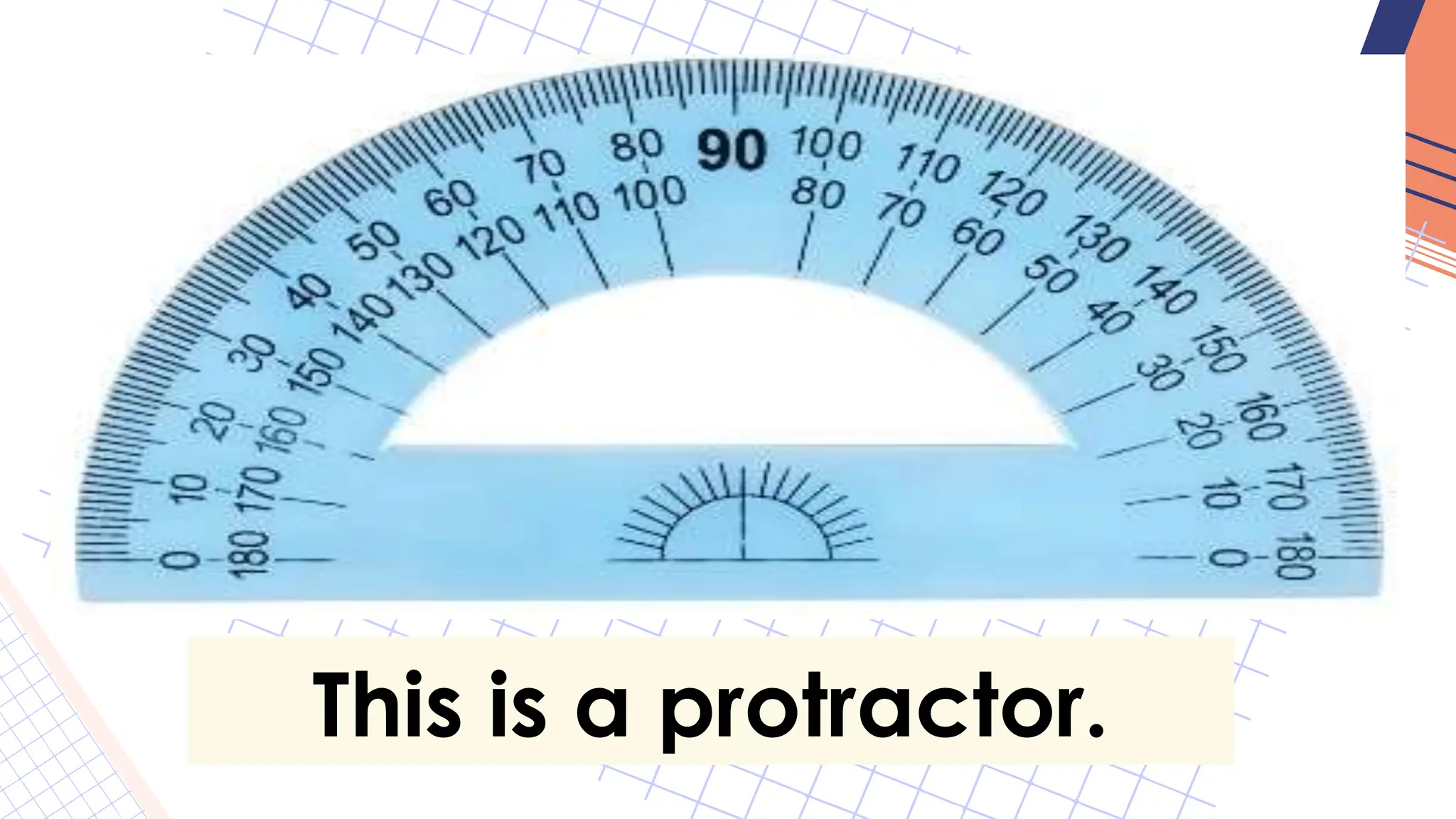
This is a protractor.
A protractor is used for measuring
angles. As shown above, a protractor
is a half or full circle measuring device,
marked in degrees along the outer
edge, with a straight line running from
0° to 180°. There is a small hole in the
center of the protractor.
Let us try to look back the concept of
rays to know more about protractor
The concept of rays is useful for us to
effectively grasp the lesson. Let us first
learn about rays.
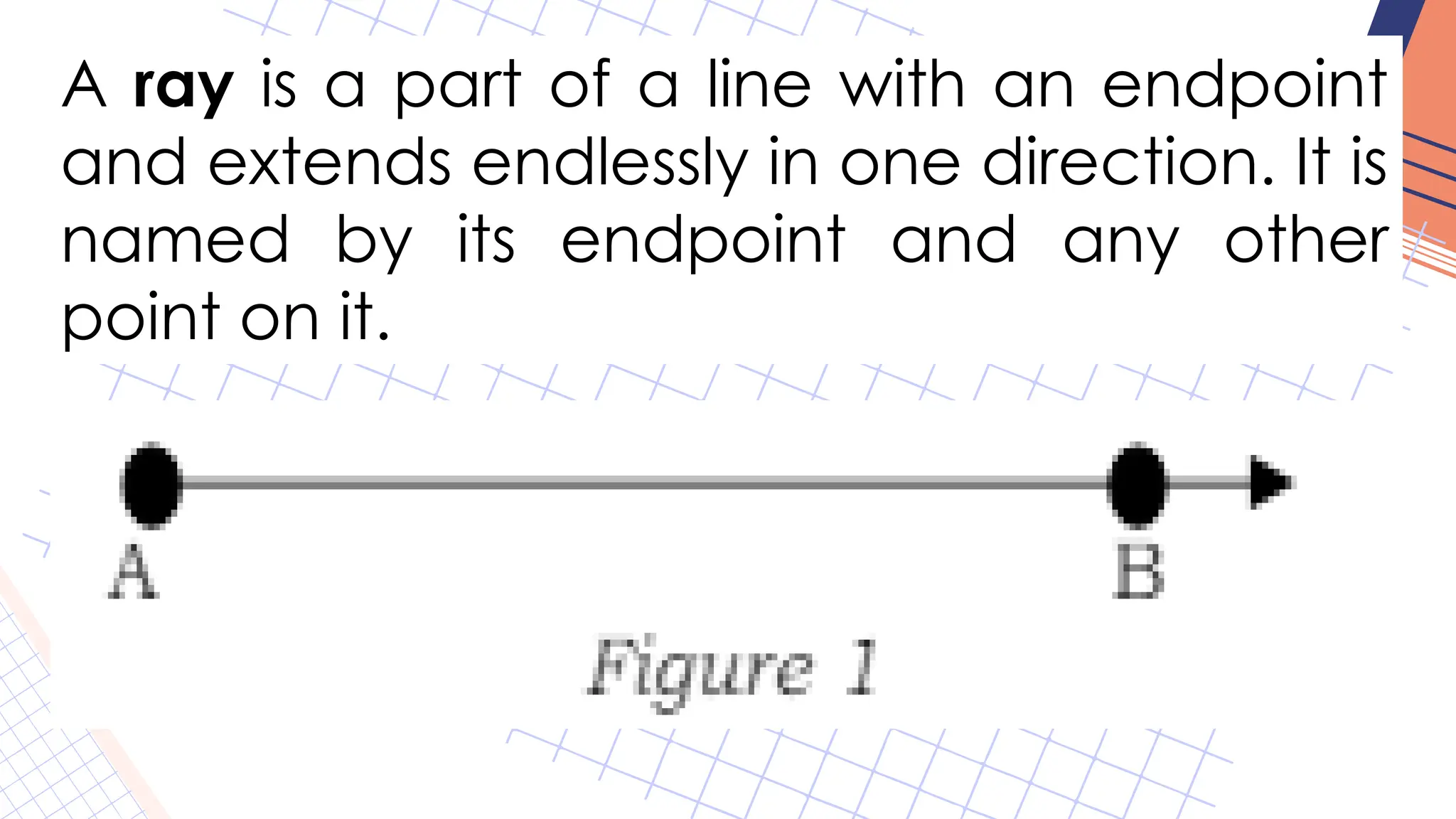
A ray is a part of a line with an endpoint
and extends endlessly in one direction. It is
named by its endpoint and any other
point on it.
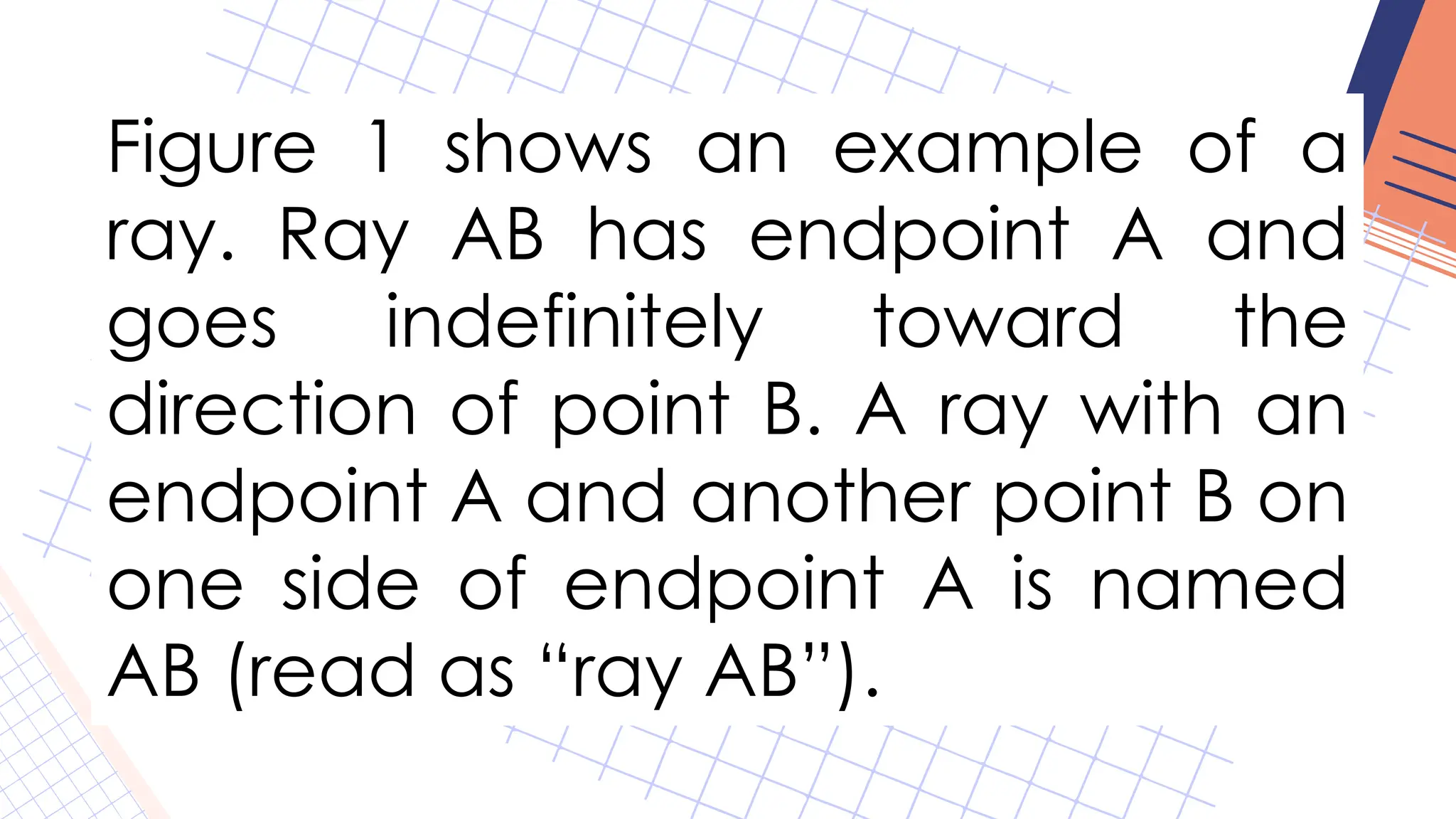
Figure 1 shows an example of a
ray. Ray AB has endpoint A and
goes indefinitely toward the
direction of point B. A ray with an
endpoint A and another point B on
one side of endpoint A is named
AB (read as “ray AB”).
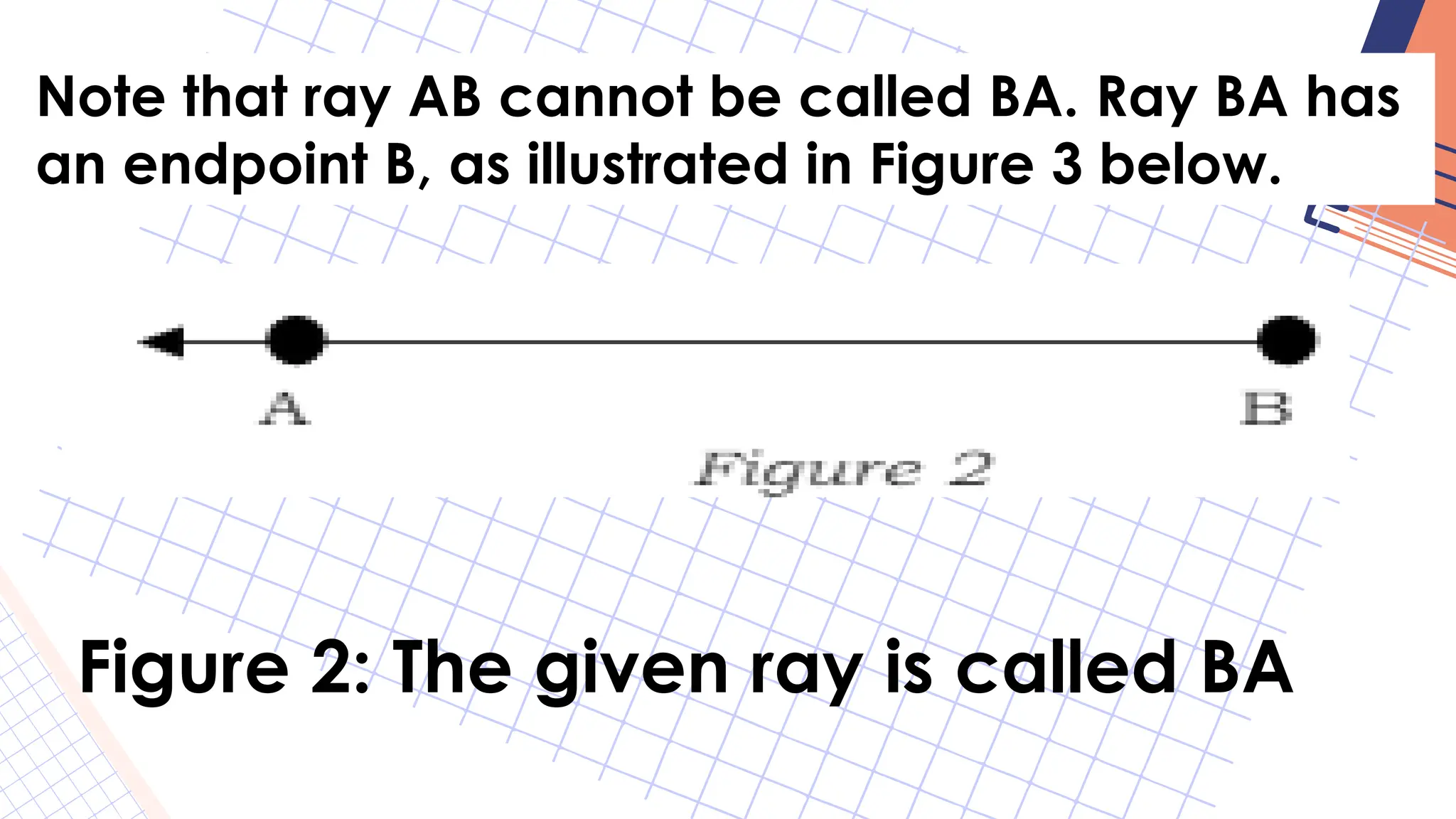
Note that ray AB cannot be called BA. Ray BA has
an endpoint B, as illustrated in Figure 3 below.
Figure 2: The given ray is called BA
What is a protractor?
The measure of an angle indicates
how wide the opening is between
its two sides. A protractor is used to
find the measure of an angle, just
like a ruler is used to find the length
of a segment.
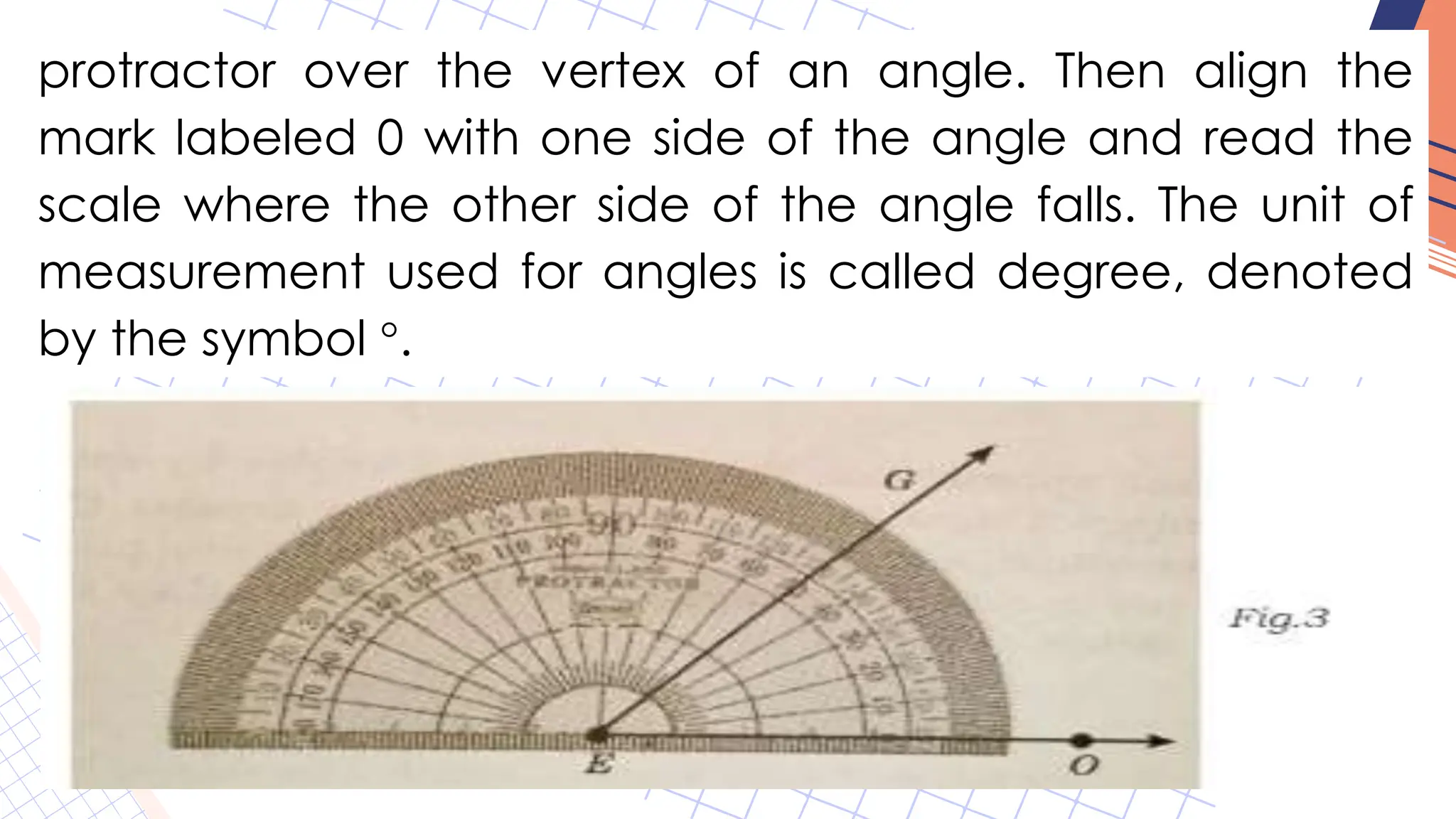
protractor over the vertex of an angle. Then align the
mark labeled 0 with one side of the angle and read the
scale where the other side of the angle falls. The unit of
measurement used for angles is called degree, denoted
by the symbol °.
A protractor usually has outer and inner degree
scales. You may use any of these scales
depending on the positions of the angle. Using
the inner scale of the protractor shown in the
figure above, the measure of ∠𝐺𝐸𝑂 is equal to
50 °, written as
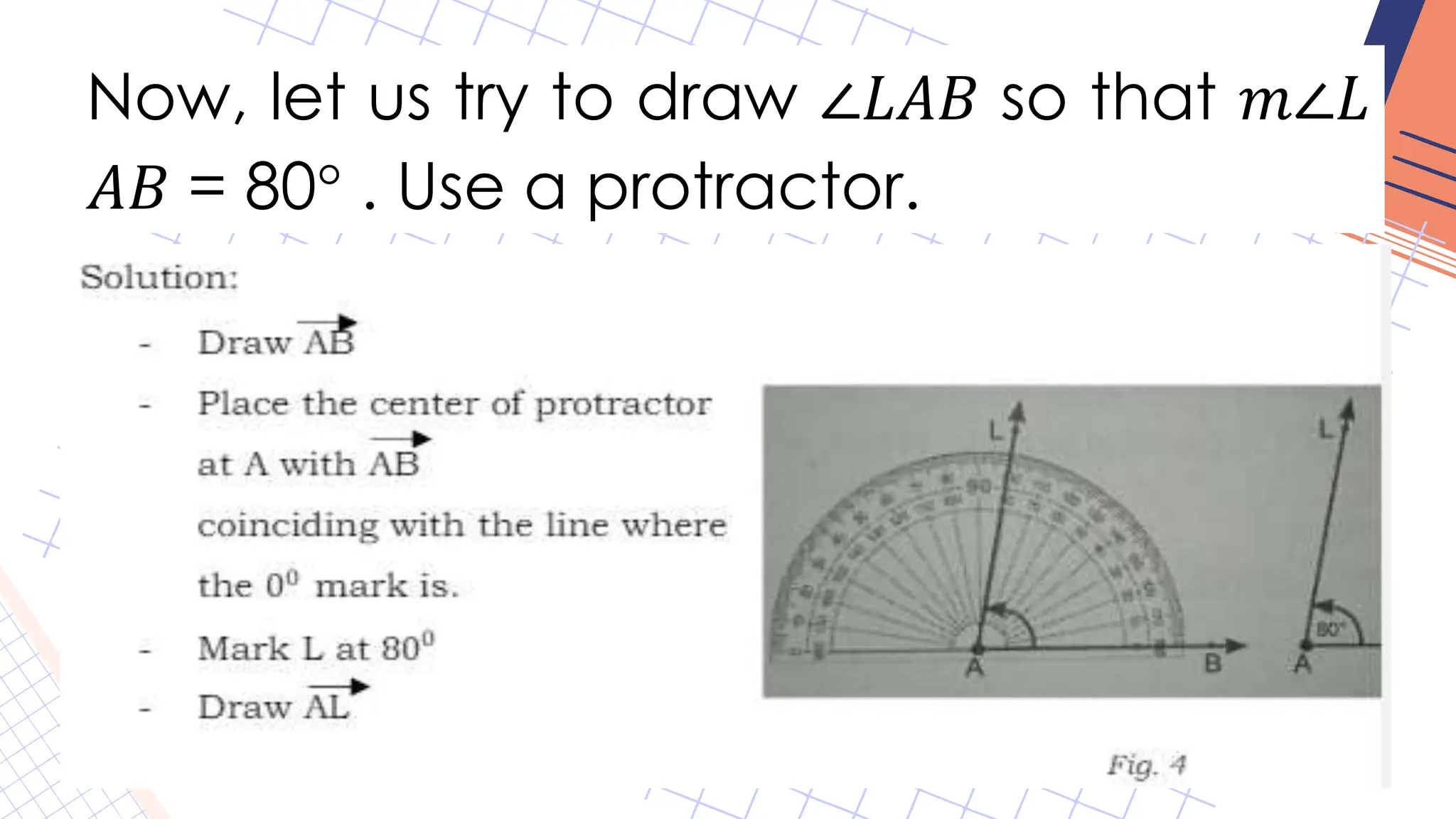
Now, let us try to draw ∠𝐿𝐴𝐵 so that 𝑚∠𝐿
𝐴𝐵 = 80° . Use a protractor.
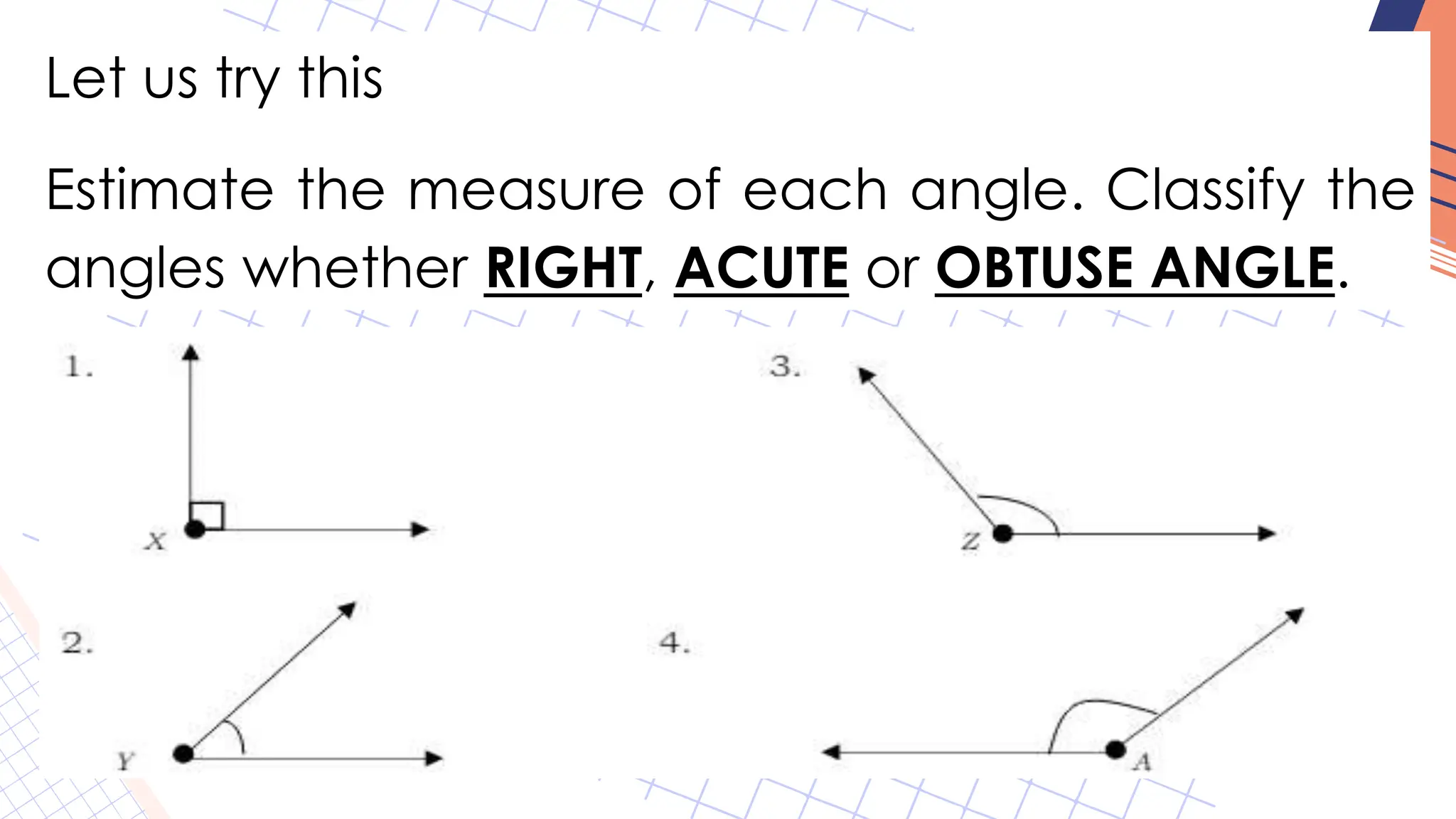
Let us try this
Estimate the measure of each angle. Classify the
angles whether RIGHT, ACUTE or OBTUSE ANGLE.
Do this
Draw a protractor
on a bondpaper
Ask the pupils
What are protractors?
Can you draw a protractor? Draw
it on a ¼ sheet of paper.
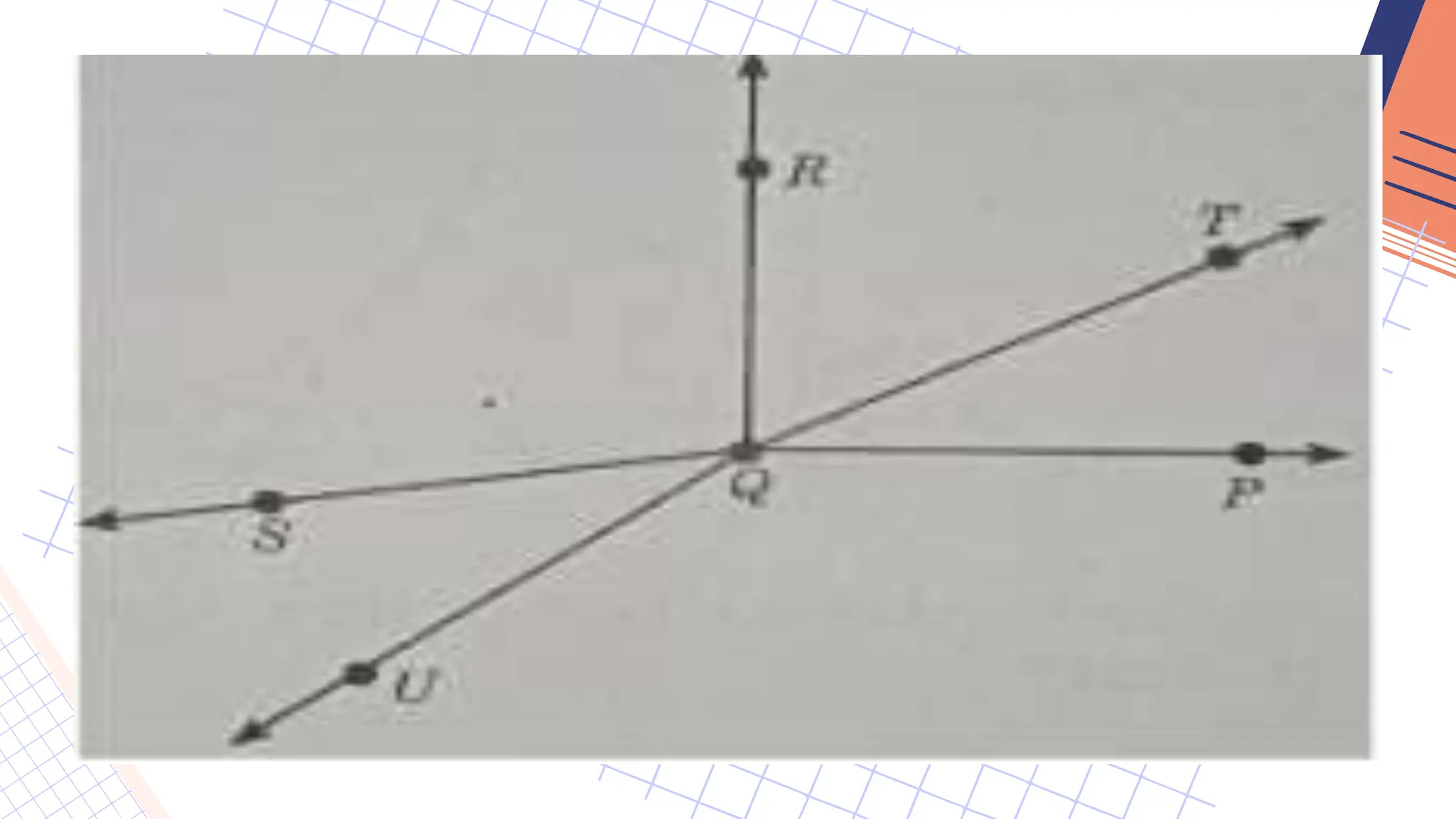
Refer to the given figure. Measure
and classify each indicated angle.
a. ∠𝑃𝑄𝑅
b. ∠𝑃𝑄𝑇
c. ∠𝑅𝑄S
Additional Activities
Assignment
Bring a protractor.
76
THANK YOU
FOR
LISTENING!
77
78
Week 1 Day 4
Draw and measure
angles using a
protractor.
Review
What is a protractor?
How are you going to
measure angle using a
protractor?
Can you recall what you see
at home or on your way to
school the angles that you
find or see?
Angles can be found everywhere.
Buildings, establishments, satellite dishes,
billboards, and many other objects forming
angles. Of course, you also have clocks in
your homes, right? Notice the figure
formed by the two hands of the clock.
They are clearly examples of angles. These
sounds interesting. Hello, angles!
Do you have your protractor with you?
Today, we are going to use that in
measuring angles.
Let’s do this together.
(The teacher demonstrates how to measure
the angle using a protractor)
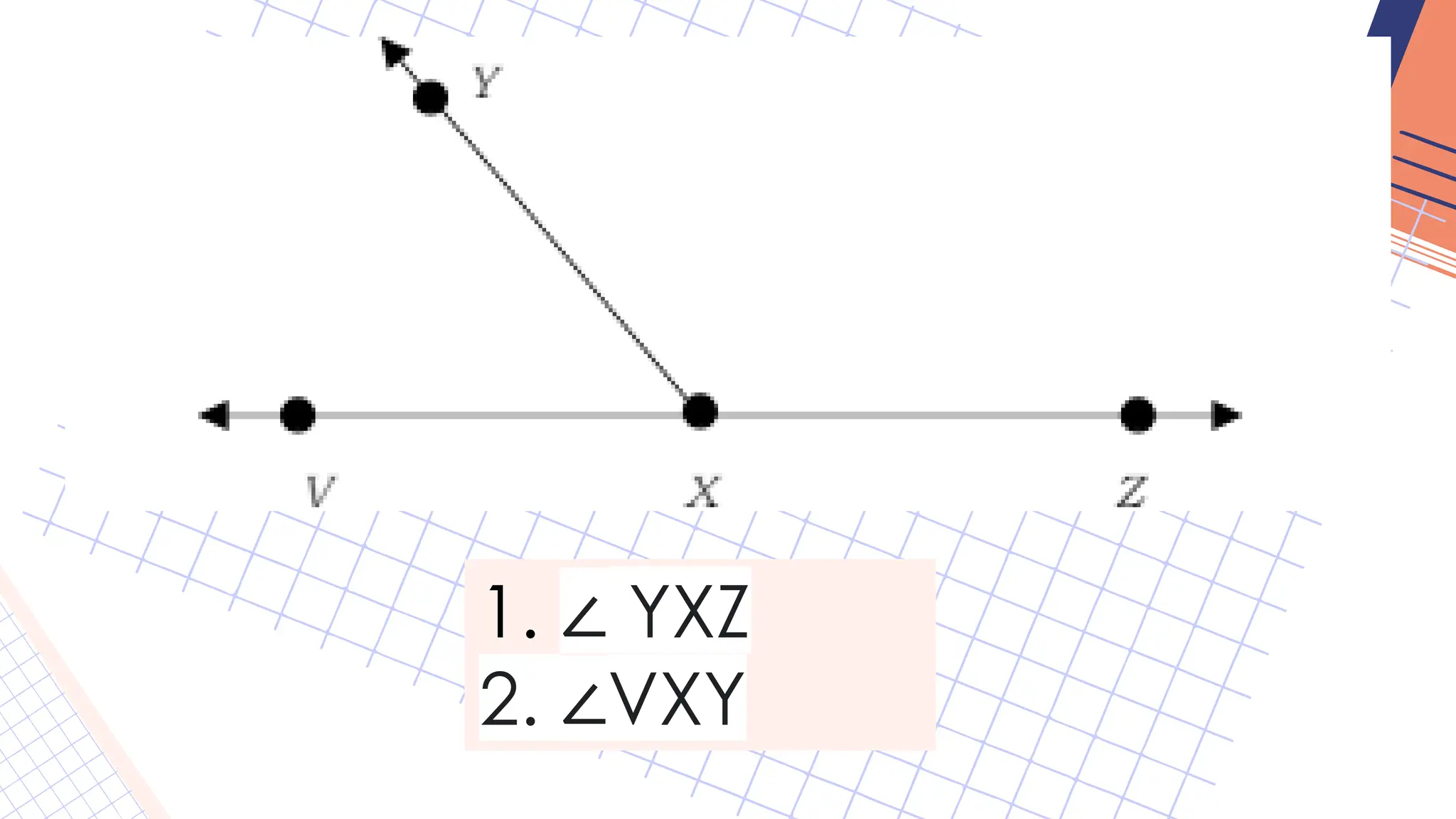
1. ∠ YXZ
2. ∠VXY
Let us learn how to measure protractor
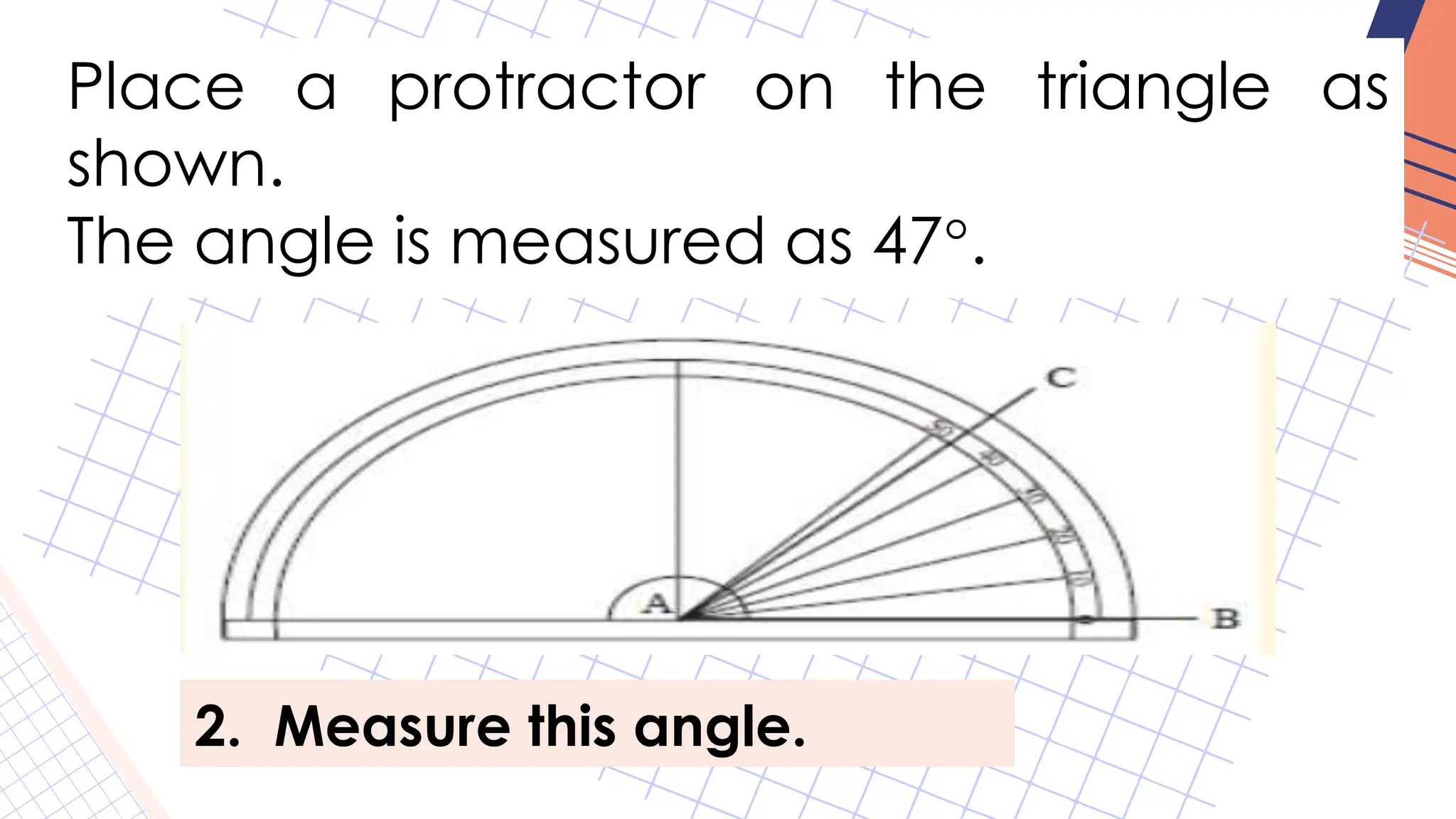
1. Measure the angle CAB in the triangle shown.
Place a protractor on the triangle as
shown.
The angle is measured as 47°.
2. Measure this angle.
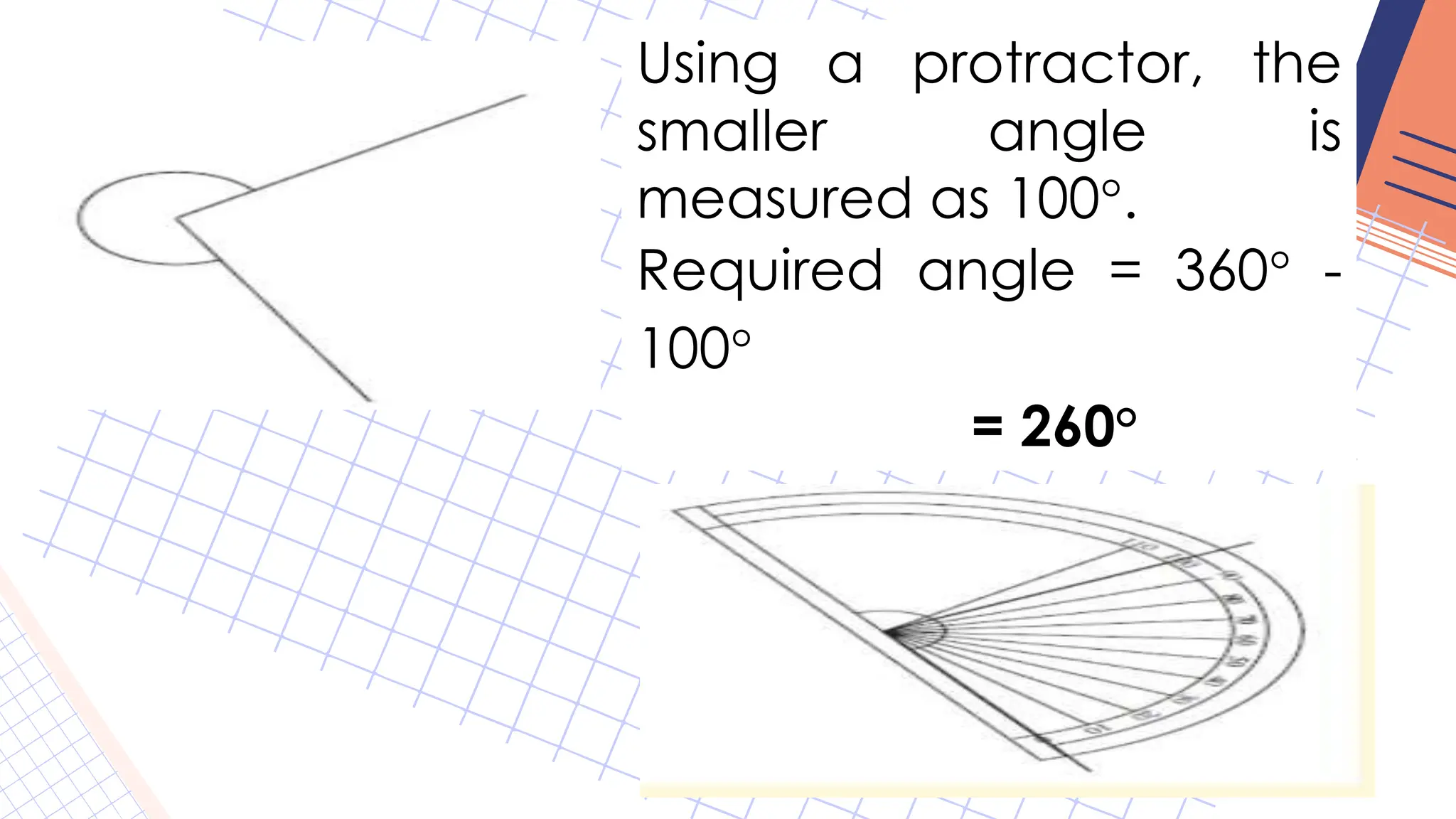
Using a protractor, the
smaller angle is
measured as 100°.
Required angle = 360° -
100°
= 260°
Try this
Draw the angles of the following using a
protractor.
1. 120 ˚
2. 330 ˚
3. 190 ˚
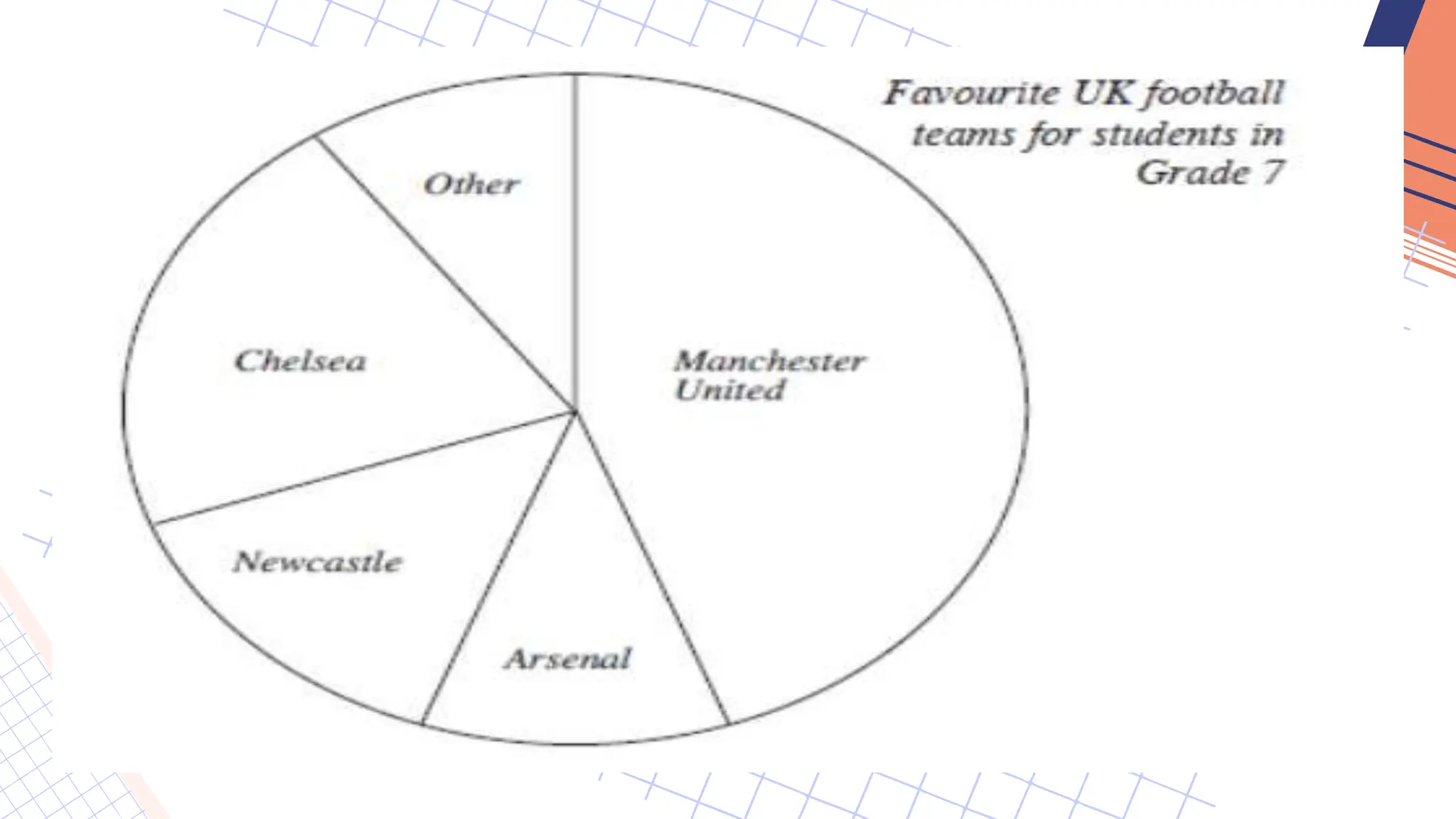
Do this
Measure each of the angles in this
pie chart. Write it on the blank
provided.
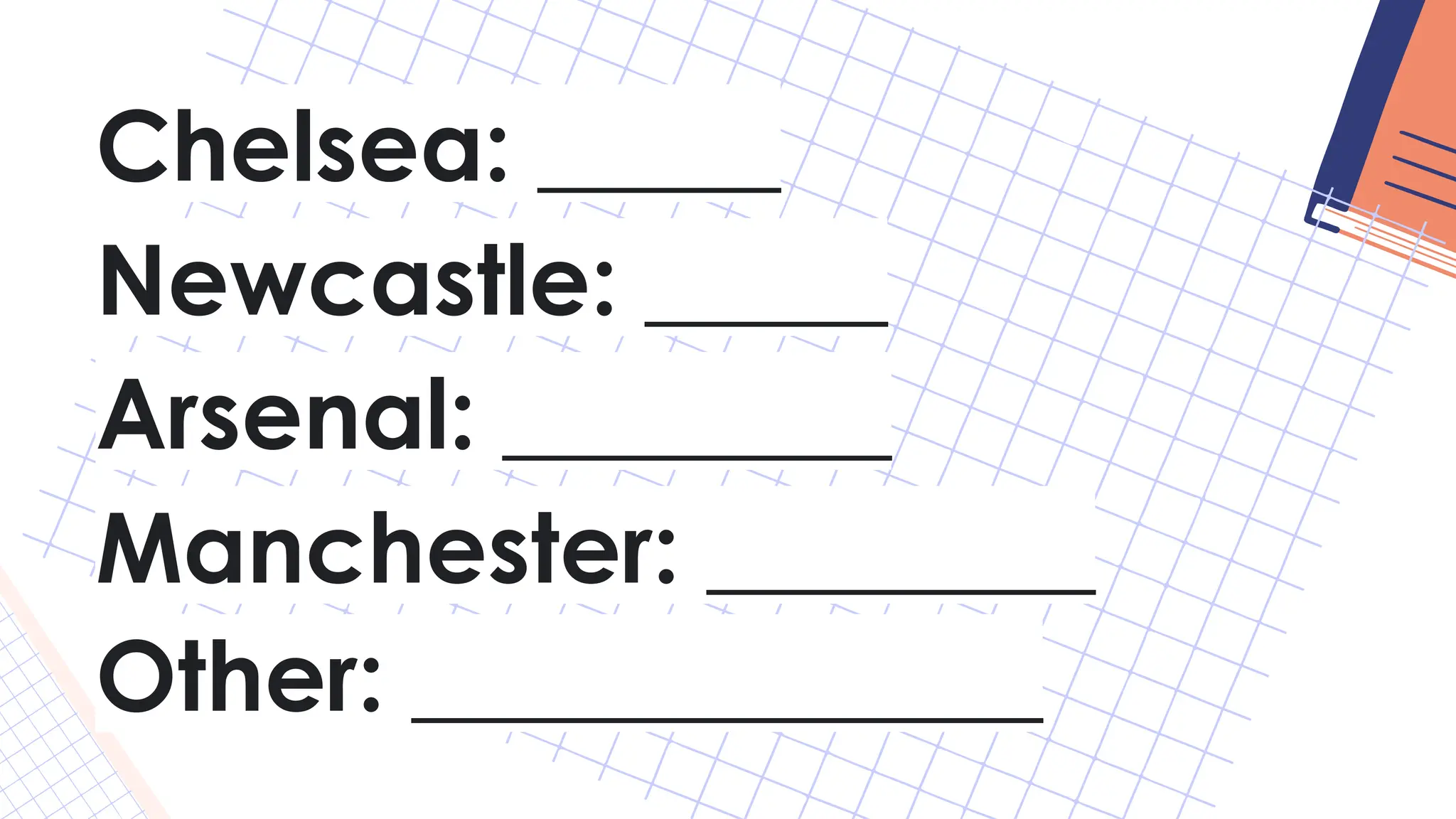
Chelsea: _____
Newcastle: _____
Arsenal: ________
Manchester: ________
Other: _____________
Ask:
How are you going to measure
angles using a protractor?
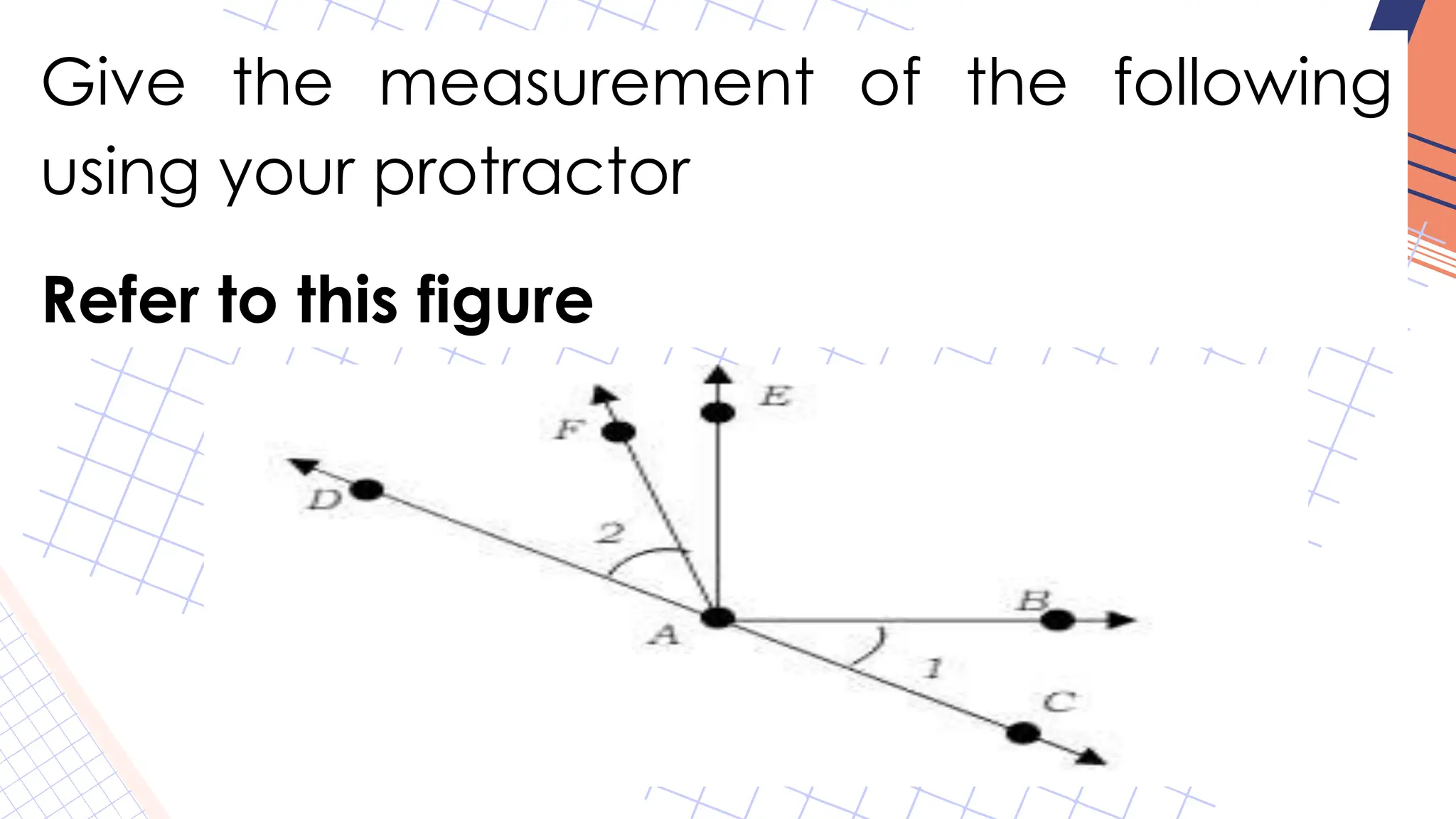
Give the measurement of the following
using your protractor
Refer to this figure
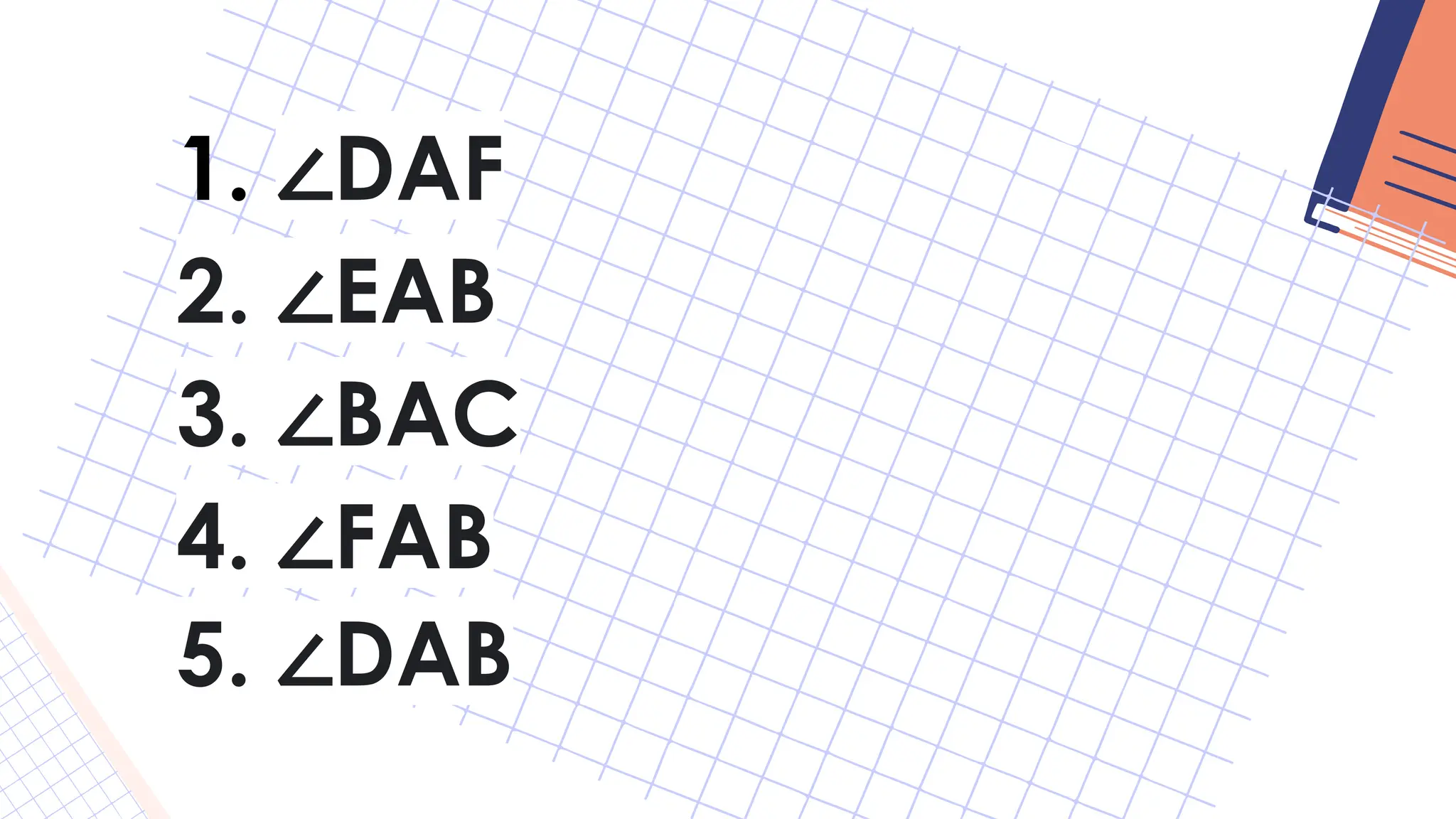
1. ∠DAF
2. ∠EAB
3. ∠BAC
4. ∠FAB
5. ∠DAB
96
THANK YOU
FOR
LISTENING!

MATH 4 MATATAG PPT QUARTER WEEK 1 POWERP

  • 1.
  • 2.
  • 3.
    Illustrate and define differentangles (right, acute, and obtuse) using models.
  • 4.
    New Lesson Daily Routine 1.Prayer 2. Greetings 3. Classroom Agreement 4. Checking of Attendance
  • 5.
    Ask: what haveyou learned about the song?
  • 6.
    The students willtry to answer this worksheet:
  • 8.
    This morning we aregoing to learn about angle
  • 9.
  • 10.
    An angle isa geometrical figure formed when two rays meet at a common point called vertex.
  • 11.
    This is thesymbol for angle: ∠
  • 12.
    There are 3types of angle Let’s take a look at the clocks showing the respective times Lola Remy, Lola Inday and Lola Nancy take their vitamins.
  • 13.
    At 9:00, theminute and hour hands of the clock form an angle which measures 90˚. This angle, like all angles which measure 90˚, is called a right angle.
  • 14.
    At 2:00, theminute and hour hands of the clock form an angle which measures 60˚. This is between 0˚ and 90˚ The angle here, like all other angles which measure between 0˚ and 90˚, is called an acute angle.
  • 15.
    At 5:00, theminute and hour hands of the clock form an angle which measures 150˚. This is between 90˚ and 180˚ The angle here, like all other angles which measure between 90˚ and 180˚, is called an obtuse angle.
  • 16.
    An angle isformed by two rays with a common endpoint.
  • 17.
    In the figurebelow, Rays BA and BC have B as their common endpoint and they form angle ∠ABC. Using symbols, we write , which is read as “angle ABC”. The angle may also be called ∠CBA.
  • 18.
    The angle abovemay also be named as ∠1, or simply ∠B.
  • 19.
    ACUTE ANGLE an anglewhose measure is less than 90 degrees.
  • 20.
    RIGHT ANGLE An anglewhose measure is 90 degrees
  • 21.
    OBTUSE ANGLE An anglewhose measure is bigger than 90 degrees but less than 180 degrees
  • 22.
    Direction: What kindof angles are the following?
  • 23.
    Ask the pupils Whatangles measure less than 90 °? What angles measure exactly 90°? What angles measure more than 90 ° but less than 180°?
  • 24.
    Directions: Answer the followingquestions. Write the letter of the correct answer on a sheet of paper.
  • 25.
    1. Which anglemeasures 90 degrees and forms a square corner? A. acute angle B. right angle C. obtuse angle D. straight angle 2. Which angle measures less than 90 degrees and smaller than a right angle? A. acute angle B. right angle C. obtuse angle D. straight angle
  • 26.
    3. Which anglemeasures more than 90 degrees? A. acute angle B. right angle C. obtuse angle D. straight angle 4. Which of the following is a measure of an obtuse angle? A. 70° B. 90° C. 120° D. 180°
  • 27.
    5. What geometricfigure is formed when two rays meet at a common endpoint? A. angle B. line C. point D. ray
  • 28.
    Identify the kindof angle represented by each of the following figure. Write the correct answer on a sheet of paper.
  • 30.
  • 31.
  • 32.
  • 33.
  • 34.
  • 35.
    Study the handsof the clock
  • 36.
    What kind ofangle was formed? (RIGHT ANGLE) Can you draw 5 clocks that shows an acute angle? What is a right angle?
  • 37.
    Illustrate the followingusing your show me board 1. Acute angle 2. Obtuse angle 3. Right angle
  • 38.
    Let us tryto see the ways to right an angle There are three ways to name angles.
  • 40.
    Degrees is aunit of measurement angles, one three-hundred and-sixtieth (1/360) of the circumference of a circle. The degree symbol or degree sign, (°) is a typographical symbol that is used, among other things, to represent degrees of arc. To measure angles, we use the unit called degrees
  • 42.
    • As themeasure of an angle increases, the name changes. • Angles are the figure formed by two rays, called the sides of an angle, sharing a common endpoint, called the vertex of the angle. • Angles are measured in degrees (°), using a protractor.
  • 43.
    • Angles canbe classified according to their measurements. • An acute angle measures less than 90°. It is smaller than a right angle. • A right angle measures 90°. It forms a square corner. • An obtuse angle measures more than 90° but less than 180°.
  • 44.
    Let us alwaysremember that A right angle measures exactly 90˚. An acute angle measures between 0 ˚ and 90 ˚. An obtuse angle measures between 90 ˚ and 180 ˚
  • 45.
    Answer Draw and tellwhat kind of angle are presented.
  • 47.
    Ask the pupils; Whatare the 3 ways in naming angles? What are the 3 types of angles?
  • 48.
    Using the figureat the right, identify if the given angle is acute, right or obtuse. Write the correct answer on a sheet of paper.
  • 50.
    Let’s try thisexercise Use the data inside the box to complete the statement. Write your answer on a sheet of paper.
  • 51.
    When two raysmeet a common endpoint, a geometric figure called (1.) _______ is formed. The common endpoint is called the (2.) ______ . Angles are measured in (3.) _______ and can be classified according to their measurements. An angle which measures 90° and forms a square corner is called the (4.) ___________. If it measures less than 90° and is smaller than a right angle, it is called the (5.) ___________. If it measures more than 90° but less than 180°, it is called (6.) ___________.
  • 52.
  • 53.
  • 54.
  • 55.
    Define and identify theuse of a protractor.
  • 56.
    Review Ask Can anyone tellthe class why angles are important?
  • 57.
    Angles are importantto define and study the polygons. There are different types of angles based on their measurement.
  • 58.
    Show the pupilsa picture or a real protractor
  • 59.
    This is aprotractor.
  • 60.
    A protractor isused for measuring angles. As shown above, a protractor is a half or full circle measuring device, marked in degrees along the outer edge, with a straight line running from 0° to 180°. There is a small hole in the center of the protractor.
  • 61.
    Let us tryto look back the concept of rays to know more about protractor The concept of rays is useful for us to effectively grasp the lesson. Let us first learn about rays.
  • 62.
    A ray isa part of a line with an endpoint and extends endlessly in one direction. It is named by its endpoint and any other point on it.
  • 63.
    Figure 1 showsan example of a ray. Ray AB has endpoint A and goes indefinitely toward the direction of point B. A ray with an endpoint A and another point B on one side of endpoint A is named AB (read as “ray AB”).
  • 64.
    Note that rayAB cannot be called BA. Ray BA has an endpoint B, as illustrated in Figure 3 below. Figure 2: The given ray is called BA
  • 65.
    What is aprotractor?
  • 66.
    The measure ofan angle indicates how wide the opening is between its two sides. A protractor is used to find the measure of an angle, just like a ruler is used to find the length of a segment.
  • 67.
    protractor over thevertex of an angle. Then align the mark labeled 0 with one side of the angle and read the scale where the other side of the angle falls. The unit of measurement used for angles is called degree, denoted by the symbol °.
  • 68.
    A protractor usuallyhas outer and inner degree scales. You may use any of these scales depending on the positions of the angle. Using the inner scale of the protractor shown in the figure above, the measure of ∠𝐺𝐸𝑂 is equal to 50 °, written as
  • 69.
    Now, let ustry to draw ∠𝐿𝐴𝐵 so that 𝑚∠𝐿 𝐴𝐵 = 80° . Use a protractor.
  • 70.
    Let us trythis Estimate the measure of each angle. Classify the angles whether RIGHT, ACUTE or OBTUSE ANGLE.
  • 71.
    Do this Draw aprotractor on a bondpaper
  • 72.
    Ask the pupils Whatare protractors? Can you draw a protractor? Draw it on a ¼ sheet of paper.
  • 73.
    Refer to thegiven figure. Measure and classify each indicated angle. a. ∠𝑃𝑄𝑅 b. ∠𝑃𝑄𝑇 c. ∠𝑅𝑄S
  • 75.
  • 76.
  • 77.
  • 78.
  • 79.
    Draw and measure anglesusing a protractor.
  • 80.
    Review What is aprotractor?
  • 81.
    How are yougoing to measure angle using a protractor?
  • 82.
    Can you recallwhat you see at home or on your way to school the angles that you find or see?
  • 83.
    Angles can befound everywhere. Buildings, establishments, satellite dishes, billboards, and many other objects forming angles. Of course, you also have clocks in your homes, right? Notice the figure formed by the two hands of the clock. They are clearly examples of angles. These sounds interesting. Hello, angles!
  • 84.
    Do you haveyour protractor with you? Today, we are going to use that in measuring angles. Let’s do this together. (The teacher demonstrates how to measure the angle using a protractor)
  • 85.
  • 86.
    Let us learnhow to measure protractor 1. Measure the angle CAB in the triangle shown.
  • 87.
    Place a protractoron the triangle as shown. The angle is measured as 47°. 2. Measure this angle.
  • 88.
    Using a protractor,the smaller angle is measured as 100°. Required angle = 360° - 100° = 260°
  • 89.
    Try this Draw theangles of the following using a protractor. 1. 120 ˚ 2. 330 ˚ 3. 190 ˚
  • 90.
    Do this Measure eachof the angles in this pie chart. Write it on the blank provided.
  • 92.
    Chelsea: _____ Newcastle: _____ Arsenal:________ Manchester: ________ Other: _____________
  • 93.
    Ask: How are yougoing to measure angles using a protractor?
  • 94.
    Give the measurementof the following using your protractor Refer to this figure
  • 95.
    1. ∠DAF 2. ∠EAB 3.∠BAC 4. ∠FAB 5. ∠DAB
  • 96.