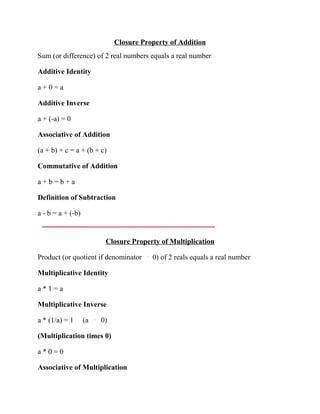
Closure Property of Addition
Sum (or difference) of 2 real numbers equals a real number

Additive Identity

a+0=a

Additive Inverse

a + (-a) = 0

Associative of Addition

(a + b) + c = a + (b + c)

Commutative of Addition

a+b=b+a

Definition of Subtraction

a - b = a + (-b)


                         Closure Property of Multiplication

Product (or quotient if denominator     0) of 2 reals equals a real number

Multiplicative Identity

a*1=a

Multiplicative Inverse

a * (1/a) = 1      (a   0)

(Multiplication times 0)

a*0=0

Associative of Multiplication
(a * b) * c = a * (b * c)

Commutative of Multiplication

a*b=b*a

Distributive Law

a(b + c) = ab + ac

Definition of Division

a / b = a(1/b)


                                     Conic Section


The General Equation for a Conic Section:
Ax2 + Bxy + Cy2 + Dx + Ey + F = 0

The type of section can be found from the sign of: B2 - 4AC

If B2 - 4AC is... then the curve is a...
 <0               ellipse, circle, point or no curve.
 =0               parabola, 2 parallel lines, 1 line or no curve.
 >0               hyperbola or 2 intersecting lines.

The Conic Sections. For any of the below with a center (j, k) instead of (0, 0),
replace each x term with (x-j) and each y term with (y-k).

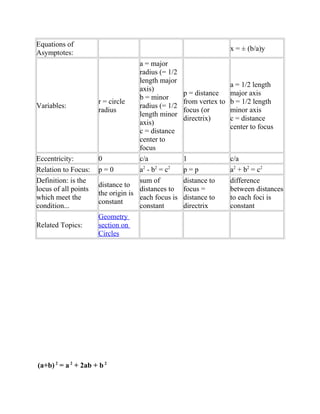
                      Circle         Ellipse         Parabola       Hyperbola
Equation (horiz.                     x2 / a2 + y2/
                      x2 + y2 = r2                   4px = y2       x2 / a2 - y2 / b2= 1
vertex):                             b2 = 1
Equations of
                                                                    y = ± (b/a)x
Asymptotes:
Equation (vert.                      y2 / a2 + x2/
                      x2 + y2 = r2                   4py = x2       y2 / a2 - x2 / b2= 1
vertex):                             b2 = 1
Equations of
                                                                   x = ± (b/a)y
Asymptotes:
                                    a = major
                                    radius (= 1/2
                                    length major
                                                                   a = 1/2 length
                                    axis)
                                                    p = distance   major axis
                                    b = minor
                      r = circle                    from vertex to b = 1/2 length
Variables:                          radius (= 1/2
                      radius                        focus (or      minor axis
                                    length minor
                                                    directrix)     c = distance
                                    axis)
                                                                   center to focus
                                    c = distance
                                    center to
                                    focus
Eccentricity:         0             c/a             1              c/a
Relation to Focus:    p=0           a2 - b2 = c2    p=p            a2 + b2 = c2
Definition: is the                  sum of          distance to    difference
                      distance to
locus of all points                 distances to    focus =        between distances
                      the origin is
which meet the                      each focus is   distance to    to each foci is
                      constant
condition...                        constant        directrix      constant
                      Geometry
Related Topics:       section on
                      Circles


(a+b) 2 = a 2 + 2ab + b 2
(a+b)(c+d) = ac + ad + bc + bd

a 2 - b 2 = (a+b)(a-b) (Difference of squares)

a3       b 3 = (a       b)(a 2   ab + b 2) (Sum and Difference of Cubes)

x 2 + (a+b)x + AB = (x + a)(x + b)

if ax 2 + bx + c = 0 then x = ( -b              (b 2 - 4ac) ) / 2a (Quadratic Formula)


                                            Powers

x a x b = x (a + b)

x a y a = (xy) a

(x a) b = x (ab)

x (a/b) = bth root of (x a) = ( bth   (x) ) a

x (-a) = 1 / x a

x (a - b) = x a / x b


                                         Logarithms

y = logb(x) if and only if x=b y

logb(1) = 0

logb(b) = 1

logb(x*y) = logb(x) + logb(y)

logb(x/y) = logb(x) - logb(y)

logb(x n) = n logb(x)
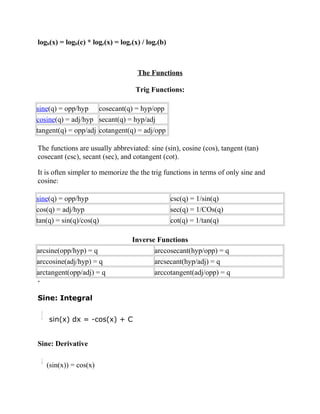
logb(x) = logb(c) * logc(x) = logc(x) / logc(b)


                                    The Functions

                                   Trig Functions:

sine(q) = opp/hyp cosecant(q) = hyp/opp
cosine(q) = adj/hyp secant(q) = hyp/adj
tangent(q) = opp/adj cotangent(q) = adj/opp

The functions are usually abbreviated: sine (sin), cosine (cos), tangent (tan)
cosecant (csc), secant (sec), and cotangent (cot).

It is often simpler to memorize the the trig functions in terms of only sine and
cosine:

sine(q) = opp/hyp                                 csc(q) = 1/sin(q)
cos(q) = adj/hyp                                  sec(q) = 1/COs(q)
tan(q) = sin(q)/cos(q)                            cot(q) = 1/tan(q)

                                  Inverse Functions
arcsine(opp/hyp) = q                     arccosecant(hyp/opp) = q
arccosine(adj/hyp) = q                   arcsecant(hyp/adj) = q
arctangent(opp/adj) = q                  arccotangent(adj/opp) = q
‘

Sine: Integral


    sin(x) dx = -cos(x) + C


Sine: Derivative

   (sin(x)) = cos(x)
Sine: Expansions

Series:

sin(x) =     (-1)k x2k+1 / (2k+1)!
= x - (1/3!)x3 + (1/5!)x5 - (1/7!)x7
(This can be derived from Taylor's Theorem.)

Product:

sin(x) = x (1 - (x / kPI)2)
= x(1 - (x/PI)2)(1 - (x/2PI)2)(1 - (x/3PI)2)*...


Cosine: Expansions

Series:

cos(x) =     (-1)k x2k / (2k)!
= 1 - (1/2!)x2 + (1/4!)x4 - (1/6!)x6
(This can be derived from Taylor's Theorem.)


Cosine: Derivative

   (cos(x)) = -sin(x)


Cosine: Integral

    cos(x) dx = -sin(x) + C
(pi =        = 3.141592...)

Area Formulas
Note: "ab" means "a" multiplied by "b". "a2" means "a squared", which is the same as "a" times
"a".

Be careful!! Units count. Use the same units for all measurements. Examples


square = a 2


rectangle = ab


parallelogram = bh


trapezoid = h/2 (b1 + b2)


circle = pi r 2


ellipse = pi r1 r2


                                                        one half times the base length times the
triangle =
                                                        height of the triangle
equilateral triangle =


triangle given SAS (two sides and the opposite angle)
= (1/2) a b sin C

triangle given a,b,c =   [s(s-a)(s-b)(s-c)] when s = (a+b+c)/2 (Heron's
formula)

regular polygon = (1/2) n sin(360°/n) S2
  when n = # of sides and S = length from center to a corner


cube = a 3


rectangular prism = a b c


irregular prism = b h


cylinder = b h = pi r 2 h


pyramid = (1/3) b h


cone = (1/3) b h = 1/3 pi r 2 h
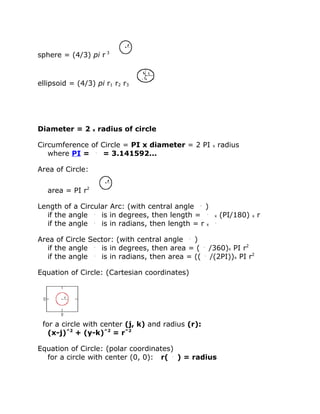
sphere = (4/3) pi r 3


ellipsoid = (4/3) pi r1 r2 r3


Diameter = 2      x   radius of circle

Circumference of Circle = PI x diameter = 2 PI       x   radius
   where PI =     = 3.141592...

Area of Circle:

   area = PI r2

Length of a Circular Arc: (with central angle    )
  if the angle    is in degrees, then length =       x   (PI/180)   x   r
  if the angle    is in radians, then length = r x

Area of Circle Sector: (with central angle   )
   if the angle   is in degrees, then area = (     /360)x PI r2
   if the angle   is in radians, then area = ((    /(2PI))x PI r2

Equation of Circle: (Cartesian coordinates)


 for a circle with center (j, k) and radius (r):
   (x-j)^2 + (y-k)^2 = r^2

Equation of Circle: (polar coordinates)
  for a circle with center (0, 0): r( ) = radius
for a circle with center with polar coordinates: (c,   ) and
radius a:
    r2 - 2cr cos(     -   ) + c2 = a2

Equation of a Circle: (parametric coordinates)
  for a circle with origin (j, k) and radius r:
   x(t) = r cos(t) + j         y(t) = r sin(t) + k


VECTORS


|<a, b>| = magnitude of vector =       (a 2+ b 2)

|<x1, .., xn>| =   (x12+ .. + xn2)

<a, b> + <c, d> = <a+c, b+d>

<x1, .., xn> + <y1, .., yn>= < x1+y1, .., xn+yn>

k <a, b> = <ka, kb>
k <x1, .., xn> = <k x1, .., k x2>


<a, b>         <c, d> = ac + bd

<x1, .., xn>        <y1, ..,yn> = x1 y1 + .. + xn yn>

R       S= |R| |S| cos         (    = angle between them)

R       S= S        R

(a R)      (bS) = (ab) R           S

R       (S + T)= R          S+ R        T

R       R = |R| 2


|R x S| = |R| |S| sin    (   = angle between both vectors).
Direction of R xS is perpendicular to A & B and according to the
right hand rule.
         | i   j   k |

R x S = | r1 r2 r3 | = / |r2 r3|       |r3 r1|   |r1 r2| 

         | s1 s2 s3 |      |s2 s3| , |s3 s1| , |s1 s2| /


SxR=-RxS

(a R) x S = R x (a S) = a (Rx S)

R x (S + T) = R x S + Rx T

RxR=0


If a, b, c = angles between the unit vectors i, j,k and R Then the
direction cosines are set by:

   COs a = (R            i) / |R|; COs b = (R          j) / |R|; COs c = (R   k)
/ |R|
|R x S| = Area of parrallagram with sides Rand S.

Component of R in the direction of S = |R|COs                 = (R        S) / |S|
(scalar result)

Projection of R in the direction of S = |R|COs               = (R        S) S/ |
S| 2 (vector result)


Basic Operations

i=          (-1)

i 2 = -1

1 / i = -i

i 4k = 1; i (4k+1) = i; i (4k+2) = -1; i (4k+3) = -i (k = integer)

       (i)=        (1/2)+       (1/2) i


Complex Definitions of Functions and Operations

(a + bi) + (c + di) = (a+c) + (b + d) i

(a + BI) (c + DI) = ac + adi + bci + bdi 2 = (ac - bd) + (ad +bc) i

1/(a + BI) = a/(a 2 + b 2) - b/(a 2 + b 2) i

(a + BI) / (c + DI) = (ac + BD)/(c 2 + d 2) + (BC - ad)/(c 2 +d 2) i

a2 + b2 = (a + BI) (a - BI)               (sum of squares)

e (i    )
            = cos     + i sin

n (a + BI) = (COs(b ln n) + i sin(b ln n))n a

if z = r(COs  + i sin             ) then z n = r n ( COs n   + i sin n     )
(DeMoivre's Theorem)
if w = r(COs    + i sin   );n=integer, then there are n complex nth
roots (z) of w for k=0,1,..n-1:

z(k) = r (1/n) [ COs( (    + 2(PI)k)/n ) + i sin( (    + 2(PI)k)/n ) ]

if z = r (COs    + i sin     ) then ln(z) = ln r + i

sin(a + BI) = sin(a)cosh(b) + COs(a)sinh(b) i

COs(a + BI) = COs(a)cosh(b) - sin(a)sinh(b) i

tan(a + BI) = ( tan(a) + i tanh(b) ) / ( 1 - i tan(a) tanh(b))
= ( sech 2(b)tan(a) + sec 2(a)tanh(b) i ) / (1 + tan 2(a)tanh 2(b))


                                FUNCTIONS

The fourier series of the function f(x)


a(0) / 2 +      (k=1..      ) (a(k) cos kx + b(k) sin kx)


a(k) = 1/PI           f(x) cos kx dx
b(k) = 1/PI           f(x) sin kx dx
   Remainder of fourier series. Sn(x) = sum of first n+1 terms
at x.


remainder(n) = f(x) - Sn(x) = 1/PI                    f(x+t) Dn(t) dt


Sn(x) = 1/PI              f(x+t) Dn(t) dt

Dn(x) = Dirichlet kernel = 1/2 + cos x + cos 2x + .. + cos nx
= [ sin(n + 1/2)x ] / [ 2sin(x/2) ]
    Riemann's Theorem. If f(x) is continuous except for a finite #
of finite jumps in every finite interval then:


lim(k->   )       f(t) cos kt dt = lim(k->     )       f(t) sin kt dt = 0
The fourier series of the function f(x) in an arbitrary
interval.


A(0) / 2 +   (k=1..     ) [ A(k) cos (k(PI)x / m) + B(k) (sin
k(PI)x / m) ]


a(k) = 1/m        f(x) cos (k(PI)x / m) dx

b(k) = 1/m         f(x) sin (k(PI)x / m) dx
   Parseval's Theorem. If f(x) is continuous; f(-PI) = f(PI) then


1/PI       f^2(x) dx = a(0)^2 / 2 +       (k=1..      ) (a(k)^2 +
b(k)^2)

   Fourier Integral of the function f(x)


f(x) =        ( a(y) cos yx + b(y) sin yx ) dy


a(y) = 1/PI        f(t) cos ty dt

b(y) = 1/PI         f(t) sin ty dt

f(x) = 1/PI        dy       f(t) cos (y(x-t)) dt

   Special Cases of Fourier Integral

if f(x) = f(-x) then


f(x) = 2/PI        cos xy dy         f(t) cos yt dt
if f(-x) = -f(x) then
f(x) = 2/PI      sin xy dy           sin yt dt
   Fourier Transforms

Fourier Cosine Transform
g(x) =     (2/PI)      f(t) cos xt dt

Fourier Sine Transform


g(x) =     (2/PI)      f(t) sin xt dt

   Identities of the Transforms

If f(-x) = f(x) then

Fourier Cosine Transform ( Fourier Cosine Transform (f(x)) )
= f(x)
If f(-x) = -f(x) then
Fourier Sine Transform (Fourier Sine Transform (f(x)) ) =
f(x)

Maths formulae

  • 1.
    Closure Property ofAddition Sum (or difference) of 2 real numbers equals a real number Additive Identity a+0=a Additive Inverse a + (-a) = 0 Associative of Addition (a + b) + c = a + (b + c) Commutative of Addition a+b=b+a Definition of Subtraction a - b = a + (-b) Closure Property of Multiplication Product (or quotient if denominator 0) of 2 reals equals a real number Multiplicative Identity a*1=a Multiplicative Inverse a * (1/a) = 1 (a 0) (Multiplication times 0) a*0=0 Associative of Multiplication
  • 2.
    (a * b)* c = a * (b * c) Commutative of Multiplication a*b=b*a Distributive Law a(b + c) = ab + ac Definition of Division a / b = a(1/b) Conic Section The General Equation for a Conic Section: Ax2 + Bxy + Cy2 + Dx + Ey + F = 0 The type of section can be found from the sign of: B2 - 4AC If B2 - 4AC is... then the curve is a... <0 ellipse, circle, point or no curve. =0 parabola, 2 parallel lines, 1 line or no curve. >0 hyperbola or 2 intersecting lines. The Conic Sections. For any of the below with a center (j, k) instead of (0, 0), replace each x term with (x-j) and each y term with (y-k). Circle Ellipse Parabola Hyperbola Equation (horiz. x2 / a2 + y2/ x2 + y2 = r2 4px = y2 x2 / a2 - y2 / b2= 1 vertex): b2 = 1 Equations of y = ± (b/a)x Asymptotes: Equation (vert. y2 / a2 + x2/ x2 + y2 = r2 4py = x2 y2 / a2 - x2 / b2= 1 vertex): b2 = 1
  • 3.
    Equations of x = ± (b/a)y Asymptotes: a = major radius (= 1/2 length major a = 1/2 length axis) p = distance major axis b = minor r = circle from vertex to b = 1/2 length Variables: radius (= 1/2 radius focus (or minor axis length minor directrix) c = distance axis) center to focus c = distance center to focus Eccentricity: 0 c/a 1 c/a Relation to Focus: p=0 a2 - b2 = c2 p=p a2 + b2 = c2 Definition: is the sum of distance to difference distance to locus of all points distances to focus = between distances the origin is which meet the each focus is distance to to each foci is constant condition... constant directrix constant Geometry Related Topics: section on Circles (a+b) 2 = a 2 + 2ab + b 2
  • 4.
    (a+b)(c+d) = ac+ ad + bc + bd a 2 - b 2 = (a+b)(a-b) (Difference of squares) a3 b 3 = (a b)(a 2 ab + b 2) (Sum and Difference of Cubes) x 2 + (a+b)x + AB = (x + a)(x + b) if ax 2 + bx + c = 0 then x = ( -b (b 2 - 4ac) ) / 2a (Quadratic Formula) Powers x a x b = x (a + b) x a y a = (xy) a (x a) b = x (ab) x (a/b) = bth root of (x a) = ( bth (x) ) a x (-a) = 1 / x a x (a - b) = x a / x b Logarithms y = logb(x) if and only if x=b y logb(1) = 0 logb(b) = 1 logb(x*y) = logb(x) + logb(y) logb(x/y) = logb(x) - logb(y) logb(x n) = n logb(x)
  • 5.
    logb(x) = logb(c)* logc(x) = logc(x) / logc(b) The Functions Trig Functions: sine(q) = opp/hyp cosecant(q) = hyp/opp cosine(q) = adj/hyp secant(q) = hyp/adj tangent(q) = opp/adj cotangent(q) = adj/opp The functions are usually abbreviated: sine (sin), cosine (cos), tangent (tan) cosecant (csc), secant (sec), and cotangent (cot). It is often simpler to memorize the the trig functions in terms of only sine and cosine: sine(q) = opp/hyp csc(q) = 1/sin(q) cos(q) = adj/hyp sec(q) = 1/COs(q) tan(q) = sin(q)/cos(q) cot(q) = 1/tan(q) Inverse Functions arcsine(opp/hyp) = q arccosecant(hyp/opp) = q arccosine(adj/hyp) = q arcsecant(hyp/adj) = q arctangent(opp/adj) = q arccotangent(adj/opp) = q ‘ Sine: Integral sin(x) dx = -cos(x) + C Sine: Derivative (sin(x)) = cos(x)
  • 6.
    Sine: Expansions Series: sin(x) = (-1)k x2k+1 / (2k+1)! = x - (1/3!)x3 + (1/5!)x5 - (1/7!)x7 (This can be derived from Taylor's Theorem.) Product: sin(x) = x (1 - (x / kPI)2) = x(1 - (x/PI)2)(1 - (x/2PI)2)(1 - (x/3PI)2)*... Cosine: Expansions Series: cos(x) = (-1)k x2k / (2k)! = 1 - (1/2!)x2 + (1/4!)x4 - (1/6!)x6 (This can be derived from Taylor's Theorem.) Cosine: Derivative (cos(x)) = -sin(x) Cosine: Integral cos(x) dx = -sin(x) + C
  • 7.
    (pi = = 3.141592...) Area Formulas Note: "ab" means "a" multiplied by "b". "a2" means "a squared", which is the same as "a" times "a". Be careful!! Units count. Use the same units for all measurements. Examples square = a 2 rectangle = ab parallelogram = bh trapezoid = h/2 (b1 + b2) circle = pi r 2 ellipse = pi r1 r2 one half times the base length times the triangle = height of the triangle
  • 8.
    equilateral triangle = trianglegiven SAS (two sides and the opposite angle) = (1/2) a b sin C triangle given a,b,c = [s(s-a)(s-b)(s-c)] when s = (a+b+c)/2 (Heron's formula) regular polygon = (1/2) n sin(360°/n) S2 when n = # of sides and S = length from center to a corner cube = a 3 rectangular prism = a b c irregular prism = b h cylinder = b h = pi r 2 h pyramid = (1/3) b h cone = (1/3) b h = 1/3 pi r 2 h
  • 9.
    sphere = (4/3)pi r 3 ellipsoid = (4/3) pi r1 r2 r3 Diameter = 2 x radius of circle Circumference of Circle = PI x diameter = 2 PI x radius where PI = = 3.141592... Area of Circle: area = PI r2 Length of a Circular Arc: (with central angle ) if the angle is in degrees, then length = x (PI/180) x r if the angle is in radians, then length = r x Area of Circle Sector: (with central angle ) if the angle is in degrees, then area = ( /360)x PI r2 if the angle is in radians, then area = (( /(2PI))x PI r2 Equation of Circle: (Cartesian coordinates) for a circle with center (j, k) and radius (r): (x-j)^2 + (y-k)^2 = r^2 Equation of Circle: (polar coordinates) for a circle with center (0, 0): r( ) = radius
  • 10.
    for a circlewith center with polar coordinates: (c, ) and radius a: r2 - 2cr cos( - ) + c2 = a2 Equation of a Circle: (parametric coordinates) for a circle with origin (j, k) and radius r: x(t) = r cos(t) + j y(t) = r sin(t) + k VECTORS |<a, b>| = magnitude of vector = (a 2+ b 2) |<x1, .., xn>| = (x12+ .. + xn2) <a, b> + <c, d> = <a+c, b+d> <x1, .., xn> + <y1, .., yn>= < x1+y1, .., xn+yn> k <a, b> = <ka, kb>
  • 11.
    k <x1, ..,xn> = <k x1, .., k x2> <a, b> <c, d> = ac + bd <x1, .., xn> <y1, ..,yn> = x1 y1 + .. + xn yn> R S= |R| |S| cos ( = angle between them) R S= S R (a R) (bS) = (ab) R S R (S + T)= R S+ R T R R = |R| 2 |R x S| = |R| |S| sin ( = angle between both vectors). Direction of R xS is perpendicular to A & B and according to the right hand rule. | i j k | R x S = | r1 r2 r3 | = / |r2 r3| |r3 r1| |r1 r2| | s1 s2 s3 | |s2 s3| , |s3 s1| , |s1 s2| / SxR=-RxS (a R) x S = R x (a S) = a (Rx S) R x (S + T) = R x S + Rx T RxR=0 If a, b, c = angles between the unit vectors i, j,k and R Then the direction cosines are set by: COs a = (R i) / |R|; COs b = (R j) / |R|; COs c = (R k) / |R|
  • 12.
    |R x S|= Area of parrallagram with sides Rand S. Component of R in the direction of S = |R|COs = (R S) / |S| (scalar result) Projection of R in the direction of S = |R|COs = (R S) S/ | S| 2 (vector result) Basic Operations i= (-1) i 2 = -1 1 / i = -i i 4k = 1; i (4k+1) = i; i (4k+2) = -1; i (4k+3) = -i (k = integer) (i)= (1/2)+ (1/2) i Complex Definitions of Functions and Operations (a + bi) + (c + di) = (a+c) + (b + d) i (a + BI) (c + DI) = ac + adi + bci + bdi 2 = (ac - bd) + (ad +bc) i 1/(a + BI) = a/(a 2 + b 2) - b/(a 2 + b 2) i (a + BI) / (c + DI) = (ac + BD)/(c 2 + d 2) + (BC - ad)/(c 2 +d 2) i a2 + b2 = (a + BI) (a - BI) (sum of squares) e (i ) = cos + i sin n (a + BI) = (COs(b ln n) + i sin(b ln n))n a if z = r(COs + i sin ) then z n = r n ( COs n + i sin n ) (DeMoivre's Theorem)
  • 13.
    if w =r(COs + i sin );n=integer, then there are n complex nth roots (z) of w for k=0,1,..n-1: z(k) = r (1/n) [ COs( ( + 2(PI)k)/n ) + i sin( ( + 2(PI)k)/n ) ] if z = r (COs + i sin ) then ln(z) = ln r + i sin(a + BI) = sin(a)cosh(b) + COs(a)sinh(b) i COs(a + BI) = COs(a)cosh(b) - sin(a)sinh(b) i tan(a + BI) = ( tan(a) + i tanh(b) ) / ( 1 - i tan(a) tanh(b)) = ( sech 2(b)tan(a) + sec 2(a)tanh(b) i ) / (1 + tan 2(a)tanh 2(b)) FUNCTIONS The fourier series of the function f(x) a(0) / 2 + (k=1.. ) (a(k) cos kx + b(k) sin kx) a(k) = 1/PI f(x) cos kx dx b(k) = 1/PI f(x) sin kx dx Remainder of fourier series. Sn(x) = sum of first n+1 terms at x. remainder(n) = f(x) - Sn(x) = 1/PI f(x+t) Dn(t) dt Sn(x) = 1/PI f(x+t) Dn(t) dt Dn(x) = Dirichlet kernel = 1/2 + cos x + cos 2x + .. + cos nx = [ sin(n + 1/2)x ] / [ 2sin(x/2) ] Riemann's Theorem. If f(x) is continuous except for a finite # of finite jumps in every finite interval then: lim(k-> ) f(t) cos kt dt = lim(k-> ) f(t) sin kt dt = 0
  • 14.
    The fourier seriesof the function f(x) in an arbitrary interval. A(0) / 2 + (k=1.. ) [ A(k) cos (k(PI)x / m) + B(k) (sin k(PI)x / m) ] a(k) = 1/m f(x) cos (k(PI)x / m) dx b(k) = 1/m f(x) sin (k(PI)x / m) dx Parseval's Theorem. If f(x) is continuous; f(-PI) = f(PI) then 1/PI f^2(x) dx = a(0)^2 / 2 + (k=1.. ) (a(k)^2 + b(k)^2) Fourier Integral of the function f(x) f(x) = ( a(y) cos yx + b(y) sin yx ) dy a(y) = 1/PI f(t) cos ty dt b(y) = 1/PI f(t) sin ty dt f(x) = 1/PI dy f(t) cos (y(x-t)) dt Special Cases of Fourier Integral if f(x) = f(-x) then f(x) = 2/PI cos xy dy f(t) cos yt dt if f(-x) = -f(x) then f(x) = 2/PI sin xy dy sin yt dt Fourier Transforms Fourier Cosine Transform
  • 15.
    g(x) = (2/PI) f(t) cos xt dt Fourier Sine Transform g(x) = (2/PI) f(t) sin xt dt Identities of the Transforms If f(-x) = f(x) then Fourier Cosine Transform ( Fourier Cosine Transform (f(x)) ) = f(x) If f(-x) = -f(x) then Fourier Sine Transform (Fourier Sine Transform (f(x)) ) = f(x)