Mathematics Form 1-Chapter 8 lines and angles KBSM of form 3 chp 1
This document contains notes on lines and angles from mathematics Form 3. It reviews concepts from Form 1 such as classifying angles and defining parallel and perpendicular lines. It then introduces new concepts like transversals, corresponding angles, interior angles, and alternate angles formed when a line crosses two parallel lines. It provides examples of using angle properties to solve problems involving triangles and quadrilaterals. Finally, it includes sample exercises involving finding missing angle measures using the properties of parallel lines crossed by a transversal.
Mathematics Form 1-Chapter 8 lines and angles KBSM of form 3 chp 1
1.
Mathematics Form 3– Chapter 1 Notes Prepared by Kelvin
1 | P a g e
Form 3 - Chapter 1 - Lines and Angle II [Notes Completely]
Review Form 1 - Chapter 9 - Lines and Angle
9.1 Angles
To compare and classify angles
Name of angle Value of angle Diagram of angle
Acute angle 0° < 90°
Right angle =90°
Obtuse angle 90° < 180°
Straight angle = 180°
Reflex angle 180° < 360°
Whole angle =360°
Determine the angle on a straight line equals 180°.
1. The sum of angles on a straight line is 180˚.
2. In diagram 2, a + b + c = 180°.
3. The value of any angle on a straight line can be found by
subtracting the angle given from 180°.
Determine the angle on a complete turn equals 360°.
1. The sum of angles on a straight line is 360˚.
2. In diagram 3, a + b + c = 360°.
3. The value of any angle on a whole turn can be found
by subtracting the angle given from 360°.
9.2 Parallel and perpendicular lines
To determine parallel lines
Parallel lines are: a) two straight lines do not intersect or meet a point.
b) distance between the lines are always the same.
Table 1
2.
Mathematics Form 3– Chapter 1 Notes Prepared by Kelvin
2 | P a g e
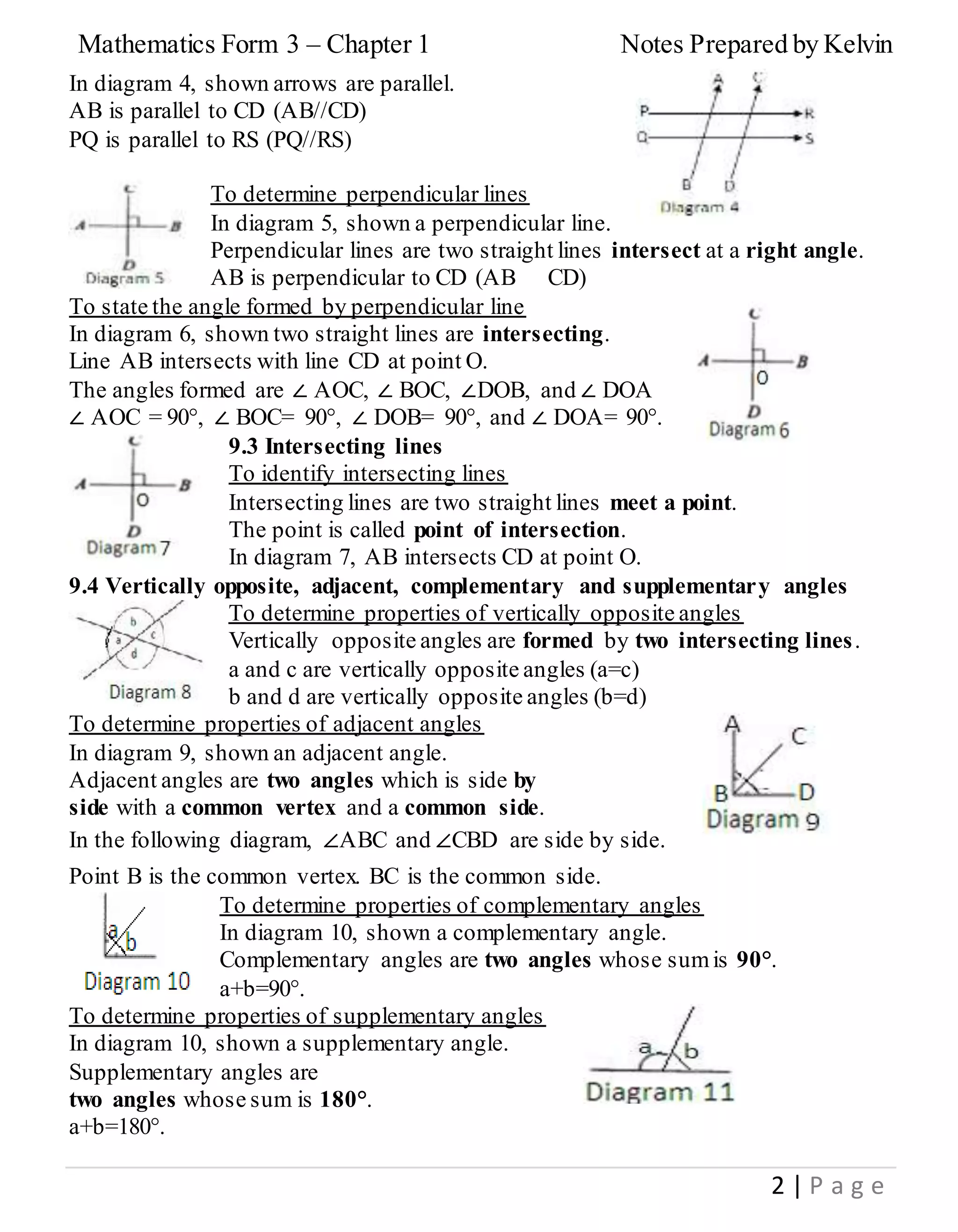
In diagram 4, shown arrows are parallel.
AB is parallel to CD (AB//CD)
PQ is parallel to RS (PQ//RS)
To determine perpendicular lines
In diagram 5, shown a perpendicular line.
Perpendicular lines are two straight lines intersect at a right angle.
AB is perpendicular to CD (AB CD)
To state the angle formed by perpendicular line
In diagram 6, shown two straight lines are intersecting.
Line AB intersects with line CD at point O.
The angles formed are ∠ AOC, ∠ BOC, ∠DOB, and ∠ DOA
∠ AOC = 90°, ∠ BOC= 90°, ∠ DOB= 90°, and ∠ DOA= 90°.
9.3 Intersecting lines
To identify intersecting lines
Intersecting lines are two straight lines meet a point.
The point is called point of intersection.
In diagram 7, AB intersects CD at point O.
9.4 Vertically opposite, adjacent, complementary and supplementary angles
To determine properties of vertically opposite angles
Vertically opposite angles are formed by two intersecting lines.
a and c are vertically opposite angles (a=c)
b and d are vertically opposite angles (b=d)
To determine properties of adjacent angles
In diagram 9, shown an adjacent angle.
Adjacent angles are two angles which is side by
side with a common vertex and a common side.
In the following diagram, ∠ABC and ∠CBD are side by side.
Point B is the common vertex. BC is the common side.
To determine properties of complementary angles
In diagram 10, shown a complementary angle.
Complementary angles are two angles whose sumis 90°.
a+b=90°.
To determine properties of supplementary angles
In diagram 10, shown a supplementary angle.
Supplementary angles are
two angles whose sum is 180°.
a+b=180°.
3.
Mathematics Form 3– Chapter 1 Notes Prepared by Kelvin
3 | P a g e
Form 3 – Chapter 1 - Lines and Angle II
In this chapter, you will learn:
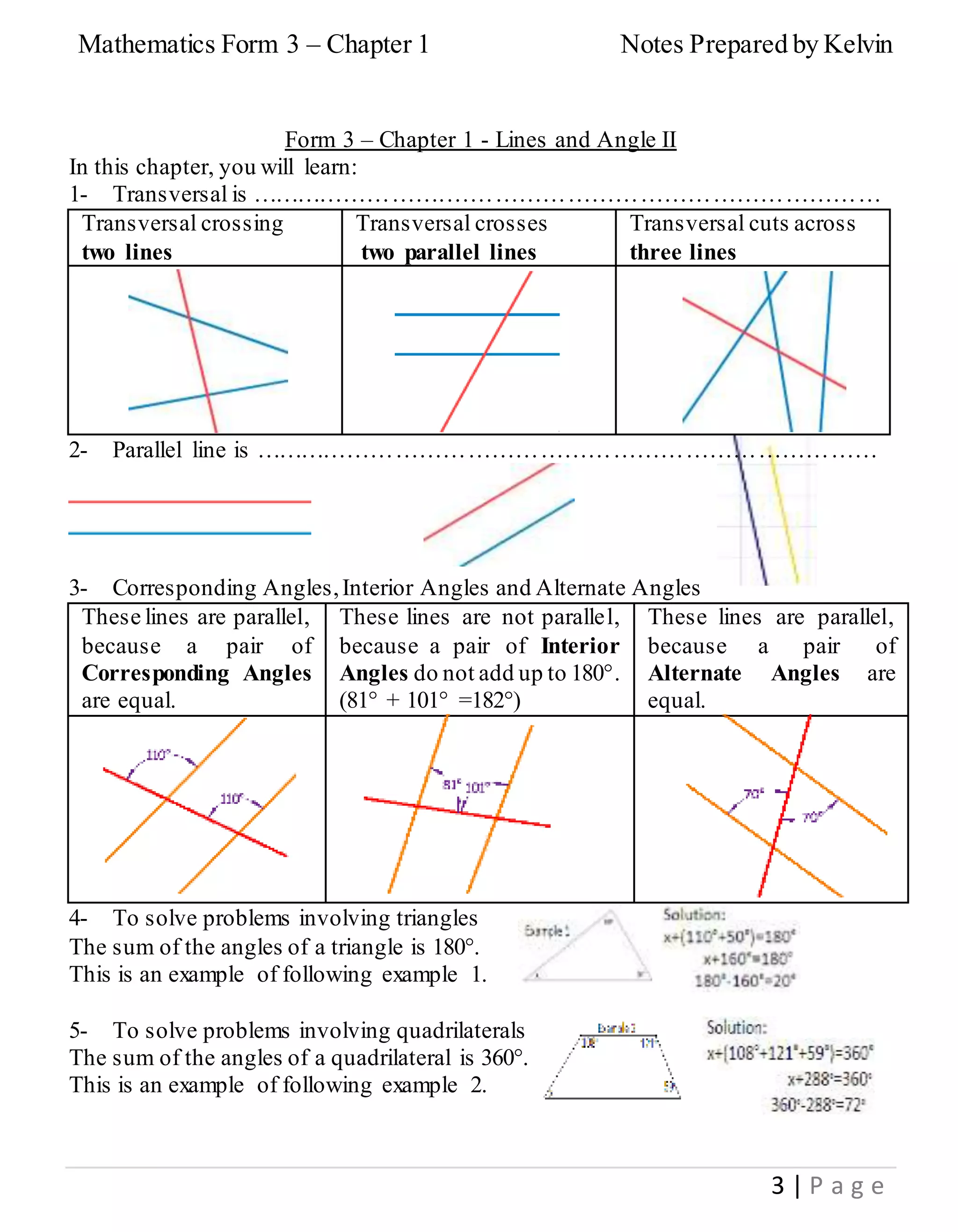
1- Transversal is …………………….………………………………………………
Transversal crossing
two lines
Transversal crosses
two parallel lines
Transversal cuts across
three lines
2- Parallel line is ……………………………………………………………………
3- Corresponding Angles,Interior Angles and Alternate Angles
These lines are parallel,
because a pair of
Corresponding Angles
are equal.
These lines are not parallel,
because a pair of Interior
Angles do not add up to 180°.
(81° + 101° =182°)
These lines are parallel,
because a pair of
Alternate Angles are
equal.
4- To solve problems involving triangles
The sum of the angles of a triangle is 180°.
This is an example of following example 1.
5- To solve problems involving quadrilaterals
The sum of the angles of a quadrilateral is 360°.
This is an example of following example 2.
4.
Mathematics Form 3– Chapter 1 Notes Prepared by Kelvin
4 | P a g e
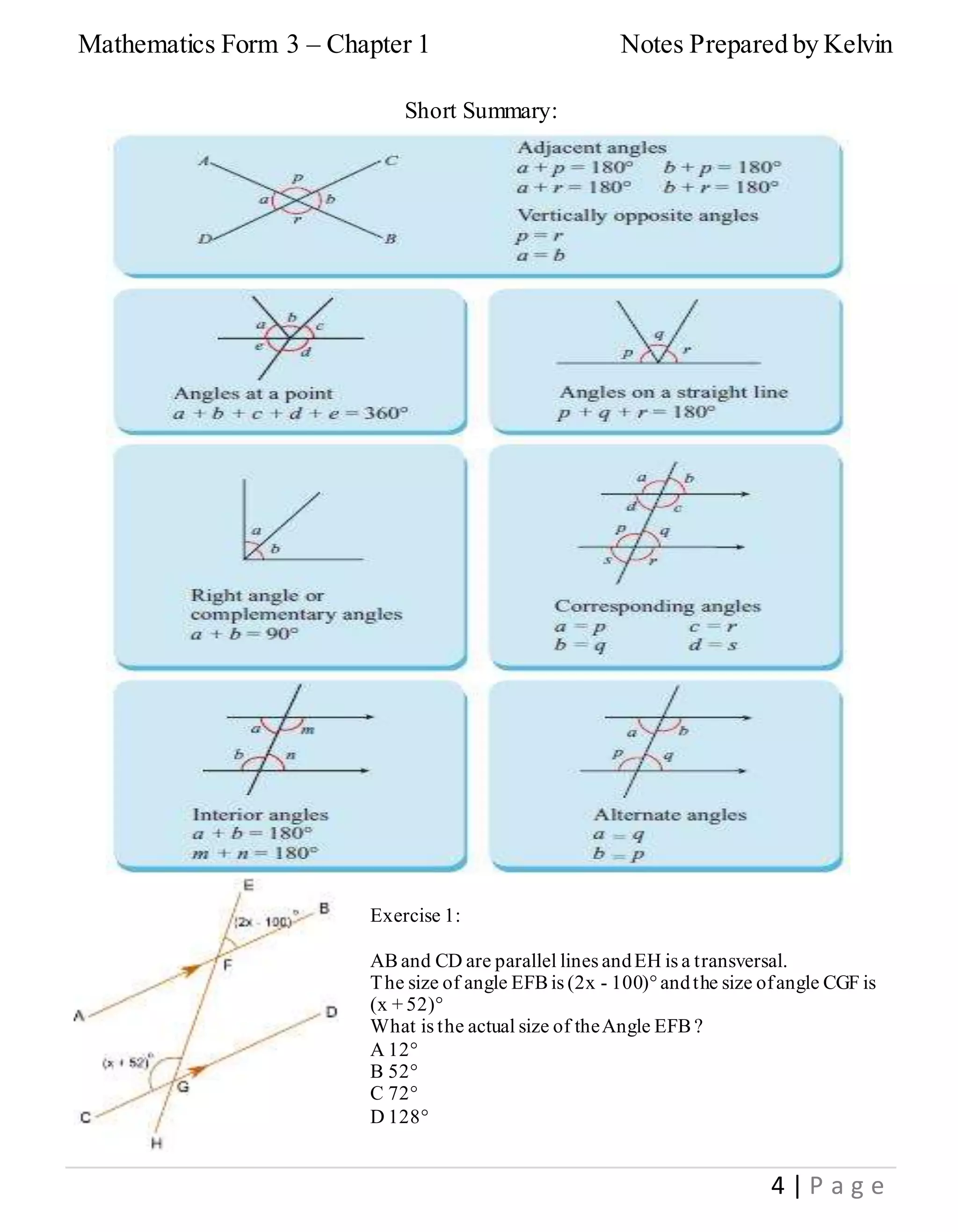
Short Summary:
Exercise 1:
AB and CD are parallel lines andEH is a transversal.
The size of angle EFB is (2x - 100)°andthe size ofangle CGF is
(x + 52)°
What is the actual size of theAngle EFB ?
A 12°
B 52°
C 72°
D 128°
5.
Mathematics Form 3– Chapter 1 Notes Prepared by Kelvin
5 | P a g e
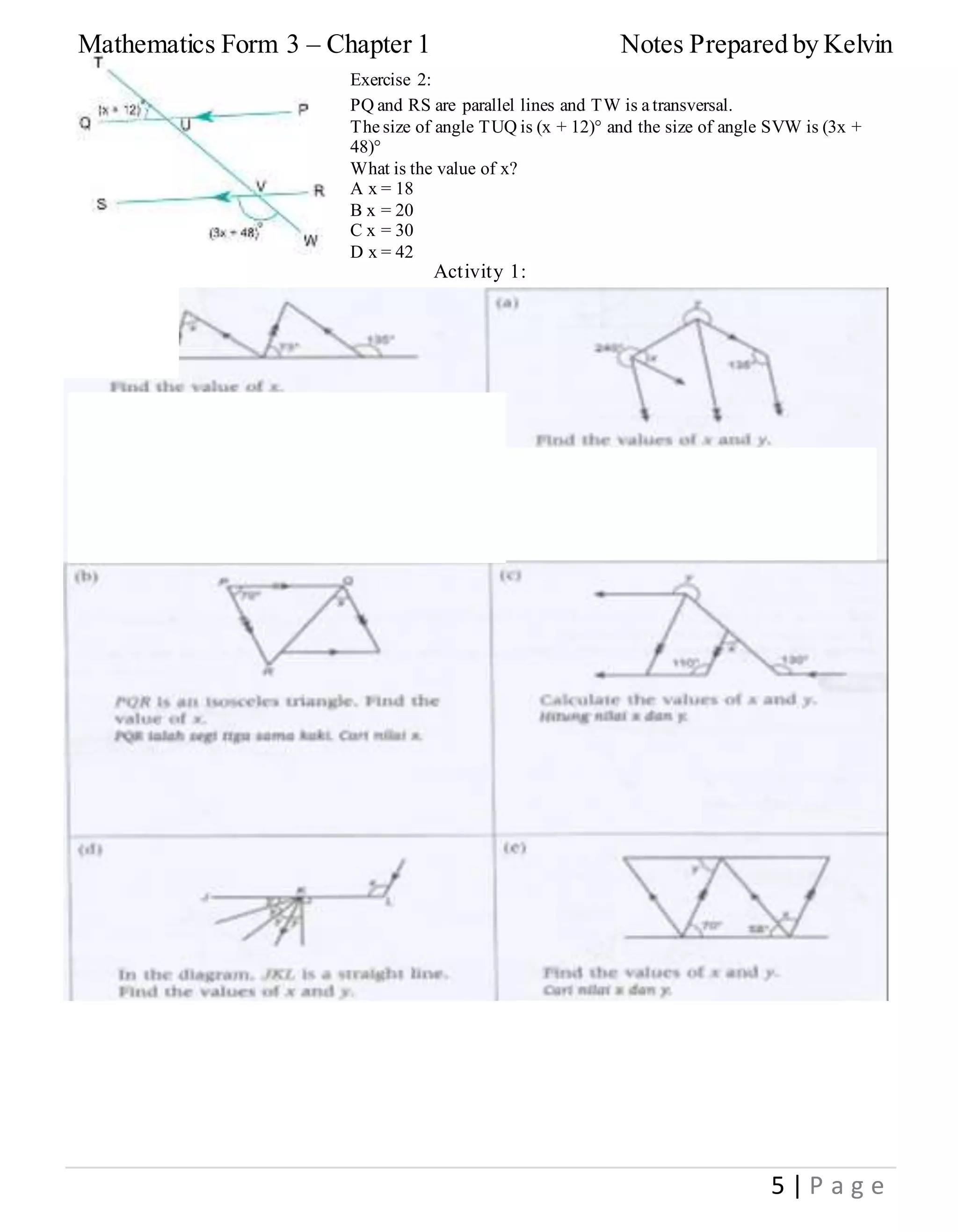
Exercise 2:
PQ and RS are parallel lines and TW is a transversal.
The size of angle TUQ is (x + 12)° and the size of angle SVW is (3x +
48)°
What is the value of x?
A x = 18
B x = 20
C x = 30
D x = 42
Activity 1:
6.
Mathematics Form 3– Chapter 1 Notes Prepared by Kelvin
6 | P a g e
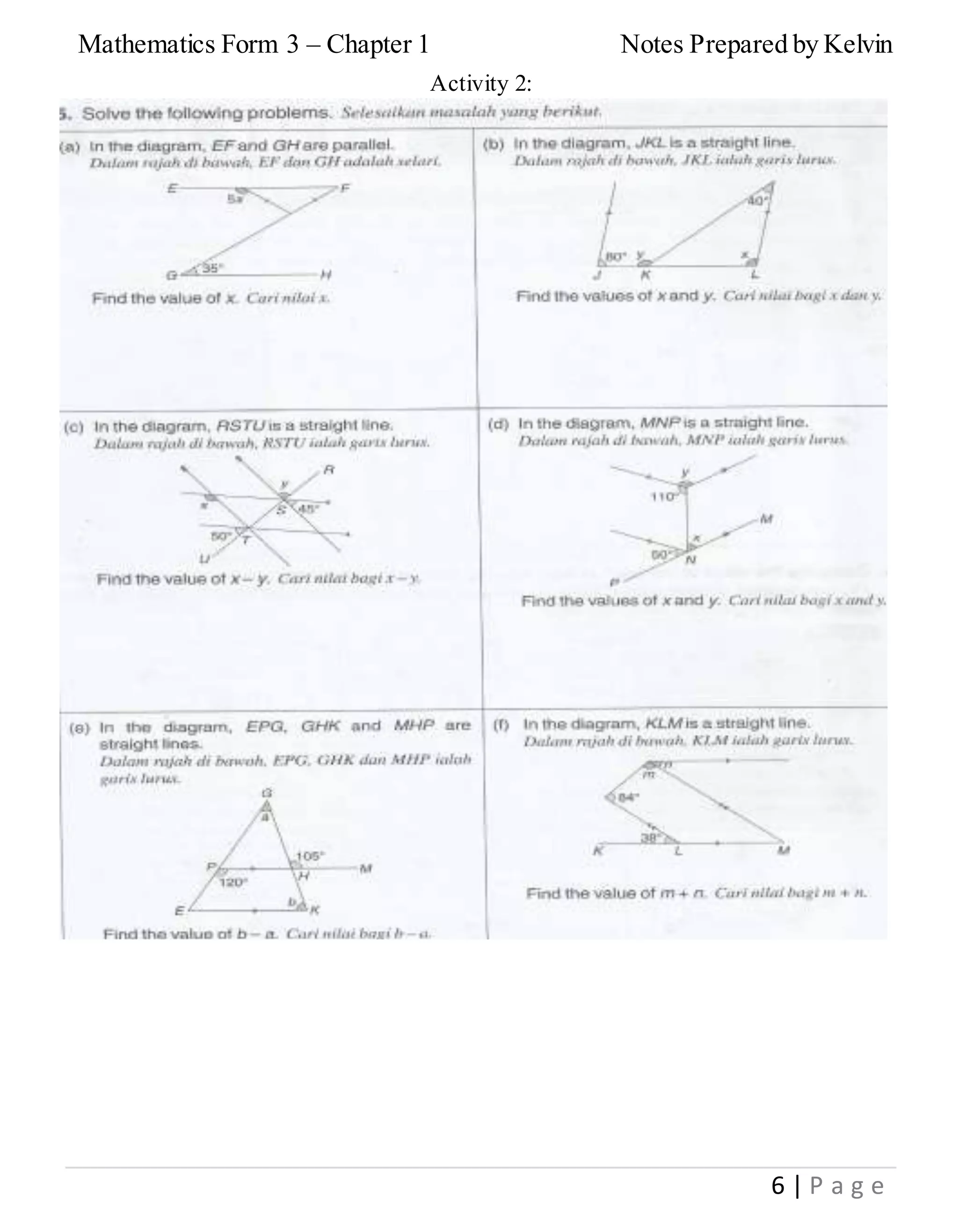
Activity 2:
![Mathematics Form 3 – Chapter 1 Notes Prepared by Kelvin
1 | P a g e
Form 3 - Chapter 1 - Lines and Angle II [Notes Completely]
Review Form 1 - Chapter 9 - Lines and Angle
9.1 Angles
To compare and classify angles
Name of angle Value of angle Diagram of angle
Acute angle 0° < 90°
Right angle =90°
Obtuse angle 90° < 180°
Straight angle = 180°
Reflex angle 180° < 360°
Whole angle =360°
Determine the angle on a straight line equals 180°.
1. The sum of angles on a straight line is 180˚.
2. In diagram 2, a + b + c = 180°.
3. The value of any angle on a straight line can be found by
subtracting the angle given from 180°.
Determine the angle on a complete turn equals 360°.
1. The sum of angles on a straight line is 360˚.
2. In diagram 3, a + b + c = 360°.
3. The value of any angle on a whole turn can be found
by subtracting the angle given from 360°.
9.2 Parallel and perpendicular lines
To determine parallel lines
Parallel lines are: a) two straight lines do not intersect or meet a point.
b) distance between the lines are always the same.
Table 1](https://image.slidesharecdn.com/mathematics-form3-chapter1linesandangleii-191107120328/75/Mathematics-Form-1-Chapter-8-lines-and-angles-KBSM-of-form-3-chp-1-1-2048.jpg)


![[NEW] Mathematics Form 1-Chapter 2 Factors and Multiples -Prime Number, Facto...](https://cdn.slidesharecdn.com/ss_thumbnails/mathematicschapter2-191107115424-thumbnail.jpg?width=640&height=640&fit=bounds)


