
UNIT 12.5 CIRCLES IN THEUNIT 12.5 CIRCLES IN THE
COORDINAGE PLANECOORDINAGE PLANE
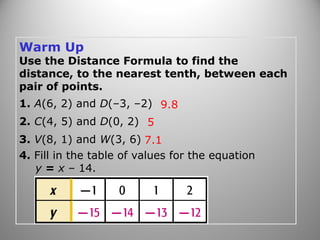
Warm Up
Use the Distance Formula to find the
distance, to the nearest tenth, between each
pair of points.
1. A(6, 2) and D(–3, –2)
2. C(4, 5) and D(0, 2)
3. V(8, 1) and W(3, 6)
9.8
5
7.1
4. Fill in the table of values for the equation
y = x – 14.
Write equations and graph circles
in the coordinate plane.
Use the equation and graph of a
circle to solve problems.
Objectives
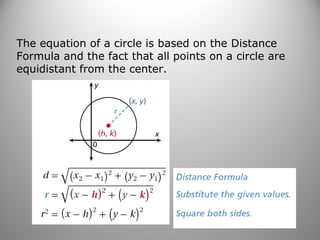
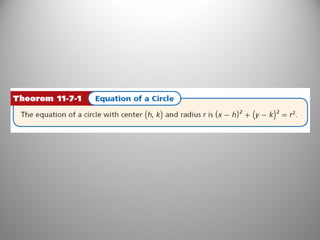
The equation of a circle is based on the Distance
Formula and the fact that all points on a circle are
equidistant from the center.
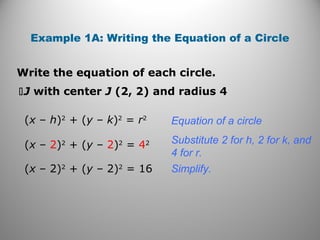
Example 1A: Writing the Equation of a Circle
Write the equation of each circle.
J with center J (2, 2) and radius 4
(x – h)2
+ (y – k)2
= r2
(x – 2)2
+ (y – 2)2
= 42
(x – 2)2
+ (y – 2)2
= 16
Equation of a circle
Substitute 2 for h, 2 for k, and
4 for r.
Simplify.
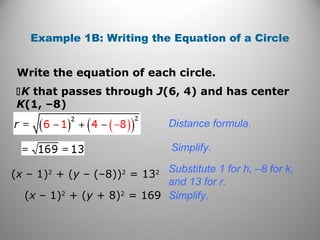
Example 1B: Writing the Equation of a Circle
Write the equation of each circle.
K that passes through J(6, 4) and has center
K(1, –8)
Distance formula.
Simplify.
(x – 1)2
+ (y – (–8))2
= 132
(x – 1)2
+ (y + 8)2
= 169
Substitute 1 for h, –8 for k,
and 13 for r.
Simplify.
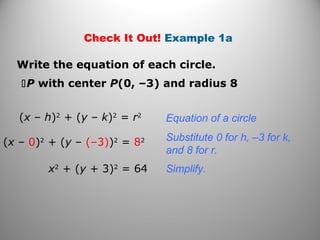
Check It Out! Example 1a
Write the equation of each circle.
P with center P(0, –3) and radius 8
(x – h)2
+ (y – k)2
= r2
(x – 0)2
+ (y – (–3))2
= 82
x2
+ (y + 3)2
= 64
Equation of a circle
Substitute 0 for h, –3 for k,
and 8 for r.
Simplify.
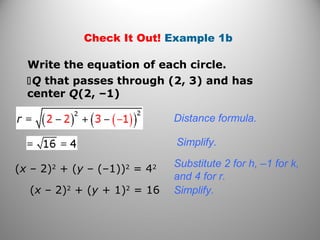
Check It Out! Example 1b
Write the equation of each circle.
Q that passes through (2, 3) and has
center Q(2, –1)
Distance formula.
Simplify.
(x – 2)2
+ (y – (–1))2
= 42
(x – 2)2
+ (y + 1)2
= 16
Substitute 2 for h, –1 for k,
and 4 for r.
Simplify.
If you are given the equation of a circle, you
can graph the circle by making a table or by
identifying its center and radius.
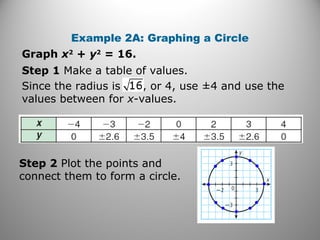
Example 2A: Graphing a Circle
Graph x2
+ y2
= 16.
Step 1 Make a table of values.
Since the radius is , or 4, use ±4 and use the
values between for x-values.
Step 2 Plot the points and
connect them to form a circle.
Example 2B: Graphing a Circle
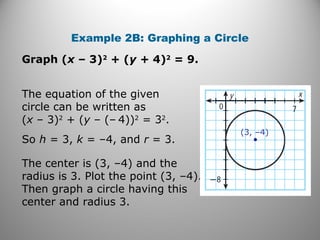
Graph (x – 3)2
+ (y + 4)2
= 9.
The equation of the given
circle can be written as
(x – 3)2
+ (y – (– 4))2
= 32
.
So h = 3, k = –4, and r = 3.
The center is (3, –4) and the
radius is 3. Plot the point (3, –4).
Then graph a circle having this
center and radius 3.
(3, –4)
Check It Out! Example 2a
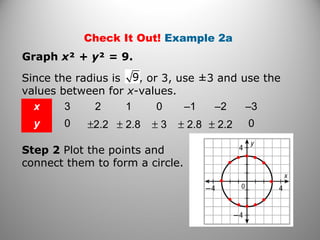
Graph x² + y² = 9.
Step 2 Plot the points and
connect them to form a circle.
Since the radius is , or 3, use ±3 and use the
values between for x-values.
x 3 2 1 0 –1 –2 –3
y 0 ±2.2 ± 2.8 ± 3 ± 2.8 ± 2.2 0
Check It Out! Example 2b
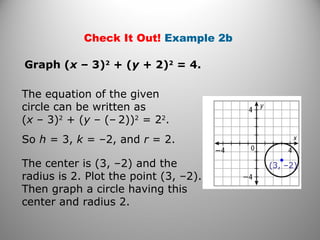
Graph (x – 3)2
+ (y + 2)2
= 4.
The equation of the given
circle can be written as
(x – 3)2
+ (y – (– 2))2
= 22
.
So h = 3, k = –2, and r = 2.
The center is (3, –2) and the
radius is 2. Plot the point (3, –2).
Then graph a circle having this
center and radius 2.
(3, –2)
Example 3: Radio Application
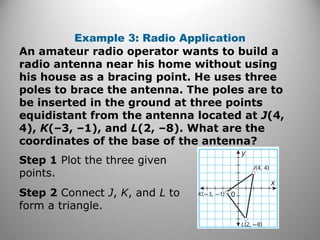
An amateur radio operator wants to build a
radio antenna near his home without using
his house as a bracing point. He uses three
poles to brace the antenna. The poles are to
be inserted in the ground at three points
equidistant from the antenna located at J(4,
4), K(–3, –1), and L(2, –8). What are the
coordinates of the base of the antenna?
Step 1 Plot the three given
points.
Step 2 Connect J, K, and L to
form a triangle.
Example 3 Continued
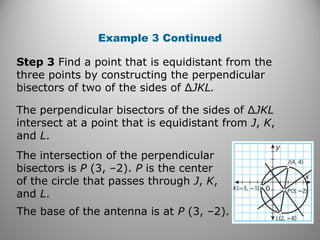
Step 3 Find a point that is equidistant from the
three points by constructing the perpendicular
bisectors of two of the sides of ∆JKL.
The perpendicular bisectors of the sides of ∆JKL
intersect at a point that is equidistant from J, K,
and L.
The intersection of the perpendicular
bisectors is P (3, –2). P is the center
of the circle that passes through J, K,
and L.
The base of the antenna is at P (3, –2).
Check It Out! Example 3
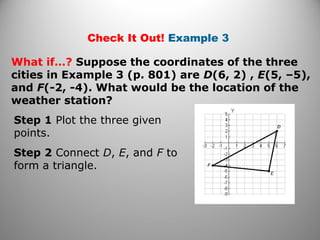
What if…? Suppose the coordinates of the three
cities in Example 3 (p. 801) are D(6, 2) , E(5, –5),
and F(-2, -4). What would be the location of the
weather station?
Step 1 Plot the three given
points.
Step 2 Connect D, E, and F to
form a triangle.
Check It Out! Example 3 Continued
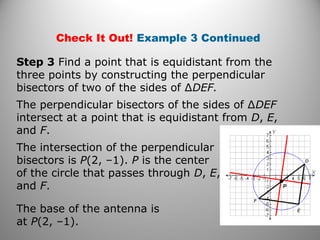
Step 3 Find a point that is equidistant from the
three points by constructing the perpendicular
bisectors of two of the sides of ∆DEF.
The perpendicular bisectors of the sides of ∆DEF
intersect at a point that is equidistant from D, E,
and F.
The intersection of the perpendicular
bisectors is P(2, –1). P is the center
of the circle that passes through D, E,
and F.
The base of the antenna is
at P(2, –1).
Lesson Quiz: Part I
Write the equation of each circle.
1. L with center L (–5, –6) and radius 9
(x + 5)2
+ (y + 6)2
= 81
2. D that passes through (–2, –1) and has
center D(2, –4)
(x – 2)2
+ (y + 4)2
= 25
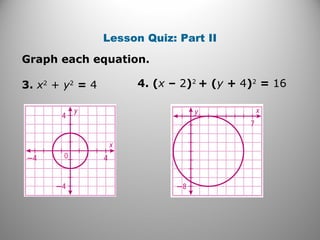
Lesson Quiz: Part II
Graph each equation.
3. x2
+ y2
= 4 4. (x – 2)2
+ (y + 4)2
= 16
Lesson Quiz: Part III
5. A carpenter is planning to build a circular gazebo
that requires the center of the structure to be
equidistant from three support columns located
at E(–2, –4), F(–2, 6), and G(10, 2).
What are the coordinates for the location of the
center of the gazebo?
(3, 1)
All rights belong to their respective owners.
Copyright Disclaimer Under Section 107 of
the Copyright Act 1976, allowance is made
for "fair use" for purposes such as criticism,
comment, news reporting, TEACHING,
scholarship, and research. 
Fair use is a use permitted by copyright
statute that might otherwise be infringing. 
Non-profit, EDUCATIONAL or personal use
tips the balance in favor of fair use.

Geometry unit 12.5

  • 1.
    UNIT 12.5 CIRCLESIN THEUNIT 12.5 CIRCLES IN THE COORDINAGE PLANECOORDINAGE PLANE
  • 2.
    Warm Up Use theDistance Formula to find the distance, to the nearest tenth, between each pair of points. 1. A(6, 2) and D(–3, –2) 2. C(4, 5) and D(0, 2) 3. V(8, 1) and W(3, 6) 9.8 5 7.1 4. Fill in the table of values for the equation y = x – 14.
  • 3.
    Write equations andgraph circles in the coordinate plane. Use the equation and graph of a circle to solve problems. Objectives
  • 4.
    The equation ofa circle is based on the Distance Formula and the fact that all points on a circle are equidistant from the center.
  • 6.
    Example 1A: Writingthe Equation of a Circle Write the equation of each circle. J with center J (2, 2) and radius 4 (x – h)2 + (y – k)2 = r2 (x – 2)2 + (y – 2)2 = 42 (x – 2)2 + (y – 2)2 = 16 Equation of a circle Substitute 2 for h, 2 for k, and 4 for r. Simplify.
  • 7.
    Example 1B: Writingthe Equation of a Circle Write the equation of each circle. K that passes through J(6, 4) and has center K(1, –8) Distance formula. Simplify. (x – 1)2 + (y – (–8))2 = 132 (x – 1)2 + (y + 8)2 = 169 Substitute 1 for h, –8 for k, and 13 for r. Simplify.
  • 8.
    Check It Out!Example 1a Write the equation of each circle. P with center P(0, –3) and radius 8 (x – h)2 + (y – k)2 = r2 (x – 0)2 + (y – (–3))2 = 82 x2 + (y + 3)2 = 64 Equation of a circle Substitute 0 for h, –3 for k, and 8 for r. Simplify.
  • 9.
    Check It Out!Example 1b Write the equation of each circle. Q that passes through (2, 3) and has center Q(2, –1) Distance formula. Simplify. (x – 2)2 + (y – (–1))2 = 42 (x – 2)2 + (y + 1)2 = 16 Substitute 2 for h, –1 for k, and 4 for r. Simplify.
  • 10.
    If you aregiven the equation of a circle, you can graph the circle by making a table or by identifying its center and radius.
  • 11.
    Example 2A: Graphinga Circle Graph x2 + y2 = 16. Step 1 Make a table of values. Since the radius is , or 4, use ±4 and use the values between for x-values. Step 2 Plot the points and connect them to form a circle.
  • 12.
    Example 2B: Graphinga Circle Graph (x – 3)2 + (y + 4)2 = 9. The equation of the given circle can be written as (x – 3)2 + (y – (– 4))2 = 32 . So h = 3, k = –4, and r = 3. The center is (3, –4) and the radius is 3. Plot the point (3, –4). Then graph a circle having this center and radius 3. (3, –4)
  • 13.
    Check It Out!Example 2a Graph x² + y² = 9. Step 2 Plot the points and connect them to form a circle. Since the radius is , or 3, use ±3 and use the values between for x-values. x 3 2 1 0 –1 –2 –3 y 0 ±2.2 ± 2.8 ± 3 ± 2.8 ± 2.2 0
  • 14.
    Check It Out!Example 2b Graph (x – 3)2 + (y + 2)2 = 4. The equation of the given circle can be written as (x – 3)2 + (y – (– 2))2 = 22 . So h = 3, k = –2, and r = 2. The center is (3, –2) and the radius is 2. Plot the point (3, –2). Then graph a circle having this center and radius 2. (3, –2)
  • 15.
    Example 3: RadioApplication An amateur radio operator wants to build a radio antenna near his home without using his house as a bracing point. He uses three poles to brace the antenna. The poles are to be inserted in the ground at three points equidistant from the antenna located at J(4, 4), K(–3, –1), and L(2, –8). What are the coordinates of the base of the antenna? Step 1 Plot the three given points. Step 2 Connect J, K, and L to form a triangle.
  • 16.
    Example 3 Continued Step3 Find a point that is equidistant from the three points by constructing the perpendicular bisectors of two of the sides of ∆JKL. The perpendicular bisectors of the sides of ∆JKL intersect at a point that is equidistant from J, K, and L. The intersection of the perpendicular bisectors is P (3, –2). P is the center of the circle that passes through J, K, and L. The base of the antenna is at P (3, –2).
  • 17.
    Check It Out!Example 3 What if…? Suppose the coordinates of the three cities in Example 3 (p. 801) are D(6, 2) , E(5, –5), and F(-2, -4). What would be the location of the weather station? Step 1 Plot the three given points. Step 2 Connect D, E, and F to form a triangle.
  • 18.
    Check It Out!Example 3 Continued Step 3 Find a point that is equidistant from the three points by constructing the perpendicular bisectors of two of the sides of ∆DEF. The perpendicular bisectors of the sides of ∆DEF intersect at a point that is equidistant from D, E, and F. The intersection of the perpendicular bisectors is P(2, –1). P is the center of the circle that passes through D, E, and F. The base of the antenna is at P(2, –1).
  • 19.
    Lesson Quiz: PartI Write the equation of each circle. 1. L with center L (–5, –6) and radius 9 (x + 5)2 + (y + 6)2 = 81 2. D that passes through (–2, –1) and has center D(2, –4) (x – 2)2 + (y + 4)2 = 25
  • 20.
    Lesson Quiz: PartII Graph each equation. 3. x2 + y2 = 4 4. (x – 2)2 + (y + 4)2 = 16
  • 21.
    Lesson Quiz: PartIII 5. A carpenter is planning to build a circular gazebo that requires the center of the structure to be equidistant from three support columns located at E(–2, –4), F(–2, 6), and G(10, 2). What are the coordinates for the location of the center of the gazebo? (3, 1)
  • 22.
    All rights belongto their respective owners. Copyright Disclaimer Under Section 107 of the Copyright Act 1976, allowance is made for "fair use" for purposes such as criticism, comment, news reporting, TEACHING, scholarship, and research.  Fair use is a use permitted by copyright statute that might otherwise be infringing.  Non-profit, EDUCATIONAL or personal use tips the balance in favor of fair use.