PLEASE READ
•All observed brown dogs are small
dogs. Therefore, all small dogs are
brown.
All observed basketball players are
tall, so all basketball players must be
tall.
PLEASE READ
All Christians believe in Jesus Christ.
Daniel is a Christian. Therefore, He
believes in Jesus Christ.
All students in Socio-Philo are
intelligent and smart. I am one of the
students in Socio-Philo. Therefore, I
am intelligent and smart.
heheheheh
PLEASE READ
All carabaos are hardworking.
Filipinos are hardworking.
Therefore, Filipinos are
carabao.
A guy sees his new neighbor out in his backyard, so he decides to get acquainted. After
introductions, he asks the new neighbor what he does for a living.
The new neighbor says, "I'm a professor." The first neigbhbor then asks, "Oh yeah,
what do you teach?"
"Logic," the professor reponds.
"What is that?" the neighbor inquires.
"Well, let me see if I can give you an example...you have a dog, right?"
"Yeah, that's right," neighbor #1 responds.
"And you have children too, right?" says the professor.
"Wow, right again!" exclaims the neighbor.
"So, then you must be married and that would make you a heterosexual, right?''
proclaims the professor.
"Unbelievable, you're absolutely correct. How do you know all this about me?"
"Well," the professor says, "I observed there was a dog house in your backyard, so you
must have a dog. I also saw bicycles next to your garage, so you must have children.
And if you have children, you are probably married and if your married, you are most
likely heterosexual... it was all logical!"
The next afternoon, the neighbor runs into his old friend. His friend asks if he has met
the new neighbor. The man says that he met him yesterday.
"What's he like?"
"Well," the man says, "he's nice and he is a professor of logic."
"Oh," says the friend, "what's logic?"
"Maybe I can give you an example. Do you have a dog house?"
"Why, no, I do not," responds the friend.
"Well, then," proclaims the man, "you must be gay!"
A couple wants a divorce, but first they must
decide who will be the main guardian of their child.
The jury asks both the man and woman for a
reason why they should be the one to keep the
child. So the jury asks the woman first. She says,
"Well I carried this child around in my stomach for
nine months and I had to go through a painful birth
process, this is my child and apart of me." The jury
is impressed and then turns to ask the man the
same question. The man replies, "OK, I take a coin
and put it in the drink machine and a drink comes
out, now tell me who does the drink belong to me
or the machine"
LOGIC: ITS NATURE
AND
CHARACTERISTICS
By Marver O. Bolonia
LOGIC
 Logic (from the Greek logike) has two
meanings: first, it describes the use of
valid reasoning in some activity;
second, it names the normative study
of reasoning or a branch thereof. In
the latter sense, it features most
prominently in the subjects
of philosophy, mathematics,
and computer science.
a proper or reasonable way of thinking
about or understanding something
 the science that studies the formal
processes used in thinking and
reasoning
a science that deals with the
principles and criteria of validity of
inference and demonstration : the
science of the formal
principles of reasoning
a particular mode of reasoning
viewed as valid or faulty
interrelation or sequence of facts
or events when seen as
inevitable or predictable
Logic is the study of the methods
and principles used in
distinguishing correct from
incorrect reasoning.
Reasoning is an art as well as a science: it is
something we do as well as understand. The
mental recognition of cause-and-effect
relationship is called ‘reasoning’.
Logical Reasoning
It may be prediction of an event from an
observed cause or the inference of a cause
from an observed event.
It is a process of passing from the known to
the unknown. It is the process of deriving a
logical inference from a hypothesis through
reasoning.
LOGIC IS OFTEN DIVIDED
INTO 2 BROAD METHOD OF
REASONING
INDUCTIVE REASONING
DEDUCTIVE REASONING
DEDUCTIVE REASONING
 Deductive reasoning happens
when a researcher works from the
more general information to the
more specific.
 Sometimes this is called the “top-
down” approach because the
researcher starts at the top with a
very broad spectrum of
information and they work their
way down to a specific conclusion.
"All men are mortal. Marver is a man. Therefore,
Marver is mortal.“
Every day, I leave for work in my car at eight
o’clock. Every day, the drive to work takes 45
minutes I arrive to work on time. Therefore, if I
leave for work at eight o’clock today, I will be on
time.
An example of deductive reasoning can be
seen in this set of statements:
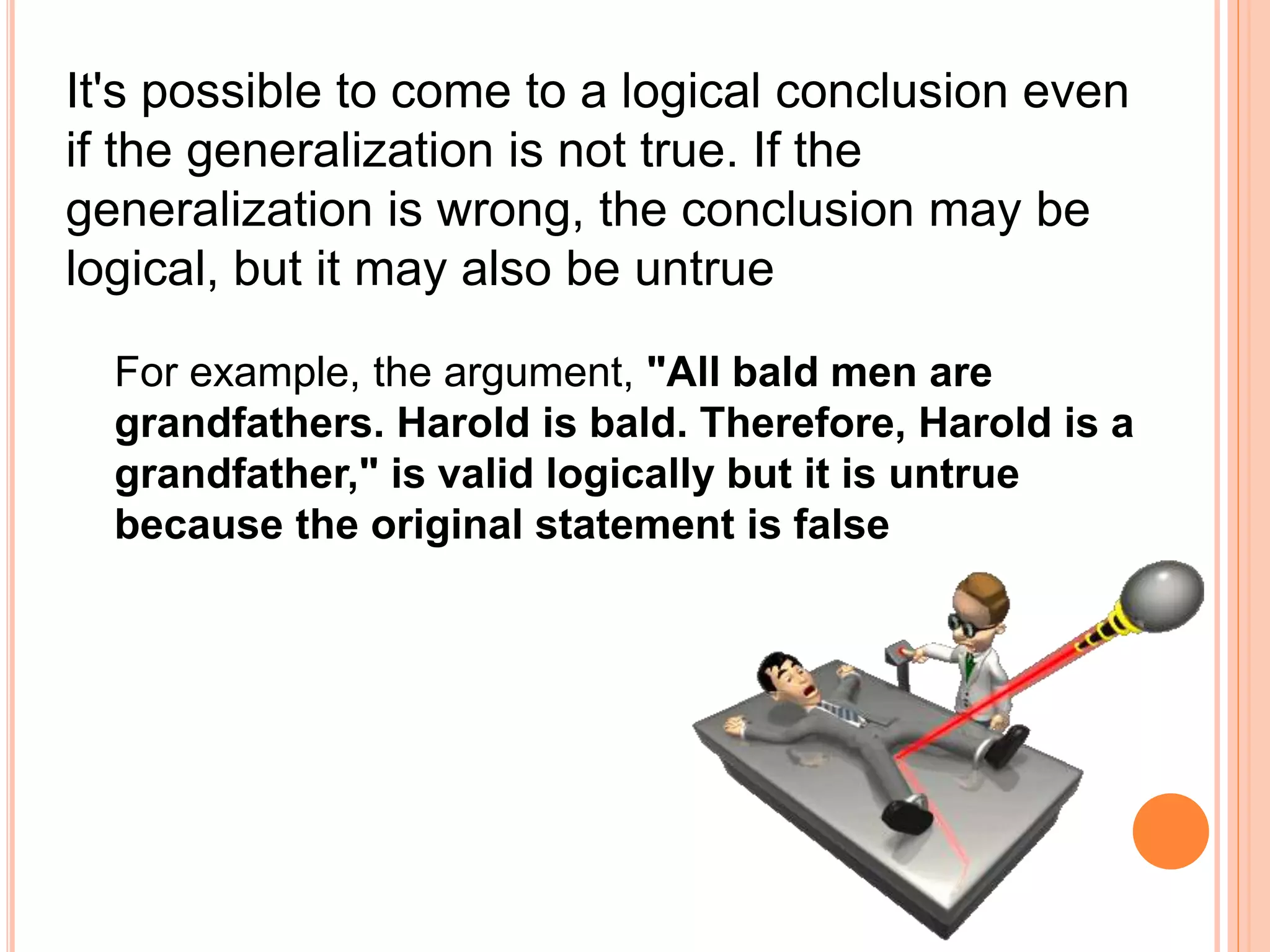
For example, the argument, "All bald men are
grandfathers. Harold is bald. Therefore, Harold is a
grandfather," is valid logically but it is untrue
because the original statement is false
It's possible to come to a logical conclusion even
if the generalization is not true. If the
generalization is wrong, the conclusion may be
logical, but it may also be untrue
Syllogism
A common form of deductive reasoning is the
syllogism, in which two statements — a major
premise and a minor premise — reach a logical
conclusion. For example, the premise "Every A
is B" could be followed by another premise,
"This C is A." Those statements would lead to
the conclusion "This C is B." Syllogisms are
considered a good way to test deductive
reasoning to make sure the argument is valid.
INDUCTIVE REASONING
 Inductive reasoning is the opposite of
deductive reasoning. Inductive reasoning
makes broad generalizations from specific
observations.
 This is sometimes called a “bottom up”
approach. The researcher begins with
specific observations and measures, begins
to then detect patterns and regularities,
formulate some tentative hypotheses to
explore, and finally ends up developing
some general conclusions or theories.
Robert is a teacher. All teachers are nice.
Therefore, it can be assumed that Robert is nice.
•Suzy is a doctor. Doctors are smart. Suzy is
assumed to be smart.
•All observed police officers are under 50 years
old. John is a police officer. John is under 50 years
old.
EXAMPLE OF INDUCTIVE
REASONING
 While inductive reasoning is commonly used in
science, it is not always logically valid because it
is not always accurate to assume that a general
principle is correct.
 Even if all of the premises are true in a
statement, inductive reasoning allows for the
conclusion to be false.
Here’s an example: "Harold is a grandfather.
Harold is bald.
Therefore, all grandfathers
are bald." The conclusion
does not follow logically
from the statements.
 By nature, inductive reasoning is more open-
ended and exploratory, especially during the
early stages. Deductive reasoning is more
narrow and is generally used to test or confirm
hypotheses.
 Most social research, however, involves both
inductive and deductive reasoning throughout
the research process. The scientific norm of
logical reasoning provides a two-way bridge
between theory and research. In practice, this
typically involves alternating between
deduction and induction.
ACTUAL PRACTICE AND ITS USE
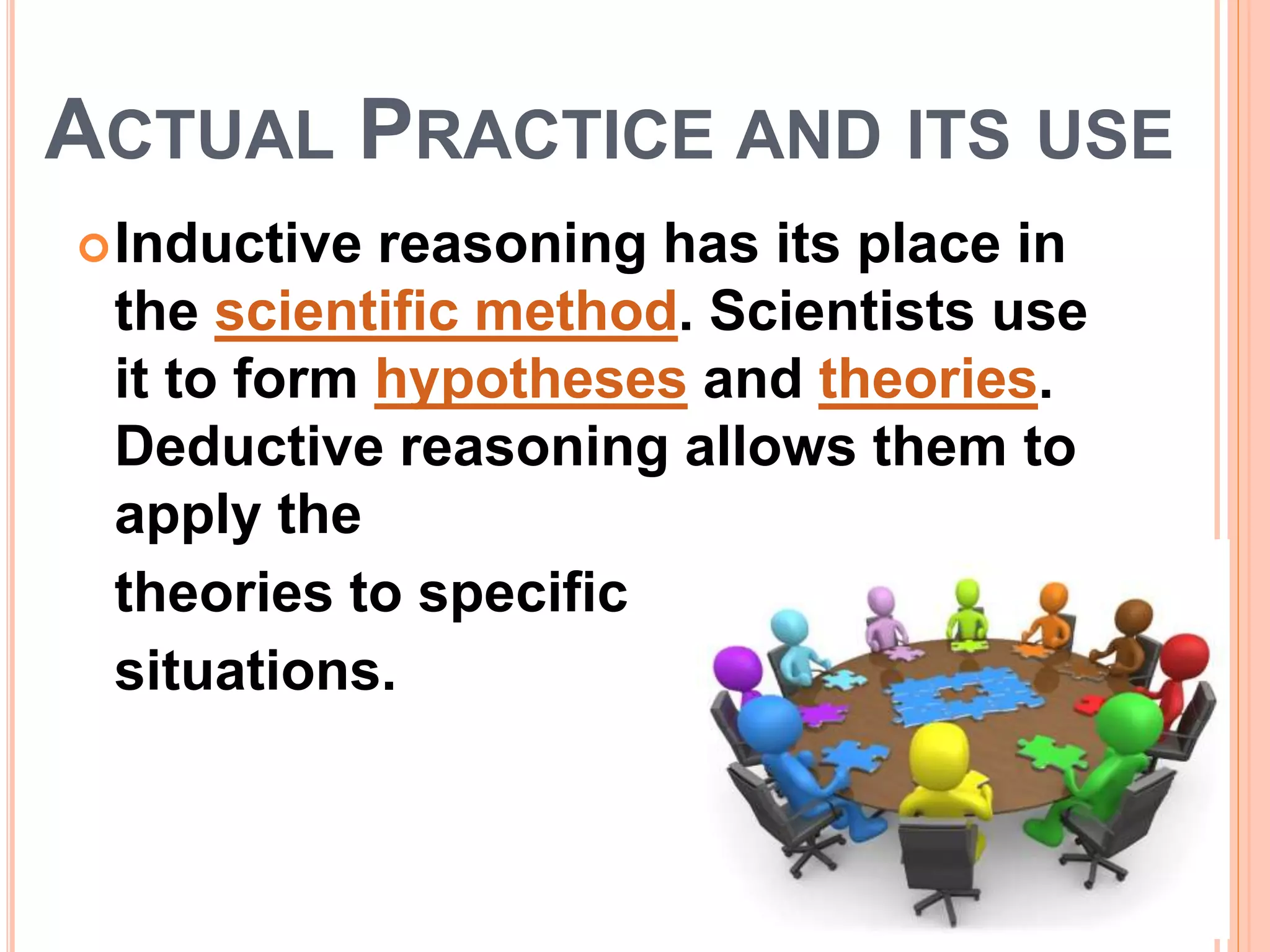
Inductive reasoning has its place in
the scientific method. Scientists use
it to form hypotheses and theories.
Deductive reasoning allows them to
apply the
theories to specific
situations.
ACTUAL PRACTICE AND ITS USE
THANK YOU FOR LISTENING
PROPERTIES OF
LOGICAL SYSTEMS
 Consistency, which means that no theorem of
the system contradicts another.
 Validity, which means that the system's rules
of proof never allow a false inference
from true premises.
 Completeness, of a logical system, which
means that if a formula is true, it can be
proven (if it is true, it is a theorem of the
system).
 Soundness, Soundness refers to logical
systems, which means that if some
formula can be proven in a system, then it
is true in the relevant model/structure .
This is the converse of completeness. A
distinct, peripheral use of soundness
refers to arguments, which means that the
premises of a valid argument are true in
the actual world.

Logic Reasoning

  • 1.
    PLEASE READ •All observedbrown dogs are small dogs. Therefore, all small dogs are brown. All observed basketball players are tall, so all basketball players must be tall.
  • 2.
    PLEASE READ All Christiansbelieve in Jesus Christ. Daniel is a Christian. Therefore, He believes in Jesus Christ. All students in Socio-Philo are intelligent and smart. I am one of the students in Socio-Philo. Therefore, I am intelligent and smart. heheheheh
  • 3.
    PLEASE READ All carabaosare hardworking. Filipinos are hardworking. Therefore, Filipinos are carabao.
  • 5.
    A guy seeshis new neighbor out in his backyard, so he decides to get acquainted. After introductions, he asks the new neighbor what he does for a living. The new neighbor says, "I'm a professor." The first neigbhbor then asks, "Oh yeah, what do you teach?" "Logic," the professor reponds. "What is that?" the neighbor inquires. "Well, let me see if I can give you an example...you have a dog, right?" "Yeah, that's right," neighbor #1 responds. "And you have children too, right?" says the professor. "Wow, right again!" exclaims the neighbor. "So, then you must be married and that would make you a heterosexual, right?'' proclaims the professor. "Unbelievable, you're absolutely correct. How do you know all this about me?" "Well," the professor says, "I observed there was a dog house in your backyard, so you must have a dog. I also saw bicycles next to your garage, so you must have children. And if you have children, you are probably married and if your married, you are most likely heterosexual... it was all logical!" The next afternoon, the neighbor runs into his old friend. His friend asks if he has met the new neighbor. The man says that he met him yesterday. "What's he like?" "Well," the man says, "he's nice and he is a professor of logic." "Oh," says the friend, "what's logic?" "Maybe I can give you an example. Do you have a dog house?" "Why, no, I do not," responds the friend. "Well, then," proclaims the man, "you must be gay!"
  • 6.
    A couple wantsa divorce, but first they must decide who will be the main guardian of their child. The jury asks both the man and woman for a reason why they should be the one to keep the child. So the jury asks the woman first. She says, "Well I carried this child around in my stomach for nine months and I had to go through a painful birth process, this is my child and apart of me." The jury is impressed and then turns to ask the man the same question. The man replies, "OK, I take a coin and put it in the drink machine and a drink comes out, now tell me who does the drink belong to me or the machine"
  • 7.
  • 8.
    LOGIC  Logic (fromthe Greek logike) has two meanings: first, it describes the use of valid reasoning in some activity; second, it names the normative study of reasoning or a branch thereof. In the latter sense, it features most prominently in the subjects of philosophy, mathematics, and computer science.
  • 9.
    a proper orreasonable way of thinking about or understanding something  the science that studies the formal processes used in thinking and reasoning a science that deals with the principles and criteria of validity of inference and demonstration : the science of the formal principles of reasoning
  • 10.
    a particular modeof reasoning viewed as valid or faulty interrelation or sequence of facts or events when seen as inevitable or predictable Logic is the study of the methods and principles used in distinguishing correct from incorrect reasoning.
  • 11.
    Reasoning is anart as well as a science: it is something we do as well as understand. The mental recognition of cause-and-effect relationship is called ‘reasoning’. Logical Reasoning It may be prediction of an event from an observed cause or the inference of a cause from an observed event. It is a process of passing from the known to the unknown. It is the process of deriving a logical inference from a hypothesis through reasoning.
  • 12.
    LOGIC IS OFTENDIVIDED INTO 2 BROAD METHOD OF REASONING INDUCTIVE REASONING DEDUCTIVE REASONING
  • 13.
    DEDUCTIVE REASONING  Deductivereasoning happens when a researcher works from the more general information to the more specific.  Sometimes this is called the “top- down” approach because the researcher starts at the top with a very broad spectrum of information and they work their way down to a specific conclusion.
  • 14.
    "All men aremortal. Marver is a man. Therefore, Marver is mortal.“ Every day, I leave for work in my car at eight o’clock. Every day, the drive to work takes 45 minutes I arrive to work on time. Therefore, if I leave for work at eight o’clock today, I will be on time. An example of deductive reasoning can be seen in this set of statements:
  • 15.
    For example, theargument, "All bald men are grandfathers. Harold is bald. Therefore, Harold is a grandfather," is valid logically but it is untrue because the original statement is false It's possible to come to a logical conclusion even if the generalization is not true. If the generalization is wrong, the conclusion may be logical, but it may also be untrue
  • 16.
    Syllogism A common formof deductive reasoning is the syllogism, in which two statements — a major premise and a minor premise — reach a logical conclusion. For example, the premise "Every A is B" could be followed by another premise, "This C is A." Those statements would lead to the conclusion "This C is B." Syllogisms are considered a good way to test deductive reasoning to make sure the argument is valid.
  • 17.
    INDUCTIVE REASONING  Inductivereasoning is the opposite of deductive reasoning. Inductive reasoning makes broad generalizations from specific observations.  This is sometimes called a “bottom up” approach. The researcher begins with specific observations and measures, begins to then detect patterns and regularities, formulate some tentative hypotheses to explore, and finally ends up developing some general conclusions or theories.
  • 18.
    Robert is ateacher. All teachers are nice. Therefore, it can be assumed that Robert is nice. •Suzy is a doctor. Doctors are smart. Suzy is assumed to be smart. •All observed police officers are under 50 years old. John is a police officer. John is under 50 years old. EXAMPLE OF INDUCTIVE REASONING
  • 19.
     While inductivereasoning is commonly used in science, it is not always logically valid because it is not always accurate to assume that a general principle is correct.  Even if all of the premises are true in a statement, inductive reasoning allows for the conclusion to be false. Here’s an example: "Harold is a grandfather. Harold is bald. Therefore, all grandfathers are bald." The conclusion does not follow logically from the statements.
  • 20.
     By nature,inductive reasoning is more open- ended and exploratory, especially during the early stages. Deductive reasoning is more narrow and is generally used to test or confirm hypotheses.  Most social research, however, involves both inductive and deductive reasoning throughout the research process. The scientific norm of logical reasoning provides a two-way bridge between theory and research. In practice, this typically involves alternating between deduction and induction. ACTUAL PRACTICE AND ITS USE
  • 21.
    Inductive reasoning hasits place in the scientific method. Scientists use it to form hypotheses and theories. Deductive reasoning allows them to apply the theories to specific situations. ACTUAL PRACTICE AND ITS USE
  • 22.
    THANK YOU FORLISTENING
  • 24.
    PROPERTIES OF LOGICAL SYSTEMS Consistency, which means that no theorem of the system contradicts another.  Validity, which means that the system's rules of proof never allow a false inference from true premises.
  • 25.
     Completeness, ofa logical system, which means that if a formula is true, it can be proven (if it is true, it is a theorem of the system).  Soundness, Soundness refers to logical systems, which means that if some formula can be proven in a system, then it is true in the relevant model/structure . This is the converse of completeness. A distinct, peripheral use of soundness refers to arguments, which means that the premises of a valid argument are true in the actual world.