Terms To Know    Ad jacent angles  - angles in a plane that have their vertex have one side in common but no interior points on common. B iconditional  - "if and only if" statement: If and only if the shape is a equilateral quadrilateral with 4 right angles, then the shape is a square. C onditional  - "if - then" statements, the "If" part is the  Hypothesis  part is the  Conclusion : If a shape is a square, then the shape is a rectangle. C onverse  - to create a converse from a conditional, switch the hypothesis and conclusion. C ounterexample  - an example that disproves a conditional. D eduction  - the process of drawing logical conclusions by an argument. E quivalence  R elation  - any relation that satisfies the reflexive property, symmetric property and the transitive property.
2.1 Proofs: Two Column Proofs: on the left side, is a statement, on the right side is the justification for the statement. use postulates and theorems to help justify your statements in proofs
2.2 Conditionals: Euler diagrams: like venn diagrams, its an easy way to see statements. If p then q. Logical Chains: can be drawn from deductive reason. three parts. 2.2.1 “ If-Then ”  Transitive property  Given: "If A then B, and if B then C." You can conclude: "If A Then C" E.g.: If a tiger is a cat, and a cat is an animal, then a tiger is an animal. E.g.: If an animal is a cow, then it is fat. Larry is a cow. Conclusion: Larry is fat Converse:  If  an animal is fat, then it is a cow
2.3 Adjacent Angles: are next to each other (in simple terms). the vertex is the same.
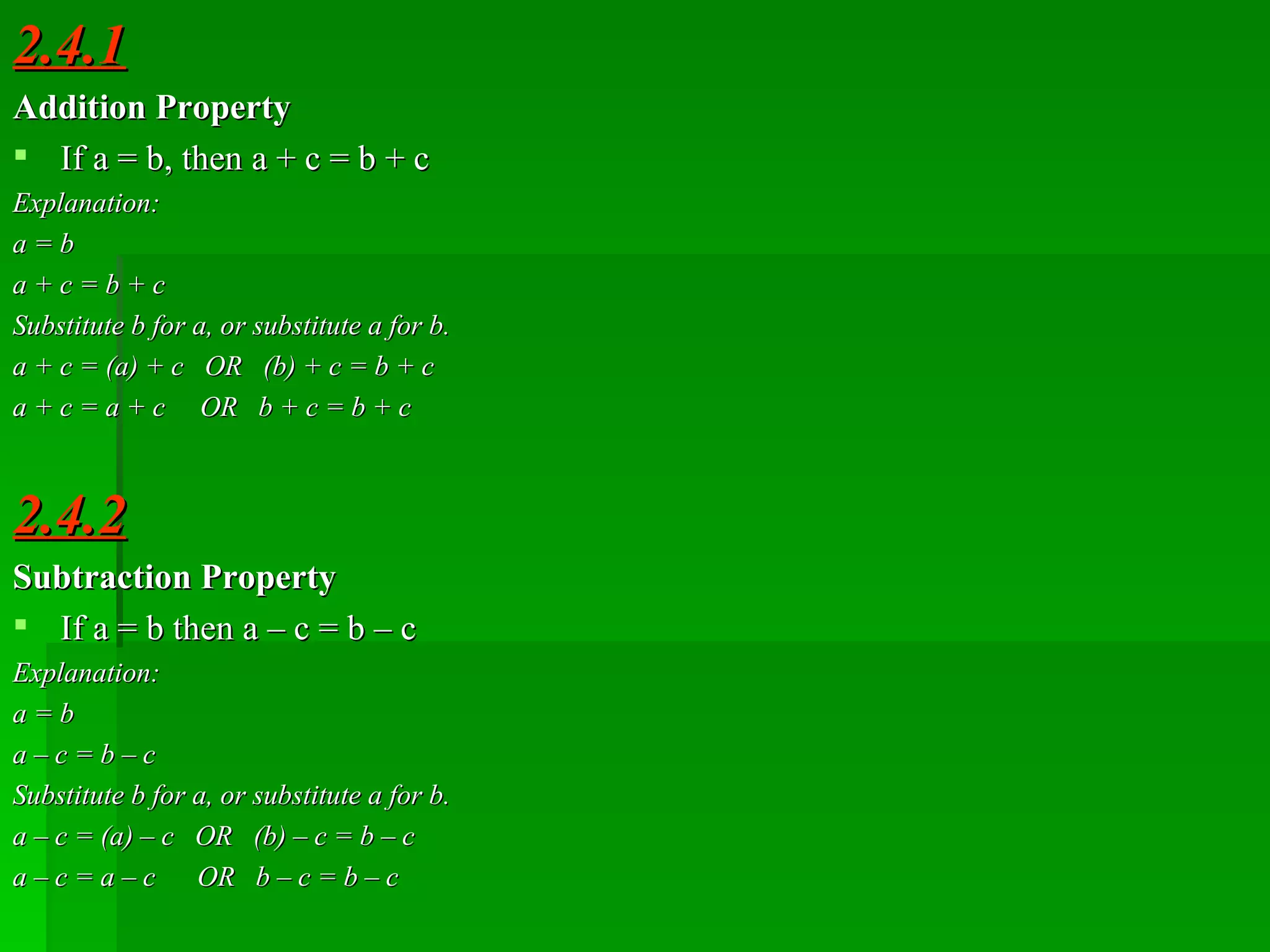
2.4.1 Addition Property If a   =   b, then a   +   c   =   b   +   c Explanation: a   =   b a   +   c   =   b   +   c Substitute b for a, or substitute a for b. a   +   c   =   (a)   +   c  OR  (b)   +   c   =   b   +   c a   +   c   =   a   +   c  OR  b   +   c   =   b   +   c 2.4.2 Subtraction Property If a   =   b then a   –   c   =   b   –   c Explanation: a   =   b a   –   c   =   b   –   c Substitute b for a, or substitute a for b. a   –   c   =   (a)   –   c  OR  (b)   –   c   =   b   –   c a   –   c   =   a   –   c  OR  b   –   c   =   b   –   c
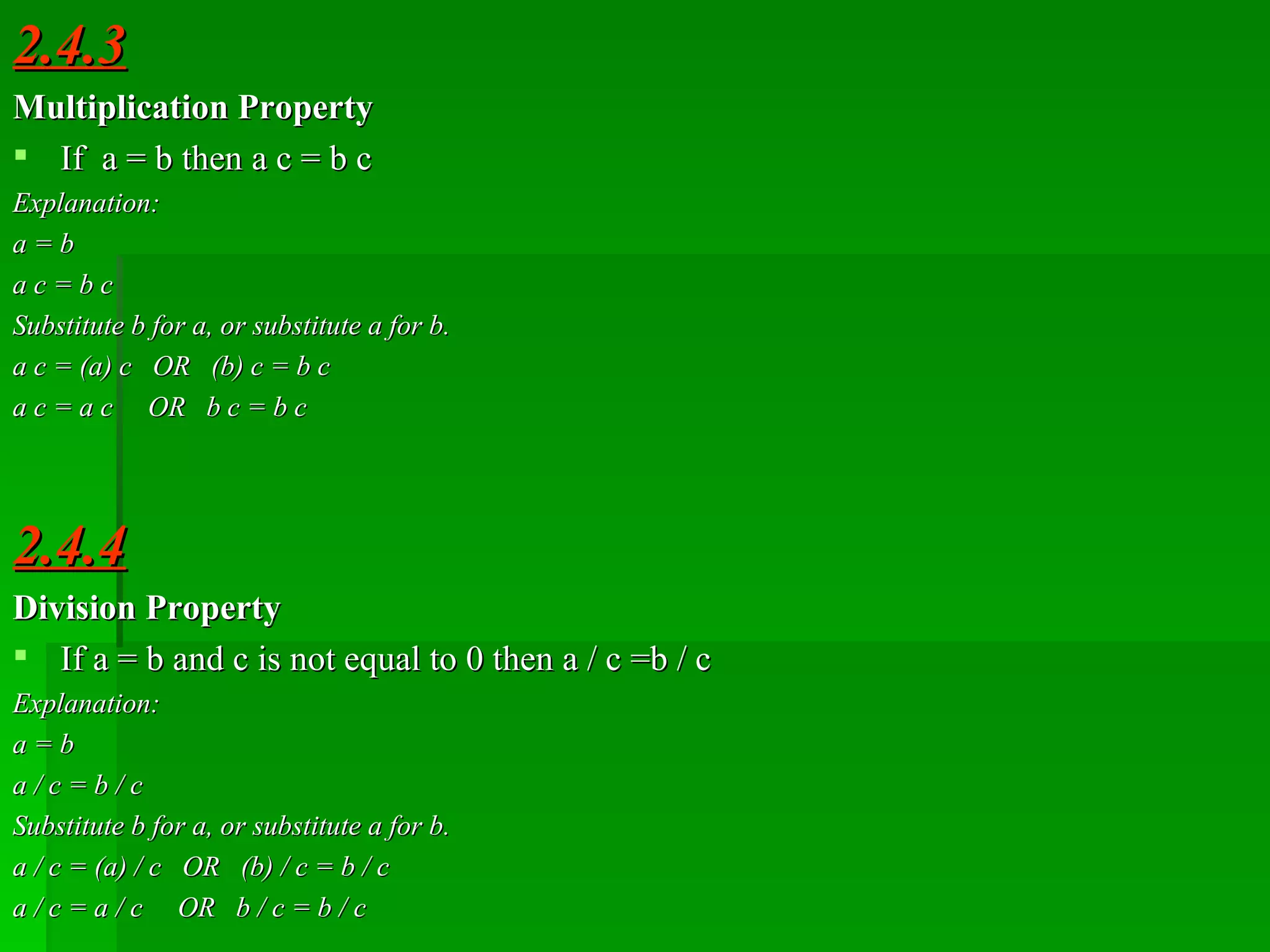
2.4.3 Multiplication Property If  a   =   b then a   c   =   b   c  Explanation: a   =   b a   c   =   b   c Substitute b for a, or substitute a for b. a   c   =   (a)   c  OR  (b)   c   =   b   c a   c   =   a   c  OR  b   c   =   b   c 2.4.4 Division Property If a   =   b and c is not equal to 0 then a   /   c =b   /   c Explanation: a   =   b a   /   c   =   b   /   c Substitute b for a, or substitute a for b. a   /   c   =   (a)   /   c  OR  (b)   /   c   =   b   /   c a   /   c   =   a   /   c  OR  b   /   c   =   b   /   c
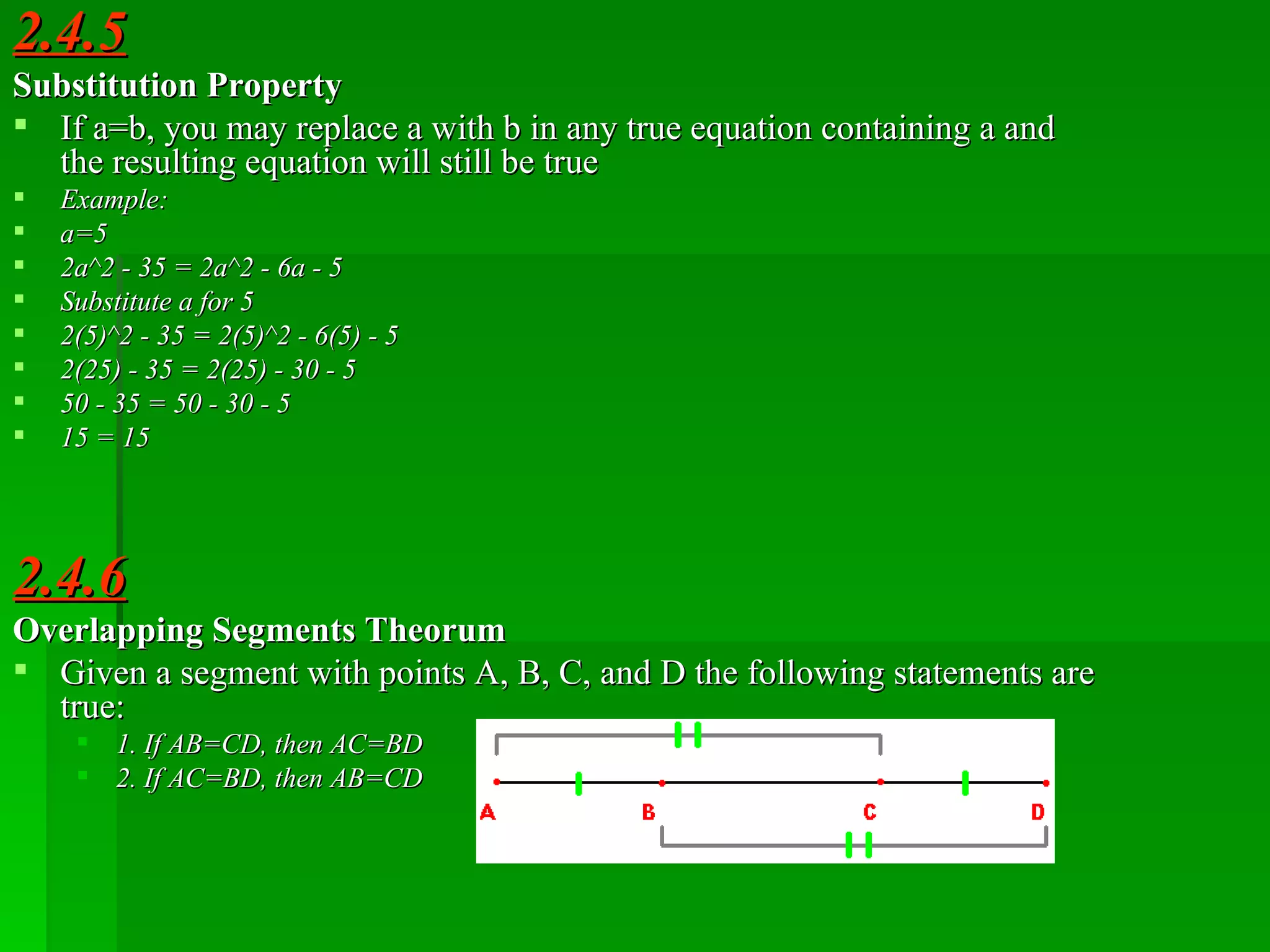
2.4.5 Substitution Property If a=b, you may replace a with b in any true equation containing a and the resulting equation will still be true Example: a=5 2a^2 - 35 = 2a^2 - 6a - 5 Substitute a for 5 2(5)^2 - 35 = 2(5)^2 - 6(5) - 5 2(25) - 35 = 2(25) - 30 - 5 50 - 35 = 50 - 30 - 5 15 = 15  2.4.6 Overlapping Segments Theorum Given a segment with points A, B, C, and D the following statements are true: 1. If AB=CD, then AC=BD 2. If AC=BD, then AB=CD
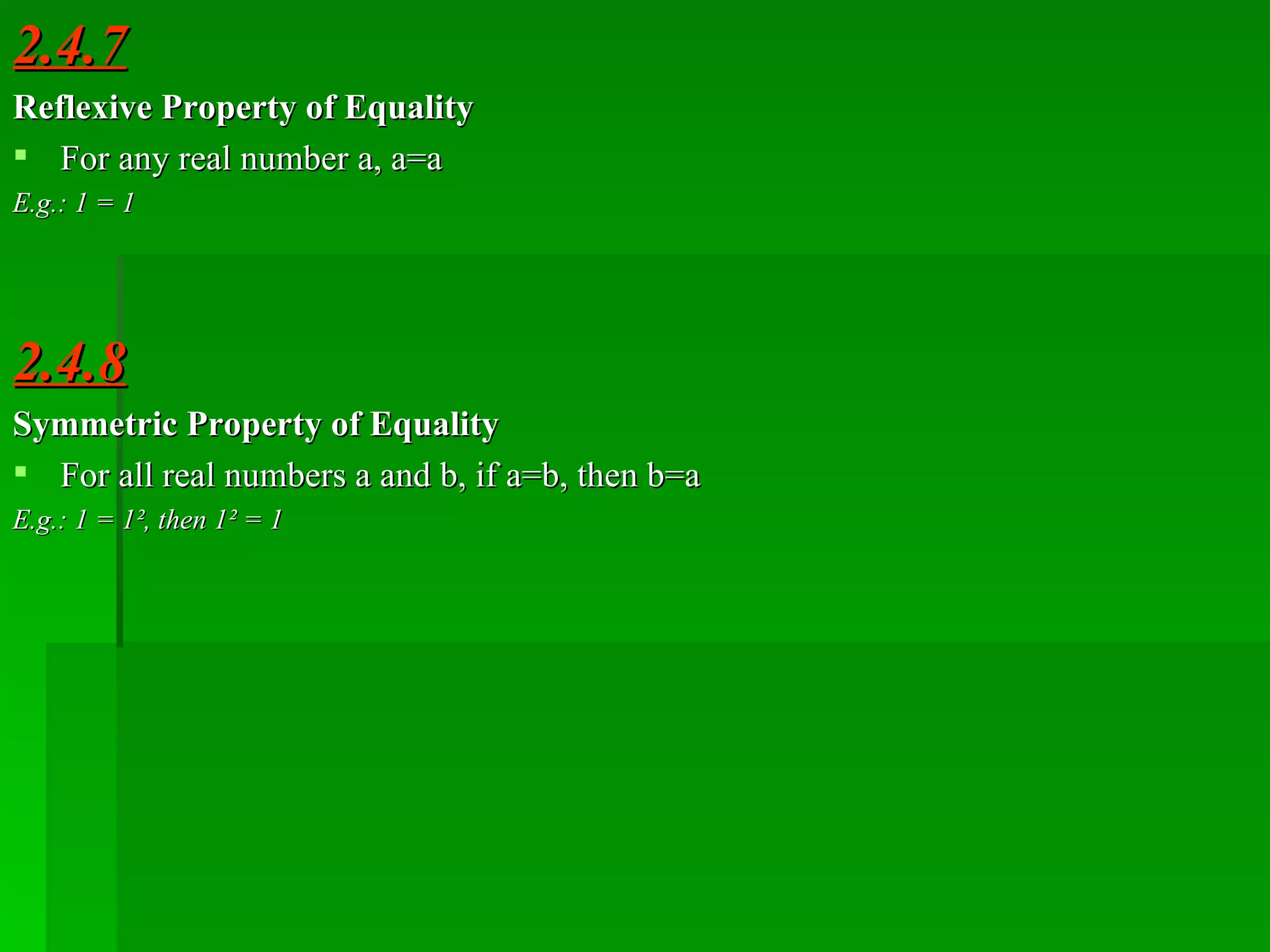
2.4.7 Reflexive Property of Equality  For any real number a, a=a E.g.: 1 = 1 2.4.8 Symmetric Property of Equality For all real numbers a and b, if a=b, then b=a E.g.: 1 = 1 ² , then 1 ²  = 1
2.4.9 Transitive Property of Equality For all real numbers a, b, and if a=b and b=c, then a=c E.g.: 1 = 1 ², 1² = 1³, then 1 = 1³ 2.4.10 Reflexive Property of Congruence figure A is congruent to figure a
2.4.11 Symmetric Property of Congruence If figure A is congruent to figure B, then figure B is congruent to figure A 2.4.12

Chapter 2 Review

  • 1.
    Terms To Know   Ad jacent angles - angles in a plane that have their vertex have one side in common but no interior points on common. B iconditional - "if and only if" statement: If and only if the shape is a equilateral quadrilateral with 4 right angles, then the shape is a square. C onditional - "if - then" statements, the "If" part is the Hypothesis part is the Conclusion : If a shape is a square, then the shape is a rectangle. C onverse - to create a converse from a conditional, switch the hypothesis and conclusion. C ounterexample - an example that disproves a conditional. D eduction - the process of drawing logical conclusions by an argument. E quivalence R elation - any relation that satisfies the reflexive property, symmetric property and the transitive property.
  • 2.
    2.1 Proofs: TwoColumn Proofs: on the left side, is a statement, on the right side is the justification for the statement. use postulates and theorems to help justify your statements in proofs
  • 3.
    2.2 Conditionals: Eulerdiagrams: like venn diagrams, its an easy way to see statements. If p then q. Logical Chains: can be drawn from deductive reason. three parts. 2.2.1 “ If-Then ” Transitive property Given: "If A then B, and if B then C." You can conclude: "If A Then C" E.g.: If a tiger is a cat, and a cat is an animal, then a tiger is an animal. E.g.: If an animal is a cow, then it is fat. Larry is a cow. Conclusion: Larry is fat Converse: If an animal is fat, then it is a cow
  • 4.
    2.3 Adjacent Angles:are next to each other (in simple terms). the vertex is the same.
  • 5.
    2.4.1 Addition PropertyIf a = b, then a + c = b + c Explanation: a = b a + c = b + c Substitute b for a, or substitute a for b. a + c = (a) + c OR (b) + c = b + c a + c = a + c OR b + c = b + c 2.4.2 Subtraction Property If a = b then a – c = b – c Explanation: a = b a – c = b – c Substitute b for a, or substitute a for b. a – c = (a) – c OR (b) – c = b – c a – c = a – c OR b – c = b – c
  • 6.
    2.4.3 Multiplication PropertyIf a = b then a c = b c Explanation: a = b a c = b c Substitute b for a, or substitute a for b. a c = (a) c OR (b) c = b c a c = a c OR b c = b c 2.4.4 Division Property If a = b and c is not equal to 0 then a / c =b / c Explanation: a = b a / c = b / c Substitute b for a, or substitute a for b. a / c = (a) / c OR (b) / c = b / c a / c = a / c OR b / c = b / c
  • 7.
    2.4.5 Substitution PropertyIf a=b, you may replace a with b in any true equation containing a and the resulting equation will still be true Example: a=5 2a^2 - 35 = 2a^2 - 6a - 5 Substitute a for 5 2(5)^2 - 35 = 2(5)^2 - 6(5) - 5 2(25) - 35 = 2(25) - 30 - 5 50 - 35 = 50 - 30 - 5 15 = 15 2.4.6 Overlapping Segments Theorum Given a segment with points A, B, C, and D the following statements are true: 1. If AB=CD, then AC=BD 2. If AC=BD, then AB=CD
  • 8.
    2.4.7 Reflexive Propertyof Equality For any real number a, a=a E.g.: 1 = 1 2.4.8 Symmetric Property of Equality For all real numbers a and b, if a=b, then b=a E.g.: 1 = 1 ² , then 1 ² = 1
  • 9.
    2.4.9 Transitive Propertyof Equality For all real numbers a, b, and if a=b and b=c, then a=c E.g.: 1 = 1 ², 1² = 1³, then 1 = 1³ 2.4.10 Reflexive Property of Congruence figure A is congruent to figure a
  • 10.
    2.4.11 Symmetric Propertyof Congruence If figure A is congruent to figure B, then figure B is congruent to figure A 2.4.12