Chapter 3 Solving Linear Equations
3.1 Solving Equations Using Addition and Subtraction You can solve an equation by using the  transformations  below to isolate the variable on one side of the equation. When you rewrite an equation using these transformations, you produce an equation with the same solutions as the original equation. These equations are called  equivalent  equations.
To change, or  transform , an equation into an equivalent equation, think of an equation as having two sides that are “in balance.” Any transformation you apply to an equation must keep the equation in balance. For example, if you if you subtract 3 from one side of the equation, you must also subtract 3 from the other side of the equation.
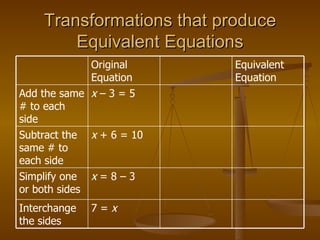
Transformations that produce Equivalent Equations 7 =  x Interchange the sides x  = 8 – 3  Simplify one or both sides x  + 6 = 10 Subtract the same # to each side x  – 3 = 5 Add the same # to each side Equivalent Equation Original Equation
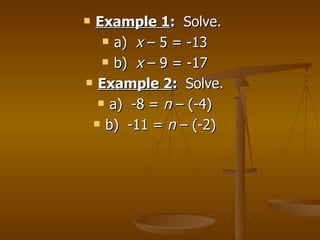
Example 1 :  Solve.  a)  x  – 5 = -13 b)  x  – 9 = -17 Example 2 :  Solve. a)  -8 =  n  – (-4) b)  -11 =  n  – (-2)
Linear Equations:  The variable is raised to the  first  power and does not occur in a denominator, inside a square root, or inside absolute value symbols. | x  + 3| = 7 - 4 +  n  = 2 n  – 6  x 2  + 5 = 9 x  + 5 = 9 Not a Linear Equation Linear Equation
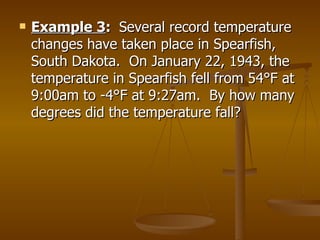
Example 3 :  Several record temperature changes have taken place in Spearfish, South Dakota.  On January 22, 1943, the temperature in Spearfish fell from 54 °F at 9:00am to -4°F at 9:27am.  By how many degrees did the temperature fall?
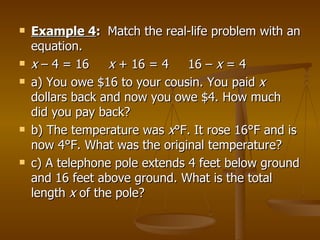
Example 4 :  Match the real-life problem with an equation. x  – 4 = 16  x  + 16 = 4  16 –  x  = 4 a) You owe $16 to your cousin. You paid  x  dollars back and now you owe $4. How much did you pay back? b) The temperature was  x °F. It rose 16°F and is now 4°F. What was the original temperature? c) A telephone pole extends 4 feet below ground and 16 feet above ground. What is the total length  x  of the pole?
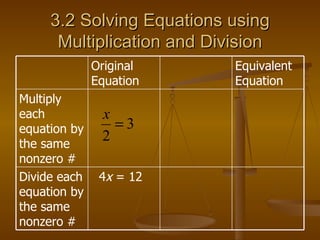
3.2 Solving Equations using Multiplication and Division 4 x  = 12 Divide each equation by the same nonzero # Multiply each equation by the same nonzero # Equivalent Equation Original Equation
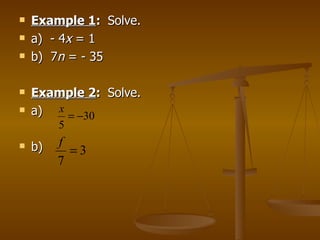
Example 1 :  Solve. a)  - 4 x  = 1 b)  7 n  = - 35 Example 2 :  Solve. a)  b)
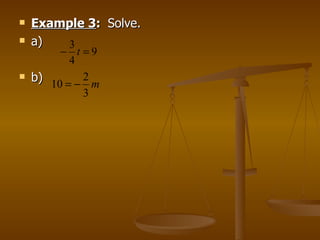
Example 3 :  Solve. a)  b)
Properties of Equality : Addition Property: Subtraction Property: Multiplication Property: Division Property:
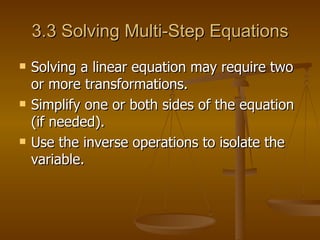
3.3 Solving Multi-Step Equations Solving a linear equation may require two or more transformations. Simplify one or both sides of the equation (if needed). Use the inverse operations to isolate the variable.
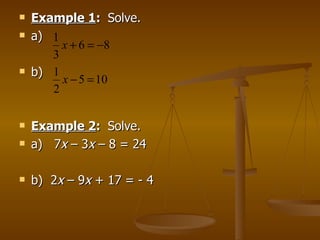
Example 1 :  Solve. a)  b)  Example 2 :  Solve. a)  7 x  – 3 x  – 8 = 24 b)  2 x  – 9 x  + 17 = - 4
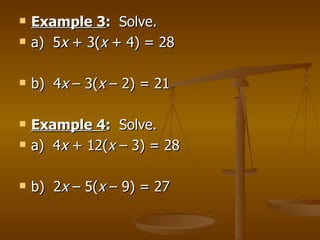
Example 3 :  Solve. a)  5 x  + 3( x  + 4) = 28 b)  4 x  – 3( x  – 2) = 21 Example 4 :  Solve. a)  4 x  + 12( x  – 3) = 28 b)  2 x  – 5( x  – 9) = 27
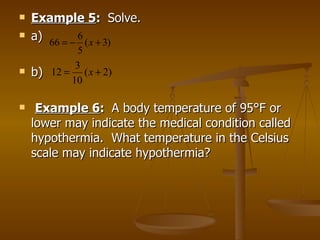
Example 5 :  Solve. a)  b)  Example 6 :  A body temperature of 95 °F or lower may indicate the medical condition called hypothermia.  What temperature in the Celsius scale may indicate hypothermia?
Example 7 :  The temperature within Earth’s crust increases about 30 ° Celsius for each kilometer of depth beneath the surface.  If the temperature at Earth’s surface is 24°C, at what depth would you expect the temperature to be 114°C?
3.6  Objective:  To find exact and apporoximate solutions of equations that contain decimals. Round-off Error :  Example 1 :  Solve the equation.  Round to the nearest hundredth. a)  7.23x + 16.51 = 47.89 – 2.55x
Example 1 :  Solve the equation.  Round to the nearest hundredth. a)  7.23x + 16.51 = 47.89 – 2.55x b)  6.6(1.2 – 7.3x) = 16.4x + 5.8
Example 2 :  Multiply the equation by a power of 10 to write an equivalent equation with integer coefficients.  Solve the equation and round to the nearest hundredth. a)  3.11x – 17.64 = 2.02x -5.89 b)  5.8 + 3.2x = 3.4x – 16.7
3.7 Formulas and Functions Objective:  To solve a formula for one of its variables and rewrite an equation in function form Formula :  an algebraic expression that relates two or more real-life quantities.
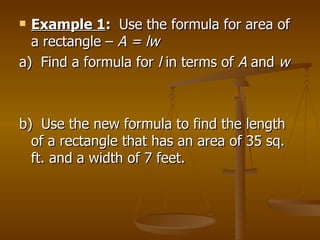
Example 1 :  Use the formula for area of a rectangle –  A = lw a)  Find a formula for  l  in terms of  A  and  w b)  Use the new formula to find the length of a rectangle that has an area of 35 sq. ft. and a width of 7 feet.
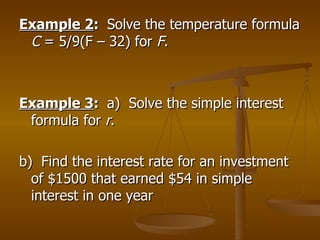
Example 2 :  Solve the temperature formula  C  = 5/9(F – 32)   for  F . Example 3 :  a)  Solve the simple interest formula for  r . b)  Find the interest rate for an investment of $1500 that earned $54 in simple interest in one year
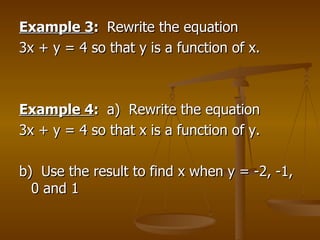
Example 3 :  Rewrite the equation  3x + y = 4 so that y is a function of x. Example 4 :  a)  Rewrite the equation 3x + y = 4 so that x is a function of y. b)  Use the result to find x when y = -2, -1, 0 and 1

Chapter 3

  • 1.
    Chapter 3 SolvingLinear Equations
  • 2.
    3.1 Solving EquationsUsing Addition and Subtraction You can solve an equation by using the transformations below to isolate the variable on one side of the equation. When you rewrite an equation using these transformations, you produce an equation with the same solutions as the original equation. These equations are called equivalent equations.
  • 3.
    To change, or transform , an equation into an equivalent equation, think of an equation as having two sides that are “in balance.” Any transformation you apply to an equation must keep the equation in balance. For example, if you if you subtract 3 from one side of the equation, you must also subtract 3 from the other side of the equation.
  • 4.
    Transformations that produceEquivalent Equations 7 = x Interchange the sides x = 8 – 3 Simplify one or both sides x + 6 = 10 Subtract the same # to each side x – 3 = 5 Add the same # to each side Equivalent Equation Original Equation
  • 5.
    Example 1 : Solve. a) x – 5 = -13 b) x – 9 = -17 Example 2 : Solve. a) -8 = n – (-4) b) -11 = n – (-2)
  • 6.
    Linear Equations: The variable is raised to the first power and does not occur in a denominator, inside a square root, or inside absolute value symbols. | x + 3| = 7 - 4 + n = 2 n – 6 x 2 + 5 = 9 x + 5 = 9 Not a Linear Equation Linear Equation
  • 7.
    Example 3 : Several record temperature changes have taken place in Spearfish, South Dakota. On January 22, 1943, the temperature in Spearfish fell from 54 °F at 9:00am to -4°F at 9:27am. By how many degrees did the temperature fall?
  • 8.
    Example 4 : Match the real-life problem with an equation. x – 4 = 16 x + 16 = 4 16 – x = 4 a) You owe $16 to your cousin. You paid x dollars back and now you owe $4. How much did you pay back? b) The temperature was x °F. It rose 16°F and is now 4°F. What was the original temperature? c) A telephone pole extends 4 feet below ground and 16 feet above ground. What is the total length x of the pole?
  • 9.
    3.2 Solving Equationsusing Multiplication and Division 4 x = 12 Divide each equation by the same nonzero # Multiply each equation by the same nonzero # Equivalent Equation Original Equation
  • 10.
    Example 1 : Solve. a) - 4 x = 1 b) 7 n = - 35 Example 2 : Solve. a) b)
  • 11.
    Example 3 : Solve. a) b)
  • 12.
    Properties of Equality: Addition Property: Subtraction Property: Multiplication Property: Division Property:
  • 13.
    3.3 Solving Multi-StepEquations Solving a linear equation may require two or more transformations. Simplify one or both sides of the equation (if needed). Use the inverse operations to isolate the variable.
  • 14.
    Example 1 : Solve. a) b) Example 2 : Solve. a) 7 x – 3 x – 8 = 24 b) 2 x – 9 x + 17 = - 4
  • 15.
    Example 3 : Solve. a) 5 x + 3( x + 4) = 28 b) 4 x – 3( x – 2) = 21 Example 4 : Solve. a) 4 x + 12( x – 3) = 28 b) 2 x – 5( x – 9) = 27
  • 16.
    Example 5 : Solve. a) b) Example 6 : A body temperature of 95 °F or lower may indicate the medical condition called hypothermia. What temperature in the Celsius scale may indicate hypothermia?
  • 17.
    Example 7 : The temperature within Earth’s crust increases about 30 ° Celsius for each kilometer of depth beneath the surface. If the temperature at Earth’s surface is 24°C, at what depth would you expect the temperature to be 114°C?
  • 18.
    3.6 Objective: To find exact and apporoximate solutions of equations that contain decimals. Round-off Error : Example 1 : Solve the equation. Round to the nearest hundredth. a) 7.23x + 16.51 = 47.89 – 2.55x
  • 19.
    Example 1 : Solve the equation. Round to the nearest hundredth. a) 7.23x + 16.51 = 47.89 – 2.55x b) 6.6(1.2 – 7.3x) = 16.4x + 5.8
  • 20.
    Example 2 : Multiply the equation by a power of 10 to write an equivalent equation with integer coefficients. Solve the equation and round to the nearest hundredth. a) 3.11x – 17.64 = 2.02x -5.89 b) 5.8 + 3.2x = 3.4x – 16.7
  • 21.
    3.7 Formulas andFunctions Objective: To solve a formula for one of its variables and rewrite an equation in function form Formula : an algebraic expression that relates two or more real-life quantities.
  • 22.
    Example 1 : Use the formula for area of a rectangle – A = lw a) Find a formula for l in terms of A and w b) Use the new formula to find the length of a rectangle that has an area of 35 sq. ft. and a width of 7 feet.
  • 23.
    Example 2 : Solve the temperature formula C = 5/9(F – 32) for F . Example 3 : a) Solve the simple interest formula for r . b) Find the interest rate for an investment of $1500 that earned $54 in simple interest in one year
  • 24.
    Example 3 : Rewrite the equation 3x + y = 4 so that y is a function of x. Example 4 : a) Rewrite the equation 3x + y = 4 so that x is a function of y. b) Use the result to find x when y = -2, -1, 0 and 1