Geometric Sequences
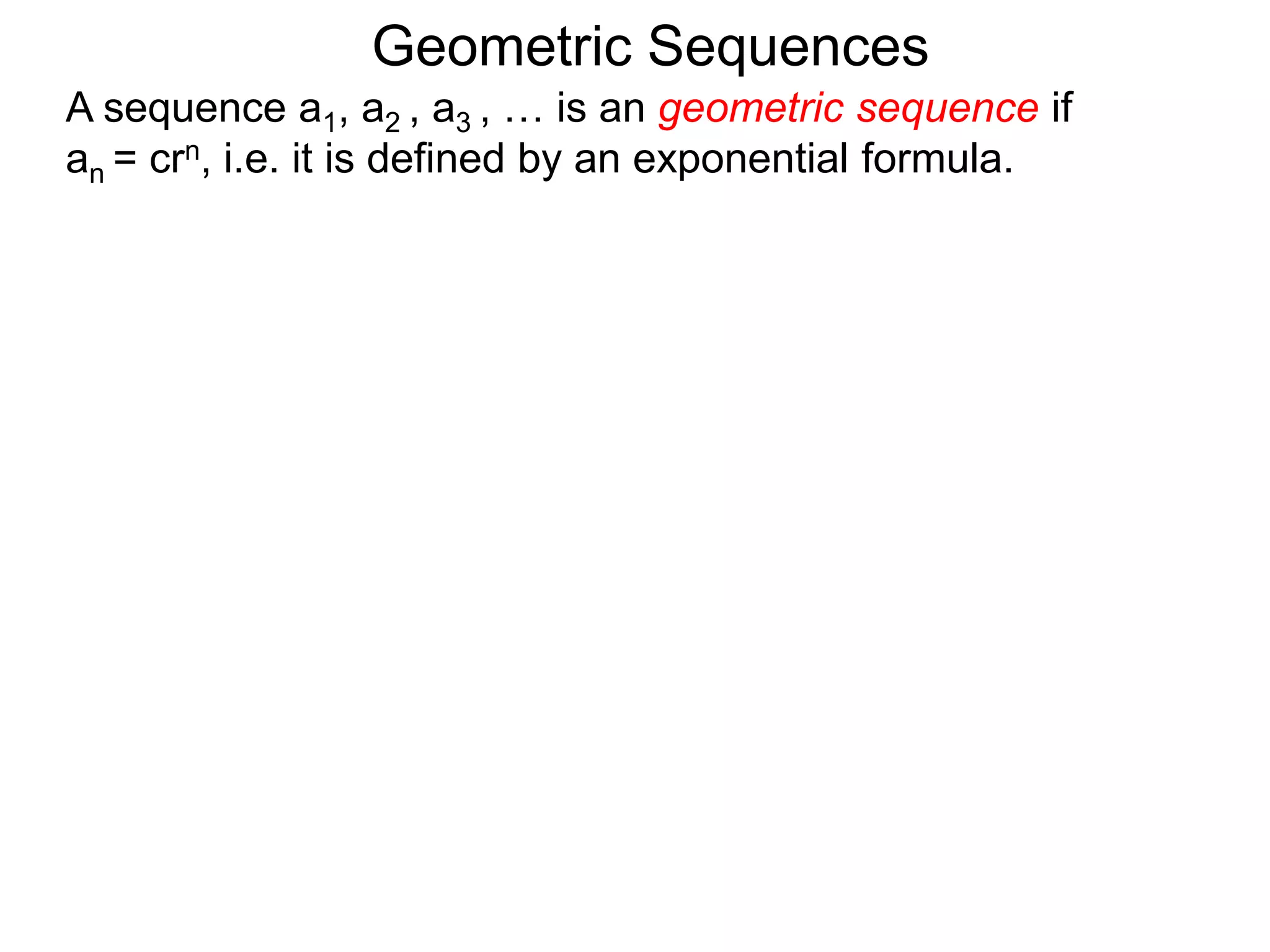
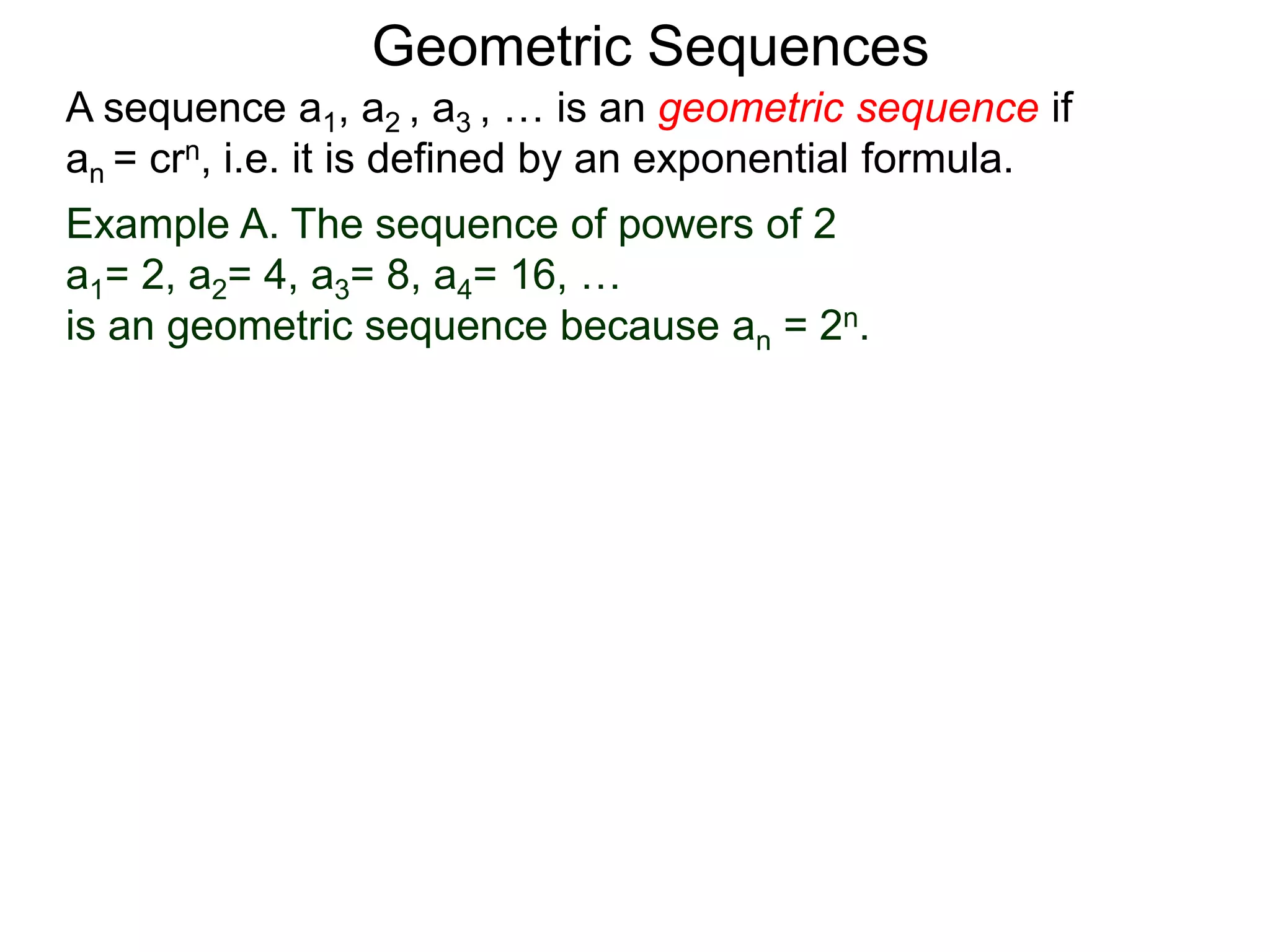
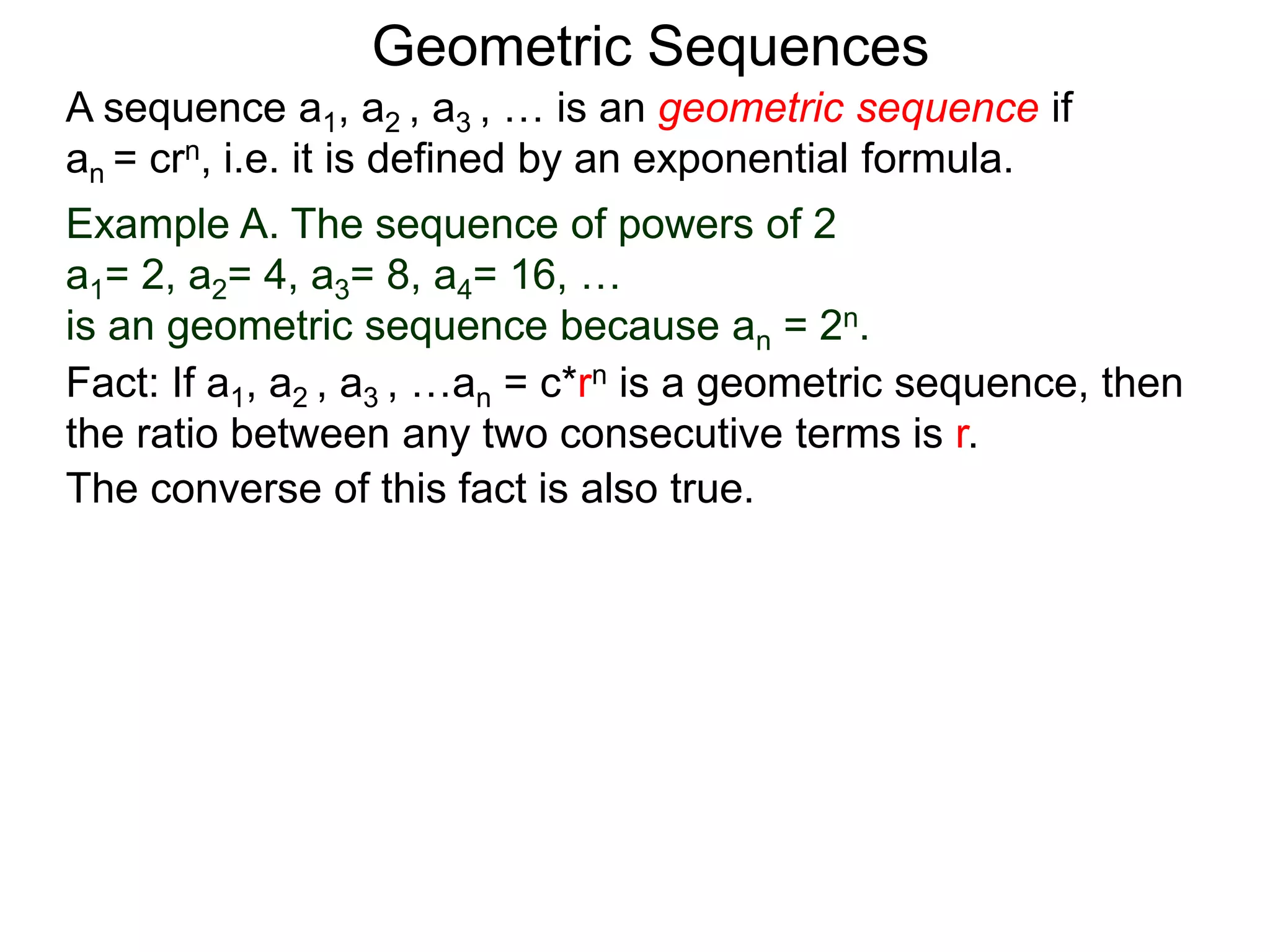
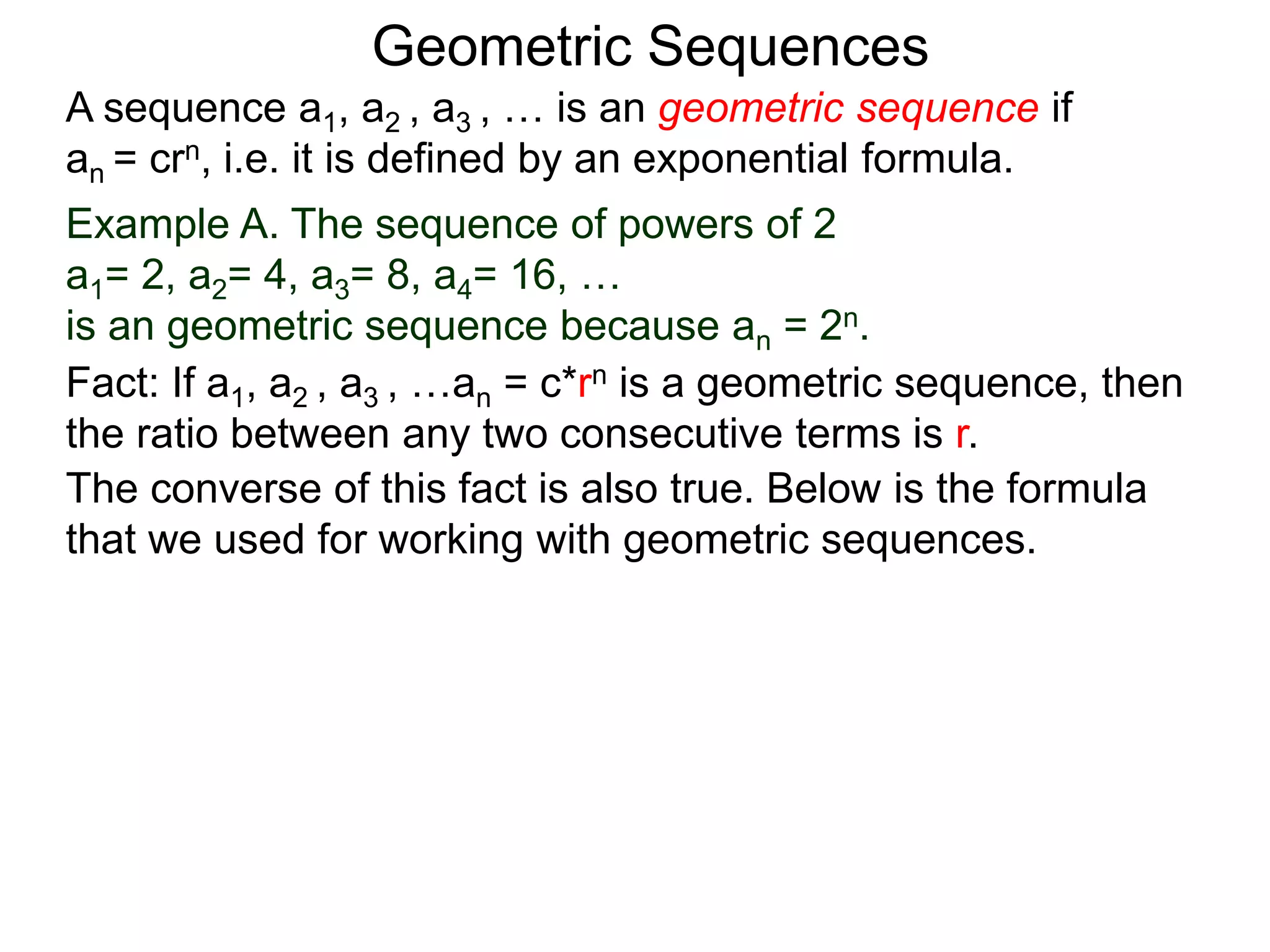
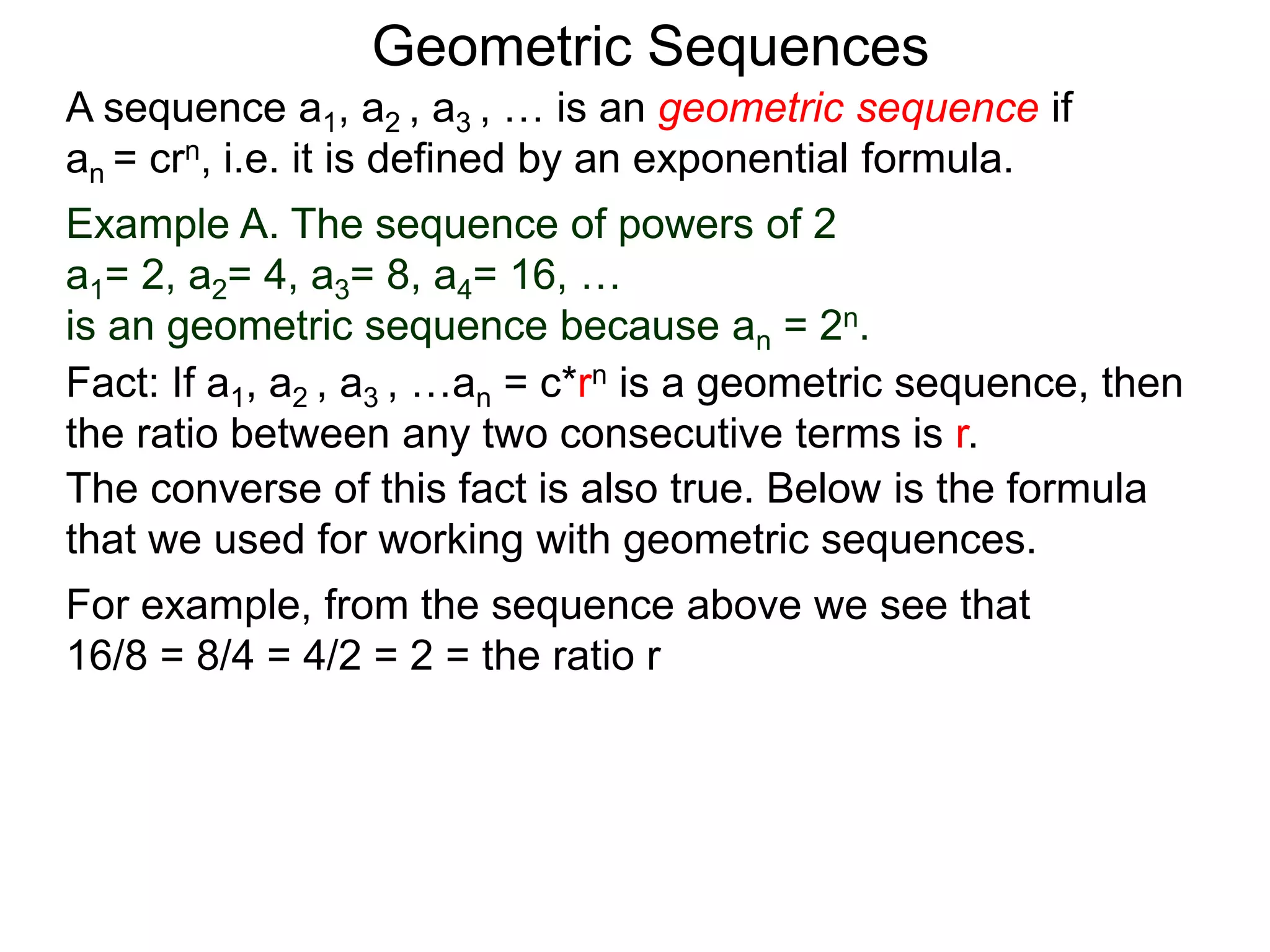
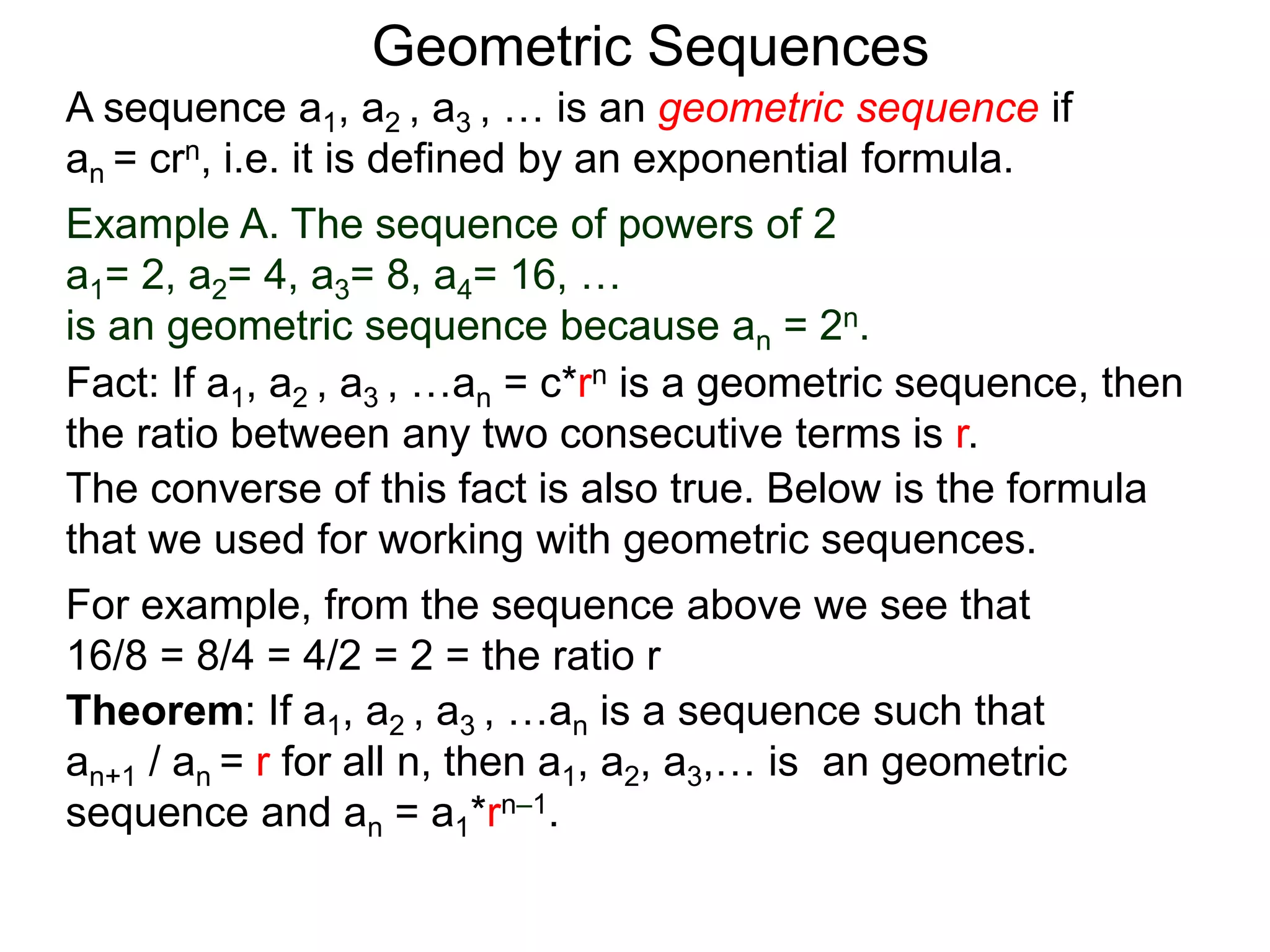
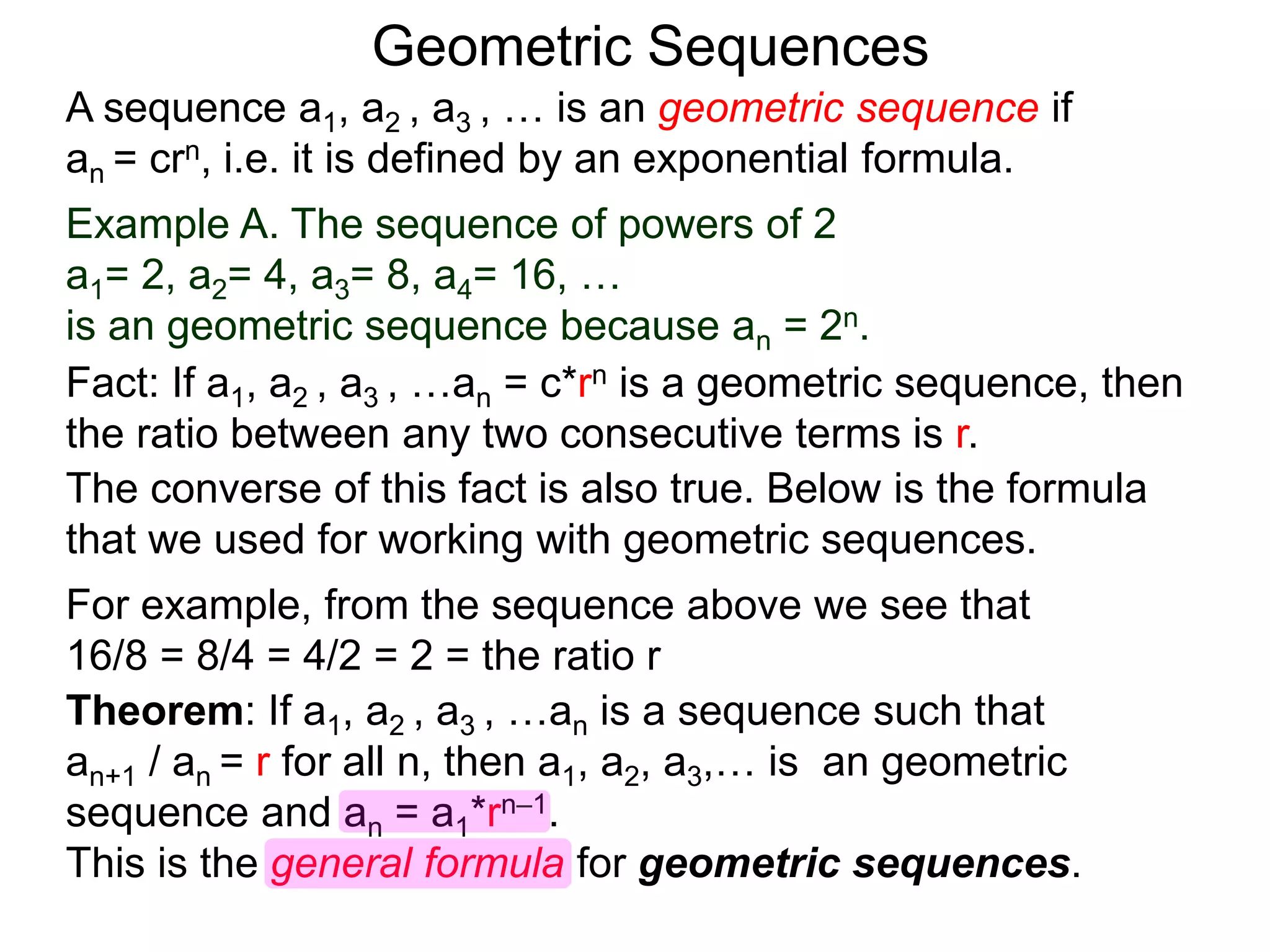
A sequence a1, a2 , a3 , … is an geometric sequence if
an = crn, i.e. it is defined by an exponential formula.
Geometric Sequences
Example A. The sequence of powers of 2
a1= 2, a2= 4, a3= 8, a4= 16, …
is an geometric sequence because an = 2n.
A sequence a1, a2 , a3 , … is an geometric sequence if
an = crn, i.e. it is defined by an exponential formula.
Geometric Sequences
Example A. The sequence of powers of 2
a1= 2, a2= 4, a3= 8, a4= 16, …
is an geometric sequence because an = 2n.
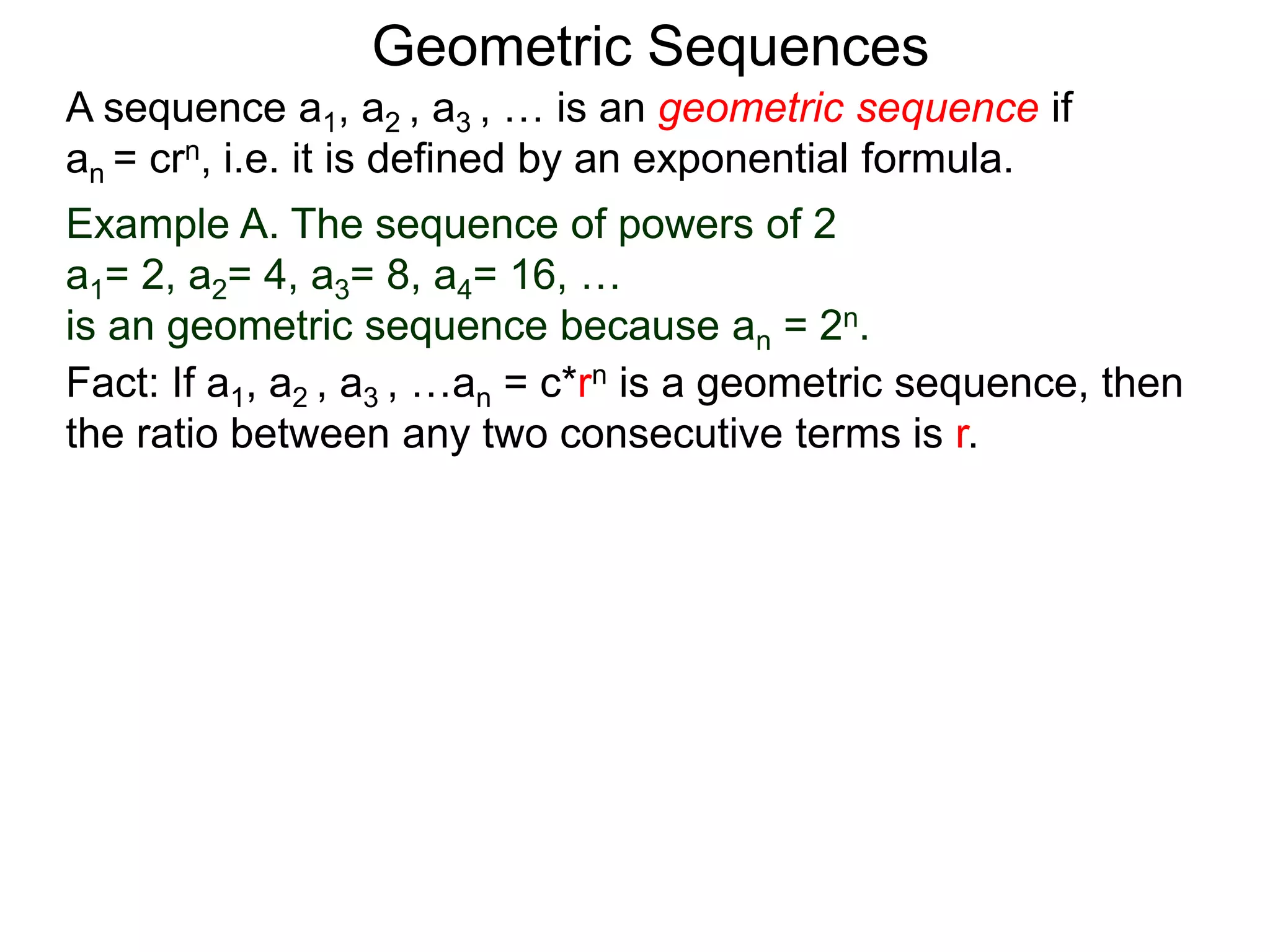
Fact: If a1, a2 , a3 , …an = c*rn is a geometric sequence, then
the ratio between any two consecutive terms is r.
A sequence a1, a2 , a3 , … is an geometric sequence if
an = crn, i.e. it is defined by an exponential formula.
Geometric Sequences
Example A. The sequence of powers of 2
a1= 2, a2= 4, a3= 8, a4= 16, …
is an geometric sequence because an = 2n.
A sequence a1, a2 , a3 , … is an geometric sequence if
an = crn, i.e. it is defined by an exponential formula.
Geometric Sequences
The converse of this fact is also true.
Fact: If a1, a2 , a3 , …an = c*rn is a geometric sequence, then
the ratio between any two consecutive terms is r.
Example A. The sequence of powers of 2
a1= 2, a2= 4, a3= 8, a4= 16, …
is an geometric sequence because an = 2n.
A sequence a1, a2 , a3 , … is an geometric sequence if
an = crn, i.e. it is defined by an exponential formula.
Geometric Sequences
The converse of this fact is also true. Below is the formula
that we used for working with geometric sequences.
Fact: If a1, a2 , a3 , …an = c*rn is a geometric sequence, then
the ratio between any two consecutive terms is r.
Example A. The sequence of powers of 2
a1= 2, a2= 4, a3= 8, a4= 16, …
is an geometric sequence because an = 2n.
A sequence a1, a2 , a3 , … is an geometric sequence if
an = crn, i.e. it is defined by an exponential formula.
Geometric Sequences
The converse of this fact is also true. Below is the formula
that we used for working with geometric sequences.
For example, from the sequence above we see that
16/8 = 8/4 = 4/2 = 2 = the ratio r
Fact: If a1, a2 , a3 , …an = c*rn is a geometric sequence, then
the ratio between any two consecutive terms is r.
Example A. The sequence of powers of 2
a1= 2, a2= 4, a3= 8, a4= 16, …
is an geometric sequence because an = 2n.
A sequence a1, a2 , a3 , … is an geometric sequence if
an = crn, i.e. it is defined by an exponential formula.
Geometric Sequences
Theorem: If a1, a2 , a3 , …an is a sequence such that
an+1 / an = r for all n, then a1, a2, a3,… is an geometric
sequence and an = a1*rn–1.
The converse of this fact is also true. Below is the formula
that we used for working with geometric sequences.
For example, from the sequence above we see that
16/8 = 8/4 = 4/2 = 2 = the ratio r
Fact: If a1, a2 , a3 , …an = c*rn is a geometric sequence, then
the ratio between any two consecutive terms is r.
Example A. The sequence of powers of 2
a1= 2, a2= 4, a3= 8, a4= 16, …
is an geometric sequence because an = 2n.
A sequence a1, a2 , a3 , … is an geometric sequence if
an = crn, i.e. it is defined by an exponential formula.
Geometric Sequences
Theorem: If a1, a2 , a3 , …an is a sequence such that
an+1 / an = r for all n, then a1, a2, a3,… is an geometric
sequence and an = a1*rn–1.
This is the general formula for geometric sequences.
The converse of this fact is also true. Below is the formula
that we used for working with geometric sequences.
For example, from the sequence above we see that
16/8 = 8/4 = 4/2 = 2 = the ratio r
Fact: If a1, a2 , a3 , …an = c*rn is a geometric sequence, then
the ratio between any two consecutive terms is r.
Geometric Sequences
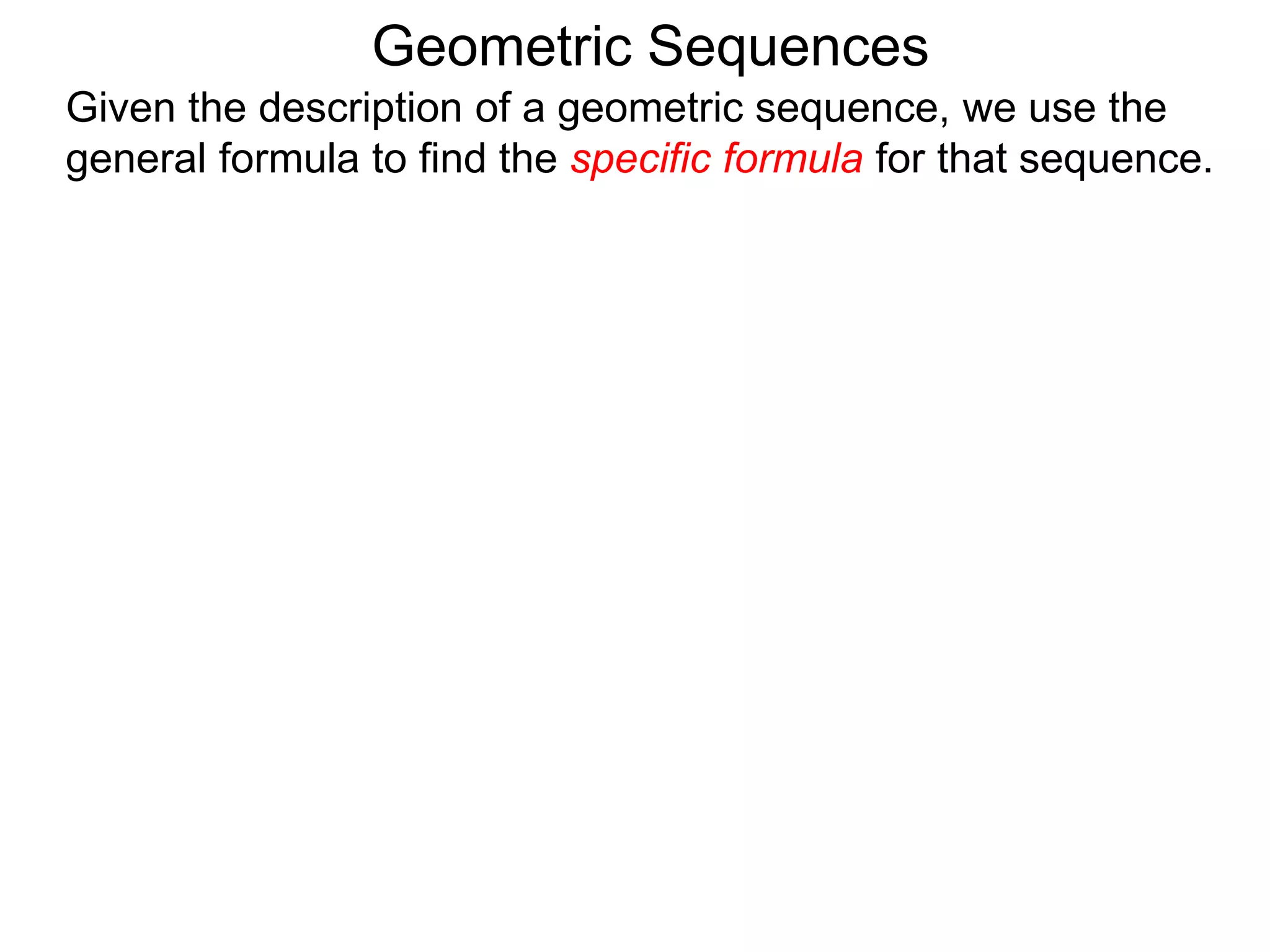
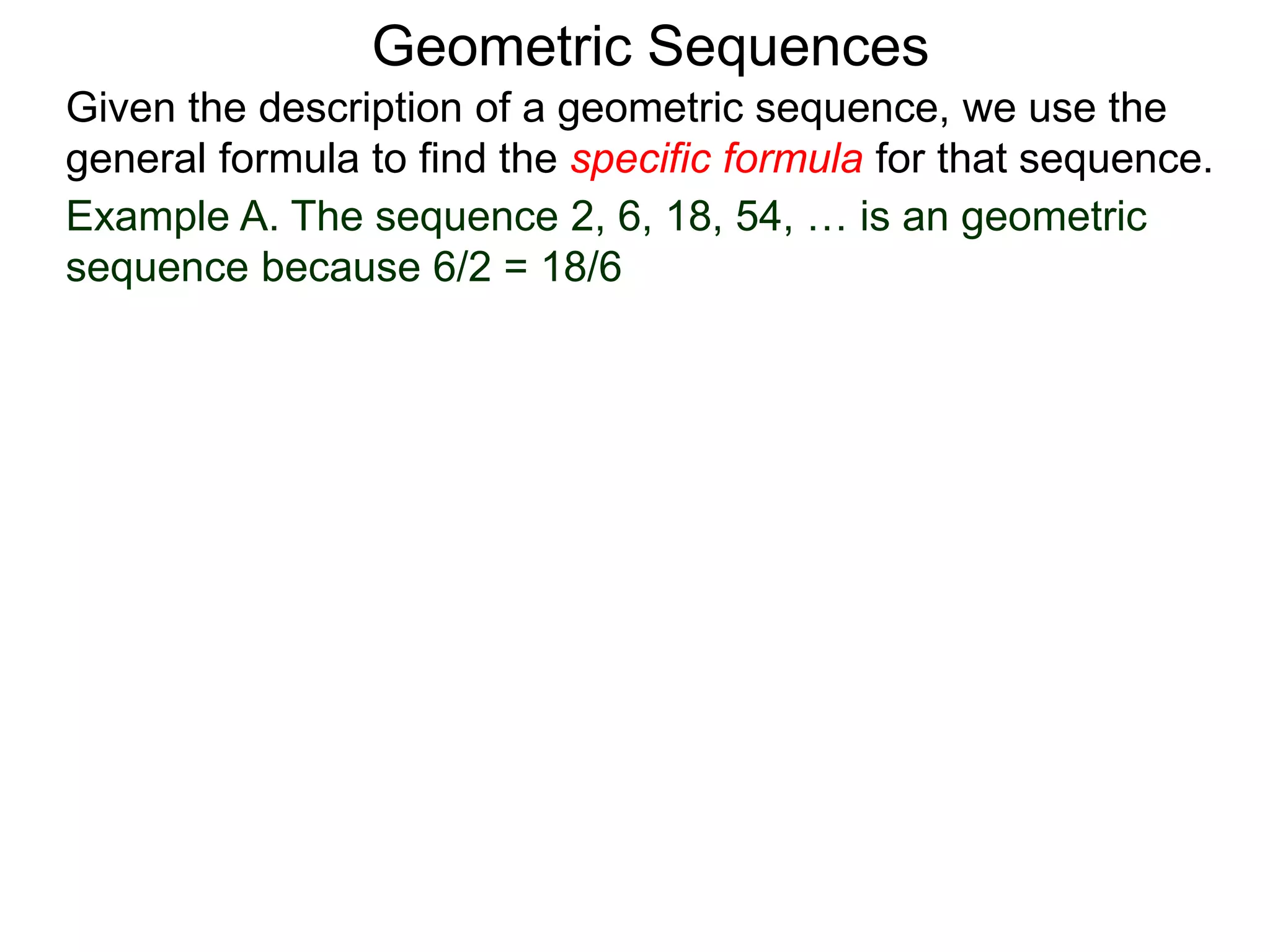
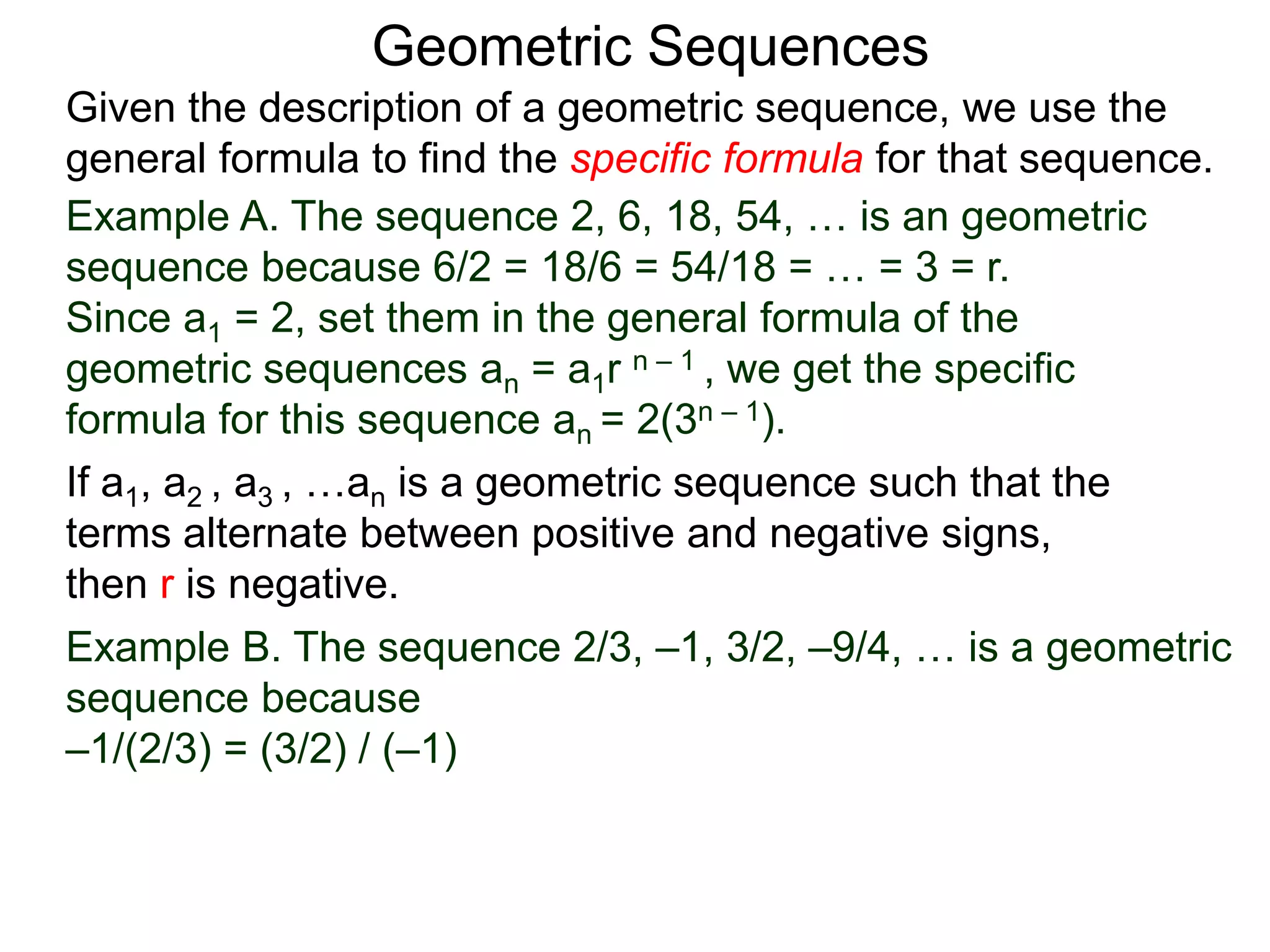
Given the description of a geometric sequence, we use the
general formula to find the specific formula for that sequence.
Example A. The sequence 2, 6, 18, 54, … is an geometric
sequence because 6/2 = 18/6
Geometric Sequences
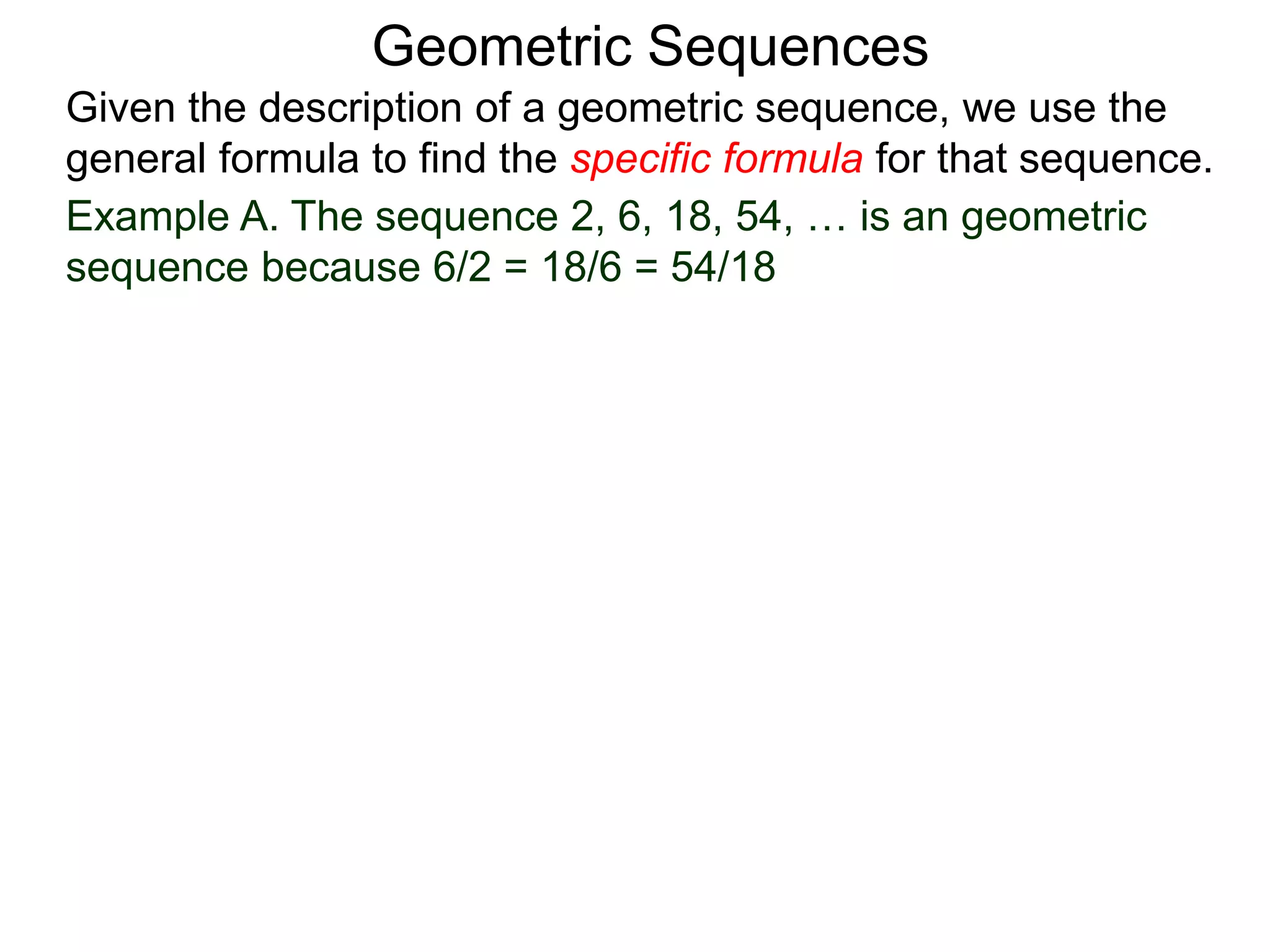
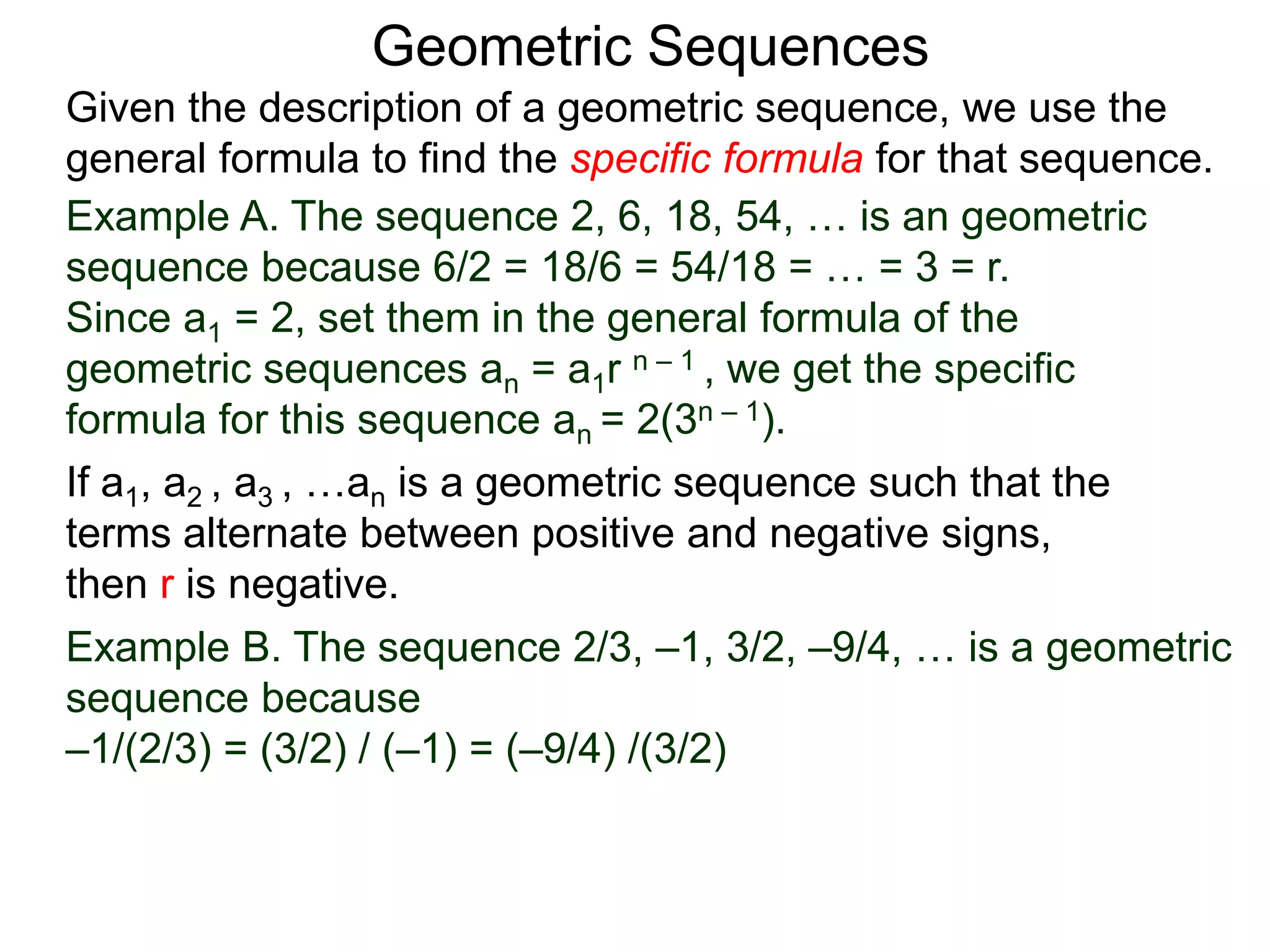
Given the description of a geometric sequence, we use the
general formula to find the specific formula for that sequence.
Example A. The sequence 2, 6, 18, 54, … is an geometric
sequence because 6/2 = 18/6 = 54/18
Geometric Sequences
Given the description of a geometric sequence, we use the
general formula to find the specific formula for that sequence.
Example A. The sequence 2, 6, 18, 54, … is an geometric
sequence because 6/2 = 18/6 = 54/18 = … = 3 = r.
Geometric Sequences
Given the description of a geometric sequence, we use the
general formula to find the specific formula for that sequence.
Example A. The sequence 2, 6, 18, 54, … is an geometric
sequence because 6/2 = 18/6 = 54/18 = … = 3 = r.
Since a1 = 2, set them in the general formula of the
geometric sequences an = a1r n – 1
Geometric Sequences
Given the description of a geometric sequence, we use the
general formula to find the specific formula for that sequence.
Example A. The sequence 2, 6, 18, 54, … is an geometric
sequence because 6/2 = 18/6 = 54/18 = … = 3 = r.
Since a1 = 2, set them in the general formula of the
geometric sequences an = a1r n – 1 , we get the specific
formula for this sequence an = 2(3n – 1).
Geometric Sequences
Given the description of a geometric sequence, we use the
general formula to find the specific formula for that sequence.
Example A. The sequence 2, 6, 18, 54, … is an geometric
sequence because 6/2 = 18/6 = 54/18 = … = 3 = r.
Since a1 = 2, set them in the general formula of the
geometric sequences an = a1r n – 1 , we get the specific
formula for this sequence an = 2(3n – 1).
Geometric Sequences
If a1, a2 , a3 , …an is a geometric sequence such that the
terms alternate between positive and negative signs,
then r is negative.
Given the description of a geometric sequence, we use the
general formula to find the specific formula for that sequence.
Example A. The sequence 2, 6, 18, 54, … is an geometric
sequence because 6/2 = 18/6 = 54/18 = … = 3 = r.
Since a1 = 2, set them in the general formula of the
geometric sequences an = a1r n – 1 , we get the specific
formula for this sequence an = 2(3n – 1).
Geometric Sequences
If a1, a2 , a3 , …an is a geometric sequence such that the
terms alternate between positive and negative signs,
then r is negative.
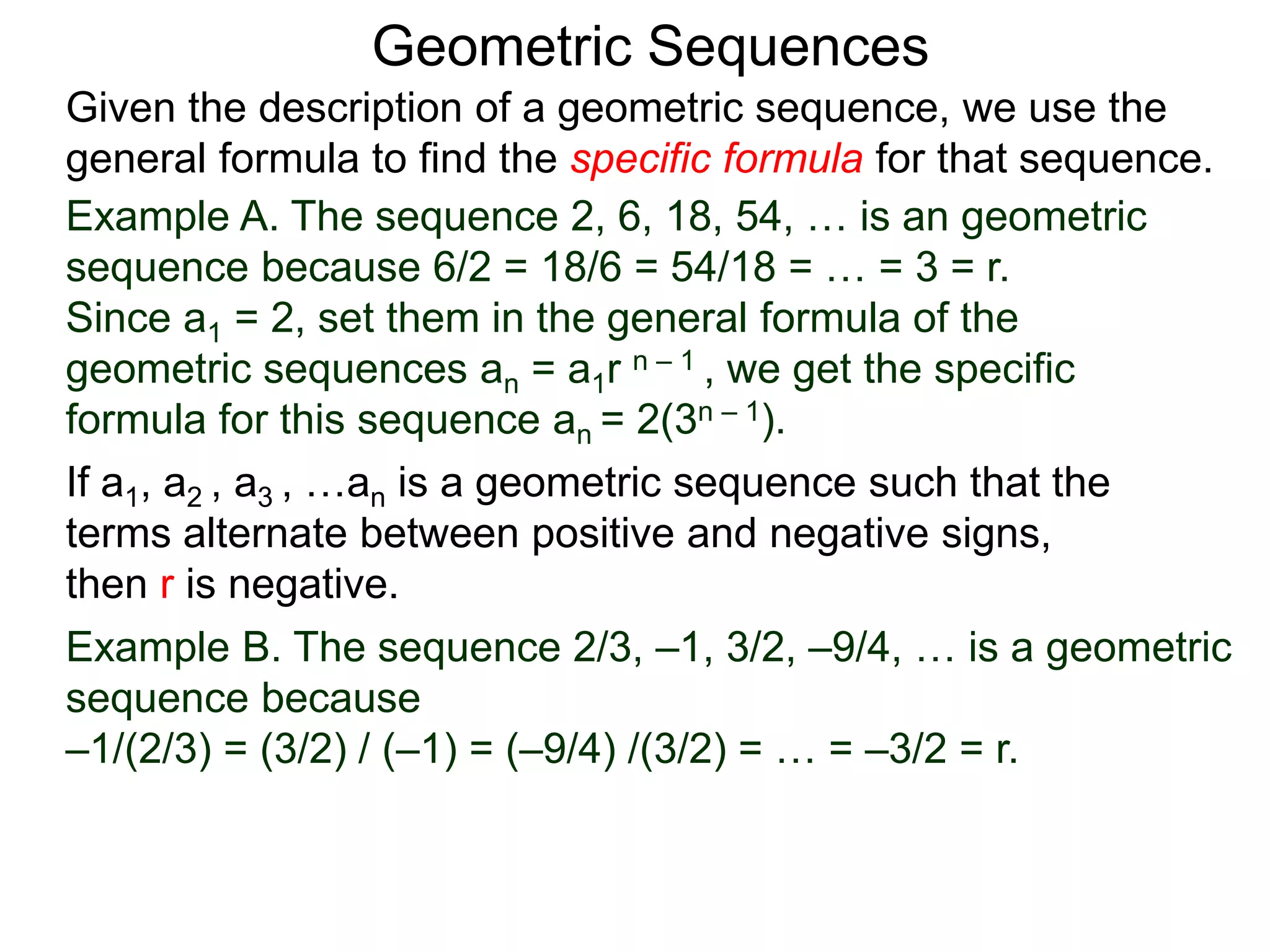
Example B. The sequence 2/3, –1, 3/2, –9/4, … is a geometric
sequence because
–1/(2/3) = (3/2) / (–1)
Given the description of a geometric sequence, we use the
general formula to find the specific formula for that sequence.
Example A. The sequence 2, 6, 18, 54, … is an geometric
sequence because 6/2 = 18/6 = 54/18 = … = 3 = r.
Since a1 = 2, set them in the general formula of the
geometric sequences an = a1r n – 1 , we get the specific
formula for this sequence an = 2(3n – 1).
Geometric Sequences
If a1, a2 , a3 , …an is a geometric sequence such that the
terms alternate between positive and negative signs,
then r is negative.
Example B. The sequence 2/3, –1, 3/2, –9/4, … is a geometric
sequence because
–1/(2/3) = (3/2) / (–1) = (–9/4) /(3/2)
Given the description of a geometric sequence, we use the
general formula to find the specific formula for that sequence.
Example A. The sequence 2, 6, 18, 54, … is an geometric
sequence because 6/2 = 18/6 = 54/18 = … = 3 = r.
Since a1 = 2, set them in the general formula of the
geometric sequences an = a1r n – 1 , we get the specific
formula for this sequence an = 2(3n – 1).
Geometric Sequences
If a1, a2 , a3 , …an is a geometric sequence such that the
terms alternate between positive and negative signs,
then r is negative.
Example B. The sequence 2/3, –1, 3/2, –9/4, … is a geometric
sequence because
–1/(2/3) = (3/2) / (–1) = (–9/4) /(3/2) = … = –3/2 = r.
Given the description of a geometric sequence, we use the
general formula to find the specific formula for that sequence.
Example A. The sequence 2, 6, 18, 54, … is an geometric
sequence because 6/2 = 18/6 = 54/18 = … = 3 = r.
Since a1 = 2, set them in the general formula of the
geometric sequences an = a1r n – 1 , we get the specific
formula for this sequence an = 2(3n – 1).
Geometric Sequences
If a1, a2 , a3 , …an is a geometric sequence such that the
terms alternate between positive and negative signs,
then r is negative.
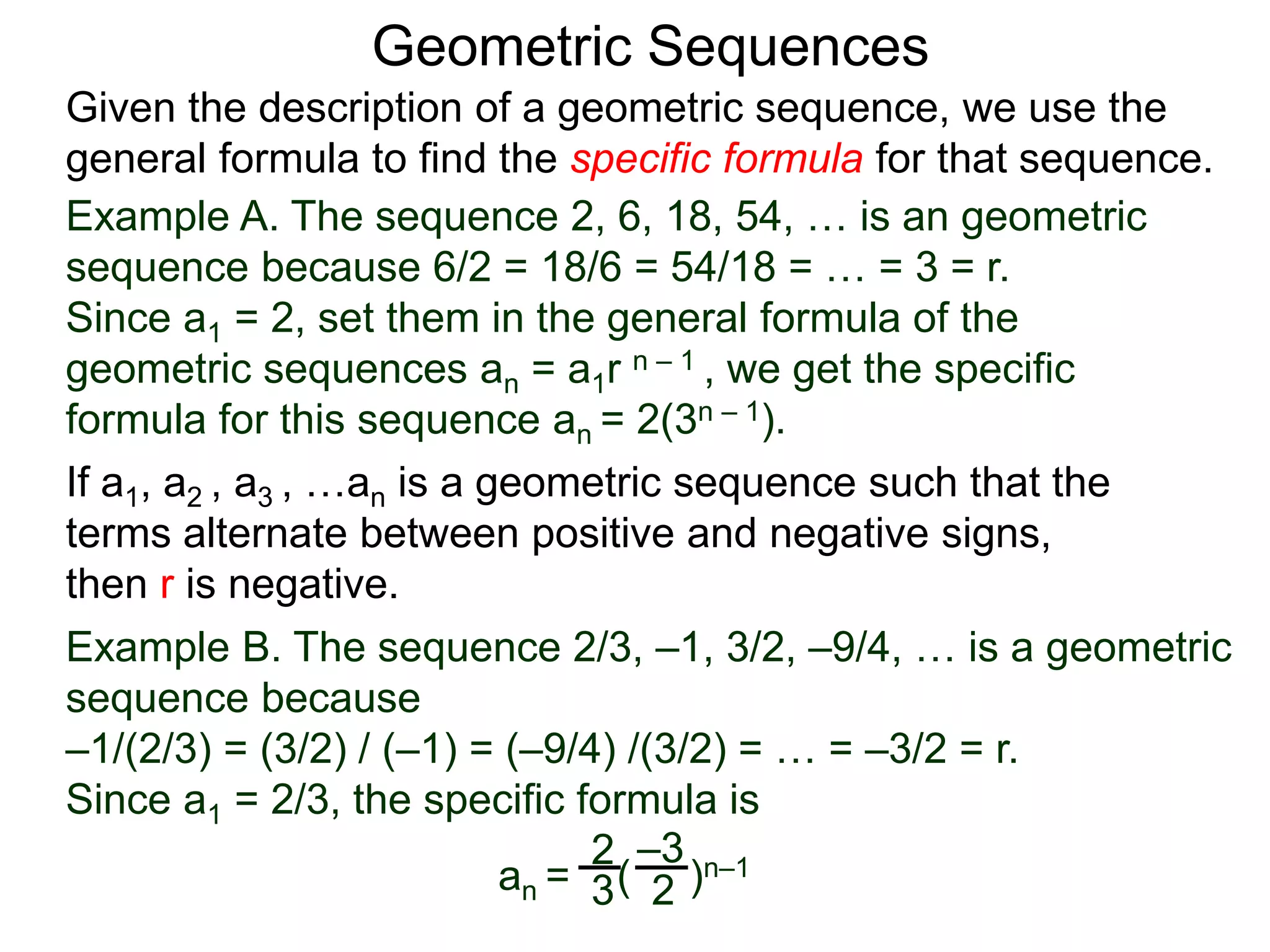
Example B. The sequence 2/3, –1, 3/2, –9/4, … is a geometric
sequence because
–1/(2/3) = (3/2) / (–1) = (–9/4) /(3/2) = … = –3/2 = r.
Since a1 = 2/3, the specific formula is
an = ( )n–12
3 2
–3
Given the description of a geometric sequence, we use the
general formula to find the specific formula for that sequence.
Geometric Sequences
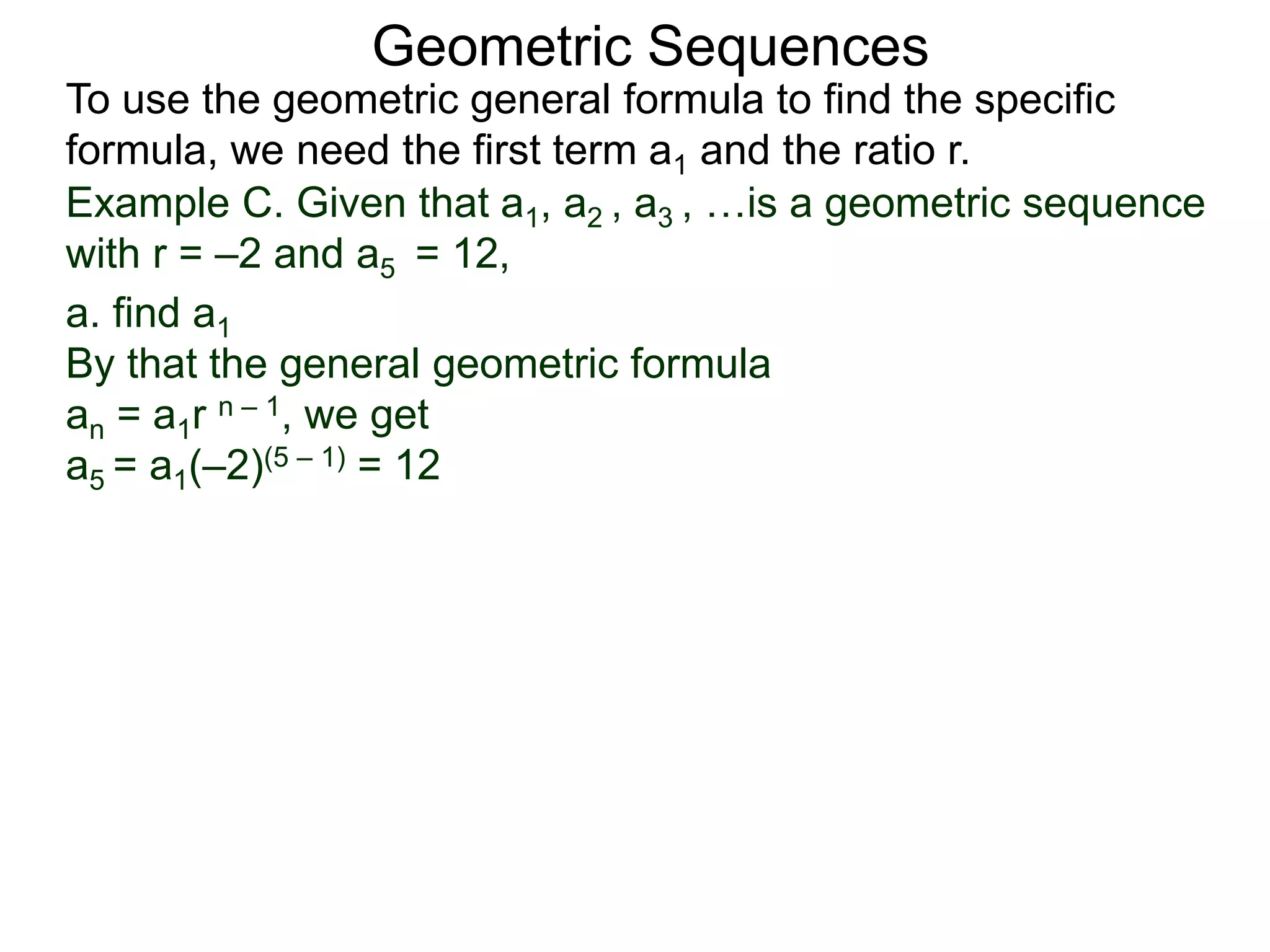
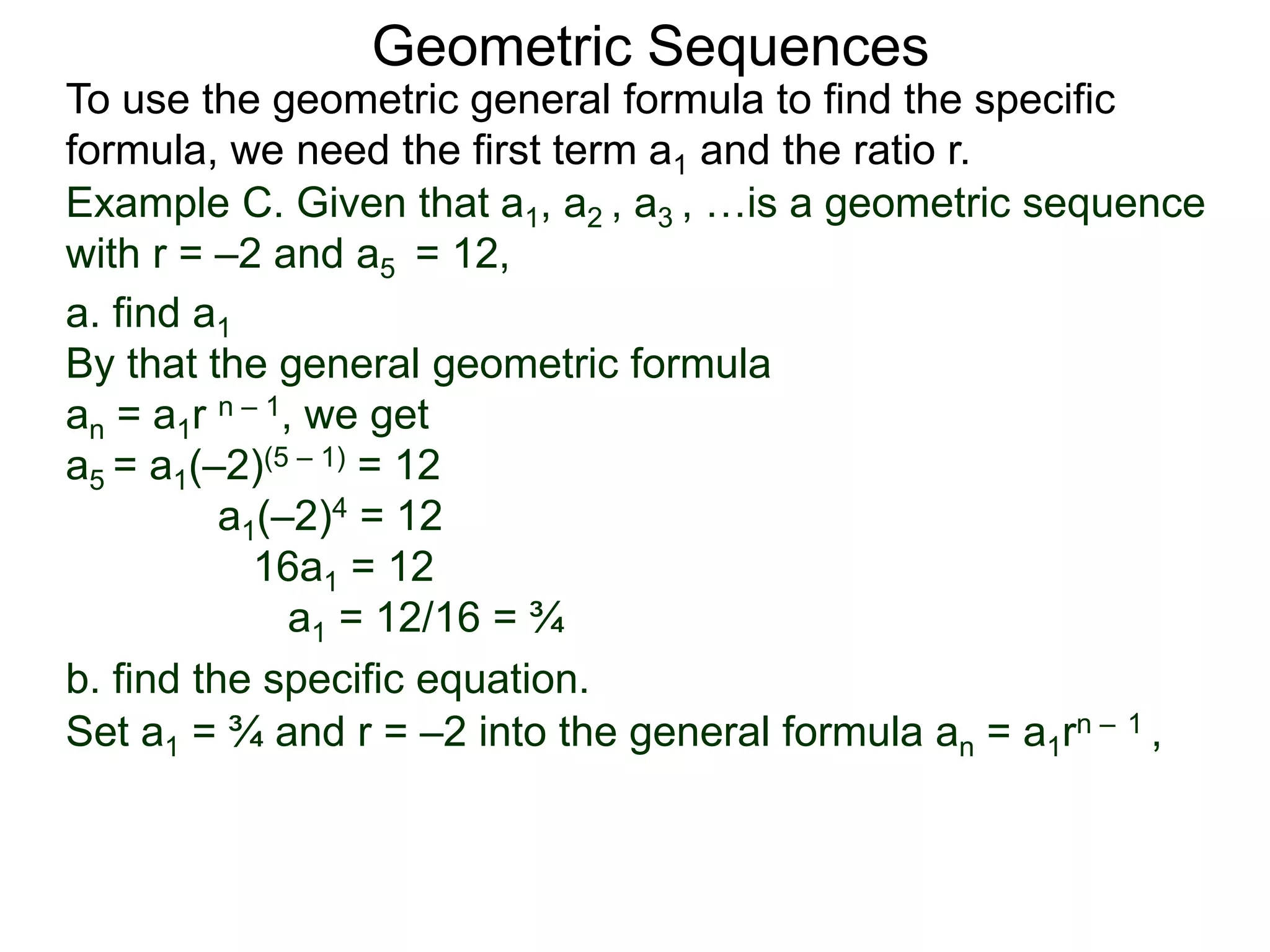
To use the geometric general formula to find the specific
formula, we need the first term a1 and the ratio r.
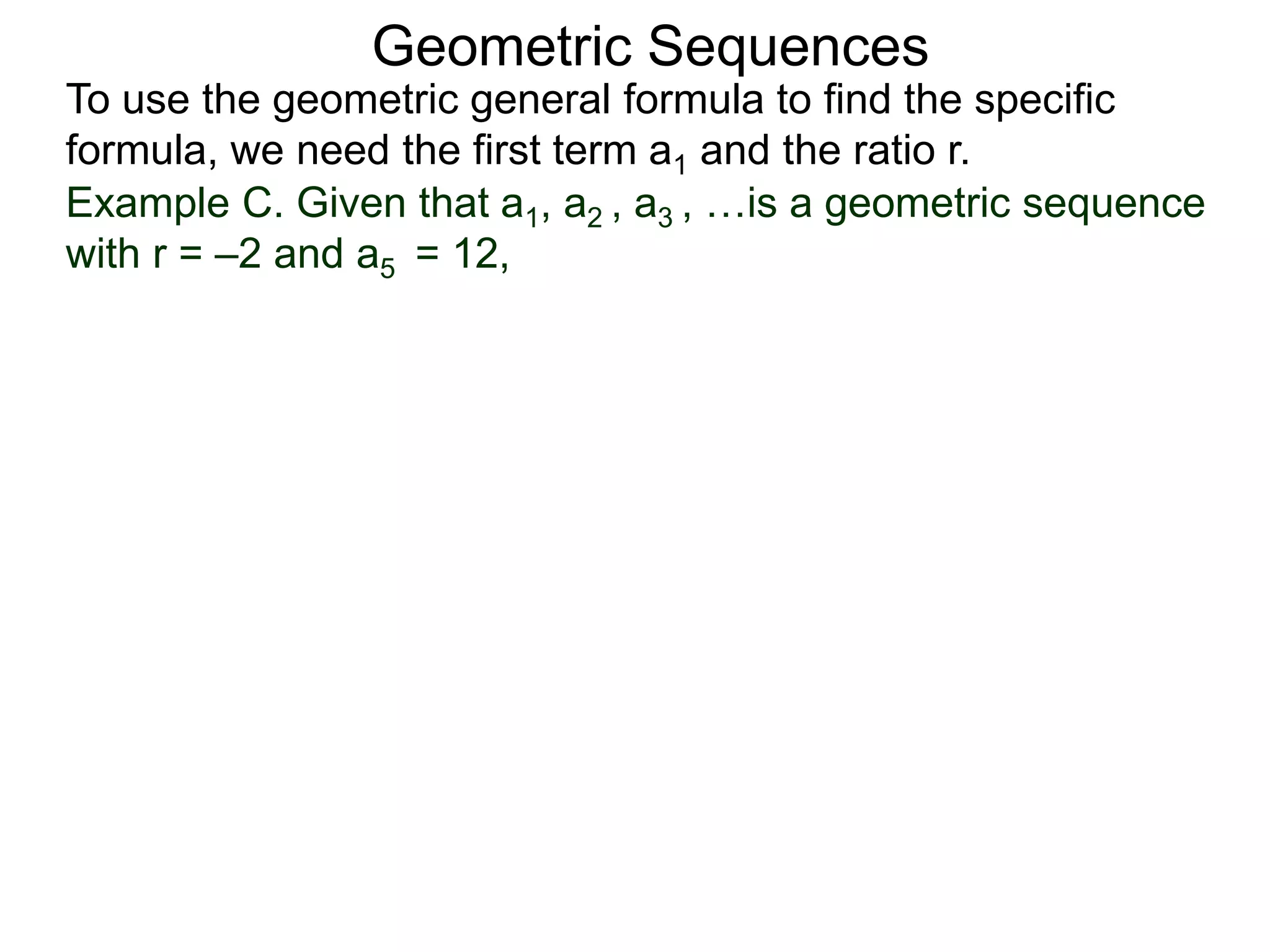
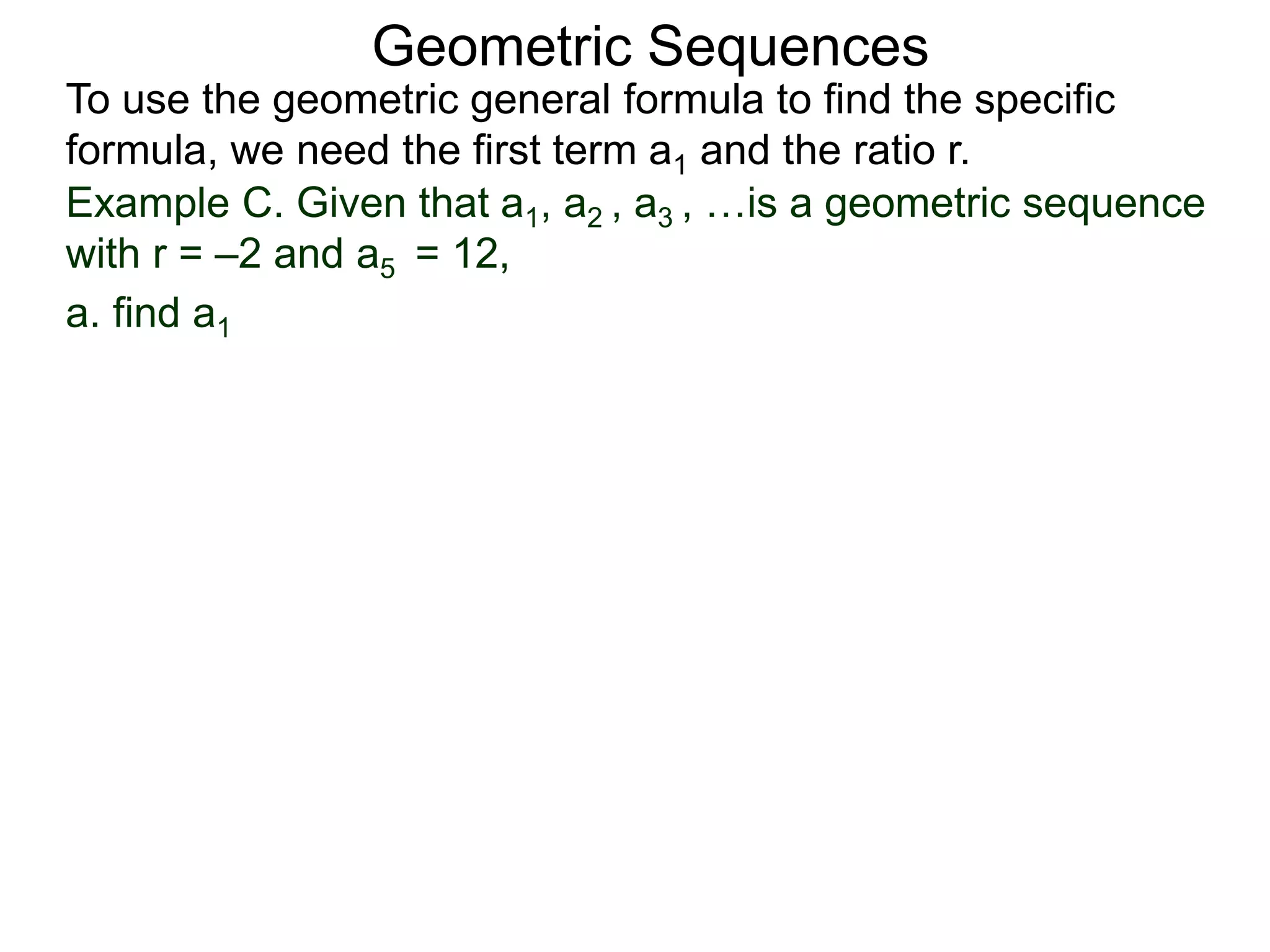
Example C. Given that a1, a2 , a3 , …is a geometric sequence
with r = –2 and a5 = 12,
Geometric Sequences
To use the geometric general formula to find the specific
formula, we need the first term a1 and the ratio r.
Example C. Given that a1, a2 , a3 , …is a geometric sequence
with r = –2 and a5 = 12,
a. find a1
Geometric Sequences
To use the geometric general formula to find the specific
formula, we need the first term a1 and the ratio r.
Example C. Given that a1, a2 , a3 , …is a geometric sequence
with r = –2 and a5 = 12,
a. find a1
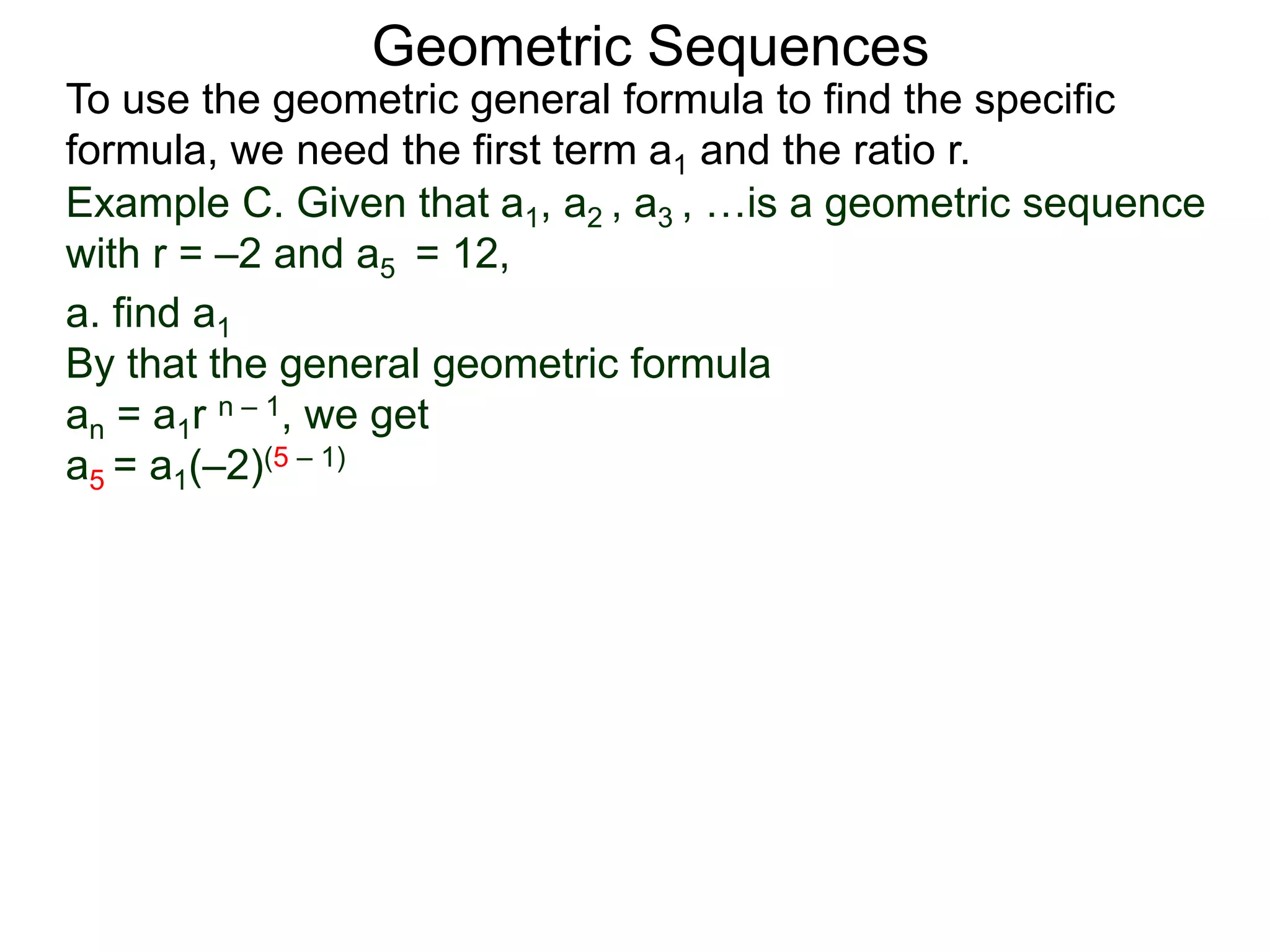
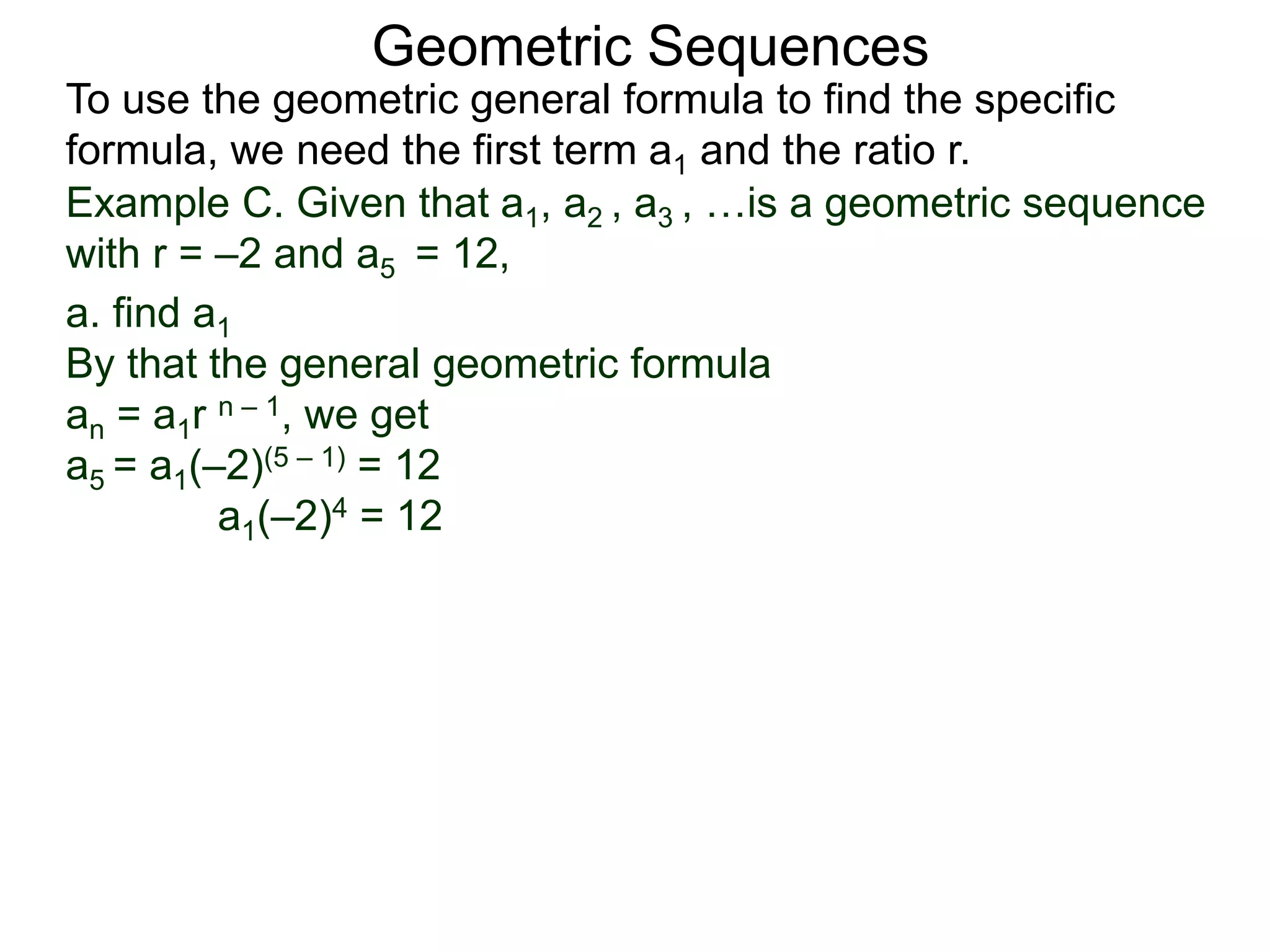
By that the general geometric formula
an = a1r n – 1, we get
a5 = a1(–2)(5 – 1)
Geometric Sequences
To use the geometric general formula to find the specific
formula, we need the first term a1 and the ratio r.
Example C. Given that a1, a2 , a3 , …is a geometric sequence
with r = –2 and a5 = 12,
a. find a1
By that the general geometric formula
an = a1r n – 1, we get
a5 = a1(–2)(5 – 1) = 12
Geometric Sequences
To use the geometric general formula to find the specific
formula, we need the first term a1 and the ratio r.
Example C. Given that a1, a2 , a3 , …is a geometric sequence
with r = –2 and a5 = 12,
a. find a1
By that the general geometric formula
an = a1r n – 1, we get
a5 = a1(–2)(5 – 1) = 12
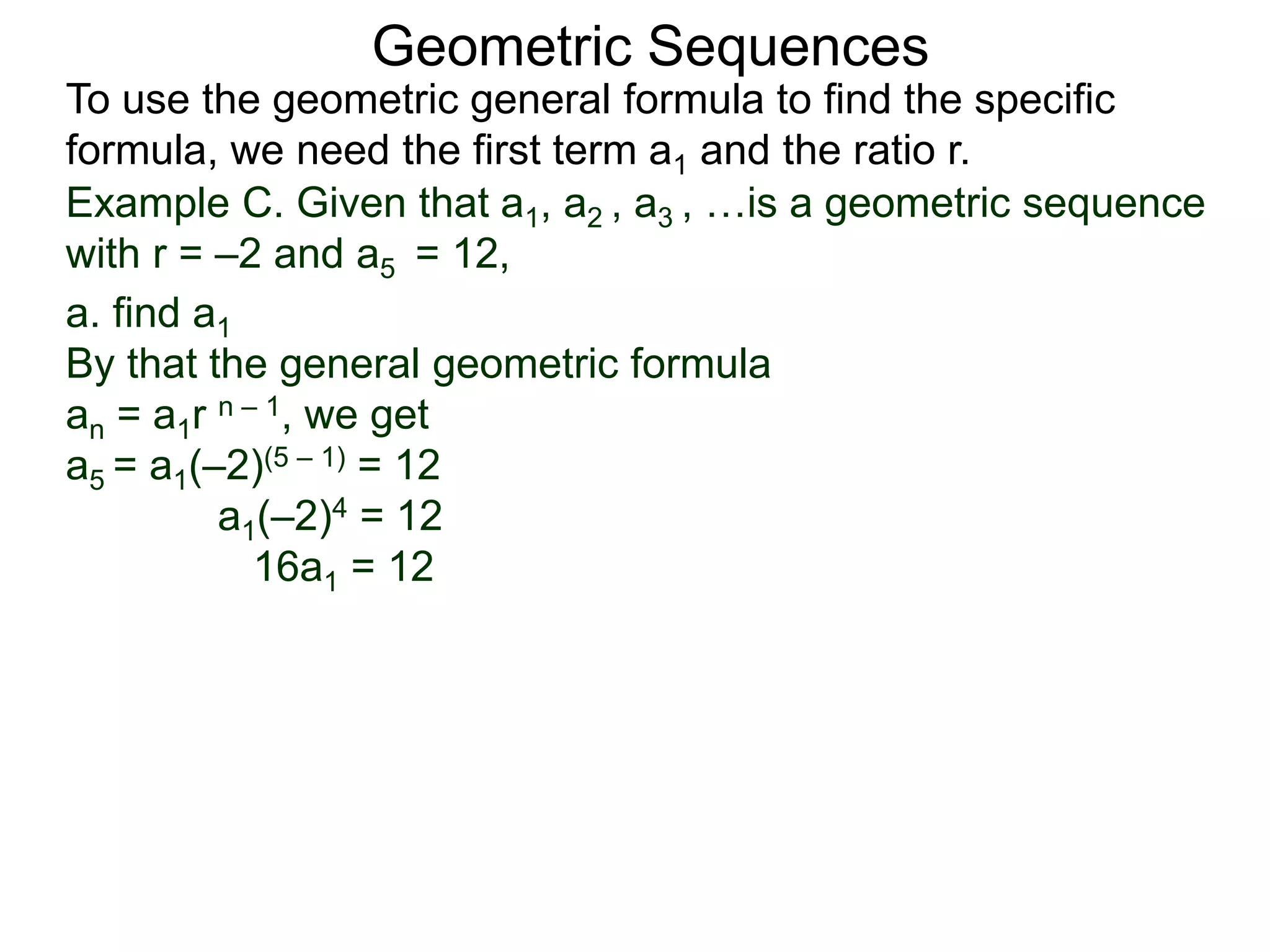
a1(–2)4 = 12
Geometric Sequences
To use the geometric general formula to find the specific
formula, we need the first term a1 and the ratio r.
Example C. Given that a1, a2 , a3 , …is a geometric sequence
with r = –2 and a5 = 12,
a. find a1
By that the general geometric formula
an = a1r n – 1, we get
a5 = a1(–2)(5 – 1) = 12
a1(–2)4 = 12
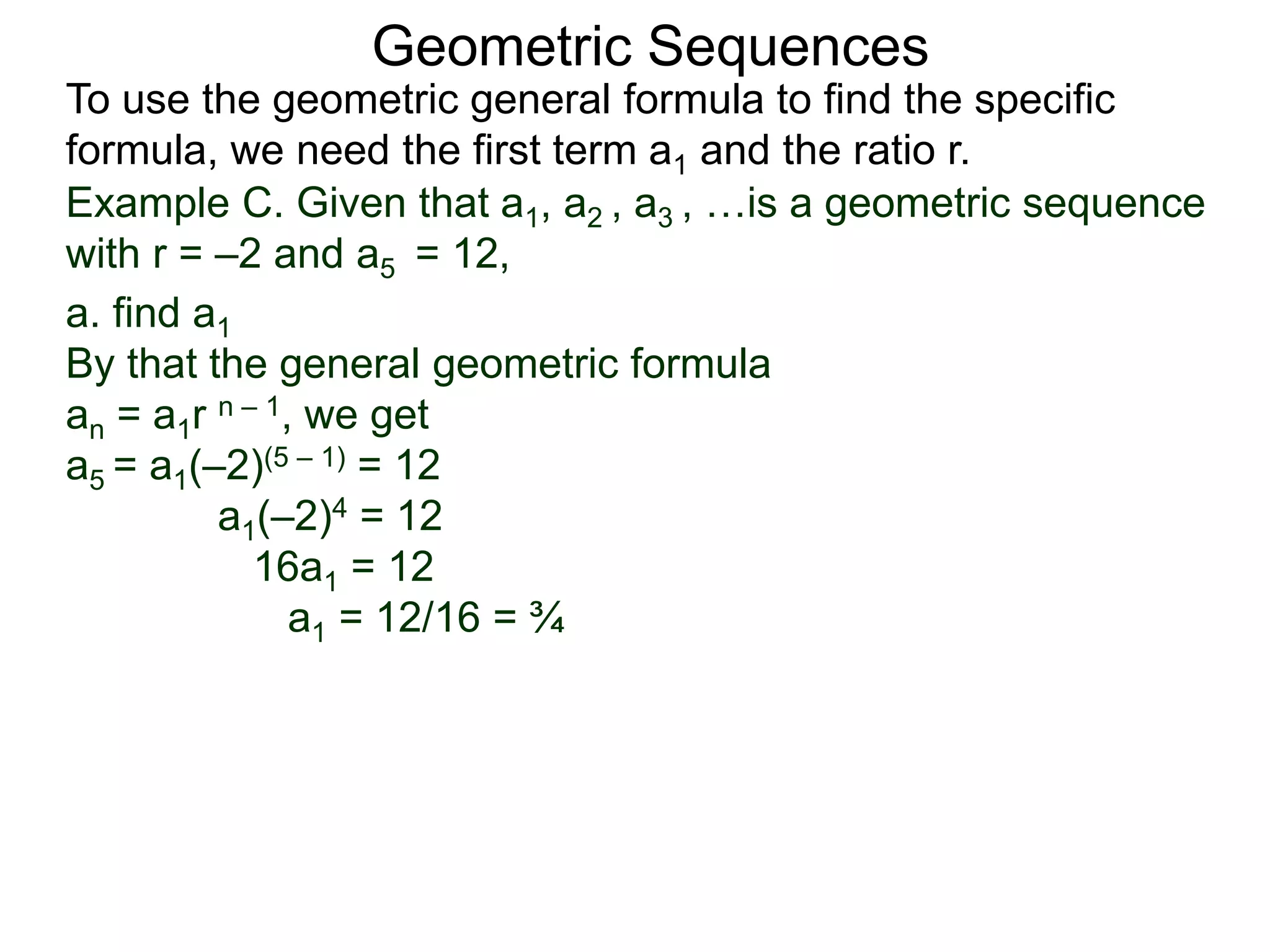
16a1 = 12
Geometric Sequences
To use the geometric general formula to find the specific
formula, we need the first term a1 and the ratio r.
Example C. Given that a1, a2 , a3 , …is a geometric sequence
with r = –2 and a5 = 12,
a. find a1
By that the general geometric formula
an = a1r n – 1, we get
a5 = a1(–2)(5 – 1) = 12
a1(–2)4 = 12
16a1 = 12
a1 = 12/16 = ¾
Geometric Sequences
To use the geometric general formula to find the specific
formula, we need the first term a1 and the ratio r.
Example C. Given that a1, a2 , a3 , …is a geometric sequence
with r = –2 and a5 = 12,
a. find a1
By that the general geometric formula
an = a1r n – 1, we get
a5 = a1(–2)(5 – 1) = 12
a1(–2)4 = 12
16a1 = 12
a1 = 12/16 = ¾
Geometric Sequences
To use the geometric general formula to find the specific
formula, we need the first term a1 and the ratio r.
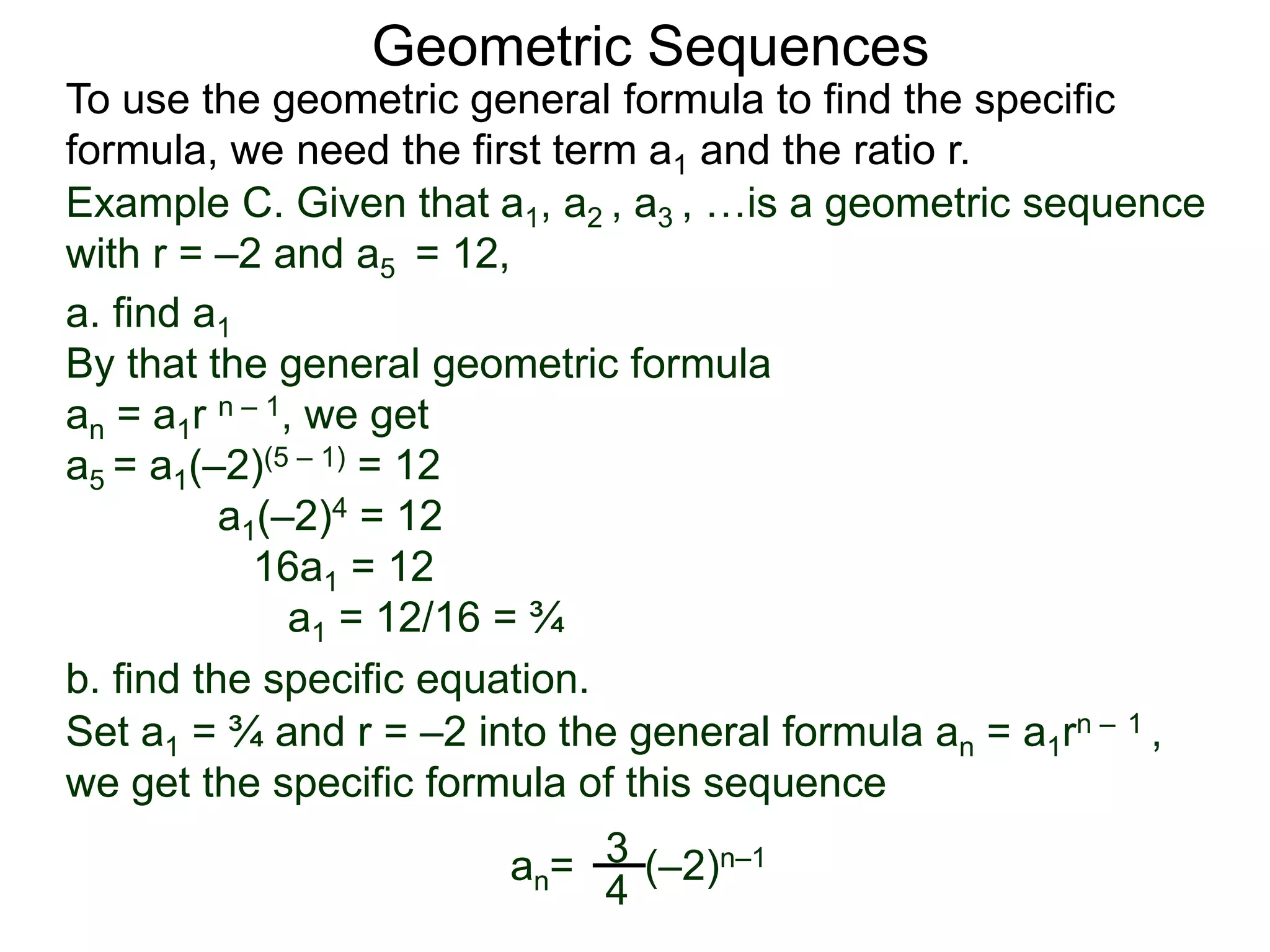
b. find the specific equation.
Example C. Given that a1, a2 , a3 , …is a geometric sequence
with r = –2 and a5 = 12,
a. find a1
By that the general geometric formula
an = a1r n – 1, we get
a5 = a1(–2)(5 – 1) = 12
a1(–2)4 = 12
16a1 = 12
a1 = 12/16 = ¾
Geometric Sequences
To use the geometric general formula to find the specific
formula, we need the first term a1 and the ratio r.
b. find the specific equation.
Set a1 = ¾ and r = –2 into the general formula an = a1rn – 1 ,
Example C. Given that a1, a2 , a3 , …is a geometric sequence
with r = –2 and a5 = 12,
a. find a1
By that the general geometric formula
an = a1r n – 1, we get
a5 = a1(–2)(5 – 1) = 12
a1(–2)4 = 12
16a1 = 12
a1 = 12/16 = ¾
3
4
an= (–2)n–1
Geometric Sequences
To use the geometric general formula to find the specific
formula, we need the first term a1 and the ratio r.
b. find the specific equation.
Set a1 = ¾ and r = –2 into the general formula an = a1rn – 1 ,
we get the specific formula of this sequence
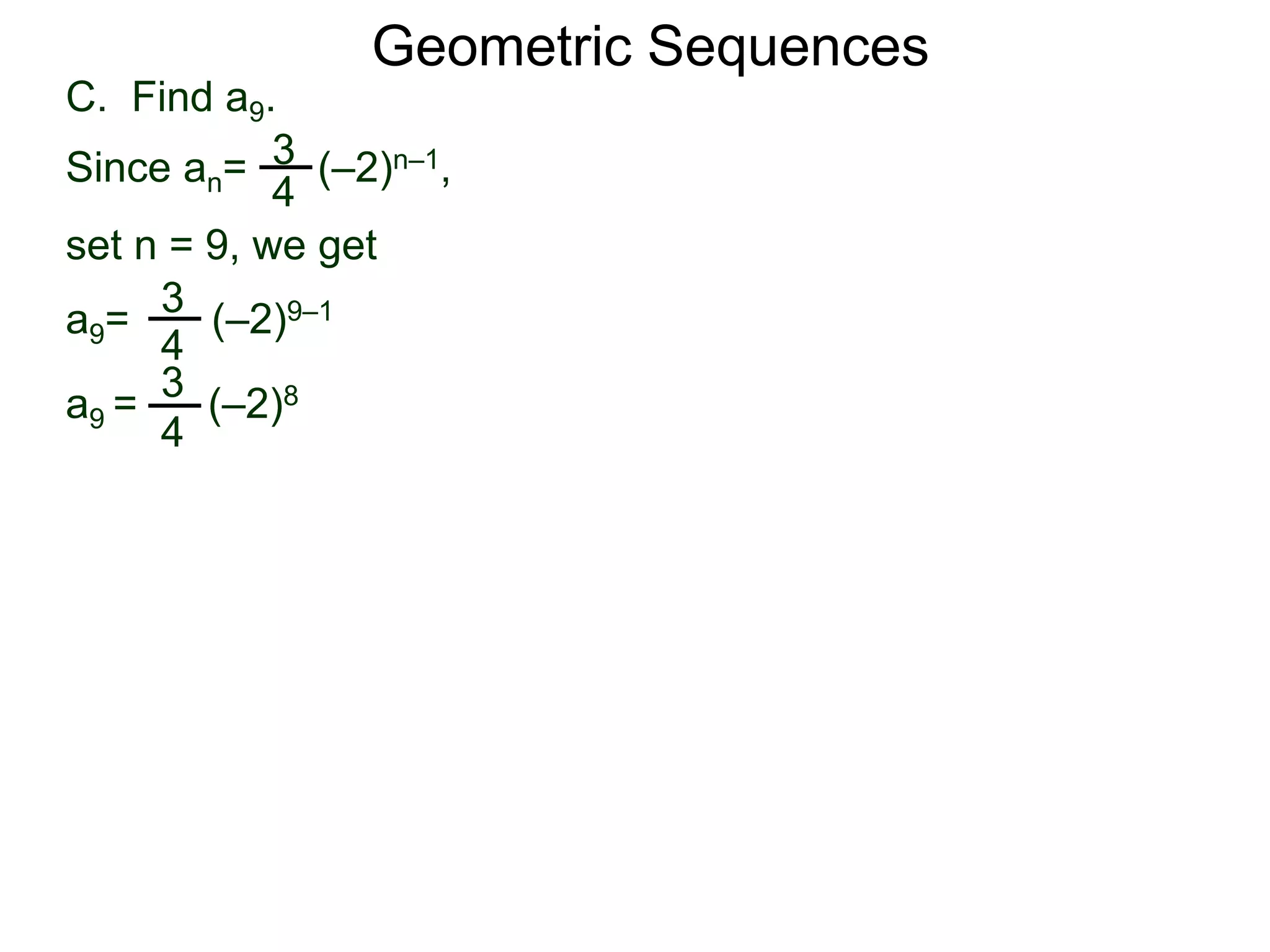
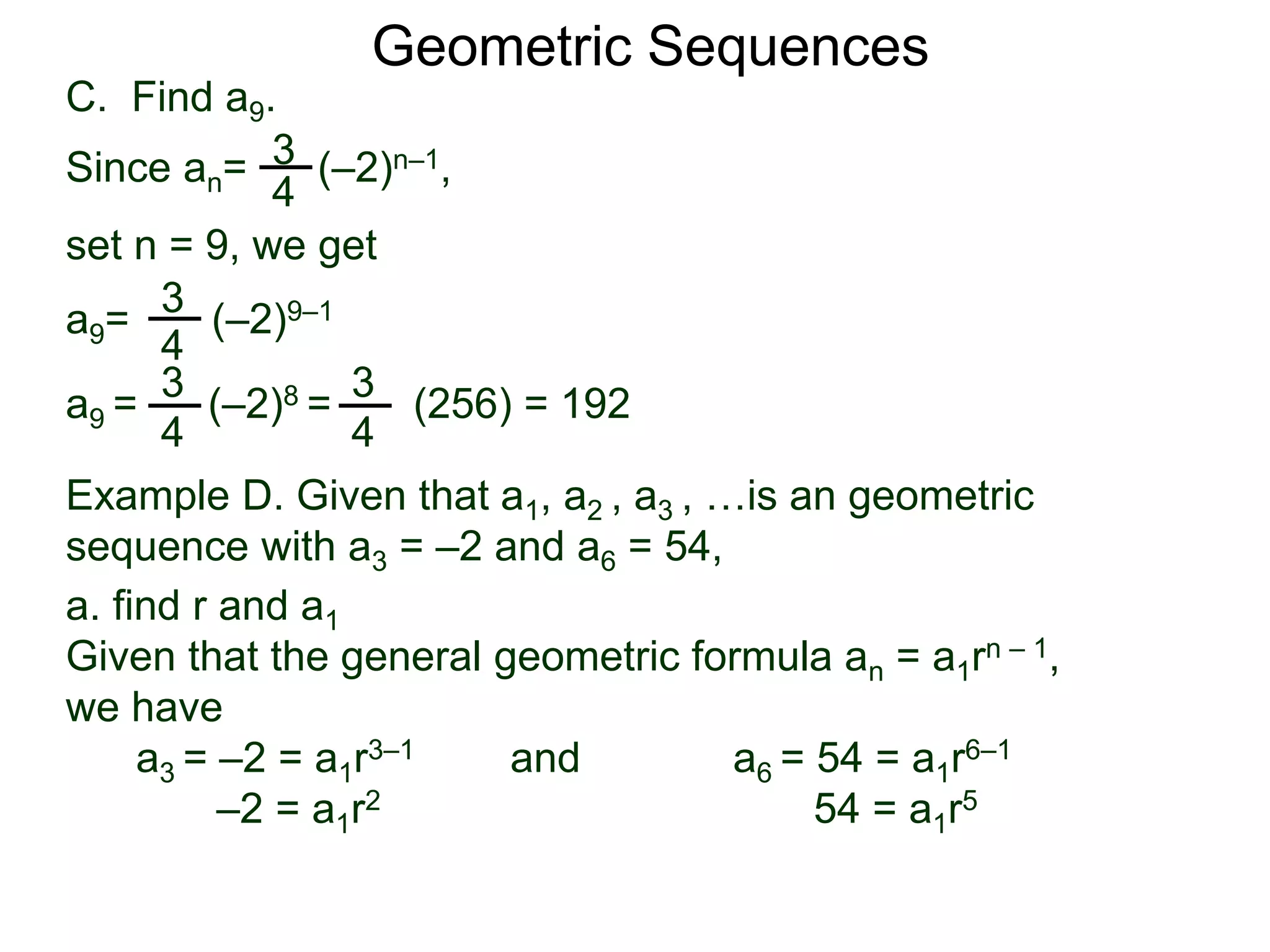
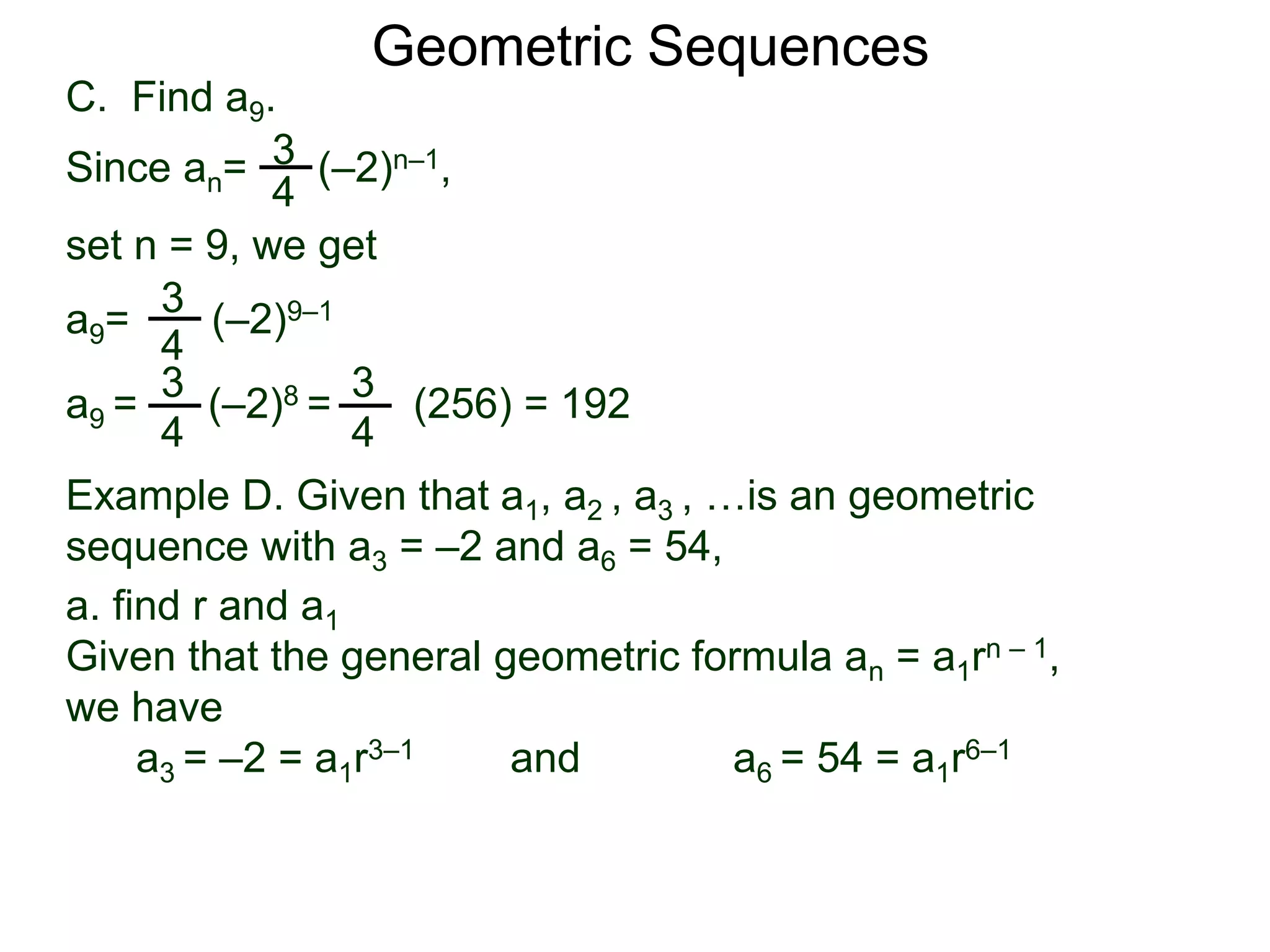
C. Find a9.
Geometric Sequences
C. Find a9.
Geometric Sequences
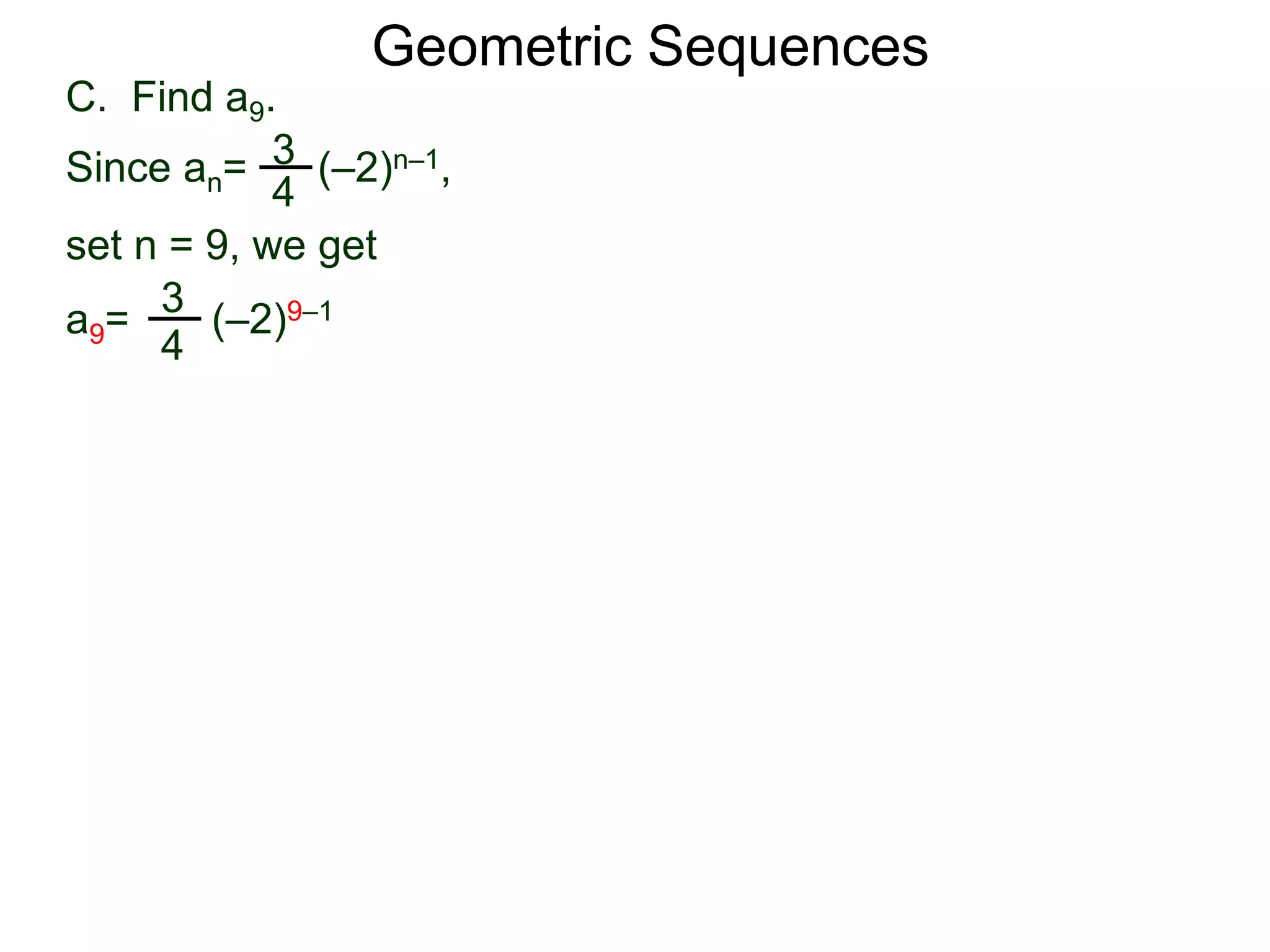
3
4
Since an= (–2)n–1,
set n = 9, we get
C. Find a9.
3
4
a9= (–2)9–1
Geometric Sequences
3
4
Since an= (–2)n–1,
set n = 9, we get
C. Find a9.
3
4
a9= (–2)9–1
a9 = (–2)83
4
Geometric Sequences
3
4
Since an= (–2)n–1,
set n = 9, we get
C. Find a9.
3
4
a9= (–2)9–1
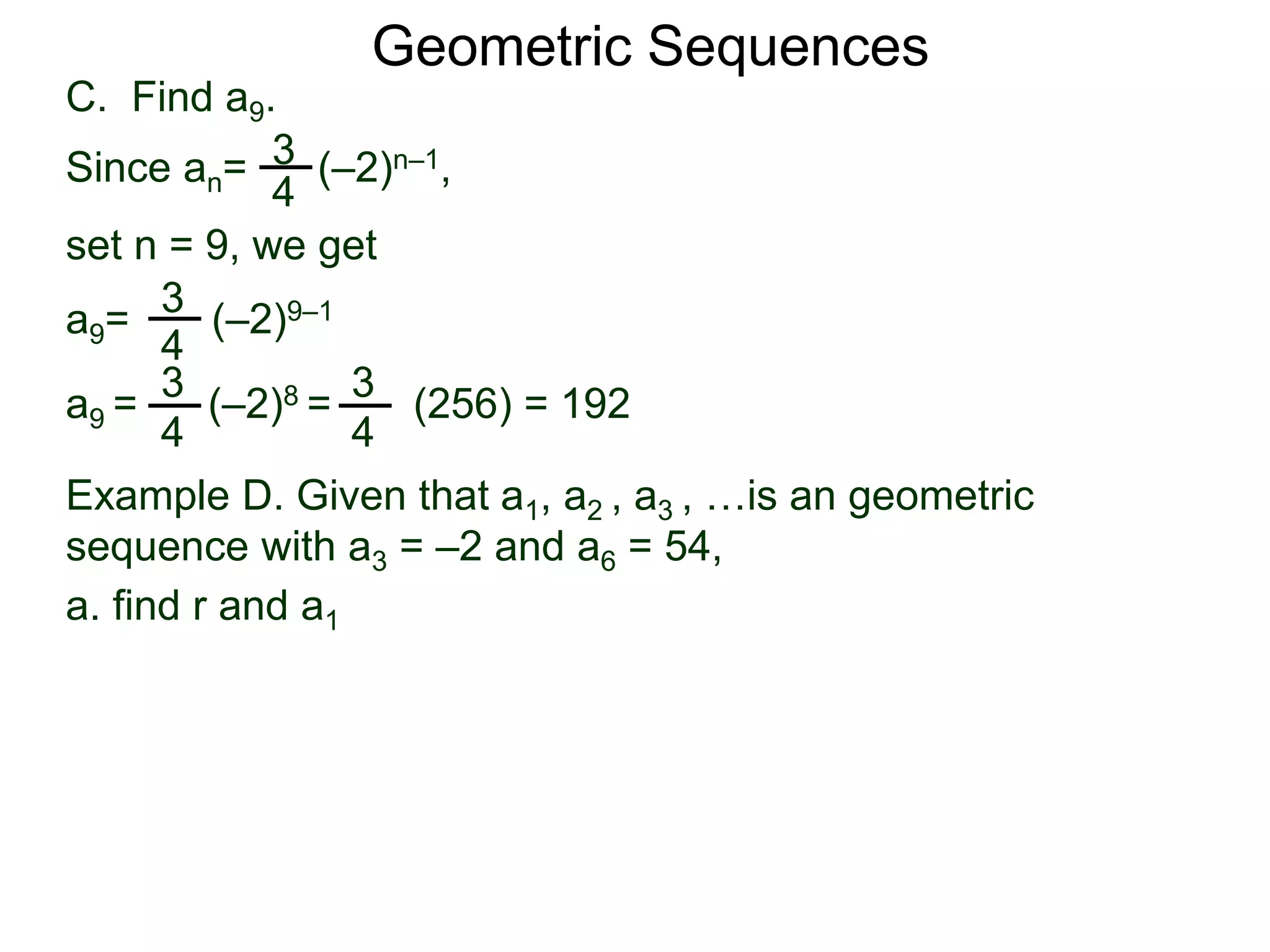
a9 = (–2)8 = (256) = 192
3
4
Geometric Sequences
3
4
Since an= (–2)n–1,
3
4
set n = 9, we get
C. Find a9.
3
4
a9= (–2)9–1
a9 = (–2)8 = (256) = 192
3
4
Geometric Sequences
3
4
Since an= (–2)n–1,
3
4
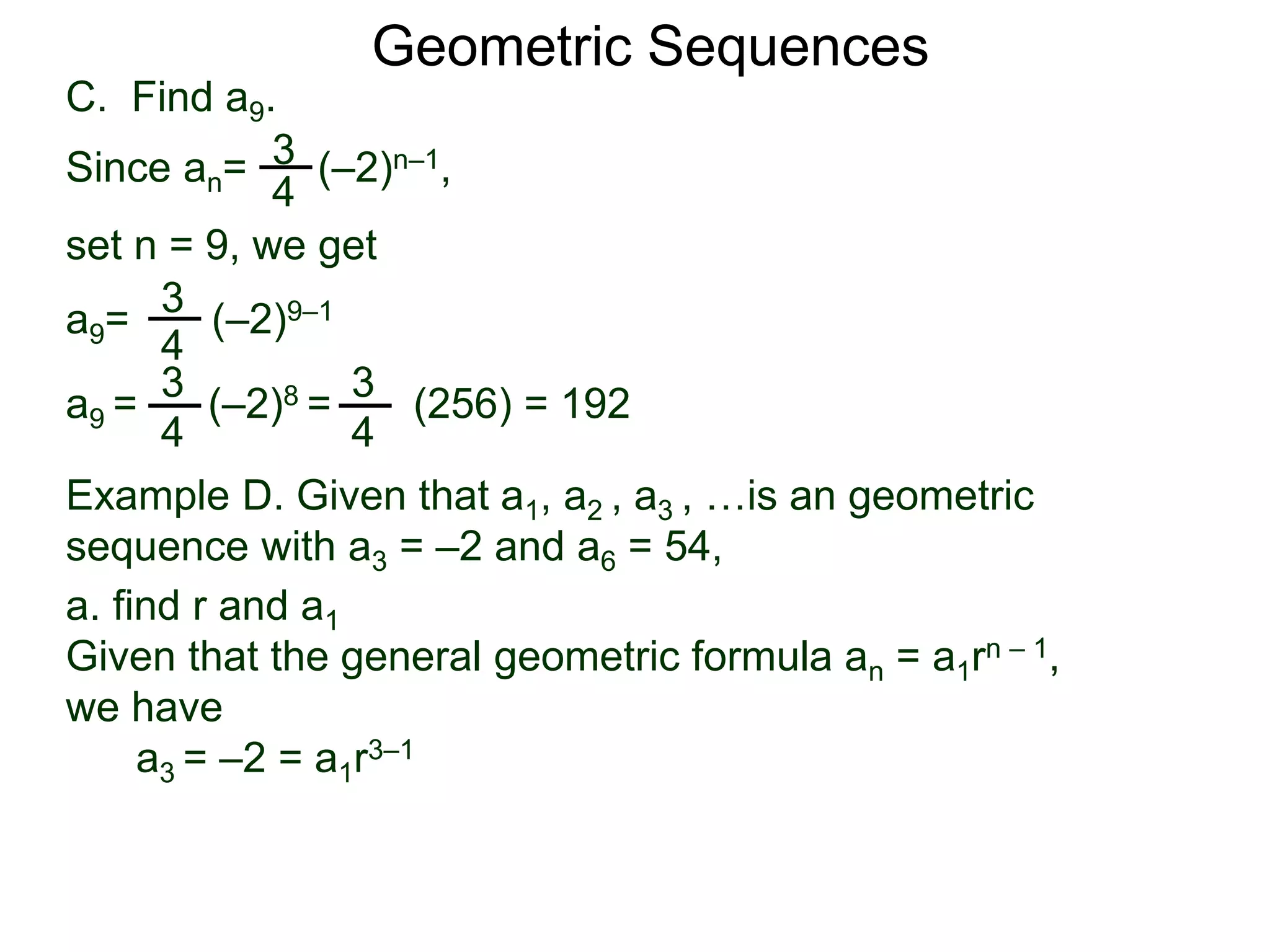
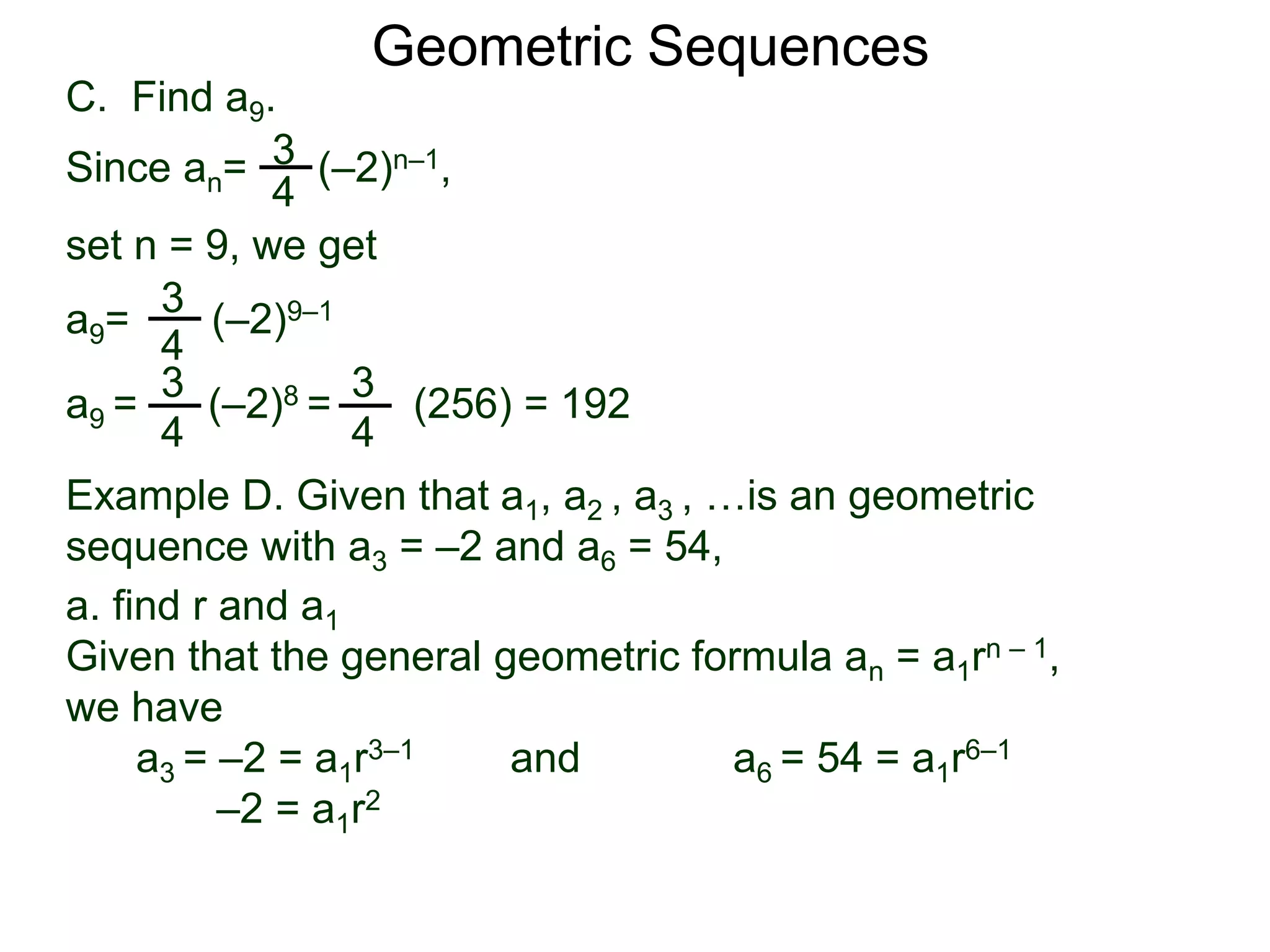
Example D. Given that a1, a2 , a3 , …is an geometric
sequence with a3 = –2 and a6 = 54,
a. find r and a1
set n = 9, we get
C. Find a9.
3
4
a9= (–2)9–1
a9 = (–2)8 = (256) = 192
3
4
Geometric Sequences
3
4
Since an= (–2)n–1,
3
4
Example D. Given that a1, a2 , a3 , …is an geometric
sequence with a3 = –2 and a6 = 54,
a. find r and a1
Given that the general geometric formula an = a1rn – 1,
we have
a3 = –2 = a1r3–1
set n = 9, we get
C. Find a9.
3
4
a9= (–2)9–1
a9 = (–2)8 = (256) = 192
3
4
Geometric Sequences
3
4
Since an= (–2)n–1,
3
4
Example D. Given that a1, a2 , a3 , …is an geometric
sequence with a3 = –2 and a6 = 54,
a. find r and a1
Given that the general geometric formula an = a1rn – 1,
we have
a3 = –2 = a1r3–1 and a6 = 54 = a1r6–1
set n = 9, we get
C. Find a9.
3
4
a9= (–2)9–1
a9 = (–2)8 = (256) = 192
3
4
Geometric Sequences
3
4
Since an= (–2)n–1,
3
4
Example D. Given that a1, a2 , a3 , …is an geometric
sequence with a3 = –2 and a6 = 54,
a. find r and a1
Given that the general geometric formula an = a1rn – 1,
we have
a3 = –2 = a1r3–1 and a6 = 54 = a1r6–1
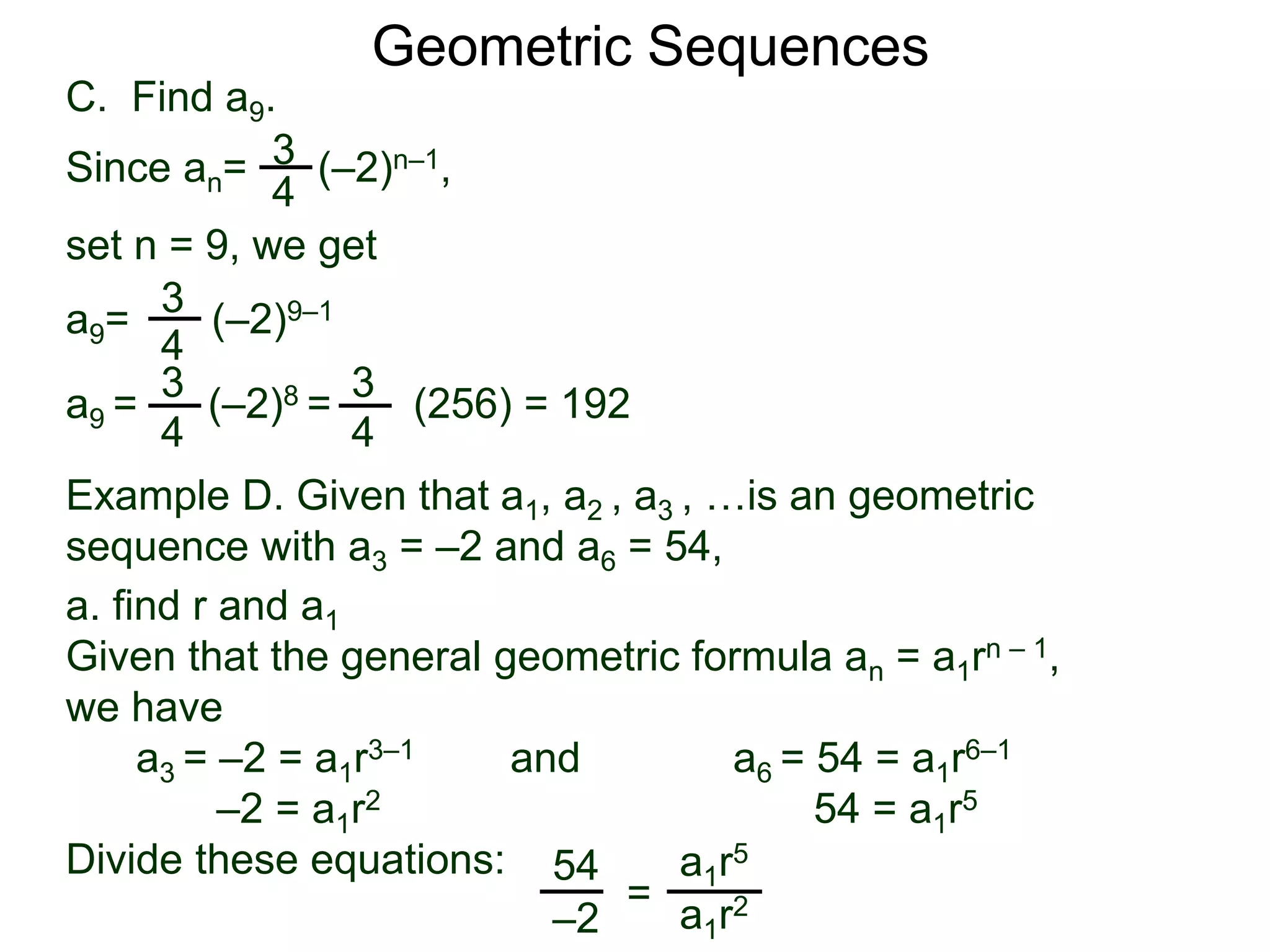
–2 = a1r2
set n = 9, we get
C. Find a9.
3
4
a9= (–2)9–1
a9 = (–2)8 = (256) = 192
3
4
Geometric Sequences
3
4
Since an= (–2)n–1,
3
4
Example D. Given that a1, a2 , a3 , …is an geometric
sequence with a3 = –2 and a6 = 54,
a. find r and a1
Given that the general geometric formula an = a1rn – 1,
we have
a3 = –2 = a1r3–1 and a6 = 54 = a1r6–1
–2 = a1r2 54 = a1r5
set n = 9, we get
C. Find a9.
3
4
a9= (–2)9–1
a9 = (–2)8 = (256) = 192
3
4
Geometric Sequences
3
4
Since an= (–2)n–1,
3
4
Example D. Given that a1, a2 , a3 , …is an geometric
sequence with a3 = –2 and a6 = 54,
a. find r and a1
Given that the general geometric formula an = a1rn – 1,
we have
a3 = –2 = a1r3–1 and a6 = 54 = a1r6–1
–2 = a1r2 54 = a1r5
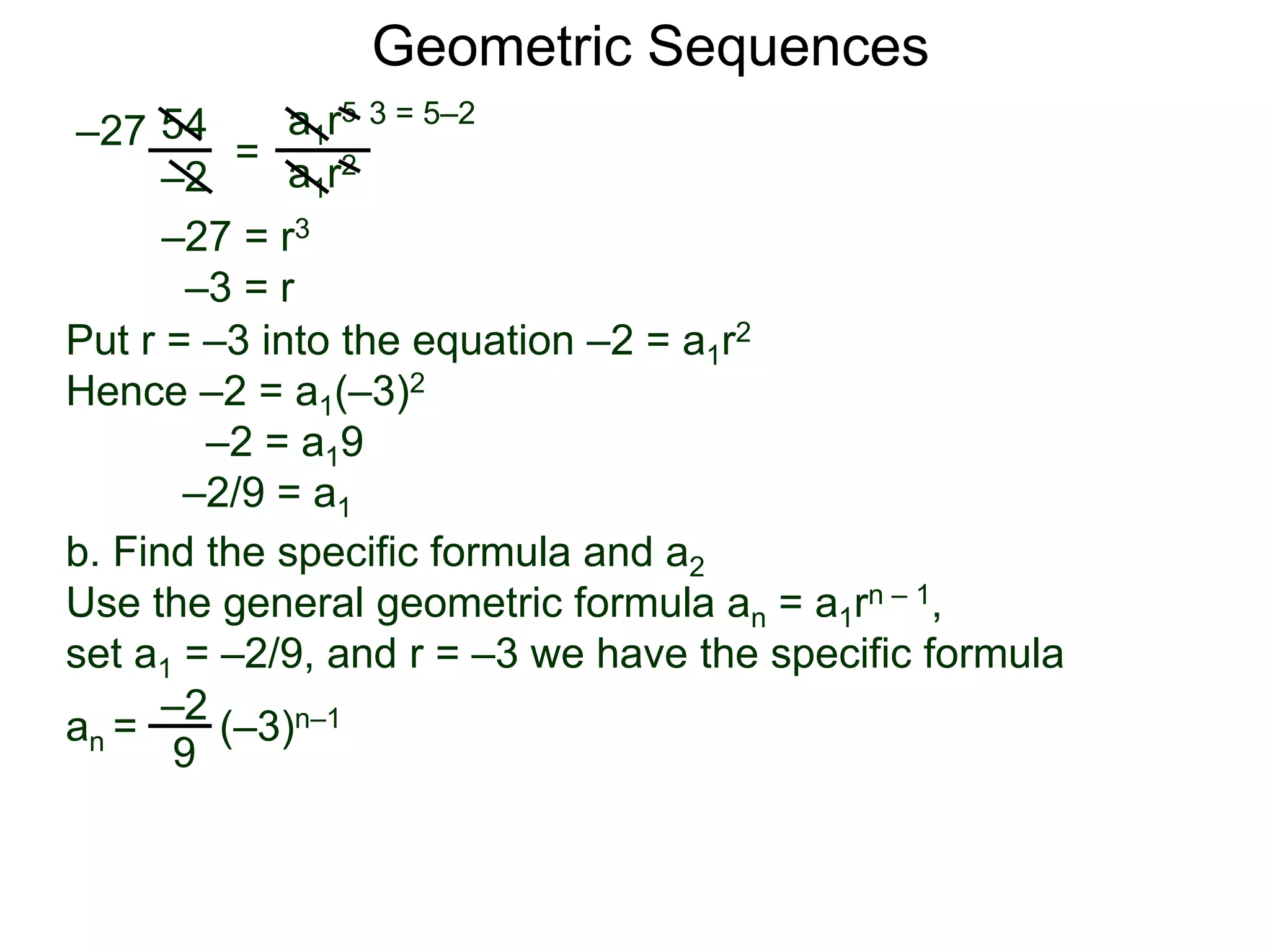
Divide these equations: 54
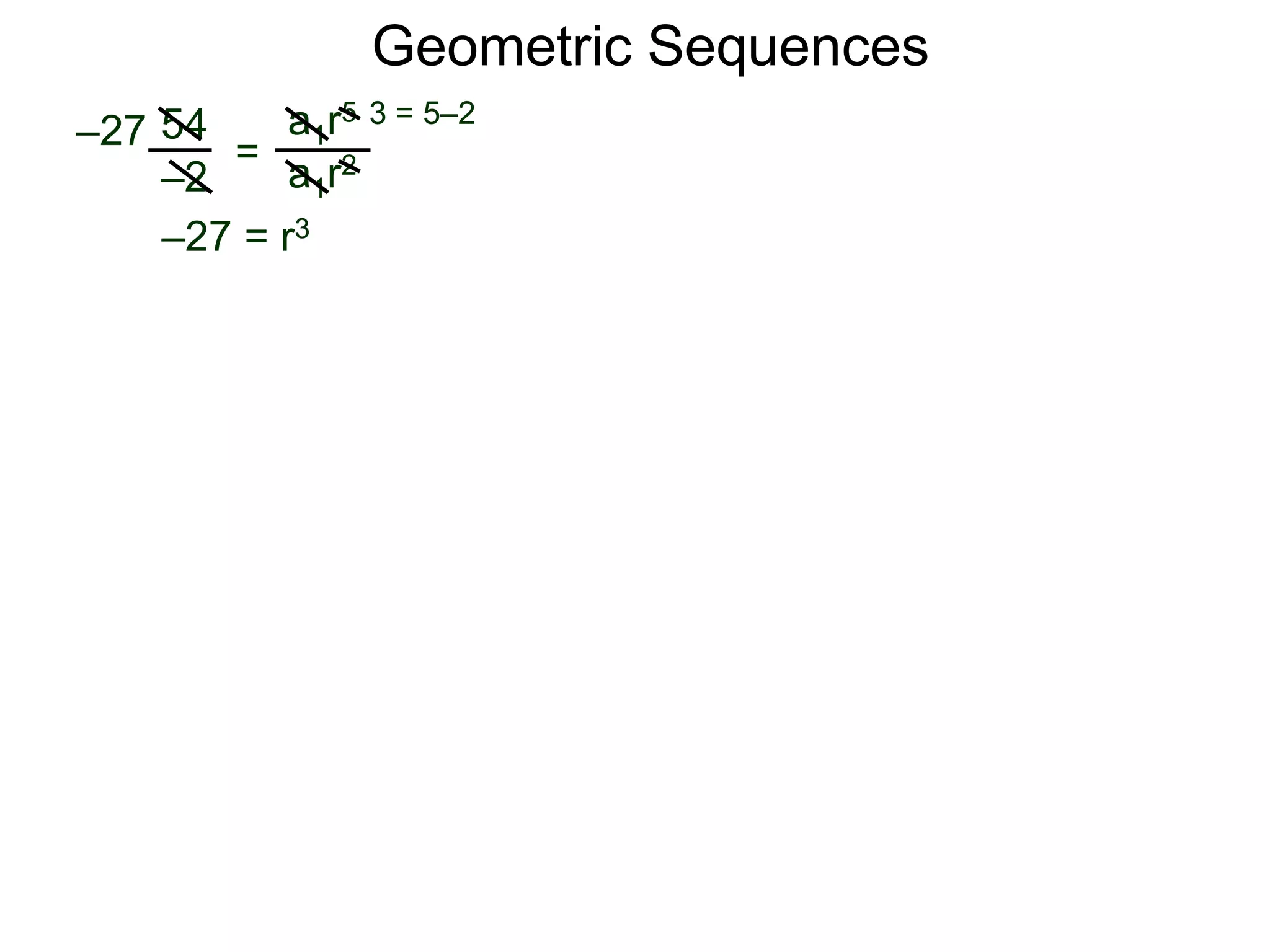
–2
=
a1r5
a1r2
54
–2
=
a1r5
a1r2
Geometric Sequences
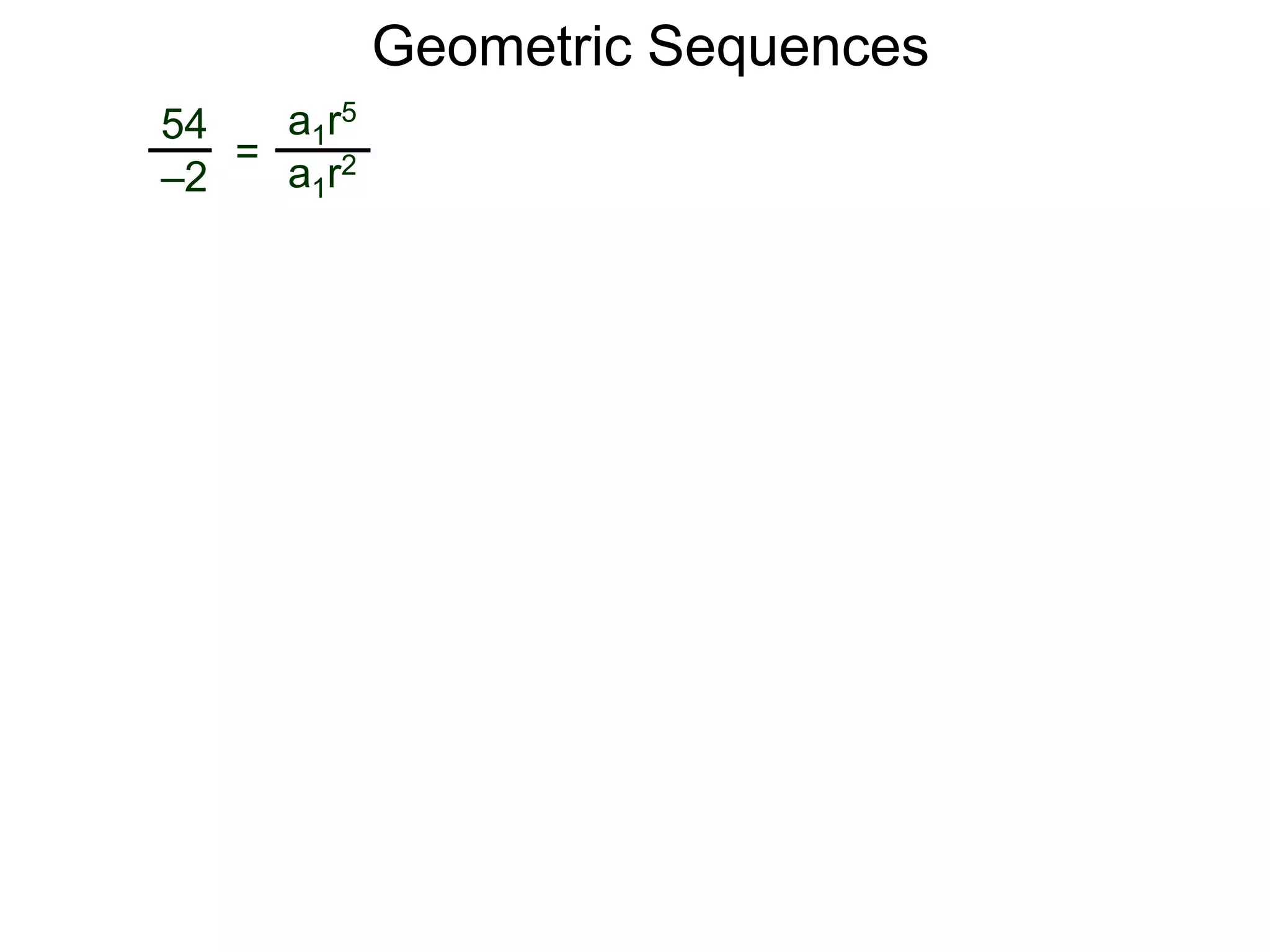
54
–2
=
a1r5
a1r2
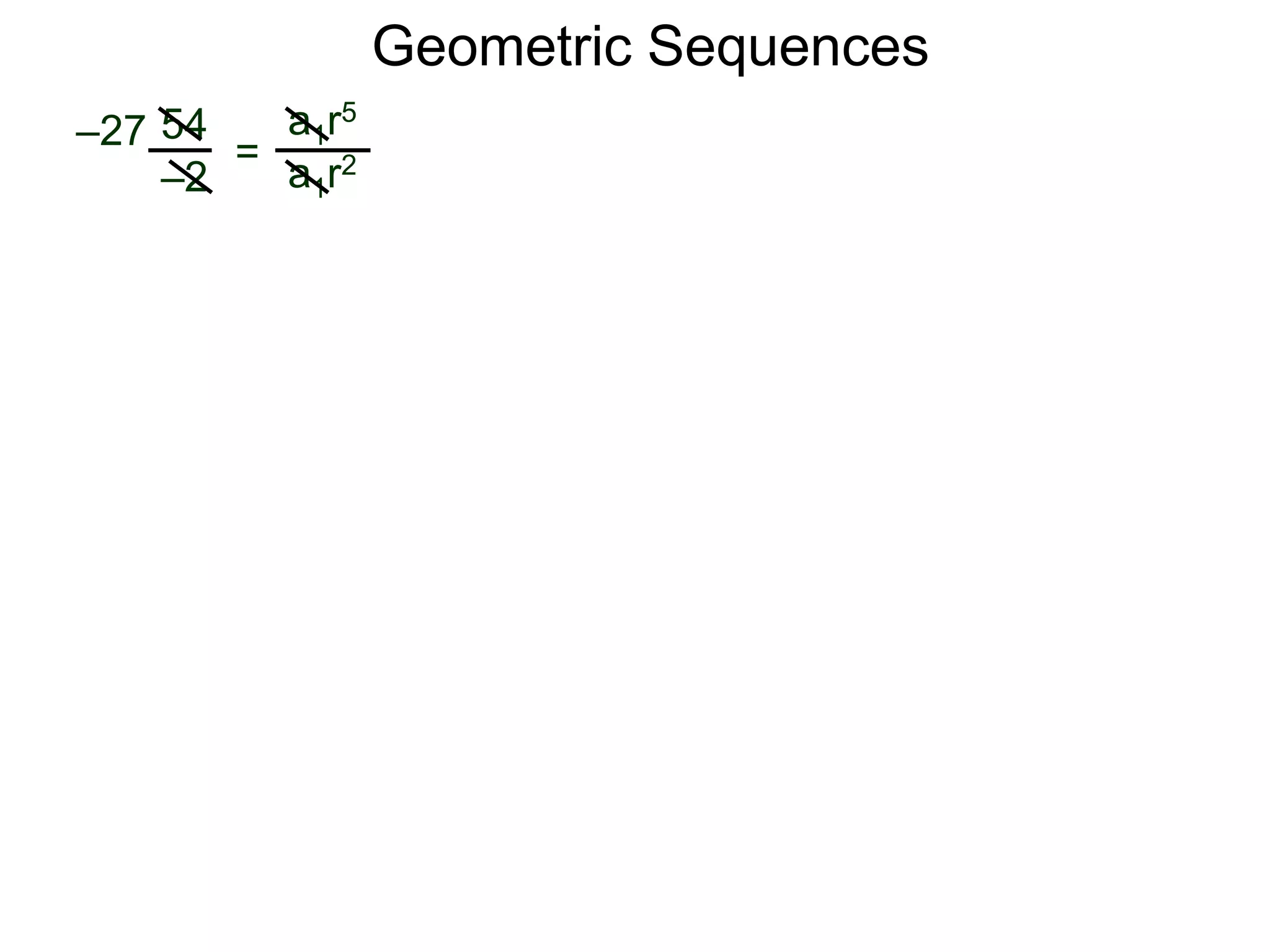
–27
Geometric Sequences
54
–2
=
a1r5
a1r2
–27
Geometric Sequences
54
–2
=
a1r5
a1r2
–27
3 = 5–2
Geometric Sequences
54
–2
=
a1r5
a1r2
–27
3 = 5–2
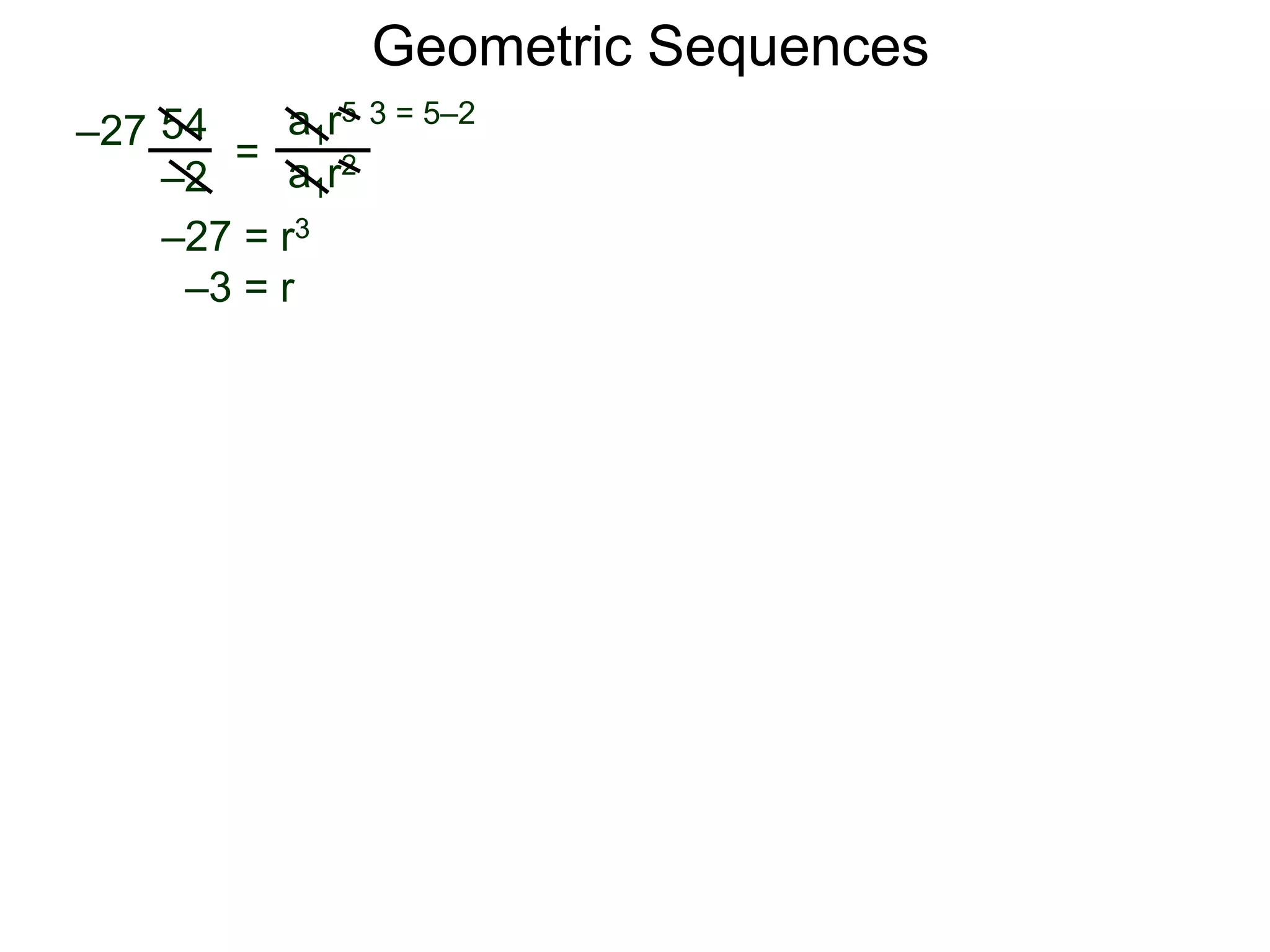
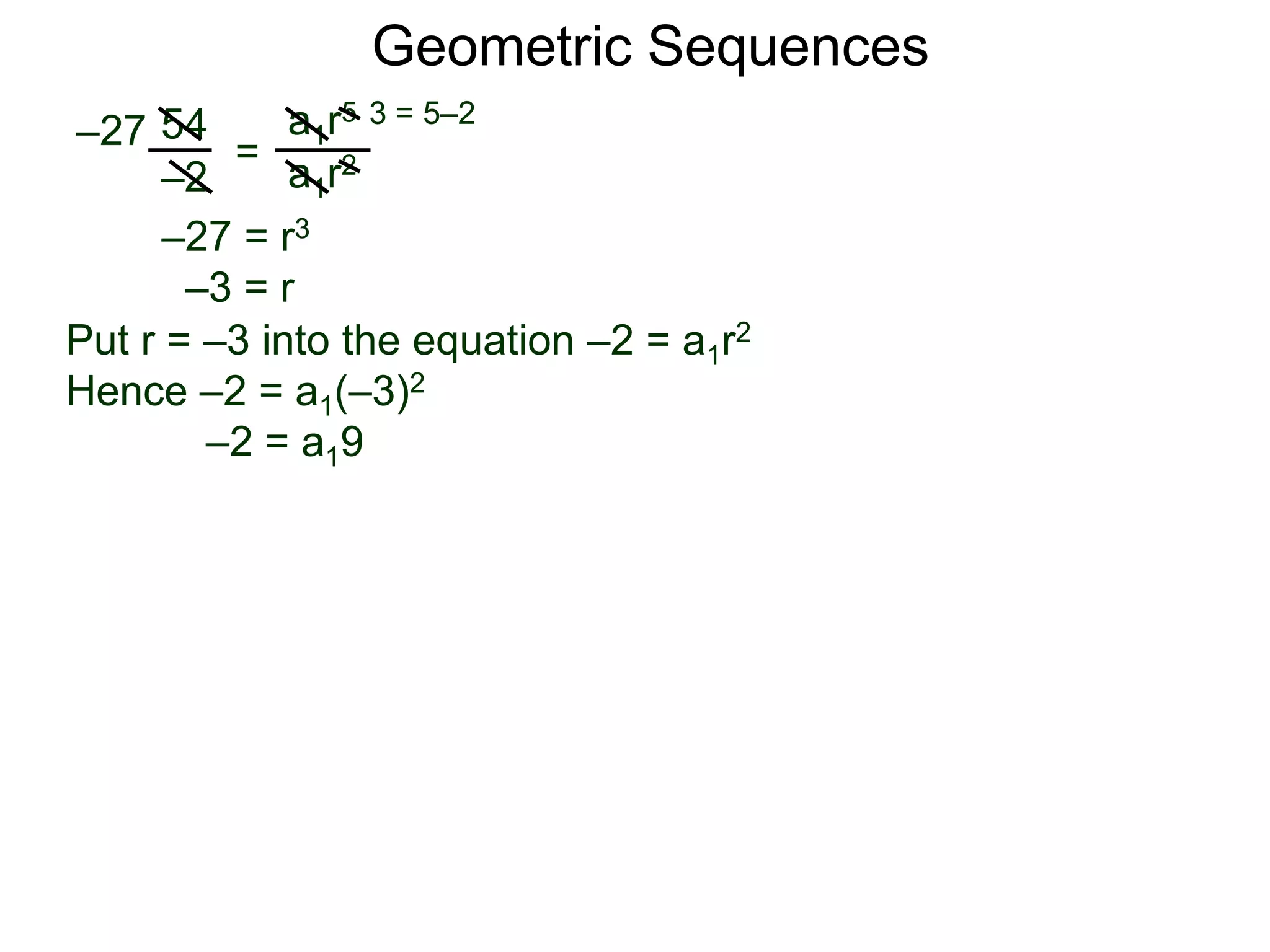
–27 = r3
Geometric Sequences
54
–2
=
a1r5
a1r2
–27
3 = 5–2
–27 = r3
–3 = r
Geometric Sequences
54
–2
=
a1r5
a1r2
–27
3 = 5–2
–27 = r3
–3 = r
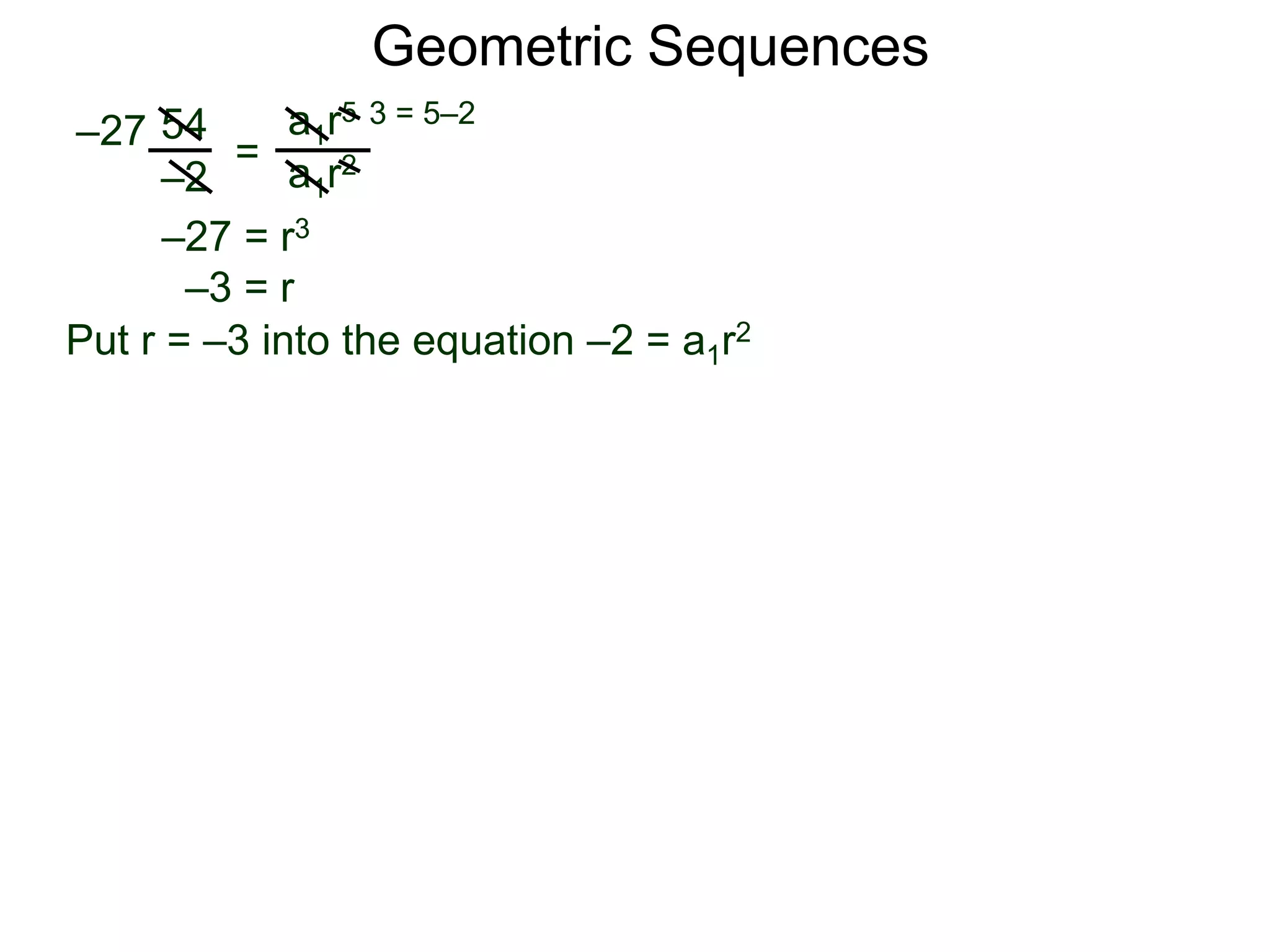
Put r = –3 into the equation –2 = a1r2
Geometric Sequences
54
–2
=
a1r5
a1r2
–27
3 = 5–2
–27 = r3
–3 = r
Put r = –3 into the equation –2 = a1r2
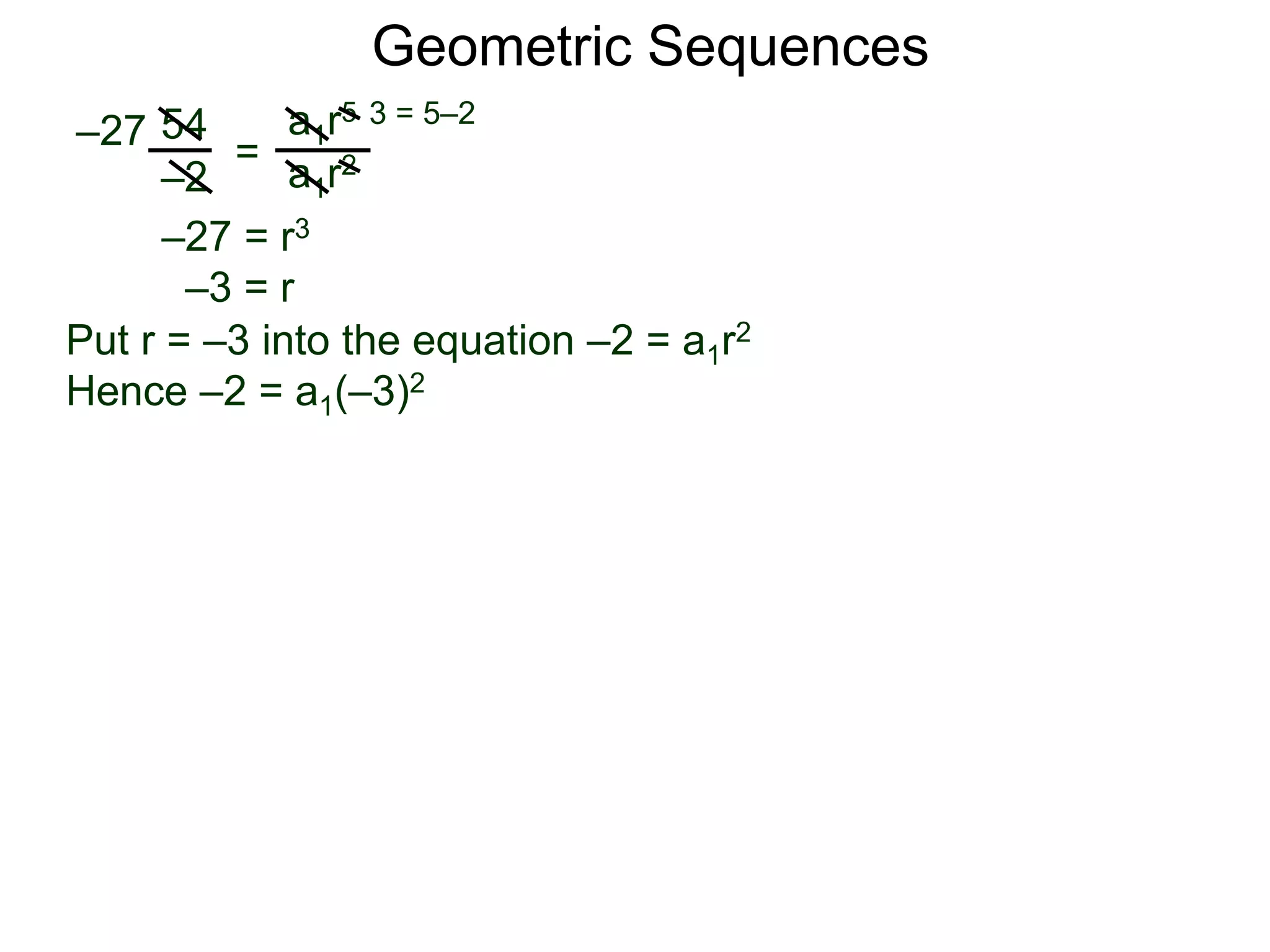
Hence –2 = a1(–3)2
Geometric Sequences
54
–2
=
a1r5
a1r2
–27
3 = 5–2
–27 = r3
–3 = r
Put r = –3 into the equation –2 = a1r2
Hence –2 = a1(–3)2
–2 = a19
Geometric Sequences
54
–2
=
a1r5
a1r2
–27
3 = 5–2
–27 = r3
–3 = r
Put r = –3 into the equation –2 = a1r2
Hence –2 = a1(–3)2
–2 = a19
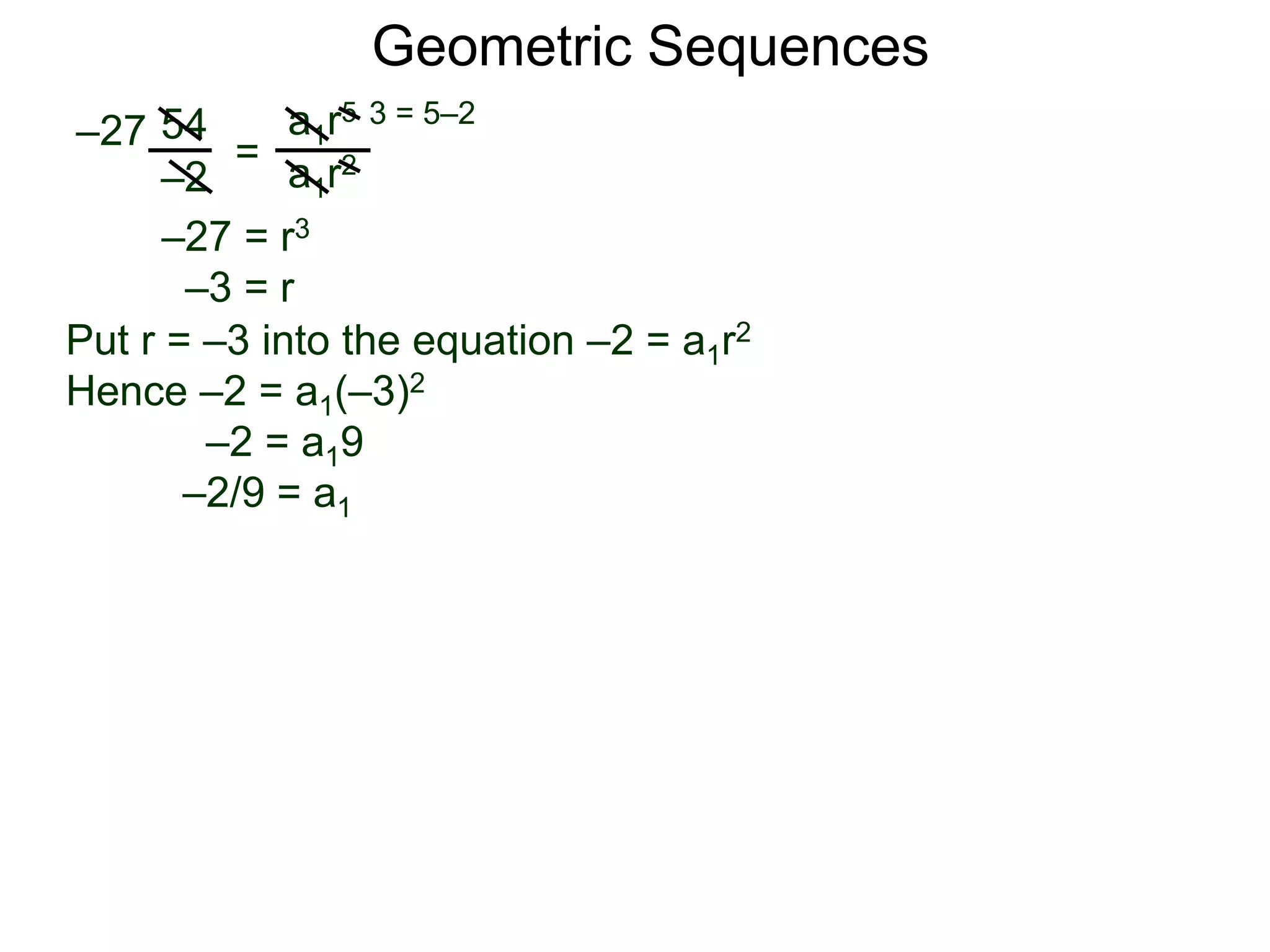
–2/9 = a1
Geometric Sequences
54
–2
=
a1r5
a1r2
–27
3 = 5–2
–27 = r3
–3 = r
Put r = –3 into the equation –2 = a1r2
Hence –2 = a1(–3)2
–2 = a19
–2/9 = a1
Geometric Sequences
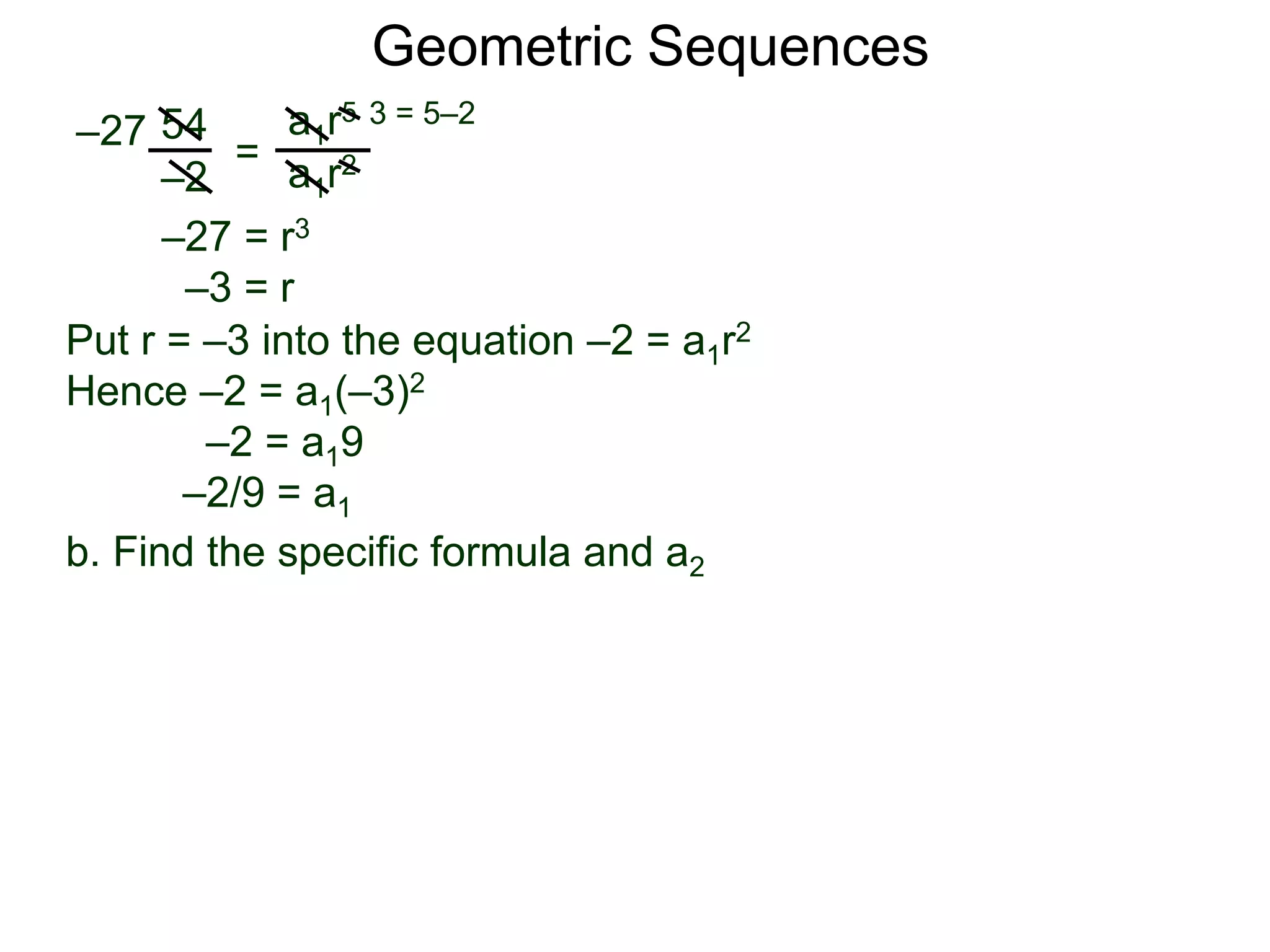
b. Find the specific formula and a2
54
–2
=
a1r5
a1r2
–27
3 = 5–2
–27 = r3
–3 = r
Put r = –3 into the equation –2 = a1r2
Hence –2 = a1(–3)2
–2 = a19
–2/9 = a1
Geometric Sequences
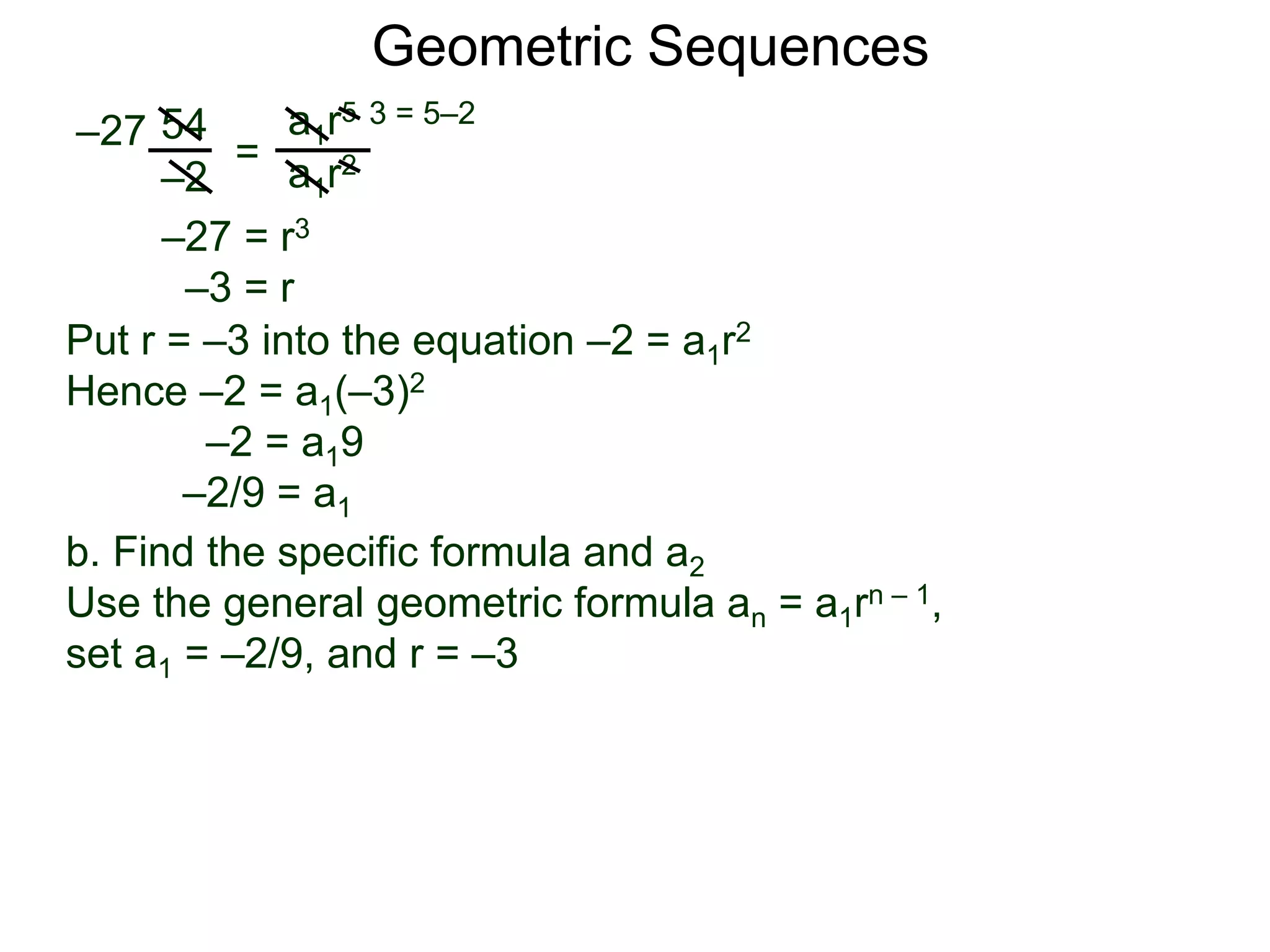
b. Find the specific formula and a2
Use the general geometric formula an = a1rn – 1,
set a1 = –2/9, and r = –3
54
–2
=
a1r5
a1r2
–27
3 = 5–2
–27 = r3
–3 = r
Put r = –3 into the equation –2 = a1r2
Hence –2 = a1(–3)2
–2 = a19
–2/9 = a1
Geometric Sequences
b. Find the specific formula and a2
Use the general geometric formula an = a1rn – 1,
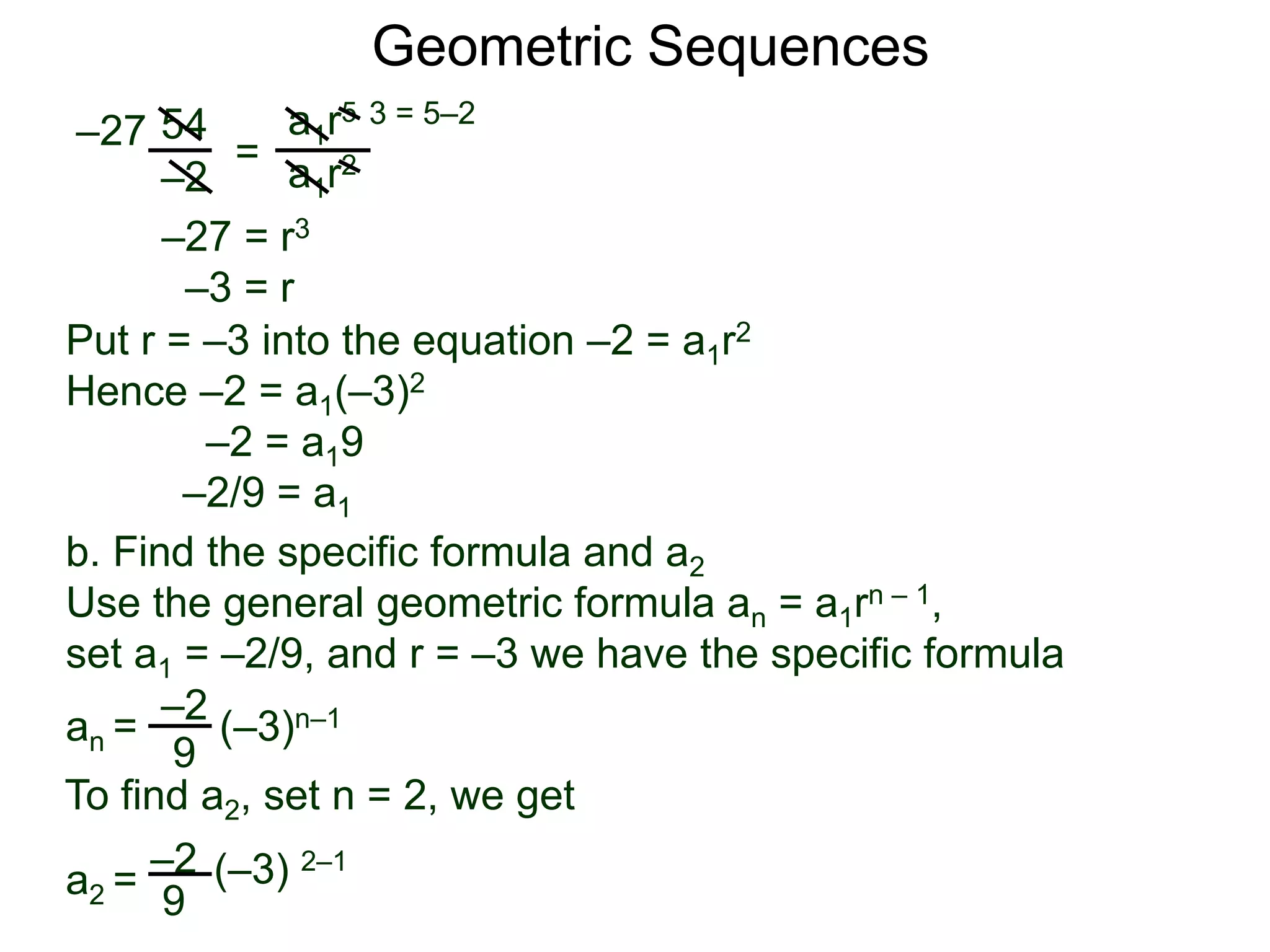
set a1 = –2/9, and r = –3 we have the specific formula
–2
9
an = (–3)n–1
54
–2
=
a1r5
a1r2
–27
3 = 5–2
–27 = r3
–3 = r
Put r = –3 into the equation –2 = a1r2
Hence –2 = a1(–3)2
–2 = a19
–2/9 = a1
Geometric Sequences
b. Find the specific formula and a2
Use the general geometric formula an = a1rn – 1,
set a1 = –2/9, and r = –3 we have the specific formula
–2
9
an = (–3)n–1
–2
9
(–3) 2–1
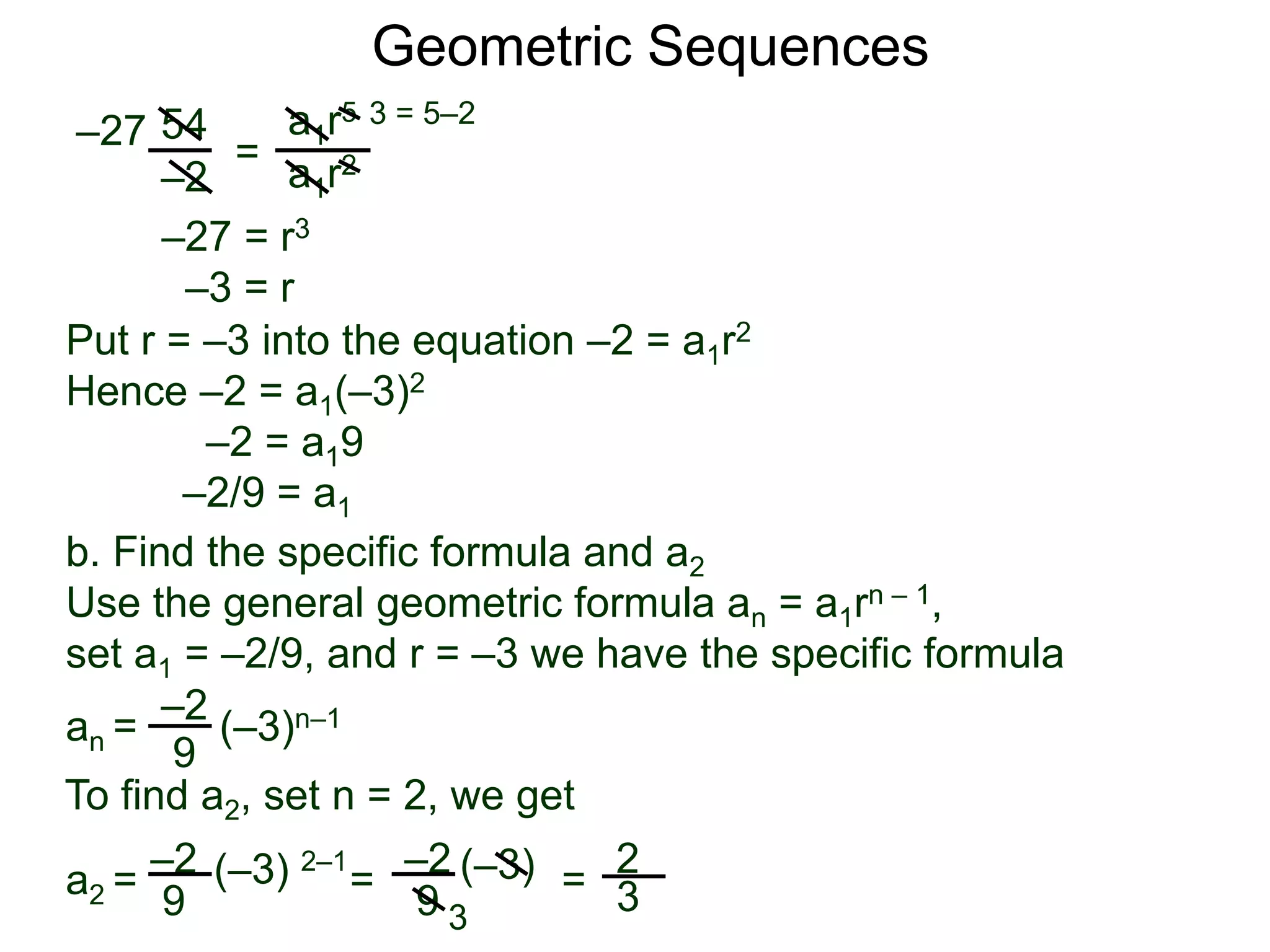
To find a2, set n = 2, we get
a2 =
54
–2
=
a1r5
a1r2
–27
3 = 5–2
–27 = r3
–3 = r
Put r = –3 into the equation –2 = a1r2
Hence –2 = a1(–3)2
–2 = a19
–2/9 = a1
Geometric Sequences
b. Find the specific formula and a2
Use the general geometric formula an = a1rn – 1,
set a1 = –2/9, and r = –3 we have the specific formula
–2
9
an = (–3)n–1
–2
9
(–3) 2–1
To find a2, set n = 2, we get
–2
9
a2 =
3
2
3= (–3) =
Geometric Sequences
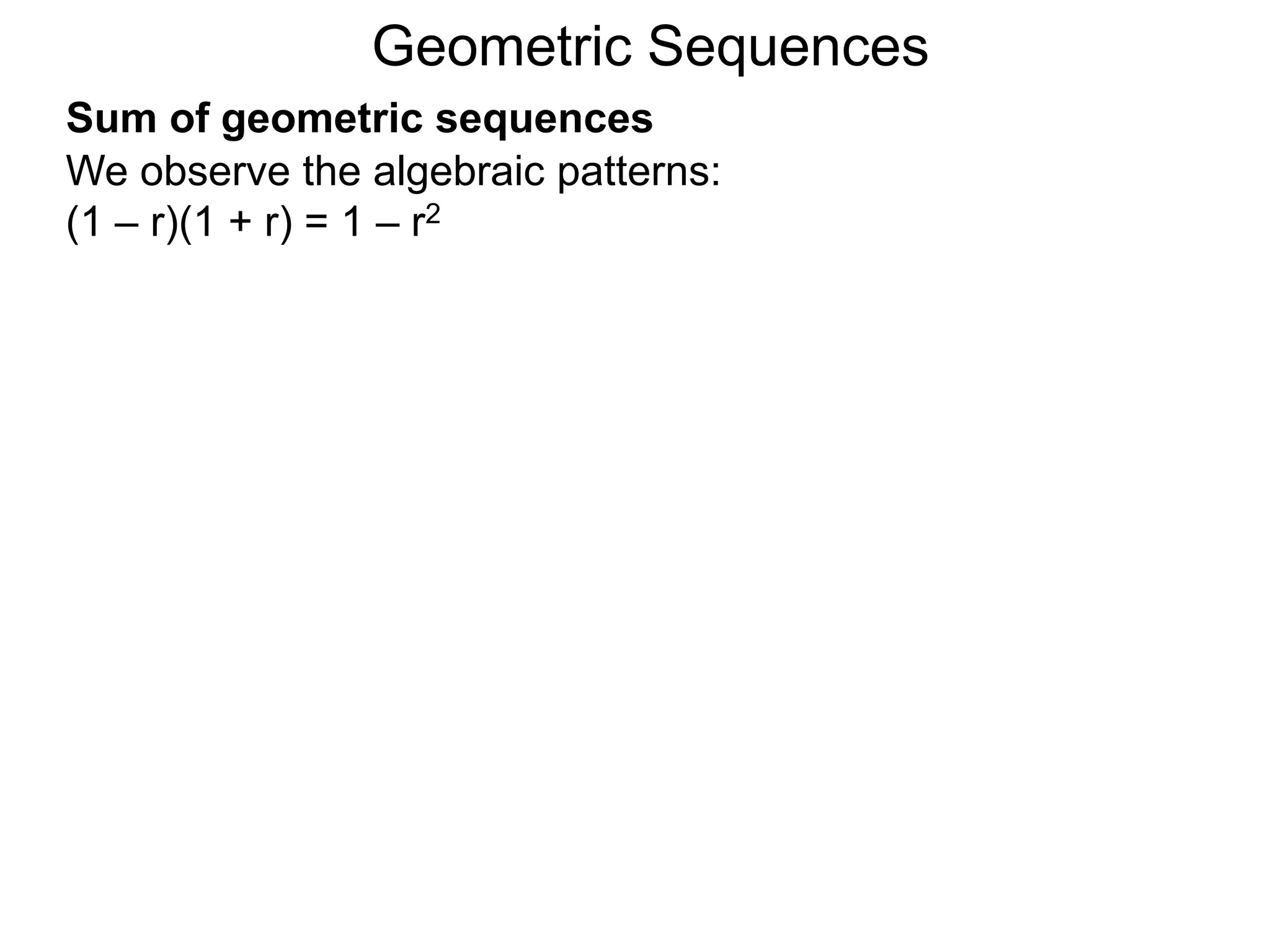
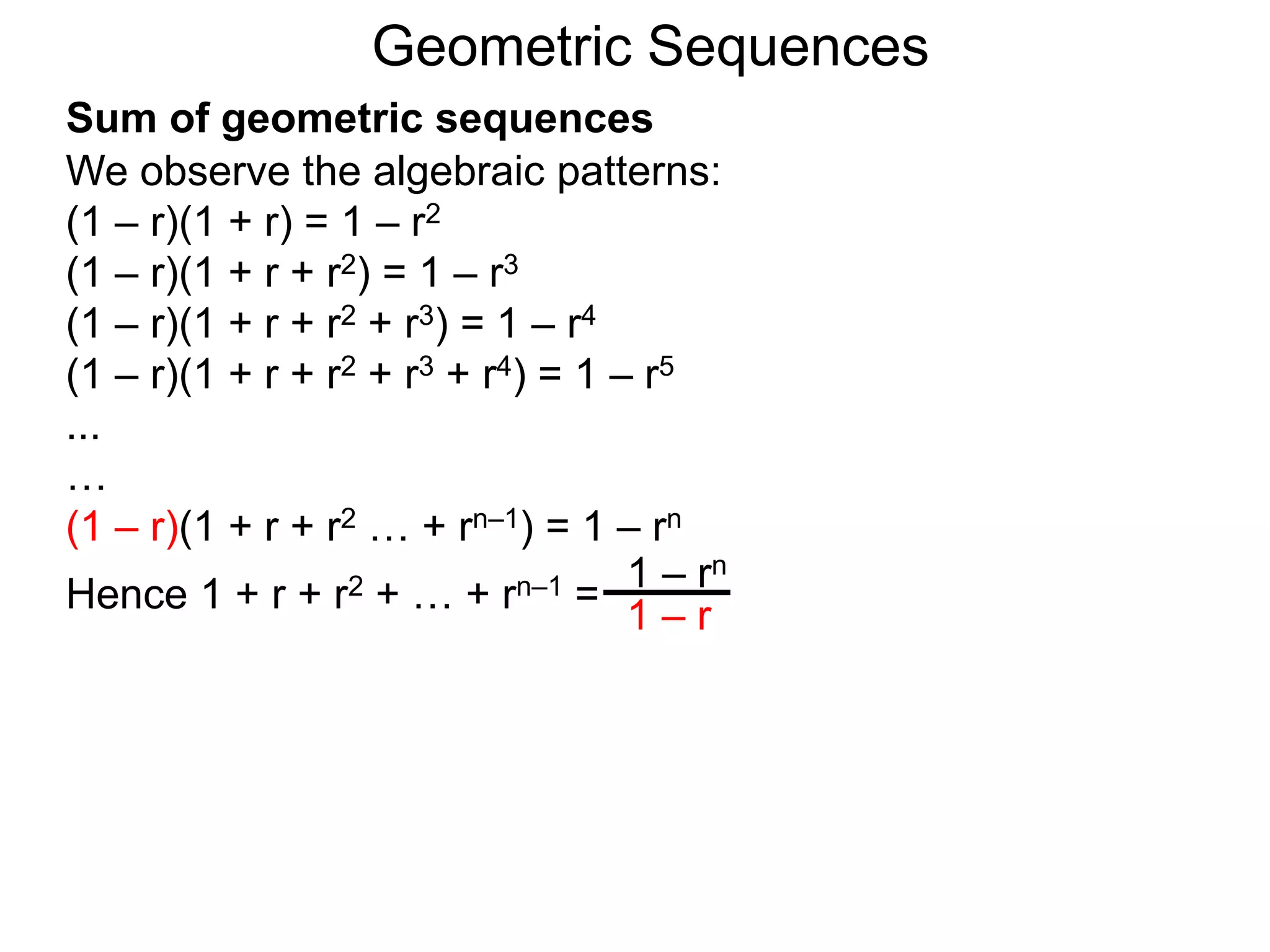
Sum of geometric sequences
We observe the algebraic patterns:
(1 – r)(1 + r) = 1 – r2
Geometric Sequences
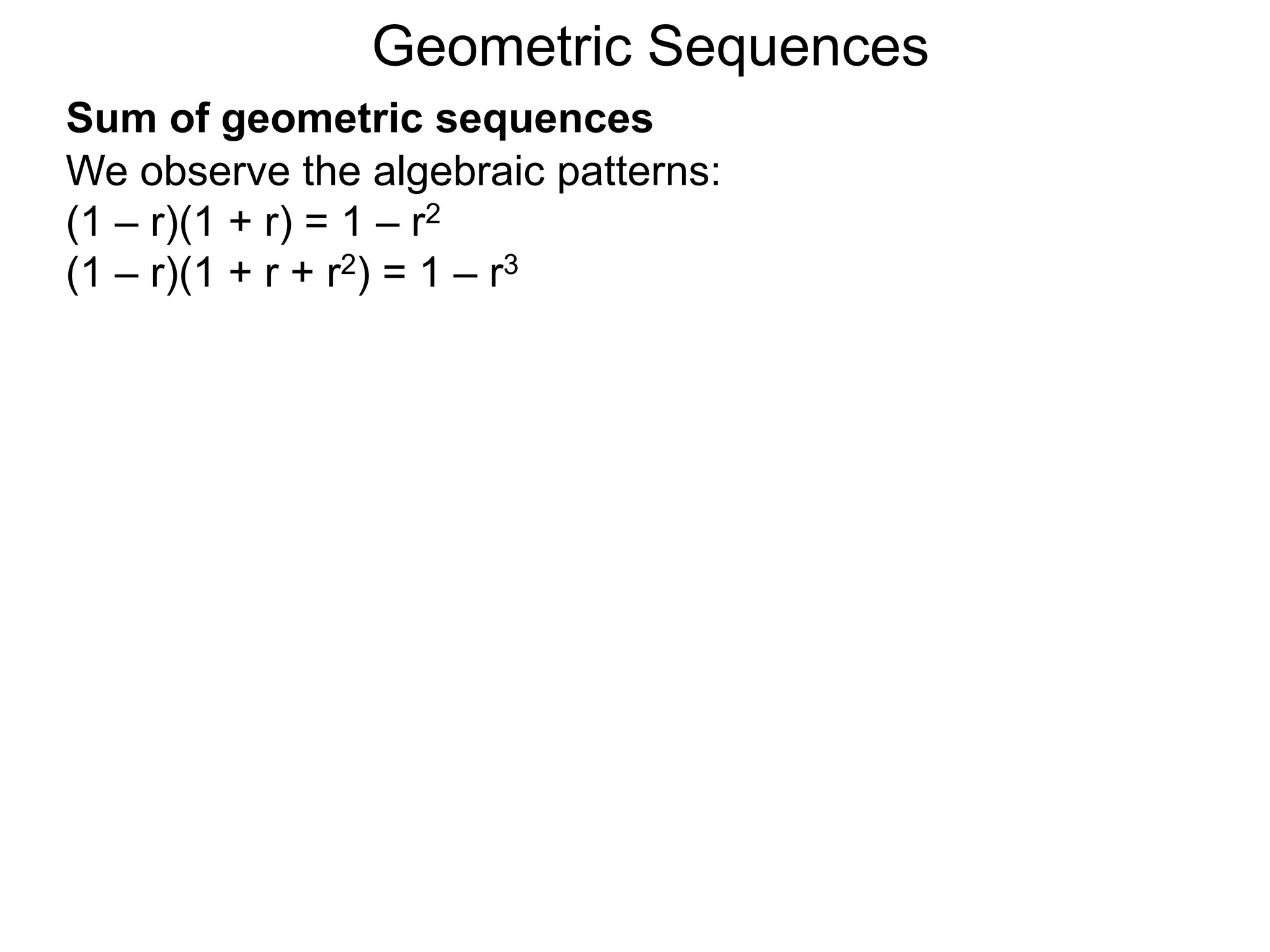
Sum of geometric sequences
We observe the algebraic patterns:
(1 – r)(1 + r) = 1 – r2
(1 – r)(1 + r + r2) = 1 – r3
Geometric Sequences
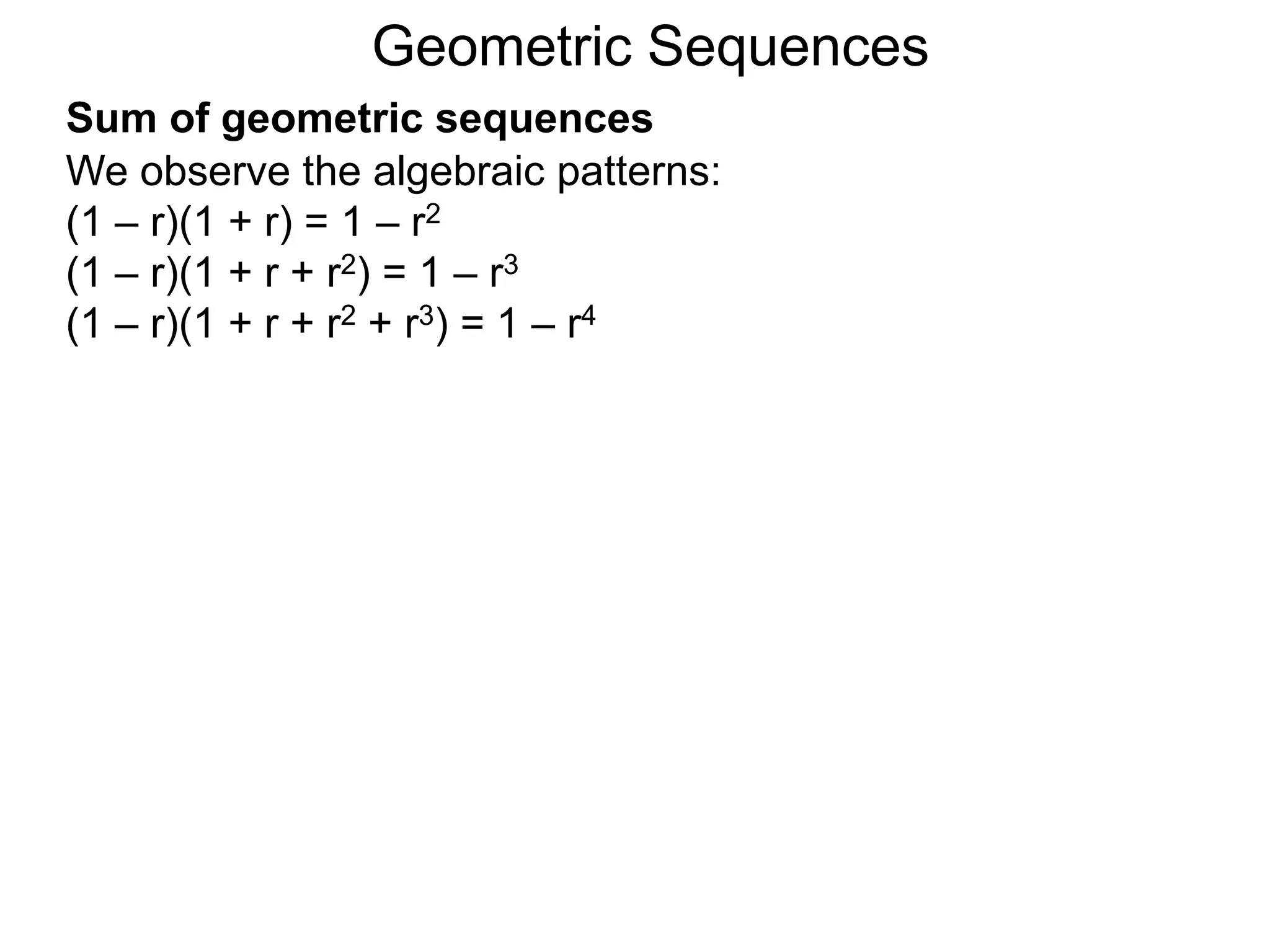
Sum of geometric sequences
We observe the algebraic patterns:
(1 – r)(1 + r) = 1 – r2
(1 – r)(1 + r + r2) = 1 – r3
(1 – r)(1 + r + r2 + r3) = 1 – r4
Geometric Sequences
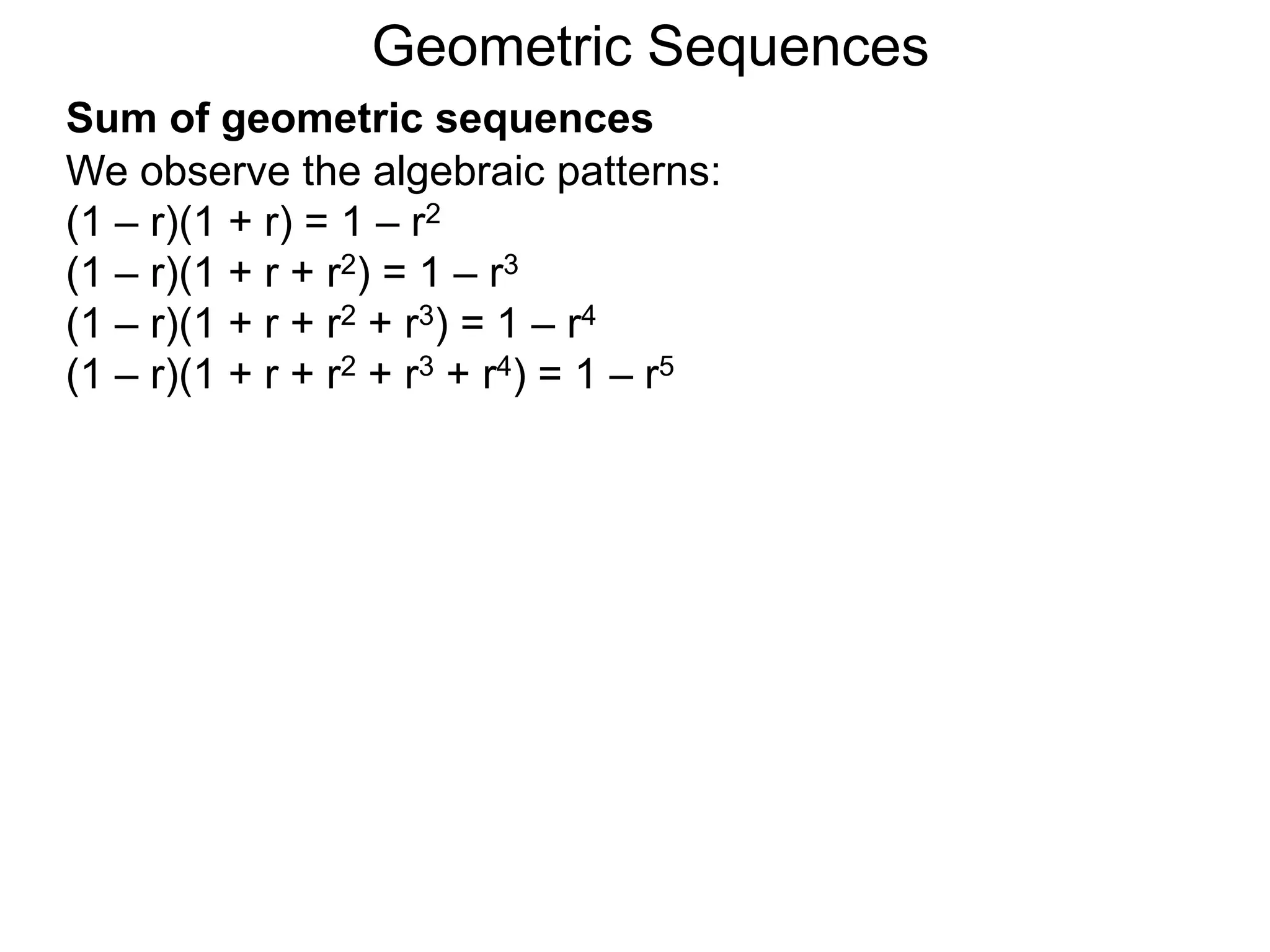
Sum of geometric sequences
We observe the algebraic patterns:
(1 – r)(1 + r) = 1 – r2
(1 – r)(1 + r + r2) = 1 – r3
(1 – r)(1 + r + r2 + r3) = 1 – r4
(1 – r)(1 + r + r2 + r3 + r4) = 1 – r5
Geometric Sequences
Sum of geometric sequences
We observe the algebraic patterns:
(1 – r)(1 + r) = 1 – r2
(1 – r)(1 + r + r2) = 1 – r3
(1 – r)(1 + r + r2 + r3) = 1 – r4
(1 – r)(1 + r + r2 + r3 + r4) = 1 – r5
...
…
(1 – r)(1 + r + r2 … + rn–1) = 1 – rn
Geometric Sequences
Sum of geometric sequences
We observe the algebraic patterns:
(1 – r)(1 + r) = 1 – r2
(1 – r)(1 + r + r2) = 1 – r3
(1 – r)(1 + r + r2 + r3) = 1 – r4
(1 – r)(1 + r + r2 + r3 + r4) = 1 – r5
...
…
(1 – r)(1 + r + r2 … + rn–1) = 1 – rn
Hence 1 + r + r2 + … + rn–1 =
1 – rn
1 – r
Geometric Sequences
Sum of geometric sequences
We observe the algebraic patterns:
(1 – r)(1 + r) = 1 – r2
(1 – r)(1 + r + r2) = 1 – r3
(1 – r)(1 + r + r2 + r3) = 1 – r4
(1 – r)(1 + r + r2 + r3 + r4) = 1 – r5
...
…
(1 – r)(1 + r + r2 … + rn–1) = 1 – rn
Hence 1 + r + r2 + … + rn–1 =
1 – rn
1 – r
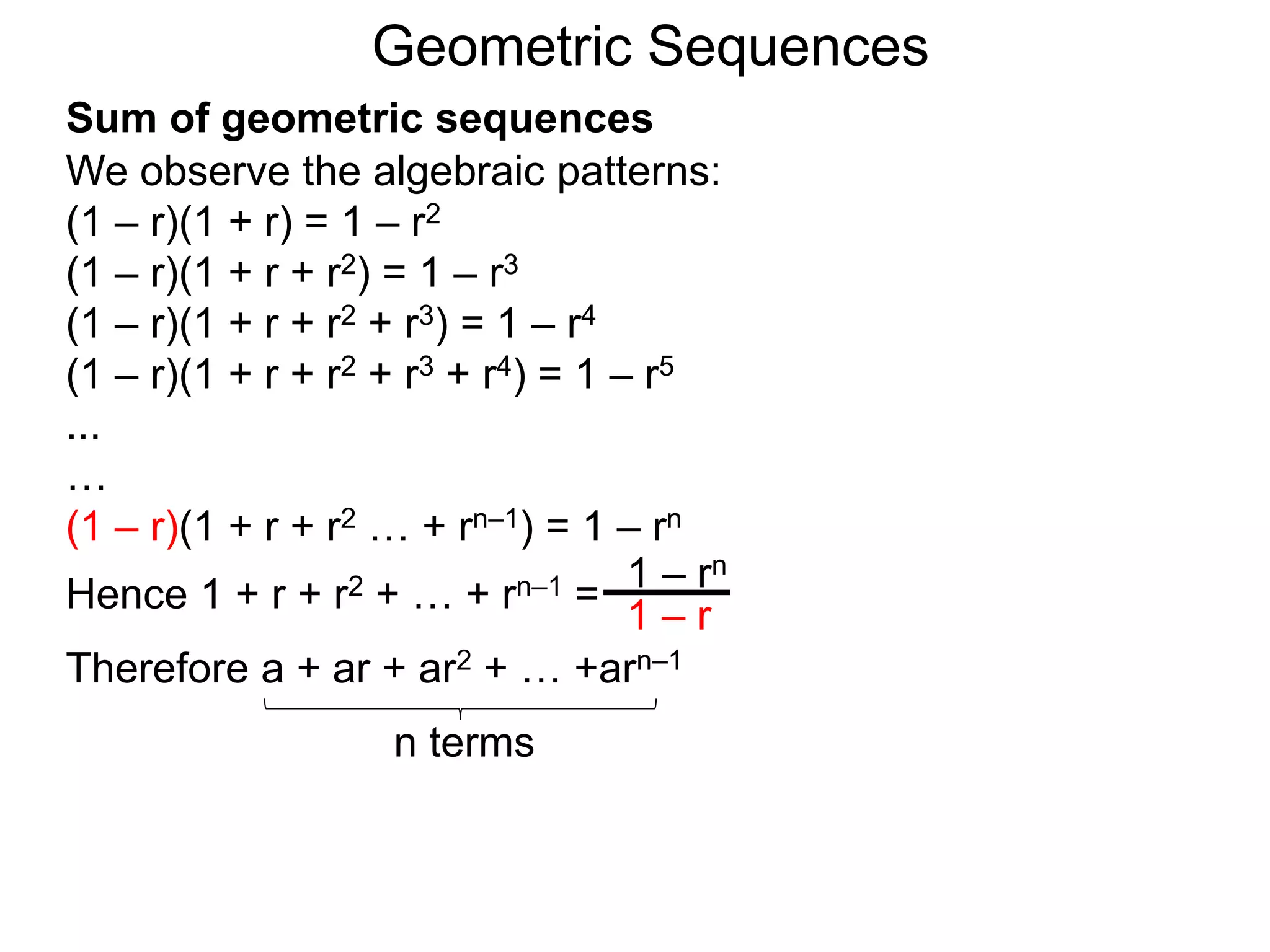
Geometric Sequences
Sum of geometric sequences
Therefore a + ar + ar2 + … +arn–1
n terms
We observe the algebraic patterns:
(1 – r)(1 + r) = 1 – r2
(1 – r)(1 + r + r2) = 1 – r3
(1 – r)(1 + r + r2 + r3) = 1 – r4
(1 – r)(1 + r + r2 + r3 + r4) = 1 – r5
...
…
(1 – r)(1 + r + r2 … + rn–1) = 1 – rn
Hence 1 + r + r2 + … + rn–1 =
1 – rn
1 – r
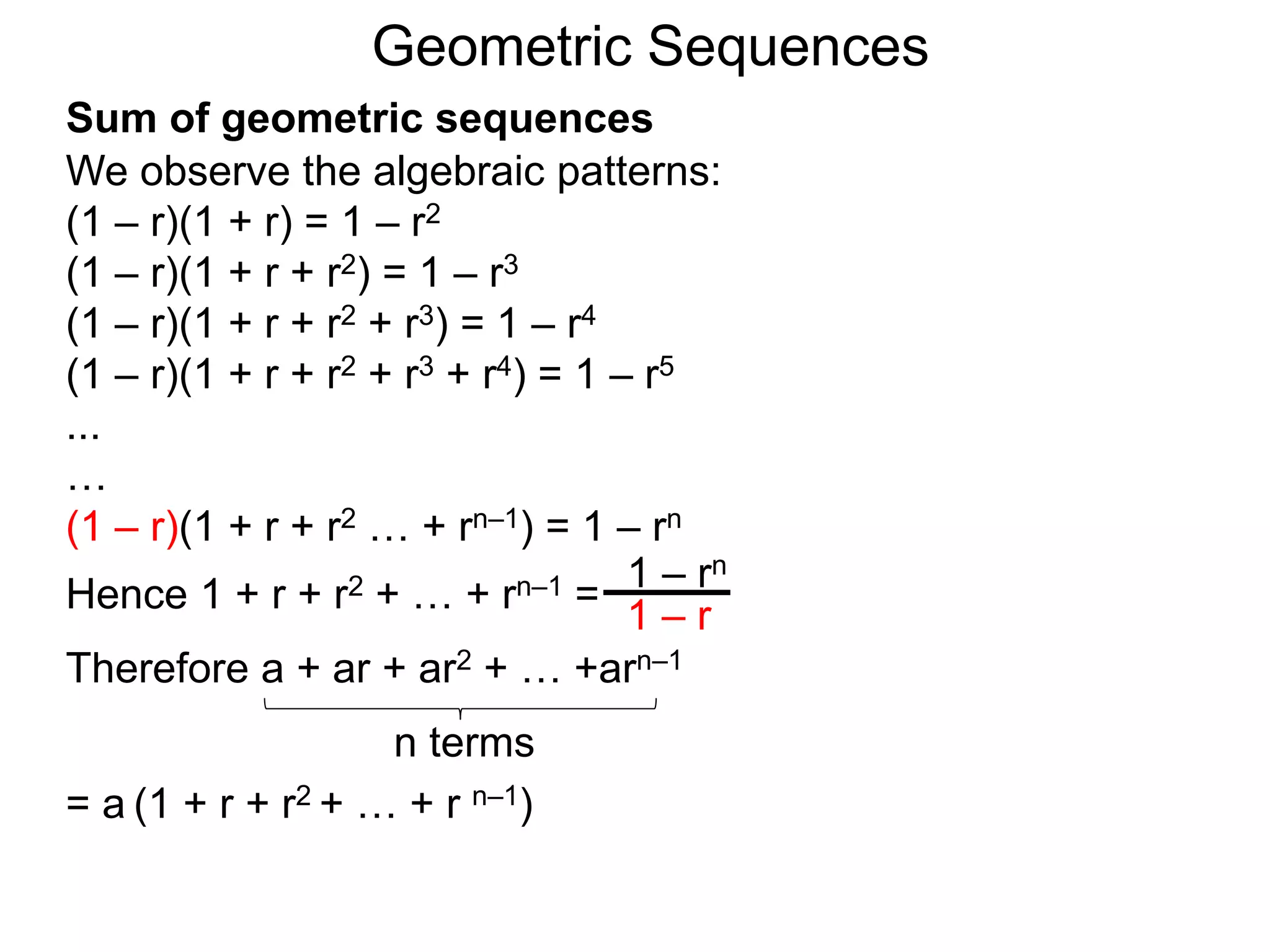
Geometric Sequences
Sum of geometric sequences
Therefore a + ar + ar2 + … +arn–1
= a (1 + r + r2 + … + r n–1)
n terms
We observe the algebraic patterns:
(1 – r)(1 + r) = 1 – r2
(1 – r)(1 + r + r2) = 1 – r3
(1 – r)(1 + r + r2 + r3) = 1 – r4
(1 – r)(1 + r + r2 + r3 + r4) = 1 – r5
...
…
(1 – r)(1 + r + r2 … + rn–1) = 1 – rn
Hence 1 + r + r2 + … + rn–1 =
1 – rn
1 – r
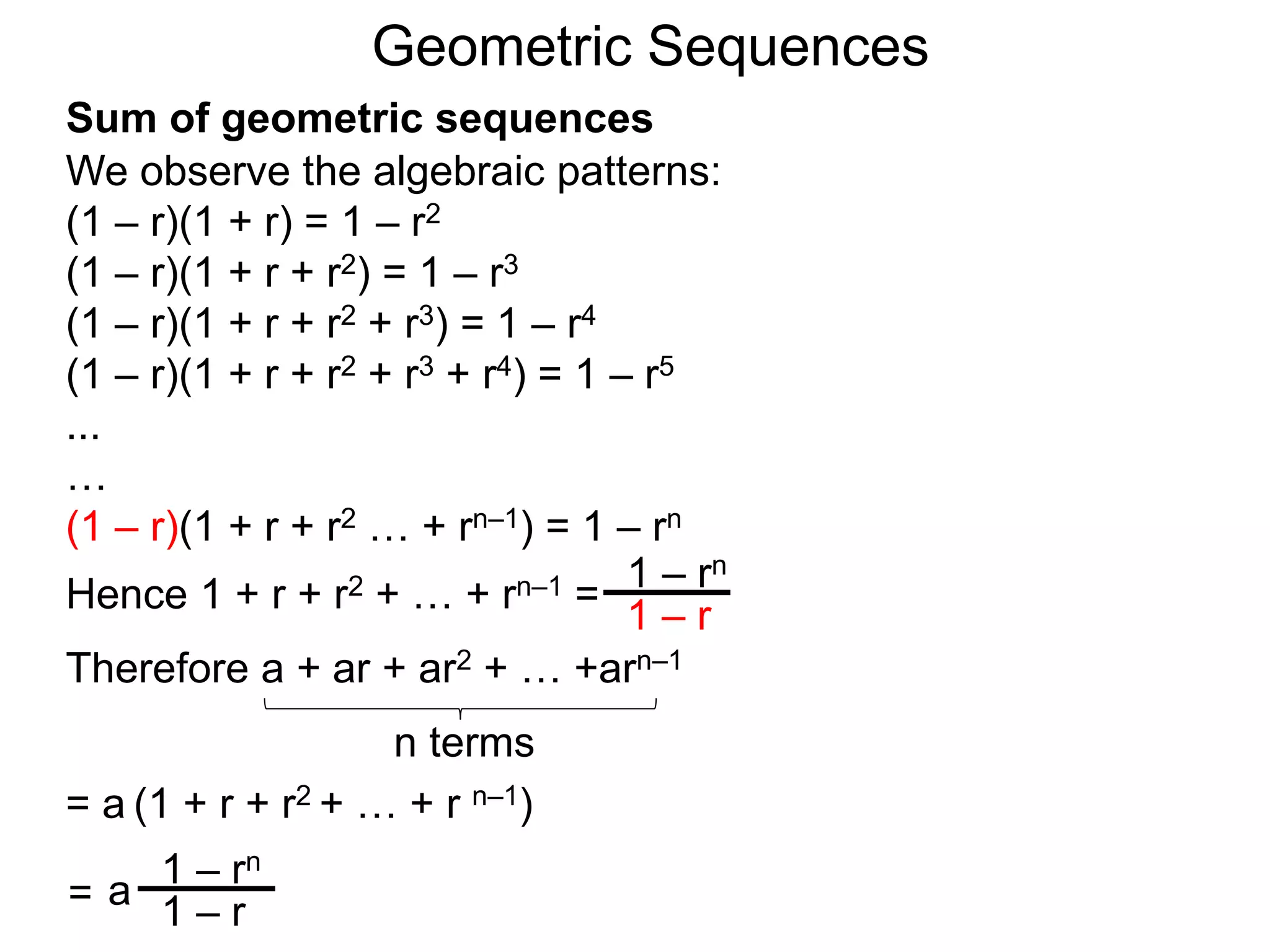
Geometric Sequences
Sum of geometric sequences
a
1 – rn
1 – r
Therefore a + ar + ar2 + … +arn–1
= a (1 + r + r2 + … + r n–1)
n terms
=
Geometric Sequences
= a
1 – rn
1 – r
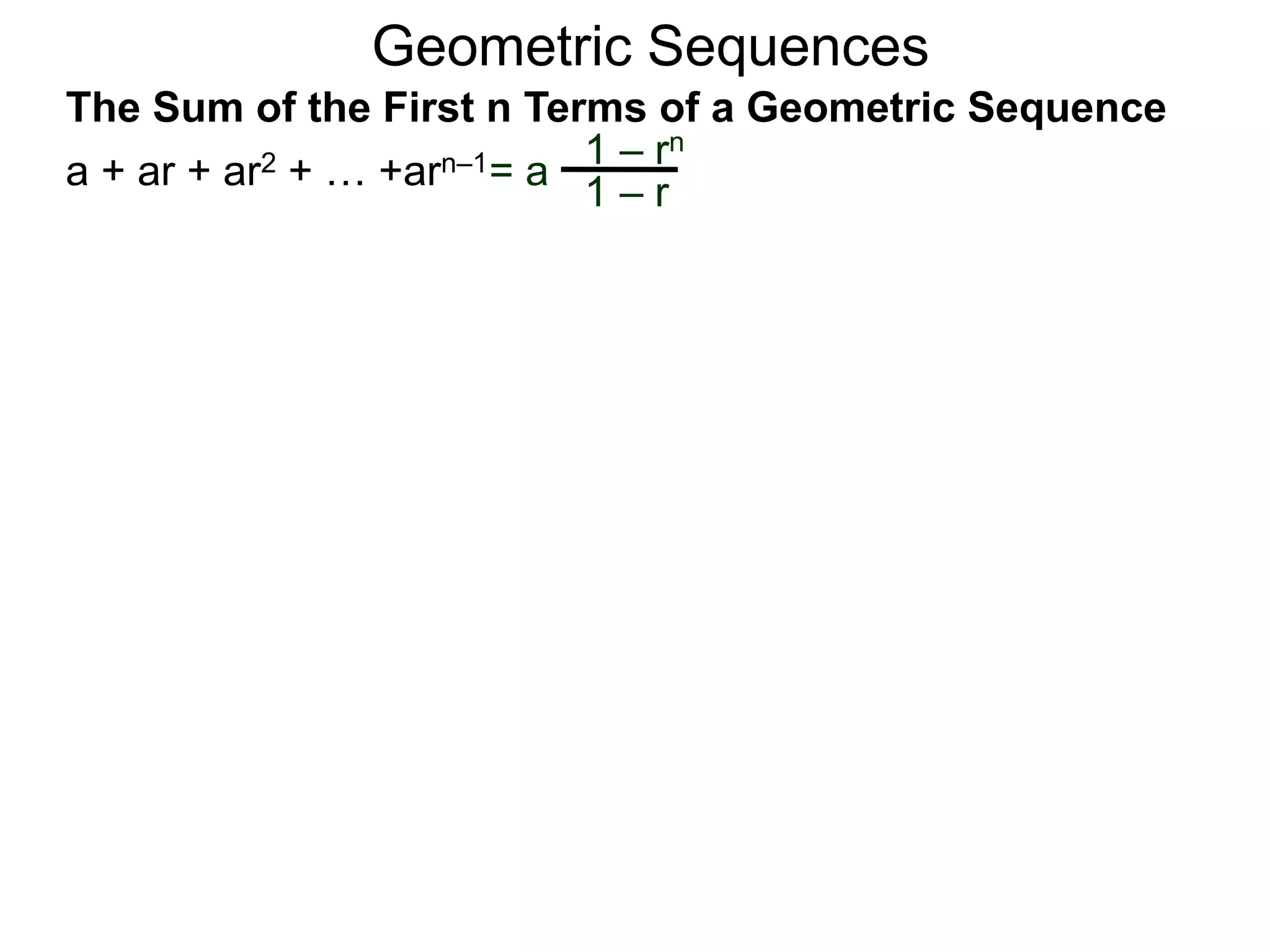
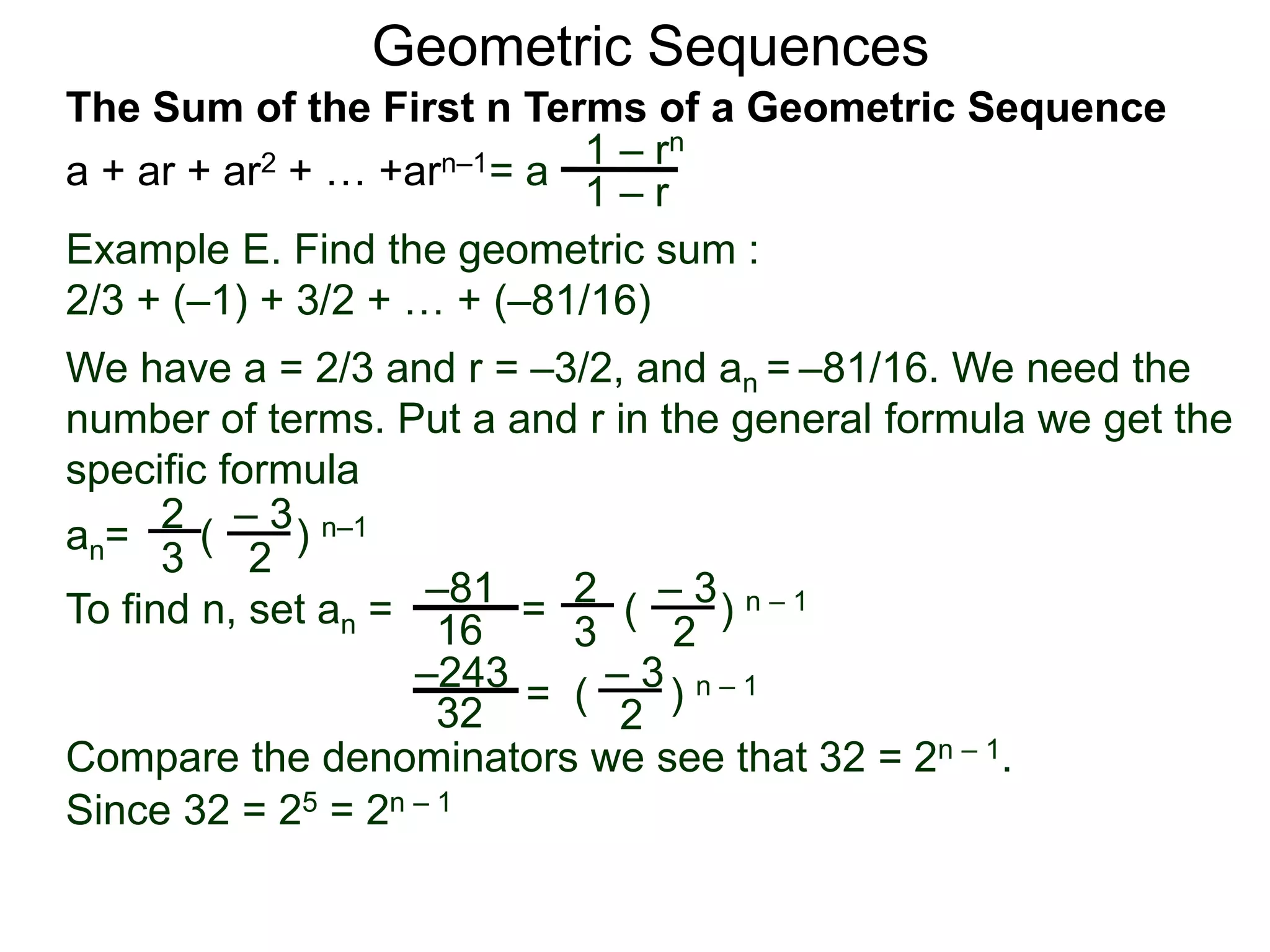
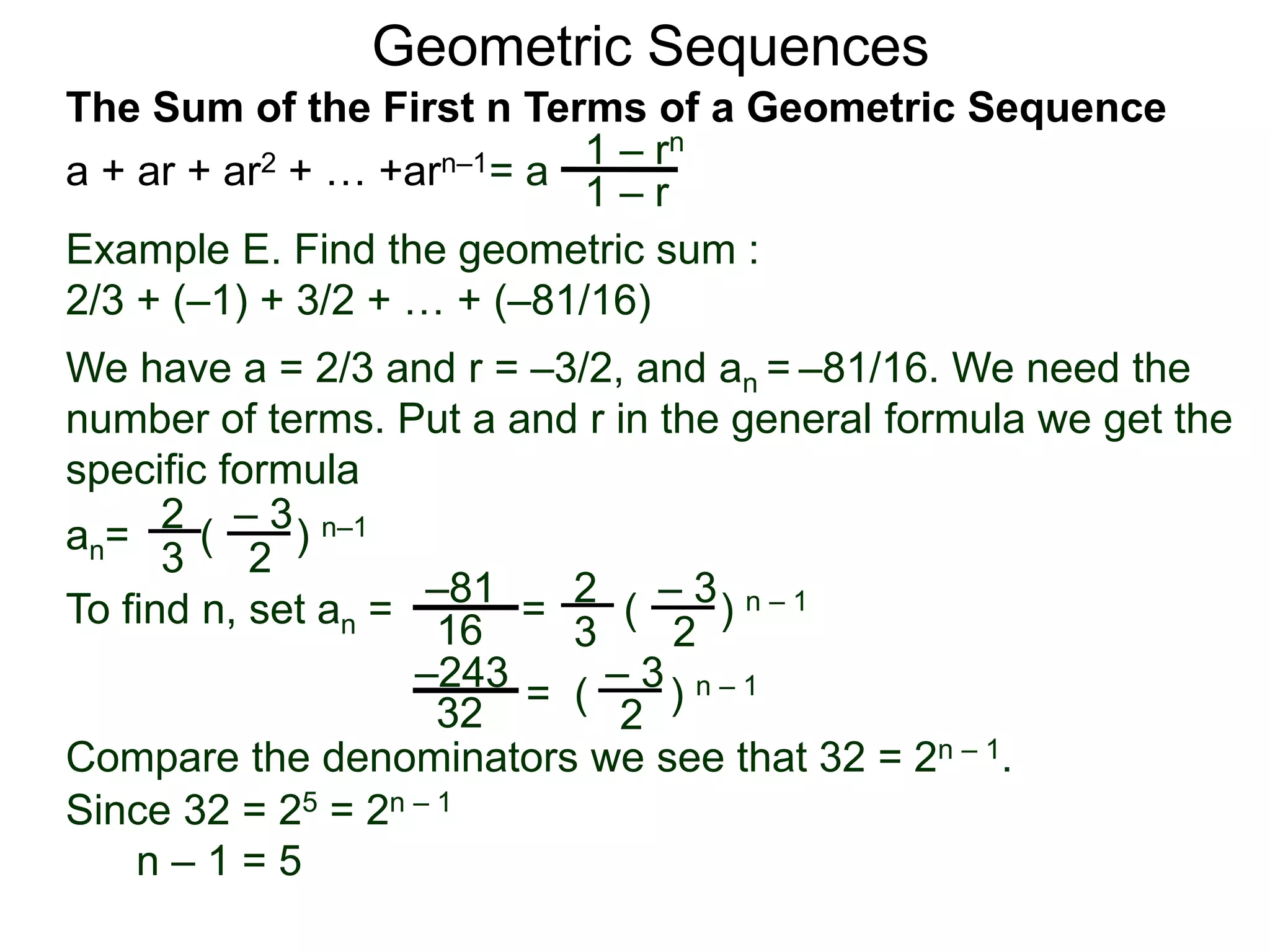
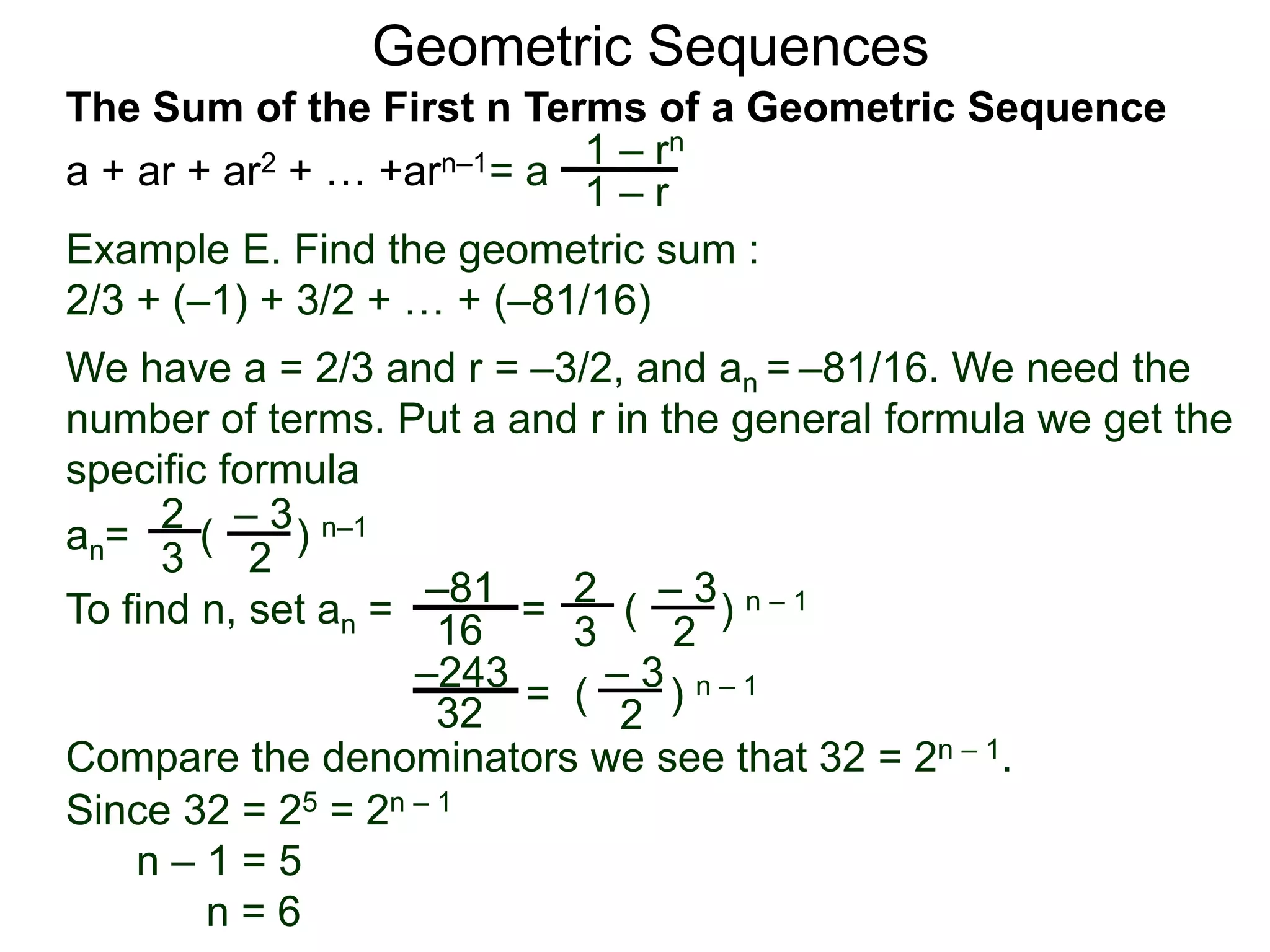
The Sum of the First n Terms of a Geometric Sequence
a + ar + ar2 + … +arn–1
Geometric Sequences
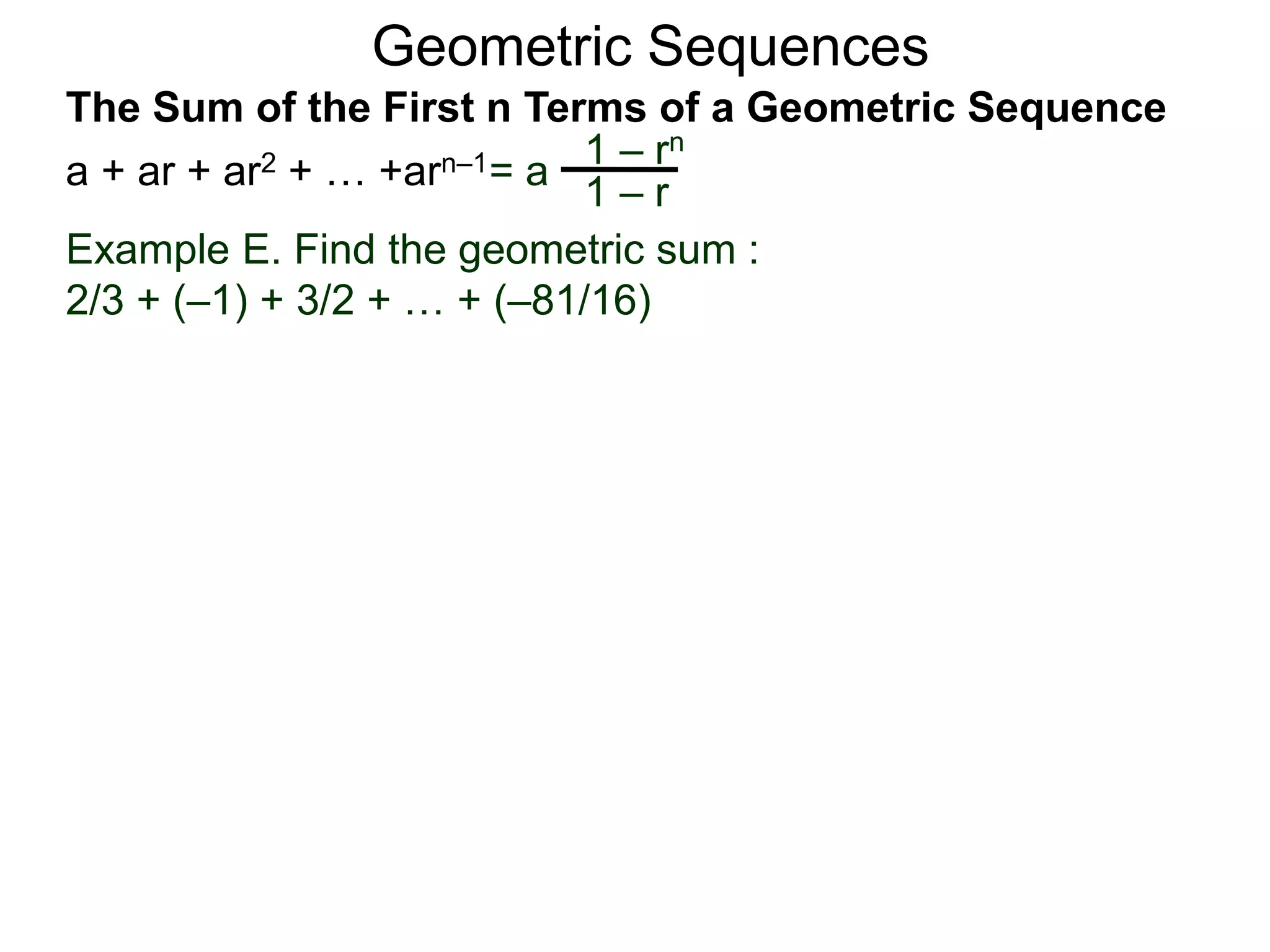
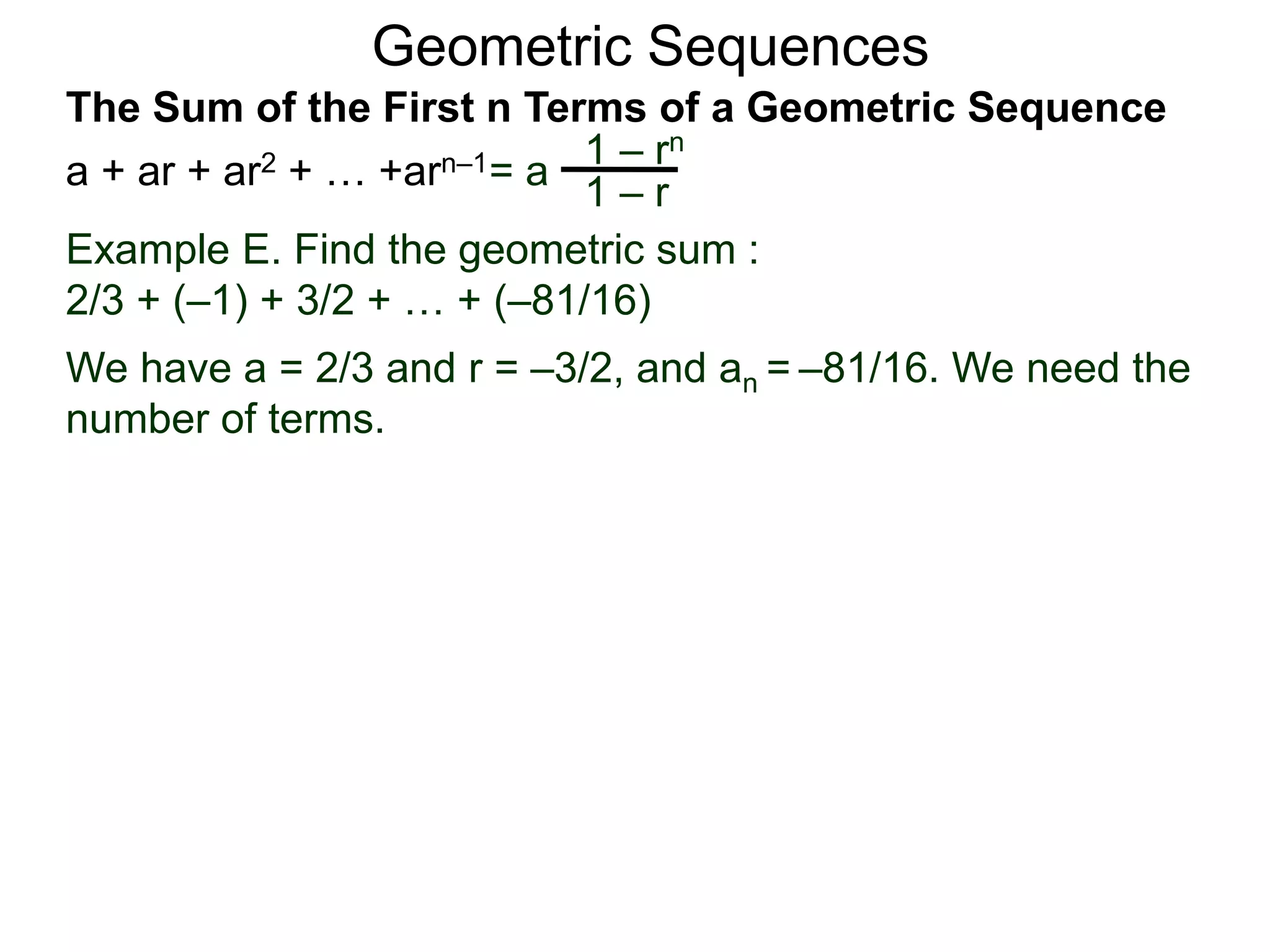
Example E. Find the geometric sum :
2/3 + (–1) + 3/2 + … + (–81/16)
= a
1 – rn
1 – r
The Sum of the First n Terms of a Geometric Sequence
a + ar + ar2 + … +arn–1
Geometric Sequences
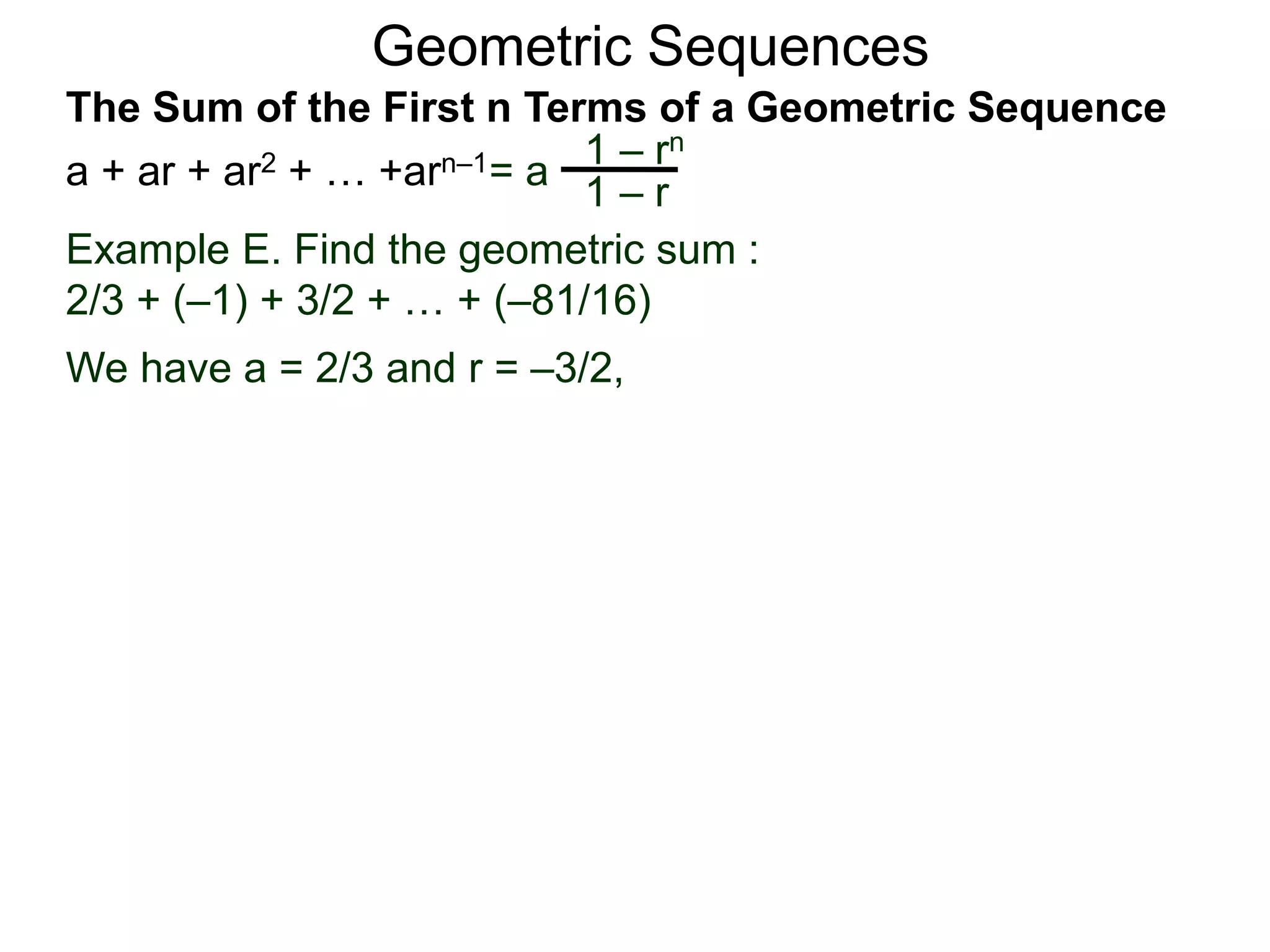
Example E. Find the geometric sum :
2/3 + (–1) + 3/2 + … + (–81/16)
We have a = 2/3 and r = –3/2,
= a
1 – rn
1 – r
The Sum of the First n Terms of a Geometric Sequence
a + ar + ar2 + … +arn–1
Geometric Sequences
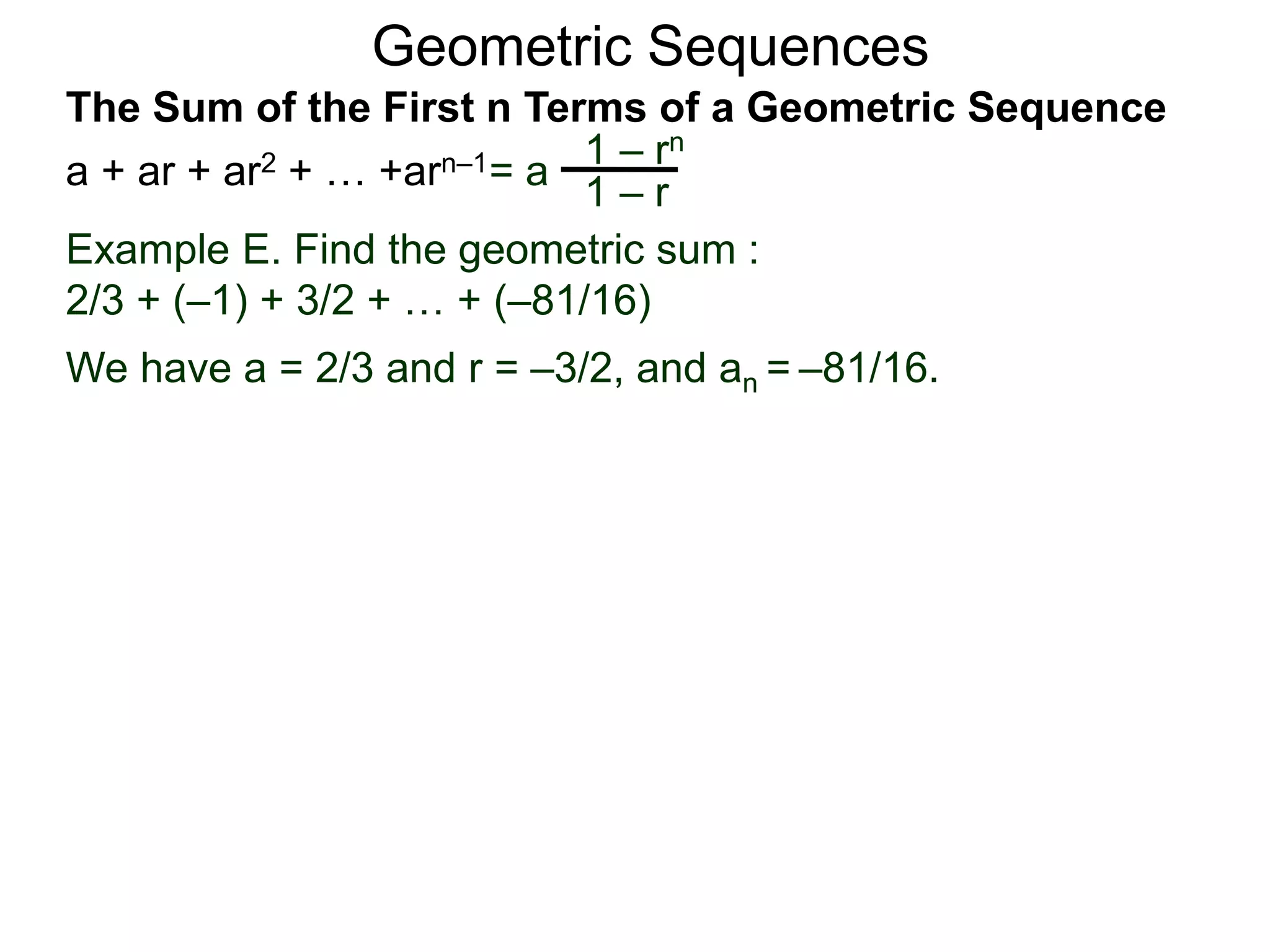
Example E. Find the geometric sum :
2/3 + (–1) + 3/2 + … + (–81/16)
We have a = 2/3 and r = –3/2, and an = –81/16.
= a
1 – rn
1 – r
The Sum of the First n Terms of a Geometric Sequence
a + ar + ar2 + … +arn–1
Geometric Sequences
Example E. Find the geometric sum :
2/3 + (–1) + 3/2 + … + (–81/16)
We have a = 2/3 and r = –3/2, and an = –81/16. We need the
number of terms.
= a
1 – rn
1 – r
The Sum of the First n Terms of a Geometric Sequence
a + ar + ar2 + … +arn–1
Geometric Sequences
Example E. Find the geometric sum :
2/3 + (–1) + 3/2 + … + (–81/16)
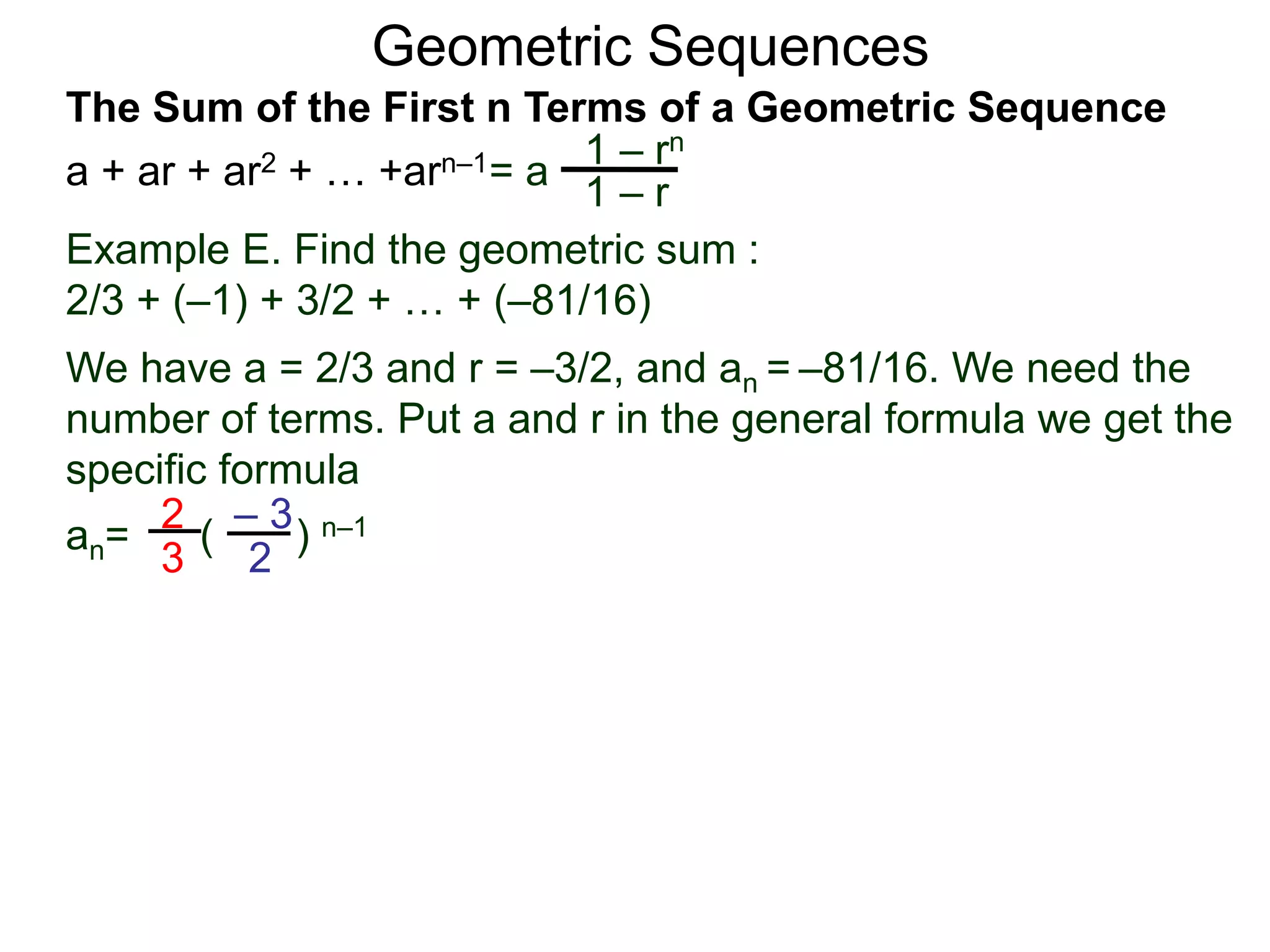
We have a = 2/3 and r = –3/2, and an = –81/16. We need the
number of terms. Put a and r in the general formula we get the
specific formula
2
3
– 3
2
an= ( ) n–1
= a
1 – rn
1 – r
The Sum of the First n Terms of a Geometric Sequence
a + ar + ar2 + … +arn–1
Geometric Sequences
Example E. Find the geometric sum :
2/3 + (–1) + 3/2 + … + (–81/16)
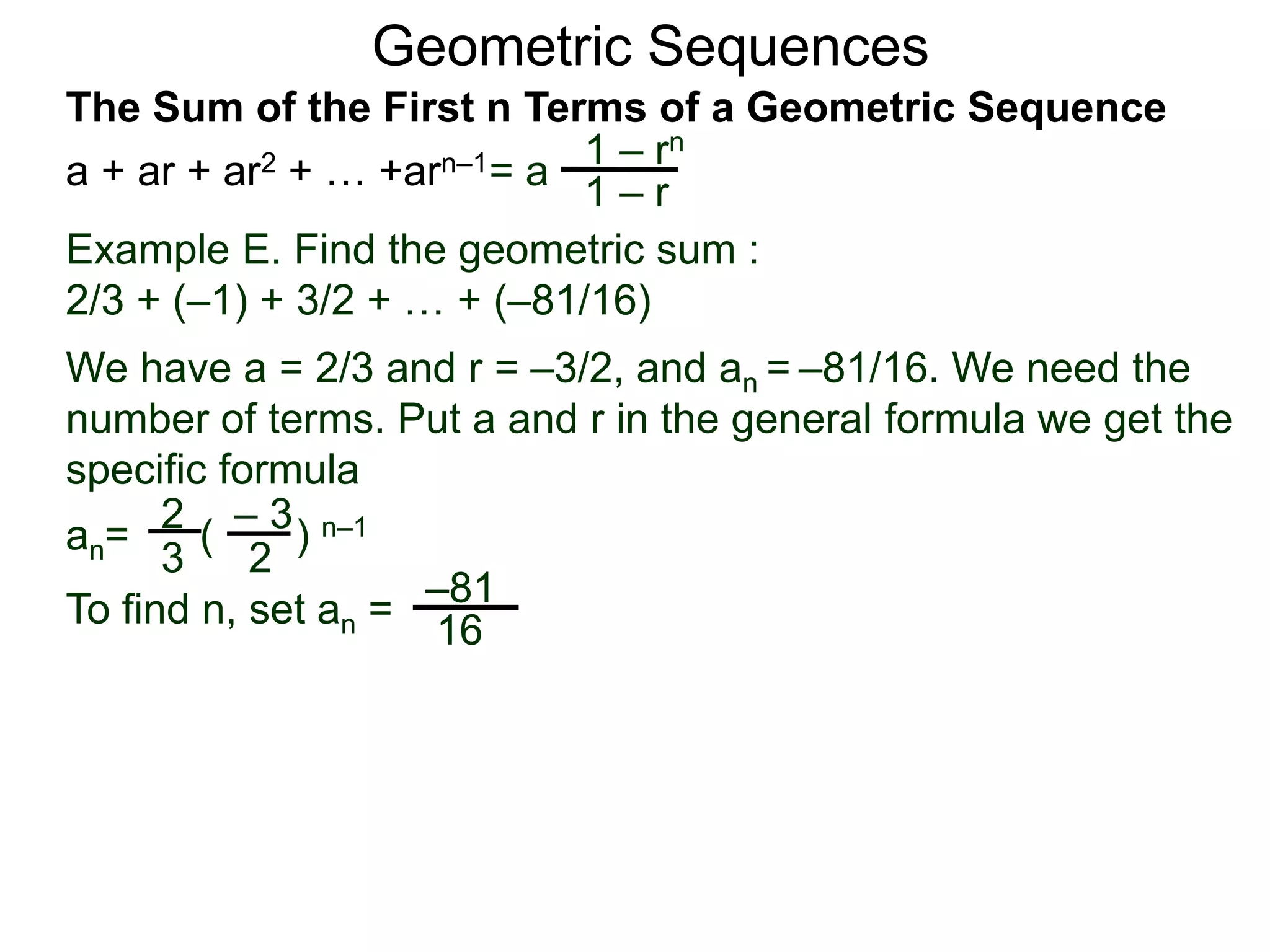
We have a = 2/3 and r = –3/2, and an = –81/16. We need the
number of terms. Put a and r in the general formula we get the
specific formula
2
3
– 3
2
an= ( ) n–1
To find n, set an =
–81
16
= a
1 – rn
1 – r
The Sum of the First n Terms of a Geometric Sequence
a + ar + ar2 + … +arn–1
Geometric Sequences
Example E. Find the geometric sum :
2/3 + (–1) + 3/2 + … + (–81/16)
We have a = 2/3 and r = –3/2, and an = –81/16. We need the
number of terms. Put a and r in the general formula we get the
specific formula
2
3
– 3
2
an= ( ) n–1
To find n, set an = =
2
3
– 3
2
( ) n – 1–81
16
= a
1 – rn
1 – r
The Sum of the First n Terms of a Geometric Sequence
a + ar + ar2 + … +arn–1
Geometric Sequences
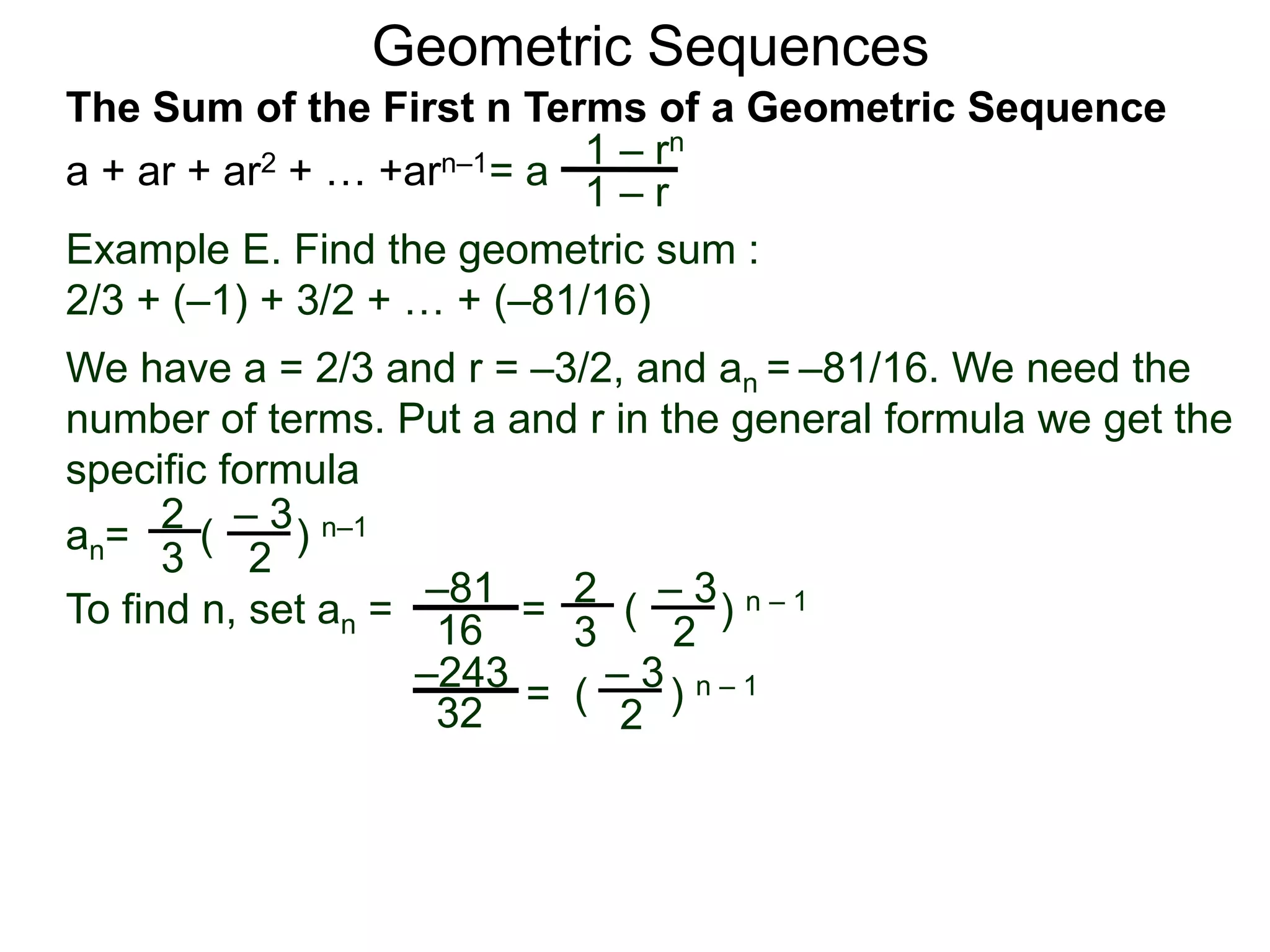
Example E. Find the geometric sum :
2/3 + (–1) + 3/2 + … + (–81/16)
We have a = 2/3 and r = –3/2, and an = –81/16. We need the
number of terms. Put a and r in the general formula we get the
specific formula
2
3
– 3
2
an= ( ) n–1
To find n, set an = =
2
3
– 3
2
( ) n – 1–81
16
– 3
2
= ( ) n – 1–243
32
= a
1 – rn
1 – r
The Sum of the First n Terms of a Geometric Sequence
a + ar + ar2 + … +arn–1
= a
1 – rn
1 – r
The Sum of the First n Terms of a Geometric Sequence
a + ar + ar2 + … +arn–1
Geometric Sequences
Example E. Find the geometric sum :
2/3 + (–1) + 3/2 + … + (–81/16)
We have a = 2/3 and r = –3/2, and an = –81/16. We need the
number of terms. Put a and r in the general formula we get the
specific formula
2
3
– 3
2
an= ( ) n–1
To find n, set an = =
2
3
– 3
2
( ) n – 1–81
16
– 3
2
= ( ) n – 1–243
32
Compare the denominators we see that 32 = 2n – 1.
Geometric Sequences
Example E. Find the geometric sum :
2/3 + (–1) + 3/2 + … + (–81/16)
We have a = 2/3 and r = –3/2, and an = –81/16. We need the
number of terms. Put a and r in the general formula we get the
specific formula
2
3
– 3
2
an= ( ) n–1
To find n, set an = =
2
3
– 3
2
( ) n – 1–81
16
– 3
2
= ( ) n – 1–243
32
Compare the denominators we see that 32 = 2n – 1.
Since 32 = 25 = 2n – 1
= a
1 – rn
1 – r
The Sum of the First n Terms of a Geometric Sequence
a + ar + ar2 + … +arn–1
Geometric Sequences
Example E. Find the geometric sum :
2/3 + (–1) + 3/2 + … + (–81/16)
We have a = 2/3 and r = –3/2, and an = –81/16. We need the
number of terms. Put a and r in the general formula we get the
specific formula
2
3
– 3
2
an= ( ) n–1
To find n, set an = =
2
3
– 3
2
( ) n – 1–81
16
– 3
2
= ( ) n – 1–243
32
Compare the denominators we see that 32 = 2n – 1.
Since 32 = 25 = 2n – 1
n – 1 = 5
= a
1 – rn
1 – r
The Sum of the First n Terms of a Geometric Sequence
a + ar + ar2 + … +arn–1
Geometric Sequences
Example E. Find the geometric sum :
2/3 + (–1) + 3/2 + … + (–81/16)
We have a = 2/3 and r = –3/2, and an = –81/16. We need the
number of terms. Put a and r in the general formula we get the
specific formula
2
3
– 3
2
an= ( ) n–1
To find n, set an = =
2
3
– 3
2
( ) n – 1–81
16
– 3
2
= ( ) n – 1–243
32
Compare the denominators we see that 32 = 2n – 1.
Since 32 = 25 = 2n – 1
n – 1 = 5
n = 6
= a
1 – rn
1 – r
The Sum of the First n Terms of a Geometric Sequence
a + ar + ar2 + … +arn–1
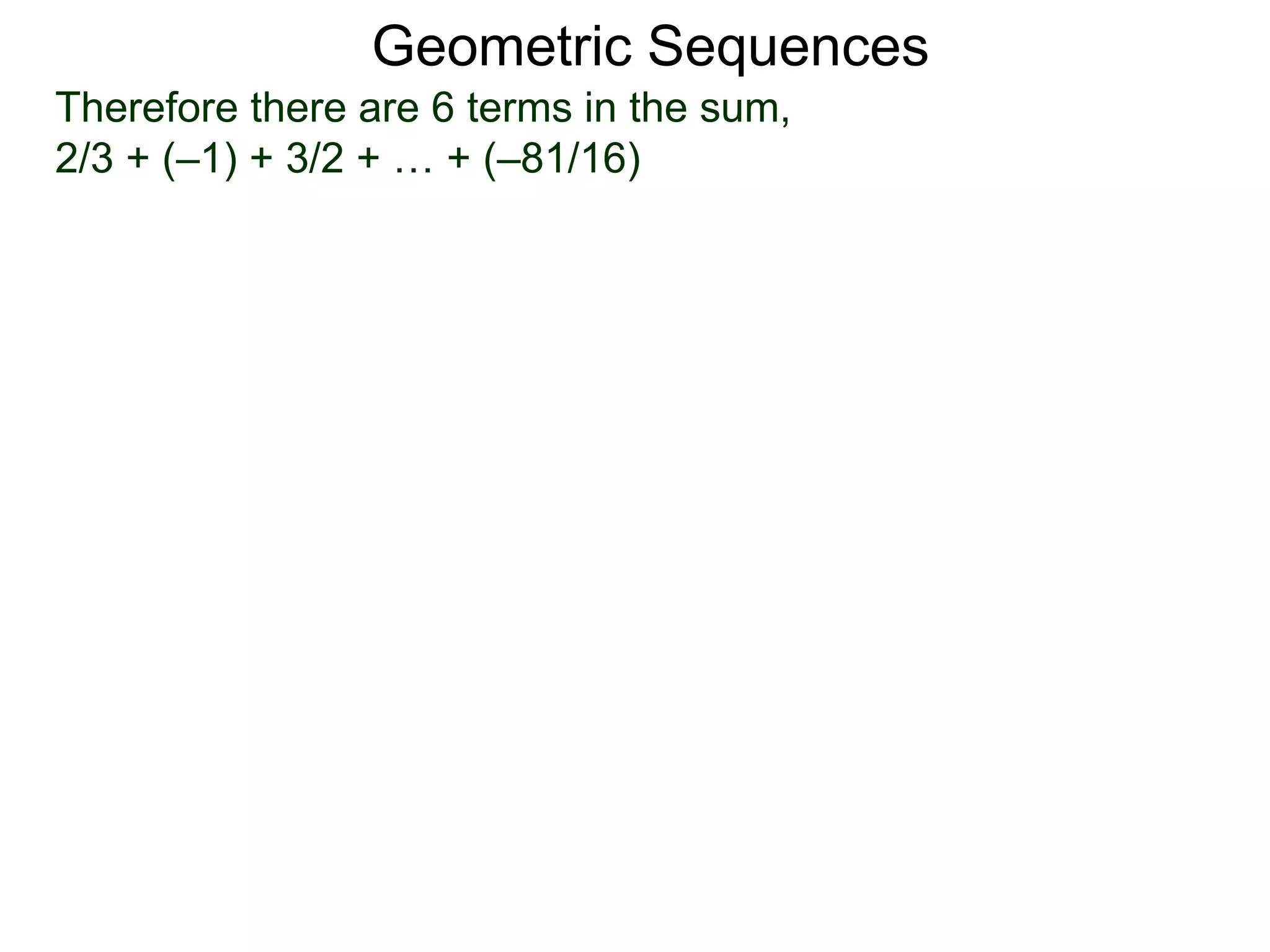
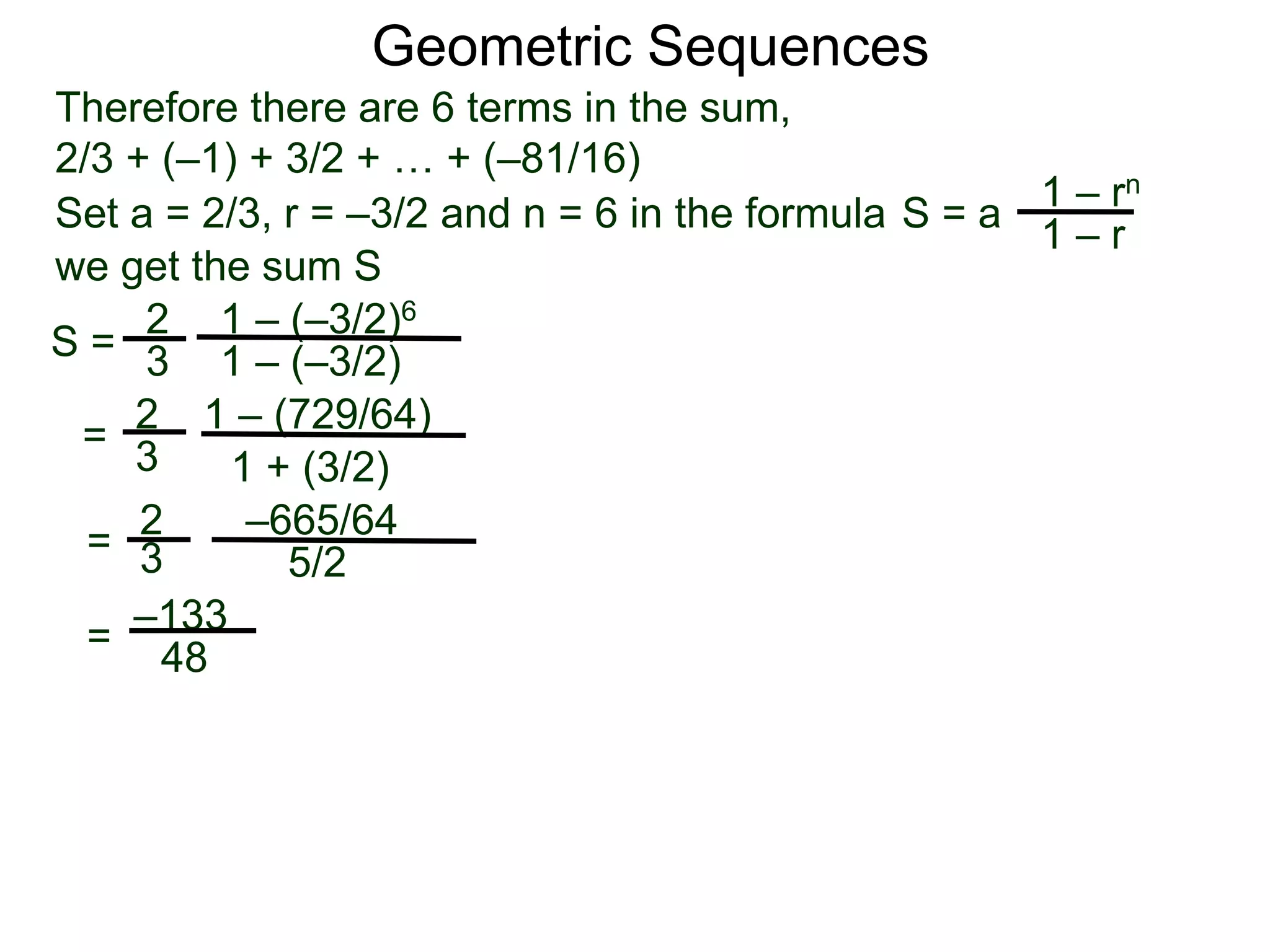
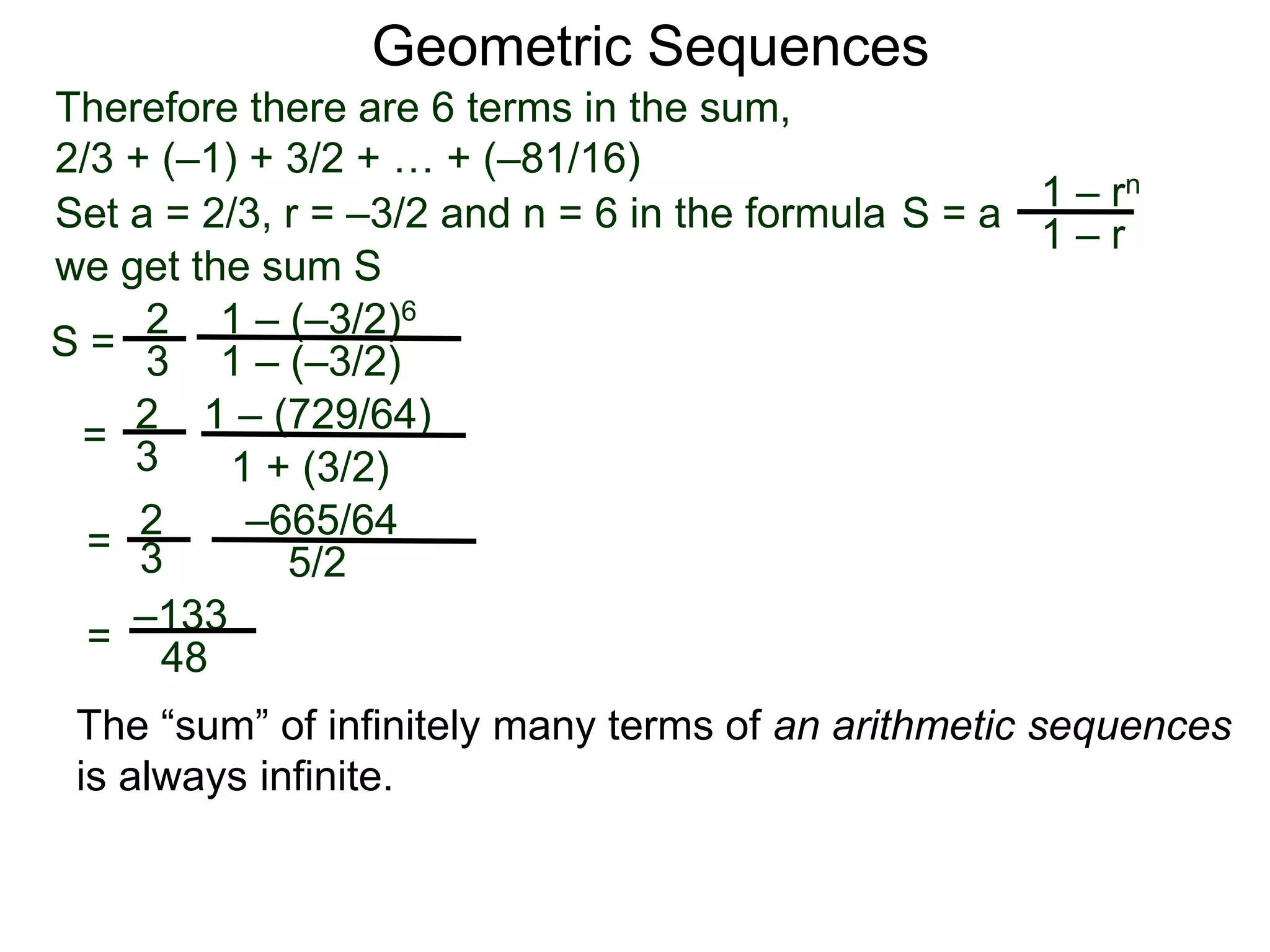
Therefore there are 6 terms in the sum,
2/3 + (–1) + 3/2 + … + (–81/16)
Geometric Sequences
Therefore there are 6 terms in the sum,
2/3 + (–1) + 3/2 + … + (–81/16)
Geometric Sequences
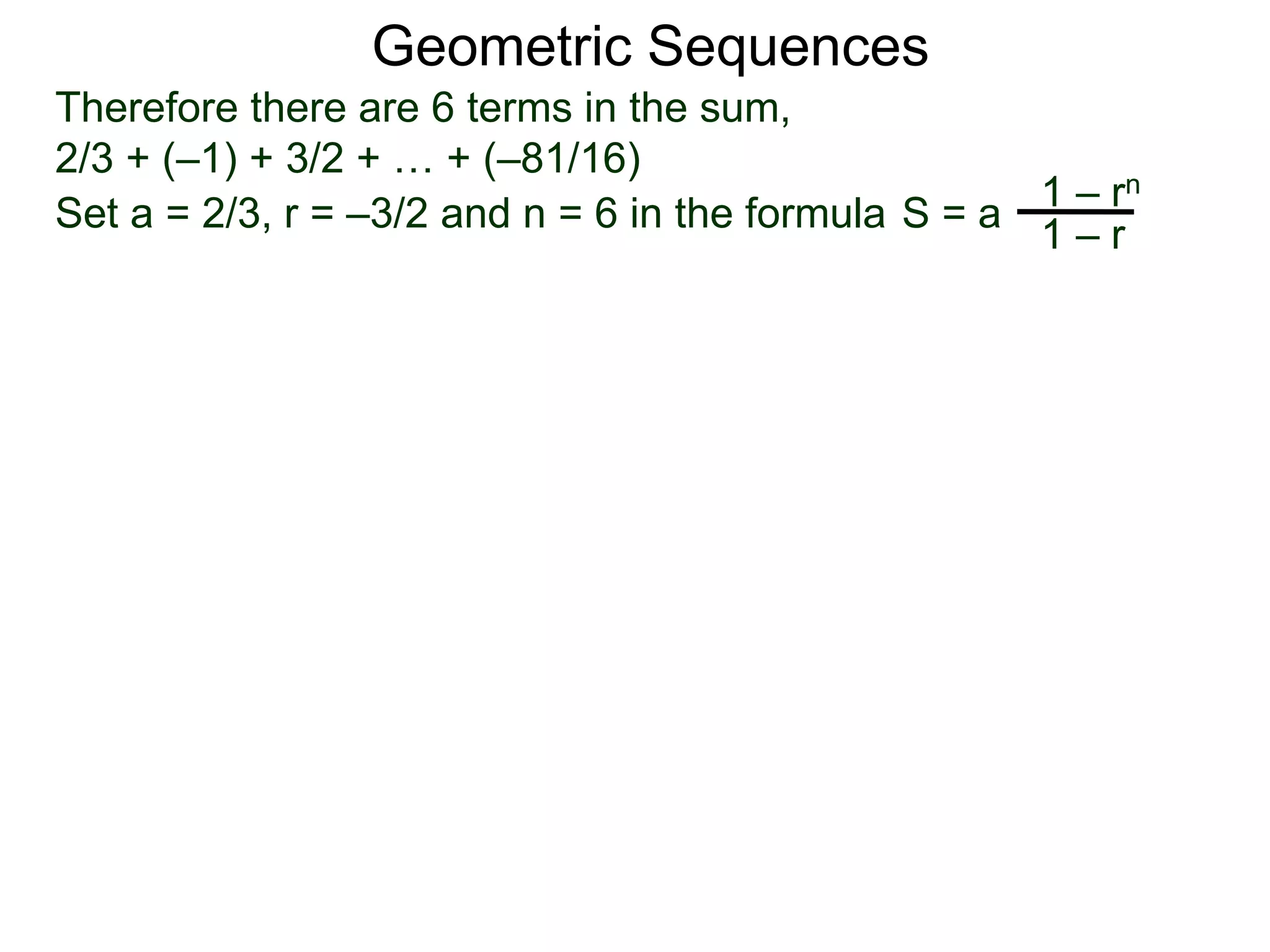
Set a = 2/3, r = –3/2 and n = 6 in the formula
1 – rn
1 – r
S = a
Therefore there are 6 terms in the sum,
2/3 + (–1) + 3/2 + … + (–81/16)
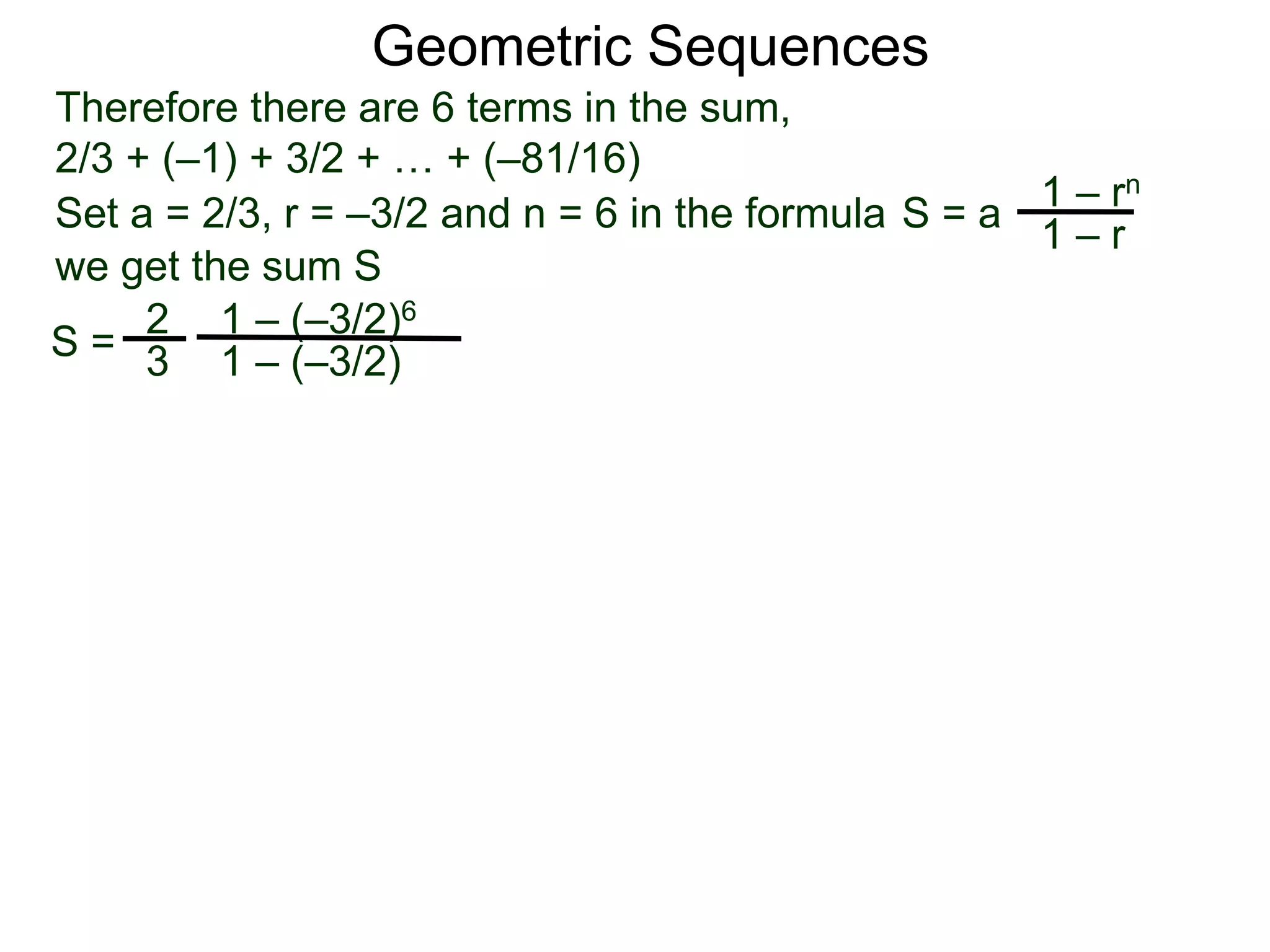
S =
2
3
1 – (–3/2)6
1 – (–3/2)
Geometric Sequences
Set a = 2/3, r = –3/2 and n = 6 in the formula
1 – rn
1 – r
S = a
we get the sum S
Therefore there are 6 terms in the sum,
2/3 + (–1) + 3/2 + … + (–81/16)
S =
2
3
1 – (–3/2)6
1 – (–3/2)
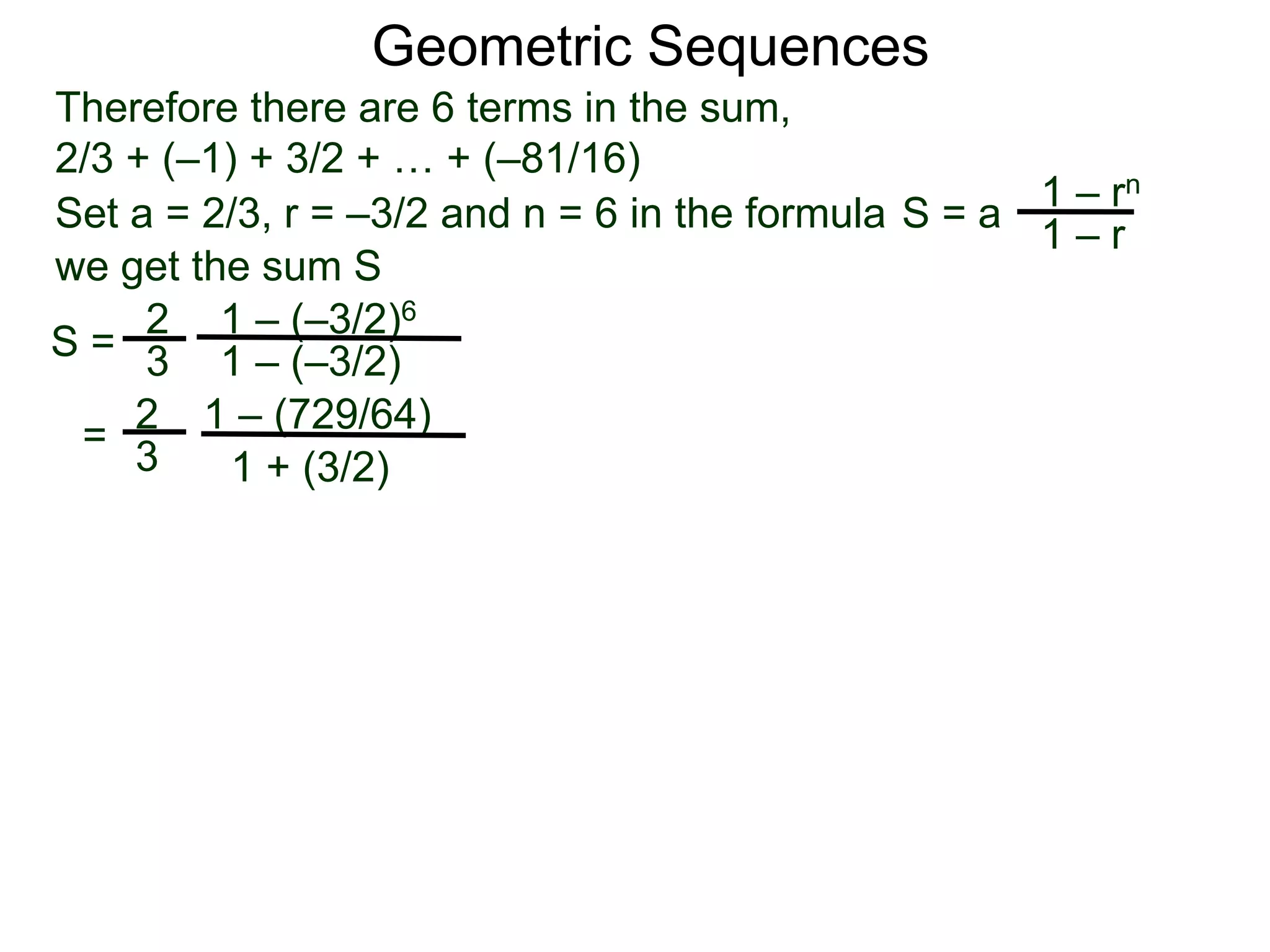
=
2
3
1 – (729/64)
1 + (3/2)
Geometric Sequences
Set a = 2/3, r = –3/2 and n = 6 in the formula
1 – rn
1 – r
S = a
we get the sum S
Therefore there are 6 terms in the sum,
2/3 + (–1) + 3/2 + … + (–81/16)
S =
2
3
1 – (–3/2)6
1 – (–3/2)
=
2
3
1 – (729/64)
1 + (3/2)
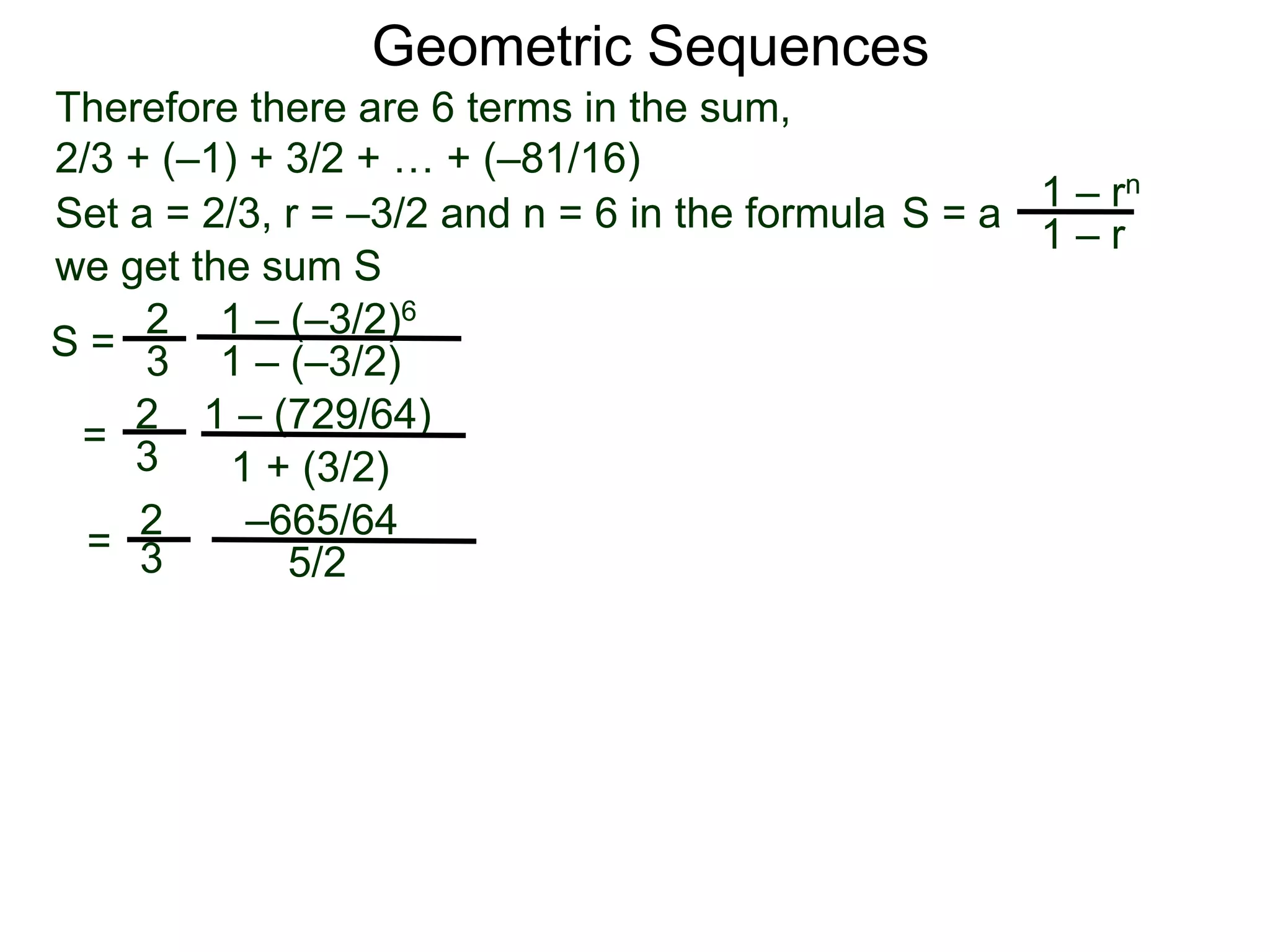
=
2
3
–665/64
5/2
Geometric Sequences
Set a = 2/3, r = –3/2 and n = 6 in the formula
1 – rn
1 – r
S = a
we get the sum S
Therefore there are 6 terms in the sum,
2/3 + (–1) + 3/2 + … + (–81/16)
S =
2
3
1 – (–3/2)6
1 – (–3/2)
=
2
3
1 – (729/64)
1 + (3/2)
=
2
3
–665/64
5/2
–133
48
Geometric Sequences
Set a = 2/3, r = –3/2 and n = 6 in the formula
1 – rn
1 – r
S = a
we get the sum S
=
Therefore there are 6 terms in the sum,
2/3 + (–1) + 3/2 + … + (–81/16)
S =
2
3
1 – (–3/2)6
1 – (–3/2)
=
2
3
1 – (729/64)
1 + (3/2)
=
2
3
–665/64
5/2
–133
48
Geometric Sequences
Set a = 2/3, r = –3/2 and n = 6 in the formula
1 – rn
1 – r
S = a
we get the sum S
=
The “sum” of infinitely many terms of an arithmetic sequences
is always infinite.
Therefore there are 6 terms in the sum,
2/3 + (–1) + 3/2 + … + (–81/16)
S =
2
3
1 – (–3/2)6
1 – (–3/2)
=
2
3
1 – (729/64)
1 + (3/2)
=
2
3
–665/64
5/2
–133
48
Geometric Sequences
Set a = 2/3, r = –3/2 and n = 6 in the formula
1 – rn
1 – r
S = a
we get the sum S
=
Adding of infinitely many terms of
an arithmetic sequences is always infinite.
But it’s possible to add infinitely many terms of
a geometric sequence to obtain a finite sum.
Infinite Sums of Geometric Sequences
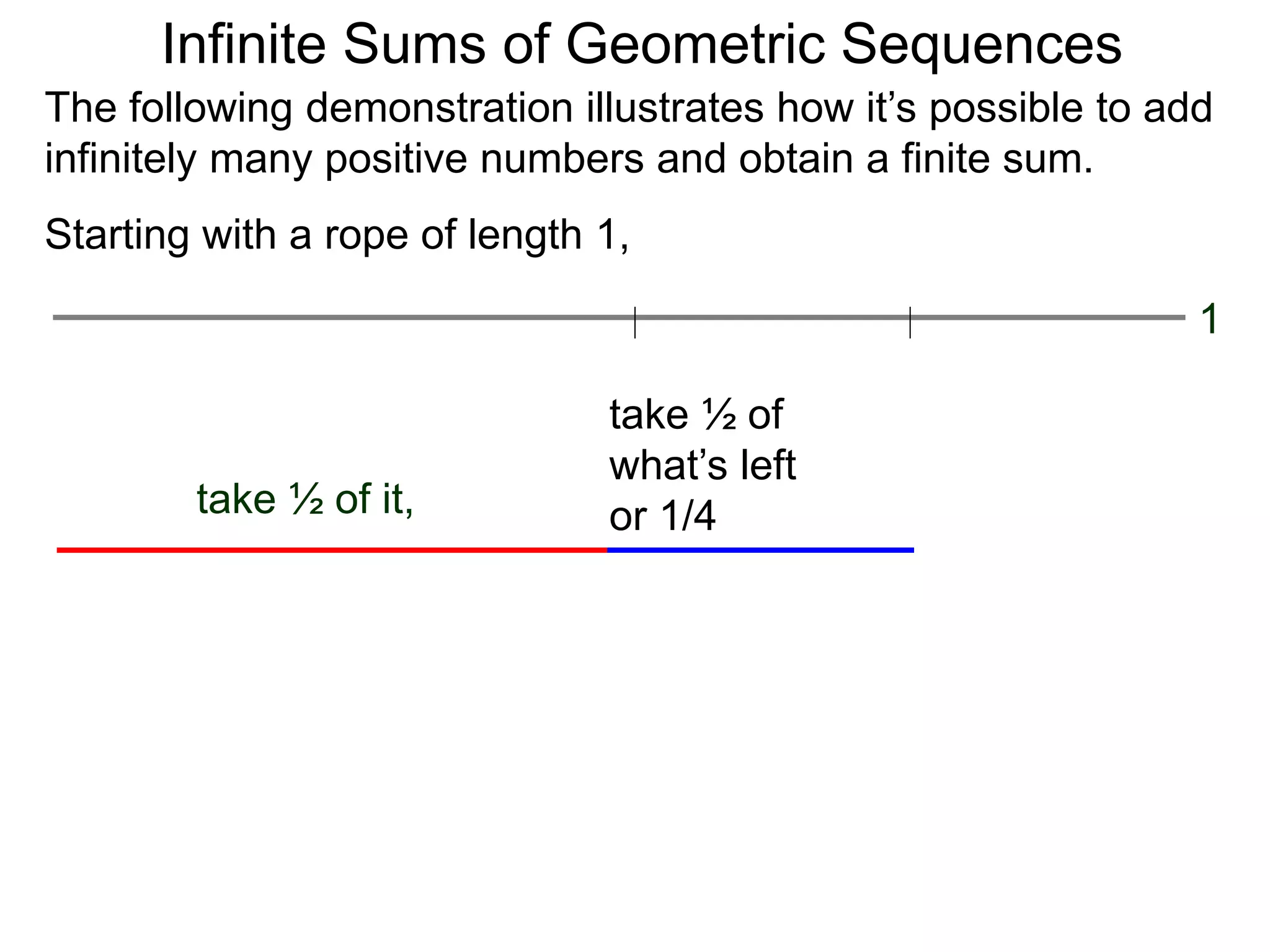
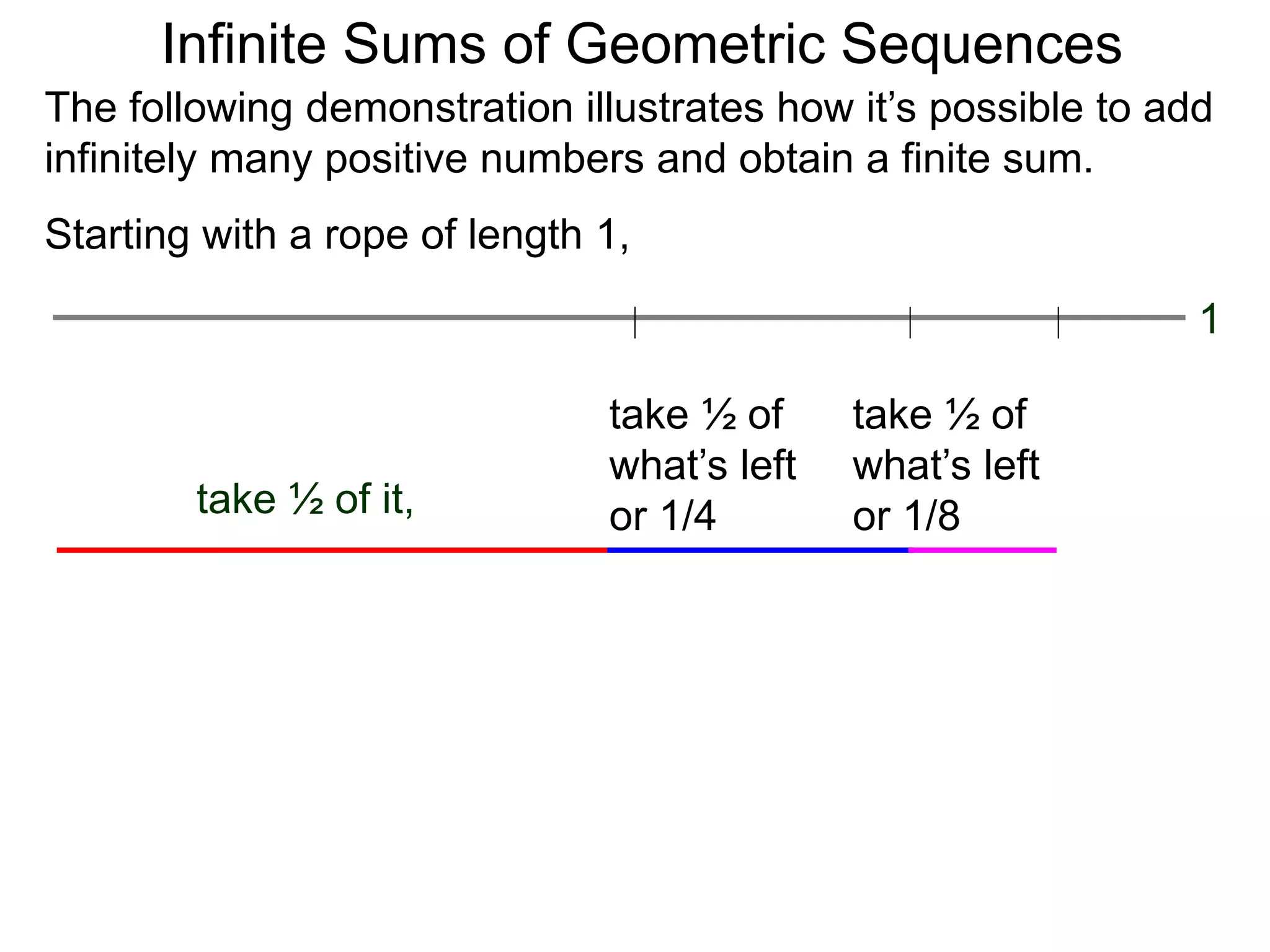
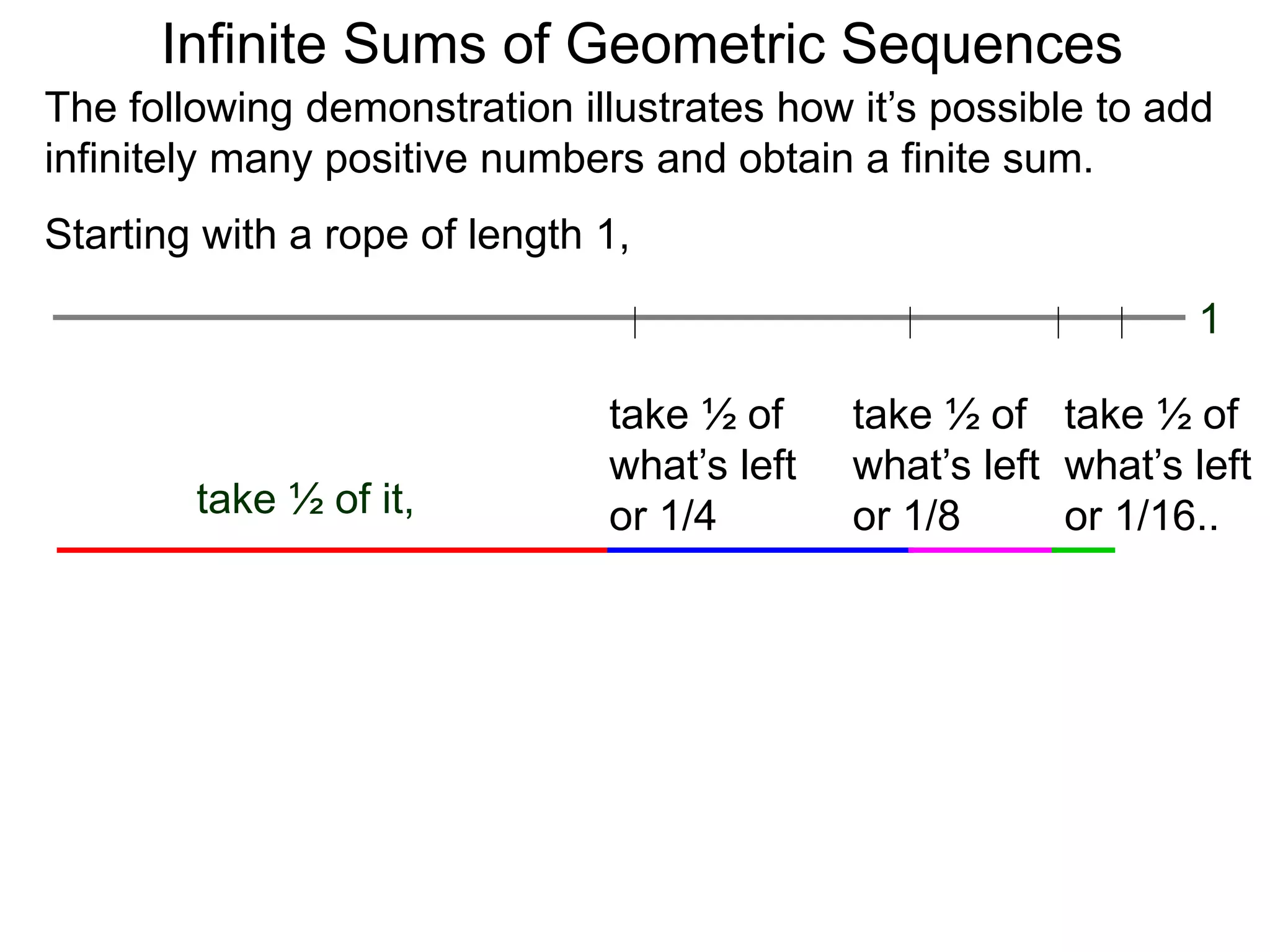
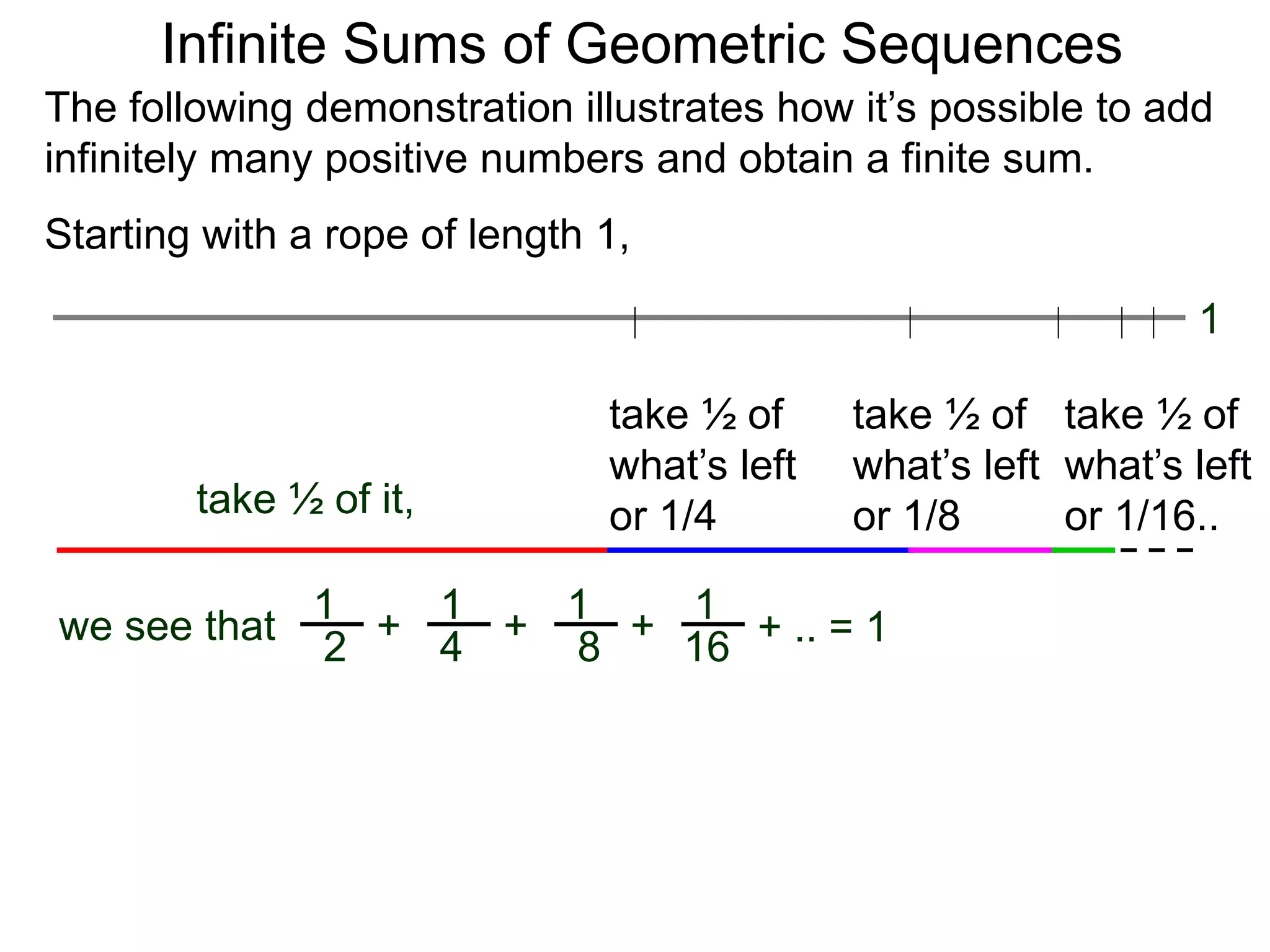
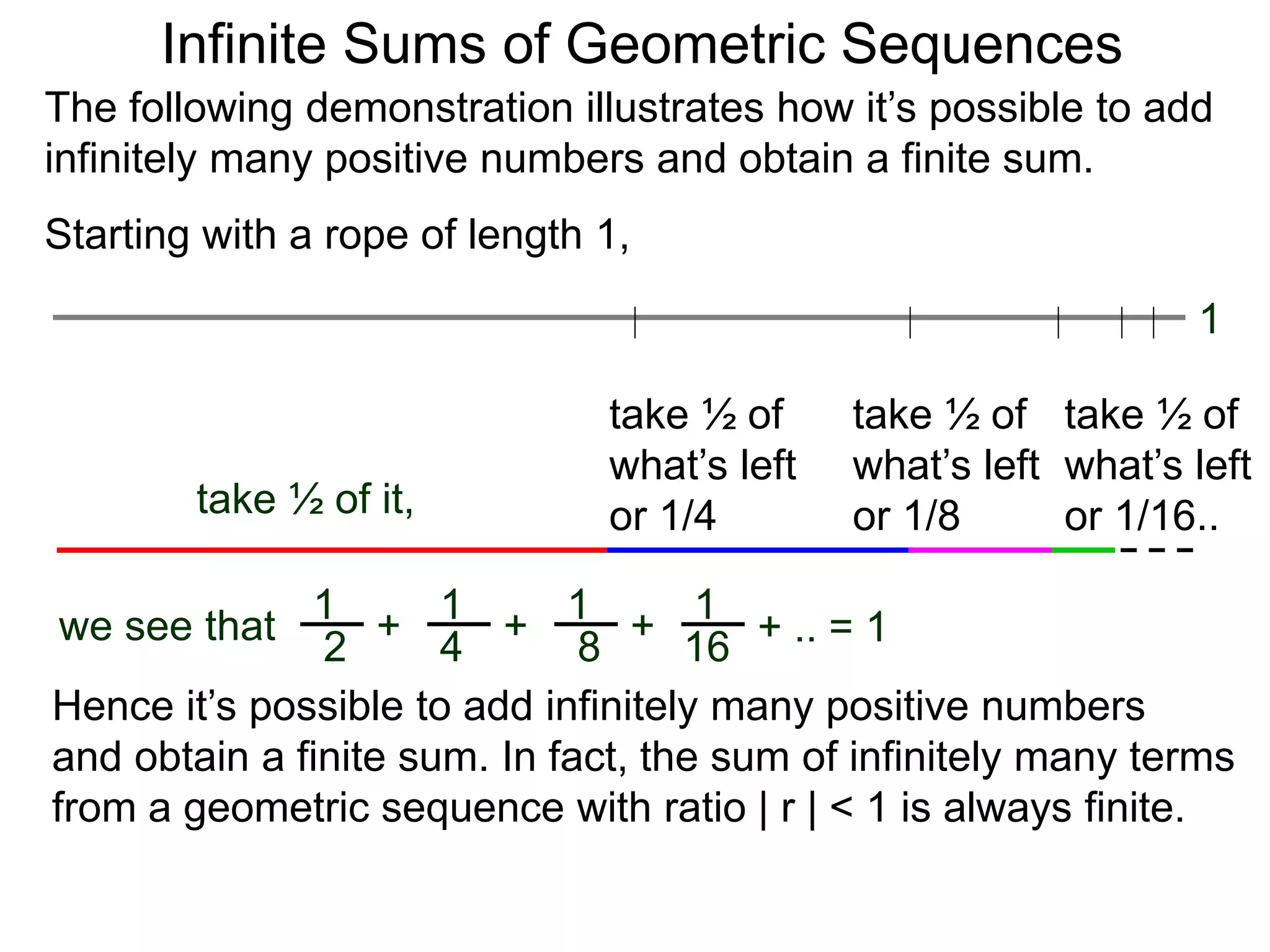
The following demonstration illustrates how it’s possible to add
infinitely many positive numbers and obtain a finite sum.
Starting with a rope of length 1,
Infinite Sums of Geometric Sequences
The following demonstration illustrates how it’s possible to add
infinitely many positive numbers and obtain a finite sum.
1
Starting with a rope of length 1,
Infinite Sums of Geometric Sequences
The following demonstration illustrates how it’s possible to add
infinitely many positive numbers and obtain a finite sum.
take ½ of it,
1
Starting with a rope of length 1,
Infinite Sums of Geometric Sequences
The following demonstration illustrates how it’s possible to add
infinitely many positive numbers and obtain a finite sum.
take ½ of it,
take ½ of
what’s left
or 1/4
1
Starting with a rope of length 1,
Infinite Sums of Geometric Sequences
The following demonstration illustrates how it’s possible to add
infinitely many positive numbers and obtain a finite sum.
take ½ of it,
take ½ of
what’s left
or 1/4
take ½ of
what’s left
or 1/8
1
Starting with a rope of length 1,
Infinite Sums of Geometric Sequences
The following demonstration illustrates how it’s possible to add
infinitely many positive numbers and obtain a finite sum.
take ½ of it,
take ½ of
what’s left
or 1/4
take ½ of
what’s left
or 1/8
take ½ of
what’s left
or 1/16..
1
Starting with a rope of length 1,
Infinite Sums of Geometric Sequences
The following demonstration illustrates how it’s possible to add
infinitely many positive numbers and obtain a finite sum.
we see that
take ½ of it,
take ½ of
what’s left
or 1/4
take ½ of
what’s left
or 1/8
take ½ of
what’s left
or 1/16..
1
2
+
1
4
+
1
8
+
1
16 + .. = 1
1
Starting with a rope of length 1,
Infinite Sums of Geometric Sequences
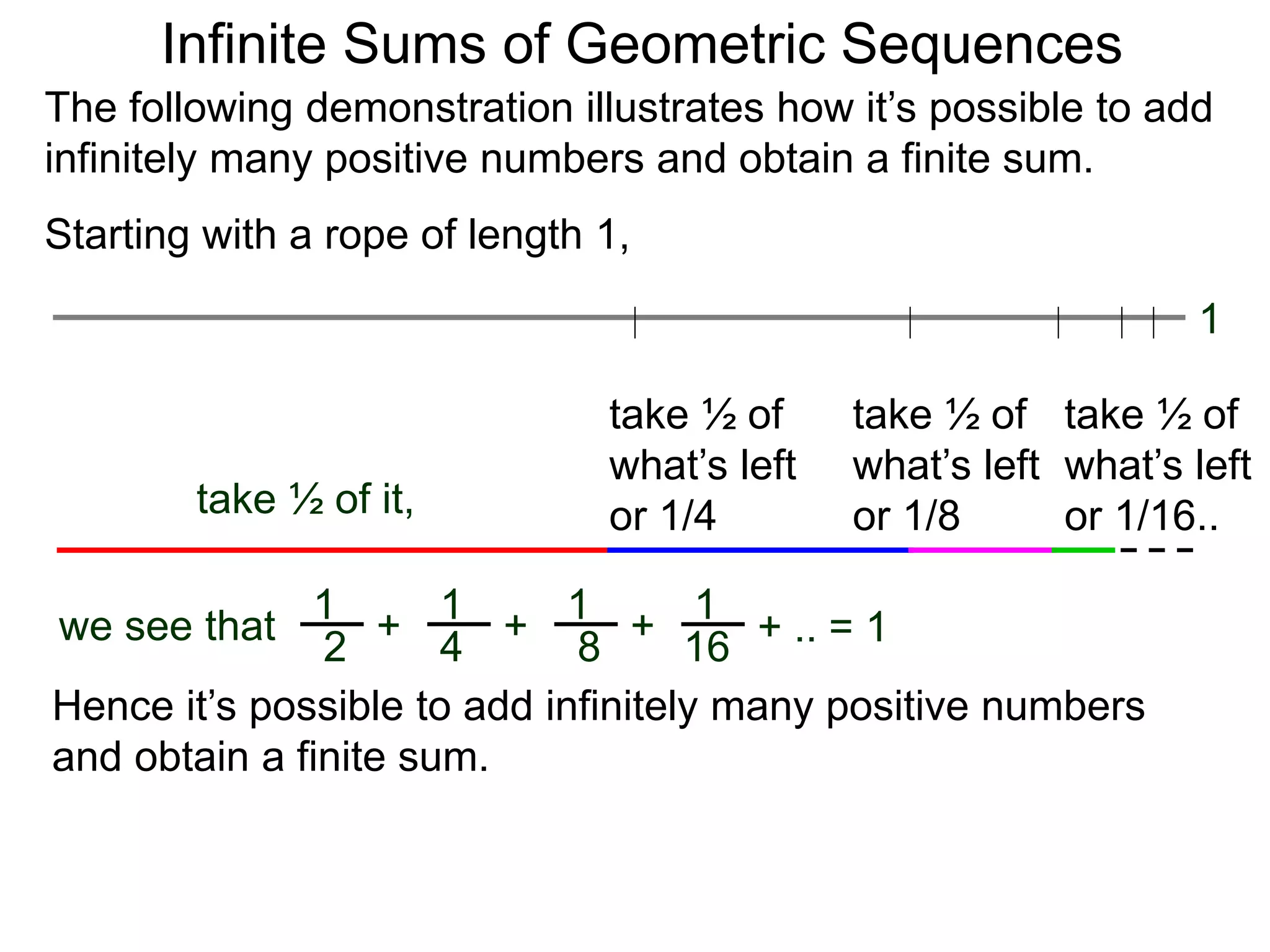
Hence it’s possible to add infinitely many positive numbers
and obtain a finite sum.
The following demonstration illustrates how it’s possible to add
infinitely many positive numbers and obtain a finite sum.
we see that
take ½ of it,
take ½ of
what’s left
or 1/4
take ½ of
what’s left
or 1/8
take ½ of
what’s left
or 1/16..
1
2
+
1
4
+
1
8
+
1
16 + .. = 1
1
Starting with a rope of length 1,
Infinite Sums of Geometric Sequences
Hence it’s possible to add infinitely many positive numbers
and obtain a finite sum. In fact, the sum of infinitely many terms
from a geometric sequence with ratio | r | < 1 is always finite.
The following demonstration illustrates how it’s possible to add
infinitely many positive numbers and obtain a finite sum.
we see that
take ½ of it,
take ½ of
what’s left
or 1/4
take ½ of
what’s left
or 1/8
take ½ of
what’s left
or 1/16..
1
2
+
1
4
+
1
8
+
1
16 + .. = 1
1
Starting with a rope of length 1,
Infinite Sums of Geometric Sequences
Hence it’s possible to add infinitely many positive numbers
and obtain a finite sum. In fact, the sum of infinitely many terms
from a geometric sequence with ratio | r | < 1 is always finite.
The example above is the sum of the geometric sequence
½, ¼, 1/8, 1/16, … with r = ½ so their sum is finite.
The following demonstration illustrates how it’s possible to add
infinitely many positive numbers and obtain a finite sum.
we see that
take ½ of it,
take ½ of
what’s left
or 1/4
take ½ of
what’s left
or 1/8
take ½ of
what’s left
or 1/16..
1
2
+
1
4
+
1
8
+
1
16 + .. = 1
1
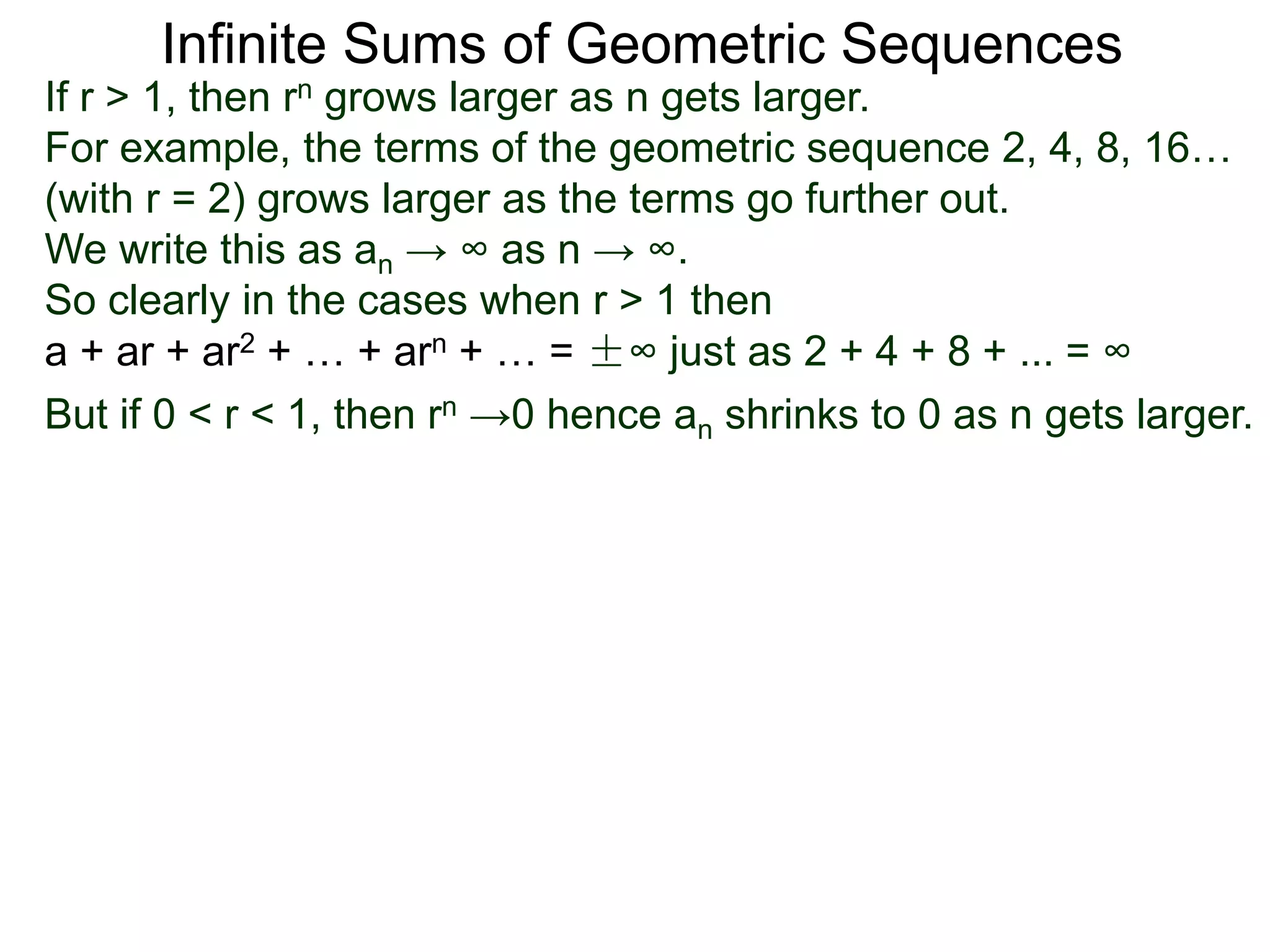
Infinite Sums of Geometric Sequences
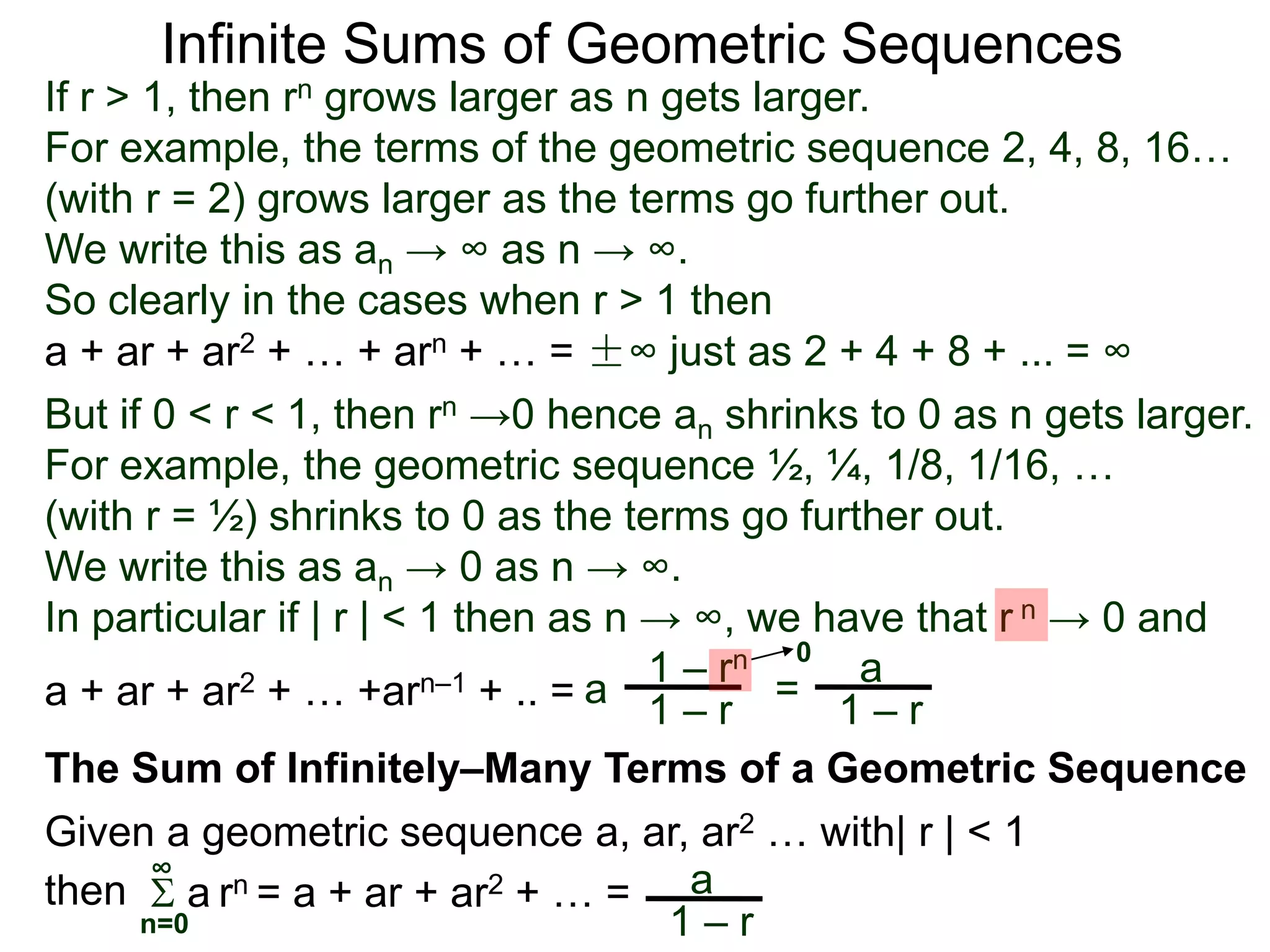
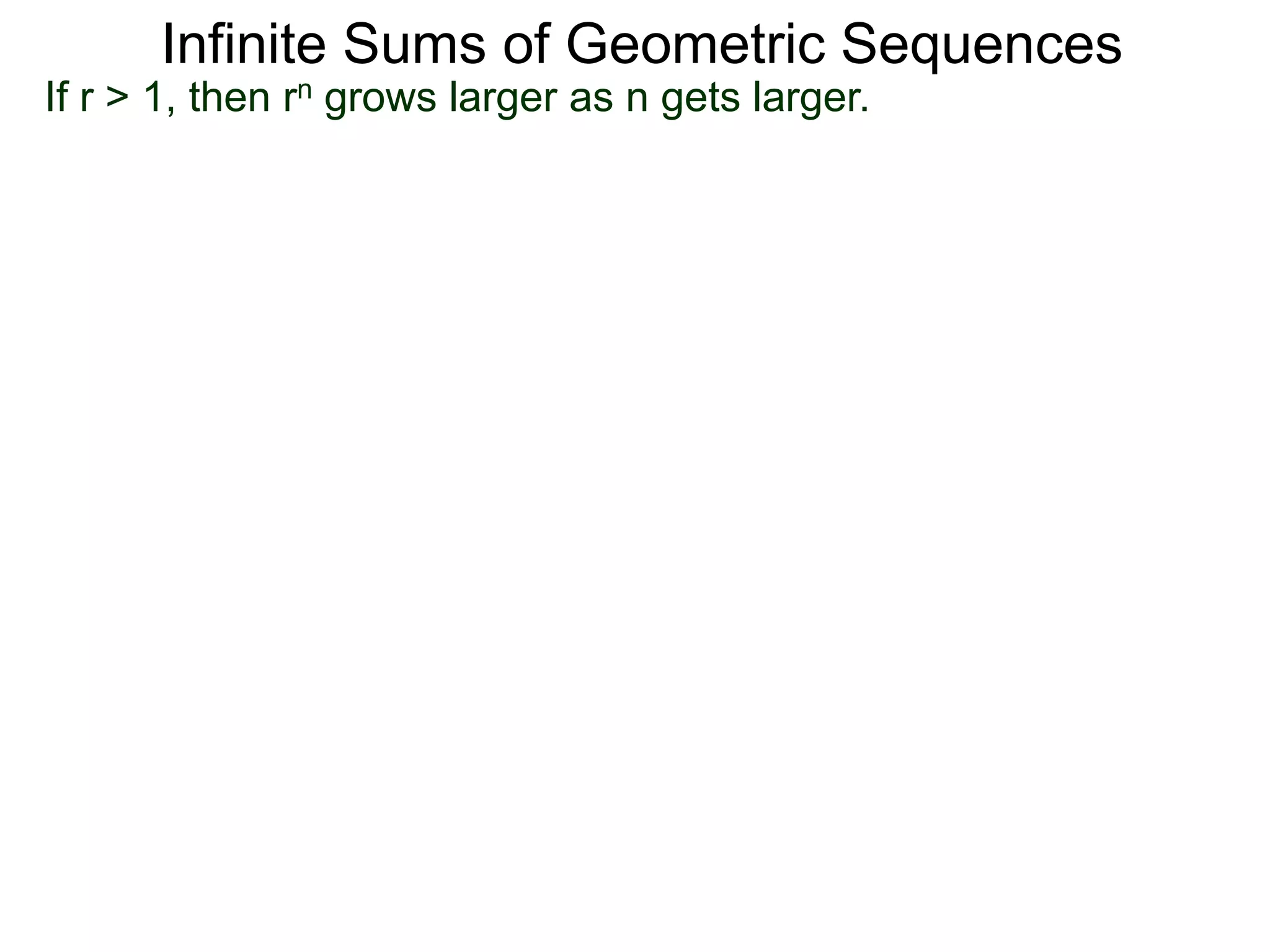
If r > 1, then rn grows larger as n gets larger.
Infinite Sums of Geometric Sequences
If r > 1, then rn grows larger as n gets larger.
For example, the terms of the geometric sequence 2, 4, 8, 16…
(with r = 2) grows larger as the terms go further out.
Infinite Sums of Geometric Sequences
If r > 1, then rn grows larger as n gets larger.
For example, the terms of the geometric sequence 2, 4, 8, 16…
(with r = 2) grows larger as the terms go further out.
We write this as an → ∞ as n → ∞.
Infinite Sums of Geometric Sequences
If r > 1, then rn grows larger as n gets larger.
For example, the terms of the geometric sequence 2, 4, 8, 16…
(with r = 2) grows larger as the terms go further out.
We write this as an → ∞ as n → ∞.
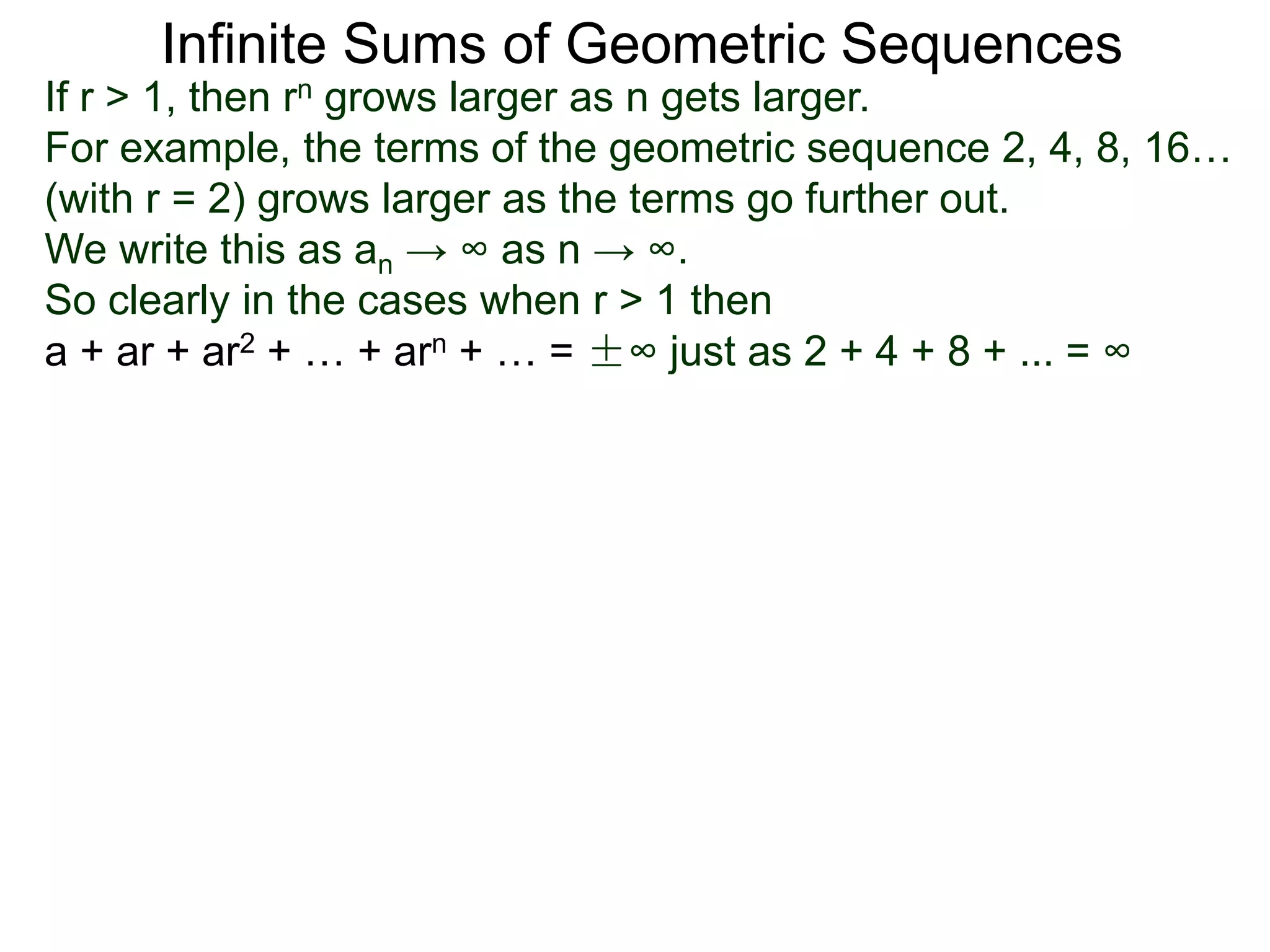
So clearly in the cases when r > 1 then
a + ar + ar2 + … + arn + … = ±∞ just as 2 + 4 + 8 + ... = ∞
Infinite Sums of Geometric Sequences
If r > 1, then rn grows larger as n gets larger.
For example, the terms of the geometric sequence 2, 4, 8, 16…
(with r = 2) grows larger as the terms go further out.
We write this as an → ∞ as n → ∞.
So clearly in the cases when r > 1 then
a + ar + ar2 + … + arn + … = ±∞ just as 2 + 4 + 8 + ... = ∞
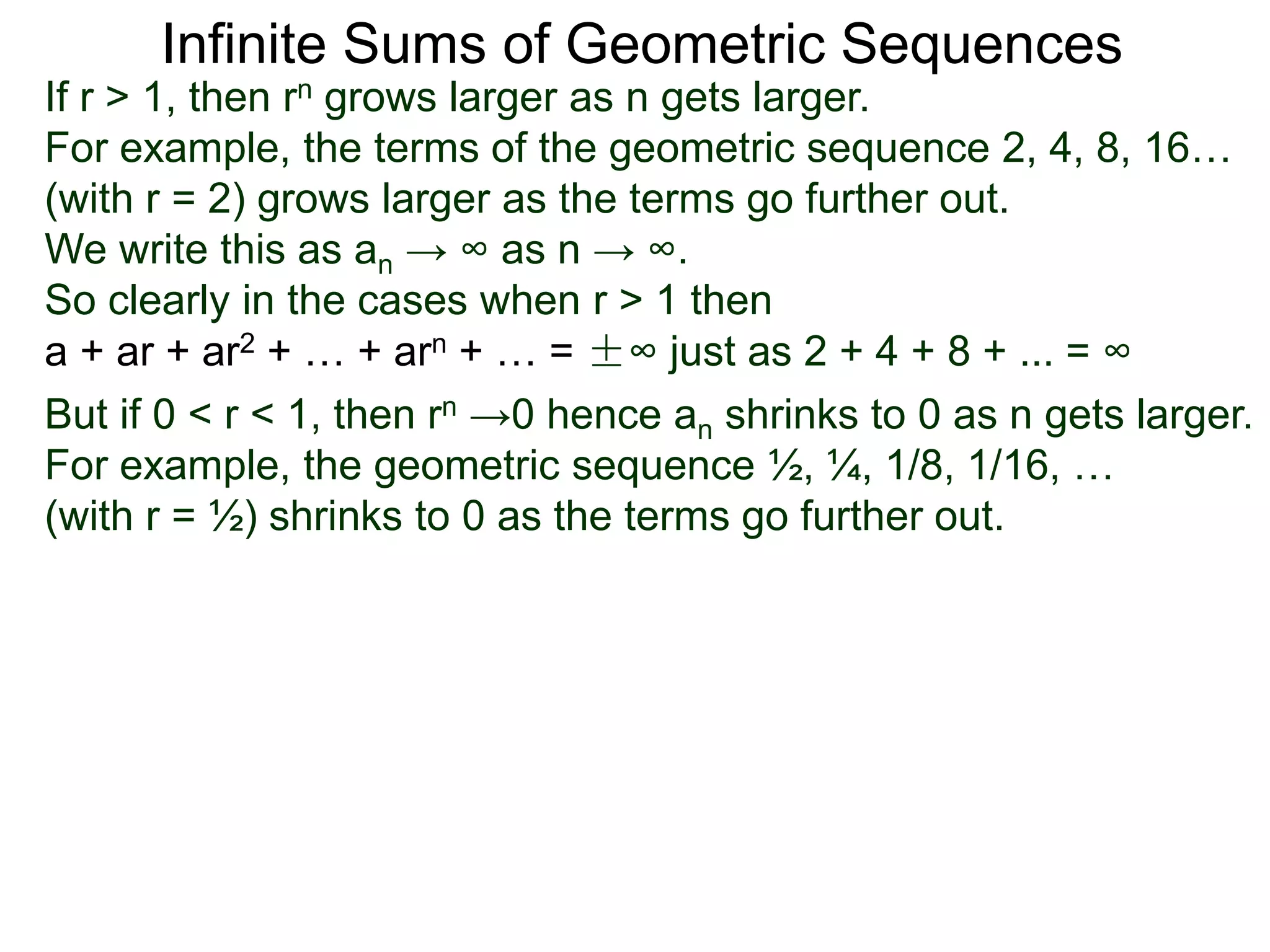
But if 0 < r < 1, then rn →0 hence an shrinks to 0 as n gets larger.
Infinite Sums of Geometric Sequences
If r > 1, then rn grows larger as n gets larger.
For example, the terms of the geometric sequence 2, 4, 8, 16…
(with r = 2) grows larger as the terms go further out.
We write this as an → ∞ as n → ∞.
So clearly in the cases when r > 1 then
a + ar + ar2 + … + arn + … = ±∞ just as 2 + 4 + 8 + ... = ∞
But if 0 < r < 1, then rn →0 hence an shrinks to 0 as n gets larger.
For example, the geometric sequence ½, ¼, 1/8, 1/16, …
(with r = ½) shrinks to 0 as the terms go further out.
Infinite Sums of Geometric Sequences
If r > 1, then rn grows larger as n gets larger.
For example, the terms of the geometric sequence 2, 4, 8, 16…
(with r = 2) grows larger as the terms go further out.
We write this as an → ∞ as n → ∞.
So clearly in the cases when r > 1 then
a + ar + ar2 + … + arn + … = ±∞ just as 2 + 4 + 8 + ... = ∞
But if 0 < r < 1, then rn →0 hence an shrinks to 0 as n gets larger.
For example, the geometric sequence ½, ¼, 1/8, 1/16, …
(with r = ½) shrinks to 0 as the terms go further out.
We write this as an → 0 as n → ∞.
Infinite Sums of Geometric Sequences
If r > 1, then rn grows larger as n gets larger.
For example, the terms of the geometric sequence 2, 4, 8, 16…
(with r = 2) grows larger as the terms go further out.
We write this as an → ∞ as n → ∞.
So clearly in the cases when r > 1 then
a + ar + ar2 + … + arn + … = ±∞ just as 2 + 4 + 8 + ... = ∞
But if 0 < r < 1, then rn →0 hence an shrinks to 0 as n gets larger.
For example, the geometric sequence ½, ¼, 1/8, 1/16, …
(with r = ½) shrinks to 0 as the terms go further out.
We write this as an → 0 as n → ∞.
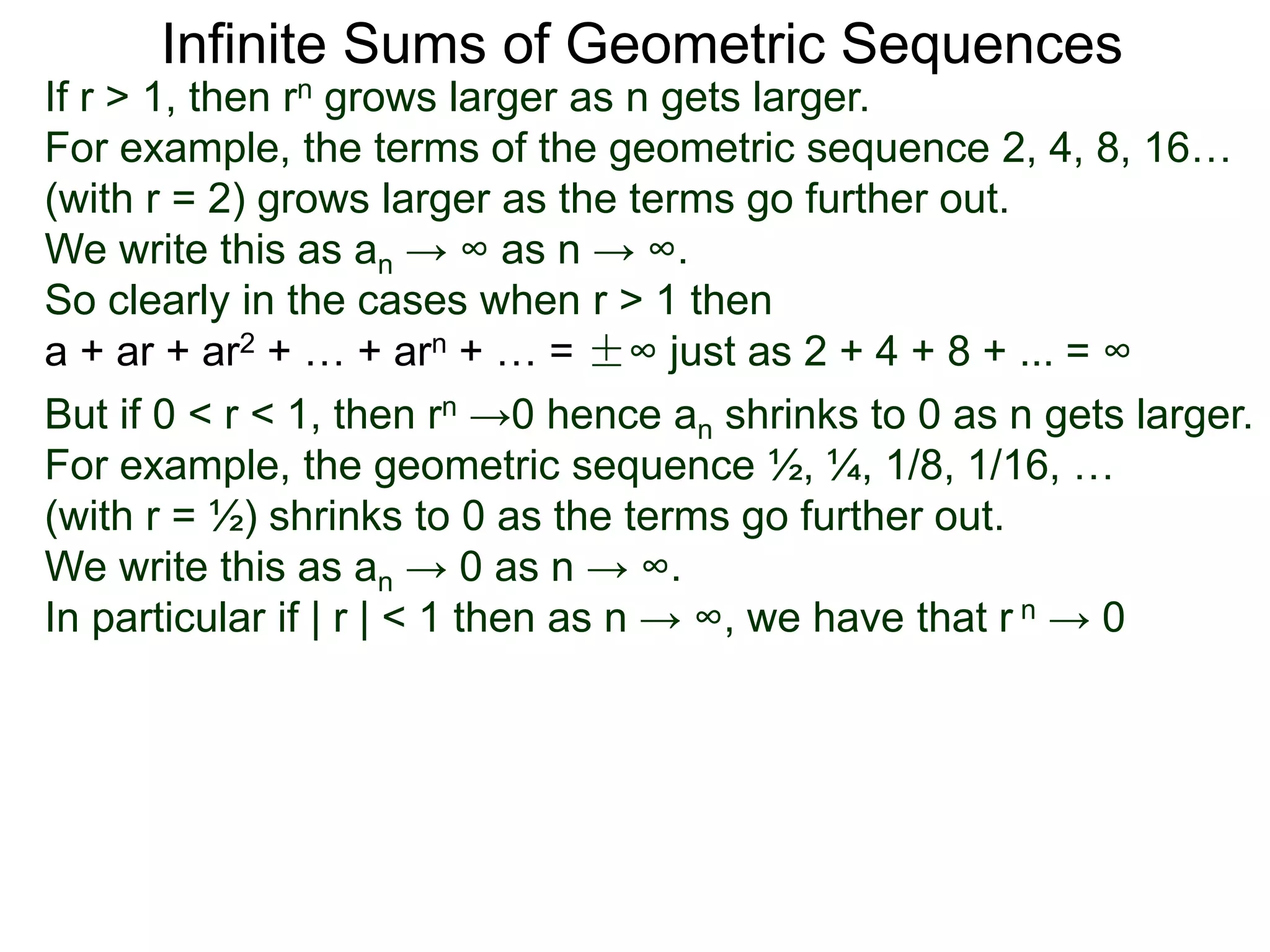
In particular if | r | < 1 then as n → ∞, we have that r n → 0
Infinite Sums of Geometric Sequences
If r > 1, then rn grows larger as n gets larger.
For example, the terms of the geometric sequence 2, 4, 8, 16…
(with r = 2) grows larger as the terms go further out.
We write this as an → ∞ as n → ∞.
So clearly in the cases when r > 1 then
a + ar + ar2 + … + arn + … = ±∞ just as 2 + 4 + 8 + ... = ∞
But if 0 < r < 1, then rn →0 hence an shrinks to 0 as n gets larger.
For example, the geometric sequence ½, ¼, 1/8, 1/16, …
(with r = ½) shrinks to 0 as the terms go further out.
We write this as an → 0 as n → ∞.
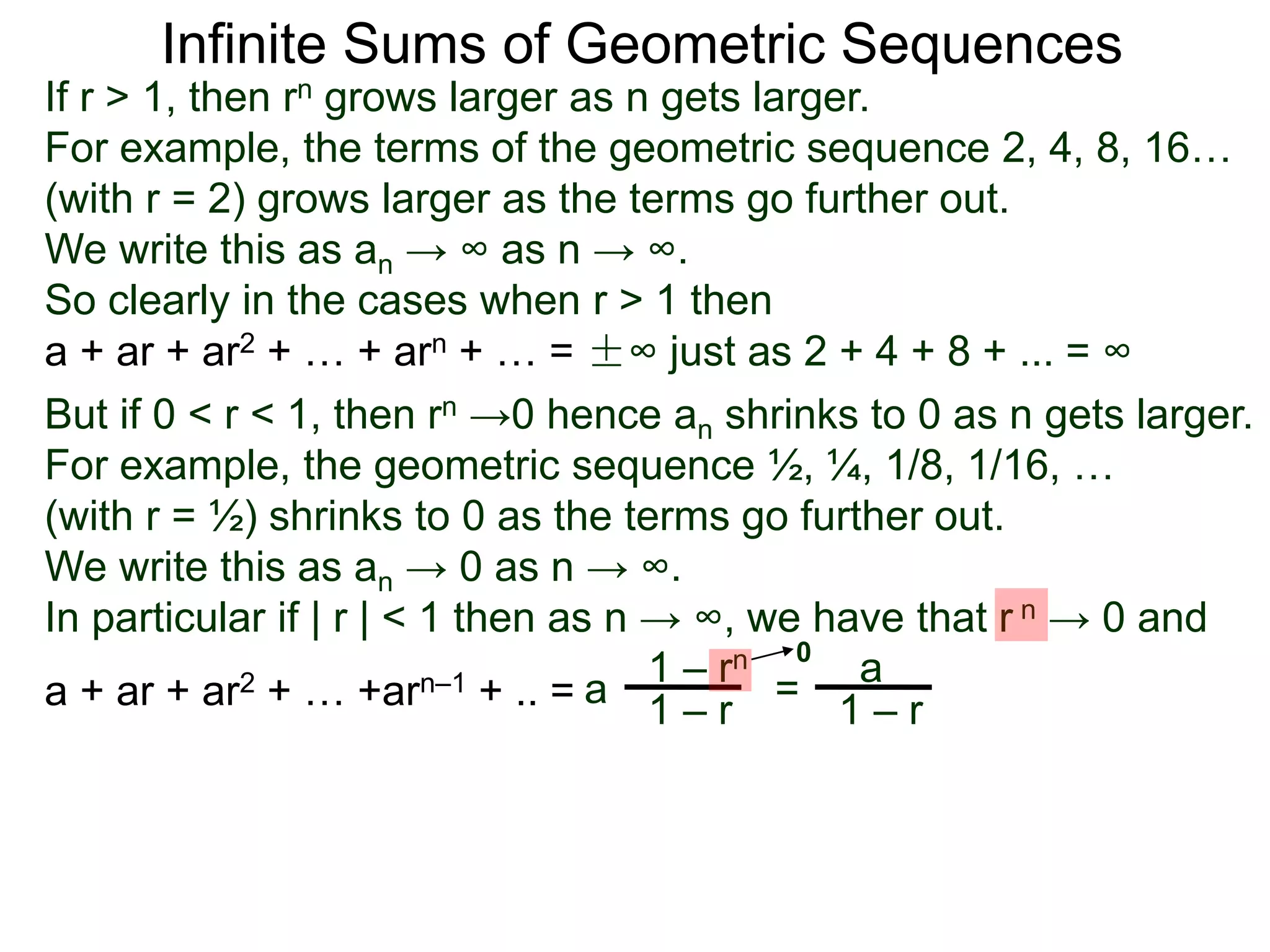
In particular if | r | < 1 then as n → ∞, we have that r n → 0 and
a
1 – rn
1 – ra + ar + ar2 + … +arn–1 + .. =
Infinite Sums of Geometric Sequences
If r > 1, then rn grows larger as n gets larger.
For example, the terms of the geometric sequence 2, 4, 8, 16…
(with r = 2) grows larger as the terms go further out.
We write this as an → ∞ as n → ∞.
So clearly in the cases when r > 1 then
a + ar + ar2 + … + arn + … = ±∞ just as 2 + 4 + 8 + ... = ∞
But if 0 < r < 1, then rn →0 hence an shrinks to 0 as n gets larger.
For example, the geometric sequence ½, ¼, 1/8, 1/16, …
(with r = ½) shrinks to 0 as the terms go further out.
We write this as an → 0 as n → ∞.
In particular if | r | < 1 then as n → ∞, we have that r n → 0 and
a
1 – rn
1 – ra + ar + ar2 + … +arn–1 + .. = =
a
1 – r
0
Infinite Sums of Geometric Sequences
If r > 1, then rn grows larger as n gets larger.
For example, the terms of the geometric sequence 2, 4, 8, 16…
(with r = 2) grows larger as the terms go further out.
We write this as an → ∞ as n → ∞.
So clearly in the cases when r > 1 then
The Sum of Infinitely–Many Terms of a Geometric Sequence
Given a geometric sequence a, ar, ar2 … with| r | < 1
a + ar + ar2 + … + arn + … = ±∞ just as 2 + 4 + 8 + ... = ∞
But if 0 < r < 1, then rn →0 hence an shrinks to 0 as n gets larger.
For example, the geometric sequence ½, ¼, 1/8, 1/16, …
(with r = ½) shrinks to 0 as the terms go further out.
We write this as an → 0 as n → ∞.
In particular if | r | < 1 then as n → ∞, we have that r n → 0 and
a
1 – rn
1 – ra + ar + ar2 + … +arn–1 + .. = =
a
1 – r
0
 a rn = a + ar + ar2 + … = a
1 – rn=0
∞
then
Geometric Sequences
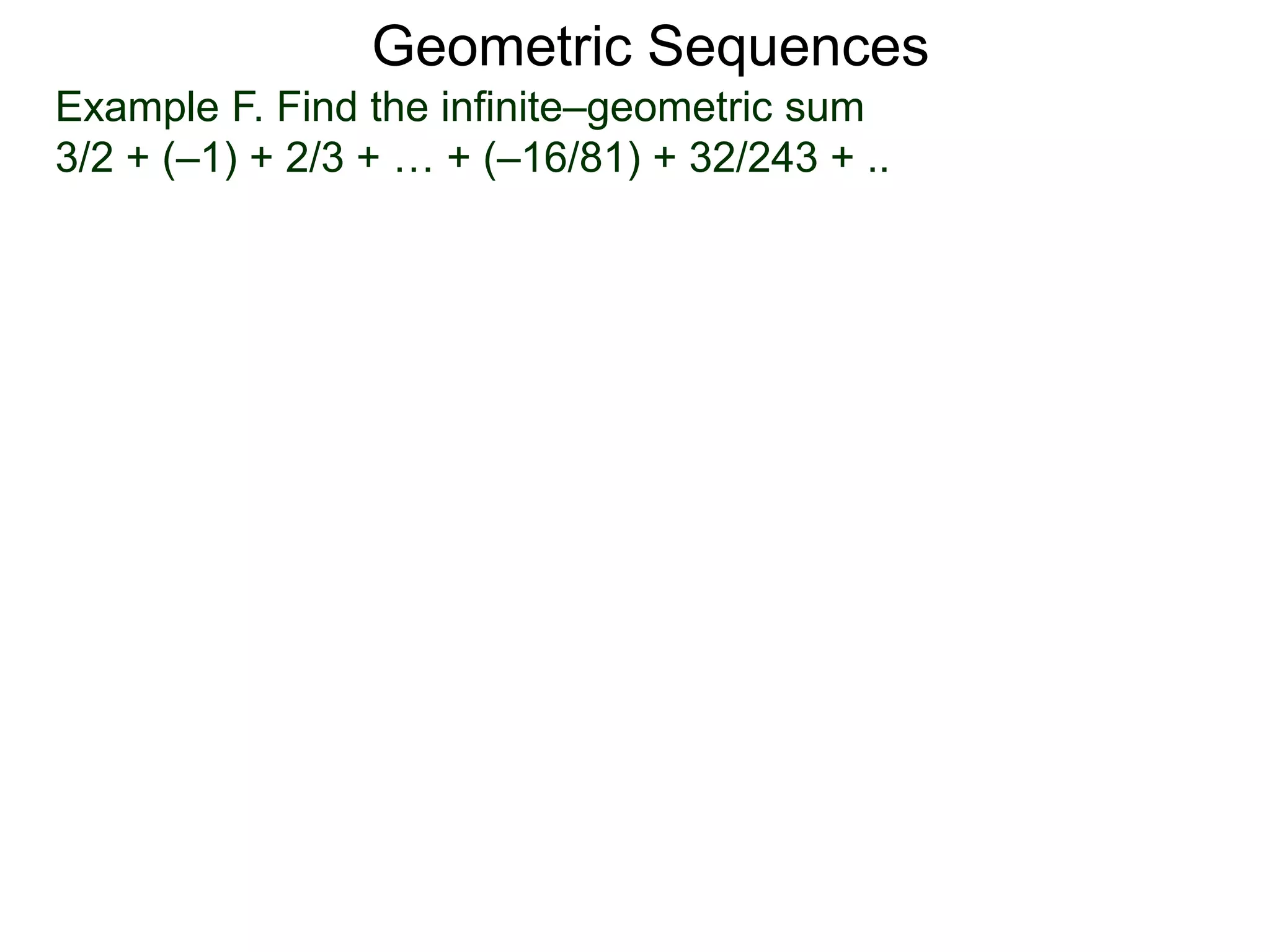
Example F. Find the infinite–geometric sum
3/2 + (–1) + 2/3 + … + (–16/81) + 32/243 + ..
Geometric Sequences
Example F. Find the infinite–geometric sum
3/2 + (–1) + 2/3 + … + (–16/81) + 32/243 + ..
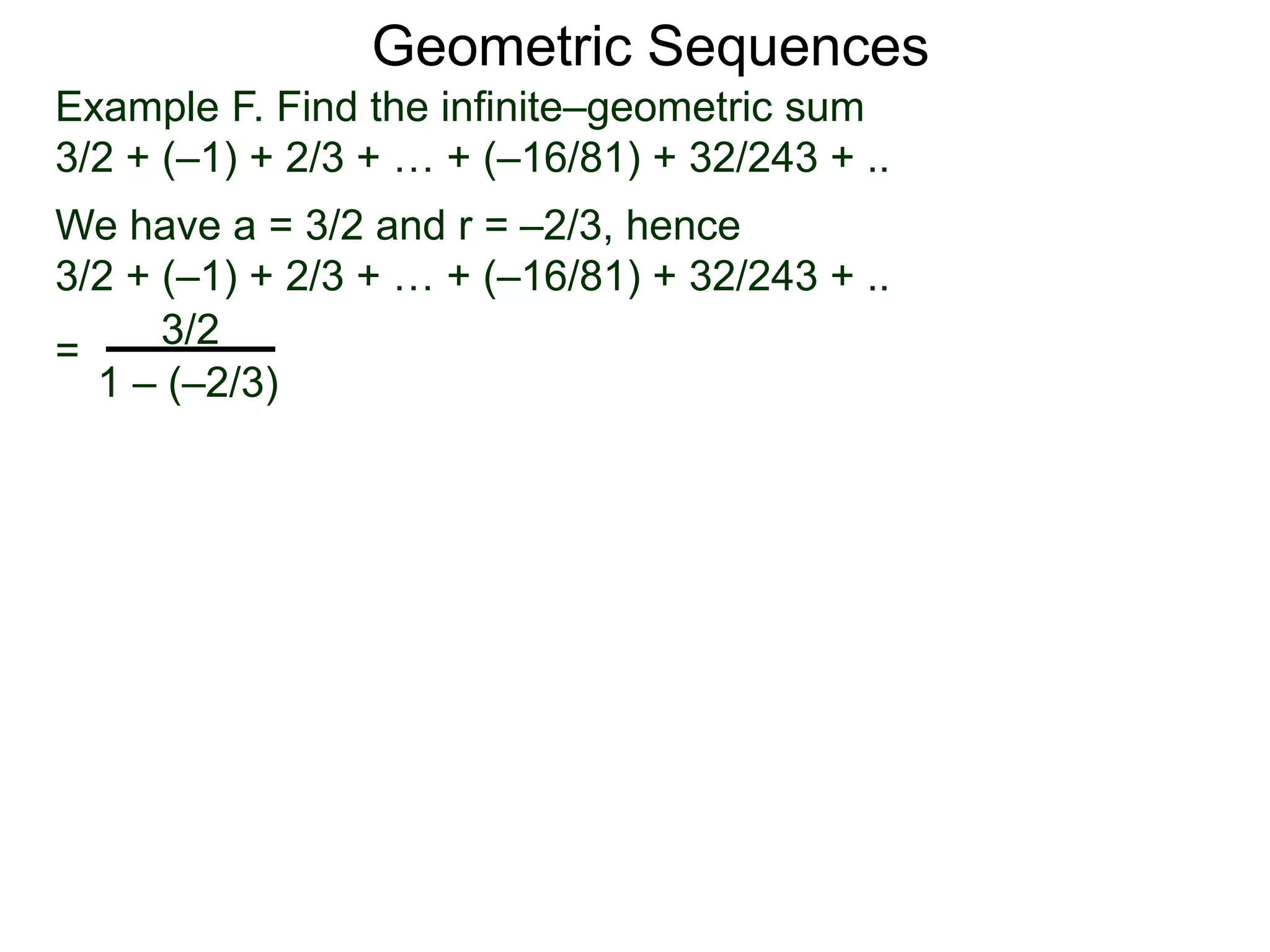
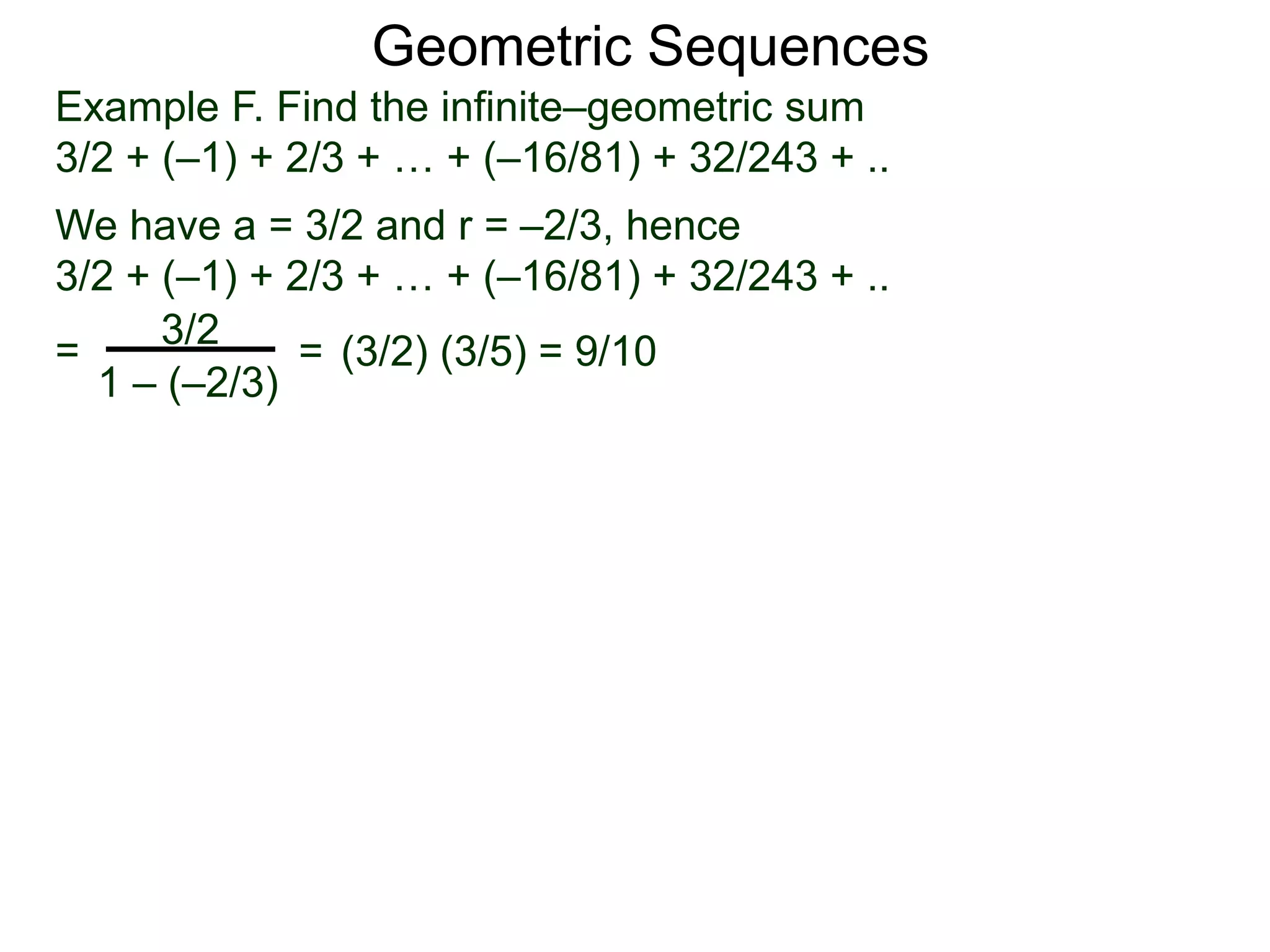
We have a = 3/2 and r = –2/3, hence
3/2 + (–1) + 2/3 + … + (–16/81) + 32/243 + ..
=
3/2
1 – (–2/3)
Geometric Sequences
Example F. Find the infinite–geometric sum
3/2 + (–1) + 2/3 + … + (–16/81) + 32/243 + ..
We have a = 3/2 and r = –2/3, hence
3/2 + (–1) + 2/3 + … + (–16/81) + 32/243 + ..
=
3/2
1 – (–2/3)
= (3/2) (3/5) = 9/10
Geometric Sequences
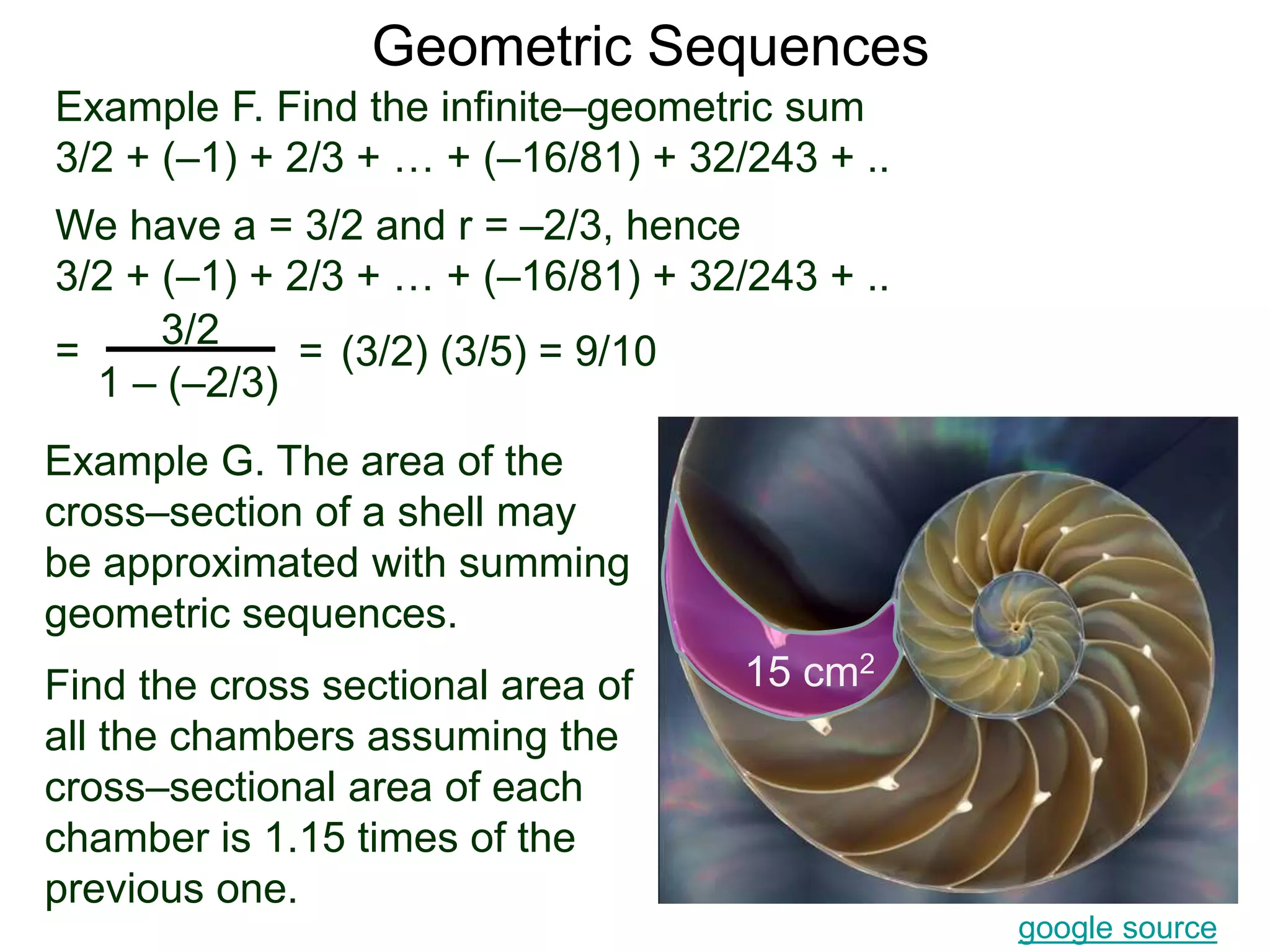
Example G. The area of the
cross–section of a shell may
be approximated with summing
geometric sequences.
Find the cross sectional area of
all the chambers assuming the
cross–sectional area of each
chamber is 1.15 times of the
previous one.
google source
15 cm2
Example F. Find the infinite–geometric sum
3/2 + (–1) + 2/3 + … + (–16/81) + 32/243 + ..
We have a = 3/2 and r = –2/3, hence
3/2 + (–1) + 2/3 + … + (–16/81) + 32/243 + ..
=
3/2
1 – (–2/3)
= (3/2) (3/5) = 9/10
Geometric Sequences
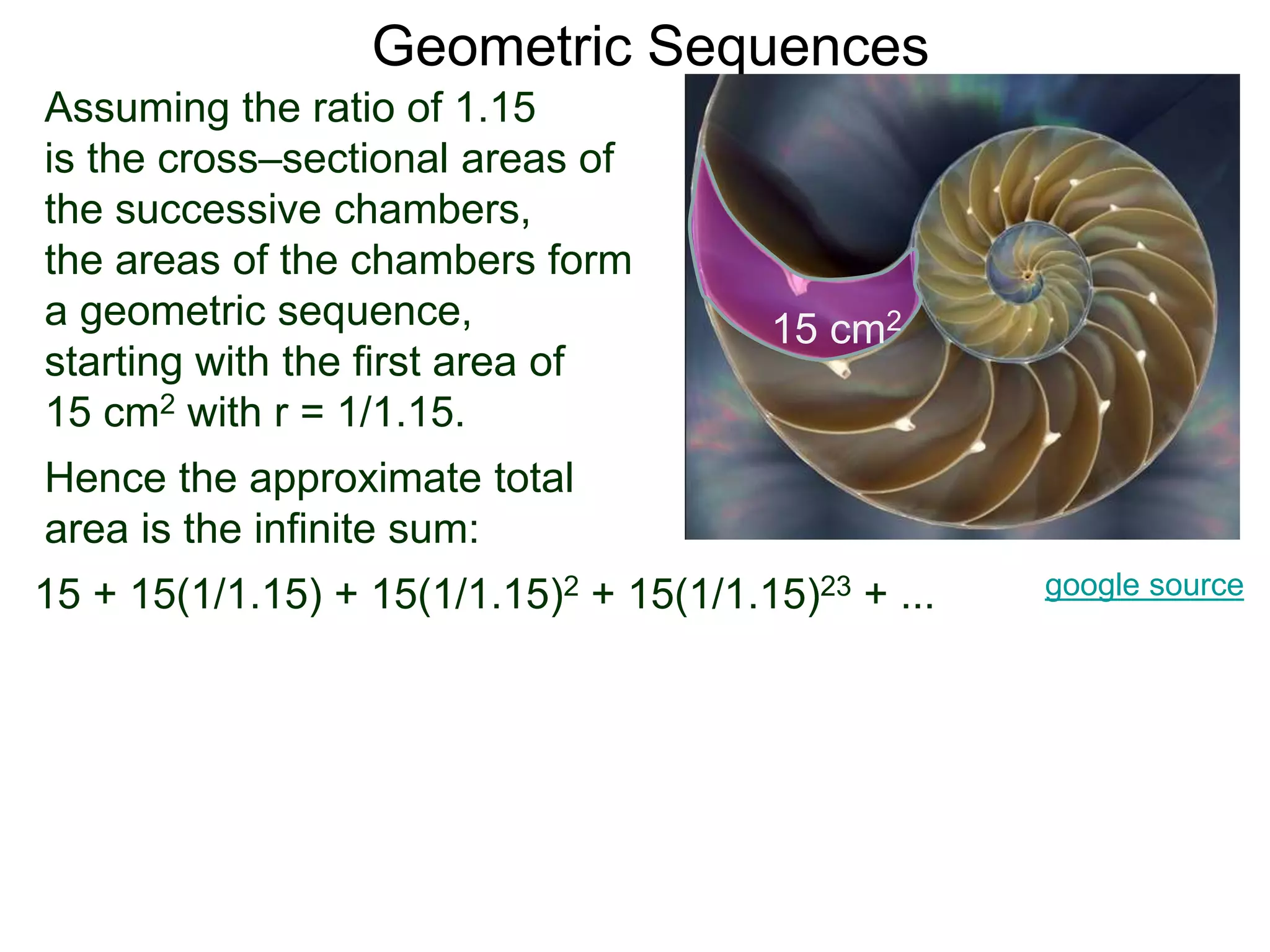
Assuming the ratio of 1.15
is the cross–sectional areas of
the successive chambers,
the areas of the chambers form
a geometric sequence,
starting with the first area of
15 cm2 with r = 1/1.15.
google source
15 cm2
Geometric Sequences
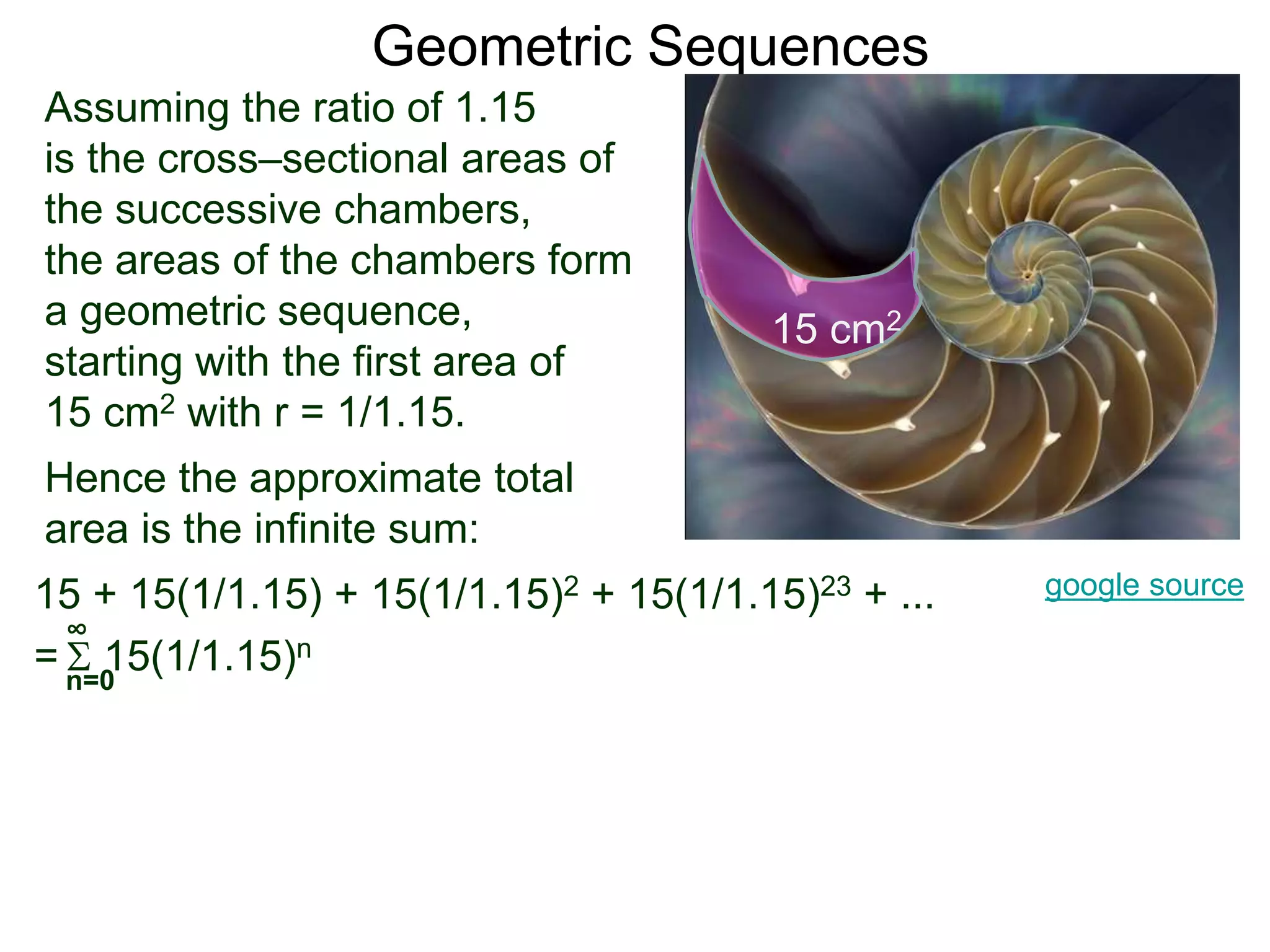
Assuming the ratio of 1.15
is the cross–sectional areas of
the successive chambers,
the areas of the chambers form
a geometric sequence,
starting with the first area of
15 cm2 with r = 1/1.15.
google source
15 cm2
15 + 15(1/1.15) + 15(1/1.15)2 + 15(1/1.15)23 + ...
Hence the approximate total
area is the infinite sum:
Geometric Sequences
Assuming the ratio of 1.15
is the cross–sectional areas of
the successive chambers,
the areas of the chambers form
a geometric sequence,
starting with the first area of
15 cm2 with r = 1/1.15.
google source
15 cm2
n=0
∞
15 + 15(1/1.15) + 15(1/1.15)2 + 15(1/1.15)23 + ...
=  15(1/1.15)n
Hence the approximate total
area is the infinite sum:
Geometric Sequences
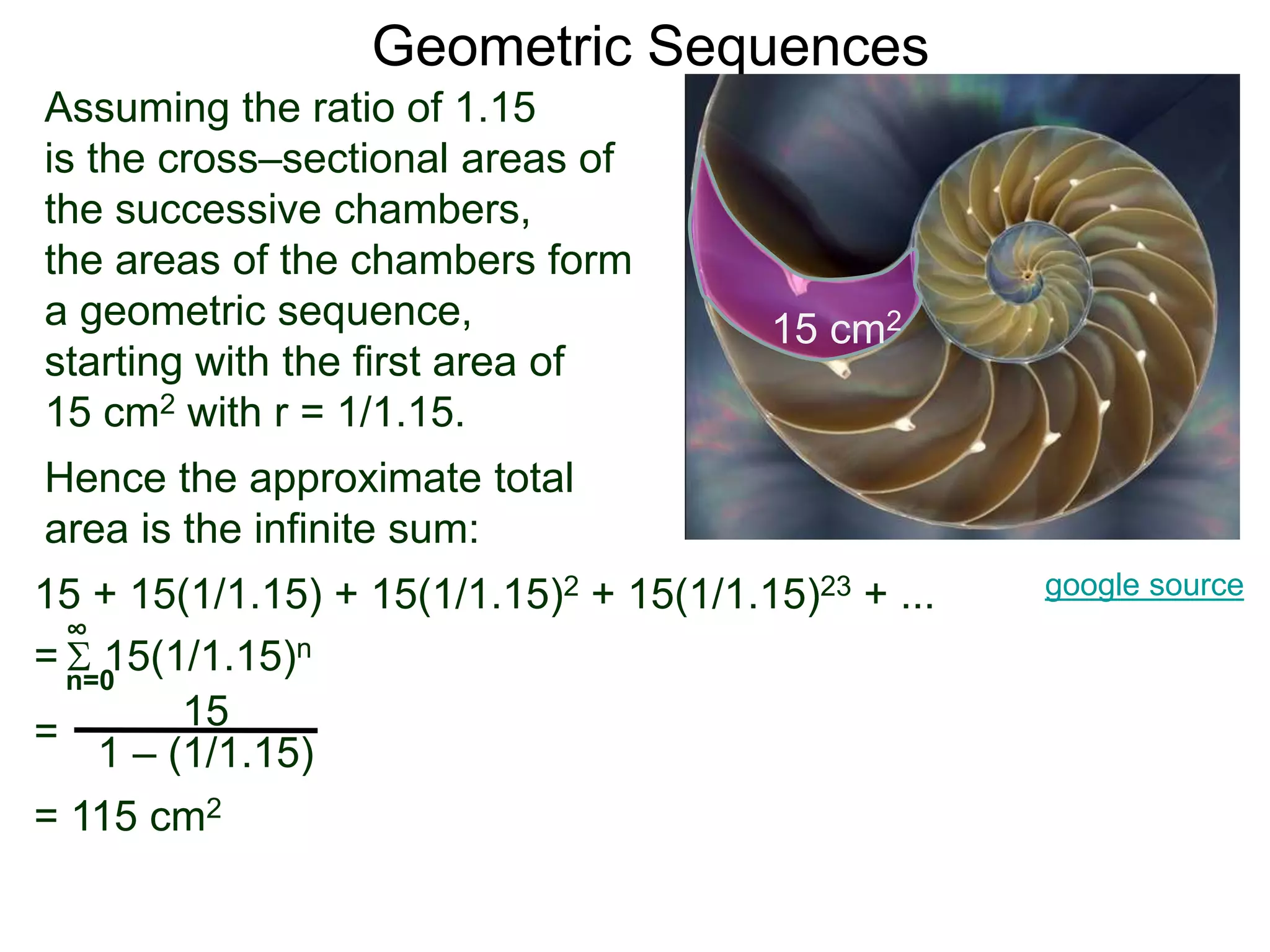
Assuming the ratio of 1.15
is the cross–sectional areas of
the successive chambers,
the areas of the chambers form
a geometric sequence,
starting with the first area of
15 cm2 with r = 1/1.15.
google source
15 cm2
Hence the approximate total
area is the infinite sum:
15
1 – (1/1.15)
n=0
∞
15 + 15(1/1.15) + 15(1/1.15)2 + 15(1/1.15)23 + ...
=  15(1/1.15)n
=
= 115 cm2
Geometric Sequences
HW.
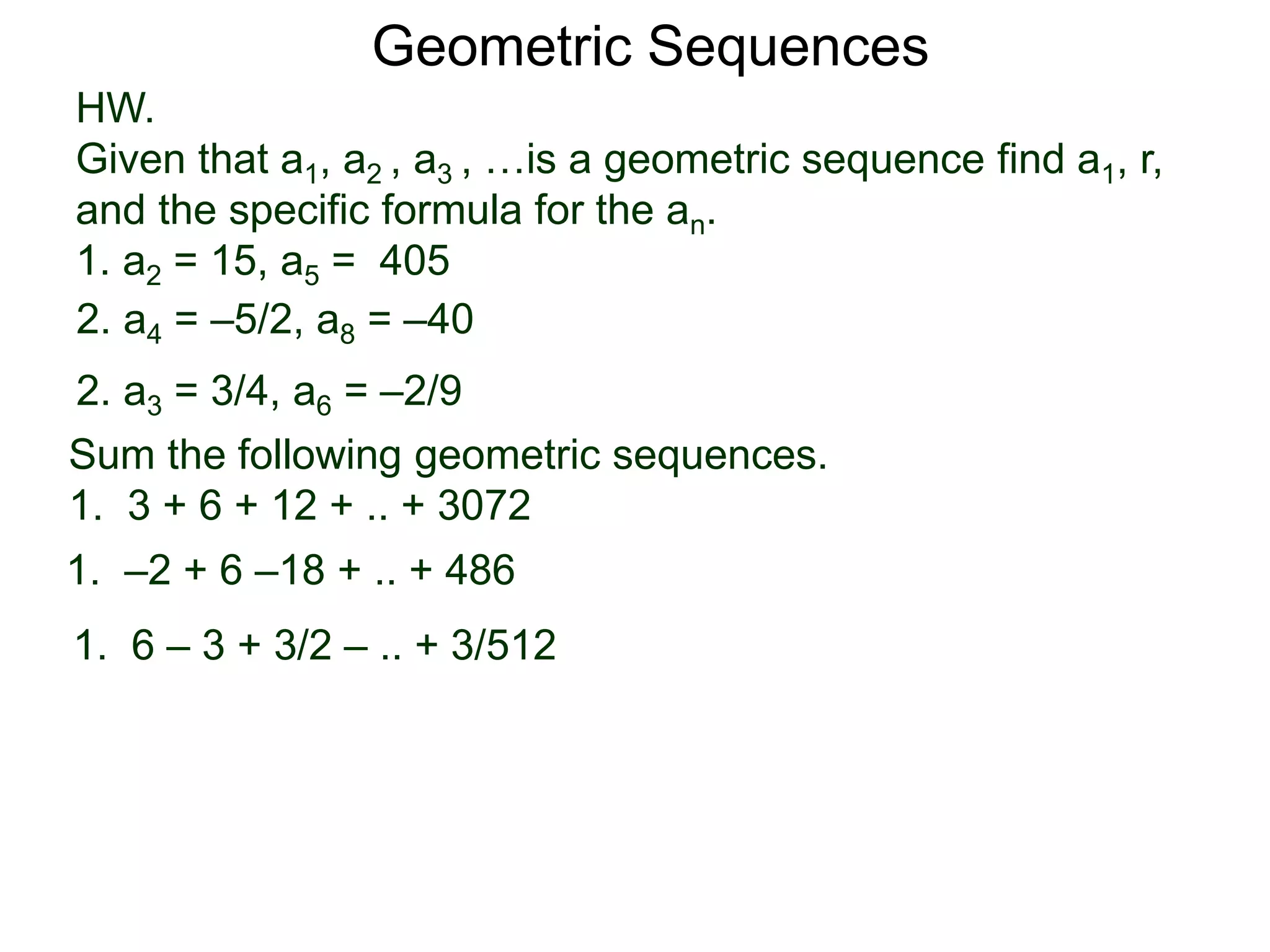
Given that a1, a2 , a3 , …is a geometric sequence find a1, r,
and the specific formula for the an.
1. a2 = 15, a5 = 405
2. a3 = 3/4, a6 = –2/9
2. a4 = –5/2, a8 = –40
Sum the following geometric sequences.
1. 3 + 6 + 12 + .. + 3072
1. –2 + 6 –18 + .. + 486
1. 6 – 3 + 3/2 – .. + 3/512

5.3 geometric sequences and sums

  • 1.
  • 2.
    A sequence a1,a2 , a3 , … is an geometric sequence if an = crn, i.e. it is defined by an exponential formula. Geometric Sequences
  • 3.
    Example A. Thesequence of powers of 2 a1= 2, a2= 4, a3= 8, a4= 16, … is an geometric sequence because an = 2n. A sequence a1, a2 , a3 , … is an geometric sequence if an = crn, i.e. it is defined by an exponential formula. Geometric Sequences
  • 4.
    Example A. Thesequence of powers of 2 a1= 2, a2= 4, a3= 8, a4= 16, … is an geometric sequence because an = 2n. Fact: If a1, a2 , a3 , …an = c*rn is a geometric sequence, then the ratio between any two consecutive terms is r. A sequence a1, a2 , a3 , … is an geometric sequence if an = crn, i.e. it is defined by an exponential formula. Geometric Sequences
  • 5.
    Example A. Thesequence of powers of 2 a1= 2, a2= 4, a3= 8, a4= 16, … is an geometric sequence because an = 2n. A sequence a1, a2 , a3 , … is an geometric sequence if an = crn, i.e. it is defined by an exponential formula. Geometric Sequences The converse of this fact is also true. Fact: If a1, a2 , a3 , …an = c*rn is a geometric sequence, then the ratio between any two consecutive terms is r.
  • 6.
    Example A. Thesequence of powers of 2 a1= 2, a2= 4, a3= 8, a4= 16, … is an geometric sequence because an = 2n. A sequence a1, a2 , a3 , … is an geometric sequence if an = crn, i.e. it is defined by an exponential formula. Geometric Sequences The converse of this fact is also true. Below is the formula that we used for working with geometric sequences. Fact: If a1, a2 , a3 , …an = c*rn is a geometric sequence, then the ratio between any two consecutive terms is r.
  • 7.
    Example A. Thesequence of powers of 2 a1= 2, a2= 4, a3= 8, a4= 16, … is an geometric sequence because an = 2n. A sequence a1, a2 , a3 , … is an geometric sequence if an = crn, i.e. it is defined by an exponential formula. Geometric Sequences The converse of this fact is also true. Below is the formula that we used for working with geometric sequences. For example, from the sequence above we see that 16/8 = 8/4 = 4/2 = 2 = the ratio r Fact: If a1, a2 , a3 , …an = c*rn is a geometric sequence, then the ratio between any two consecutive terms is r.
  • 8.
    Example A. Thesequence of powers of 2 a1= 2, a2= 4, a3= 8, a4= 16, … is an geometric sequence because an = 2n. A sequence a1, a2 , a3 , … is an geometric sequence if an = crn, i.e. it is defined by an exponential formula. Geometric Sequences Theorem: If a1, a2 , a3 , …an is a sequence such that an+1 / an = r for all n, then a1, a2, a3,… is an geometric sequence and an = a1*rn–1. The converse of this fact is also true. Below is the formula that we used for working with geometric sequences. For example, from the sequence above we see that 16/8 = 8/4 = 4/2 = 2 = the ratio r Fact: If a1, a2 , a3 , …an = c*rn is a geometric sequence, then the ratio between any two consecutive terms is r.
  • 9.
    Example A. Thesequence of powers of 2 a1= 2, a2= 4, a3= 8, a4= 16, … is an geometric sequence because an = 2n. A sequence a1, a2 , a3 , … is an geometric sequence if an = crn, i.e. it is defined by an exponential formula. Geometric Sequences Theorem: If a1, a2 , a3 , …an is a sequence such that an+1 / an = r for all n, then a1, a2, a3,… is an geometric sequence and an = a1*rn–1. This is the general formula for geometric sequences. The converse of this fact is also true. Below is the formula that we used for working with geometric sequences. For example, from the sequence above we see that 16/8 = 8/4 = 4/2 = 2 = the ratio r Fact: If a1, a2 , a3 , …an = c*rn is a geometric sequence, then the ratio between any two consecutive terms is r.
  • 10.
    Geometric Sequences Given thedescription of a geometric sequence, we use the general formula to find the specific formula for that sequence.
  • 11.
    Example A. Thesequence 2, 6, 18, 54, … is an geometric sequence because 6/2 = 18/6 Geometric Sequences Given the description of a geometric sequence, we use the general formula to find the specific formula for that sequence.
  • 12.
    Example A. Thesequence 2, 6, 18, 54, … is an geometric sequence because 6/2 = 18/6 = 54/18 Geometric Sequences Given the description of a geometric sequence, we use the general formula to find the specific formula for that sequence.
  • 13.
    Example A. Thesequence 2, 6, 18, 54, … is an geometric sequence because 6/2 = 18/6 = 54/18 = … = 3 = r. Geometric Sequences Given the description of a geometric sequence, we use the general formula to find the specific formula for that sequence.
  • 14.
    Example A. Thesequence 2, 6, 18, 54, … is an geometric sequence because 6/2 = 18/6 = 54/18 = … = 3 = r. Since a1 = 2, set them in the general formula of the geometric sequences an = a1r n – 1 Geometric Sequences Given the description of a geometric sequence, we use the general formula to find the specific formula for that sequence.
  • 15.
    Example A. Thesequence 2, 6, 18, 54, … is an geometric sequence because 6/2 = 18/6 = 54/18 = … = 3 = r. Since a1 = 2, set them in the general formula of the geometric sequences an = a1r n – 1 , we get the specific formula for this sequence an = 2(3n – 1). Geometric Sequences Given the description of a geometric sequence, we use the general formula to find the specific formula for that sequence.
  • 16.
    Example A. Thesequence 2, 6, 18, 54, … is an geometric sequence because 6/2 = 18/6 = 54/18 = … = 3 = r. Since a1 = 2, set them in the general formula of the geometric sequences an = a1r n – 1 , we get the specific formula for this sequence an = 2(3n – 1). Geometric Sequences If a1, a2 , a3 , …an is a geometric sequence such that the terms alternate between positive and negative signs, then r is negative. Given the description of a geometric sequence, we use the general formula to find the specific formula for that sequence.
  • 17.
    Example A. Thesequence 2, 6, 18, 54, … is an geometric sequence because 6/2 = 18/6 = 54/18 = … = 3 = r. Since a1 = 2, set them in the general formula of the geometric sequences an = a1r n – 1 , we get the specific formula for this sequence an = 2(3n – 1). Geometric Sequences If a1, a2 , a3 , …an is a geometric sequence such that the terms alternate between positive and negative signs, then r is negative. Example B. The sequence 2/3, –1, 3/2, –9/4, … is a geometric sequence because –1/(2/3) = (3/2) / (–1) Given the description of a geometric sequence, we use the general formula to find the specific formula for that sequence.
  • 18.
    Example A. Thesequence 2, 6, 18, 54, … is an geometric sequence because 6/2 = 18/6 = 54/18 = … = 3 = r. Since a1 = 2, set them in the general formula of the geometric sequences an = a1r n – 1 , we get the specific formula for this sequence an = 2(3n – 1). Geometric Sequences If a1, a2 , a3 , …an is a geometric sequence such that the terms alternate between positive and negative signs, then r is negative. Example B. The sequence 2/3, –1, 3/2, –9/4, … is a geometric sequence because –1/(2/3) = (3/2) / (–1) = (–9/4) /(3/2) Given the description of a geometric sequence, we use the general formula to find the specific formula for that sequence.
  • 19.
    Example A. Thesequence 2, 6, 18, 54, … is an geometric sequence because 6/2 = 18/6 = 54/18 = … = 3 = r. Since a1 = 2, set them in the general formula of the geometric sequences an = a1r n – 1 , we get the specific formula for this sequence an = 2(3n – 1). Geometric Sequences If a1, a2 , a3 , …an is a geometric sequence such that the terms alternate between positive and negative signs, then r is negative. Example B. The sequence 2/3, –1, 3/2, –9/4, … is a geometric sequence because –1/(2/3) = (3/2) / (–1) = (–9/4) /(3/2) = … = –3/2 = r. Given the description of a geometric sequence, we use the general formula to find the specific formula for that sequence.
  • 20.
    Example A. Thesequence 2, 6, 18, 54, … is an geometric sequence because 6/2 = 18/6 = 54/18 = … = 3 = r. Since a1 = 2, set them in the general formula of the geometric sequences an = a1r n – 1 , we get the specific formula for this sequence an = 2(3n – 1). Geometric Sequences If a1, a2 , a3 , …an is a geometric sequence such that the terms alternate between positive and negative signs, then r is negative. Example B. The sequence 2/3, –1, 3/2, –9/4, … is a geometric sequence because –1/(2/3) = (3/2) / (–1) = (–9/4) /(3/2) = … = –3/2 = r. Since a1 = 2/3, the specific formula is an = ( )n–12 3 2 –3 Given the description of a geometric sequence, we use the general formula to find the specific formula for that sequence.
  • 21.
    Geometric Sequences To usethe geometric general formula to find the specific formula, we need the first term a1 and the ratio r.
  • 22.
    Example C. Giventhat a1, a2 , a3 , …is a geometric sequence with r = –2 and a5 = 12, Geometric Sequences To use the geometric general formula to find the specific formula, we need the first term a1 and the ratio r.
  • 23.
    Example C. Giventhat a1, a2 , a3 , …is a geometric sequence with r = –2 and a5 = 12, a. find a1 Geometric Sequences To use the geometric general formula to find the specific formula, we need the first term a1 and the ratio r.
  • 24.
    Example C. Giventhat a1, a2 , a3 , …is a geometric sequence with r = –2 and a5 = 12, a. find a1 By that the general geometric formula an = a1r n – 1, we get a5 = a1(–2)(5 – 1) Geometric Sequences To use the geometric general formula to find the specific formula, we need the first term a1 and the ratio r.
  • 25.
    Example C. Giventhat a1, a2 , a3 , …is a geometric sequence with r = –2 and a5 = 12, a. find a1 By that the general geometric formula an = a1r n – 1, we get a5 = a1(–2)(5 – 1) = 12 Geometric Sequences To use the geometric general formula to find the specific formula, we need the first term a1 and the ratio r.
  • 26.
    Example C. Giventhat a1, a2 , a3 , …is a geometric sequence with r = –2 and a5 = 12, a. find a1 By that the general geometric formula an = a1r n – 1, we get a5 = a1(–2)(5 – 1) = 12 a1(–2)4 = 12 Geometric Sequences To use the geometric general formula to find the specific formula, we need the first term a1 and the ratio r.
  • 27.
    Example C. Giventhat a1, a2 , a3 , …is a geometric sequence with r = –2 and a5 = 12, a. find a1 By that the general geometric formula an = a1r n – 1, we get a5 = a1(–2)(5 – 1) = 12 a1(–2)4 = 12 16a1 = 12 Geometric Sequences To use the geometric general formula to find the specific formula, we need the first term a1 and the ratio r.
  • 28.
    Example C. Giventhat a1, a2 , a3 , …is a geometric sequence with r = –2 and a5 = 12, a. find a1 By that the general geometric formula an = a1r n – 1, we get a5 = a1(–2)(5 – 1) = 12 a1(–2)4 = 12 16a1 = 12 a1 = 12/16 = ¾ Geometric Sequences To use the geometric general formula to find the specific formula, we need the first term a1 and the ratio r.
  • 29.
    Example C. Giventhat a1, a2 , a3 , …is a geometric sequence with r = –2 and a5 = 12, a. find a1 By that the general geometric formula an = a1r n – 1, we get a5 = a1(–2)(5 – 1) = 12 a1(–2)4 = 12 16a1 = 12 a1 = 12/16 = ¾ Geometric Sequences To use the geometric general formula to find the specific formula, we need the first term a1 and the ratio r. b. find the specific equation.
  • 30.
    Example C. Giventhat a1, a2 , a3 , …is a geometric sequence with r = –2 and a5 = 12, a. find a1 By that the general geometric formula an = a1r n – 1, we get a5 = a1(–2)(5 – 1) = 12 a1(–2)4 = 12 16a1 = 12 a1 = 12/16 = ¾ Geometric Sequences To use the geometric general formula to find the specific formula, we need the first term a1 and the ratio r. b. find the specific equation. Set a1 = ¾ and r = –2 into the general formula an = a1rn – 1 ,
  • 31.
    Example C. Giventhat a1, a2 , a3 , …is a geometric sequence with r = –2 and a5 = 12, a. find a1 By that the general geometric formula an = a1r n – 1, we get a5 = a1(–2)(5 – 1) = 12 a1(–2)4 = 12 16a1 = 12 a1 = 12/16 = ¾ 3 4 an= (–2)n–1 Geometric Sequences To use the geometric general formula to find the specific formula, we need the first term a1 and the ratio r. b. find the specific equation. Set a1 = ¾ and r = –2 into the general formula an = a1rn – 1 , we get the specific formula of this sequence
  • 32.
  • 33.
    C. Find a9. GeometricSequences 3 4 Since an= (–2)n–1,
  • 34.
    set n =9, we get C. Find a9. 3 4 a9= (–2)9–1 Geometric Sequences 3 4 Since an= (–2)n–1,
  • 35.
    set n =9, we get C. Find a9. 3 4 a9= (–2)9–1 a9 = (–2)83 4 Geometric Sequences 3 4 Since an= (–2)n–1,
  • 36.
    set n =9, we get C. Find a9. 3 4 a9= (–2)9–1 a9 = (–2)8 = (256) = 192 3 4 Geometric Sequences 3 4 Since an= (–2)n–1, 3 4
  • 37.
    set n =9, we get C. Find a9. 3 4 a9= (–2)9–1 a9 = (–2)8 = (256) = 192 3 4 Geometric Sequences 3 4 Since an= (–2)n–1, 3 4 Example D. Given that a1, a2 , a3 , …is an geometric sequence with a3 = –2 and a6 = 54, a. find r and a1
  • 38.
    set n =9, we get C. Find a9. 3 4 a9= (–2)9–1 a9 = (–2)8 = (256) = 192 3 4 Geometric Sequences 3 4 Since an= (–2)n–1, 3 4 Example D. Given that a1, a2 , a3 , …is an geometric sequence with a3 = –2 and a6 = 54, a. find r and a1 Given that the general geometric formula an = a1rn – 1, we have a3 = –2 = a1r3–1
  • 39.
    set n =9, we get C. Find a9. 3 4 a9= (–2)9–1 a9 = (–2)8 = (256) = 192 3 4 Geometric Sequences 3 4 Since an= (–2)n–1, 3 4 Example D. Given that a1, a2 , a3 , …is an geometric sequence with a3 = –2 and a6 = 54, a. find r and a1 Given that the general geometric formula an = a1rn – 1, we have a3 = –2 = a1r3–1 and a6 = 54 = a1r6–1
  • 40.
    set n =9, we get C. Find a9. 3 4 a9= (–2)9–1 a9 = (–2)8 = (256) = 192 3 4 Geometric Sequences 3 4 Since an= (–2)n–1, 3 4 Example D. Given that a1, a2 , a3 , …is an geometric sequence with a3 = –2 and a6 = 54, a. find r and a1 Given that the general geometric formula an = a1rn – 1, we have a3 = –2 = a1r3–1 and a6 = 54 = a1r6–1 –2 = a1r2
  • 41.
    set n =9, we get C. Find a9. 3 4 a9= (–2)9–1 a9 = (–2)8 = (256) = 192 3 4 Geometric Sequences 3 4 Since an= (–2)n–1, 3 4 Example D. Given that a1, a2 , a3 , …is an geometric sequence with a3 = –2 and a6 = 54, a. find r and a1 Given that the general geometric formula an = a1rn – 1, we have a3 = –2 = a1r3–1 and a6 = 54 = a1r6–1 –2 = a1r2 54 = a1r5
  • 42.
    set n =9, we get C. Find a9. 3 4 a9= (–2)9–1 a9 = (–2)8 = (256) = 192 3 4 Geometric Sequences 3 4 Since an= (–2)n–1, 3 4 Example D. Given that a1, a2 , a3 , …is an geometric sequence with a3 = –2 and a6 = 54, a. find r and a1 Given that the general geometric formula an = a1rn – 1, we have a3 = –2 = a1r3–1 and a6 = 54 = a1r6–1 –2 = a1r2 54 = a1r5 Divide these equations: 54 –2 = a1r5 a1r2
  • 43.
  • 44.
  • 45.
  • 46.
  • 47.
  • 48.
    54 –2 = a1r5 a1r2 –27 3 = 5–2 –27= r3 –3 = r Geometric Sequences
  • 49.
    54 –2 = a1r5 a1r2 –27 3 = 5–2 –27= r3 –3 = r Put r = –3 into the equation –2 = a1r2 Geometric Sequences
  • 50.
    54 –2 = a1r5 a1r2 –27 3 = 5–2 –27= r3 –3 = r Put r = –3 into the equation –2 = a1r2 Hence –2 = a1(–3)2 Geometric Sequences
  • 51.
    54 –2 = a1r5 a1r2 –27 3 = 5–2 –27= r3 –3 = r Put r = –3 into the equation –2 = a1r2 Hence –2 = a1(–3)2 –2 = a19 Geometric Sequences
  • 52.
    54 –2 = a1r5 a1r2 –27 3 = 5–2 –27= r3 –3 = r Put r = –3 into the equation –2 = a1r2 Hence –2 = a1(–3)2 –2 = a19 –2/9 = a1 Geometric Sequences
  • 53.
    54 –2 = a1r5 a1r2 –27 3 = 5–2 –27= r3 –3 = r Put r = –3 into the equation –2 = a1r2 Hence –2 = a1(–3)2 –2 = a19 –2/9 = a1 Geometric Sequences b. Find the specific formula and a2
  • 54.
    54 –2 = a1r5 a1r2 –27 3 = 5–2 –27= r3 –3 = r Put r = –3 into the equation –2 = a1r2 Hence –2 = a1(–3)2 –2 = a19 –2/9 = a1 Geometric Sequences b. Find the specific formula and a2 Use the general geometric formula an = a1rn – 1, set a1 = –2/9, and r = –3
  • 55.
    54 –2 = a1r5 a1r2 –27 3 = 5–2 –27= r3 –3 = r Put r = –3 into the equation –2 = a1r2 Hence –2 = a1(–3)2 –2 = a19 –2/9 = a1 Geometric Sequences b. Find the specific formula and a2 Use the general geometric formula an = a1rn – 1, set a1 = –2/9, and r = –3 we have the specific formula –2 9 an = (–3)n–1
  • 56.
    54 –2 = a1r5 a1r2 –27 3 = 5–2 –27= r3 –3 = r Put r = –3 into the equation –2 = a1r2 Hence –2 = a1(–3)2 –2 = a19 –2/9 = a1 Geometric Sequences b. Find the specific formula and a2 Use the general geometric formula an = a1rn – 1, set a1 = –2/9, and r = –3 we have the specific formula –2 9 an = (–3)n–1 –2 9 (–3) 2–1 To find a2, set n = 2, we get a2 =
  • 57.
    54 –2 = a1r5 a1r2 –27 3 = 5–2 –27= r3 –3 = r Put r = –3 into the equation –2 = a1r2 Hence –2 = a1(–3)2 –2 = a19 –2/9 = a1 Geometric Sequences b. Find the specific formula and a2 Use the general geometric formula an = a1rn – 1, set a1 = –2/9, and r = –3 we have the specific formula –2 9 an = (–3)n–1 –2 9 (–3) 2–1 To find a2, set n = 2, we get –2 9 a2 = 3 2 3= (–3) =
  • 58.
    Geometric Sequences Sum ofgeometric sequences
  • 59.
    We observe thealgebraic patterns: (1 – r)(1 + r) = 1 – r2 Geometric Sequences Sum of geometric sequences
  • 60.
    We observe thealgebraic patterns: (1 – r)(1 + r) = 1 – r2 (1 – r)(1 + r + r2) = 1 – r3 Geometric Sequences Sum of geometric sequences
  • 61.
    We observe thealgebraic patterns: (1 – r)(1 + r) = 1 – r2 (1 – r)(1 + r + r2) = 1 – r3 (1 – r)(1 + r + r2 + r3) = 1 – r4 Geometric Sequences Sum of geometric sequences
  • 62.
    We observe thealgebraic patterns: (1 – r)(1 + r) = 1 – r2 (1 – r)(1 + r + r2) = 1 – r3 (1 – r)(1 + r + r2 + r3) = 1 – r4 (1 – r)(1 + r + r2 + r3 + r4) = 1 – r5 Geometric Sequences Sum of geometric sequences
  • 63.
    We observe thealgebraic patterns: (1 – r)(1 + r) = 1 – r2 (1 – r)(1 + r + r2) = 1 – r3 (1 – r)(1 + r + r2 + r3) = 1 – r4 (1 – r)(1 + r + r2 + r3 + r4) = 1 – r5 ... … (1 – r)(1 + r + r2 … + rn–1) = 1 – rn Geometric Sequences Sum of geometric sequences
  • 64.
    We observe thealgebraic patterns: (1 – r)(1 + r) = 1 – r2 (1 – r)(1 + r + r2) = 1 – r3 (1 – r)(1 + r + r2 + r3) = 1 – r4 (1 – r)(1 + r + r2 + r3 + r4) = 1 – r5 ... … (1 – r)(1 + r + r2 … + rn–1) = 1 – rn Hence 1 + r + r2 + … + rn–1 = 1 – rn 1 – r Geometric Sequences Sum of geometric sequences
  • 65.
    We observe thealgebraic patterns: (1 – r)(1 + r) = 1 – r2 (1 – r)(1 + r + r2) = 1 – r3 (1 – r)(1 + r + r2 + r3) = 1 – r4 (1 – r)(1 + r + r2 + r3 + r4) = 1 – r5 ... … (1 – r)(1 + r + r2 … + rn–1) = 1 – rn Hence 1 + r + r2 + … + rn–1 = 1 – rn 1 – r Geometric Sequences Sum of geometric sequences Therefore a + ar + ar2 + … +arn–1 n terms
  • 66.
    We observe thealgebraic patterns: (1 – r)(1 + r) = 1 – r2 (1 – r)(1 + r + r2) = 1 – r3 (1 – r)(1 + r + r2 + r3) = 1 – r4 (1 – r)(1 + r + r2 + r3 + r4) = 1 – r5 ... … (1 – r)(1 + r + r2 … + rn–1) = 1 – rn Hence 1 + r + r2 + … + rn–1 = 1 – rn 1 – r Geometric Sequences Sum of geometric sequences Therefore a + ar + ar2 + … +arn–1 = a (1 + r + r2 + … + r n–1) n terms
  • 67.
    We observe thealgebraic patterns: (1 – r)(1 + r) = 1 – r2 (1 – r)(1 + r + r2) = 1 – r3 (1 – r)(1 + r + r2 + r3) = 1 – r4 (1 – r)(1 + r + r2 + r3 + r4) = 1 – r5 ... … (1 – r)(1 + r + r2 … + rn–1) = 1 – rn Hence 1 + r + r2 + … + rn–1 = 1 – rn 1 – r Geometric Sequences Sum of geometric sequences a 1 – rn 1 – r Therefore a + ar + ar2 + … +arn–1 = a (1 + r + r2 + … + r n–1) n terms =
  • 68.
    Geometric Sequences = a 1– rn 1 – r The Sum of the First n Terms of a Geometric Sequence a + ar + ar2 + … +arn–1
  • 69.
    Geometric Sequences Example E.Find the geometric sum : 2/3 + (–1) + 3/2 + … + (–81/16) = a 1 – rn 1 – r The Sum of the First n Terms of a Geometric Sequence a + ar + ar2 + … +arn–1
  • 70.
    Geometric Sequences Example E.Find the geometric sum : 2/3 + (–1) + 3/2 + … + (–81/16) We have a = 2/3 and r = –3/2, = a 1 – rn 1 – r The Sum of the First n Terms of a Geometric Sequence a + ar + ar2 + … +arn–1
  • 71.
    Geometric Sequences Example E.Find the geometric sum : 2/3 + (–1) + 3/2 + … + (–81/16) We have a = 2/3 and r = –3/2, and an = –81/16. = a 1 – rn 1 – r The Sum of the First n Terms of a Geometric Sequence a + ar + ar2 + … +arn–1
  • 72.
    Geometric Sequences Example E.Find the geometric sum : 2/3 + (–1) + 3/2 + … + (–81/16) We have a = 2/3 and r = –3/2, and an = –81/16. We need the number of terms. = a 1 – rn 1 – r The Sum of the First n Terms of a Geometric Sequence a + ar + ar2 + … +arn–1
  • 73.
    Geometric Sequences Example E.Find the geometric sum : 2/3 + (–1) + 3/2 + … + (–81/16) We have a = 2/3 and r = –3/2, and an = –81/16. We need the number of terms. Put a and r in the general formula we get the specific formula 2 3 – 3 2 an= ( ) n–1 = a 1 – rn 1 – r The Sum of the First n Terms of a Geometric Sequence a + ar + ar2 + … +arn–1
  • 74.
    Geometric Sequences Example E.Find the geometric sum : 2/3 + (–1) + 3/2 + … + (–81/16) We have a = 2/3 and r = –3/2, and an = –81/16. We need the number of terms. Put a and r in the general formula we get the specific formula 2 3 – 3 2 an= ( ) n–1 To find n, set an = –81 16 = a 1 – rn 1 – r The Sum of the First n Terms of a Geometric Sequence a + ar + ar2 + … +arn–1
  • 75.
    Geometric Sequences Example E.Find the geometric sum : 2/3 + (–1) + 3/2 + … + (–81/16) We have a = 2/3 and r = –3/2, and an = –81/16. We need the number of terms. Put a and r in the general formula we get the specific formula 2 3 – 3 2 an= ( ) n–1 To find n, set an = = 2 3 – 3 2 ( ) n – 1–81 16 = a 1 – rn 1 – r The Sum of the First n Terms of a Geometric Sequence a + ar + ar2 + … +arn–1
  • 76.
    Geometric Sequences Example E.Find the geometric sum : 2/3 + (–1) + 3/2 + … + (–81/16) We have a = 2/3 and r = –3/2, and an = –81/16. We need the number of terms. Put a and r in the general formula we get the specific formula 2 3 – 3 2 an= ( ) n–1 To find n, set an = = 2 3 – 3 2 ( ) n – 1–81 16 – 3 2 = ( ) n – 1–243 32 = a 1 – rn 1 – r The Sum of the First n Terms of a Geometric Sequence a + ar + ar2 + … +arn–1
  • 77.
    = a 1 –rn 1 – r The Sum of the First n Terms of a Geometric Sequence a + ar + ar2 + … +arn–1 Geometric Sequences Example E. Find the geometric sum : 2/3 + (–1) + 3/2 + … + (–81/16) We have a = 2/3 and r = –3/2, and an = –81/16. We need the number of terms. Put a and r in the general formula we get the specific formula 2 3 – 3 2 an= ( ) n–1 To find n, set an = = 2 3 – 3 2 ( ) n – 1–81 16 – 3 2 = ( ) n – 1–243 32 Compare the denominators we see that 32 = 2n – 1.
  • 78.
    Geometric Sequences Example E.Find the geometric sum : 2/3 + (–1) + 3/2 + … + (–81/16) We have a = 2/3 and r = –3/2, and an = –81/16. We need the number of terms. Put a and r in the general formula we get the specific formula 2 3 – 3 2 an= ( ) n–1 To find n, set an = = 2 3 – 3 2 ( ) n – 1–81 16 – 3 2 = ( ) n – 1–243 32 Compare the denominators we see that 32 = 2n – 1. Since 32 = 25 = 2n – 1 = a 1 – rn 1 – r The Sum of the First n Terms of a Geometric Sequence a + ar + ar2 + … +arn–1
  • 79.
    Geometric Sequences Example E.Find the geometric sum : 2/3 + (–1) + 3/2 + … + (–81/16) We have a = 2/3 and r = –3/2, and an = –81/16. We need the number of terms. Put a and r in the general formula we get the specific formula 2 3 – 3 2 an= ( ) n–1 To find n, set an = = 2 3 – 3 2 ( ) n – 1–81 16 – 3 2 = ( ) n – 1–243 32 Compare the denominators we see that 32 = 2n – 1. Since 32 = 25 = 2n – 1 n – 1 = 5 = a 1 – rn 1 – r The Sum of the First n Terms of a Geometric Sequence a + ar + ar2 + … +arn–1
  • 80.
    Geometric Sequences Example E.Find the geometric sum : 2/3 + (–1) + 3/2 + … + (–81/16) We have a = 2/3 and r = –3/2, and an = –81/16. We need the number of terms. Put a and r in the general formula we get the specific formula 2 3 – 3 2 an= ( ) n–1 To find n, set an = = 2 3 – 3 2 ( ) n – 1–81 16 – 3 2 = ( ) n – 1–243 32 Compare the denominators we see that 32 = 2n – 1. Since 32 = 25 = 2n – 1 n – 1 = 5 n = 6 = a 1 – rn 1 – r The Sum of the First n Terms of a Geometric Sequence a + ar + ar2 + … +arn–1
  • 81.
    Therefore there are6 terms in the sum, 2/3 + (–1) + 3/2 + … + (–81/16) Geometric Sequences
  • 82.
    Therefore there are6 terms in the sum, 2/3 + (–1) + 3/2 + … + (–81/16) Geometric Sequences Set a = 2/3, r = –3/2 and n = 6 in the formula 1 – rn 1 – r S = a
  • 83.
    Therefore there are6 terms in the sum, 2/3 + (–1) + 3/2 + … + (–81/16) S = 2 3 1 – (–3/2)6 1 – (–3/2) Geometric Sequences Set a = 2/3, r = –3/2 and n = 6 in the formula 1 – rn 1 – r S = a we get the sum S
  • 84.
    Therefore there are6 terms in the sum, 2/3 + (–1) + 3/2 + … + (–81/16) S = 2 3 1 – (–3/2)6 1 – (–3/2) = 2 3 1 – (729/64) 1 + (3/2) Geometric Sequences Set a = 2/3, r = –3/2 and n = 6 in the formula 1 – rn 1 – r S = a we get the sum S
  • 85.
    Therefore there are6 terms in the sum, 2/3 + (–1) + 3/2 + … + (–81/16) S = 2 3 1 – (–3/2)6 1 – (–3/2) = 2 3 1 – (729/64) 1 + (3/2) = 2 3 –665/64 5/2 Geometric Sequences Set a = 2/3, r = –3/2 and n = 6 in the formula 1 – rn 1 – r S = a we get the sum S
  • 86.
    Therefore there are6 terms in the sum, 2/3 + (–1) + 3/2 + … + (–81/16) S = 2 3 1 – (–3/2)6 1 – (–3/2) = 2 3 1 – (729/64) 1 + (3/2) = 2 3 –665/64 5/2 –133 48 Geometric Sequences Set a = 2/3, r = –3/2 and n = 6 in the formula 1 – rn 1 – r S = a we get the sum S =
  • 87.
    Therefore there are6 terms in the sum, 2/3 + (–1) + 3/2 + … + (–81/16) S = 2 3 1 – (–3/2)6 1 – (–3/2) = 2 3 1 – (729/64) 1 + (3/2) = 2 3 –665/64 5/2 –133 48 Geometric Sequences Set a = 2/3, r = –3/2 and n = 6 in the formula 1 – rn 1 – r S = a we get the sum S = The “sum” of infinitely many terms of an arithmetic sequences is always infinite.
  • 88.
    Therefore there are6 terms in the sum, 2/3 + (–1) + 3/2 + … + (–81/16) S = 2 3 1 – (–3/2)6 1 – (–3/2) = 2 3 1 – (729/64) 1 + (3/2) = 2 3 –665/64 5/2 –133 48 Geometric Sequences Set a = 2/3, r = –3/2 and n = 6 in the formula 1 – rn 1 – r S = a we get the sum S = Adding of infinitely many terms of an arithmetic sequences is always infinite. But it’s possible to add infinitely many terms of a geometric sequence to obtain a finite sum.
  • 89.
    Infinite Sums ofGeometric Sequences The following demonstration illustrates how it’s possible to add infinitely many positive numbers and obtain a finite sum.
  • 90.
    Starting with arope of length 1, Infinite Sums of Geometric Sequences The following demonstration illustrates how it’s possible to add infinitely many positive numbers and obtain a finite sum. 1
  • 91.
    Starting with arope of length 1, Infinite Sums of Geometric Sequences The following demonstration illustrates how it’s possible to add infinitely many positive numbers and obtain a finite sum. take ½ of it, 1
  • 92.
    Starting with arope of length 1, Infinite Sums of Geometric Sequences The following demonstration illustrates how it’s possible to add infinitely many positive numbers and obtain a finite sum. take ½ of it, take ½ of what’s left or 1/4 1
  • 93.
    Starting with arope of length 1, Infinite Sums of Geometric Sequences The following demonstration illustrates how it’s possible to add infinitely many positive numbers and obtain a finite sum. take ½ of it, take ½ of what’s left or 1/4 take ½ of what’s left or 1/8 1
  • 94.
    Starting with arope of length 1, Infinite Sums of Geometric Sequences The following demonstration illustrates how it’s possible to add infinitely many positive numbers and obtain a finite sum. take ½ of it, take ½ of what’s left or 1/4 take ½ of what’s left or 1/8 take ½ of what’s left or 1/16.. 1
  • 95.
    Starting with arope of length 1, Infinite Sums of Geometric Sequences The following demonstration illustrates how it’s possible to add infinitely many positive numbers and obtain a finite sum. we see that take ½ of it, take ½ of what’s left or 1/4 take ½ of what’s left or 1/8 take ½ of what’s left or 1/16.. 1 2 + 1 4 + 1 8 + 1 16 + .. = 1 1
  • 96.
    Starting with arope of length 1, Infinite Sums of Geometric Sequences Hence it’s possible to add infinitely many positive numbers and obtain a finite sum. The following demonstration illustrates how it’s possible to add infinitely many positive numbers and obtain a finite sum. we see that take ½ of it, take ½ of what’s left or 1/4 take ½ of what’s left or 1/8 take ½ of what’s left or 1/16.. 1 2 + 1 4 + 1 8 + 1 16 + .. = 1 1
  • 97.
    Starting with arope of length 1, Infinite Sums of Geometric Sequences Hence it’s possible to add infinitely many positive numbers and obtain a finite sum. In fact, the sum of infinitely many terms from a geometric sequence with ratio | r | < 1 is always finite. The following demonstration illustrates how it’s possible to add infinitely many positive numbers and obtain a finite sum. we see that take ½ of it, take ½ of what’s left or 1/4 take ½ of what’s left or 1/8 take ½ of what’s left or 1/16.. 1 2 + 1 4 + 1 8 + 1 16 + .. = 1 1
  • 98.
    Starting with arope of length 1, Infinite Sums of Geometric Sequences Hence it’s possible to add infinitely many positive numbers and obtain a finite sum. In fact, the sum of infinitely many terms from a geometric sequence with ratio | r | < 1 is always finite. The example above is the sum of the geometric sequence ½, ¼, 1/8, 1/16, … with r = ½ so their sum is finite. The following demonstration illustrates how it’s possible to add infinitely many positive numbers and obtain a finite sum. we see that take ½ of it, take ½ of what’s left or 1/4 take ½ of what’s left or 1/8 take ½ of what’s left or 1/16.. 1 2 + 1 4 + 1 8 + 1 16 + .. = 1 1
  • 99.
    Infinite Sums ofGeometric Sequences If r > 1, then rn grows larger as n gets larger.
  • 100.
    Infinite Sums ofGeometric Sequences If r > 1, then rn grows larger as n gets larger. For example, the terms of the geometric sequence 2, 4, 8, 16… (with r = 2) grows larger as the terms go further out.
  • 101.
    Infinite Sums ofGeometric Sequences If r > 1, then rn grows larger as n gets larger. For example, the terms of the geometric sequence 2, 4, 8, 16… (with r = 2) grows larger as the terms go further out. We write this as an → ∞ as n → ∞.
  • 102.
    Infinite Sums ofGeometric Sequences If r > 1, then rn grows larger as n gets larger. For example, the terms of the geometric sequence 2, 4, 8, 16… (with r = 2) grows larger as the terms go further out. We write this as an → ∞ as n → ∞. So clearly in the cases when r > 1 then a + ar + ar2 + … + arn + … = ±∞ just as 2 + 4 + 8 + ... = ∞
  • 103.
    Infinite Sums ofGeometric Sequences If r > 1, then rn grows larger as n gets larger. For example, the terms of the geometric sequence 2, 4, 8, 16… (with r = 2) grows larger as the terms go further out. We write this as an → ∞ as n → ∞. So clearly in the cases when r > 1 then a + ar + ar2 + … + arn + … = ±∞ just as 2 + 4 + 8 + ... = ∞ But if 0 < r < 1, then rn →0 hence an shrinks to 0 as n gets larger.
  • 104.
    Infinite Sums ofGeometric Sequences If r > 1, then rn grows larger as n gets larger. For example, the terms of the geometric sequence 2, 4, 8, 16… (with r = 2) grows larger as the terms go further out. We write this as an → ∞ as n → ∞. So clearly in the cases when r > 1 then a + ar + ar2 + … + arn + … = ±∞ just as 2 + 4 + 8 + ... = ∞ But if 0 < r < 1, then rn →0 hence an shrinks to 0 as n gets larger. For example, the geometric sequence ½, ¼, 1/8, 1/16, … (with r = ½) shrinks to 0 as the terms go further out.
  • 105.
    Infinite Sums ofGeometric Sequences If r > 1, then rn grows larger as n gets larger. For example, the terms of the geometric sequence 2, 4, 8, 16… (with r = 2) grows larger as the terms go further out. We write this as an → ∞ as n → ∞. So clearly in the cases when r > 1 then a + ar + ar2 + … + arn + … = ±∞ just as 2 + 4 + 8 + ... = ∞ But if 0 < r < 1, then rn →0 hence an shrinks to 0 as n gets larger. For example, the geometric sequence ½, ¼, 1/8, 1/16, … (with r = ½) shrinks to 0 as the terms go further out. We write this as an → 0 as n → ∞.
  • 106.
    Infinite Sums ofGeometric Sequences If r > 1, then rn grows larger as n gets larger. For example, the terms of the geometric sequence 2, 4, 8, 16… (with r = 2) grows larger as the terms go further out. We write this as an → ∞ as n → ∞. So clearly in the cases when r > 1 then a + ar + ar2 + … + arn + … = ±∞ just as 2 + 4 + 8 + ... = ∞ But if 0 < r < 1, then rn →0 hence an shrinks to 0 as n gets larger. For example, the geometric sequence ½, ¼, 1/8, 1/16, … (with r = ½) shrinks to 0 as the terms go further out. We write this as an → 0 as n → ∞. In particular if | r | < 1 then as n → ∞, we have that r n → 0
  • 107.
    Infinite Sums ofGeometric Sequences If r > 1, then rn grows larger as n gets larger. For example, the terms of the geometric sequence 2, 4, 8, 16… (with r = 2) grows larger as the terms go further out. We write this as an → ∞ as n → ∞. So clearly in the cases when r > 1 then a + ar + ar2 + … + arn + … = ±∞ just as 2 + 4 + 8 + ... = ∞ But if 0 < r < 1, then rn →0 hence an shrinks to 0 as n gets larger. For example, the geometric sequence ½, ¼, 1/8, 1/16, … (with r = ½) shrinks to 0 as the terms go further out. We write this as an → 0 as n → ∞. In particular if | r | < 1 then as n → ∞, we have that r n → 0 and a 1 – rn 1 – ra + ar + ar2 + … +arn–1 + .. =
  • 108.
    Infinite Sums ofGeometric Sequences If r > 1, then rn grows larger as n gets larger. For example, the terms of the geometric sequence 2, 4, 8, 16… (with r = 2) grows larger as the terms go further out. We write this as an → ∞ as n → ∞. So clearly in the cases when r > 1 then a + ar + ar2 + … + arn + … = ±∞ just as 2 + 4 + 8 + ... = ∞ But if 0 < r < 1, then rn →0 hence an shrinks to 0 as n gets larger. For example, the geometric sequence ½, ¼, 1/8, 1/16, … (with r = ½) shrinks to 0 as the terms go further out. We write this as an → 0 as n → ∞. In particular if | r | < 1 then as n → ∞, we have that r n → 0 and a 1 – rn 1 – ra + ar + ar2 + … +arn–1 + .. = = a 1 – r 0
  • 109.
    Infinite Sums ofGeometric Sequences If r > 1, then rn grows larger as n gets larger. For example, the terms of the geometric sequence 2, 4, 8, 16… (with r = 2) grows larger as the terms go further out. We write this as an → ∞ as n → ∞. So clearly in the cases when r > 1 then The Sum of Infinitely–Many Terms of a Geometric Sequence Given a geometric sequence a, ar, ar2 … with| r | < 1 a + ar + ar2 + … + arn + … = ±∞ just as 2 + 4 + 8 + ... = ∞ But if 0 < r < 1, then rn →0 hence an shrinks to 0 as n gets larger. For example, the geometric sequence ½, ¼, 1/8, 1/16, … (with r = ½) shrinks to 0 as the terms go further out. We write this as an → 0 as n → ∞. In particular if | r | < 1 then as n → ∞, we have that r n → 0 and a 1 – rn 1 – ra + ar + ar2 + … +arn–1 + .. = = a 1 – r 0  a rn = a + ar + ar2 + … = a 1 – rn=0 ∞ then
  • 110.
    Geometric Sequences Example F.Find the infinite–geometric sum 3/2 + (–1) + 2/3 + … + (–16/81) + 32/243 + ..
  • 111.
    Geometric Sequences Example F.Find the infinite–geometric sum 3/2 + (–1) + 2/3 + … + (–16/81) + 32/243 + .. We have a = 3/2 and r = –2/3, hence 3/2 + (–1) + 2/3 + … + (–16/81) + 32/243 + .. = 3/2 1 – (–2/3)
  • 112.
    Geometric Sequences Example F.Find the infinite–geometric sum 3/2 + (–1) + 2/3 + … + (–16/81) + 32/243 + .. We have a = 3/2 and r = –2/3, hence 3/2 + (–1) + 2/3 + … + (–16/81) + 32/243 + .. = 3/2 1 – (–2/3) = (3/2) (3/5) = 9/10
  • 113.
    Geometric Sequences Example G.The area of the cross–section of a shell may be approximated with summing geometric sequences. Find the cross sectional area of all the chambers assuming the cross–sectional area of each chamber is 1.15 times of the previous one. google source 15 cm2 Example F. Find the infinite–geometric sum 3/2 + (–1) + 2/3 + … + (–16/81) + 32/243 + .. We have a = 3/2 and r = –2/3, hence 3/2 + (–1) + 2/3 + … + (–16/81) + 32/243 + .. = 3/2 1 – (–2/3) = (3/2) (3/5) = 9/10
  • 114.
    Geometric Sequences Assuming theratio of 1.15 is the cross–sectional areas of the successive chambers, the areas of the chambers form a geometric sequence, starting with the first area of 15 cm2 with r = 1/1.15. google source 15 cm2
  • 115.
    Geometric Sequences Assuming theratio of 1.15 is the cross–sectional areas of the successive chambers, the areas of the chambers form a geometric sequence, starting with the first area of 15 cm2 with r = 1/1.15. google source 15 cm2 15 + 15(1/1.15) + 15(1/1.15)2 + 15(1/1.15)23 + ... Hence the approximate total area is the infinite sum:
  • 116.
    Geometric Sequences Assuming theratio of 1.15 is the cross–sectional areas of the successive chambers, the areas of the chambers form a geometric sequence, starting with the first area of 15 cm2 with r = 1/1.15. google source 15 cm2 n=0 ∞ 15 + 15(1/1.15) + 15(1/1.15)2 + 15(1/1.15)23 + ... =  15(1/1.15)n Hence the approximate total area is the infinite sum:
  • 117.
    Geometric Sequences Assuming theratio of 1.15 is the cross–sectional areas of the successive chambers, the areas of the chambers form a geometric sequence, starting with the first area of 15 cm2 with r = 1/1.15. google source 15 cm2 Hence the approximate total area is the infinite sum: 15 1 – (1/1.15) n=0 ∞ 15 + 15(1/1.15) + 15(1/1.15)2 + 15(1/1.15)23 + ... =  15(1/1.15)n = = 115 cm2
  • 118.
    Geometric Sequences HW. Given thata1, a2 , a3 , …is a geometric sequence find a1, r, and the specific formula for the an. 1. a2 = 15, a5 = 405 2. a3 = 3/4, a6 = –2/9 2. a4 = –5/2, a8 = –40 Sum the following geometric sequences. 1. 3 + 6 + 12 + .. + 3072 1. –2 + 6 –18 + .. + 486 1. 6 – 3 + 3/2 – .. + 3/512