Grade 10 – Mathematics
Quarter I
INFINITE GEOMETRIC SERIES
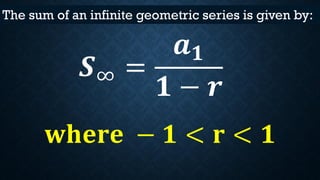
The sum of an infinite geometric series is given by:
𝑺∞ =
𝒂 𝟏
𝟏 − 𝒓
𝐰𝐡𝐞𝐫𝐞 − 𝟏 < 𝐫 < 𝟏
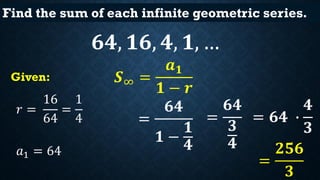
Find the sum of each infinite geometric series.
𝟔𝟒, 𝟏𝟔, 𝟒, 𝟏, …
𝑟 =
16
64
=
1
4
𝑎1 = 64
𝑺∞ =
𝒂 𝟏
𝟏 − 𝒓
Given:
=
𝟔𝟒
𝟏 −
𝟏
𝟒
=
𝟔𝟒
𝟑
𝟒
= 𝟔𝟒 ∙
𝟒
𝟑
=
𝟐𝟓𝟔
𝟑
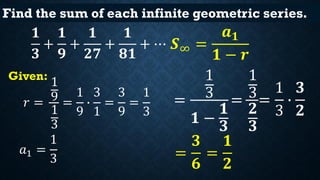
Find the sum of each infinite geometric series.
𝟏
𝟑
+
𝟏
𝟗
+
𝟏
𝟐𝟕
+
𝟏
𝟖𝟏
+ ⋯
𝑟 =
1
9
1
3
=
1
9
∙
3
1
=
3
9
=
1
3
𝑎1 =
1
3
𝑺∞ =
𝒂 𝟏
𝟏 − 𝒓
Given:
=
1
3
𝟏 −
𝟏
𝟑
=
1
3
𝟐
𝟑
=
1
3
∙
𝟑
𝟐
=
𝟑
𝟔
=
𝟏
𝟐
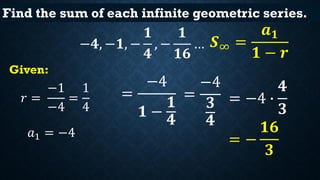
Find the sum of each infinite geometric series.
−𝟒, −𝟏, −
𝟏
𝟒
, −
𝟏
𝟏𝟔
…
𝑟 =
−1
−4
=
1
4
𝑎1 = −4
𝑺∞ =
𝒂 𝟏
𝟏 − 𝒓
Given:
=
−4
𝟏 −
𝟏
𝟒
=
−4
𝟑
𝟒
= −4 ∙
𝟒
𝟑
= −
𝟏𝟔
𝟑
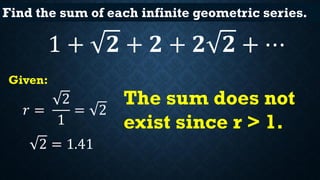
Find the sum of each infinite geometric series.
1 + 𝟐 + 𝟐 + 𝟐 𝟐 + ⋯
𝑟 =
2
1
= 2
The sum does not
exist since r > 1.
Given:
2 = 1.41
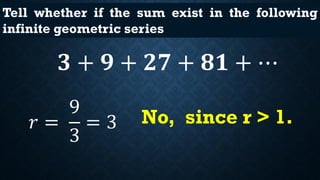
Tell whether if the sum exist in the following
infinite geometric series
𝟑 + 𝟗 + 𝟐𝟕 + 𝟖𝟏 + ⋯
𝑟 =
9
3
= 3 No, since r > 1.
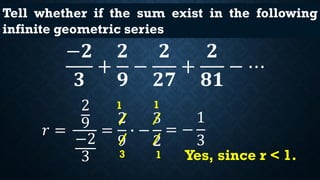
Tell whether if the sum exist in the following
infinite geometric series
−𝟐
𝟑
+
𝟐
𝟗
−
𝟐
𝟐𝟕
+
𝟐
𝟖𝟏
− ⋯
𝑟 =
2
9
−2
3
=
2
9
∙ −
3
2
Yes, since r < 1.
1
1
1
3
= −
1
3
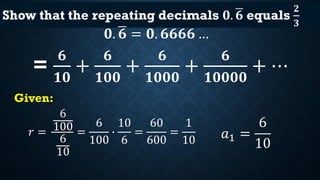
Show that the repeating decimals 𝟎. ഥ𝟔 equals
𝟐
𝟑
𝟎. ഥ𝟔 = 𝟎. 𝟔𝟔𝟔𝟔 …
𝑟 =
6
100
6
10
=
6
100
∙
10
6
=
60
600
=
1
10
Given:
𝑎1 =
6
10
=
𝟔
𝟏𝟎
+
𝟔
𝟏𝟎𝟎
+
𝟔
𝟏𝟎𝟎𝟎
+
𝟔
𝟏𝟎𝟎𝟎𝟎
+ ⋯
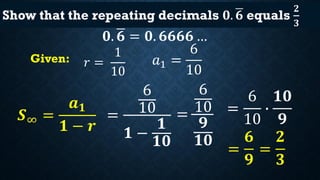
Show that the repeating decimals 𝟎. ഥ𝟔 equals
𝟐
𝟑
𝟎. ഥ𝟔 = 𝟎. 𝟔𝟔𝟔𝟔 …
𝑟 =
1
10
Given: 𝑎1 =
6
10
𝑺∞ =
𝒂 𝟏
𝟏 − 𝒓
=
6
10
𝟏 −
𝟏
𝟏𝟎
=
6
10
𝟗
𝟏𝟎
=
6
10
∙
𝟏𝟎
𝟗
=
𝟔
𝟗
=
𝟐
𝟑
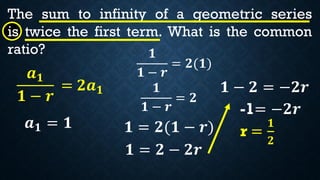
The sum to infinity of a geometric series
is twice the first term. What is the common
ratio?
𝒂 𝟏
𝟏 − 𝒓
= 𝟐𝒂 𝟏
𝒂 𝟏 = 𝟏
𝟏
𝟏 − 𝒓
= 𝟐(𝟏)
𝟏
𝟏 − 𝒓
= 𝟐
𝟏 = 𝟐 − 𝟐𝒓
𝟏 = 𝟐(𝟏 − 𝒓)
𝟏 − 𝟐 = −𝟐𝒓
-1= −𝟐𝒓
r =
𝟏
𝟐
REFERENCES:
❖ Nivera, G.C. (2015). Grade 10 Mathematics Pattern and
Practicalities. Don Bosco Press, Inc. Makati City,
Philippines.
❖ Mathematics Grade 10 Learner’s Module. Department of
Education. Pasig City, Philippines.

Infinite Geometric Series

  • 1.
    Grade 10 –Mathematics Quarter I INFINITE GEOMETRIC SERIES
  • 2.
    The sum ofan infinite geometric series is given by: 𝑺∞ = 𝒂 𝟏 𝟏 − 𝒓 𝐰𝐡𝐞𝐫𝐞 − 𝟏 < 𝐫 < 𝟏
  • 3.
    Find the sumof each infinite geometric series. 𝟔𝟒, 𝟏𝟔, 𝟒, 𝟏, … 𝑟 = 16 64 = 1 4 𝑎1 = 64 𝑺∞ = 𝒂 𝟏 𝟏 − 𝒓 Given: = 𝟔𝟒 𝟏 − 𝟏 𝟒 = 𝟔𝟒 𝟑 𝟒 = 𝟔𝟒 ∙ 𝟒 𝟑 = 𝟐𝟓𝟔 𝟑
  • 4.
    Find the sumof each infinite geometric series. 𝟏 𝟑 + 𝟏 𝟗 + 𝟏 𝟐𝟕 + 𝟏 𝟖𝟏 + ⋯ 𝑟 = 1 9 1 3 = 1 9 ∙ 3 1 = 3 9 = 1 3 𝑎1 = 1 3 𝑺∞ = 𝒂 𝟏 𝟏 − 𝒓 Given: = 1 3 𝟏 − 𝟏 𝟑 = 1 3 𝟐 𝟑 = 1 3 ∙ 𝟑 𝟐 = 𝟑 𝟔 = 𝟏 𝟐
  • 5.
    Find the sumof each infinite geometric series. −𝟒, −𝟏, − 𝟏 𝟒 , − 𝟏 𝟏𝟔 … 𝑟 = −1 −4 = 1 4 𝑎1 = −4 𝑺∞ = 𝒂 𝟏 𝟏 − 𝒓 Given: = −4 𝟏 − 𝟏 𝟒 = −4 𝟑 𝟒 = −4 ∙ 𝟒 𝟑 = − 𝟏𝟔 𝟑
  • 6.
    Find the sumof each infinite geometric series. 1 + 𝟐 + 𝟐 + 𝟐 𝟐 + ⋯ 𝑟 = 2 1 = 2 The sum does not exist since r > 1. Given: 2 = 1.41
  • 7.
    Tell whether ifthe sum exist in the following infinite geometric series 𝟑 + 𝟗 + 𝟐𝟕 + 𝟖𝟏 + ⋯ 𝑟 = 9 3 = 3 No, since r > 1.
  • 8.
    Tell whether ifthe sum exist in the following infinite geometric series −𝟐 𝟑 + 𝟐 𝟗 − 𝟐 𝟐𝟕 + 𝟐 𝟖𝟏 − ⋯ 𝑟 = 2 9 −2 3 = 2 9 ∙ − 3 2 Yes, since r < 1. 1 1 1 3 = − 1 3
  • 9.
    Show that therepeating decimals 𝟎. ഥ𝟔 equals 𝟐 𝟑 𝟎. ഥ𝟔 = 𝟎. 𝟔𝟔𝟔𝟔 … 𝑟 = 6 100 6 10 = 6 100 ∙ 10 6 = 60 600 = 1 10 Given: 𝑎1 = 6 10 = 𝟔 𝟏𝟎 + 𝟔 𝟏𝟎𝟎 + 𝟔 𝟏𝟎𝟎𝟎 + 𝟔 𝟏𝟎𝟎𝟎𝟎 + ⋯
  • 10.
    Show that therepeating decimals 𝟎. ഥ𝟔 equals 𝟐 𝟑 𝟎. ഥ𝟔 = 𝟎. 𝟔𝟔𝟔𝟔 … 𝑟 = 1 10 Given: 𝑎1 = 6 10 𝑺∞ = 𝒂 𝟏 𝟏 − 𝒓 = 6 10 𝟏 − 𝟏 𝟏𝟎 = 6 10 𝟗 𝟏𝟎 = 6 10 ∙ 𝟏𝟎 𝟗 = 𝟔 𝟗 = 𝟐 𝟑
  • 11.
    The sum toinfinity of a geometric series is twice the first term. What is the common ratio? 𝒂 𝟏 𝟏 − 𝒓 = 𝟐𝒂 𝟏 𝒂 𝟏 = 𝟏 𝟏 𝟏 − 𝒓 = 𝟐(𝟏) 𝟏 𝟏 − 𝒓 = 𝟐 𝟏 = 𝟐 − 𝟐𝒓 𝟏 = 𝟐(𝟏 − 𝒓) 𝟏 − 𝟐 = −𝟐𝒓 -1= −𝟐𝒓 r = 𝟏 𝟐
  • 12.
    REFERENCES: ❖ Nivera, G.C.(2015). Grade 10 Mathematics Pattern and Practicalities. Don Bosco Press, Inc. Makati City, Philippines. ❖ Mathematics Grade 10 Learner’s Module. Department of Education. Pasig City, Philippines.