The document explains what a sequence is, defining it as an ordered set of terms identified by a general term equation. It includes examples of finding specific terms within a sequence using given formulas and provides practice problems for identifying both finite and infinite sequences. The overall focus is on understanding and calculating the terms of various mathematical sequences.

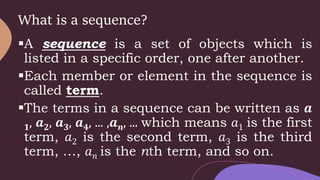
What is asequence?
A sequence is a set of objects which is
listed in a specific order, one after another.
Each member or element in the sequence is
called term.
The terms in a sequence can be written as 𝒂
𝟏, 𝒂𝟐, 𝒂𝟑, 𝒂𝟒, ... ,𝒂𝒏, ... which means 𝑎1 is the first
term, 𝑎2 is the second term, 𝑎3 is the third
term, …, 𝑎𝑛 is the nth term, and so on.
4.
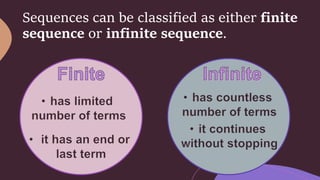
Sequences can beclassified as either finite
sequence or infinite sequence.
5.
Finding terms ofa sequence
A term in a sequence can be
identified using a general term.
A general term or the nth term
is usually expressed as an
equation.
6.
How to finda term of a sequence
using a general term?
Consider the following steps:
1. Substitute the value of n.
2. Perform the operations.
3. Simplify.
7.
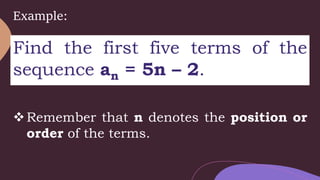
Example:
Find the firstfive terms of the
sequence an = 5n – 2.
Remember that n denotes the position or
order of the terms.
8.
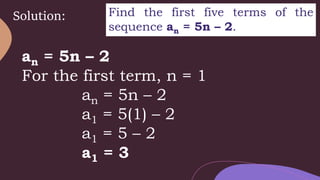
Solution: Find thefirst five terms of the
sequence an = 5n – 2.
an = 5n – 2
For the first term, n = 1
an = 5n – 2
a1 = 5(1) – 2
a1 = 5 – 2
a1 = 3
9.
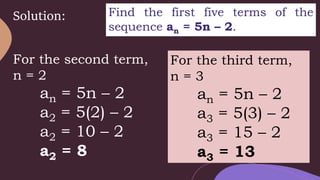
Solution: Find thefirst five terms of the
sequence an = 5n – 2.
For the second term,
n = 2
an = 5n – 2
a2 = 5(2) – 2
a2 = 10 – 2
a2 = 8
For the third term,
n = 3
an = 5n – 2
a3 = 5(3) – 2
a3 = 15 – 2
a3 = 13
10.
Solution: Find thefirst five terms of the
sequence an = 5n – 2.
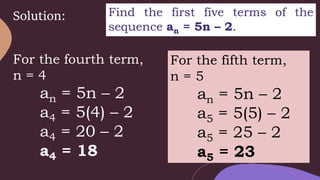
For the fourth term,
n = 4
an = 5n – 2
a4 = 5(4) – 2
a4 = 20 – 2
a4 = 18
For the fifth term,
n = 5
an = 5n – 2
a5 = 5(5) – 2
a5 = 25 – 2
a5 = 23
11.
Answer:
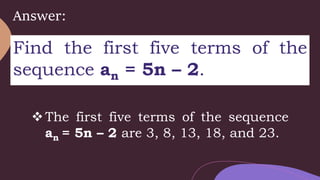
Find the firstfive terms of the
sequence an = 5n – 2.
The first five terms of the sequence
an = 5n – 2 are 3, 8, 13, 18, and 23.
13.
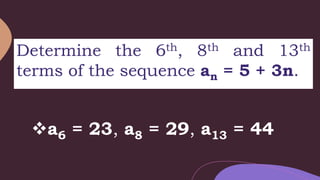
Determine the 6th,8th and 13th
terms of the sequence an = 5 + 3n.
a6 = 23, a8 = 29, a13 = 44
16.
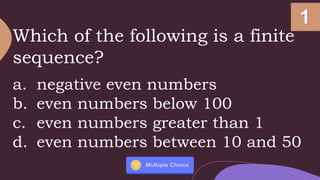
Which of thefollowing is a finite
sequence?
a. negative even numbers
b. even numbers below 100
c. even numbers greater than 1
d. even numbers between 10 and 50
17.
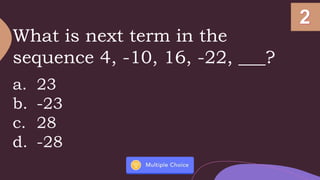
What is nextterm in the
sequence 4, -10, 16, -22, ___?
a. 23
b. -23
c. 28
d. -28
18.
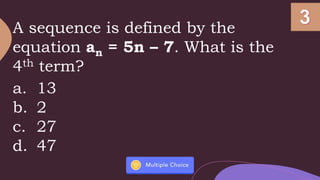
A sequence isdefined by the
equation an = 5n – 7. What is the
4th term?
a. 13
b. 2
c. 27
d. 47
19.
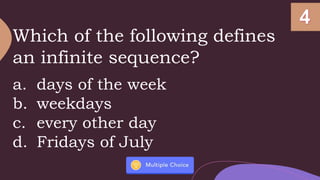
Which of thefollowing defines
an infinite sequence?
a. days of the week
b. weekdays
c. every other day
d. Fridays of July
20.
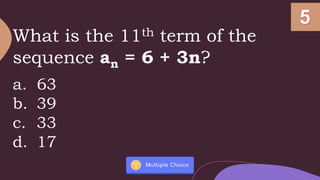
What is the11th term of the
sequence an = 6 + 3n?
a. 63
b. 39
c. 33
d. 17
21.
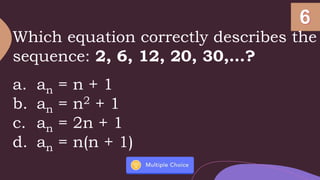
Which equation correctlydescribes the
sequence: 2, 6, 12, 20, 30,…?
a. an = n + 1
b. an = n2 + 1
c. an = 2n + 1
d. an = n(n + 1)
22.
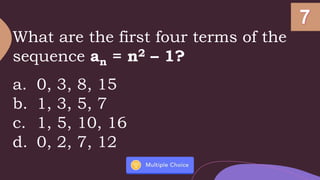
What are thefirst four terms of the
sequence an = n2 – 1?
a. 0, 3, 8, 15
b. 1, 3, 5, 7
c. 1, 5, 10, 16
d. 0, 2, 7, 12