STRATEGIC INTERVENTION MATERIAL
MATHEMATICS 10
PREPARED BY:
ALMA EDQUID BAJA
T-2
Department of Education
Region III
Schools Division of Zambales
GUISGUIS NATIONAL HIGH SCHOOL
Guisguis, Sta. Cruz, Zambales
LEAST MASTERED SKILLS
Illustrates Geometric
Sequence
Sub-Tasks:
• Distinguish between arithmetic and
geometric sequences.
• Find the common ratio of a geometric
sequence.
• Determine the geometric means and nth
term of a geometric sequence.
• Find the sum of the terms of a given finite
and infinite geometric sequence.
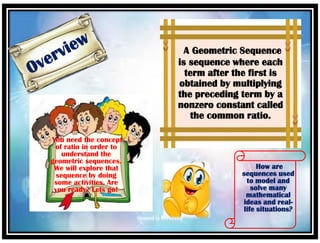
A Geometric Sequence
is sequence where each
term after the first is
obtained by multiplying
the preceding term by a
nonzero constant called
the common ratio.
How are
sequences used
to model and
solve many
mathematical
ideas and real-
life situations?
You need the concept
of ratio in order to
understand the
geometric sequences.

We will explore that
sequence by doing
some activities. Are
you ready? Lets go!
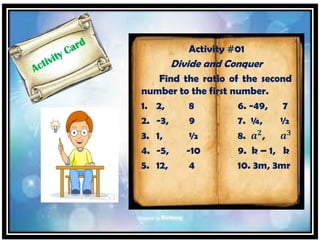
Activity #01
Divide and Conquer
Find the ratio of the second
number to the first number.
1. 2, 8 6. -49, 7
2. -3, 9 7. ¼, ½
3. 1, ½ 8. 𝒂 𝟐
, 𝒂 𝟑
4. -5, -10 9. k – 1, k
5. 12, 4 10. 3m, 3mr
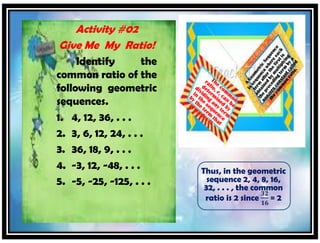
Activity #02
Give Me My Ratio!
Identify the
common ratio of the
following geometric
sequences.

1. 4, 12, 36, . . .
2. 3, 6, 12, 24, . . .
3. 36, 18, 9, . . .
4. -3, 12, -48, . . .
5. -5, -25, -125, . . .
Thus, in the geometric
sequence 2, 4, 8, 16,
32, . . . , the common
ratio is 2 since
𝟑𝟐
𝟏𝟔
= 2
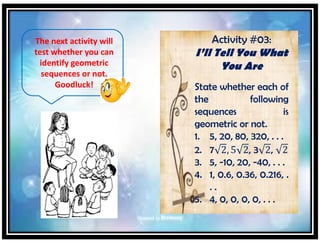
The next activity will
test whether you can
identify geometric
sequences or not.
Goodluck!
Activity #03:
I’ll Tell You What
You Are
State whether each of
the following
sequences is
geometric or not.
1. 5, 20, 80, 320, . . .
2. 7 2, 5 2, 3 2, 2
3. 5, -10, 20, -40, . . .
4. 1, 0.6, 0.36, 0.216, .
. .
5. 4, 0, 0, 0, 0, . . .
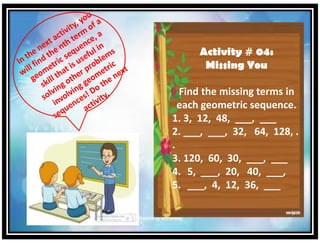
Activity # 04:
Missing You
Find the missing terms in
each geometric sequence.
1. 3, 12, 48, ___, ___
2. ___, ___, 32, 64, 128, .
.
3. 120, 60, 30, ___, ___
4. 5, ___, 20, 40, ___,
5. ___, 4, 12, 36, ___
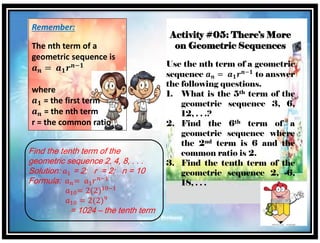
Remember:
The nth term of a
geometric sequence is
𝒂 𝒏 = 𝒂 𝟏 𝒓 𝒏−𝟏
where
𝒂 𝟏 = the first term
𝒂 𝒏 = the nth term
r = the common ratio
Find the tenth term of the
geometric sequence 2, 4, 8, . . .
Solution: 𝑎1 = 2; r = 2; n = 10
Formula: 𝑎 𝑛= 𝑎1 𝑟 𝑛−1
𝑎10= 2(2)10−1
𝑎10 = 2(2)9
= 1024 – the tenth term
Activity #05: There’s More
on Geometric Sequences
Use the nth term of a geometric
sequence 𝒂 𝒏 = 𝒂 𝟏 𝒓 𝒏−𝟏
to answer
the following questions.
1. What is the 5th term of the
geometric sequence 3, 6,
12, . . .?
2. Find the 6th term of a
geometric sequence where
the 2nd term is 6 and the
common ratio is 2.
3. Find the tenth term of the
geometric sequence 2, -6,
18, . . .
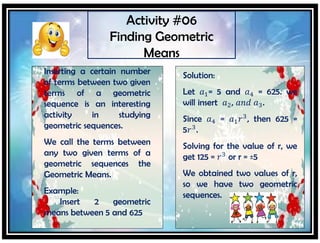
Activity #06
Finding Geometric
Means
Inserting a certain number
of terms between two given
terms of a geometric
sequence is an interesting
activity in studying
geometric sequences.

We call the terms between
any two given terms of a
geometric sequences the
Geometric Means.
Example:
Insert 2 geometric
means between 5 and 625
Solution:
Let 𝑎1= 5 and 𝑎4 = 625. we
will insert 𝑎2, 𝑎𝑛𝑑 𝑎3.
Since 𝑎4 = 𝑎1 𝑟3
, then 625 =
5𝑟3
.
Solving for the value of r, we
get 125 = 𝑟3
or r = ±5
We obtained two values of r,
so we have two geometric
sequences.
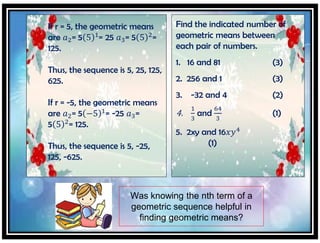
If r = 5, the geometric means
are 𝑎2= 5 5 1
= 25 𝑎3= 5 5 2
=
125.
Thus, the sequence is 5, 25, 125,
625.
If r = -5, the geometric means
are 𝑎2= 5 −5 1
= -25 𝑎3=
5 5 2
= 125.
Thus, the sequence is 5, -25,
125, -625.
Find the indicated number of
geometric means between
each pair of numbers.
1. 16 and 81 (3)
2. 256 and 1 (3)
3. -32 and 4 (2)
4.
1
3
and
64
3
(1)
5. 2xy and 16𝑥𝑦4
(1)
Was knowing the nth term of a
geometric sequence helpful in
finding geometric means?
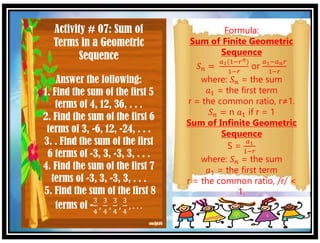
Activity # 07: Sum of
Terms in a Geometric
Sequence
Answer the following:
1. Find the sum of the first 5
terms of 4, 12, 36, . . .
2. Find the sum of the first 6
terms of 3, -6, 12, -24, . . .
3. . Find the sum of the first
6 terms of -3, 3, -3, 3, . . .
4. Find the sum of the first 7
terms of -3, 3, -3, 3, . . .
5. Find the sum of the first 8
terms of -
3
4
,
3
4
,
3
4
,
3
4
, . . .
Formula:
Sum of Finite Geometric
Sequence
𝑆 𝑛 =
𝑎1(1−𝑟 𝑛)
1−𝑟
or
𝑎1−𝑎 𝑛 𝑟
1−𝑟
where: 𝑆 𝑛 = the sum
𝑎1 = the first term
r = the common ratio, r≠1.
𝑆 𝑛 = n 𝑎1 if r = 1
Sum of Infinite Geometric
Sequence
S =
𝑎1
1−𝑟
where: 𝑆 𝑛 = the sum
𝑎1 = the first term
r = the common ratio, /r/ <
1.
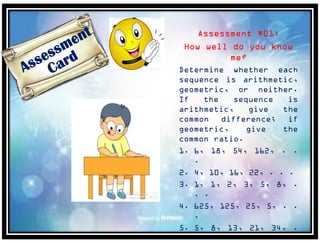
Assessment #01:
How well do you know
me?
Determine whether each
sequence is arithmetic,
geometric, or neither.
If the sequence is
arithmetic, give the
common difference; if
geometric, give the
common ratio.
1. 6, 18, 54, 162, . .
.
2. 4, 10, 16, 22, . . .
3. 1, 1, 2, 3, 5, 8, .
. .
4. 625, 125, 25, 5, . .
.
5. 5, 8, 13, 21, 34, .
. .
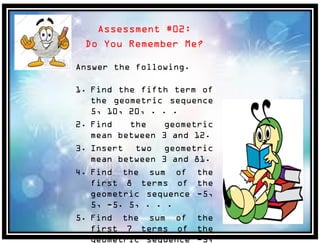
Assessment #02:
Do You Remember Me?
Answer the following.
1. Find the fifth term of
the geometric sequence
5, 10, 20, . . .
2. Find the geometric
mean between 3 and 12.
3. Insert two geometric
mean between 3 and 81.
4. Find the sum of the
first 8 terms of the
geometric sequence -5,
5, -5. 5, . . .
5. Find the sum of the
first 7 terms of the
geometric sequence -5,
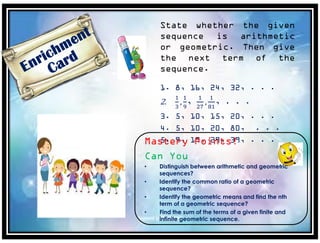
State whether the given
sequence is arithmetic
or geometric. Then give
the next term of the
sequence.
1. 8, 16, 24, 32, . . .
2.
1
3
,
1
9
,
1
27
,
1
81
, . . .
3. 5, 10, 15, 20, . . .
4. 5, 10, 20, 80, . . .
5. 9, 19, 29, 39, . . .Mastery Points!
Can You
• Distinguish between arithmetic and geometric
sequences?
• Identify the common ratio of a geometric
sequence?
• Identify the geometric means and find the nth
term of a geometric sequence?
• Find the sum of the terms of a given finite and
infinite geometric sequence.
- Mathematics Learners
Module-Grade10 (DEPED) p.
26 - 47
- Intermediate Algebra -
Soledad Jose-Dilao, Ed.D.
Julieta G. Bernabe, Published
by JTW Corporation.
- Intermediate Algebra,
Corazon Alano, et.al,
Abiva Publishing House,
Inc.
- http://www.goggle.com
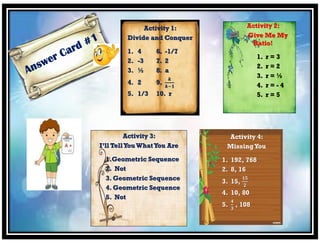
Activity 1:
Divide and Conquer
1. 4 6. -1/7
2. -3 7. 2
3. ½ 8. a
4. 2 9.
𝒌
𝒌−𝟏
5. 1/3 10. r
Activity 2:
Give Me My
Ratio!
1. r = 3
2. r = 2
3. r = ½
4. r = - 4
5. r = 5
Activity 3:
I’ll TellYouWhatYou Are
1.Geometric Sequence
2. Not
3. Geometric Sequence
4. Geometric Sequence
5. Not
Activity 4:
MissingYou
1. 192, 768
2. 8, 16
3. 15,
𝟏𝟓
𝟐
4. 10, 80
5.
𝟒
𝟑
, 108
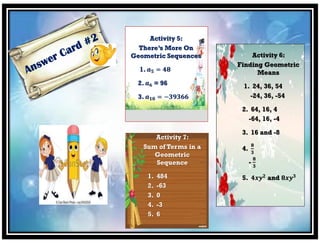
Activity 5:
There’s More On
Geometric Sequences
1. 𝒂 𝟓 = 𝟒𝟖
2. 𝒂 𝟔 = 96
3. 𝒂 𝟏𝟎 = −𝟑𝟗𝟑𝟔𝟔
Activity 7:
Sum of Terms in a
Geometric
Sequence
1. 484
2. -63
3. 0
4. -3
5. 6
Activity 6:
Finding Geometric
Means
1. 24, 36, 54
-24, 36, -54
2. 64, 16, 4
-64, 16, -4
3. 16 and -8
4.
𝟖
𝟑
-
𝟖
𝟑
5. 𝟒𝒙𝒚 𝟐
and 𝟖𝒙𝒚 𝟑
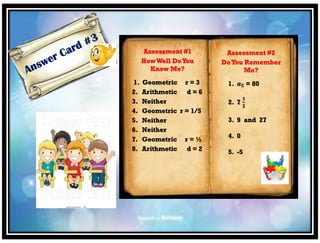
Assessment #1
HowWell DoYou
Know Me?
1. Geometric r = 3
2. Arithmetic d = 6
3. Neither
4. Geometric r = 1/5
5. Neither
6. Neither
7. Geometric r = ½
8. Arithmetic d = 2
Assessment #2
DoYou Remember
Me?
1. 𝒂 𝟓 = 80
2. 7
𝟏
𝟐
3. 9 and 27
4. 0
5. -5
Prepared and Submitted by:
ALMA E. BAJA
T-2
Approved:
JULITA M. VALDEZ
Principal II
I did great and fully
understood the lesson
51 - 67
I did good and partially
understood the lesson. I still
need to review.
21 - 50
I need to go back with the
lesson because there are
still areas I need to work
on. I will not give up.
1-20
I
My Score is
________
Geometric Sequence by Alma Baja

Geometric Sequence by Alma Baja

  • 1.
    STRATEGIC INTERVENTION MATERIAL MATHEMATICS10 PREPARED BY: ALMA EDQUID BAJA T-2 Department of Education Region III Schools Division of Zambales GUISGUIS NATIONAL HIGH SCHOOL Guisguis, Sta. Cruz, Zambales
  • 2.
    LEAST MASTERED SKILLS IllustratesGeometric Sequence Sub-Tasks: • Distinguish between arithmetic and geometric sequences. • Find the common ratio of a geometric sequence. • Determine the geometric means and nth term of a geometric sequence. • Find the sum of the terms of a given finite and infinite geometric sequence.
  • 3.
    A Geometric Sequence issequence where each term after the first is obtained by multiplying the preceding term by a nonzero constant called the common ratio. How are sequences used to model and solve many mathematical ideas and real- life situations? You need the concept of ratio in order to understand the geometric sequences. We will explore that sequence by doing some activities. Are you ready? Lets go!
  • 4.
    Activity #01 Divide andConquer Find the ratio of the second number to the first number. 1. 2, 8 6. -49, 7 2. -3, 9 7. ¼, ½ 3. 1, ½ 8. 𝒂 𝟐 , 𝒂 𝟑 4. -5, -10 9. k – 1, k 5. 12, 4 10. 3m, 3mr
  • 5.
    Activity #02 Give MeMy Ratio! Identify the common ratio of the following geometric sequences. 1. 4, 12, 36, . . . 2. 3, 6, 12, 24, . . . 3. 36, 18, 9, . . . 4. -3, 12, -48, . . . 5. -5, -25, -125, . . . Thus, in the geometric sequence 2, 4, 8, 16, 32, . . . , the common ratio is 2 since 𝟑𝟐 𝟏𝟔 = 2
  • 6.
    The next activitywill test whether you can identify geometric sequences or not. Goodluck! Activity #03: I’ll Tell You What You Are State whether each of the following sequences is geometric or not. 1. 5, 20, 80, 320, . . . 2. 7 2, 5 2, 3 2, 2 3. 5, -10, 20, -40, . . . 4. 1, 0.6, 0.36, 0.216, . . . 5. 4, 0, 0, 0, 0, . . .
  • 7.
    Activity # 04: MissingYou Find the missing terms in each geometric sequence. 1. 3, 12, 48, ___, ___ 2. ___, ___, 32, 64, 128, . . 3. 120, 60, 30, ___, ___ 4. 5, ___, 20, 40, ___, 5. ___, 4, 12, 36, ___
  • 8.
    Remember: The nth termof a geometric sequence is 𝒂 𝒏 = 𝒂 𝟏 𝒓 𝒏−𝟏 where 𝒂 𝟏 = the first term 𝒂 𝒏 = the nth term r = the common ratio Find the tenth term of the geometric sequence 2, 4, 8, . . . Solution: 𝑎1 = 2; r = 2; n = 10 Formula: 𝑎 𝑛= 𝑎1 𝑟 𝑛−1 𝑎10= 2(2)10−1 𝑎10 = 2(2)9 = 1024 – the tenth term Activity #05: There’s More on Geometric Sequences Use the nth term of a geometric sequence 𝒂 𝒏 = 𝒂 𝟏 𝒓 𝒏−𝟏 to answer the following questions. 1. What is the 5th term of the geometric sequence 3, 6, 12, . . .? 2. Find the 6th term of a geometric sequence where the 2nd term is 6 and the common ratio is 2. 3. Find the tenth term of the geometric sequence 2, -6, 18, . . .
  • 9.
    Activity #06 Finding Geometric Means Insertinga certain number of terms between two given terms of a geometric sequence is an interesting activity in studying geometric sequences. We call the terms between any two given terms of a geometric sequences the Geometric Means. Example: Insert 2 geometric means between 5 and 625 Solution: Let 𝑎1= 5 and 𝑎4 = 625. we will insert 𝑎2, 𝑎𝑛𝑑 𝑎3. Since 𝑎4 = 𝑎1 𝑟3 , then 625 = 5𝑟3 . Solving for the value of r, we get 125 = 𝑟3 or r = ±5 We obtained two values of r, so we have two geometric sequences.
  • 10.
    If r =5, the geometric means are 𝑎2= 5 5 1 = 25 𝑎3= 5 5 2 = 125. Thus, the sequence is 5, 25, 125, 625. If r = -5, the geometric means are 𝑎2= 5 −5 1 = -25 𝑎3= 5 5 2 = 125. Thus, the sequence is 5, -25, 125, -625. Find the indicated number of geometric means between each pair of numbers. 1. 16 and 81 (3) 2. 256 and 1 (3) 3. -32 and 4 (2) 4. 1 3 and 64 3 (1) 5. 2xy and 16𝑥𝑦4 (1) Was knowing the nth term of a geometric sequence helpful in finding geometric means?
  • 11.
    Activity # 07:Sum of Terms in a Geometric Sequence Answer the following: 1. Find the sum of the first 5 terms of 4, 12, 36, . . . 2. Find the sum of the first 6 terms of 3, -6, 12, -24, . . . 3. . Find the sum of the first 6 terms of -3, 3, -3, 3, . . . 4. Find the sum of the first 7 terms of -3, 3, -3, 3, . . . 5. Find the sum of the first 8 terms of - 3 4 , 3 4 , 3 4 , 3 4 , . . . Formula: Sum of Finite Geometric Sequence 𝑆 𝑛 = 𝑎1(1−𝑟 𝑛) 1−𝑟 or 𝑎1−𝑎 𝑛 𝑟 1−𝑟 where: 𝑆 𝑛 = the sum 𝑎1 = the first term r = the common ratio, r≠1. 𝑆 𝑛 = n 𝑎1 if r = 1 Sum of Infinite Geometric Sequence S = 𝑎1 1−𝑟 where: 𝑆 𝑛 = the sum 𝑎1 = the first term r = the common ratio, /r/ < 1.
  • 12.
    Assessment #01: How welldo you know me? Determine whether each sequence is arithmetic, geometric, or neither. If the sequence is arithmetic, give the common difference; if geometric, give the common ratio. 1. 6, 18, 54, 162, . . . 2. 4, 10, 16, 22, . . . 3. 1, 1, 2, 3, 5, 8, . . . 4. 625, 125, 25, 5, . . . 5. 5, 8, 13, 21, 34, . . .
  • 13.
    Assessment #02: Do YouRemember Me? Answer the following. 1. Find the fifth term of the geometric sequence 5, 10, 20, . . . 2. Find the geometric mean between 3 and 12. 3. Insert two geometric mean between 3 and 81. 4. Find the sum of the first 8 terms of the geometric sequence -5, 5, -5. 5, . . . 5. Find the sum of the first 7 terms of the geometric sequence -5,
  • 14.
    State whether thegiven sequence is arithmetic or geometric. Then give the next term of the sequence. 1. 8, 16, 24, 32, . . . 2. 1 3 , 1 9 , 1 27 , 1 81 , . . . 3. 5, 10, 15, 20, . . . 4. 5, 10, 20, 80, . . . 5. 9, 19, 29, 39, . . .Mastery Points! Can You • Distinguish between arithmetic and geometric sequences? • Identify the common ratio of a geometric sequence? • Identify the geometric means and find the nth term of a geometric sequence? • Find the sum of the terms of a given finite and infinite geometric sequence.
  • 15.
    - Mathematics Learners Module-Grade10(DEPED) p. 26 - 47 - Intermediate Algebra - Soledad Jose-Dilao, Ed.D. Julieta G. Bernabe, Published by JTW Corporation. - Intermediate Algebra, Corazon Alano, et.al, Abiva Publishing House, Inc. - http://www.goggle.com
  • 16.
    Activity 1: Divide andConquer 1. 4 6. -1/7 2. -3 7. 2 3. ½ 8. a 4. 2 9. 𝒌 𝒌−𝟏 5. 1/3 10. r Activity 2: Give Me My Ratio! 1. r = 3 2. r = 2 3. r = ½ 4. r = - 4 5. r = 5 Activity 3: I’ll TellYouWhatYou Are 1.Geometric Sequence 2. Not 3. Geometric Sequence 4. Geometric Sequence 5. Not Activity 4: MissingYou 1. 192, 768 2. 8, 16 3. 15, 𝟏𝟓 𝟐 4. 10, 80 5. 𝟒 𝟑 , 108
  • 17.
    Activity 5: There’s MoreOn Geometric Sequences 1. 𝒂 𝟓 = 𝟒𝟖 2. 𝒂 𝟔 = 96 3. 𝒂 𝟏𝟎 = −𝟑𝟗𝟑𝟔𝟔 Activity 7: Sum of Terms in a Geometric Sequence 1. 484 2. -63 3. 0 4. -3 5. 6 Activity 6: Finding Geometric Means 1. 24, 36, 54 -24, 36, -54 2. 64, 16, 4 -64, 16, -4 3. 16 and -8 4. 𝟖 𝟑 - 𝟖 𝟑 5. 𝟒𝒙𝒚 𝟐 and 𝟖𝒙𝒚 𝟑
  • 18.
    Assessment #1 HowWell DoYou KnowMe? 1. Geometric r = 3 2. Arithmetic d = 6 3. Neither 4. Geometric r = 1/5 5. Neither 6. Neither 7. Geometric r = ½ 8. Arithmetic d = 2 Assessment #2 DoYou Remember Me? 1. 𝒂 𝟓 = 80 2. 7 𝟏 𝟐 3. 9 and 27 4. 0 5. -5
  • 19.
    Prepared and Submittedby: ALMA E. BAJA T-2 Approved: JULITA M. VALDEZ Principal II
  • 20.
    I did greatand fully understood the lesson 51 - 67 I did good and partially understood the lesson. I still need to review. 21 - 50 I need to go back with the lesson because there are still areas I need to work on. I will not give up. 1-20 I My Score is ________