This document contains a lesson plan for teaching multiplying rational expressions in Math 8. The lesson plan outlines the intended learning outcomes, learning content including subject matter and references, learning experiences such as classifying rational expressions, and an assignment for students to practice multiplying rational expressions. The lesson plan provides step-by-step instructions for multiplying rational expressions by factoring, canceling common factors, and simplifying the resulting expression.
Republic of thePhilippines
Department of Education
Region VII Central Visayas
Division of Cebu City
Quiot National High School
Bogo, Quiot, Cebu City
A Semi-Detailed Lesson Plan
In Math 8
___________________
Date of Teaching
____________________
Time of Teaching
Quiot National High School- Afternoon Session
Venue of Teaching
Prepared by:
LORIE JANE L. LETADA
Teacher 1
Observed by:
ELEANOR D. GALLARDO
ASSISTANT PRINCIPAL
2.
I. Intended LearningOutcomes
Through varied learning activities, the grade 8 students with at least80 % ofaccuracy shall able to:
1. differentiate rational expressions from non-rational expressions
2. multiply rational expressions
3. Relate multiply rational expressions in real life situation
II. Learning Content
A. Subject Matter
Multiplying Rational Expressions
B. Reference
Diaz, Z., Mojica M. (2013) . Next Century Mathematics 8; Quezon City ; Phoenix
Publishing House , Inc; Mathematics 8 Learner’s Module K-12; DepEd K-12
Modified Curriculum Guide and Teacher’s Guide for Mathematics 8
https://www.mathsisfun.com/simplifying-fractions.html
C. Materials
Learners’ Module; Google Classroom; powerpointpresentation; google forms
III. Learning Experiences
A. Activity
B. Analysis
1. How many expressions did you place in the column ofrational algebraic expressions?
2. How many expressions did you place under the column ofnot rational algebraic expression column?
3. How did you differentiate a rational algebraic expression from a not rational algebraic expression?
4. Were you able to place each expression in its appropriate column?
5. What difficulty did you encounter in classifying the expressions?
mmClassify Me!
3.
C. Abstraction
To multiplyrational expressions, recall the rules for multiplying fractions. If the denominators
are not equal to zero, then we simply multiply the numerators and denominators. The same
rule applies to rational expressions.
If a, b, c, and d represent polynomials where b ≠ 0 and d ≠ 0. Then,
Multiply each rational expression and simplify.
1.
𝟓
𝟏𝟐
∗
𝟖
𝟏𝟓
=
2.
𝟏𝟓
𝟐𝒚 𝟐 ∗
𝒚 𝟒
𝟐𝟎𝒚 𝟐 =
3.
𝟒𝒙 𝟐
−𝟗
𝒙 𝟐 −𝟓𝒙+𝟔
∗
𝟑𝒙−𝟔
𝟖𝒙+𝟏𝟐
=
𝟒.
𝟑𝒔
𝟒𝒔+𝟏
∗
𝟐𝒔+𝟏
𝟑𝒔 𝟐 =
D. Application
Multiply each rational expression and simplify.
1.
𝟔
𝟏𝟎
∗
𝟓
𝟏𝟓
=
𝒂
𝒃
∗
𝒄
𝒅
=
𝒂𝒄
𝒃𝒅
Step 1 Factor each expression.
𝟓
𝟏𝟐
∗
𝟖
𝟏𝟓
=
𝟓
( 𝟒)(𝟑)
∗
( 𝟒) (𝟐)
( 𝟑) (𝟓)
Step 2 Cancel all common
factors.
𝟓
( 𝟒)(𝟑)
*
( 𝟒) (𝟐)
( 𝟑) (𝟓)
Step 3: Write what is left.
𝟓
𝟏𝟐
∗
𝟖
𝟏𝟓
=
𝟐
( 𝟑) (𝟑)
=
𝟐
𝟗
Step 1: Factor each expression.
𝟏𝟓
𝟐𝒚 𝟐 ∗
𝒚 𝟒
𝟐𝟎𝒚 𝟐 =
( 𝟓 )( 𝟑)
( 𝟐)(𝒚 𝟐)
∗
( 𝒚 𝟐)(𝒚 𝟐
)
( 𝟓)( 𝟒)(𝒚 𝟐)
Step 2 Cancel all common factors.
𝟏𝟓
𝟐𝒚 𝟐 ∗
𝒚 𝟒
𝟐𝟎𝒚 𝟐 =
( 𝟓 ) ( 𝟑)
( 𝟐) (𝒚 𝟐)
∗
( 𝒚 𝟐) (𝒚 𝟐
)
( 𝟓) ( 𝟒) (𝒚 𝟐)
Step 3: Write what is left.
𝟏𝟓
𝟐𝒚 𝟐 ∗
𝒚 𝟒
𝟐𝟎𝒚 𝟐 =
𝟑
(𝟐)(𝟒)
=
𝟑
𝟖
Step 1: Factor each expression.
𝟒𝒙 𝟐
−𝟗
𝒙 𝟐 −𝟓𝒙+𝟔
∗
𝟑𝒙−𝟔
𝟖𝒙+𝟏𝟐
=
( 𝟐𝒙−𝟑 )(𝟐𝒙+𝟑)
( 𝒙−𝟑)(𝒙−𝟐)
*
𝟑 ( 𝒙−𝟐 )
𝟒(𝟐𝒙+𝟑)
Step 2 : Cancel all common factors.
𝟒𝒙 𝟐
−𝟗
𝒙 𝟐 −𝟓𝒙+𝟔
∗
𝟑𝒙−𝟔
𝟖𝒙+𝟏𝟐
=
( 𝟐𝒙−𝟑 )(𝟐𝒙+𝟑)
( 𝒙−𝟑)(𝒙−𝟐)
*
𝟑 ( 𝒙−𝟐 )
𝟒(𝟐𝒙+𝟑)
Step 3: Write what is left.
𝟒𝒙 𝟐
−𝟗
𝒙 𝟐−𝟓𝒙+𝟔
∗
𝟑𝒙−𝟔
𝟖𝒙+𝟏𝟐
=
( 𝟐𝒙−𝟑 )
( 𝒙−𝟑)
∗
𝟑
𝟒
=
𝟑 ( 𝟐𝒙−𝟑 )
𝟒 ( 𝒙−𝟑 )
Step 1: Factor each expression.
𝟑𝒔
𝟒𝒔+𝟐
∗
𝟐𝒔+𝟏
𝟑𝒔 𝟐 =
𝟑𝒔
𝟐(𝟐𝒔+𝟏)
∗
(𝟐𝒔+𝟏)
𝒔 ( 𝟑𝒔 )
Step 2 : Cancel all common factors.
𝟑𝒔
𝟒𝒔+𝟐
∗
𝟐𝒔+𝟏
𝟑𝒔 𝟐 =
𝟑𝒔
𝟐(𝟐𝒔+𝟏)
∗
(𝟐𝒔+𝟏)
𝒔 ( 𝟑𝒔 )
𝟑𝒔
𝟒𝒔+𝟐
∗
𝟐𝒔+𝟏
𝟑𝒔 𝟐 =
𝟏
𝟐 ( 𝒔)
=
𝟏
𝟐𝒔
Factor, in
mathematics,
a number or
algebraic
expression
that divides
another
number or
expression
evenly—i.e.,
with no
remainder.
For example,
3 and 6
are factors of
12 because
12 ÷ 3 = 4
exactly and
12 ÷ 6 = 2
exactly.
Step 1 Factor each expression. Step 2 Cancel all common
factors.
Step 3: Write what is left.
4.
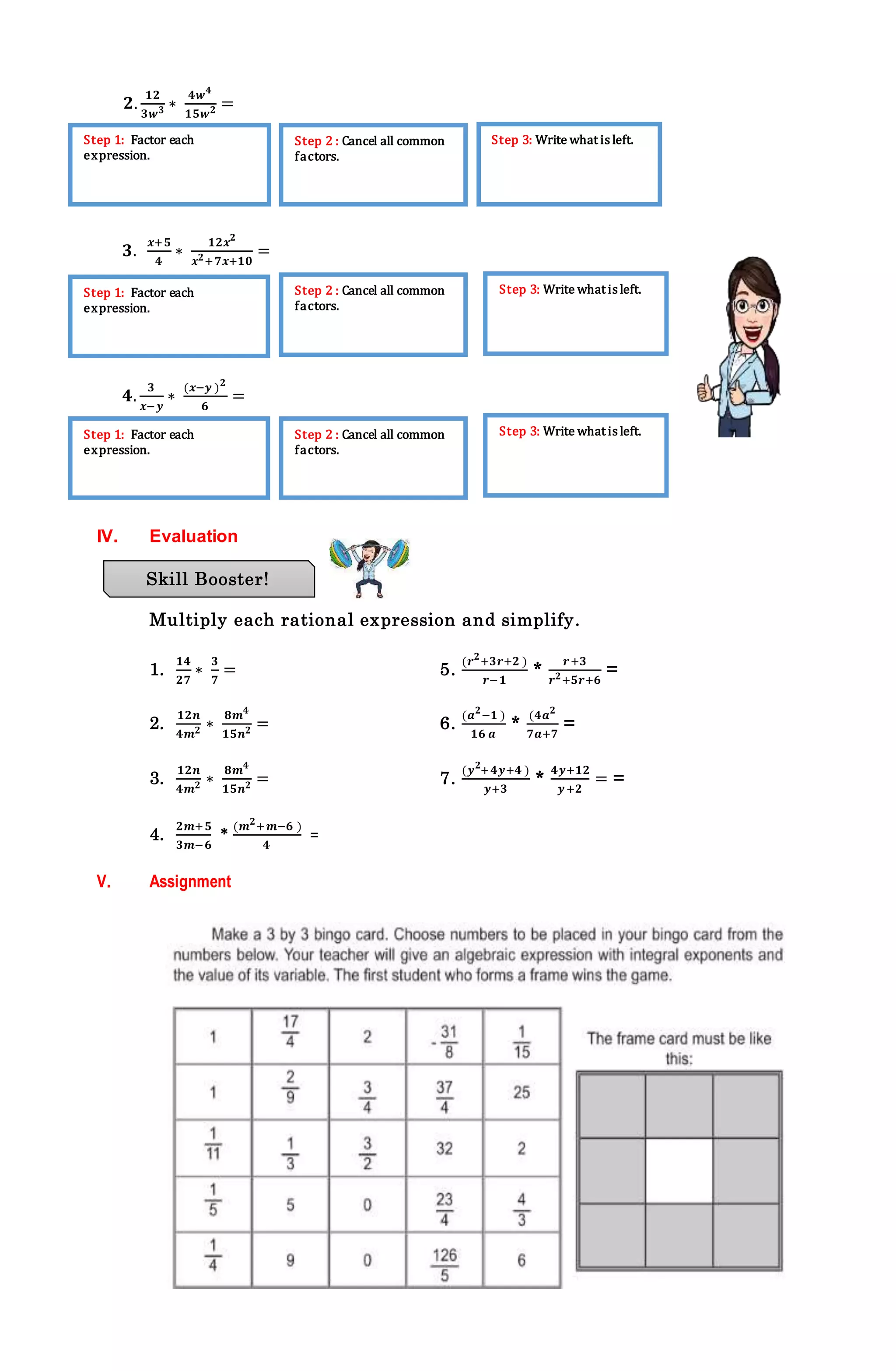
𝟐.
𝟏𝟐
𝟑𝒘 𝟑 ∗
𝟒𝒘𝟒
𝟏𝟓𝒘 𝟐 =
𝟑.
𝒙+𝟓
𝟒
∗
𝟏𝟐𝒙 𝟐
𝒙 𝟐+𝟕𝒙+𝟏𝟎
=
𝟒.
𝟑
𝒙−𝒚
∗
(𝒙−𝒚 ) 𝟐
𝟔
=
IV. Evaluation
Multiply each rational expression and simplify.
1.
𝟏𝟒
𝟐𝟕
∗
𝟑
𝟕
= 5.
(𝒓 𝟐
+𝟑𝒓+𝟐 )
𝒓−𝟏
*
𝒓+𝟑
𝒓 𝟐+𝟓𝒓+𝟔
=
2.
𝟏𝟐𝒏
𝟒𝒎 𝟐 ∗
𝟖𝒎 𝟒
𝟏𝟓𝒏 𝟐 = 6.
(𝒂 𝟐
−𝟏 )
𝟏𝟔 𝒂
*
(𝟒𝒂 𝟐
𝟕𝒂+𝟕
=
3.
𝟏𝟐𝒏
𝟒𝒎 𝟐 ∗
𝟖𝒎 𝟒
𝟏𝟓𝒏 𝟐 = 7.
(𝒚 𝟐
+𝟒𝒚+𝟒 )
𝒚+𝟑
*
𝟒𝒚+𝟏𝟐
𝒚+𝟐
= =
4.
𝟐𝒎+𝟓
𝟑𝒎−𝟔
*
(𝒎 𝟐
+𝒎−𝟔 )
𝟒
=
V. Assignment
Skill Booster!
Step 1: Factor each
expression.
Step 2 : Cancel all common
factors.
Step 3: Write what is left.
Step 1: Factor each
expression.
Step 2 : Cancel all common
factors.
Step 3: Write what is left.
Step 1: Factor each
expression.
Step 2 : Cancel all common
factors.
Step 3: Write what is left.