MATHEMATICS 10
Weeks 6-8 of Quarter 3
Lessons
✓Terms Related to Probability
✓Probability of a Simple or a Compound Event
𝑷(𝑨)
✓Probability of a Union of Two Events
𝑷(𝑨 ∪ 𝑩)
✓Probability of Independent Events
𝑷(𝑨 ∩ 𝑩)
✓Conditional Probability
𝑷 𝑨 𝑩
Some Phrases to Remember
▪ at least a number (e.g. at least 3):
3, 4, 5, 6, 7, 8, 9, 10, 11, 12…
▪ at most a number (e.g. at most 3):
0, 1, 2, 3 only
▪ divisible by a number or a multiple of a number
(e.g. divisible by 4 or multiple of 4)
4, 8, 12, 16, 20, 24, 28, 32, 36, 40, …
▪ an odd number:
1, 3, 5, 7, 9, 11, 13, 15, 17, 19, …
▪ an even number:
2, 4, 6, 8, 10, 12, 14, 16, 18, 20, …
▪ a prime number:
2, 3, 5, 7, 11, 13, 17, 19, 23, 29, …
▪ a composite number:
4, 6, 8, 9, 10, 12, 14, 15, 16, 18, …
▪ a non-prime and non-composite number: 1 only
DEFINITION OF TERMS
•Probability refers to the chance or
likelihood that an event will happen.
As a number, it lies between 0 (the event will
not happen) and 1 (the event will happen).
0 or 0%
0.25 or
1
4
or 25%
0.75 or
3
4
or 75%
1 or 100%
DEFINITION OF TERMS
•Experiment is anything that is repeatedly
do where results may vary even conditions
are similar.
tossing a coin, tossing three coins, rolling a
die, rolling two dice, tossing a coin and a die,
drawing a card from a deck of cards
DEFINITION OF TERMS
•Sample Space is the set of all possible
outcomes in an experiment.
tossing a coin:
𝑆 = {H,T)
tossing two coins:
𝑆 = {HH, TT, HT, TH}
tossing three coins:
𝑆 = {HHH, TTT, HTH, THT, HHT, TTH, HTT, THH}
rolling a die: 𝑆 = {1, 2, 3, 4, 5, 6}
rolling two dice:
𝑆 = {(1,1), (1,2), (1,3), (1,4), (1,5), (1,6), (2,1),
(2,2), (2,3), (2,4), (2,5), (2,6), (3,1), (3,2), (3,3),
(3,4), (3,5), (3,6), (4,1), (4,2), (4,3), (4,4), (4,5),
(4,6), (5,1), (5,2), (5,3), (5,4), (5,5), (5,6), (6,1),
(6,2), (6,3), (6,4), (6,5), (6,6)}
a family having 3 children:
𝑆 = {BBB, GGG, BGB, GBG, BBG, GGB, BGG, GBB}
tossing a coin and a die:
𝑆 = {H1, H2, H3, H4, H5, H6, T1, T2, T3, T4, T5, T6}
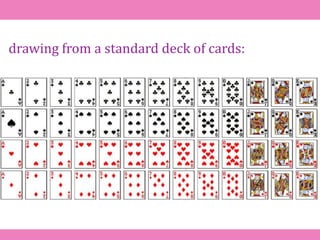
drawing from a standard deck of cards:
A standard deck of 52 cards comprises 13 ranks
in each of the four French suits: clubs ( ), spades
( ), hearts ( ), and diamonds ( ).
Each suit includes an ace, number cards (2, 3, 4, 5,
6, 7, 8, 9, 10), and face cards (king, queen, jack).
DEFINITION OF TERMS
•Event is any subset of a sample space.
getting a tail in tossing a coin:
𝐸 = {T}
getting one head and one tail in tossing two coins:
𝐸 = {HT, TH}
getting at least two heads when tossing three coins:
𝐸 = {HHH, HTH, HHT, THH}
having at most 2 girls in a family with 3 children:
𝐸 = {BBB, BGB, GBG, BBG, GGB, BGG, GBB}
:
getting both even numbers when rolling two dice:
𝐸 = {(2,2), (2,4), (2,6), (4,2), (4,4), (4,6),(6,2),
(6,4), (6,6)}
getting a head and an even number when tossing a
coin and a die:
𝐸 = {H2, H4, H6}
getting a red face card from a deck of cards:
𝐸 = { }
Experiment: selecting a letter from the word
SUPERCALIFRAGILISTICEXPIALIDOCIOUS
𝑆 ={S, U, P, E, R, C, A, L, I, F, R, A, G, I, L, I, S, T, I, C, E,
X, P, I, A, L, I, D, O, C, I, O, U, S}
𝐸 = selecting a consonant
𝐸 ={S, P, R, C, L, F, R, G, L, S, T, C, X, P, L, D, C, S}
More Examples: Sample Space (S) and Events (E)
Experiment: selecting a letter from the word
SUPERCALIFRAGILISTICEXPIALIDOCIOUS
𝑆 ={S, U, P, E, R, C, A, L, I, F, R, A, G, I, L, I, S, T, I, C, E,
X, P, I, A, L, I, D, O, C, I, O, U, S}
𝐸 = selecting a consonant
𝐸 ={S, P, R, C, L, F, R, G, L, S, T, C, X, P, L, D, C, S}
More Examples: Sample Space (S) and Events (E)
Experiment: picking a ball from a box containing
20 balls numbered 1 to 20
𝑆 ={1, 2, 3, 4, 5, 6, 7, 8, 9, 10, 11, 12, 13, 14, 15, 16,
17, 18, 19, 20}
𝐸 = picking a composite number
𝐸 ={4, 6, 8, 9, 10, 12, 14, 15, 16, 18, 20}
More Examples: Sample Space (S) and Events (E)
Experiment: tossing two coins
𝑆 = {HH, TT, HT, TH}
𝐸 = getting a head and a tail
𝐸 = {HT, TH}
Experiment: tossing three coins
𝑆 = {HHH, TTT, HTH, THT, HHT, TTH, HTT, THH}
𝐸 = getting at least 2 heads
𝐸 = {HHH, HTH, HHT, THH}
Experiment: rolling a die
𝑆 = {1, 2, 3, 4, 5, 6}
𝐸 = getting an odd number
𝐸 = {1, 3, 5, }
More Examples: Sample Space (S) and Events (E)
Experiment: rolling two dice
𝑆 = {(1,1), (1,2), (1,3), (1,4), (1,5), (1,6), (2,1), (2,2),
(2,3), (2,4), (2,5), (2,6), (3,1), (3,2), (3,3), (3,4),
(3,5), (3,6), (4,1), (4,2), (4,3), (4,4), (4,5), (4,6),
(5,1), (5,2), (5,3), (5,4), (5,5), (5,6), (6,1), (6,2),
(6,3), (6,4), (6,5), (6,6)}
E = the first die shows an even number, and the
second die shows a number divisible by 3
𝐸 = (2,3), (2,6), (4,3), (4,6), (6,3), (6,6)}
More Examples: Sample Space (S) and Events (E)
Experiment: choosing a child from a family
having 3 children
𝑆 = {BBB, GGG, BGB, GBG, BBG, GGB, BGG, GBB}
𝐸 = getting at most 2 girls
𝐸 = {BBB, BGB, GBG, BBG, GGB, BGG, GBB}
Experiment: tossing a coin and a die
𝑆 = {H1, H2, H3, H4, H5, H6, T1, T2, T3, T4, T5, T6}
𝐸 = getting a tail and a prime number
𝐸 = {T2, T3, T5,}
More Examples: Sample Space (S) and Events (E)
Experiment:
drawing from a standard deck of cards
𝐸 = drawing a black number card
𝐸 = drawing an ace
𝐸 = drawing a club
𝐸 = drawing a red face card
𝐸 = drawing a red card
𝐸 = drawing a jack
𝐸 = drawing a 3
𝐸 = drawing a spade
𝐸 = drawing a black king
𝐸 = drawing a red queen
𝐸 = drawing a number card
(52)
(18)
(4)
(13)
(6)
(26)
(4)
(4)
(13)
(2)
(2)
(36)
More Examples: Sample Space (S) and Events (E)
Cardinality:
DEFINITION OF TERMS
•Sure event is an event whose outcome must
occur. Probability is 1.
✓getting a counting number less than 7 when a die
is rolled
✓selecting a vowel letter from the word EUOUAE
•Impossible event is an event whose
outcome must not occur. Probability is 0.
✓getting a 7 when a die is rolled
✓selecting a vowel letter from the word RHYTHMS
DEFINITION OF TERMS
•Sample point is an outcome of an
experiment.
H, T, HH, TT, HT, TH, HHH, TTT, HTH, THT, HHT,
TTH, HTT, THH, 1, 2, 3, 4, 5, 6, (1,1), (1,2), (1,3),
(1,4), (1,5), (1,6), (2,1), (2,2), (2,3), (2,4), (2,5),
(2,6), (3,3), (4,4), (5,5) (6,6), H1, H2, H3, H4, H5,
H6, T1, T2, T3, T4, T5, T6, BBB, GGG, BGB, GBG,
BBG, GGB, BGG, GBB
•Cardinality is the number of outcomes in a
sample space or in an event.
Cardinality of a Sample Space or an Event:
• tossing a coin: 2
• tossing two coins: 4
• tossing three coins: 8
• rolling a die: 6
• rolling two dice: 36
• tossing a coin and a die: 12
• drawing a card from a deck of cards: 52
• getting one head in tossing two coins: 2
• getting at least two heads (tossing three coins): 4
• getting both even numbers (rolling two dice): 9
• having at most 2 girls (family with 3 children): 7
• drawing a red face card from a deck of cards: 6
•Simple event is an event with only one
outcome.
✓selecting a vowel letter in the word ANGRY
✓getting a non-prime and non-composite number
when rolling a die
•Compound event is an event with more than
one outcome.
✓selecting a consonant in the word BIRD
✓getting two numbers with a sum greater than 5
when rolling two dice
PROBABILITY OF
simple and compound EVENTS
𝑃 𝐸 =
number of favorable outcomes
number of possible outcomes
1. What is the probability of selecting a month of
the year with a letter “J” in its name?
𝑃 𝐸 =
3
12
=
𝟏
𝟒
2. What is choosing a vowel letter in the word
COPYRIGHTABLE?
𝑃 𝐸 =
𝟒
𝟏𝟑
PROBABILITY OF
simple and compound EVENTS
3. A box contains 6 red marbles, 4 orange
marbles, 3 yellow marbles, 5 green marbles,
and 2 blue marbles. What is the probability of
drawing a green marble?
5
20
=
𝟏
𝟒
4. There are 45 students in a class. 20 of them
are boys. If a student is selected at random for
a field trip, what is the probability of selecting
a girl?
25
45
=
𝟓
𝟗
5. There are 3 green chips, 5 orange chips, 2 red
chips, 4 yellow chips, and 6 blue chips in a jar.
A chip is to be drawn from the jar. What is the
probability that it is a color that is not
orange?
15
20
=
𝟑
𝟒
6. getting at least one tail when tossing two
coins?
𝟑
𝟒
7. getting a perfect square number when a die is
rolled?
2
6
=
𝟏
𝟑
8. having a girl as the youngest child in a family
with three children?
4
8
=
𝟏
𝟐
9. getting two numbers with a sum greater than
8 when rolling two dice?
10
36
=
𝟓
𝟏𝟖
10.drawing a black number card from a deck?
18
52
=
𝟗
𝟐𝟔
UNION AND INTERSECTION
OF EVENTS
• Event is a subset of the sample space.
• The union of events is the set of all outcomes
which belong to either first event or second
event or both. The union of events 𝐴 and 𝐵 is
denoted by 𝑨 ∪ 𝑩 (𝐴 or 𝐵).
• The intersection of events is the set of all
outcomes which belong to both events. The
intersection of events 𝐴 and 𝐵 is denoted by
𝑨 ∩ 𝑩 (𝐴 and 𝐵).
UNION AND INTERSECTION
OF EVENTS
A ball is picked from a box containing 20 balls
numbered from 1 to 20. Give the outcomes of
the two events.
𝐴 = the event of getting an even number
{2, 4, 6, 8, 10, 12, 14, 16, 18, 20}
𝐵 = the event of getting a composite number
{4, 6, 8, 9, 10, 12, 14, 15, 16, 18, 20}
UNION AND INTERSECTION
OF EVENTS
List the following:
1. outcomes found in either event 𝐴 or set 𝐵 or
both. (𝑨 ∪ 𝑩)
{2, 4, 6, 8, 9, 10, 12, 14, 15, 16, 18, 20}
2. outcomes found both in event 𝐴 and event 𝐵.
(𝑨 ∩ 𝑩)
{4, 6, 8, 10, 12, 14, 16, 18, 20}
Mutually exclusive events are events that do
not occur at the same time.
They are also called disjoint events since they
do not happen simultaneously.
MUTUALLY EXCLUSIVE EVENTS
Mutually Exclusive Events
Non Mutually Exclusive
Events
1. getting an odd number
or an even number when
rolling a die
2. picking a ball that shows a
number greater than 16
or a perfect square
number from a box of 20
balls numbered 1 to 20.
3. getting an ace or a
number card when
drawing a card from a
standard deck of cards
1. getting an odd number or
a prime number when
rolling a die
2. picking a ball that shows a
number less than 16 or a
number divisible by 5
from a box of 20 balls
numbered 1 to 20.
3. getting an ace or a black
card when drawing a card
from a standard deck of
cards
A chip is picked from a bowl containing 25 chips
numbered from 1 to 25. Give the outcomes of the
two events.
𝐴 = the event of getting a number divisible by 5
{5, 10, 15, 20, 25}
𝐵 = the event of getting a number divisible by 6
{6, 12, 18, 24}
MUTUALLY EXCLUSIVE OR NOT?
They are mutually exclusive. There is no 𝐴 ∩ 𝐵.
A ball is picked from a box containing 20 balls
numbered from 1 to 20. Give the outcomes of
the two events.
𝐴 = the event of getting an odd number
{1, 3, 5, 7, 9, 11, 13, 15, 17, 19}
𝐵 = the event of getting a prime number
{2, 3, 5, 7, 11, 13, 17, 19}
MUTUALLY EXCLUSIVE OR NOT?
They are not mutually exclusive. It is because
there is 𝐴 ∩ 𝐵 = {3, 5, 7, 11, 13, 17, 19}.
A card is drawn from a deck of 52 cards.
𝐴 = the event of drawing a spade
𝐵 = the event of drawing a face card
MUTUALLY EXCLUSIVE OR NOT?
They are not mutually exclusive. There is 𝐴 ∩ 𝐵.
A card is drawn from a
standard deck of cards.
𝐴 = the event of
drawing an ace
𝐵 = the event of
drawing a number card
MUTUALLY EXCLUSIVE OR NOT?
They are mutually exclusive. There is no 𝐴 ∩ 𝐵.
Two dice are rolled.
𝐴 = the event of getting two numbers whose sum
is greater than 6
{(1,6), (2,5), (2,6), (3,4), (3,5), (3,6), (4,3),
(4,4), (4,5), (4,6), (5,2), (5,3), (5,4), (5,5),
(5,6), (6,1), (6,2), (6,3), (6,4), (6,5), (6,6)}
𝐵 = the event that the first numbers is odd, and
the second number is even
{(1,2), (1,4), (1,6), (3,2), (3,4), (3,6), (5,2),
(5,4), (5,6)
MUTUALLY EXCLUSIVE OR NOT?
They are not mutually exclusive.
PROBABILITY OF
A UNION OF TWO EVENTS
• If 𝐴 and 𝐵 are events in the same sample space,
then the probability of 𝐴 or 𝐵 occurring is:
𝑃 𝐴 𝑜𝑟 𝐵 = 𝑃 𝐴 ∪ 𝐵
= 𝑷 𝑨 + 𝑷 𝑩 − 𝑷(𝑨 ∩ 𝑩)
• If 𝐴 ∩ 𝐵 is an empty set, then 𝐴 and 𝐵 are
mutually exclusive events:
𝑃 𝐴 𝑜𝑟 𝐵 = 𝑃 𝐴 ∪ 𝐵
= 𝑷 𝑨 + 𝑷 𝑩
PROBABILITY OF
A UNION OF TWO EVENTS
PROBABILITY OF
A Union of two events
1. What is the probability of getting a number less
than 5 or a number divisible by 3 when a die is
rolled?
𝑃(𝐴) getting a number less than 5 {1,2, 3, 4}
4
6
𝑃(𝐵) getting a number divisible by 3 {3, 6}
2
6
𝑃 𝐴 ∩ 𝐵 getting both
less than 5 and divisible by 3 {3}
1
6
𝑷 𝑨 ∪ 𝑩 =
4
6
+
2
6
−
1
6
=
𝟓
𝟔
PROBABILITY OF
A Union of two events
2. What is the probability of getting a prime
number or an odd number in the rolling of a
die?
𝑃(𝐴) getting a prime number {2, 3, 5}
3
6
𝑃(𝐵) getting an odd number {1, 3, 5}
3
6
𝑃 𝐴 ∩ 𝐵 getting both prime and odd {3, 5}
2
6
𝑷 𝑨 ∪ 𝑩 =
3
6
+
3
6
−
2
6
=
4
6
=
𝟐
𝟑
PROBABILITY OF
A Union of two events
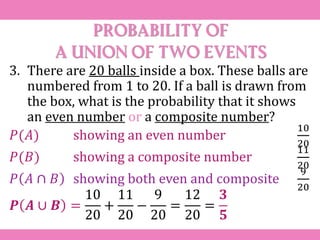
3. There are 20 balls inside a box. These balls are
numbered from 1 to 20. If a ball is drawn from
the box, what is the probability that it shows
an even number or a composite number?
𝑃(𝐴) showing an even number
10
20
𝑃(𝐵) showing a composite number
11
20
𝑃 𝐴 ∩ 𝐵 showing both even and composite
9
20
𝑷 𝑨 ∪ 𝑩 =
10
20
+
11
20
−
9
20
=
12
20
=
𝟑
𝟓
PROBABILITY OF
A Union of two events
4. In a deck of 52 cards, what is the probability of
drawing a red card or a face card?
𝑃(𝐴) drawing a red card
26
52
𝑃(𝐵) drawing a face card
12
52
𝐴 ∩ 𝐵 drawing both a red card
and a face card
6
52
𝑷 𝑨 ∪ 𝑩 =
26
52
+
12
52
−
6
52
=
32
52
=
𝟖
𝟏𝟑
PROBABILITY OF
A Union of two events
5. In a standard deck of cards, what is the
probability of drawing an ace or a black jack?
𝑃(𝐴) drawing an ace
4
52
𝑃(𝐵) drawing a black jack
2
52
𝑃 𝐴 ∩ 𝐵 drawing both an ace & a black jack 0
𝑷 𝑨 ∪ 𝑩 =
4
52
+
2
52
=
6
52
=
𝟑
𝟐𝟔
PROBABILITY OF
Independent events
• If 𝐴 and 𝐵 are independent events, the
probability that both events 𝐴 and 𝐵 occur is the
product of their individual probabilities.
𝑷 𝑨 𝒂𝒏𝒅 𝑩 = 𝑷 𝑨 ∩ 𝑩 = 𝑷 𝑨 ∙ 𝑷 𝑩
• Two events are independent if the occurrence or
non-occurrence of one event does not affect the
probability of occurrence of the other event.
PROBABILITY OF
Independent events
o tossing of a coin and a die
o tossing of two coins
o tossing of three coins
o rolling of two dice
o drawing two balls, one at a time and with
replacement from a box
o drawing two cards, one at a time with
replacement, from a standard deck of cards
PROBABILITY OF
Independent events
1. Two letters will be chosen from the words
“word” and “games”. The first letter will come
from “word” and the second letter will come
from “games”. What is the probability that the
first letter is a consonant and the second letter
is a vowel?
𝑃(𝐴) choosing a consonant letter (1st word: word)
𝟑
𝟒
𝑃(𝐵) choosing a vowel letter (2nd word: games)
𝟐
𝟓
𝑷 𝑨 ∩ 𝑩 =
3
4
∙
2
5
=
6
20
=
𝟑
𝟏𝟎
PROBABILITY OF
Independent events
2. If two dice are rolled, what is the probability
that a number divisible by 3 appears on the
first die and an even number appears on the
second die?
𝑃(𝐴) getting a number divisible by 3 (1st die)
2
6
or
𝟏
𝟑
𝑃(𝐵) getting an even number (2nd die)
3
6
or
𝟏
𝟐
𝑷 𝑨 ∩ 𝑩 =
1
3
∙
1
2
=
𝟏
𝟔
PROBABILITY OF
Independent events
3. If a coin and a die are tossed, what is the
probability of getting a head and an odd
number?
𝑃(𝐴) getting a head (coin)
𝟏
𝟐
𝑃(𝐵) getting an odd number (die)
3
6
or
𝟏
𝟐
𝑷 𝑨 ∩ 𝑩 =
1
2
∙
1
2
=
𝟏
𝟒
PROBABILITY OF
Independent events
4. The probability that Rodrigo will pass the
exam is
3
5
. The probability that Antonio will
pass the same exam is
5
6
. If each of them takes
the exam, what is the probability that:
a. both Rodrigo and Antonio will pass.
b. Rodrigo will pass and Antonio will fail.
c. Antonio will pass and Rodrigo will fail.
d. one of the two will pass. (Rodrigo or Antonio)
e. both Rodrigo and Antonio will fail.
a. both Rodrigo and Antonio will pass.
3
5
∙
5
6
=
15
30
=
𝟏
𝟐
b. Rodrigo will pass and Antonio will fail.
3
5
∙
1
6
=
3
30
=
𝟏
𝟏𝟎
c. Antonio will pass and Rodrigo will fail.
5
6
∙
2
5
=
10
30
=
𝟏
𝟑
d. one of the two will pass. (Rodrigo or Antonio)
1
10
+
1
3
=
𝟏𝟑
𝟑𝟎
e. both Rodrigo and Antonio will fail.
2
5
∙
1
6
=
2
30
=
𝟏
𝟏𝟓
PROBABILITY OF
Independent events
5. A large box contains 3 green balls and 6 red
balls. Two balls are drawn at random from the
box, one at a time and with replacement. What
is the probability that the first ball drawn is
green and the second ball drawn is red?
𝑃(𝐴) drawing a green ball (1st ball)
3
9
or
𝟏
𝟑
(𝐵) drawing a red ball (2nd ball)
6
9
or
𝟐
𝟑
𝑷 𝑨 ∩ 𝑩 =
1
3
∙
2
3
=
𝟐
𝟗
PROBABILITY OF
dependent events
6. A large box contains 3 green balls and 6 red
balls. Two balls are drawn at random from the
box, one at a time and without replacement.
What is the probability that the first ball
drawn is green and the second ball drawn is
red?
𝑃(𝐴) drawing a green ball (1st ball)
3
9
or
𝟏
𝟑
P(𝐵) drawing a red ball (2nd ball)
6
8
or
𝟑
𝟒
𝑷 𝑨 ∩ 𝑩 =
1
3
∙
3
4
=
3
12
=
𝟏
𝟒
Conditional probability
• Conditional probability is the probability that
an event will occur given that another event has
already occurred.
• If 𝐴 and 𝐵 are any events, then
𝑃 𝐴 𝐵 =
𝑃(𝐴 𝑎𝑛𝑑 𝐵)
𝑃(𝐵)
𝑷 𝑨 𝑩 =
𝑷(𝑨 ∩ 𝑩)
𝑷(𝑩)
𝑃 𝐴 𝐵 is read as “the probability of A given B”.
Conditional probability
1. The probability that Leni studies and passes
her summative test in Math is
3
5
. If the
probability that she studies is
9
10
, what is the
probability that she passes her summative test,
given that she studied?
𝑃(𝐴) passes (not given)
𝑃(𝐵) studies
9
10
𝑃(𝐴 ∩ 𝐵) studies and passes
3
5
𝑷 𝑨 𝑩 =
3
5
9
10
=
30
45
=
𝟐
𝟑
Conditional probability
2. When two dice are rolled, what is the
probability that the sum of the numbers
appeared is 7 if it is known that one of the
numbers is 3?
𝑃(𝐴) sum of the numbers is 7
6
36
or
𝟏
𝟔
𝑃(𝐵) one of the numbers is 3
𝟏𝟏
𝟑𝟔
𝑃(𝐴 ∩ 𝐵) sum is 7 & one number is 3
2
36
or
𝟏
𝟏𝟖
𝑷 𝑨 𝑩 =
1
18
11
36
=
36
198
=
𝟐
𝟏𝟏
Conditional probability
3. In rolling two dice, what is the probability that
both numbers appeared are even given that the
product of the two numbers is 12?
𝑃(𝐴) both numbers are even
9
36
or
𝟏
𝟒
𝑃(𝐵) product is 12
4
36
or
𝟏
𝟗
𝑃(𝐴 ∩ 𝐵) both are even & product is 12
2
36
or
𝟏
𝟏𝟖
𝑷 𝑨 𝑩 =
1
18
1
9
=
9
18
=
𝟏
𝟐
Conditional probability
4. A card is drawn from a deck of 52 cards. What
is the probability that it is a black queen if it is
known that the card is a spade?
𝑃(𝐴) black queen
2
52
or
𝟏
𝟐𝟔
𝑃(𝐵) spade
13
52
or
𝟏
𝟒
𝑃(𝐴 ∩ 𝐵) both black queen and spade
𝟏
𝟓𝟐
𝑷 𝑨 𝑩 =
1
52
1
4
=
4
52
=
𝟏
𝟏𝟑
Conditional probability
5. In a bowl, there are 20 chips numbered from 1
to 20. If a chip is drawn, what is the probability
that the chip shows an even number given that
it is a composite number?
𝑃(𝐴) even number
10
20
or
𝟏
𝟐
𝑃(𝐵) composite number
𝟏𝟏
𝟐𝟎
𝑃(𝐴 ∩ 𝐵) both even and composite
𝟗
𝟐𝟎
𝑷 𝑨 𝑩 =
9
20
11
20
=
180
220
=
𝟗
𝟏𝟏
Here are simple explanations for item
numbers 2 to 5 on how to obtain the
conditional probability in an easy way.
Conditional probability
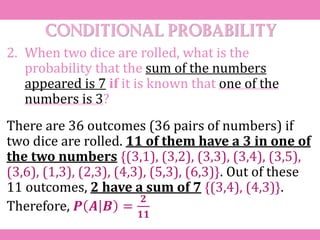
2. When two dice are rolled, what is the
probability that the sum of the numbers
appeared is 7 if it is known that one of the
numbers is 3?
There are 36 outcomes (36 pairs of numbers) if
two dice are rolled. 11 of them have a 3 in one of
the two numbers {(3,1), (3,2), (3,3), (3,4), (3,5),
(3,6), (1,3), (2,3), (4,3), (5,3), (6,3)}. Out of these
11 outcomes, 2 have a sum of 7 {(3,4), (4,3)}.
Therefore, 𝑷 𝑨 𝑩 =
𝟐
𝟏𝟏
Conditional probability
3. In rolling two dice, what is the probability that
both numbers appeared are even given that the
product of the two numbers is 12?
There are 36 outcomes (pairs of numbers) when
two dice are rolled. There are 4 outcomes where
the product of the two numbers is 12 {(2,6), (6,2),
(3,4), (4,3)}. Out of these 4 outcomes, there are 2
where both numbers are even {(2,6), (6,2)}. So,
𝑷 𝑨 𝑩 =
𝟐
𝟒
=
𝟏
𝟐
Conditional probability
4. A card is drawn from a deck of 52 cards. What
is the probability that it is a black queen if it is
known that the card is a spade?
From a deck of 52 cards, there are 13 spades. Out
of these 13, there is 1 black queen.
Hence, 𝑷 𝑨 𝑩 =
𝟏
𝟏𝟑
Conditional probability
5. In a bowl, there are 20 chips numbered from 1
to 20. If a chip is drawn, what is the probability
that the chip shows an even number given that
it is a composite number?
From 1 to 20, there are 11 composite numbers
{4, 6, 8, 9, 10, 12, 14, 15, 16, 18, 20}. Out of these
11 composite numbers, 9 are even numbers {4,
6, 8, 10, 12, 14, 16, 18, 20}. Thus, 𝑷 𝑨 𝑩 =
𝟗
𝟏𝟏

Probability

  • 1.
  • 2.
    Lessons ✓Terms Related toProbability ✓Probability of a Simple or a Compound Event 𝑷(𝑨) ✓Probability of a Union of Two Events 𝑷(𝑨 ∪ 𝑩) ✓Probability of Independent Events 𝑷(𝑨 ∩ 𝑩) ✓Conditional Probability 𝑷 𝑨 𝑩
  • 3.
    Some Phrases toRemember ▪ at least a number (e.g. at least 3): 3, 4, 5, 6, 7, 8, 9, 10, 11, 12… ▪ at most a number (e.g. at most 3): 0, 1, 2, 3 only ▪ divisible by a number or a multiple of a number (e.g. divisible by 4 or multiple of 4) 4, 8, 12, 16, 20, 24, 28, 32, 36, 40, … ▪ an odd number: 1, 3, 5, 7, 9, 11, 13, 15, 17, 19, … ▪ an even number: 2, 4, 6, 8, 10, 12, 14, 16, 18, 20, … ▪ a prime number: 2, 3, 5, 7, 11, 13, 17, 19, 23, 29, … ▪ a composite number: 4, 6, 8, 9, 10, 12, 14, 15, 16, 18, … ▪ a non-prime and non-composite number: 1 only
  • 5.
    DEFINITION OF TERMS •Probabilityrefers to the chance or likelihood that an event will happen. As a number, it lies between 0 (the event will not happen) and 1 (the event will happen). 0 or 0% 0.25 or 1 4 or 25% 0.75 or 3 4 or 75% 1 or 100%
  • 6.
    DEFINITION OF TERMS •Experimentis anything that is repeatedly do where results may vary even conditions are similar. tossing a coin, tossing three coins, rolling a die, rolling two dice, tossing a coin and a die, drawing a card from a deck of cards
  • 7.
    DEFINITION OF TERMS •SampleSpace is the set of all possible outcomes in an experiment. tossing a coin: 𝑆 = {H,T) tossing two coins: 𝑆 = {HH, TT, HT, TH} tossing three coins: 𝑆 = {HHH, TTT, HTH, THT, HHT, TTH, HTT, THH} rolling a die: 𝑆 = {1, 2, 3, 4, 5, 6}
  • 8.
    rolling two dice: 𝑆= {(1,1), (1,2), (1,3), (1,4), (1,5), (1,6), (2,1), (2,2), (2,3), (2,4), (2,5), (2,6), (3,1), (3,2), (3,3), (3,4), (3,5), (3,6), (4,1), (4,2), (4,3), (4,4), (4,5), (4,6), (5,1), (5,2), (5,3), (5,4), (5,5), (5,6), (6,1), (6,2), (6,3), (6,4), (6,5), (6,6)} a family having 3 children: 𝑆 = {BBB, GGG, BGB, GBG, BBG, GGB, BGG, GBB} tossing a coin and a die: 𝑆 = {H1, H2, H3, H4, H5, H6, T1, T2, T3, T4, T5, T6}
  • 9.
    drawing from astandard deck of cards:
  • 10.
    A standard deckof 52 cards comprises 13 ranks in each of the four French suits: clubs ( ), spades ( ), hearts ( ), and diamonds ( ). Each suit includes an ace, number cards (2, 3, 4, 5, 6, 7, 8, 9, 10), and face cards (king, queen, jack).
  • 11.
    DEFINITION OF TERMS •Eventis any subset of a sample space. getting a tail in tossing a coin: 𝐸 = {T} getting one head and one tail in tossing two coins: 𝐸 = {HT, TH} getting at least two heads when tossing three coins: 𝐸 = {HHH, HTH, HHT, THH} having at most 2 girls in a family with 3 children: 𝐸 = {BBB, BGB, GBG, BBG, GGB, BGG, GBB} :
  • 12.
    getting both evennumbers when rolling two dice: 𝐸 = {(2,2), (2,4), (2,6), (4,2), (4,4), (4,6),(6,2), (6,4), (6,6)} getting a head and an even number when tossing a coin and a die: 𝐸 = {H2, H4, H6} getting a red face card from a deck of cards: 𝐸 = { }
  • 13.
    Experiment: selecting aletter from the word SUPERCALIFRAGILISTICEXPIALIDOCIOUS 𝑆 ={S, U, P, E, R, C, A, L, I, F, R, A, G, I, L, I, S, T, I, C, E, X, P, I, A, L, I, D, O, C, I, O, U, S} 𝐸 = selecting a consonant 𝐸 ={S, P, R, C, L, F, R, G, L, S, T, C, X, P, L, D, C, S} More Examples: Sample Space (S) and Events (E)
  • 14.
    Experiment: selecting aletter from the word SUPERCALIFRAGILISTICEXPIALIDOCIOUS 𝑆 ={S, U, P, E, R, C, A, L, I, F, R, A, G, I, L, I, S, T, I, C, E, X, P, I, A, L, I, D, O, C, I, O, U, S} 𝐸 = selecting a consonant 𝐸 ={S, P, R, C, L, F, R, G, L, S, T, C, X, P, L, D, C, S} More Examples: Sample Space (S) and Events (E)
  • 15.
    Experiment: picking aball from a box containing 20 balls numbered 1 to 20 𝑆 ={1, 2, 3, 4, 5, 6, 7, 8, 9, 10, 11, 12, 13, 14, 15, 16, 17, 18, 19, 20} 𝐸 = picking a composite number 𝐸 ={4, 6, 8, 9, 10, 12, 14, 15, 16, 18, 20} More Examples: Sample Space (S) and Events (E)
  • 16.
    Experiment: tossing twocoins 𝑆 = {HH, TT, HT, TH} 𝐸 = getting a head and a tail 𝐸 = {HT, TH} Experiment: tossing three coins 𝑆 = {HHH, TTT, HTH, THT, HHT, TTH, HTT, THH} 𝐸 = getting at least 2 heads 𝐸 = {HHH, HTH, HHT, THH} Experiment: rolling a die 𝑆 = {1, 2, 3, 4, 5, 6} 𝐸 = getting an odd number 𝐸 = {1, 3, 5, } More Examples: Sample Space (S) and Events (E)
  • 17.
    Experiment: rolling twodice 𝑆 = {(1,1), (1,2), (1,3), (1,4), (1,5), (1,6), (2,1), (2,2), (2,3), (2,4), (2,5), (2,6), (3,1), (3,2), (3,3), (3,4), (3,5), (3,6), (4,1), (4,2), (4,3), (4,4), (4,5), (4,6), (5,1), (5,2), (5,3), (5,4), (5,5), (5,6), (6,1), (6,2), (6,3), (6,4), (6,5), (6,6)} E = the first die shows an even number, and the second die shows a number divisible by 3 𝐸 = (2,3), (2,6), (4,3), (4,6), (6,3), (6,6)} More Examples: Sample Space (S) and Events (E)
  • 18.
    Experiment: choosing achild from a family having 3 children 𝑆 = {BBB, GGG, BGB, GBG, BBG, GGB, BGG, GBB} 𝐸 = getting at most 2 girls 𝐸 = {BBB, BGB, GBG, BBG, GGB, BGG, GBB} Experiment: tossing a coin and a die 𝑆 = {H1, H2, H3, H4, H5, H6, T1, T2, T3, T4, T5, T6} 𝐸 = getting a tail and a prime number 𝐸 = {T2, T3, T5,} More Examples: Sample Space (S) and Events (E)
  • 19.
    Experiment: drawing from astandard deck of cards 𝐸 = drawing a black number card 𝐸 = drawing an ace 𝐸 = drawing a club 𝐸 = drawing a red face card 𝐸 = drawing a red card 𝐸 = drawing a jack 𝐸 = drawing a 3 𝐸 = drawing a spade 𝐸 = drawing a black king 𝐸 = drawing a red queen 𝐸 = drawing a number card (52) (18) (4) (13) (6) (26) (4) (4) (13) (2) (2) (36) More Examples: Sample Space (S) and Events (E) Cardinality:
  • 20.
    DEFINITION OF TERMS •Sureevent is an event whose outcome must occur. Probability is 1. ✓getting a counting number less than 7 when a die is rolled ✓selecting a vowel letter from the word EUOUAE •Impossible event is an event whose outcome must not occur. Probability is 0. ✓getting a 7 when a die is rolled ✓selecting a vowel letter from the word RHYTHMS
  • 21.
    DEFINITION OF TERMS •Samplepoint is an outcome of an experiment. H, T, HH, TT, HT, TH, HHH, TTT, HTH, THT, HHT, TTH, HTT, THH, 1, 2, 3, 4, 5, 6, (1,1), (1,2), (1,3), (1,4), (1,5), (1,6), (2,1), (2,2), (2,3), (2,4), (2,5), (2,6), (3,3), (4,4), (5,5) (6,6), H1, H2, H3, H4, H5, H6, T1, T2, T3, T4, T5, T6, BBB, GGG, BGB, GBG, BBG, GGB, BGG, GBB •Cardinality is the number of outcomes in a sample space or in an event.
  • 22.
    Cardinality of aSample Space or an Event: • tossing a coin: 2 • tossing two coins: 4 • tossing three coins: 8 • rolling a die: 6 • rolling two dice: 36 • tossing a coin and a die: 12 • drawing a card from a deck of cards: 52 • getting one head in tossing two coins: 2 • getting at least two heads (tossing three coins): 4 • getting both even numbers (rolling two dice): 9 • having at most 2 girls (family with 3 children): 7 • drawing a red face card from a deck of cards: 6
  • 24.
    •Simple event isan event with only one outcome. ✓selecting a vowel letter in the word ANGRY ✓getting a non-prime and non-composite number when rolling a die •Compound event is an event with more than one outcome. ✓selecting a consonant in the word BIRD ✓getting two numbers with a sum greater than 5 when rolling two dice
  • 25.
    PROBABILITY OF simple andcompound EVENTS 𝑃 𝐸 = number of favorable outcomes number of possible outcomes
  • 26.
    1. What isthe probability of selecting a month of the year with a letter “J” in its name? 𝑃 𝐸 = 3 12 = 𝟏 𝟒 2. What is choosing a vowel letter in the word COPYRIGHTABLE? 𝑃 𝐸 = 𝟒 𝟏𝟑 PROBABILITY OF simple and compound EVENTS
  • 27.
    3. A boxcontains 6 red marbles, 4 orange marbles, 3 yellow marbles, 5 green marbles, and 2 blue marbles. What is the probability of drawing a green marble? 5 20 = 𝟏 𝟒 4. There are 45 students in a class. 20 of them are boys. If a student is selected at random for a field trip, what is the probability of selecting a girl? 25 45 = 𝟓 𝟗
  • 28.
    5. There are3 green chips, 5 orange chips, 2 red chips, 4 yellow chips, and 6 blue chips in a jar. A chip is to be drawn from the jar. What is the probability that it is a color that is not orange? 15 20 = 𝟑 𝟒 6. getting at least one tail when tossing two coins? 𝟑 𝟒
  • 29.
    7. getting aperfect square number when a die is rolled? 2 6 = 𝟏 𝟑 8. having a girl as the youngest child in a family with three children? 4 8 = 𝟏 𝟐
  • 30.
    9. getting twonumbers with a sum greater than 8 when rolling two dice? 10 36 = 𝟓 𝟏𝟖 10.drawing a black number card from a deck? 18 52 = 𝟗 𝟐𝟔
  • 32.
    UNION AND INTERSECTION OFEVENTS • Event is a subset of the sample space. • The union of events is the set of all outcomes which belong to either first event or second event or both. The union of events 𝐴 and 𝐵 is denoted by 𝑨 ∪ 𝑩 (𝐴 or 𝐵). • The intersection of events is the set of all outcomes which belong to both events. The intersection of events 𝐴 and 𝐵 is denoted by 𝑨 ∩ 𝑩 (𝐴 and 𝐵).
  • 33.
    UNION AND INTERSECTION OFEVENTS A ball is picked from a box containing 20 balls numbered from 1 to 20. Give the outcomes of the two events. 𝐴 = the event of getting an even number {2, 4, 6, 8, 10, 12, 14, 16, 18, 20} 𝐵 = the event of getting a composite number {4, 6, 8, 9, 10, 12, 14, 15, 16, 18, 20}
  • 34.
    UNION AND INTERSECTION OFEVENTS List the following: 1. outcomes found in either event 𝐴 or set 𝐵 or both. (𝑨 ∪ 𝑩) {2, 4, 6, 8, 9, 10, 12, 14, 15, 16, 18, 20} 2. outcomes found both in event 𝐴 and event 𝐵. (𝑨 ∩ 𝑩) {4, 6, 8, 10, 12, 14, 16, 18, 20}
  • 35.
    Mutually exclusive eventsare events that do not occur at the same time. They are also called disjoint events since they do not happen simultaneously. MUTUALLY EXCLUSIVE EVENTS
  • 36.
    Mutually Exclusive Events NonMutually Exclusive Events 1. getting an odd number or an even number when rolling a die 2. picking a ball that shows a number greater than 16 or a perfect square number from a box of 20 balls numbered 1 to 20. 3. getting an ace or a number card when drawing a card from a standard deck of cards 1. getting an odd number or a prime number when rolling a die 2. picking a ball that shows a number less than 16 or a number divisible by 5 from a box of 20 balls numbered 1 to 20. 3. getting an ace or a black card when drawing a card from a standard deck of cards
  • 37.
    A chip ispicked from a bowl containing 25 chips numbered from 1 to 25. Give the outcomes of the two events. 𝐴 = the event of getting a number divisible by 5 {5, 10, 15, 20, 25} 𝐵 = the event of getting a number divisible by 6 {6, 12, 18, 24} MUTUALLY EXCLUSIVE OR NOT? They are mutually exclusive. There is no 𝐴 ∩ 𝐵.
  • 38.
    A ball ispicked from a box containing 20 balls numbered from 1 to 20. Give the outcomes of the two events. 𝐴 = the event of getting an odd number {1, 3, 5, 7, 9, 11, 13, 15, 17, 19} 𝐵 = the event of getting a prime number {2, 3, 5, 7, 11, 13, 17, 19} MUTUALLY EXCLUSIVE OR NOT? They are not mutually exclusive. It is because there is 𝐴 ∩ 𝐵 = {3, 5, 7, 11, 13, 17, 19}.
  • 39.
    A card isdrawn from a deck of 52 cards. 𝐴 = the event of drawing a spade 𝐵 = the event of drawing a face card MUTUALLY EXCLUSIVE OR NOT? They are not mutually exclusive. There is 𝐴 ∩ 𝐵.
  • 40.
    A card isdrawn from a standard deck of cards. 𝐴 = the event of drawing an ace 𝐵 = the event of drawing a number card MUTUALLY EXCLUSIVE OR NOT? They are mutually exclusive. There is no 𝐴 ∩ 𝐵.
  • 41.
    Two dice arerolled. 𝐴 = the event of getting two numbers whose sum is greater than 6 {(1,6), (2,5), (2,6), (3,4), (3,5), (3,6), (4,3), (4,4), (4,5), (4,6), (5,2), (5,3), (5,4), (5,5), (5,6), (6,1), (6,2), (6,3), (6,4), (6,5), (6,6)} 𝐵 = the event that the first numbers is odd, and the second number is even {(1,2), (1,4), (1,6), (3,2), (3,4), (3,6), (5,2), (5,4), (5,6) MUTUALLY EXCLUSIVE OR NOT? They are not mutually exclusive.
  • 42.
    PROBABILITY OF A UNIONOF TWO EVENTS • If 𝐴 and 𝐵 are events in the same sample space, then the probability of 𝐴 or 𝐵 occurring is: 𝑃 𝐴 𝑜𝑟 𝐵 = 𝑃 𝐴 ∪ 𝐵 = 𝑷 𝑨 + 𝑷 𝑩 − 𝑷(𝑨 ∩ 𝑩) • If 𝐴 ∩ 𝐵 is an empty set, then 𝐴 and 𝐵 are mutually exclusive events: 𝑃 𝐴 𝑜𝑟 𝐵 = 𝑃 𝐴 ∪ 𝐵 = 𝑷 𝑨 + 𝑷 𝑩
  • 43.
  • 44.
    PROBABILITY OF A Unionof two events 1. What is the probability of getting a number less than 5 or a number divisible by 3 when a die is rolled? 𝑃(𝐴) getting a number less than 5 {1,2, 3, 4} 4 6 𝑃(𝐵) getting a number divisible by 3 {3, 6} 2 6 𝑃 𝐴 ∩ 𝐵 getting both less than 5 and divisible by 3 {3} 1 6 𝑷 𝑨 ∪ 𝑩 = 4 6 + 2 6 − 1 6 = 𝟓 𝟔
  • 45.
    PROBABILITY OF A Unionof two events 2. What is the probability of getting a prime number or an odd number in the rolling of a die? 𝑃(𝐴) getting a prime number {2, 3, 5} 3 6 𝑃(𝐵) getting an odd number {1, 3, 5} 3 6 𝑃 𝐴 ∩ 𝐵 getting both prime and odd {3, 5} 2 6 𝑷 𝑨 ∪ 𝑩 = 3 6 + 3 6 − 2 6 = 4 6 = 𝟐 𝟑
  • 46.
    PROBABILITY OF A Unionof two events 3. There are 20 balls inside a box. These balls are numbered from 1 to 20. If a ball is drawn from the box, what is the probability that it shows an even number or a composite number? 𝑃(𝐴) showing an even number 10 20 𝑃(𝐵) showing a composite number 11 20 𝑃 𝐴 ∩ 𝐵 showing both even and composite 9 20 𝑷 𝑨 ∪ 𝑩 = 10 20 + 11 20 − 9 20 = 12 20 = 𝟑 𝟓
  • 47.
    PROBABILITY OF A Unionof two events 4. In a deck of 52 cards, what is the probability of drawing a red card or a face card? 𝑃(𝐴) drawing a red card 26 52 𝑃(𝐵) drawing a face card 12 52 𝐴 ∩ 𝐵 drawing both a red card and a face card 6 52 𝑷 𝑨 ∪ 𝑩 = 26 52 + 12 52 − 6 52 = 32 52 = 𝟖 𝟏𝟑
  • 48.
    PROBABILITY OF A Unionof two events 5. In a standard deck of cards, what is the probability of drawing an ace or a black jack? 𝑃(𝐴) drawing an ace 4 52 𝑃(𝐵) drawing a black jack 2 52 𝑃 𝐴 ∩ 𝐵 drawing both an ace & a black jack 0 𝑷 𝑨 ∪ 𝑩 = 4 52 + 2 52 = 6 52 = 𝟑 𝟐𝟔
  • 50.
    PROBABILITY OF Independent events •If 𝐴 and 𝐵 are independent events, the probability that both events 𝐴 and 𝐵 occur is the product of their individual probabilities. 𝑷 𝑨 𝒂𝒏𝒅 𝑩 = 𝑷 𝑨 ∩ 𝑩 = 𝑷 𝑨 ∙ 𝑷 𝑩 • Two events are independent if the occurrence or non-occurrence of one event does not affect the probability of occurrence of the other event.
  • 51.
    PROBABILITY OF Independent events otossing of a coin and a die o tossing of two coins o tossing of three coins o rolling of two dice o drawing two balls, one at a time and with replacement from a box o drawing two cards, one at a time with replacement, from a standard deck of cards
  • 52.
    PROBABILITY OF Independent events 1.Two letters will be chosen from the words “word” and “games”. The first letter will come from “word” and the second letter will come from “games”. What is the probability that the first letter is a consonant and the second letter is a vowel? 𝑃(𝐴) choosing a consonant letter (1st word: word) 𝟑 𝟒 𝑃(𝐵) choosing a vowel letter (2nd word: games) 𝟐 𝟓 𝑷 𝑨 ∩ 𝑩 = 3 4 ∙ 2 5 = 6 20 = 𝟑 𝟏𝟎
  • 53.
    PROBABILITY OF Independent events 2.If two dice are rolled, what is the probability that a number divisible by 3 appears on the first die and an even number appears on the second die? 𝑃(𝐴) getting a number divisible by 3 (1st die) 2 6 or 𝟏 𝟑 𝑃(𝐵) getting an even number (2nd die) 3 6 or 𝟏 𝟐 𝑷 𝑨 ∩ 𝑩 = 1 3 ∙ 1 2 = 𝟏 𝟔
  • 54.
    PROBABILITY OF Independent events 3.If a coin and a die are tossed, what is the probability of getting a head and an odd number? 𝑃(𝐴) getting a head (coin) 𝟏 𝟐 𝑃(𝐵) getting an odd number (die) 3 6 or 𝟏 𝟐 𝑷 𝑨 ∩ 𝑩 = 1 2 ∙ 1 2 = 𝟏 𝟒
  • 55.
    PROBABILITY OF Independent events 4.The probability that Rodrigo will pass the exam is 3 5 . The probability that Antonio will pass the same exam is 5 6 . If each of them takes the exam, what is the probability that: a. both Rodrigo and Antonio will pass. b. Rodrigo will pass and Antonio will fail. c. Antonio will pass and Rodrigo will fail. d. one of the two will pass. (Rodrigo or Antonio) e. both Rodrigo and Antonio will fail.
  • 56.
    a. both Rodrigoand Antonio will pass. 3 5 ∙ 5 6 = 15 30 = 𝟏 𝟐 b. Rodrigo will pass and Antonio will fail. 3 5 ∙ 1 6 = 3 30 = 𝟏 𝟏𝟎 c. Antonio will pass and Rodrigo will fail. 5 6 ∙ 2 5 = 10 30 = 𝟏 𝟑 d. one of the two will pass. (Rodrigo or Antonio) 1 10 + 1 3 = 𝟏𝟑 𝟑𝟎 e. both Rodrigo and Antonio will fail. 2 5 ∙ 1 6 = 2 30 = 𝟏 𝟏𝟓
  • 57.
    PROBABILITY OF Independent events 5.A large box contains 3 green balls and 6 red balls. Two balls are drawn at random from the box, one at a time and with replacement. What is the probability that the first ball drawn is green and the second ball drawn is red? 𝑃(𝐴) drawing a green ball (1st ball) 3 9 or 𝟏 𝟑 (𝐵) drawing a red ball (2nd ball) 6 9 or 𝟐 𝟑 𝑷 𝑨 ∩ 𝑩 = 1 3 ∙ 2 3 = 𝟐 𝟗
  • 58.
    PROBABILITY OF dependent events 6.A large box contains 3 green balls and 6 red balls. Two balls are drawn at random from the box, one at a time and without replacement. What is the probability that the first ball drawn is green and the second ball drawn is red? 𝑃(𝐴) drawing a green ball (1st ball) 3 9 or 𝟏 𝟑 P(𝐵) drawing a red ball (2nd ball) 6 8 or 𝟑 𝟒 𝑷 𝑨 ∩ 𝑩 = 1 3 ∙ 3 4 = 3 12 = 𝟏 𝟒
  • 60.
    Conditional probability • Conditionalprobability is the probability that an event will occur given that another event has already occurred. • If 𝐴 and 𝐵 are any events, then 𝑃 𝐴 𝐵 = 𝑃(𝐴 𝑎𝑛𝑑 𝐵) 𝑃(𝐵) 𝑷 𝑨 𝑩 = 𝑷(𝑨 ∩ 𝑩) 𝑷(𝑩) 𝑃 𝐴 𝐵 is read as “the probability of A given B”.
  • 61.
    Conditional probability 1. Theprobability that Leni studies and passes her summative test in Math is 3 5 . If the probability that she studies is 9 10 , what is the probability that she passes her summative test, given that she studied? 𝑃(𝐴) passes (not given) 𝑃(𝐵) studies 9 10 𝑃(𝐴 ∩ 𝐵) studies and passes 3 5 𝑷 𝑨 𝑩 = 3 5 9 10 = 30 45 = 𝟐 𝟑
  • 62.
    Conditional probability 2. Whentwo dice are rolled, what is the probability that the sum of the numbers appeared is 7 if it is known that one of the numbers is 3? 𝑃(𝐴) sum of the numbers is 7 6 36 or 𝟏 𝟔 𝑃(𝐵) one of the numbers is 3 𝟏𝟏 𝟑𝟔 𝑃(𝐴 ∩ 𝐵) sum is 7 & one number is 3 2 36 or 𝟏 𝟏𝟖 𝑷 𝑨 𝑩 = 1 18 11 36 = 36 198 = 𝟐 𝟏𝟏
  • 63.
    Conditional probability 3. Inrolling two dice, what is the probability that both numbers appeared are even given that the product of the two numbers is 12? 𝑃(𝐴) both numbers are even 9 36 or 𝟏 𝟒 𝑃(𝐵) product is 12 4 36 or 𝟏 𝟗 𝑃(𝐴 ∩ 𝐵) both are even & product is 12 2 36 or 𝟏 𝟏𝟖 𝑷 𝑨 𝑩 = 1 18 1 9 = 9 18 = 𝟏 𝟐
  • 64.
    Conditional probability 4. Acard is drawn from a deck of 52 cards. What is the probability that it is a black queen if it is known that the card is a spade? 𝑃(𝐴) black queen 2 52 or 𝟏 𝟐𝟔 𝑃(𝐵) spade 13 52 or 𝟏 𝟒 𝑃(𝐴 ∩ 𝐵) both black queen and spade 𝟏 𝟓𝟐 𝑷 𝑨 𝑩 = 1 52 1 4 = 4 52 = 𝟏 𝟏𝟑
  • 65.
    Conditional probability 5. Ina bowl, there are 20 chips numbered from 1 to 20. If a chip is drawn, what is the probability that the chip shows an even number given that it is a composite number? 𝑃(𝐴) even number 10 20 or 𝟏 𝟐 𝑃(𝐵) composite number 𝟏𝟏 𝟐𝟎 𝑃(𝐴 ∩ 𝐵) both even and composite 𝟗 𝟐𝟎 𝑷 𝑨 𝑩 = 9 20 11 20 = 180 220 = 𝟗 𝟏𝟏
  • 66.
    Here are simpleexplanations for item numbers 2 to 5 on how to obtain the conditional probability in an easy way.
  • 67.
    Conditional probability 2. Whentwo dice are rolled, what is the probability that the sum of the numbers appeared is 7 if it is known that one of the numbers is 3? There are 36 outcomes (36 pairs of numbers) if two dice are rolled. 11 of them have a 3 in one of the two numbers {(3,1), (3,2), (3,3), (3,4), (3,5), (3,6), (1,3), (2,3), (4,3), (5,3), (6,3)}. Out of these 11 outcomes, 2 have a sum of 7 {(3,4), (4,3)}. Therefore, 𝑷 𝑨 𝑩 = 𝟐 𝟏𝟏
  • 68.
    Conditional probability 3. Inrolling two dice, what is the probability that both numbers appeared are even given that the product of the two numbers is 12? There are 36 outcomes (pairs of numbers) when two dice are rolled. There are 4 outcomes where the product of the two numbers is 12 {(2,6), (6,2), (3,4), (4,3)}. Out of these 4 outcomes, there are 2 where both numbers are even {(2,6), (6,2)}. So, 𝑷 𝑨 𝑩 = 𝟐 𝟒 = 𝟏 𝟐
  • 69.
    Conditional probability 4. Acard is drawn from a deck of 52 cards. What is the probability that it is a black queen if it is known that the card is a spade? From a deck of 52 cards, there are 13 spades. Out of these 13, there is 1 black queen. Hence, 𝑷 𝑨 𝑩 = 𝟏 𝟏𝟑
  • 70.
    Conditional probability 5. Ina bowl, there are 20 chips numbered from 1 to 20. If a chip is drawn, what is the probability that the chip shows an even number given that it is a composite number? From 1 to 20, there are 11 composite numbers {4, 6, 8, 9, 10, 12, 14, 15, 16, 18, 20}. Out of these 11 composite numbers, 9 are even numbers {4, 6, 8, 10, 12, 14, 16, 18, 20}. Thus, 𝑷 𝑨 𝑩 = 𝟗 𝟏𝟏