Prepared by:
MRS. JUNA E. VENTURA
Demonstration Teacher
ATTENDANCE
CHECK
A gentle reminder:
S- sustained interest all through out the lesson
A-always show respect to the ideas of others
F-follow safety protocols
E- engage in 4 Cs( creativity, communication,
critical thinking & cooperation)
and
A –actively participate
L- live what you have learned
I- impart knowledge and experiences
V-voice out gray areas in the lesson
E- enjoy!
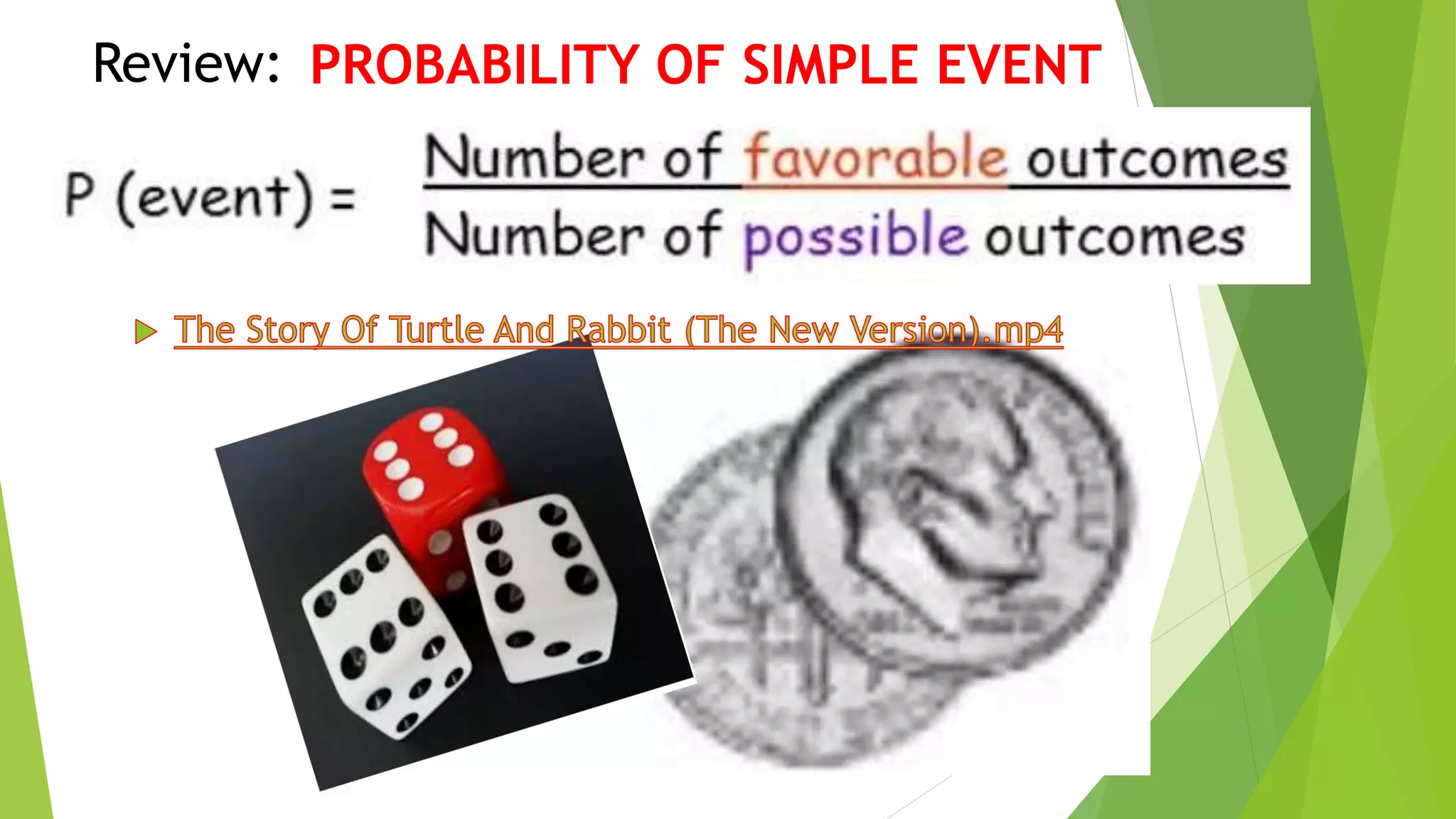
Review: PROBABILITY OF SIMPLE EVENT
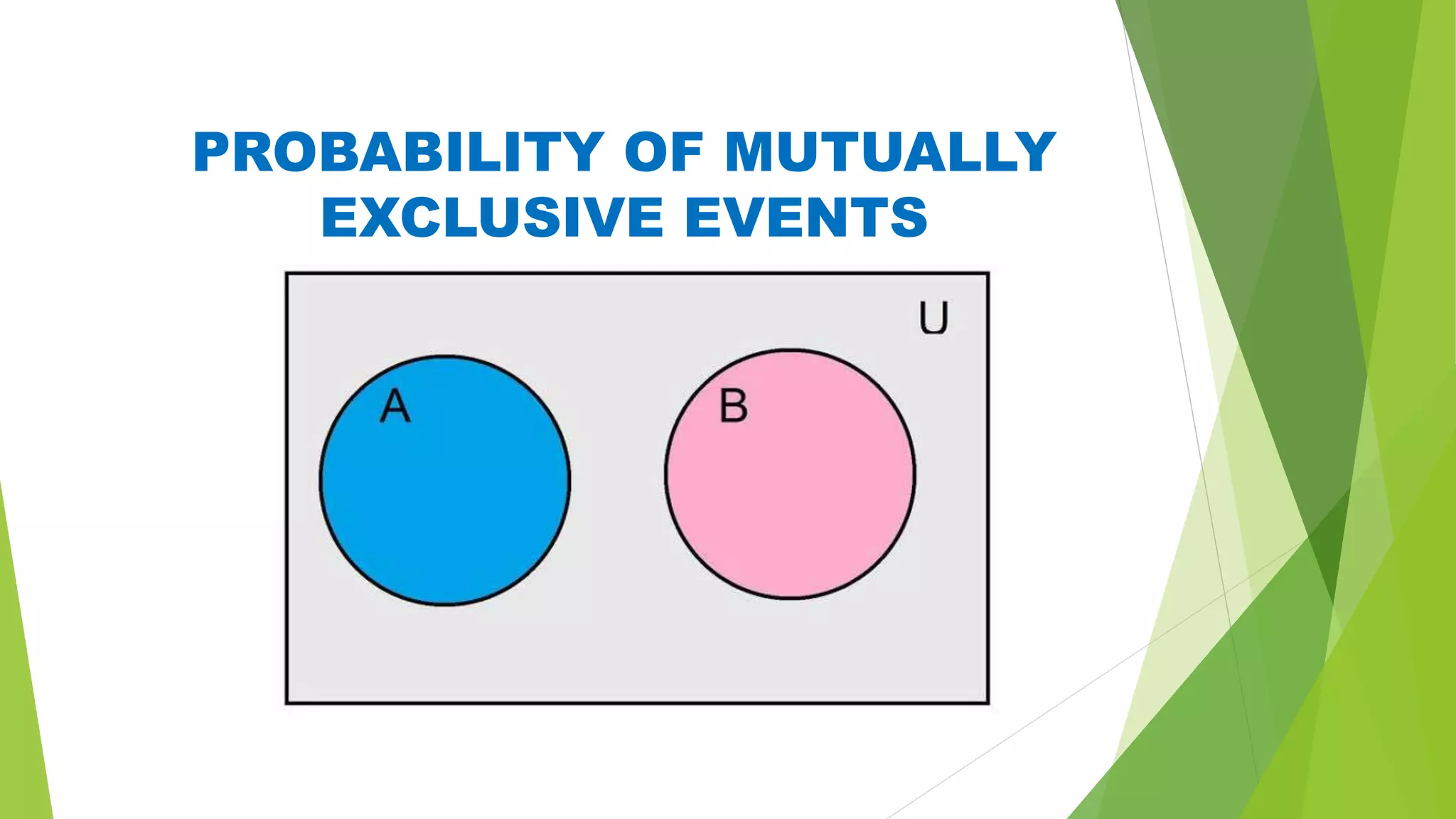
PROBABILITY OF MUTUALLY
EXCLUSIVE EVENTS
OBJECTIVES:
At the end of the lesson, the Grade 10 students
should be able to perform the following tasks
with 80% success.
1. identify whether the two events are mutually
exclusive or not mutually exclusive;
2. solve problems involving mutually exclusive
events;
3. demonstrate understanding of real-life
situations involving mutually exclusive events.
Activity:
Problem:
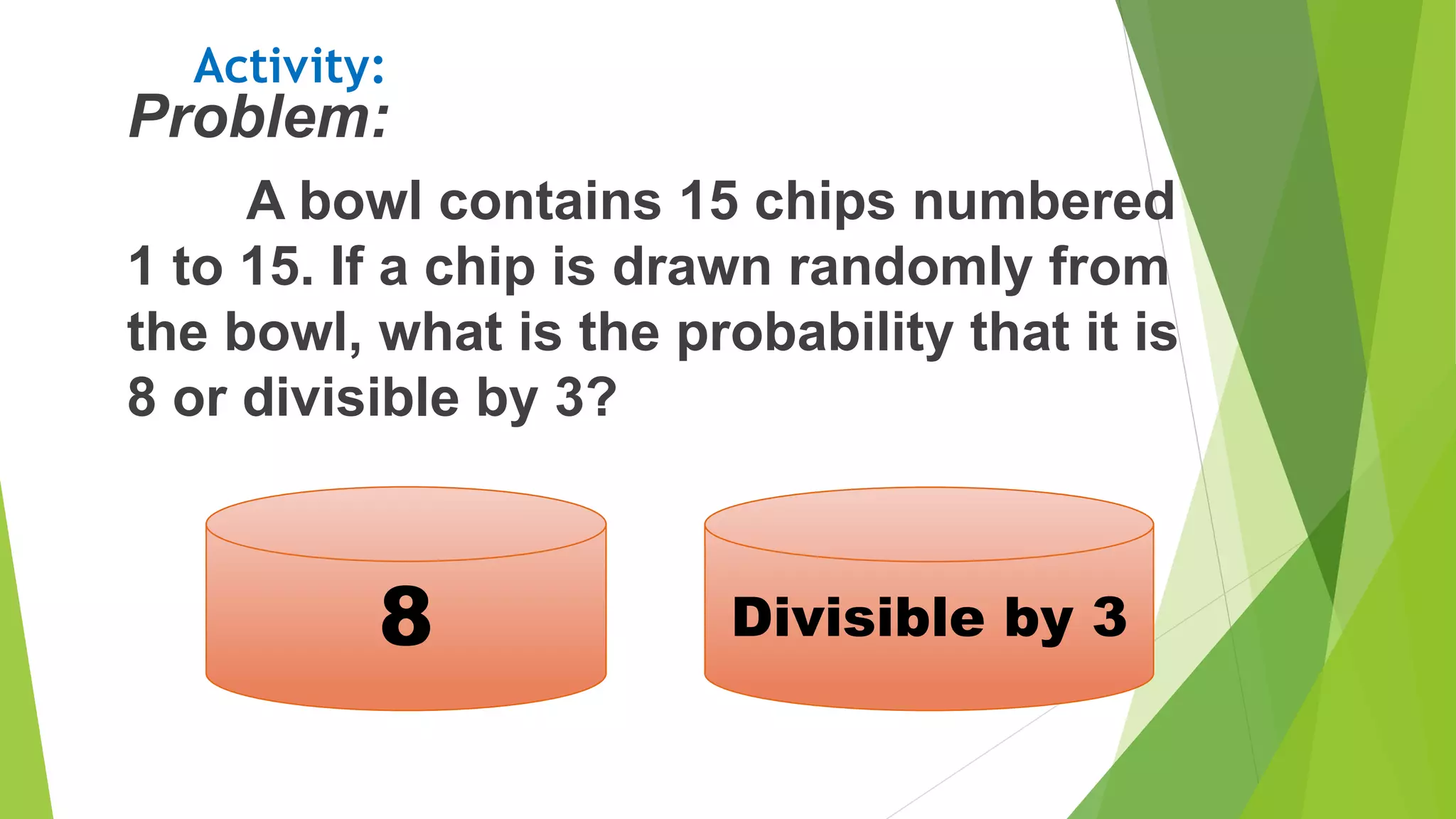
A bowl contains 15 chips numbered
1 to 15. If a chip is drawn randomly from
the bowl, what is the probability that it is
8 or divisible by 3?
8 Divisible by 3
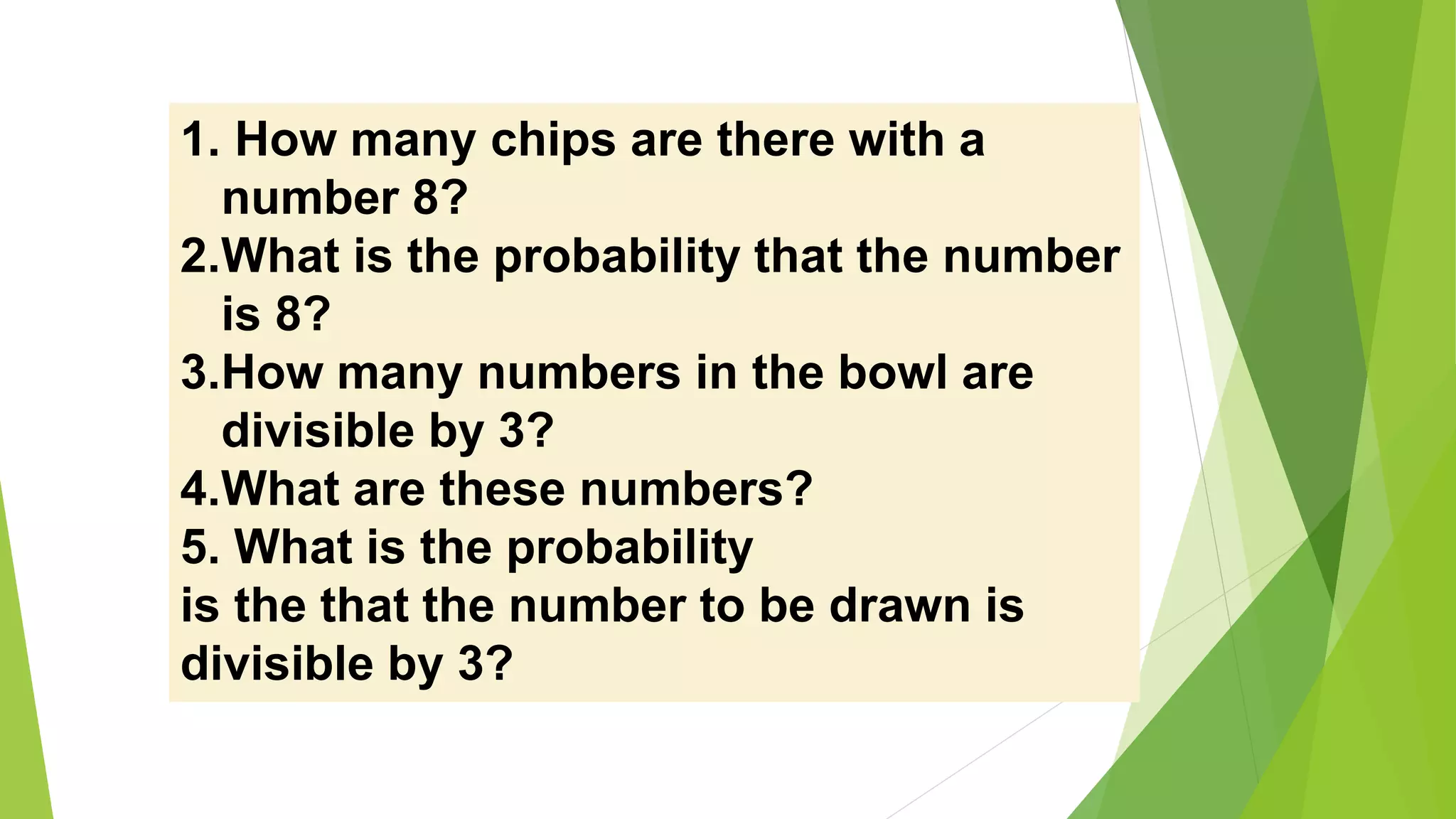
1. How many chips are there with a
number 8?
2.What is the probability that the number
is 8?
3.How many numbers in the bowl are
divisible by 3?
4.What are these numbers?
5. What is the probability
is the that the number to be drawn is
divisible by 3?
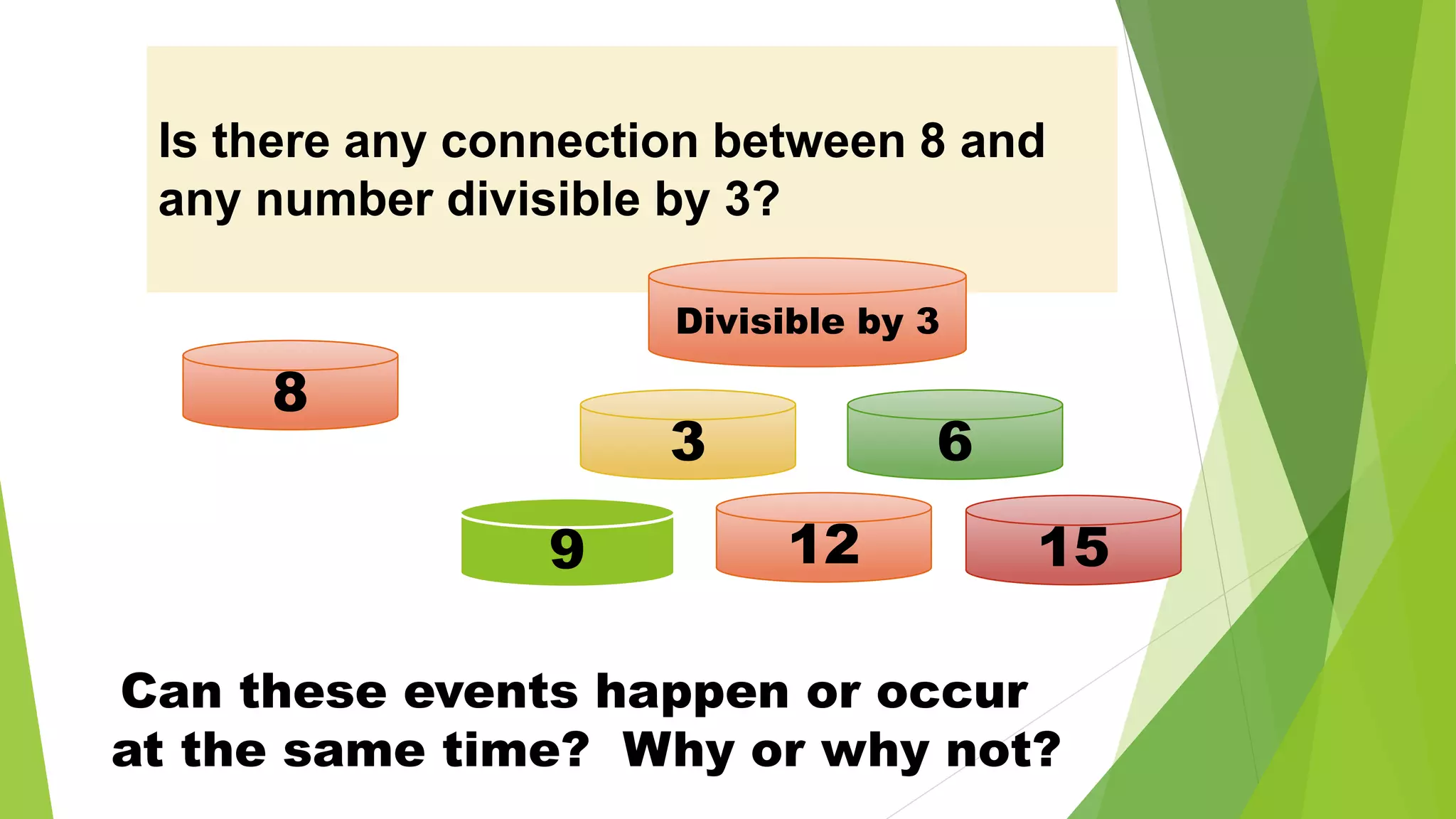
Is there any connection between 8 and
any number divisible by 3?
8
Divisible by 3
3 6
9 12 15
Can these events happen or occur
at the same time? Why or why not?
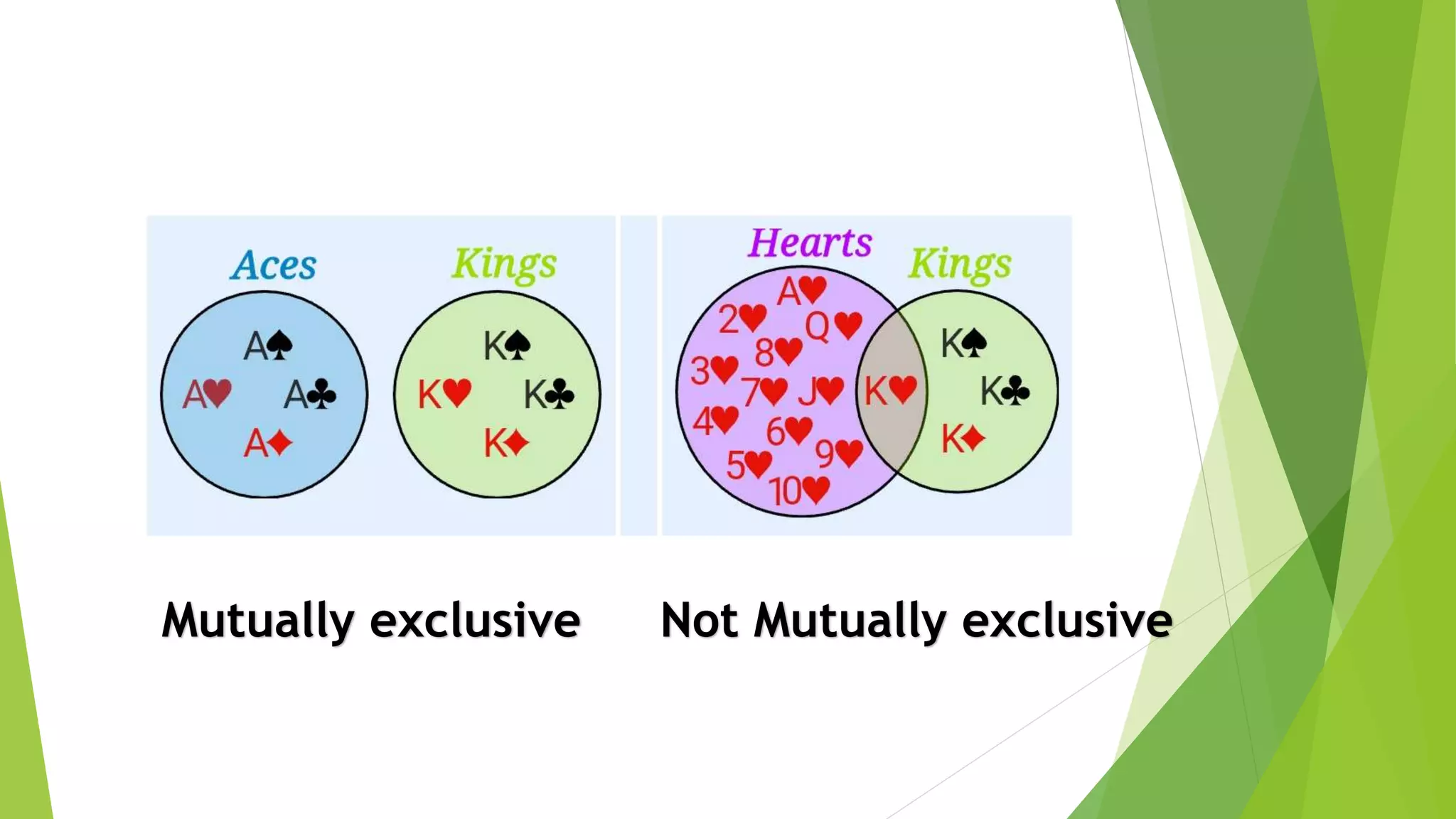
Mutually exclusive Not Mutually exclusive
-are events that cannot occur or
happen at the same time.
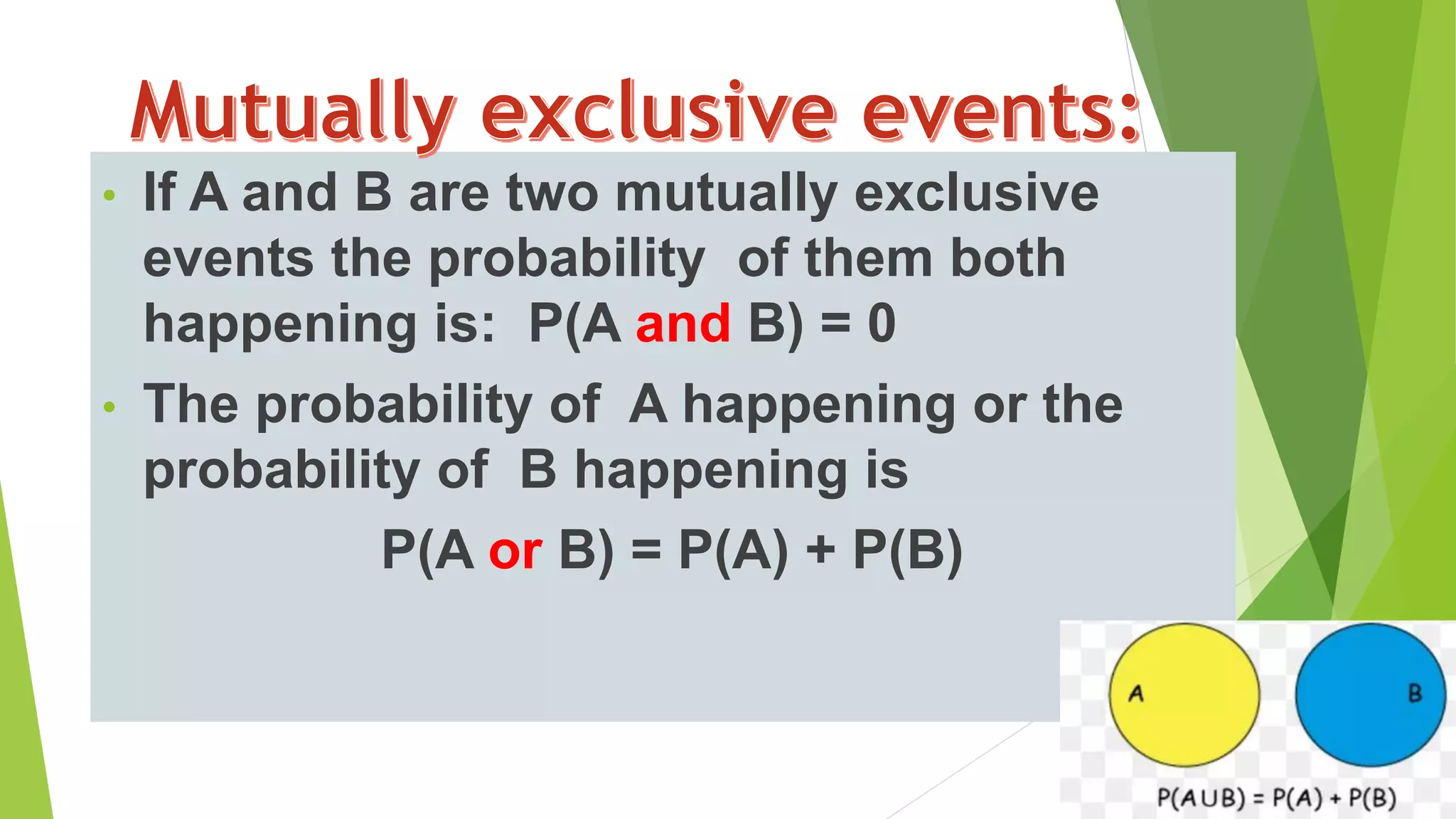
• If A and B are two mutually exclusive
events the probability of them both
happening is: P(A and B) = 0
• The probability of A happening or the
probability of B happening is
P(A or B) = P(A) + P(B)
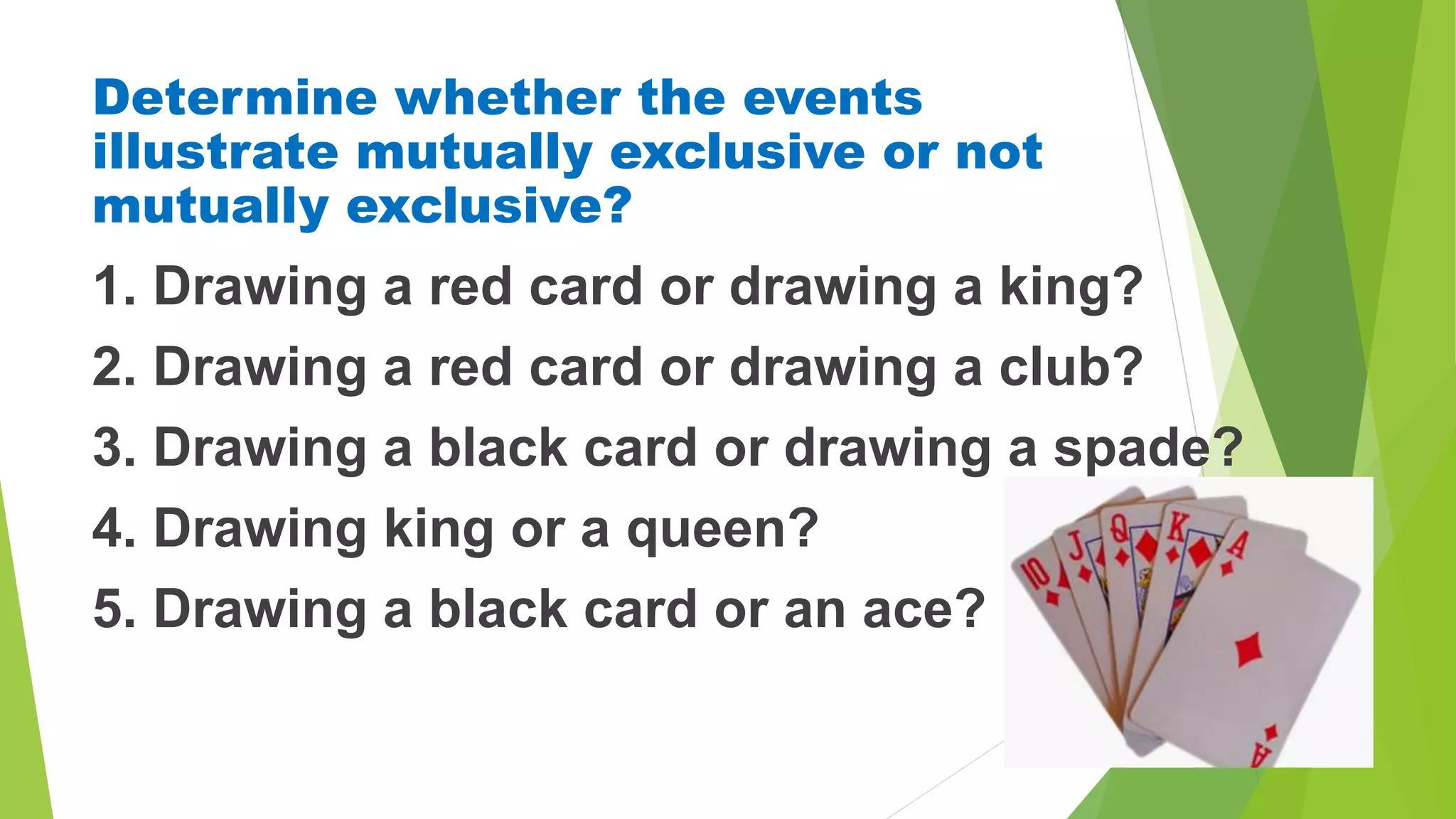
1. Drawing a red card or drawing a king?
2. Drawing a red card or drawing a club?
3. Drawing a black card or drawing a spade?
4. Drawing king or a queen?
5. Drawing a black card or an ace?
Determine whether the events
illustrate mutually exclusive or not
mutually exclusive?
Steps:
1. Determine the total number of
outcomes for the first event.
2. Find the probability of the first event.
3. Determine the total number of
outcomes for the second event.
4. Find the probability of the second
event.
5. Add the probabilities.
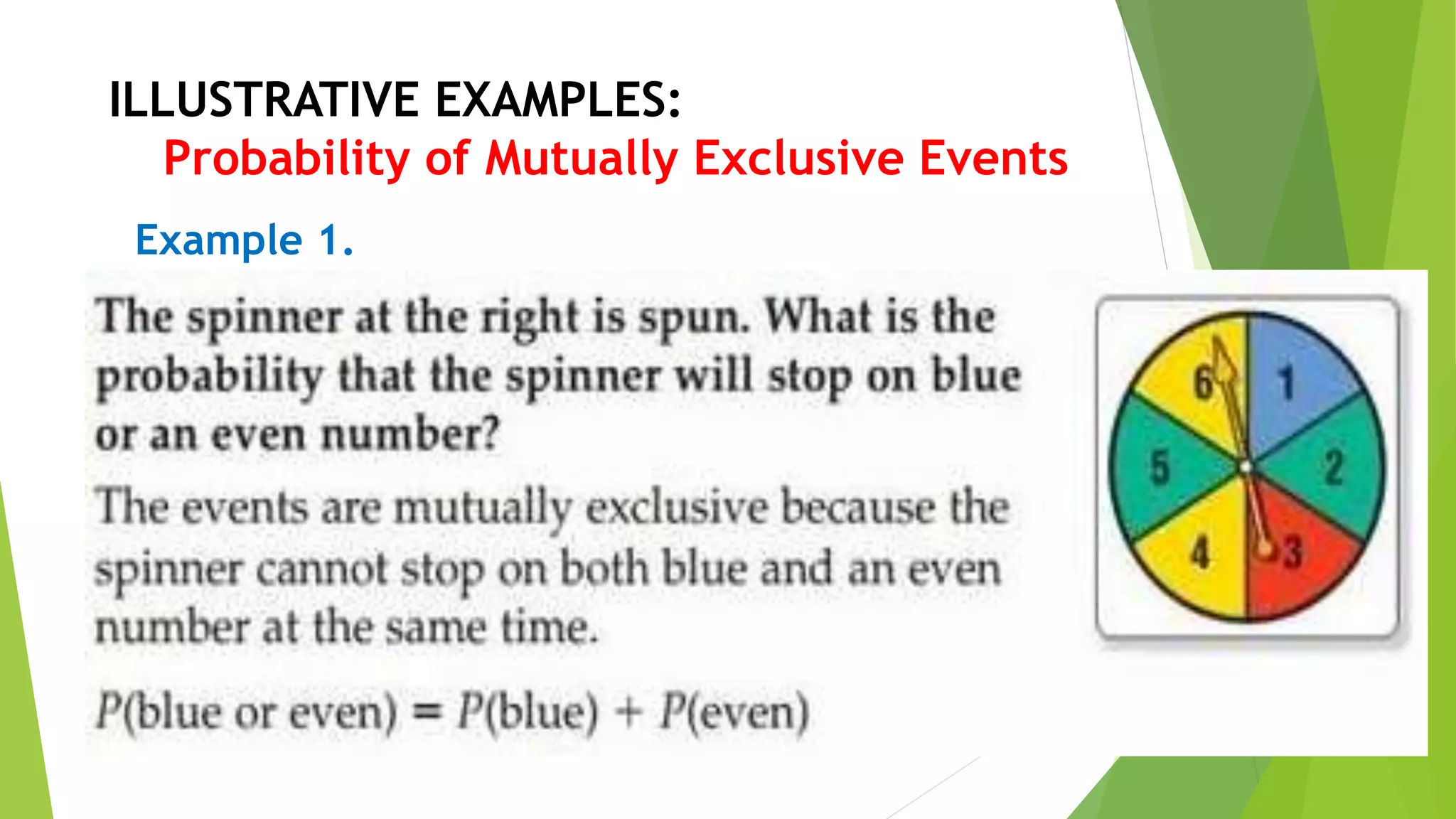
ILLUSTRATIVE EXAMPLES:
Probability of Mutually Exclusive Events
Example 1.
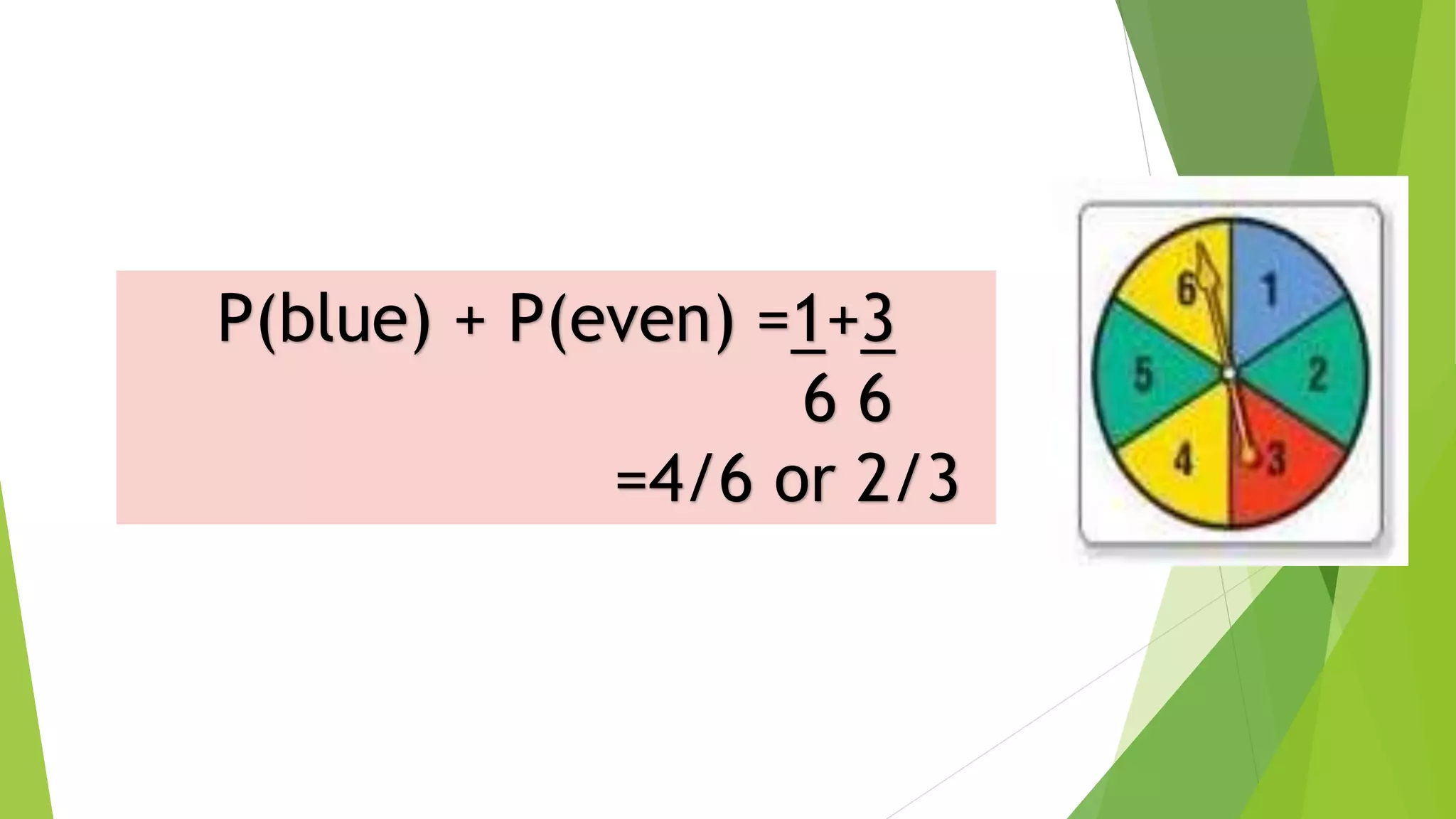
P(blue) + P(even) =1+3
6 6
=4/6 or 2/3
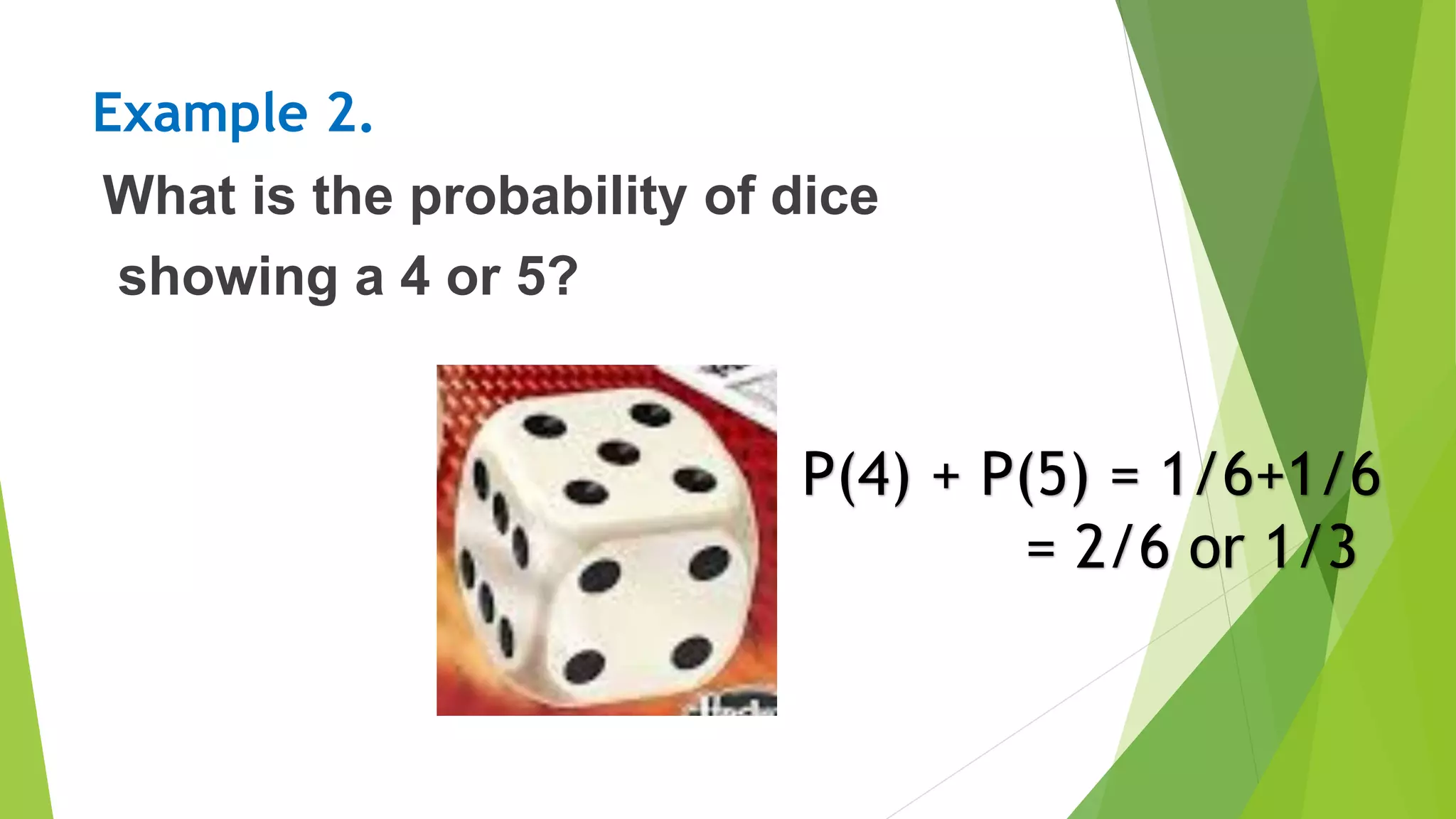
Example 2.
What is the probability of dice
showing a 4 or 5?
P(4) + P(5) = 1/6+1/6
= 2/6 or 1/3
Example 3.
A spinner has 4 equal sectors colored blue,
red, purple and orange. What is the
probability of landing on red or purple
after spinning the spinner?
P(red) + P(purple) = ¼ + ¼
=2/4 or 1/2
1. What learning/s have you gained
from the discussion?
2. When can you say that the events
are mutually exclusive? Not mutually
exclusive?
3. Do you think mutually exclusive
events exists in real –life situations?
Give examples.
Group Activity
Instructions:
In each group: select a leader, a
scribe, peace officer and a presenter.
You will be given a task card and
materials to be used . Write your
answer in the provided answer sheet.
Rubrics:
Accuracy – 60%
Delivery – 30%
Teamwork– 10%
Group Activity:
In each group, choose any
from the provided learning
materials, create another
problem on the probability of
mutually exclusive events,
then solve completely.
Mario has 45 red chips, 12 blue
chips, and 24 white chips. What is
the probability that Mario randomly
selects a red chip or a white chip?
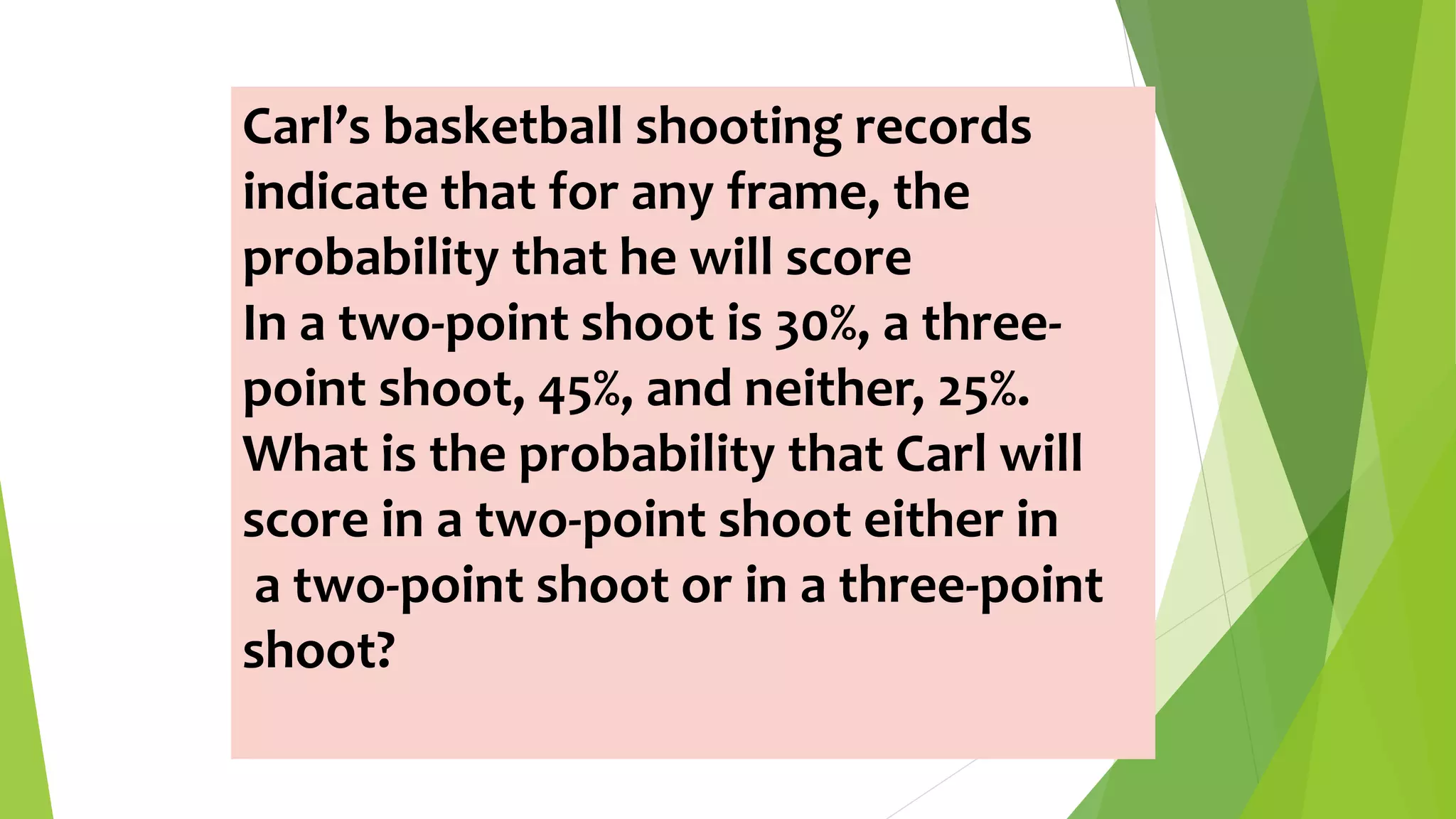
Carl’s basketball shooting records
indicate that for any frame, the
probability that he will score
In a two-point shoot is 30%, a three-
point shoot, 45%, and neither, 25%.
What is the probability that Carl will
score in a two-point shoot either in
a two-point shoot or in a three-point
shoot?
Rhian likes to wear colored shirts. She
has 15 shirts in the closet. Five of these
are blue, four are in different shades of
red, and the rest are of different colors.
What is the probability
that she will wear a blue or a red shirt?
Have you encountered problems/difficulties in our
lesson today?
What about at home or during the onslaught of the
recent typhoon Paeng?
What are these problems or difficulties and how did
they solve such difficulties/problems?
Suppose there are indigenous persons with disability in
your barangay, how are you going to help them if they
are in difficult circumstances?
1. What are mutually exclusive
events?
2. How will you find the probability
of mutually exclusive events?
SOLVE COMPLETELY!
A. Determine whether the following illustrates
mutually exclusive events or not mutually exclusive
events.
1. Drawing a red card or a black card?
2. Drawing a heart or drawing a jack card?
3. Drawing a black card or drawing queen?
4. Drawing a jack or a queen?
5. Drawing a 5 or an ace?
B. Solve the following mutually
exclusive events. Answer completely.
1. A card is drawn from a standard
deck. Find the probability of drawing
an ace or a queen.
2. What is the probability of a dice
showing a 2 or a 5?
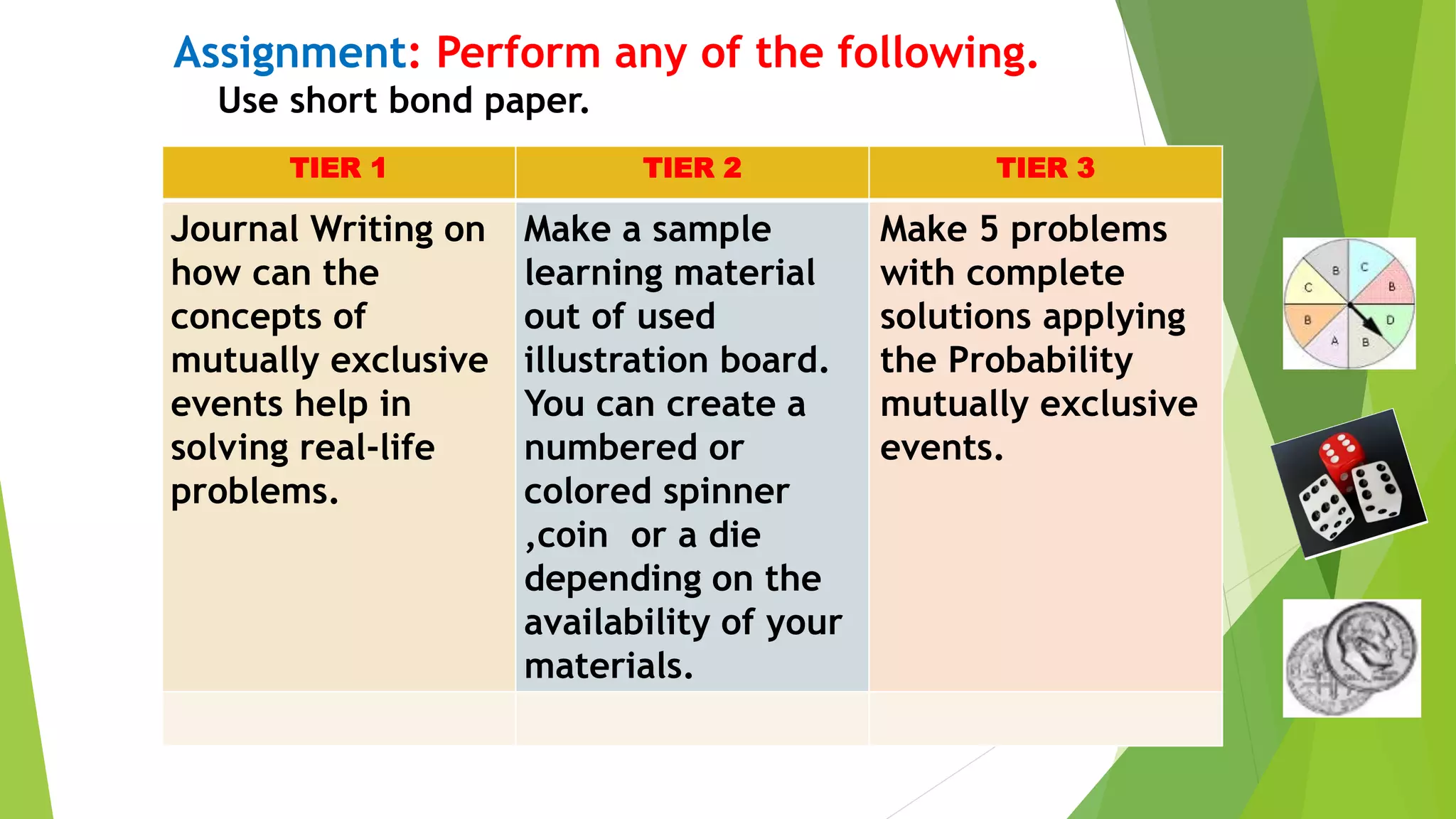
Assignment: Perform any of the following.
Use short bond paper.
TIER 1 TIER 2 TIER 3
Journal Writing on
how can the
concepts of
mutually exclusive
events help in
solving real-life
problems.
Make a sample
learning material
out of used
illustration board.
You can create a
numbered or
colored spinner
,coin or a die
depending on the
availability of your
materials.
Make 5 problems
with complete
solutions applying
the Probability
mutually exclusive
events.
PROBABILITY OF MUTUALLY EXCLUSIVE EVENTS final.pptx

PROBABILITY OF MUTUALLY EXCLUSIVE EVENTS final.pptx

  • 1.
    Prepared by: MRS. JUNAE. VENTURA Demonstration Teacher
  • 3.
  • 4.
    A gentle reminder: S-sustained interest all through out the lesson A-always show respect to the ideas of others F-follow safety protocols E- engage in 4 Cs( creativity, communication, critical thinking & cooperation) and A –actively participate L- live what you have learned I- impart knowledge and experiences V-voice out gray areas in the lesson E- enjoy!
  • 5.
  • 6.
  • 7.
    OBJECTIVES: At the endof the lesson, the Grade 10 students should be able to perform the following tasks with 80% success. 1. identify whether the two events are mutually exclusive or not mutually exclusive; 2. solve problems involving mutually exclusive events; 3. demonstrate understanding of real-life situations involving mutually exclusive events.
  • 8.
    Activity: Problem: A bowl contains15 chips numbered 1 to 15. If a chip is drawn randomly from the bowl, what is the probability that it is 8 or divisible by 3? 8 Divisible by 3
  • 9.
    1. How manychips are there with a number 8? 2.What is the probability that the number is 8? 3.How many numbers in the bowl are divisible by 3? 4.What are these numbers? 5. What is the probability is the that the number to be drawn is divisible by 3?
  • 10.
    Is there anyconnection between 8 and any number divisible by 3? 8 Divisible by 3 3 6 9 12 15 Can these events happen or occur at the same time? Why or why not?
  • 11.
    Mutually exclusive NotMutually exclusive
  • 12.
    -are events thatcannot occur or happen at the same time.
  • 13.
    • If Aand B are two mutually exclusive events the probability of them both happening is: P(A and B) = 0 • The probability of A happening or the probability of B happening is P(A or B) = P(A) + P(B)
  • 14.
    1. Drawing ared card or drawing a king? 2. Drawing a red card or drawing a club? 3. Drawing a black card or drawing a spade? 4. Drawing king or a queen? 5. Drawing a black card or an ace? Determine whether the events illustrate mutually exclusive or not mutually exclusive?
  • 15.
    Steps: 1. Determine thetotal number of outcomes for the first event. 2. Find the probability of the first event. 3. Determine the total number of outcomes for the second event. 4. Find the probability of the second event. 5. Add the probabilities.
  • 16.
    ILLUSTRATIVE EXAMPLES: Probability ofMutually Exclusive Events Example 1.
  • 17.
    P(blue) + P(even)=1+3 6 6 =4/6 or 2/3
  • 18.
    Example 2. What isthe probability of dice showing a 4 or 5? P(4) + P(5) = 1/6+1/6 = 2/6 or 1/3
  • 19.
    Example 3. A spinnerhas 4 equal sectors colored blue, red, purple and orange. What is the probability of landing on red or purple after spinning the spinner? P(red) + P(purple) = ¼ + ¼ =2/4 or 1/2
  • 20.
    1. What learning/shave you gained from the discussion? 2. When can you say that the events are mutually exclusive? Not mutually exclusive? 3. Do you think mutually exclusive events exists in real –life situations? Give examples.
  • 21.
    Group Activity Instructions: In eachgroup: select a leader, a scribe, peace officer and a presenter. You will be given a task card and materials to be used . Write your answer in the provided answer sheet. Rubrics: Accuracy – 60% Delivery – 30% Teamwork– 10%
  • 22.
    Group Activity: In eachgroup, choose any from the provided learning materials, create another problem on the probability of mutually exclusive events, then solve completely.
  • 23.
    Mario has 45red chips, 12 blue chips, and 24 white chips. What is the probability that Mario randomly selects a red chip or a white chip?
  • 24.
    Carl’s basketball shootingrecords indicate that for any frame, the probability that he will score In a two-point shoot is 30%, a three- point shoot, 45%, and neither, 25%. What is the probability that Carl will score in a two-point shoot either in a two-point shoot or in a three-point shoot?
  • 25.
    Rhian likes towear colored shirts. She has 15 shirts in the closet. Five of these are blue, four are in different shades of red, and the rest are of different colors. What is the probability that she will wear a blue or a red shirt?
  • 26.
    Have you encounteredproblems/difficulties in our lesson today? What about at home or during the onslaught of the recent typhoon Paeng? What are these problems or difficulties and how did they solve such difficulties/problems? Suppose there are indigenous persons with disability in your barangay, how are you going to help them if they are in difficult circumstances?
  • 27.
    1. What aremutually exclusive events? 2. How will you find the probability of mutually exclusive events?
  • 28.
    SOLVE COMPLETELY! A. Determinewhether the following illustrates mutually exclusive events or not mutually exclusive events. 1. Drawing a red card or a black card? 2. Drawing a heart or drawing a jack card? 3. Drawing a black card or drawing queen? 4. Drawing a jack or a queen? 5. Drawing a 5 or an ace?
  • 29.
    B. Solve thefollowing mutually exclusive events. Answer completely. 1. A card is drawn from a standard deck. Find the probability of drawing an ace or a queen. 2. What is the probability of a dice showing a 2 or a 5?
  • 30.
    Assignment: Perform anyof the following. Use short bond paper. TIER 1 TIER 2 TIER 3 Journal Writing on how can the concepts of mutually exclusive events help in solving real-life problems. Make a sample learning material out of used illustration board. You can create a numbered or colored spinner ,coin or a die depending on the availability of your materials. Make 5 problems with complete solutions applying the Probability mutually exclusive events.