NUMERIC PATTERN
GRADE 8
Baraka Loibanguti
1
NUMERIC PATTERN
Numeric patterns are commonly divided into
1. Arithmetic (made by adding or subtracting a number each
time).
2. Geometric (which involve multiplying or dividing by a number).
Some geometric patterns are exponential, that is, they are
made by multiplying by an exponent.
Baraka Loibanguti
2
ARITHMETIC PATTERNS
The arithmetic patterns are one obtained by adding or
subtracting a constant number all the time. The constant
number is called the common difference.
Example of arithmetic patterns
(a) 2, 4, 6, 8, 10, …,…, …, …, … (can you guess the missing terms?
Baraka Loibanguti
3
ARITHMETIC PATTERN CONT.…
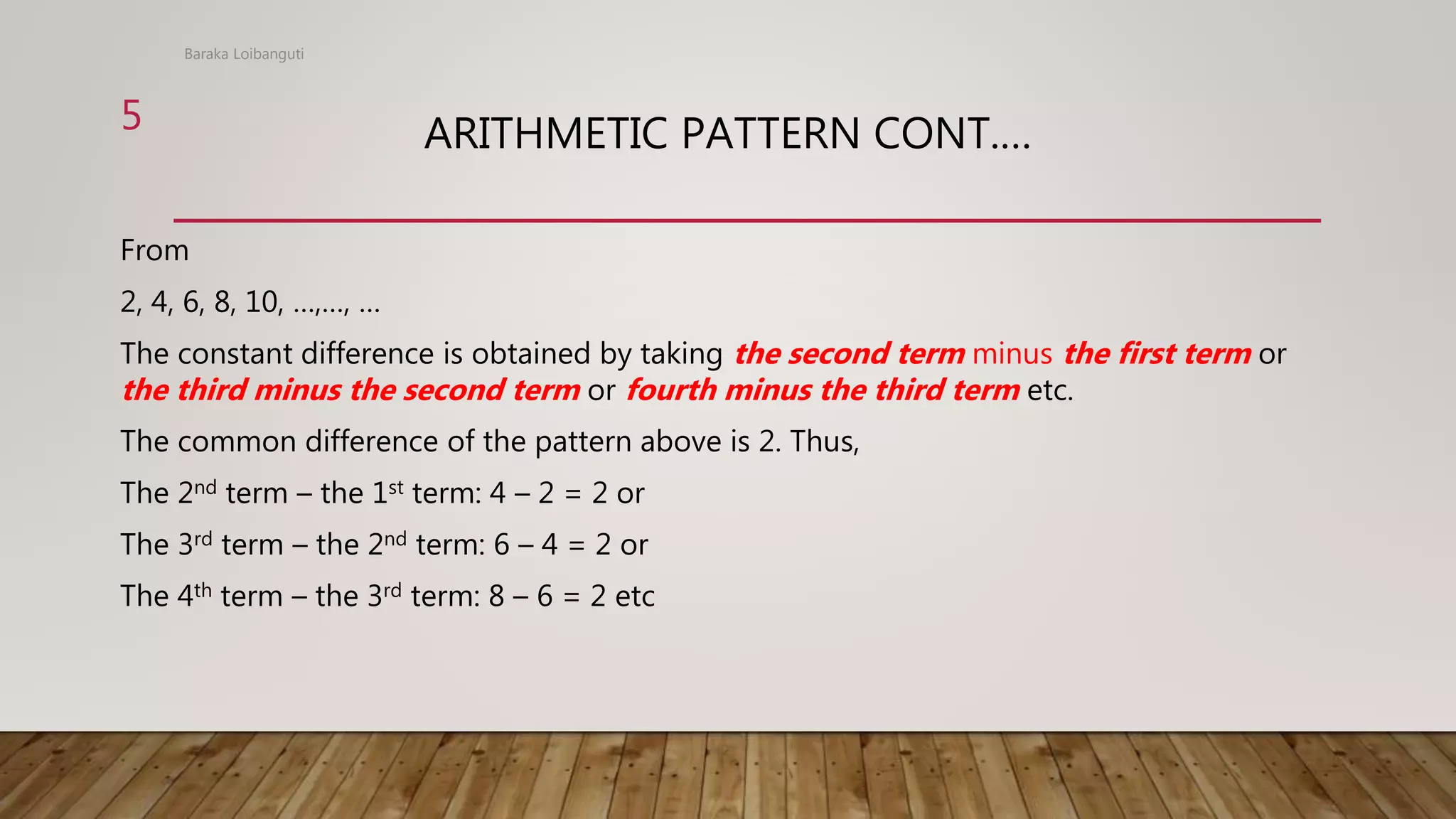
From
2, 4, 6, 8, 10, …,…, … The numbers 2, 4, 6, 8, 10 are referred to as
TERMS.
Therefore,
2 is the first term
4 is the second term
6 is the third term
8 is the fourth term
10 is the fifth term etc.
Baraka Loibanguti
4
ARITHMETIC PATTERN CONT.…
From
2, 4, 6, 8, 10, …,…, …
The constant difference is obtained by taking the second term minus the first term or
the third minus the second term or fourth minus the third term etc.
The common difference of the pattern above is 2. Thus,
The 2nd term – the 1st term: 4 – 2 = 2 or
The 3rd term – the 2nd term: 6 – 4 = 2 or
The 4th term – the 3rd term: 8 – 6 = 2 etc
Baraka Loibanguti
5
ARITHMETIC PATTERN CONT.…
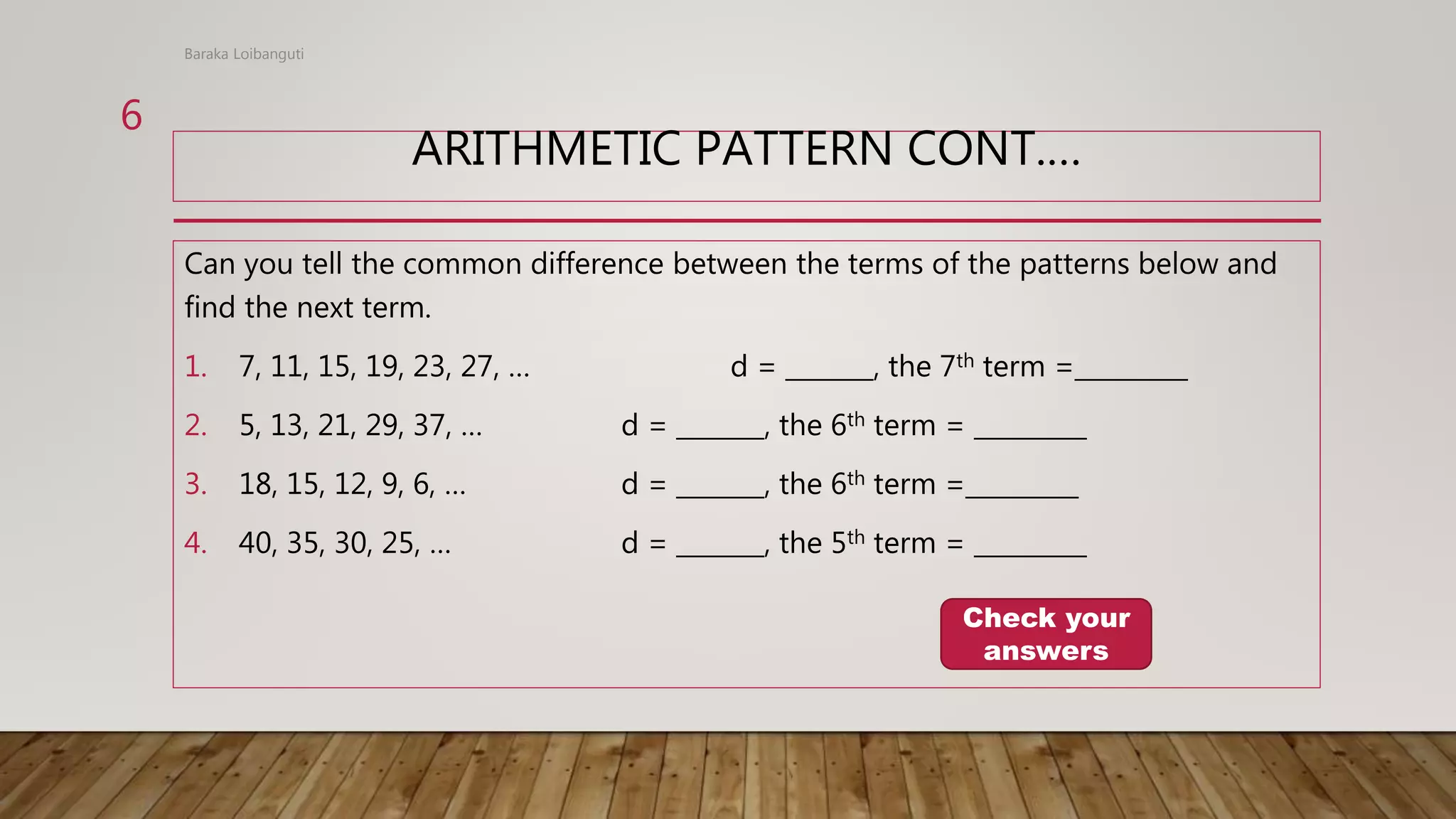
Can you tell the common difference between the terms of the patterns below and
find the next term.
1. 7, 11, 15, 19, 23, 27, … d = _______, the 7th term =_________
2. 5, 13, 21, 29, 37, … d = _______, the 6th term = _________
3. 18, 15, 12, 9, 6, … d = _______, the 6th term =_________
4. 40, 35, 30, 25, … d = _______, the 5th term = _________
Check your
answers
Baraka Loibanguti
6
PATTERNS
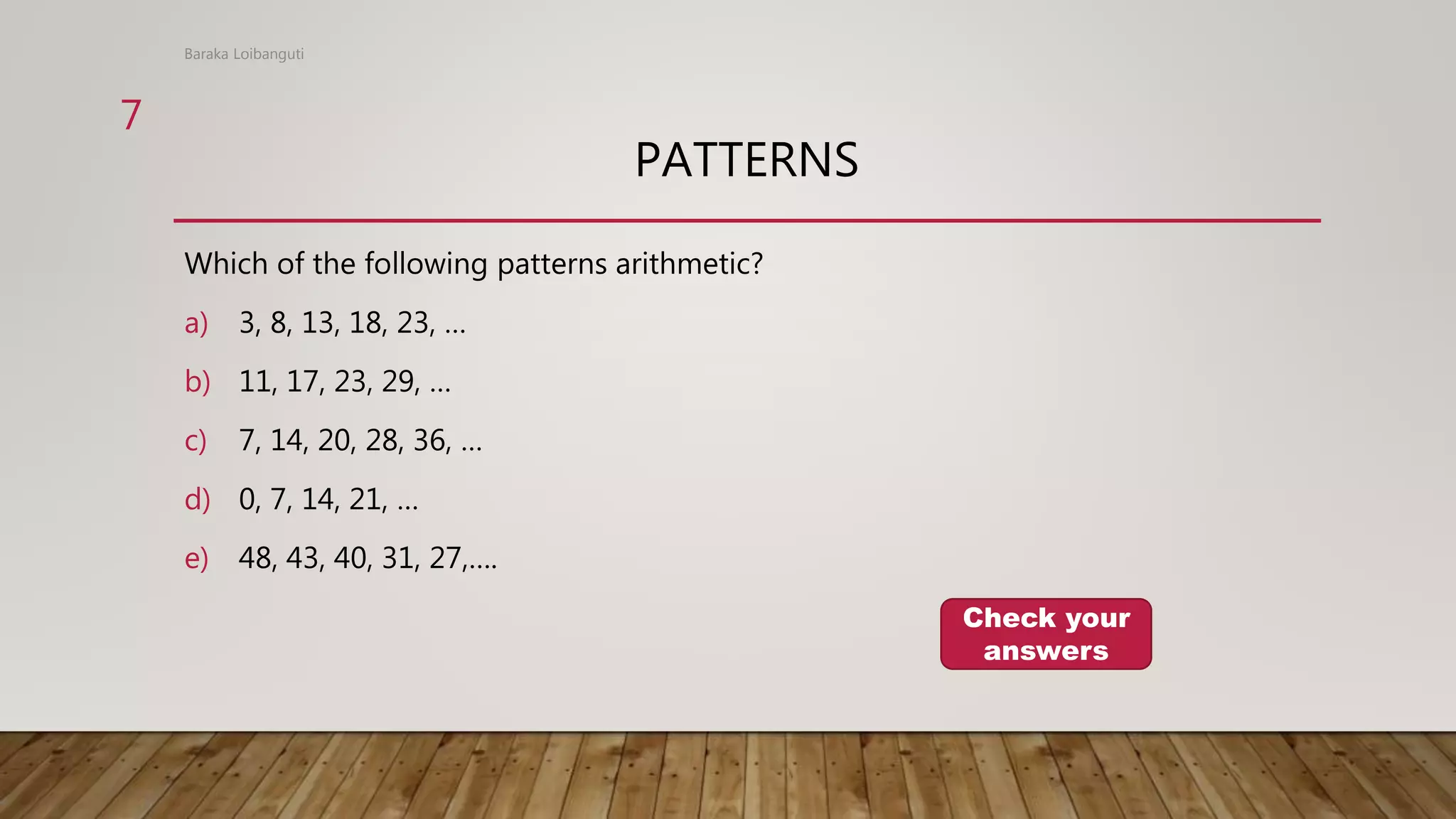
Which of the following patterns arithmetic?
a) 3, 8, 13, 18, 23, …
b) 11, 17, 23, 29, …
c) 7, 14, 20, 28, 36, …
d) 0, 7, 14, 21, …
e) 48, 43, 40, 31, 27,….
Baraka Loibanguti
Check your
answers
7
ARITHMETIC PATTERNS
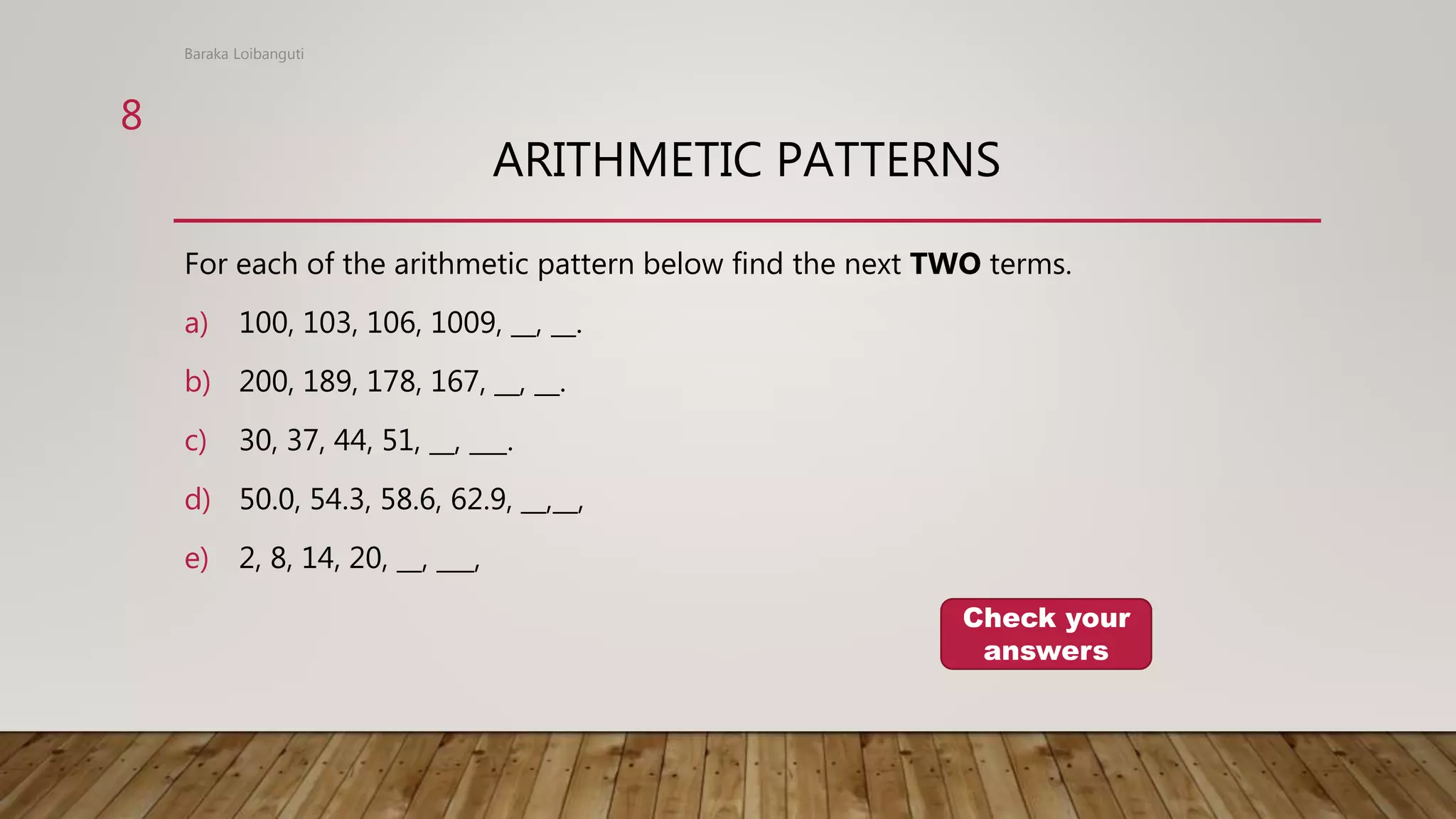
For each of the arithmetic pattern below find the next TWO terms.
a) 100, 103, 106, 1009, __, __.
b) 200, 189, 178, 167, __, __.
c) 30, 37, 44, 51, __, ___.
d) 50.0, 54.3, 58.6, 62.9, __,__,
e) 2, 8, 14, 20, __, ___,
Baraka Loibanguti
Check your
answers
8
ARITHMETIC PATTERNS
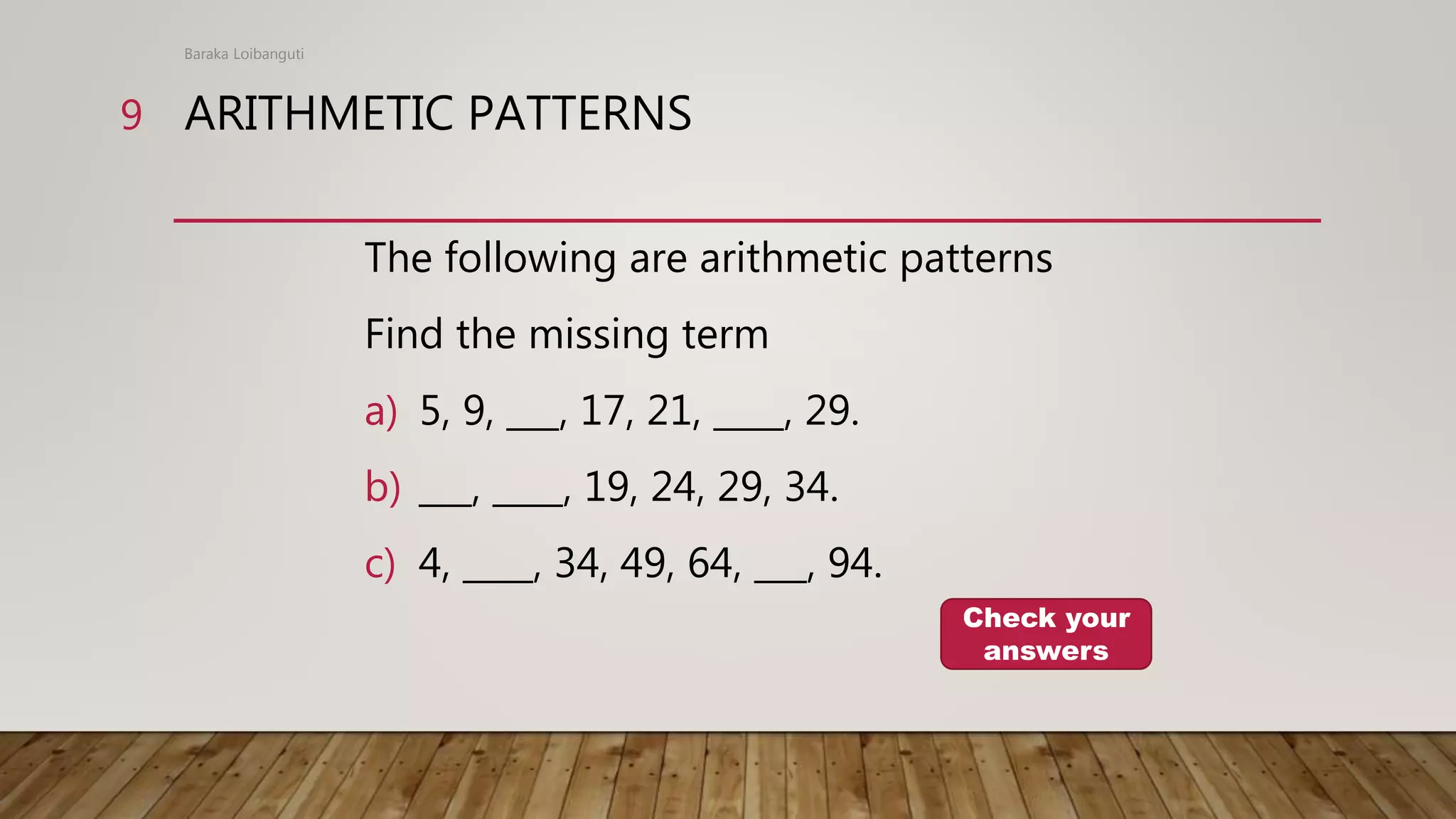
The following are arithmetic patterns
Find the missing term
a) 5, 9, ___, 17, 21, ____, 29.
b) ___, ____, 19, 24, 29, 34.
c) 4, ____, 34, 49, 64, ___, 94.
Baraka Loibanguti
9
Check your
answers
SUMMARY
We have discussed the arithmetic patterns and you
have noted that THE ARITHMETIC PATTERNS have
the common difference between the consecutive
terms. Using this common difference you can
determine the next few terms of the pattern. [Feel
free to repeat the part for further clarification].
Baraka Loibanguti
10
ANSWERS
Baraka Loibanguti
11
ARITHMETIC PATTERN ANSWERS
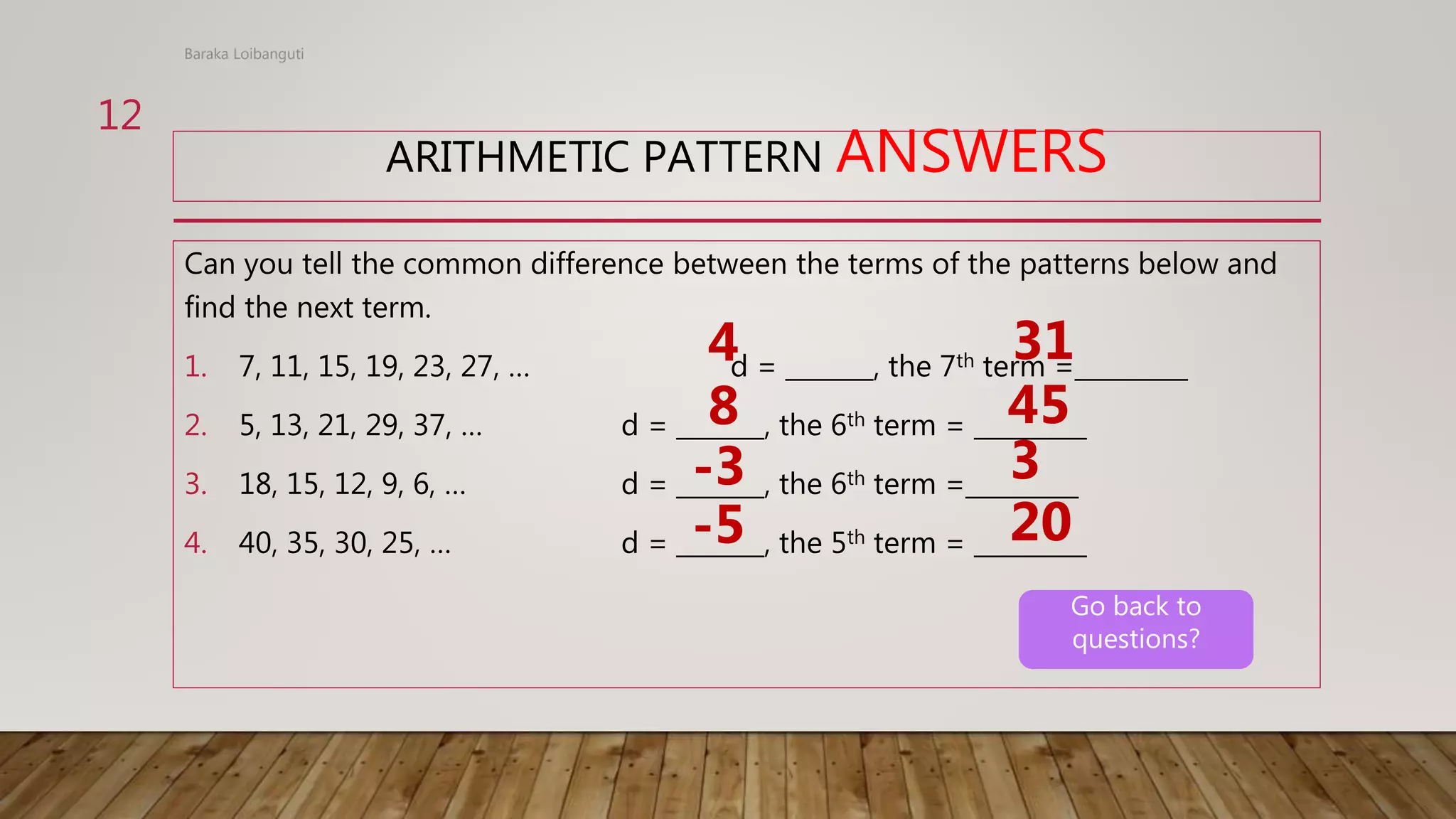
Can you tell the common difference between the terms of the patterns below and
find the next term.
1. 7, 11, 15, 19, 23, 27, … d = _______, the 7th term =_________
2. 5, 13, 21, 29, 37, … d = _______, the 6th term = _________
3. 18, 15, 12, 9, 6, … d = _______, the 6th term =_________
4. 40, 35, 30, 25, … d = _______, the 5th term = _________
4 31
8
-3
-5
45
3
20
Baraka Loibanguti
12
Go back to
questions?
PATTERNS ANSWERS
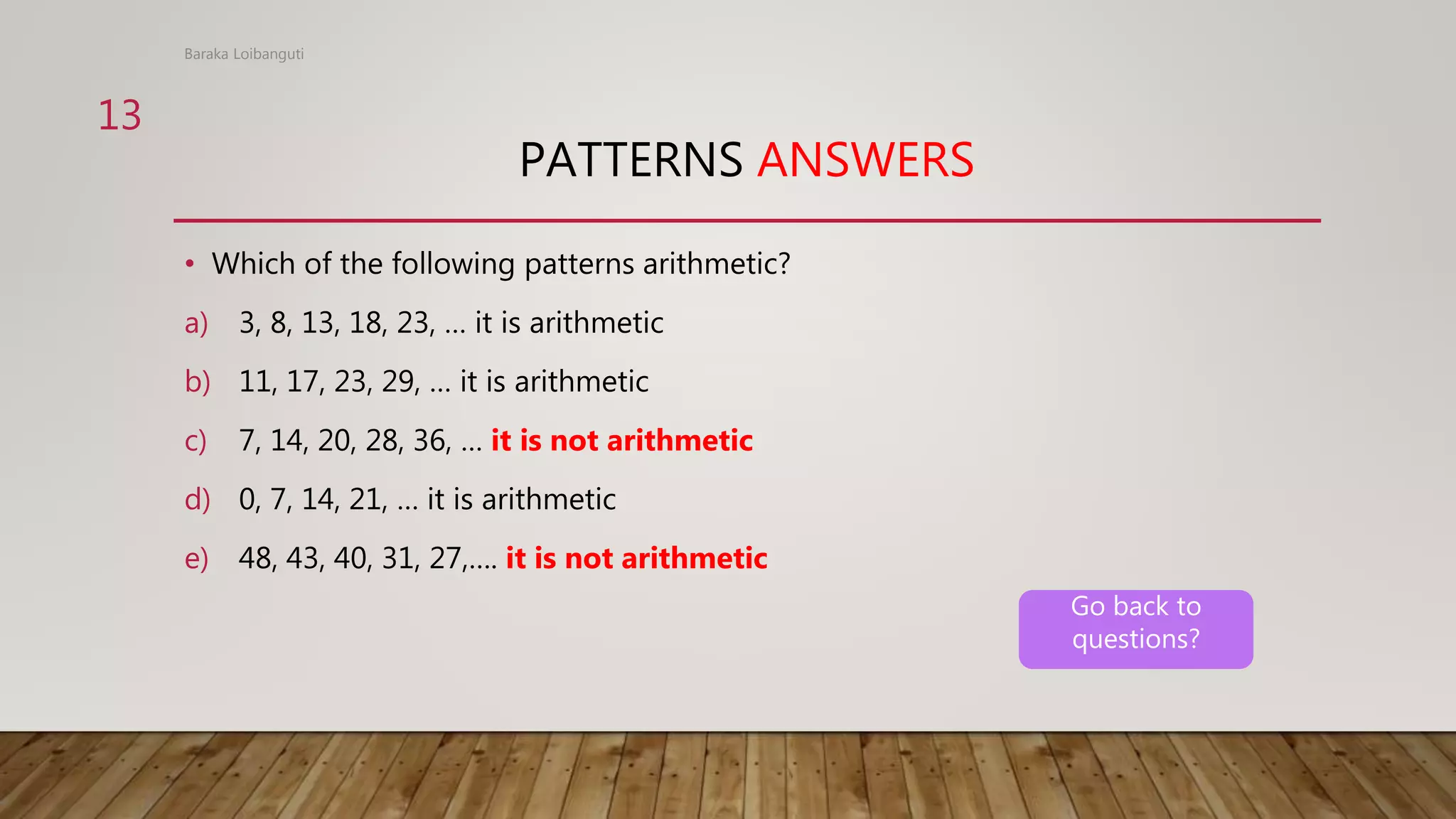
• Which of the following patterns arithmetic?
a) 3, 8, 13, 18, 23, … it is arithmetic
b) 11, 17, 23, 29, … it is arithmetic
c) 7, 14, 20, 28, 36, … it is not arithmetic
d) 0, 7, 14, 21, … it is arithmetic
e) 48, 43, 40, 31, 27,…. it is not arithmetic
Baraka Loibanguti
13
Go back to
questions?
ARITHMETIC PATTERNS ANSWERS
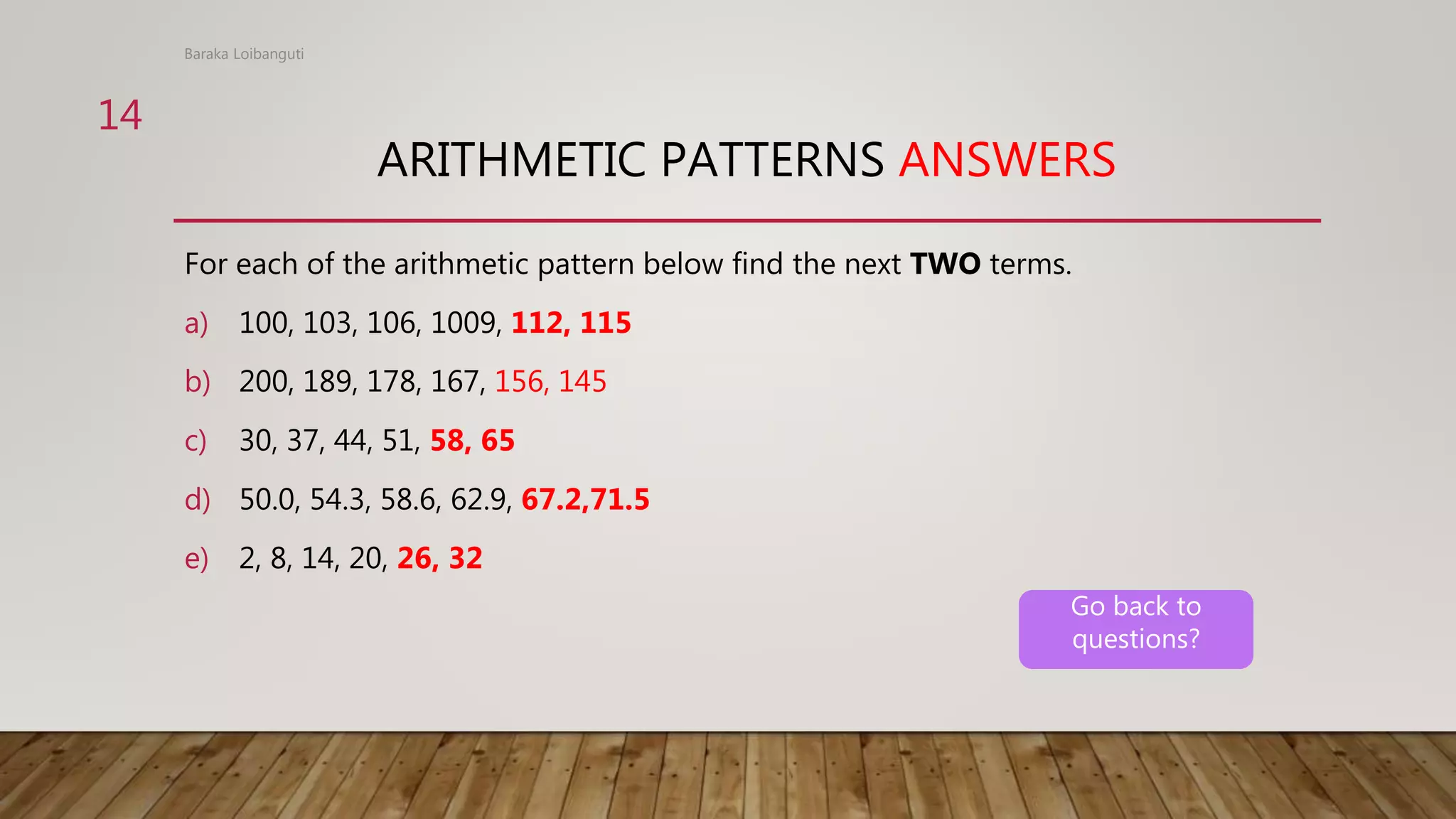
For each of the arithmetic pattern below find the next TWO terms.
a) 100, 103, 106, 1009, 112, 115
b) 200, 189, 178, 167, 156, 145
c) 30, 37, 44, 51, 58, 65
d) 50.0, 54.3, 58.6, 62.9, 67.2,71.5
e) 2, 8, 14, 20, 26, 32
Baraka Loibanguti
14
Go back to
questions?
ARITHMETIC PATTERNS ANSWERS
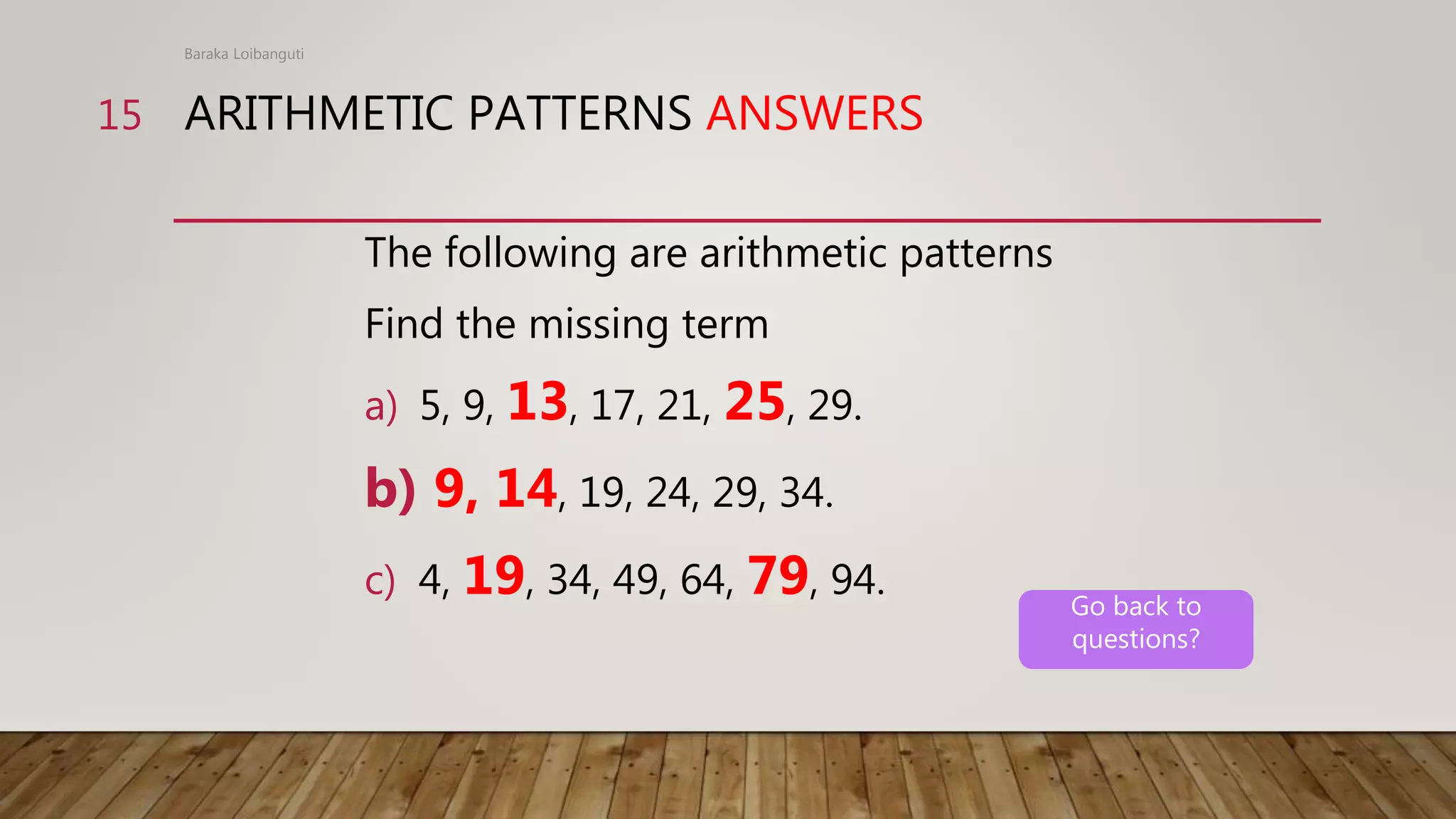
The following are arithmetic patterns
Find the missing term
a) 5, 9, 13, 17, 21, 25, 29.
b) 9, 14, 19, 24, 29, 34.
c) 4, 19, 34, 49, 64, 79, 94.
Baraka Loibanguti
15
Go back to
questions?
Baraka Loibanguti
16
GEOMETRY PATTERN
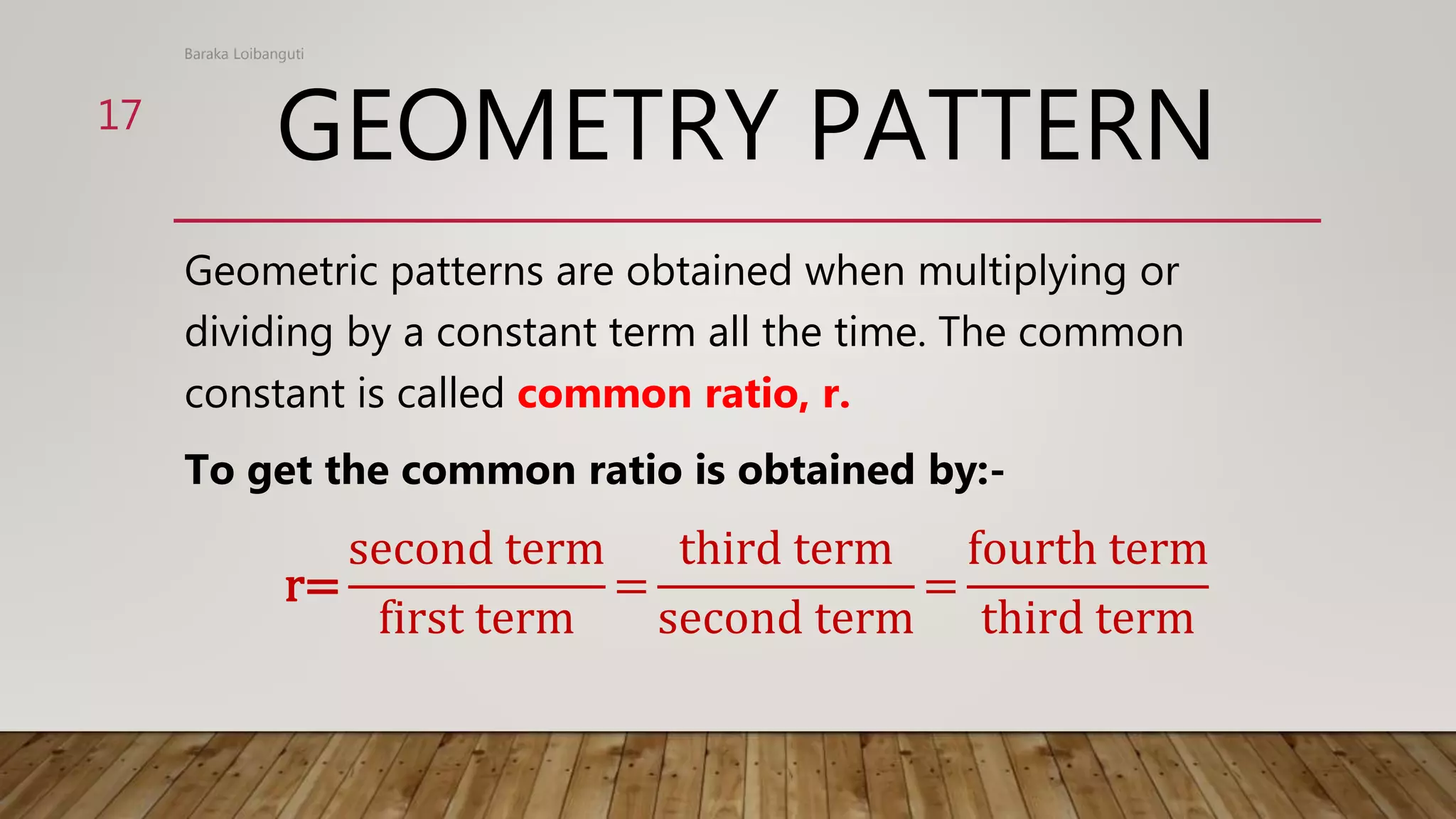
Geometric patterns are obtained when multiplying or
dividing by a constant term all the time. The common
constant is called common ratio, r.
To get the common ratio is obtained by:-
r=
second term
first term
=
third term
second term
=
fourth term
third term
Baraka Loibanguti
17
EXAMPLE
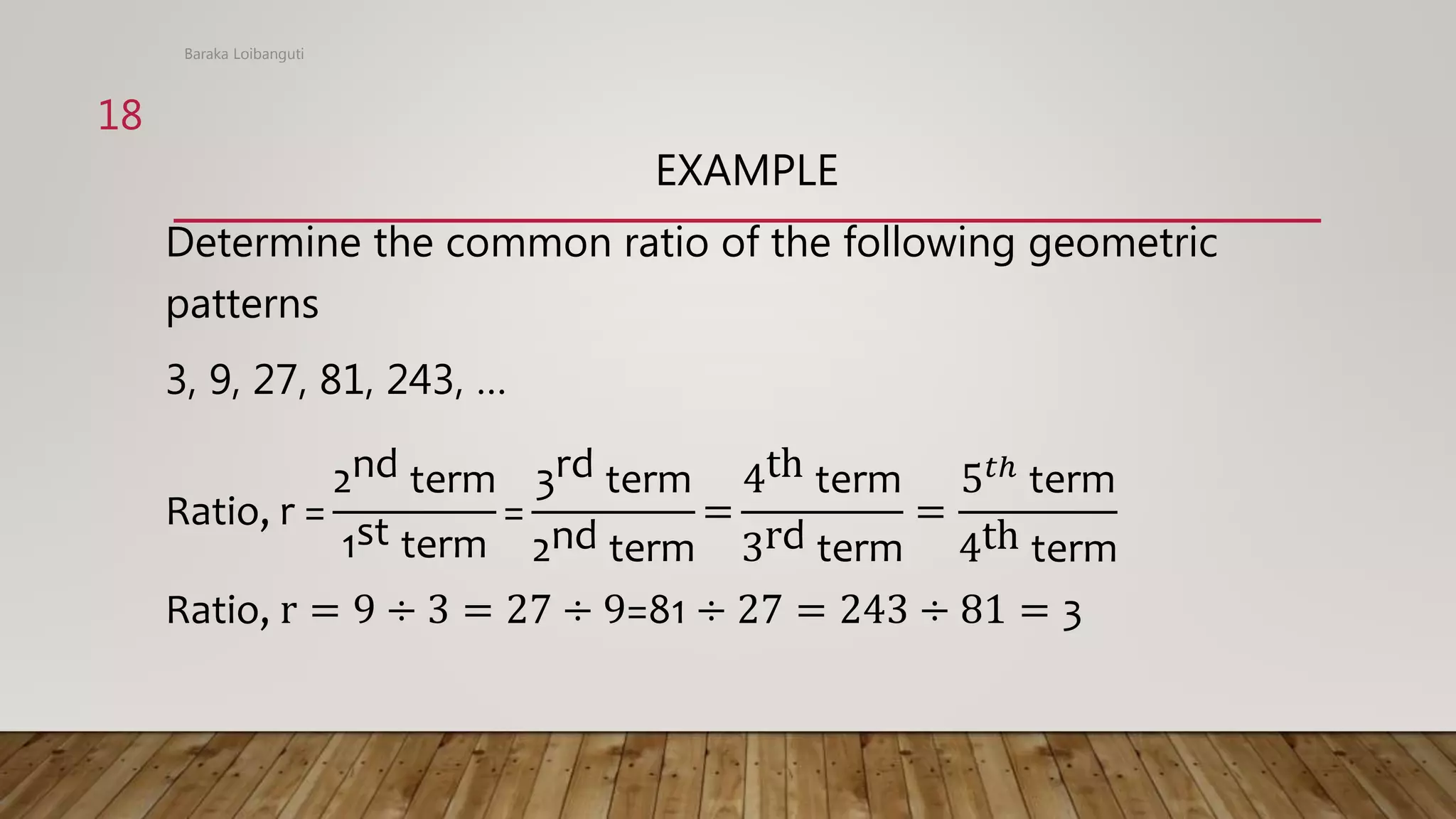
Determine the common ratio of the following geometric
patterns
3, 9, 27, 81, 243, …
Ratio, r =
2nd term
1st term
=
3rd term
2nd term
=
4th term
3rd term
=
5𝑡ℎ
term
4th term
Ratio, r = 9 ÷ 3 = 27 ÷ 9=81 ÷ 27 = 243 ÷ 81 = 3
Baraka Loibanguti
18
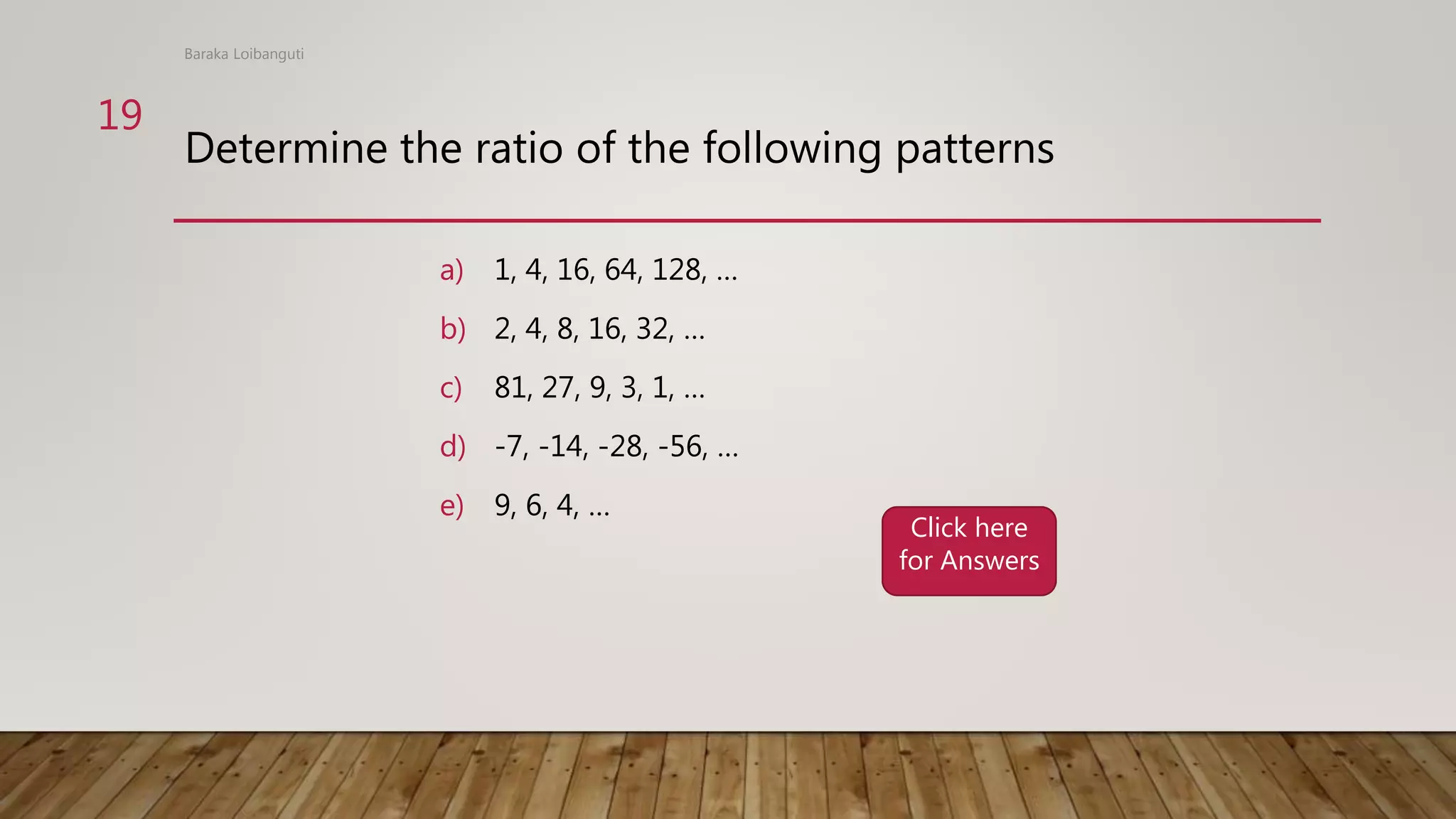
Determine the ratio of the following patterns
a) 1, 4, 16, 64, 128, …
b) 2, 4, 8, 16, 32, …
c) 81, 27, 9, 3, 1, …
d) -7, -14, -28, -56, …
e) 9, 6, 4, …
Baraka Loibanguti
19
Click here
for Answers
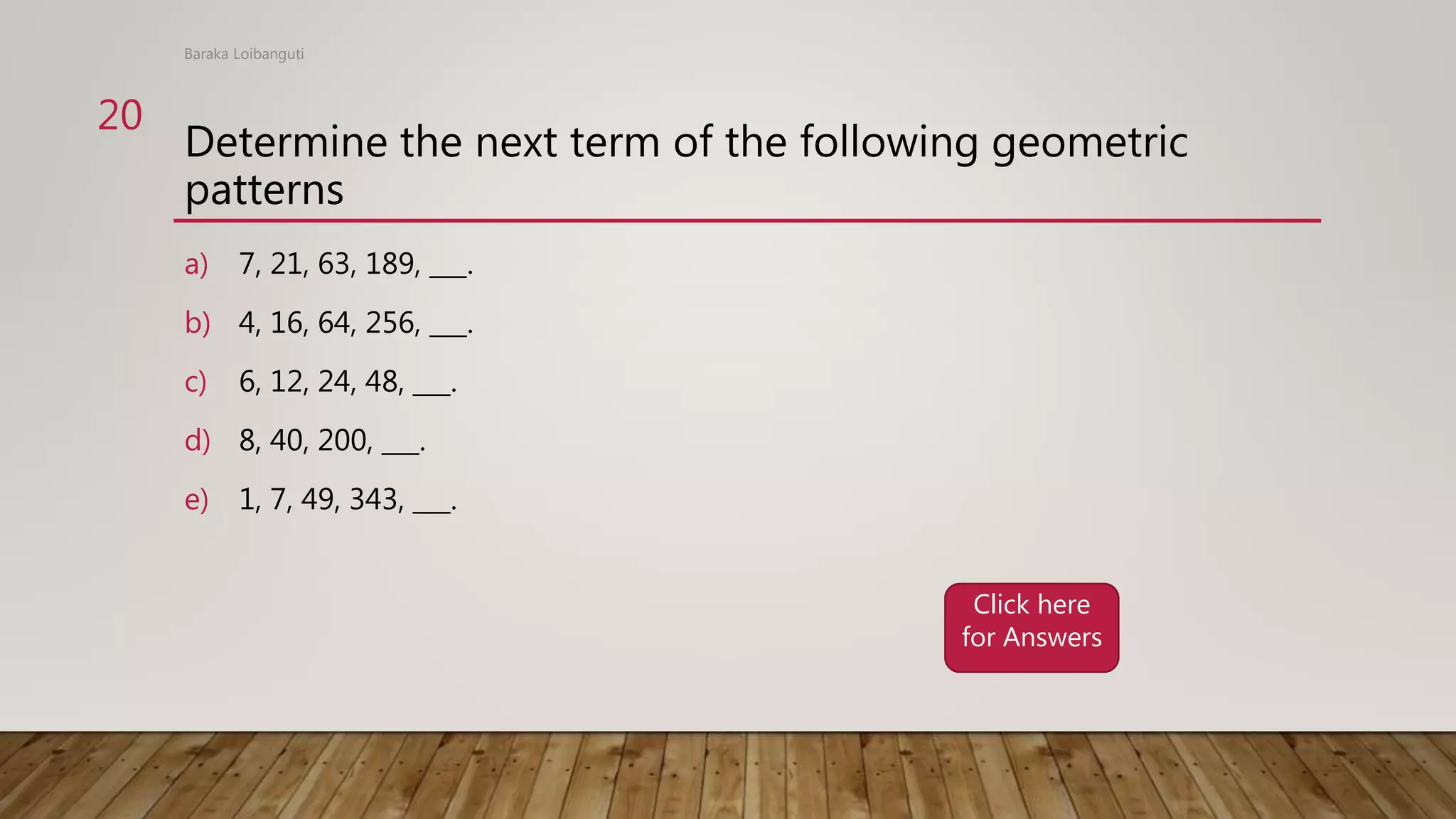
Determine the next term of the following geometric
patterns
a) 7, 21, 63, 189, ___.
b) 4, 16, 64, 256, ___.
c) 6, 12, 24, 48, ___.
d) 8, 40, 200, ___.
e) 1, 7, 49, 343, ___.
Baraka Loibanguti
20
Click here
for Answers
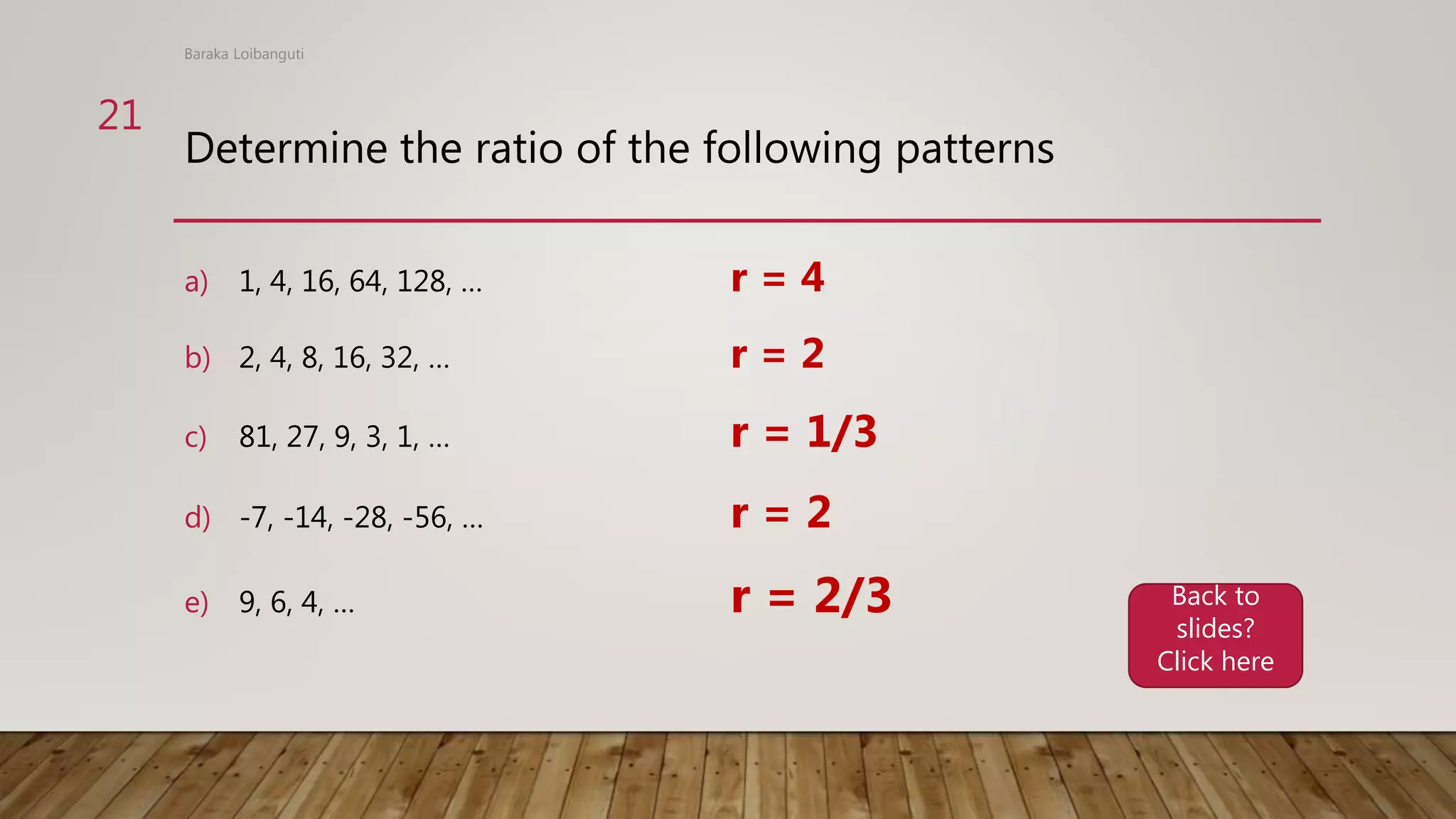
Determine the ratio of the following patterns
a) 1, 4, 16, 64, 128, … r = 4
b) 2, 4, 8, 16, 32, … r = 2
c) 81, 27, 9, 3, 1, … r = 1/3
d) -7, -14, -28, -56, … r = 2
e) 9, 6, 4, … r = 2/3
Baraka Loibanguti
21
Back to
slides?
Click here
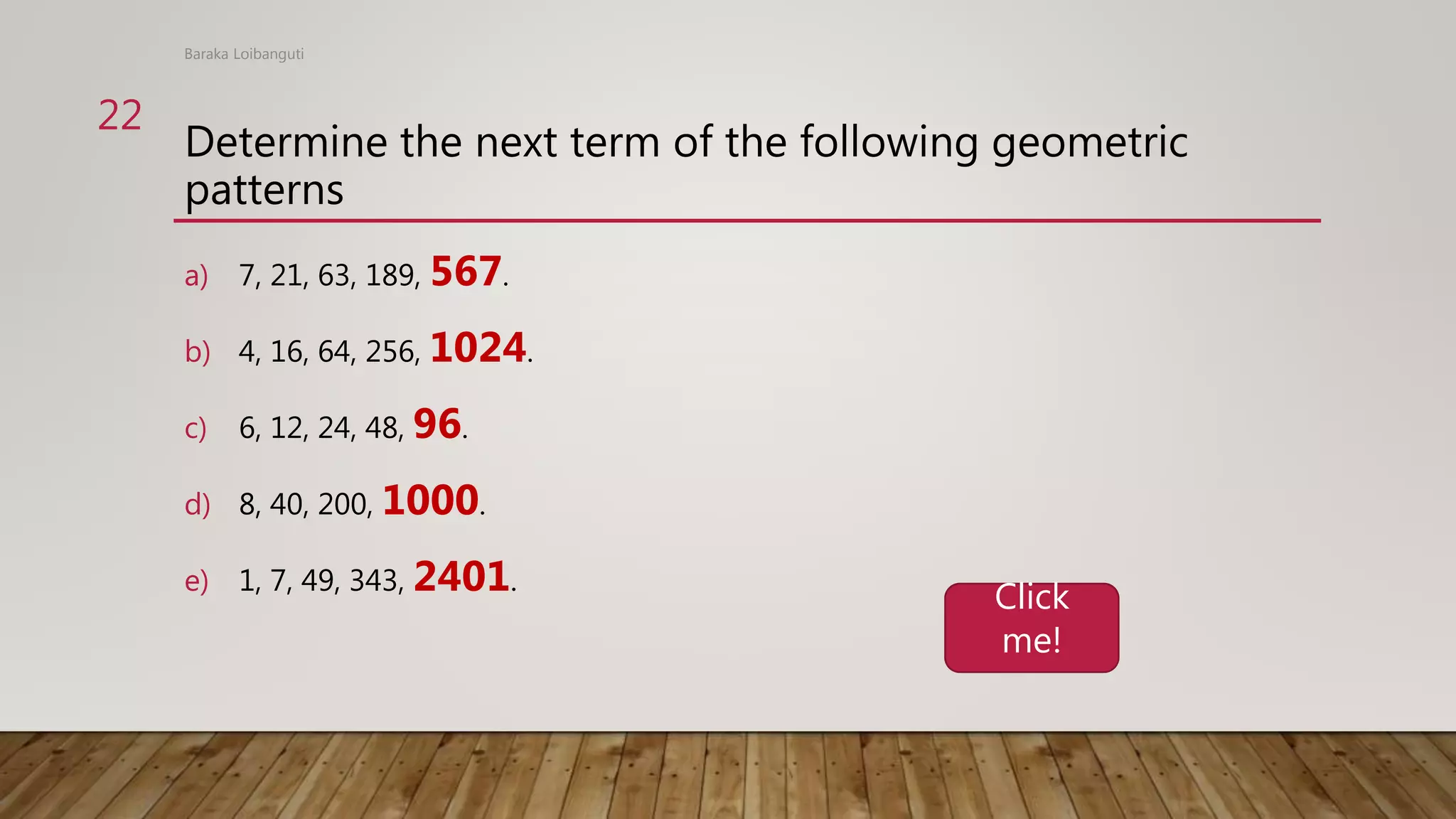
Determine the next term of the following geometric
patterns
a) 7, 21, 63, 189, 567.
b) 4, 16, 64, 256, 1024.
c) 6, 12, 24, 48, 96.
d) 8, 40, 200, 1000.
e) 1, 7, 49, 343, 2401.
Baraka Loibanguti
22
Click
me!
Baraka Loibanguti
23
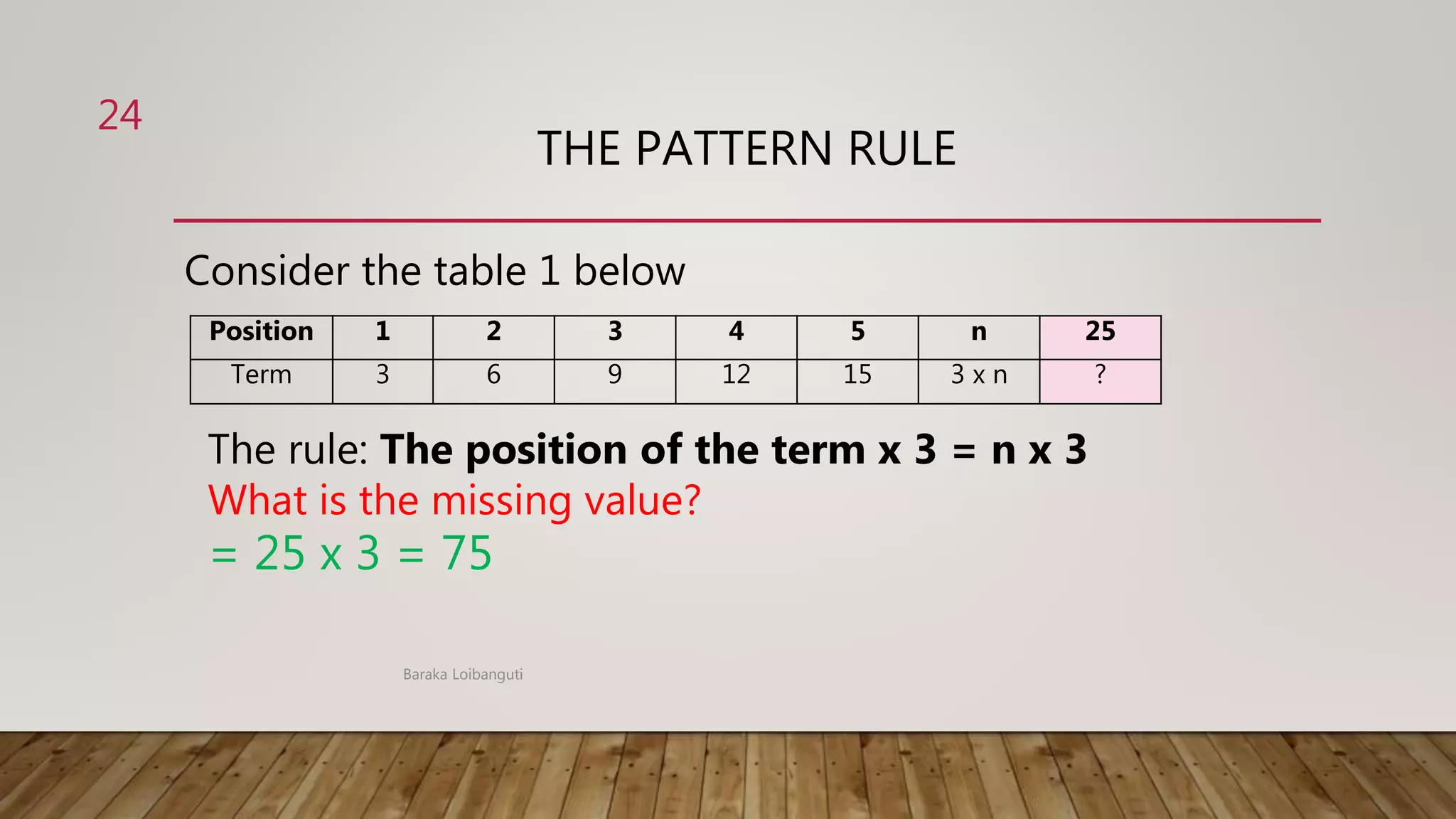
THE PATTERN RULE
Consider the table 1 below
Baraka Loibanguti
24
Position 1 2 3 4 5 n 25
Term 3 6 9 12 15 3 x n ?
The rule: The position of the term x 3 = n x 3
What is the missing value?
= 25 x 3 = 75
THE PATTERN RULE CONT…
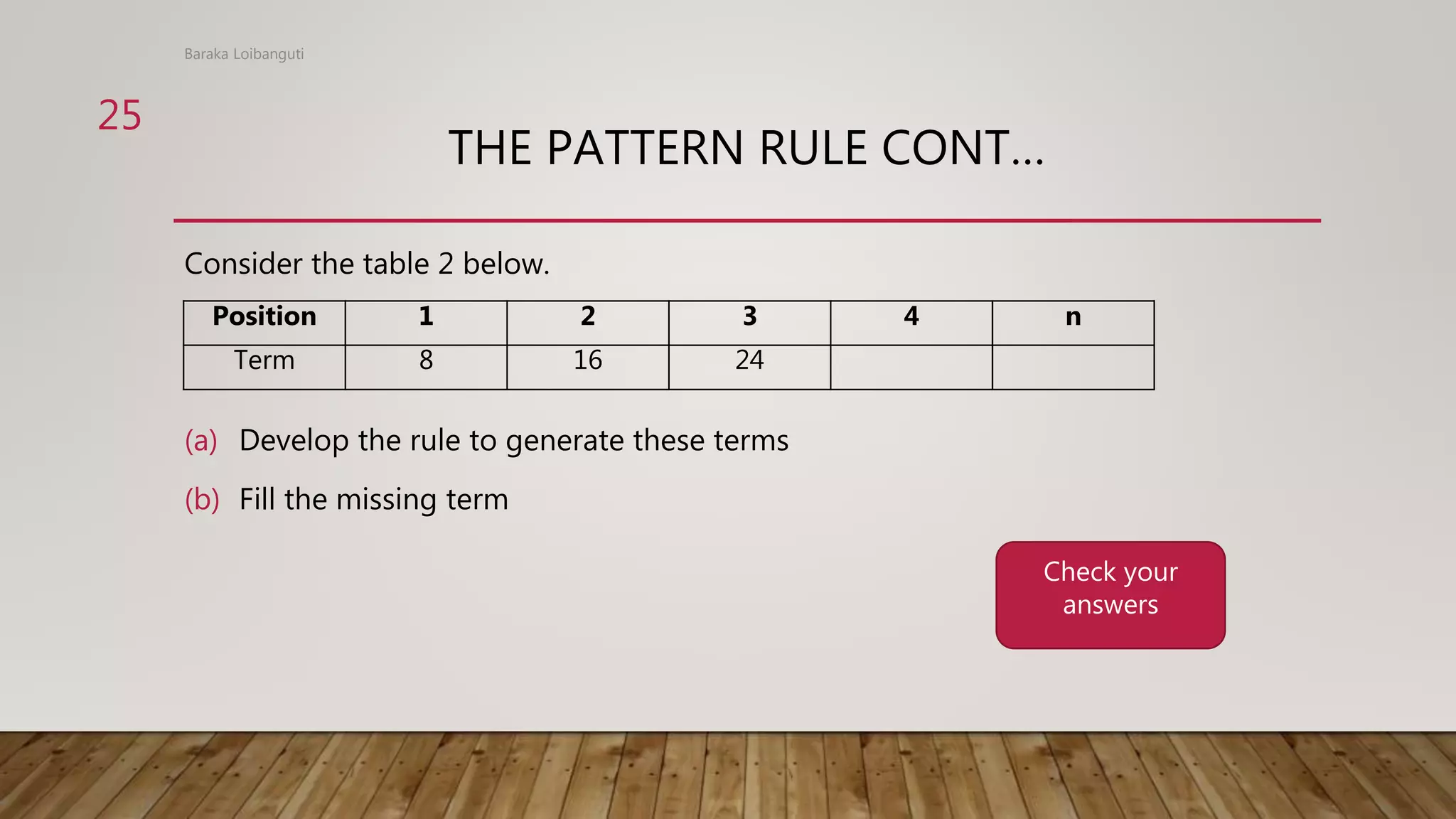
Consider the table 2 below.
(a) Develop the rule to generate these terms
(b) Fill the missing term
Baraka Loibanguti
25
Position 1 2 3 4 n
Term 8 16 24
Check your
answers
THE PATTERN RULE CONT…
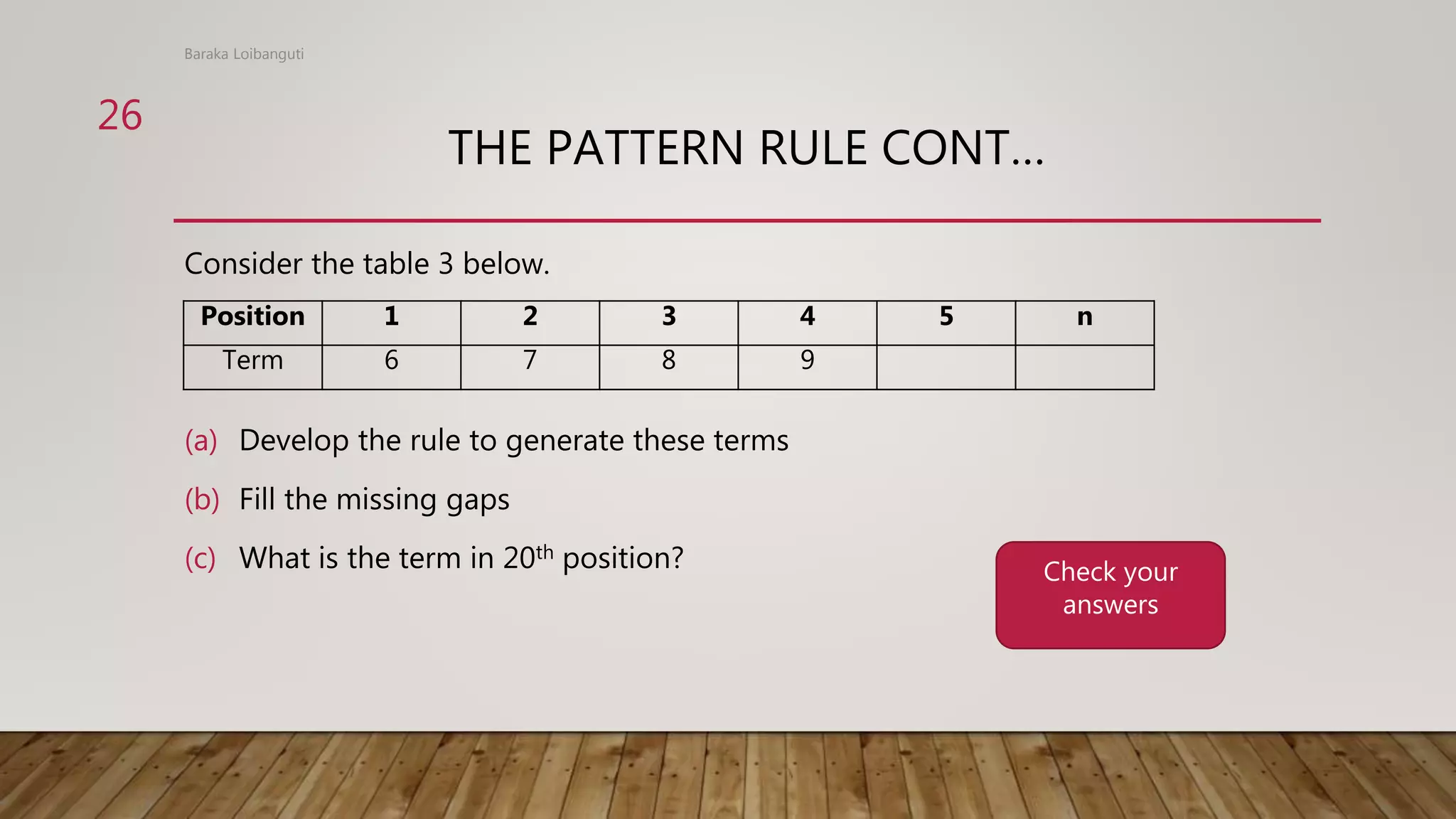
Consider the table 3 below.
(a) Develop the rule to generate these terms
(b) Fill the missing gaps
(c) What is the term in 20th position?
Baraka Loibanguti
26
Position 1 2 3 4 5 n
Term 6 7 8 9
Check your
answers
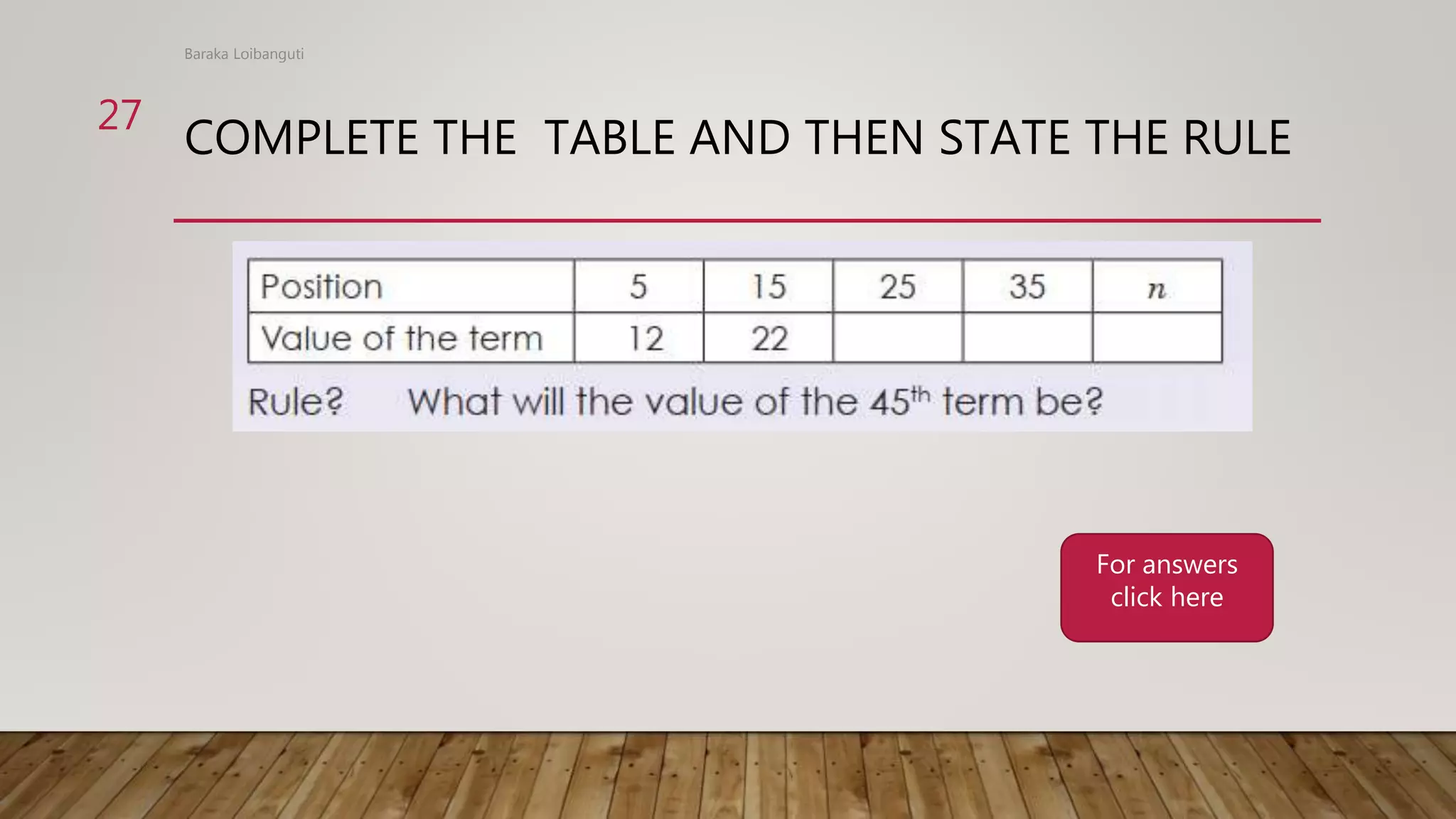
COMPLETE THE TABLE AND THEN STATE THE RULE
Baraka Loibanguti
27
For answers
click here
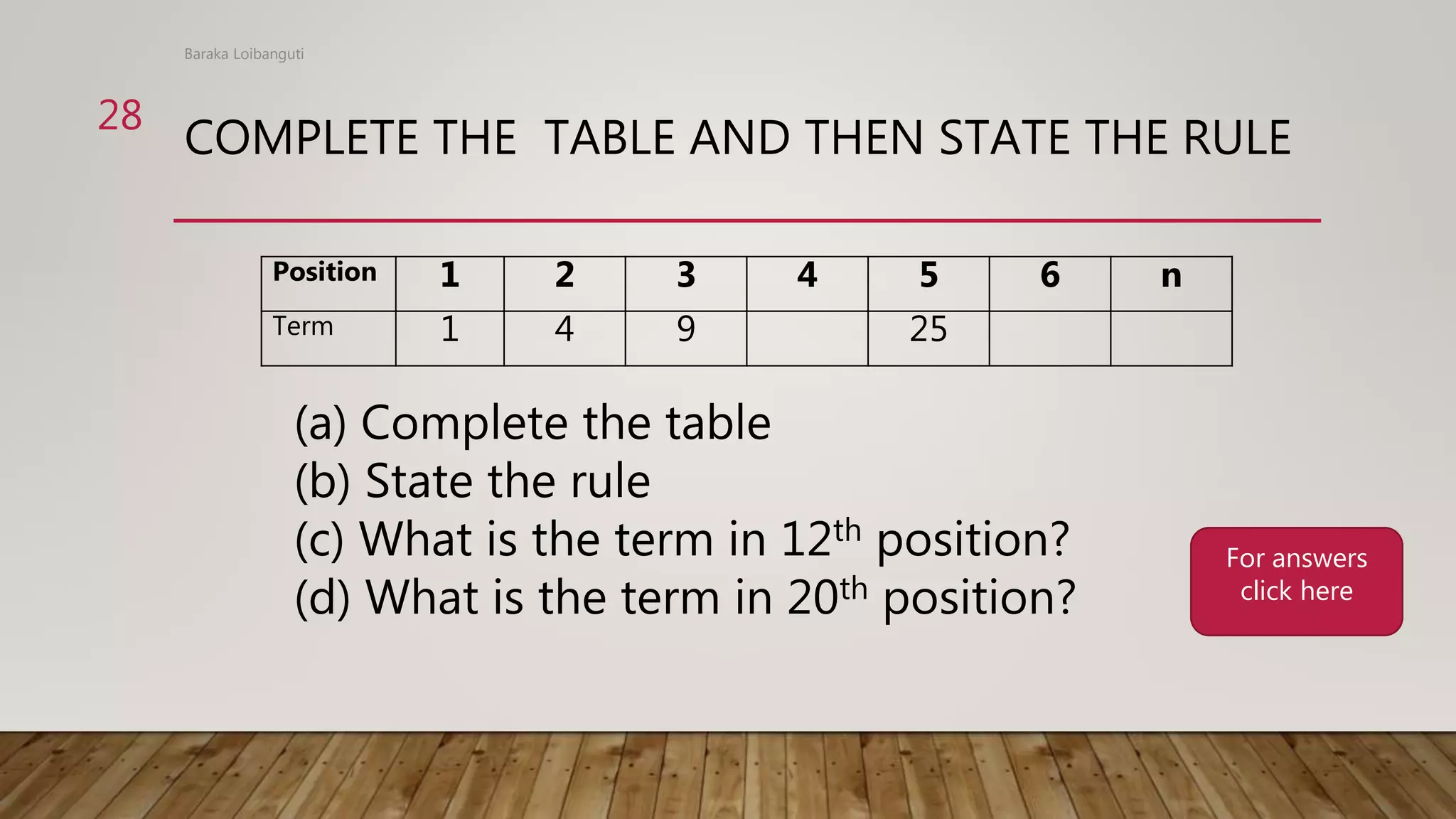
COMPLETE THE TABLE AND THEN STATE THE RULE
Baraka Loibanguti
28
For answers
click here
Position 1 2 3 4 5 6 n
Term 1 4 9 25
(a) Complete the table
(b) State the rule
(c) What is the term in 12th position?
(d) What is the term in 20th position?
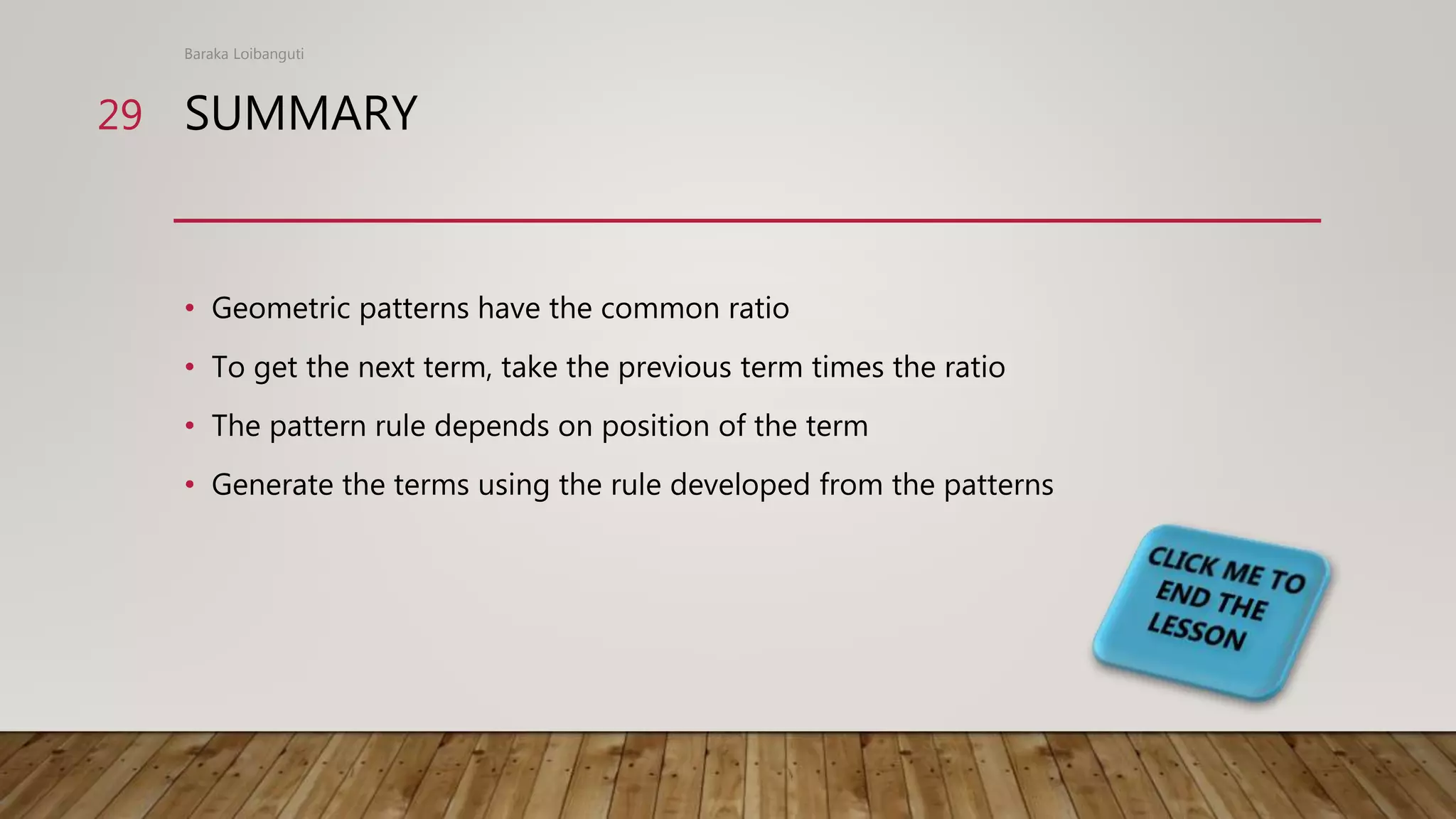
SUMMARY
• Geometric patterns have the common ratio
• To get the next term, take the previous term times the ratio
• The pattern rule depends on position of the term
• Generate the terms using the rule developed from the patterns
Baraka Loibanguti
29
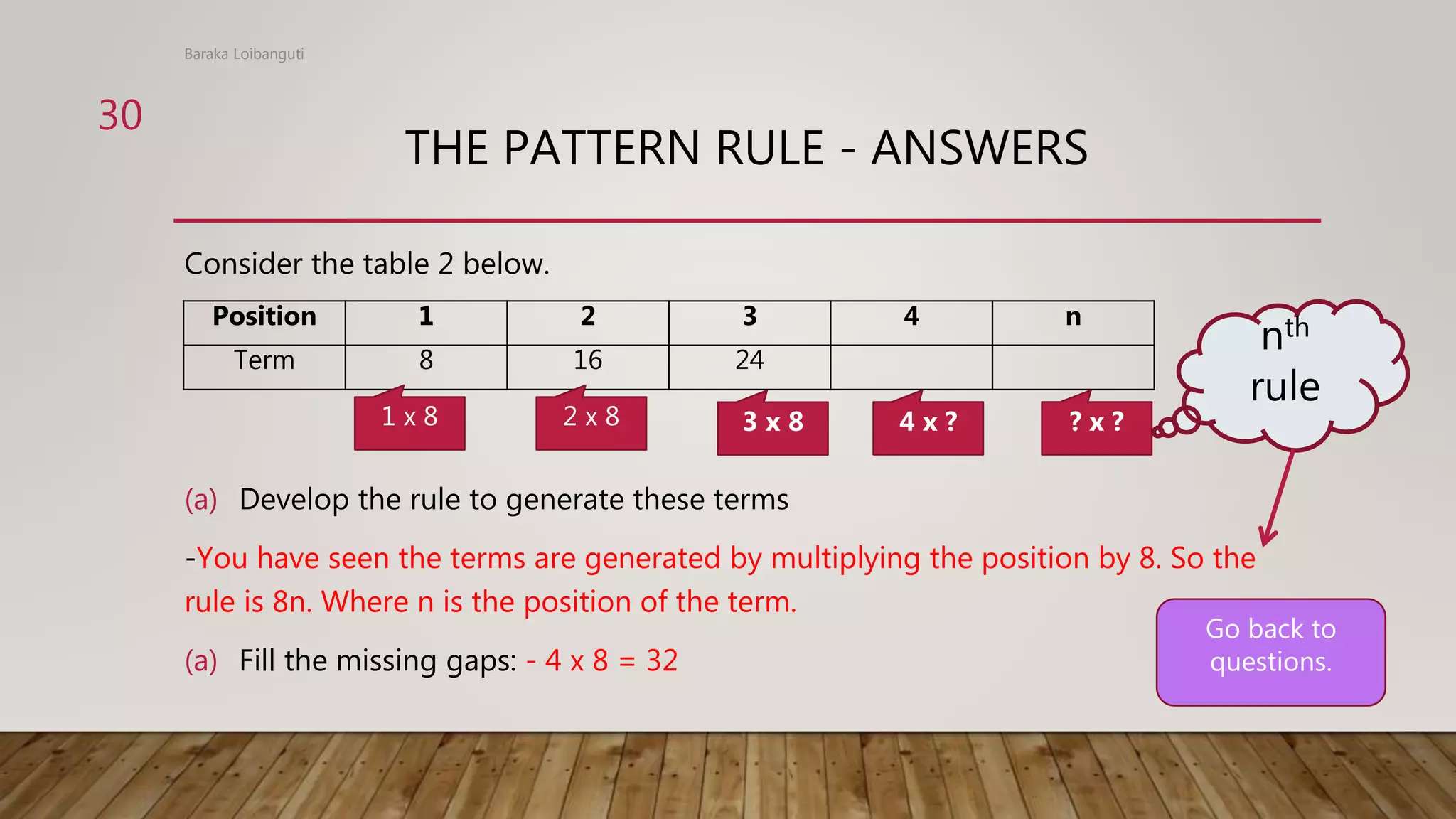
THE PATTERN RULE - ANSWERS
Consider the table 2 below.
(a) Develop the rule to generate these terms
-You have seen the terms are generated by multiplying the position by 8. So the
rule is 8n. Where n is the position of the term.
(a) Fill the missing gaps: - 4 x 8 = 32
Baraka Loibanguti
30
Position 1 2 3 4 n
Term 8 16 24
Go back to
questions.
1 x 8 2 x 8 3 x 8 4 x ? ? x ?
nth
rule
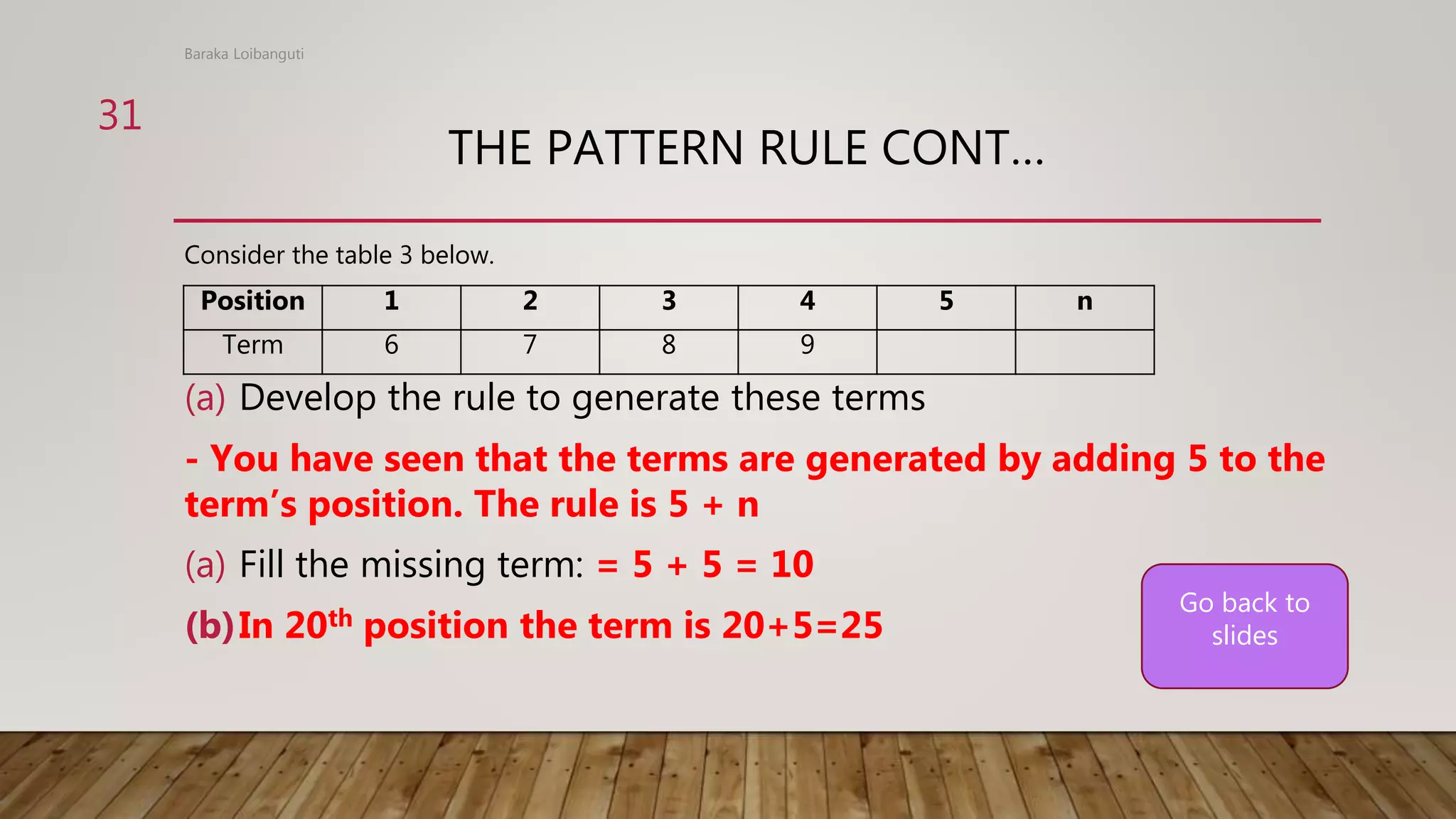
THE PATTERN RULE CONT…
Consider the table 3 below.
(a) Develop the rule to generate these terms
- You have seen that the terms are generated by adding 5 to the
term’s position. The rule is 5 + n
(a) Fill the missing term: = 5 + 5 = 10
(b)In 20th position the term is 20+5=25
Baraka Loibanguti
31
Position 1 2 3 4 5 n
Term 6 7 8 9
Go back to
slides
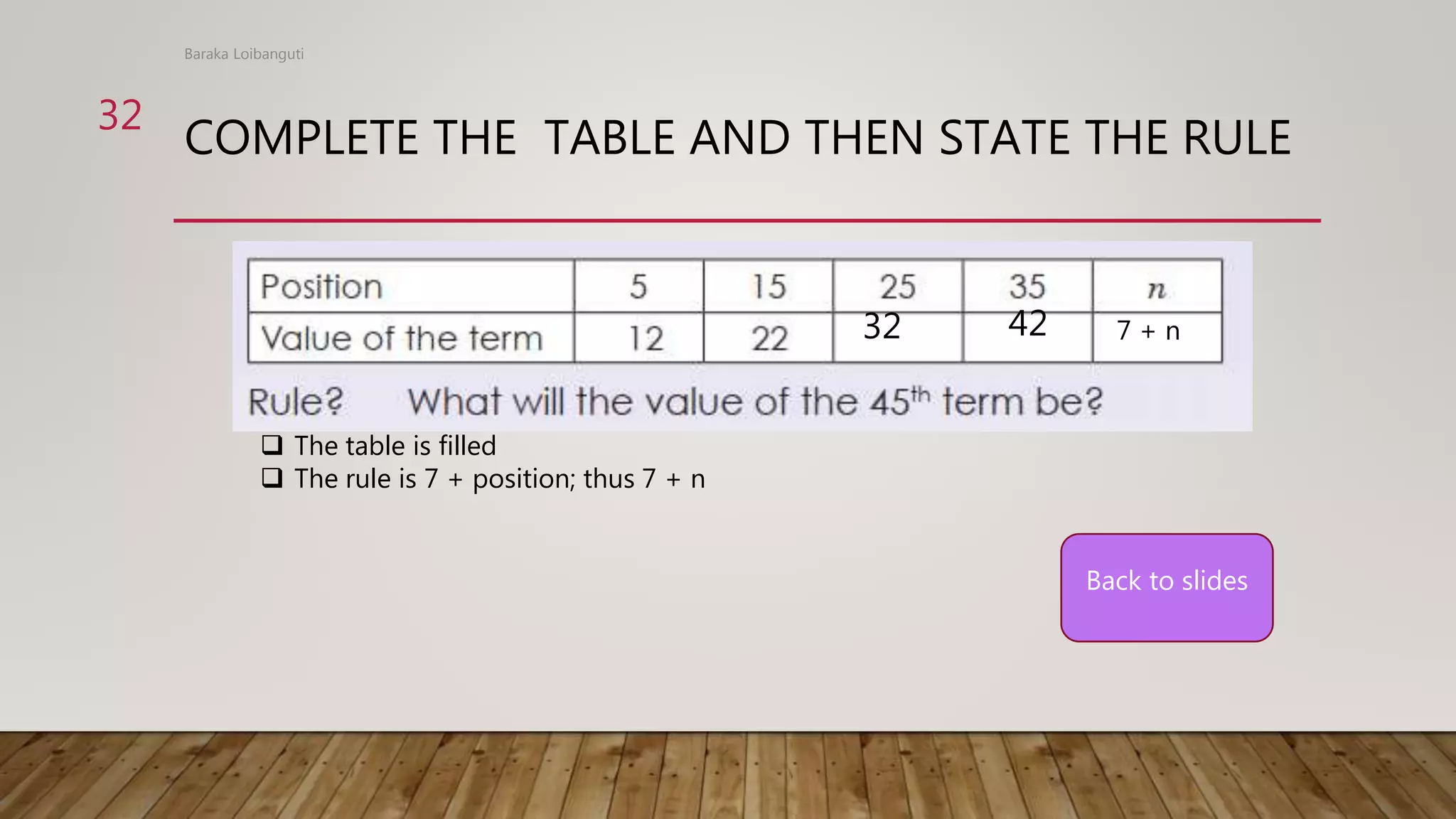
COMPLETE THE TABLE AND THEN STATE THE RULE
Baraka Loibanguti
32
Back to slides
 The table is filled
 The rule is 7 + position; thus 7 + n
32 42 7 + n
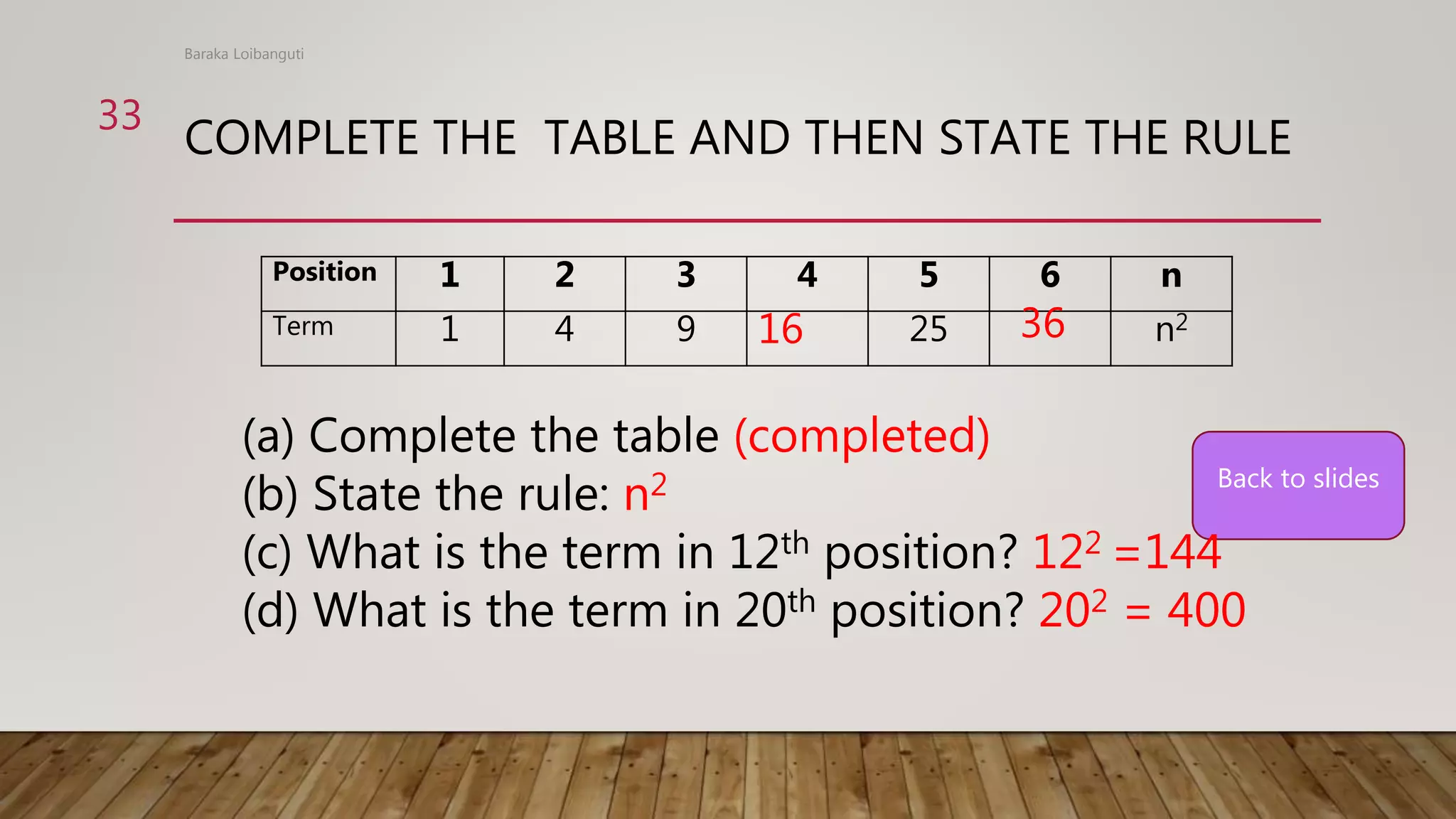
COMPLETE THE TABLE AND THEN STATE THE RULE
Baraka Loibanguti
33
Back to slides
Position 1 2 3 4 5 6 n
Term 1 4 9 25 n2
(a) Complete the table (completed)
(b) State the rule: n2
(c) What is the term in 12th position? 122 =144
(d) What is the term in 20th position? 202 = 400
16 36
• May I here from you?
-How did you find these slides?
-Anything to be improved?
-Let me know by clicking the safe link below
Baraka Loibanguti
34
barakaloibanguti@gmail.com

NUMERIC PATTERN.pptx

  • 1.
  • 2.
    NUMERIC PATTERN Numeric patternsare commonly divided into 1. Arithmetic (made by adding or subtracting a number each time). 2. Geometric (which involve multiplying or dividing by a number). Some geometric patterns are exponential, that is, they are made by multiplying by an exponent. Baraka Loibanguti 2
  • 3.
    ARITHMETIC PATTERNS The arithmeticpatterns are one obtained by adding or subtracting a constant number all the time. The constant number is called the common difference. Example of arithmetic patterns (a) 2, 4, 6, 8, 10, …,…, …, …, … (can you guess the missing terms? Baraka Loibanguti 3
  • 4.
    ARITHMETIC PATTERN CONT.… From 2,4, 6, 8, 10, …,…, … The numbers 2, 4, 6, 8, 10 are referred to as TERMS. Therefore, 2 is the first term 4 is the second term 6 is the third term 8 is the fourth term 10 is the fifth term etc. Baraka Loibanguti 4
  • 5.
    ARITHMETIC PATTERN CONT.… From 2,4, 6, 8, 10, …,…, … The constant difference is obtained by taking the second term minus the first term or the third minus the second term or fourth minus the third term etc. The common difference of the pattern above is 2. Thus, The 2nd term – the 1st term: 4 – 2 = 2 or The 3rd term – the 2nd term: 6 – 4 = 2 or The 4th term – the 3rd term: 8 – 6 = 2 etc Baraka Loibanguti 5
  • 6.
    ARITHMETIC PATTERN CONT.… Canyou tell the common difference between the terms of the patterns below and find the next term. 1. 7, 11, 15, 19, 23, 27, … d = _______, the 7th term =_________ 2. 5, 13, 21, 29, 37, … d = _______, the 6th term = _________ 3. 18, 15, 12, 9, 6, … d = _______, the 6th term =_________ 4. 40, 35, 30, 25, … d = _______, the 5th term = _________ Check your answers Baraka Loibanguti 6
  • 7.
    PATTERNS Which of thefollowing patterns arithmetic? a) 3, 8, 13, 18, 23, … b) 11, 17, 23, 29, … c) 7, 14, 20, 28, 36, … d) 0, 7, 14, 21, … e) 48, 43, 40, 31, 27,…. Baraka Loibanguti Check your answers 7
  • 8.
    ARITHMETIC PATTERNS For eachof the arithmetic pattern below find the next TWO terms. a) 100, 103, 106, 1009, __, __. b) 200, 189, 178, 167, __, __. c) 30, 37, 44, 51, __, ___. d) 50.0, 54.3, 58.6, 62.9, __,__, e) 2, 8, 14, 20, __, ___, Baraka Loibanguti Check your answers 8
  • 9.
    ARITHMETIC PATTERNS The followingare arithmetic patterns Find the missing term a) 5, 9, ___, 17, 21, ____, 29. b) ___, ____, 19, 24, 29, 34. c) 4, ____, 34, 49, 64, ___, 94. Baraka Loibanguti 9 Check your answers
  • 10.
    SUMMARY We have discussedthe arithmetic patterns and you have noted that THE ARITHMETIC PATTERNS have the common difference between the consecutive terms. Using this common difference you can determine the next few terms of the pattern. [Feel free to repeat the part for further clarification]. Baraka Loibanguti 10
  • 11.
  • 12.
    ARITHMETIC PATTERN ANSWERS Canyou tell the common difference between the terms of the patterns below and find the next term. 1. 7, 11, 15, 19, 23, 27, … d = _______, the 7th term =_________ 2. 5, 13, 21, 29, 37, … d = _______, the 6th term = _________ 3. 18, 15, 12, 9, 6, … d = _______, the 6th term =_________ 4. 40, 35, 30, 25, … d = _______, the 5th term = _________ 4 31 8 -3 -5 45 3 20 Baraka Loibanguti 12 Go back to questions?
  • 13.
    PATTERNS ANSWERS • Whichof the following patterns arithmetic? a) 3, 8, 13, 18, 23, … it is arithmetic b) 11, 17, 23, 29, … it is arithmetic c) 7, 14, 20, 28, 36, … it is not arithmetic d) 0, 7, 14, 21, … it is arithmetic e) 48, 43, 40, 31, 27,…. it is not arithmetic Baraka Loibanguti 13 Go back to questions?
  • 14.
    ARITHMETIC PATTERNS ANSWERS Foreach of the arithmetic pattern below find the next TWO terms. a) 100, 103, 106, 1009, 112, 115 b) 200, 189, 178, 167, 156, 145 c) 30, 37, 44, 51, 58, 65 d) 50.0, 54.3, 58.6, 62.9, 67.2,71.5 e) 2, 8, 14, 20, 26, 32 Baraka Loibanguti 14 Go back to questions?
  • 15.
    ARITHMETIC PATTERNS ANSWERS Thefollowing are arithmetic patterns Find the missing term a) 5, 9, 13, 17, 21, 25, 29. b) 9, 14, 19, 24, 29, 34. c) 4, 19, 34, 49, 64, 79, 94. Baraka Loibanguti 15 Go back to questions?
  • 16.
  • 17.
    GEOMETRY PATTERN Geometric patternsare obtained when multiplying or dividing by a constant term all the time. The common constant is called common ratio, r. To get the common ratio is obtained by:- r= second term first term = third term second term = fourth term third term Baraka Loibanguti 17
  • 18.
    EXAMPLE Determine the commonratio of the following geometric patterns 3, 9, 27, 81, 243, … Ratio, r = 2nd term 1st term = 3rd term 2nd term = 4th term 3rd term = 5𝑡ℎ term 4th term Ratio, r = 9 ÷ 3 = 27 ÷ 9=81 ÷ 27 = 243 ÷ 81 = 3 Baraka Loibanguti 18
  • 19.
    Determine the ratioof the following patterns a) 1, 4, 16, 64, 128, … b) 2, 4, 8, 16, 32, … c) 81, 27, 9, 3, 1, … d) -7, -14, -28, -56, … e) 9, 6, 4, … Baraka Loibanguti 19 Click here for Answers
  • 20.
    Determine the nextterm of the following geometric patterns a) 7, 21, 63, 189, ___. b) 4, 16, 64, 256, ___. c) 6, 12, 24, 48, ___. d) 8, 40, 200, ___. e) 1, 7, 49, 343, ___. Baraka Loibanguti 20 Click here for Answers
  • 21.
    Determine the ratioof the following patterns a) 1, 4, 16, 64, 128, … r = 4 b) 2, 4, 8, 16, 32, … r = 2 c) 81, 27, 9, 3, 1, … r = 1/3 d) -7, -14, -28, -56, … r = 2 e) 9, 6, 4, … r = 2/3 Baraka Loibanguti 21 Back to slides? Click here
  • 22.
    Determine the nextterm of the following geometric patterns a) 7, 21, 63, 189, 567. b) 4, 16, 64, 256, 1024. c) 6, 12, 24, 48, 96. d) 8, 40, 200, 1000. e) 1, 7, 49, 343, 2401. Baraka Loibanguti 22 Click me!
  • 23.
  • 24.
    THE PATTERN RULE Considerthe table 1 below Baraka Loibanguti 24 Position 1 2 3 4 5 n 25 Term 3 6 9 12 15 3 x n ? The rule: The position of the term x 3 = n x 3 What is the missing value? = 25 x 3 = 75
  • 25.
    THE PATTERN RULECONT… Consider the table 2 below. (a) Develop the rule to generate these terms (b) Fill the missing term Baraka Loibanguti 25 Position 1 2 3 4 n Term 8 16 24 Check your answers
  • 26.
    THE PATTERN RULECONT… Consider the table 3 below. (a) Develop the rule to generate these terms (b) Fill the missing gaps (c) What is the term in 20th position? Baraka Loibanguti 26 Position 1 2 3 4 5 n Term 6 7 8 9 Check your answers
  • 27.
    COMPLETE THE TABLEAND THEN STATE THE RULE Baraka Loibanguti 27 For answers click here
  • 28.
    COMPLETE THE TABLEAND THEN STATE THE RULE Baraka Loibanguti 28 For answers click here Position 1 2 3 4 5 6 n Term 1 4 9 25 (a) Complete the table (b) State the rule (c) What is the term in 12th position? (d) What is the term in 20th position?
  • 29.
    SUMMARY • Geometric patternshave the common ratio • To get the next term, take the previous term times the ratio • The pattern rule depends on position of the term • Generate the terms using the rule developed from the patterns Baraka Loibanguti 29
  • 30.
    THE PATTERN RULE- ANSWERS Consider the table 2 below. (a) Develop the rule to generate these terms -You have seen the terms are generated by multiplying the position by 8. So the rule is 8n. Where n is the position of the term. (a) Fill the missing gaps: - 4 x 8 = 32 Baraka Loibanguti 30 Position 1 2 3 4 n Term 8 16 24 Go back to questions. 1 x 8 2 x 8 3 x 8 4 x ? ? x ? nth rule
  • 31.
    THE PATTERN RULECONT… Consider the table 3 below. (a) Develop the rule to generate these terms - You have seen that the terms are generated by adding 5 to the term’s position. The rule is 5 + n (a) Fill the missing term: = 5 + 5 = 10 (b)In 20th position the term is 20+5=25 Baraka Loibanguti 31 Position 1 2 3 4 5 n Term 6 7 8 9 Go back to slides
  • 32.
    COMPLETE THE TABLEAND THEN STATE THE RULE Baraka Loibanguti 32 Back to slides  The table is filled  The rule is 7 + position; thus 7 + n 32 42 7 + n
  • 33.
    COMPLETE THE TABLEAND THEN STATE THE RULE Baraka Loibanguti 33 Back to slides Position 1 2 3 4 5 6 n Term 1 4 9 25 n2 (a) Complete the table (completed) (b) State the rule: n2 (c) What is the term in 12th position? 122 =144 (d) What is the term in 20th position? 202 = 400 16 36
  • 34.
    • May Ihere from you? -How did you find these slides? -Anything to be improved? -Let me know by clicking the safe link below Baraka Loibanguti 34 barakaloibanguti@gmail.com