PAT301. Diseases of field and
horticultural crops and their
management (1+1)🍅
Tomato spotted wilt
virus
INTRODUCTION
• Tomato spotted wilt virus (TSWV) is a spherical shaped RNA
virus. It is one of the 10 most economical destructive plant
viruses
• Also called as Orthotospo virus
• The host range of TSWV is Over 1000 species iof 85 families.
• Common hosts:
. Tomatoes, peppers, potatoes, celery, eggplant, peanuts,
lettuce, pineapple, cucurbits (melons, squash, cucumbers,
etc.), many legumes, many ornamentals, and weeds such as
field bindweed and curly dock
History
• This virus disease firstly identified in 1919 at Australia.
• The disease decreased in prevalence between the 1940s
• In 1940s to 1980s this disease caused heavy yield loss in
tomato at USA and Hawaii.
• .The worldwide spread of the western flower thrips
(Frankliniella occidentalis), an efficient TSWVvector, from
the westernpart of the USA during the 1980s has certainly
played an important role in TSWV emergence.
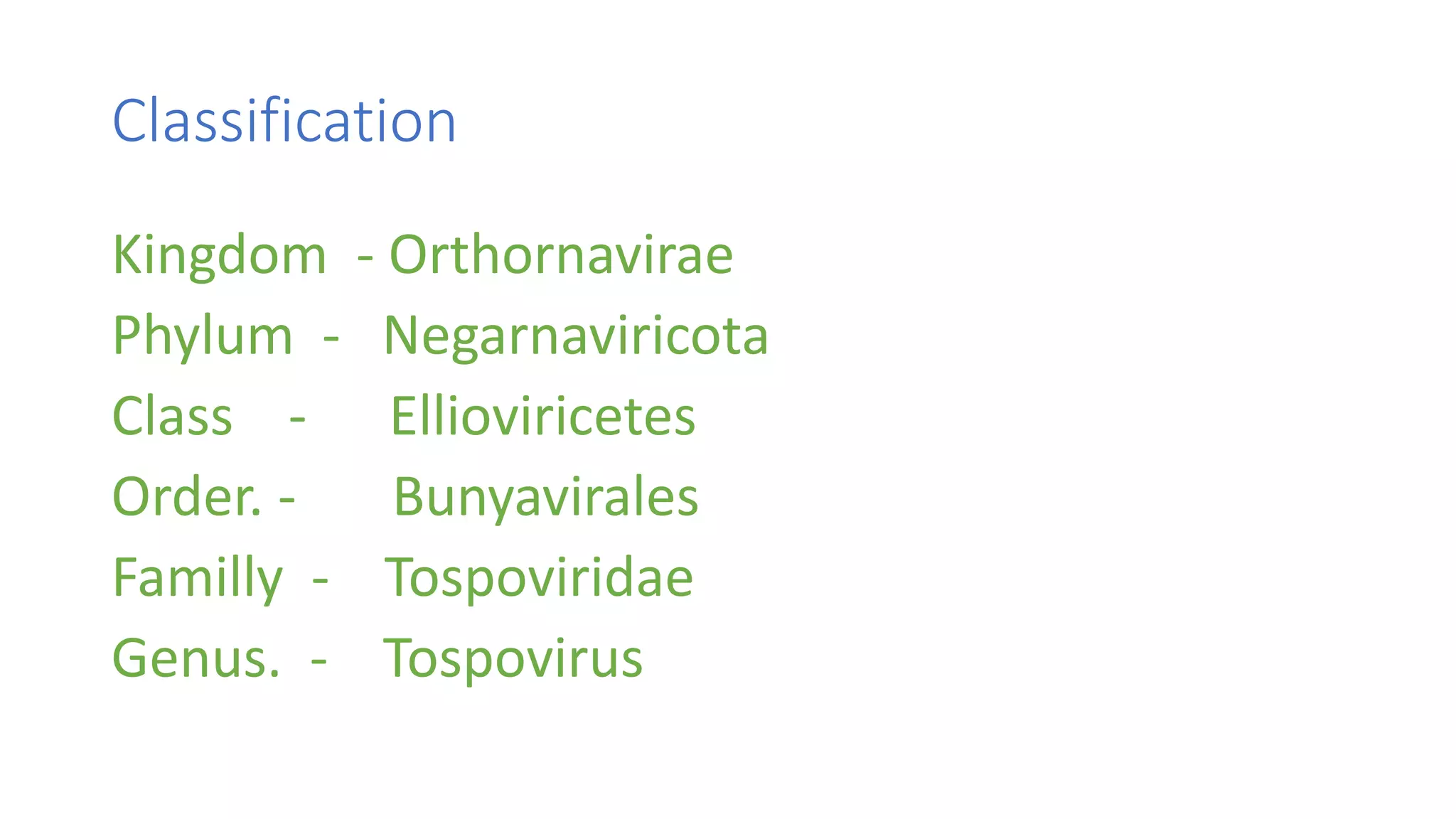
Classification
Kingdom - Orthornavirae
Phylum - Negarnaviricota
Class - Ellioviricetes
Order. - Bunyavirales
Familly - Tospoviridae
Genus. - Tospovirus
Symptoms
• Stunting is a common symptom of TSWV infection, and is
generally more severe when young plants are infected .
• Chlorotic or necrotic rings form on the leaves of many infected
hosts , and may also appear on the fruits of some hosts .
• Necrosis may develop in the foliage of some hosts,. Although
TSWV is not seed transmitted, it may cause discoloration of
seed produced on infected hosts . Hence, tomato spotted wilt
may affect both the quantity and quality of plant products.
• Additionally, movement of infected plant material may result in
TSWV being introduced into a new setting.
Pathogen
• It is a spherical shaped single stranded RNA virus
• Size 80-110 nm In diameter
• It has 3 RNA’s inside the viral envelope which differ in and
size and are called Large, medium, small.
• Frankliniella occidentalis, the western flower thrips, is
considered to be the most important vector species
because it is globally distributed and can transmit most
tospoviruses
Disease Transmission
• TSWV is transmitted from infected plants to
healthy plants by at least ten species of thrips.
• Thrips are tiny winged insects that feed on
plants through sucking mouthparts.
• Thrips transmit the virus in a persistent
propagative manner, which means that once the
insect has picked up the virus, the virus replicates
within the insect and the insect is able to transmit
the virus for the remainder of its life.
Challenges in controlling Tospo virus diseases
•Broad host range
•Multiple vector species
•Evolution of new strains
•Ability to overcome host plant resistance
Disease Management
• Controlling this disease is difficult. The wide host range,
which includes many perennial ornamentals and weeds,
enables the virus to successfully overseason from one
crop to the next.
• Controlling thrips is somewhat more effective in
greenhouse situations. In greenhouses, however,
growers should take care to avoid repeated sprays of
similar insecticides because thrips are able to build up
resistance to commonly used insecticides in a relatively
short time.
Cultural practices
• Virus free planting material
• Remove all infected plants.
• Insect control by traps
• Crop rotation
• Use mulching practices
• Check seed sources for new cultivars
Chemical practices
•Control of thrips may be obtained with
pyrethroids, carbamates, chlorinated
hydrocarbons, organophosphates, and
soaps.
•Insecticides are most effective when applied
in the morning, when the thrips are most
active and the chance for plant damage is
reduced.
TOMATO SPOTTED WILT VIRUS

TOMATO SPOTTED WILT VIRUS

  • 1.
    PAT301. Diseases offield and horticultural crops and their management (1+1)🍅 Tomato spotted wilt virus
  • 2.
    INTRODUCTION • Tomato spottedwilt virus (TSWV) is a spherical shaped RNA virus. It is one of the 10 most economical destructive plant viruses • Also called as Orthotospo virus • The host range of TSWV is Over 1000 species iof 85 families. • Common hosts: . Tomatoes, peppers, potatoes, celery, eggplant, peanuts, lettuce, pineapple, cucurbits (melons, squash, cucumbers, etc.), many legumes, many ornamentals, and weeds such as field bindweed and curly dock
  • 3.
    History • This virusdisease firstly identified in 1919 at Australia. • The disease decreased in prevalence between the 1940s • In 1940s to 1980s this disease caused heavy yield loss in tomato at USA and Hawaii. • .The worldwide spread of the western flower thrips (Frankliniella occidentalis), an efficient TSWVvector, from the westernpart of the USA during the 1980s has certainly played an important role in TSWV emergence.
  • 4.
    Classification Kingdom - Orthornavirae Phylum- Negarnaviricota Class - Ellioviricetes Order. - Bunyavirales Familly - Tospoviridae Genus. - Tospovirus
  • 5.
    Symptoms • Stunting isa common symptom of TSWV infection, and is generally more severe when young plants are infected . • Chlorotic or necrotic rings form on the leaves of many infected hosts , and may also appear on the fruits of some hosts . • Necrosis may develop in the foliage of some hosts,. Although TSWV is not seed transmitted, it may cause discoloration of seed produced on infected hosts . Hence, tomato spotted wilt may affect both the quantity and quality of plant products. • Additionally, movement of infected plant material may result in TSWV being introduced into a new setting.
  • 7.
    Pathogen • It isa spherical shaped single stranded RNA virus • Size 80-110 nm In diameter • It has 3 RNA’s inside the viral envelope which differ in and size and are called Large, medium, small. • Frankliniella occidentalis, the western flower thrips, is considered to be the most important vector species because it is globally distributed and can transmit most tospoviruses
  • 8.
    Disease Transmission • TSWVis transmitted from infected plants to healthy plants by at least ten species of thrips. • Thrips are tiny winged insects that feed on plants through sucking mouthparts. • Thrips transmit the virus in a persistent propagative manner, which means that once the insect has picked up the virus, the virus replicates within the insect and the insect is able to transmit the virus for the remainder of its life.
  • 9.
    Challenges in controllingTospo virus diseases •Broad host range •Multiple vector species •Evolution of new strains •Ability to overcome host plant resistance
  • 10.
    Disease Management • Controllingthis disease is difficult. The wide host range, which includes many perennial ornamentals and weeds, enables the virus to successfully overseason from one crop to the next. • Controlling thrips is somewhat more effective in greenhouse situations. In greenhouses, however, growers should take care to avoid repeated sprays of similar insecticides because thrips are able to build up resistance to commonly used insecticides in a relatively short time.
  • 11.
    Cultural practices • Virusfree planting material • Remove all infected plants. • Insect control by traps • Crop rotation • Use mulching practices • Check seed sources for new cultivars
  • 12.
    Chemical practices •Control ofthrips may be obtained with pyrethroids, carbamates, chlorinated hydrocarbons, organophosphates, and soaps. •Insecticides are most effective when applied in the morning, when the thrips are most active and the chance for plant damage is reduced.