PAT-301 DISEASE OF FIELDAND
HORTICULTURAL CROPS AND THEIR
MANAGEMENT-I (1+1)
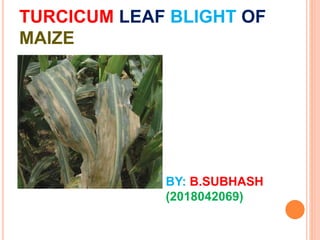
TURCICUM LEAF BLIGHT OF
MAIZE
BY: B.SUBHASH
(2018042069)
DISEASE NAME:
Turcicum leaf blight
PATHOGEN NAME:
COMMON NAME:
Helminthosporium turcicum
HOSTS:
corn, Johnson grass (or) Sudan grass, sorghum, maize,
Exserohilum turcicum
TAXONOMY
Kingdom:
Fungi
Phylum:
Ascomycota
Class:
Dothideomycetes
Order:
Pleosporales
Family:
Pleosporaceae
Genus:
Exserohilum
Species:
Exserohilum turcicum
INTRODUCTION
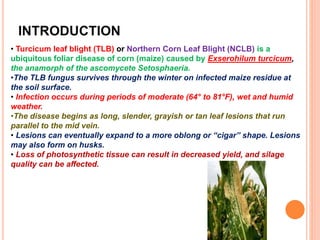
• Turcicum leaf blight (TLB) or Northern Corn Leaf Blight (NCLB) is a
ubiquitous foliar disease of corn (maize) caused by Exserohilum turcicum,
the anamorph of the ascomycete Setosphaeria.
•The TLB fungus survives through the winter on infected maize residue at
the soil surface.
• Infection occurs during periods of moderate (64° to 81°F), wet and humid
weather.
•The disease begins as long, slender, grayish or tan leaf lesions that run
parallel to the mid vein.
• Lesions can eventually expand to a more oblong or “cigar” shape. Lesions
may also form on husks.
• Loss of photosynthetic tissue can result in decreased yield, and silage
quality can be affected.
PATHOGEN CHARACTER
 Mycelium is branched, septate, inter and intra
cellular.
 Conidiophores arises in groups, long,
unbranched, slightly curved,geniculate and
yellowish brown
 Conidia borne singly, distinctly curved,
fusiform, long, 3-7 septate.
SYMPTOMS
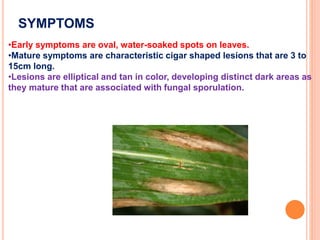
•Early symptoms are oval, water-soaked spots on leaves.
•Mature symptoms are characteristic cigar shaped lesions that are 3 to
15cm long.
•Lesions are elliptical and tan in color, developing distinct dark areas as
they mature that are associated with fungal sporulation.
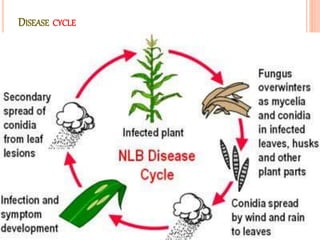
DISEASE CYCLE
EPIDAMOLOGY
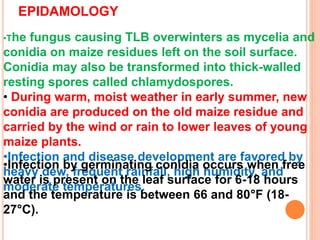
•The fungus causing TLB overwinters as mycelia and
conidia on maize residues left on the soil surface.
Conidia may also be transformed into thick-walled
resting spores called chlamydospores.
• During warm, moist weather in early summer, new
conidia are produced on the old maize residue and
carried by the wind or rain to lower leaves of young
maize plants.
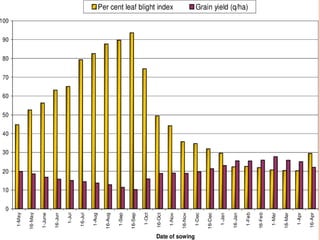
•Infection and disease development are favored by
heavy dew, frequent rainfall, high humidity, and
moderate temperatures.
•Infection by germinating conidia occurs when free
water is present on the leaf surface for 6-18 hours
and the temperature is between 66 and 80°F (18-
27°C).
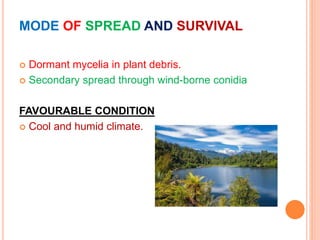
MODE OF SPREAD AND SURVIVAL
 Dormant mycelia in plant debris.
 Secondary spread through wind-borne conidia
FAVOURABLE CONDITION
 Cool and humid climate.
MANAGEMENT
 Spray with MANCOZEB @ 2.0 g/lit.
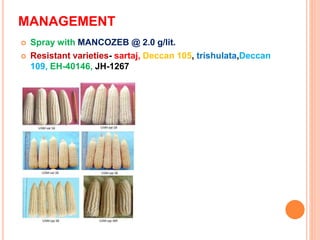
 Resistant varieties- sartaj, Deccan 105, trishulata,Deccan
109, EH-40146, JH-1267
Turcicum leaf blight of maize

Turcicum leaf blight of maize

  • 1.
    PAT-301 DISEASE OFFIELDAND HORTICULTURAL CROPS AND THEIR MANAGEMENT-I (1+1)
  • 2.
    TURCICUM LEAF BLIGHTOF MAIZE BY: B.SUBHASH (2018042069)
  • 3.
    DISEASE NAME: Turcicum leafblight PATHOGEN NAME: COMMON NAME: Helminthosporium turcicum HOSTS: corn, Johnson grass (or) Sudan grass, sorghum, maize, Exserohilum turcicum
  • 4.
  • 5.
    INTRODUCTION • Turcicum leafblight (TLB) or Northern Corn Leaf Blight (NCLB) is a ubiquitous foliar disease of corn (maize) caused by Exserohilum turcicum, the anamorph of the ascomycete Setosphaeria. •The TLB fungus survives through the winter on infected maize residue at the soil surface. • Infection occurs during periods of moderate (64° to 81°F), wet and humid weather. •The disease begins as long, slender, grayish or tan leaf lesions that run parallel to the mid vein. • Lesions can eventually expand to a more oblong or “cigar” shape. Lesions may also form on husks. • Loss of photosynthetic tissue can result in decreased yield, and silage quality can be affected.
  • 6.
    PATHOGEN CHARACTER  Myceliumis branched, septate, inter and intra cellular.  Conidiophores arises in groups, long, unbranched, slightly curved,geniculate and yellowish brown  Conidia borne singly, distinctly curved, fusiform, long, 3-7 septate.
  • 7.
    SYMPTOMS •Early symptoms areoval, water-soaked spots on leaves. •Mature symptoms are characteristic cigar shaped lesions that are 3 to 15cm long. •Lesions are elliptical and tan in color, developing distinct dark areas as they mature that are associated with fungal sporulation.
  • 8.
  • 9.
    EPIDAMOLOGY •The fungus causingTLB overwinters as mycelia and conidia on maize residues left on the soil surface. Conidia may also be transformed into thick-walled resting spores called chlamydospores. • During warm, moist weather in early summer, new conidia are produced on the old maize residue and carried by the wind or rain to lower leaves of young maize plants. •Infection and disease development are favored by heavy dew, frequent rainfall, high humidity, and moderate temperatures. •Infection by germinating conidia occurs when free water is present on the leaf surface for 6-18 hours and the temperature is between 66 and 80°F (18- 27°C).
  • 11.
    MODE OF SPREADAND SURVIVAL  Dormant mycelia in plant debris.  Secondary spread through wind-borne conidia FAVOURABLE CONDITION  Cool and humid climate.
  • 12.
    MANAGEMENT  Spray withMANCOZEB @ 2.0 g/lit.  Resistant varieties- sartaj, Deccan 105, trishulata,Deccan 109, EH-40146, JH-1267