GANDHINAGAR INSTITUTE OF 
TECHNOLOGY 
Elements of Civil Engineering 
Presentation on 
“Geographical Information System” 
Prepared By:- 
Vedant Dave 140120119247 
Vivek Verma 140120119248 
Kuldeep Tiwari 140120119233 
Prahar Vyas 140120119251 
Nilesh Sharma 140120119215 
Guided By:- 
Mrs. Priyanka Mehta 
Mrs. Ankita Shah
Flow of Presentation 
1. Introduction to GIS 
2. History of Development 
3. Key Components of GIS 
4. GIS Processes 
5. 4 M’s of GIS 
6. Contribution Disciplines of GIS 
7. Applications of GIS 
8. Research Papers
Introduction to GIS 
GEOGRAPHIC 
implies that locations of the data items are known, or can be 
calculated, in terms of Geographic coordinates (Latitude, 
Longitude) 
INFORMATION 
implies that the data in a GIS are organized to yield useful 
knowledge, often as colored maps and images, but also as statistical 
graphics, tables, and various on-screen responses to interactive 
queries. 
SYSTEM 
implies that a GIS is made up from several inter-related and linked 
components with different functions. Thus, GIS have functional 
capabilities for data capture, input, manipulation, transformation, 
visualization, combinations, query, analysis, modelling and output.
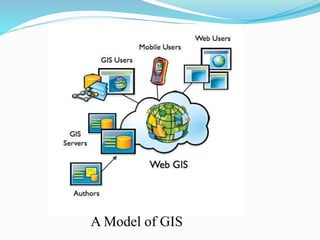
A Model of GIS
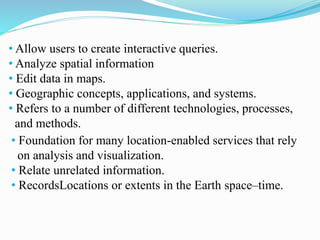
• Allow users to create interactive queries. 
• Analyze spatial information 
• Edit data in maps. 
• Geographic concepts, applications, and systems. 
• Refers to a number of different technologies, processes, 
and methods. 
• Foundation for many location-enabled services that rely 
on analysis and visualization. 
• Relate unrelated information. 
• RecordsLocations or extents in the Earth space–time.
The x, y and z axis representating the longitude, latitude, 
and elevation, respectively
History of Development 
• John Snow's 1855 map of the Soho cholera in the London. 
 1966 GIS demonstrated by Howard 
Fisher 
 1969 ESRI founded 
 1970’s satellites aid GPS 
 1971 GIS project used a layering 
system to display data 
 1979 Odessy developed
GIS concepts 
 London cholera epidemic 1854 
8 
Soho 
+ 
Cholera death 
Water pump
 1986 MapInfo developed 
 1986 SPOT satellite was launched. 
 1992 the Lebanon used GIS to 
rebuild electricity network the
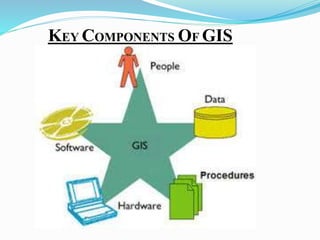
KEY COMPONENTS OF GIS
1. Hardware:- 
• Used in stand-alone or networked configurations. 
• Chief part of GIS such as Computer etc. 
• Help to run centralized computer servers to desktop 
2. Software:- 
•Analyse and display geographic information. 
•Provides function and tools needed. 
3. Data:- 
•Collects the geographic and other tabular data 
•It assemble to use specifications and requirements 
•Integrate spatial data with other existing data resources 
•Key functionality is to store the data.
4.People:- 
• Developers and users are quiet important. 
• Ranges from Specialists to Normal Users. 
5. Procedures:- 
• Drafting Designs 
• Implementing Plans 
• Integration into the business strategy and operation 
• Requires necessary investments in hardware and 
software
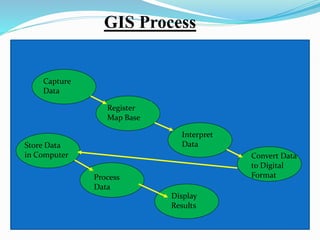
Capture 
Data 
GIS Process 
Register 
Map Base 
Interpret 
Data 
Convert Data 
to Digital 
Format 
Store Data 
in Computer 
Process 
Data 
Display 
Results
4 M’s of GIS
Land Use Environmental 
Cadastral 4 M’s 
Assessment 
Agriculture Drainage Network 
Hydrology Model Terrains 
Measurement 
Mapping 
Monitoring 
Modelling
Contribution Disciplines
Mathematics 
GIS 
Geography 
Cartography 
CAD,CAM 
Automated 
Cartography 
Surveying 
Photographical 
Digital 
Photogrammetry 
Remote Sensing 
Technology 
Statistics
Applications of GIS 
1. Agriculture 
 Farm management 
 Pest/Disease tracking 
 Crop monitoring 
 Yield prediction 
 Soil analysis
2. Natural Resource Management 
 Forestry 
 Ecology 
 Mining 
 Petroleum 
 Water Resources
3.Planning and Economic Development 
 Land Use/Zoning 
 Emergency Preparedness 
 Population Forecast 
 Market Analysis 
 Property Tax Assessment 
 Transportation
4. Geography Matters 
Today’s challenges require geographic approach 
 Climate Change 
 Urban Growth 
 Sustainable Agriculture 
 Water Quality and Availability 
 International and National Security 
 Energy 
 Epidemiology/Disease Tracking 
 Natural Hazards: Seismicity, Weather Events
5.Vehicle Routing
6. Land Use Planning and Management 
Map of Ahmedabad City through GIS
7.Environmental Applications 
• Land cover and land use analysis 
• Modelling watersheds 
• Soil Erosion 
• Forest management 
• Conservation and Protected Areas 
Marine Map
8.Business Applications 
• Delivery of goods and services 
• Retail store placement 
• Distribution of competitors 
• Location of potential customers 
• Traffic flow 
• Parking locations
Expenditures using costumer market data
Literature Review 
L 
TOPIC:- 
An overview of 
“Geographic Information 
System" and its role and 
applicability in 
Environmental 
Monitoring and Process 
Modelling 
Author:- 
Miroslav Rusko, 
Roman Chovanec, 
Dana Roskova 
Volume 29 
Edition :- 1st 
Year:- 2010 
Methodology Used:- Result/Conclusion:- 
GIS system are the powerful 
and effective tool for creating 
intelligent maps. The system 
functions only when the 
requisite expertise is available, 
the data are compiled, the 
necessary routines are 
organized, and the programs are 
modified to suit the application, 
and/or the organization’s needs. 
GIS integrates all kinds of 
information and applications 
with a geographic component 
into one manageable system. 
The hardware and software 
functions of GIS include:- 
• Data input 
• Data storage 
• Data management (data 
manipulation, updating, 
changing, exchange) 
• Data reporting (retrieval, 
presentation, analysis, 
combination, etc.). 
All of these actions and 
operations are applied to 
GIS as a tool that forms its 
database.
Literature Review 
L 
TOPIC:- 
Developing a Web-based 
GIS Application 
for Earthquake 
Information 
Author :- 
A. Garagon Dogru , 
T. Selcuk , 
H. Ozener, 
O. Gurkan, G. Toz 
Volume 1 
Edition :- 1st 
Year:- NA 
Methodology Used:- Result/Conclusion:- 
It is designed to allow viewing, 
querying, and analysis of 
geographic information. This 
application is a software 
independent System. It offers 
maximum functionality with the 
minimum effort. The drawback 
in such a distributed system is 
that data come 
from different sources based on 
different forms and datas 
which cause havoc in a GIS. The 
response time for generating 
maps is related to the map server 
configuration (memory, disk, and 
processor). 
This paper focuses on 
development and 
implementation of a web-based 
GIS application for 
earthquake information. 
Methods used:- 
• Integrating various data from 
different sources. 
• Provides public users to 
access information. 
• Gathers information about 
Earthquakes doing spatial 
and attribute query. 
• Easy data management 
including maintenance and 
updating.
Literature Review 
L 
TOPIC:- 
GIS Technology for 
Disasters 
and Emergency 
Management 
Author :- 
Russ Johnson 
Volume 1 
Edition :- 1st 
Year:- May 2000 
Methodology Used:- Result/Conclusion:- 
This paper will identify 
emergency management 
activities and describe how 
GIS technology plays a 
critically important role. 
Methods Used:- 
• Information analysis 
• Mapping 
• Emergency management 
planning 
• Planning Implementation 
• Modifications in Planning 
•Data Reporting 
GIS allows emergency 
management needs to be 
identified prior to an incident. 
Emergency management 
personnel can use modeling for 
training, for actual tactical 
deployment during a disaster, 
or to analyze the consequences 
of a possible disaster. In short, 
the thoughtful application of a 
GIS can take 
much of the panic and surprise 
out of emergencies.
Literature Review 
TOPIC:- 
GIS and Transportation: 
Status and Challenges 
It is designed to allow viewing, querying, and analysis 
of geographic information. 
Author:- 
Michael F. 
Goodchild 
Volume 1 
Edition :- 1st 
Methodology Used:- Result/Conclusion:- 
Database designs have been 
influenced by a number of 
historical practices and 
traditions, and three of these 
have been of particular 
significance to GIS: map, 
navigation, and the study of 
behavior. Six research 
challenges have been 
identified, ranging from the 
technical issues of 
representation and unambiguous 
communication of location to 
the economic modeling of GIS 
data creation and use. 
The application of GIS in 
transportation, dates from 
the very earliest in the 1960s. 
Methods Used:- 
• The mapping 
• The navigation 
• Unambiguous 
communication 
• Connectivity 
• Response to new 
technologies 
• Map Implementation 
• Map Recovery
References 
Websites:- 
www.google.com 
www.wikipedia.org 
www.mtf.stuba.sk 
ncgia.ucsb.edu 
www.isprs.org 
Journals:- 
Research Papers Authors 
GIS and its role and applicability in 
Environmental Monitoring and 
Process Modelling 
Developing a Web-based GIS 
Application for Earthquake Info. 
GIS Technology for Disasters and 
Emergency Management 
GIS and Transportation: Status and 
Challenges 
Miroslav Rusko, Roman Chovanec, 
Dana Roskova 
A. Garagon Dogru , T. Selcuk , 
H. Ozener, O. Gurkan, G. Toz 
Russ Johnson 
Michael F. Goodchild 
1. 
2. 
3. 
4. 
Books:- 
R.B.Khasiya
Gis powerpoint

Gis powerpoint

  • 1.
    GANDHINAGAR INSTITUTE OF TECHNOLOGY Elements of Civil Engineering Presentation on “Geographical Information System” Prepared By:- Vedant Dave 140120119247 Vivek Verma 140120119248 Kuldeep Tiwari 140120119233 Prahar Vyas 140120119251 Nilesh Sharma 140120119215 Guided By:- Mrs. Priyanka Mehta Mrs. Ankita Shah
  • 2.
    Flow of Presentation 1. Introduction to GIS 2. History of Development 3. Key Components of GIS 4. GIS Processes 5. 4 M’s of GIS 6. Contribution Disciplines of GIS 7. Applications of GIS 8. Research Papers
  • 3.
    Introduction to GIS GEOGRAPHIC implies that locations of the data items are known, or can be calculated, in terms of Geographic coordinates (Latitude, Longitude) INFORMATION implies that the data in a GIS are organized to yield useful knowledge, often as colored maps and images, but also as statistical graphics, tables, and various on-screen responses to interactive queries. SYSTEM implies that a GIS is made up from several inter-related and linked components with different functions. Thus, GIS have functional capabilities for data capture, input, manipulation, transformation, visualization, combinations, query, analysis, modelling and output.
  • 4.
  • 5.
    • Allow usersto create interactive queries. • Analyze spatial information • Edit data in maps. • Geographic concepts, applications, and systems. • Refers to a number of different technologies, processes, and methods. • Foundation for many location-enabled services that rely on analysis and visualization. • Relate unrelated information. • RecordsLocations or extents in the Earth space–time.
  • 6.
    The x, yand z axis representating the longitude, latitude, and elevation, respectively
  • 7.
    History of Development • John Snow's 1855 map of the Soho cholera in the London.  1966 GIS demonstrated by Howard Fisher  1969 ESRI founded  1970’s satellites aid GPS  1971 GIS project used a layering system to display data  1979 Odessy developed
  • 8.
    GIS concepts London cholera epidemic 1854 8 Soho + Cholera death Water pump
  • 9.
     1986 MapInfodeveloped  1986 SPOT satellite was launched.  1992 the Lebanon used GIS to rebuild electricity network the
  • 10.
  • 11.
    1. Hardware:- •Used in stand-alone or networked configurations. • Chief part of GIS such as Computer etc. • Help to run centralized computer servers to desktop 2. Software:- •Analyse and display geographic information. •Provides function and tools needed. 3. Data:- •Collects the geographic and other tabular data •It assemble to use specifications and requirements •Integrate spatial data with other existing data resources •Key functionality is to store the data.
  • 12.
    4.People:- • Developersand users are quiet important. • Ranges from Specialists to Normal Users. 5. Procedures:- • Drafting Designs • Implementing Plans • Integration into the business strategy and operation • Requires necessary investments in hardware and software
  • 13.
    Capture Data GISProcess Register Map Base Interpret Data Convert Data to Digital Format Store Data in Computer Process Data Display Results
  • 14.
  • 15.
    Land Use Environmental Cadastral 4 M’s Assessment Agriculture Drainage Network Hydrology Model Terrains Measurement Mapping Monitoring Modelling
  • 16.
  • 17.
    Mathematics GIS Geography Cartography CAD,CAM Automated Cartography Surveying Photographical Digital Photogrammetry Remote Sensing Technology Statistics
  • 18.
    Applications of GIS 1. Agriculture  Farm management  Pest/Disease tracking  Crop monitoring  Yield prediction  Soil analysis
  • 19.
    2. Natural ResourceManagement  Forestry  Ecology  Mining  Petroleum  Water Resources
  • 20.
    3.Planning and EconomicDevelopment  Land Use/Zoning  Emergency Preparedness  Population Forecast  Market Analysis  Property Tax Assessment  Transportation
  • 24.
    4. Geography Matters Today’s challenges require geographic approach  Climate Change  Urban Growth  Sustainable Agriculture  Water Quality and Availability  International and National Security  Energy  Epidemiology/Disease Tracking  Natural Hazards: Seismicity, Weather Events
  • 25.
  • 29.
    6. Land UsePlanning and Management Map of Ahmedabad City through GIS
  • 30.
    7.Environmental Applications •Land cover and land use analysis • Modelling watersheds • Soil Erosion • Forest management • Conservation and Protected Areas Marine Map
  • 31.
    8.Business Applications •Delivery of goods and services • Retail store placement • Distribution of competitors • Location of potential customers • Traffic flow • Parking locations
  • 32.
  • 33.
    Literature Review L TOPIC:- An overview of “Geographic Information System" and its role and applicability in Environmental Monitoring and Process Modelling Author:- Miroslav Rusko, Roman Chovanec, Dana Roskova Volume 29 Edition :- 1st Year:- 2010 Methodology Used:- Result/Conclusion:- GIS system are the powerful and effective tool for creating intelligent maps. The system functions only when the requisite expertise is available, the data are compiled, the necessary routines are organized, and the programs are modified to suit the application, and/or the organization’s needs. GIS integrates all kinds of information and applications with a geographic component into one manageable system. The hardware and software functions of GIS include:- • Data input • Data storage • Data management (data manipulation, updating, changing, exchange) • Data reporting (retrieval, presentation, analysis, combination, etc.). All of these actions and operations are applied to GIS as a tool that forms its database.
  • 34.
    Literature Review L TOPIC:- Developing a Web-based GIS Application for Earthquake Information Author :- A. Garagon Dogru , T. Selcuk , H. Ozener, O. Gurkan, G. Toz Volume 1 Edition :- 1st Year:- NA Methodology Used:- Result/Conclusion:- It is designed to allow viewing, querying, and analysis of geographic information. This application is a software independent System. It offers maximum functionality with the minimum effort. The drawback in such a distributed system is that data come from different sources based on different forms and datas which cause havoc in a GIS. The response time for generating maps is related to the map server configuration (memory, disk, and processor). This paper focuses on development and implementation of a web-based GIS application for earthquake information. Methods used:- • Integrating various data from different sources. • Provides public users to access information. • Gathers information about Earthquakes doing spatial and attribute query. • Easy data management including maintenance and updating.
  • 35.
    Literature Review L TOPIC:- GIS Technology for Disasters and Emergency Management Author :- Russ Johnson Volume 1 Edition :- 1st Year:- May 2000 Methodology Used:- Result/Conclusion:- This paper will identify emergency management activities and describe how GIS technology plays a critically important role. Methods Used:- • Information analysis • Mapping • Emergency management planning • Planning Implementation • Modifications in Planning •Data Reporting GIS allows emergency management needs to be identified prior to an incident. Emergency management personnel can use modeling for training, for actual tactical deployment during a disaster, or to analyze the consequences of a possible disaster. In short, the thoughtful application of a GIS can take much of the panic and surprise out of emergencies.
  • 36.
    Literature Review TOPIC:- GIS and Transportation: Status and Challenges It is designed to allow viewing, querying, and analysis of geographic information. Author:- Michael F. Goodchild Volume 1 Edition :- 1st Methodology Used:- Result/Conclusion:- Database designs have been influenced by a number of historical practices and traditions, and three of these have been of particular significance to GIS: map, navigation, and the study of behavior. Six research challenges have been identified, ranging from the technical issues of representation and unambiguous communication of location to the economic modeling of GIS data creation and use. The application of GIS in transportation, dates from the very earliest in the 1960s. Methods Used:- • The mapping • The navigation • Unambiguous communication • Connectivity • Response to new technologies • Map Implementation • Map Recovery
  • 37.
    References Websites:- www.google.com www.wikipedia.org www.mtf.stuba.sk ncgia.ucsb.edu www.isprs.org Journals:- Research Papers Authors GIS and its role and applicability in Environmental Monitoring and Process Modelling Developing a Web-based GIS Application for Earthquake Info. GIS Technology for Disasters and Emergency Management GIS and Transportation: Status and Challenges Miroslav Rusko, Roman Chovanec, Dana Roskova A. Garagon Dogru , T. Selcuk , H. Ozener, O. Gurkan, G. Toz Russ Johnson Michael F. Goodchild 1. 2. 3. 4. Books:- R.B.Khasiya