PAT202.PRINCIPLES OF INTEGRATED
PLANT DISEASE MANAGEMENT.(1+1)
FUNGICIDES COMPATIBILITY WITH
AGROCHEMICALS
INTRODUCTION
• Fungicides are biological chemical compounds or biological
organisms used to kill the parasitic fungi or their spores. Chemical
which is used to control oomycetes, which are not fungi also
referred as fungicides.
• Fungicides can either be contact,translaminar or
systematic.Contact fungicides are not taken up into the plant
tissue& protect only the plant where the spray is deposited.
•Translaminar fungicides redistributed the fungicide
from the upper, sprayed leaf surface to the lower,
unsprayed surface.
•Systemic fungicides are taken up and redistributed
through the vessels.
•Few fungicides move to all parts of a plant.
AGROCHEMICALS
•Agrochemicals are pesticides, herbicides or
fertilizers used for the management of
ecosystem in agricultural sectors. Rudimentary
variations on agrochemicals have been used
for millennia to improve crop yields and
control the population of agricultural pests.
INTERACTION OF FUNGICIDES WITH
OTHER AGROCHEMICALS
• Simultaneous or sequential application of fungicides is followed in a single cropping
systems.
• These chemicals are may undergo a change in physical & chemical characters with
which could lead to enhancement or reduction in the efficiency of one or more
compounds.
• The interaction effects were seen much later in the growing season or in the next
season due to build up of persistent chemicals or their residues on soil.
TYPES OF EFFECTS BY THE
INTERACTION
• Additive effect: It is a effect of a combination, which is equal to the sum of the
effects of the components taken independently.
• Synergistic effect: The total effect of a combination is greater or more prolonged
than the sum of the effects of the two taken independently.
• Antagonistic effect: The total effect of a combination is smaller than the effect of the
most active component applied alone.
• Independent effect: The total effect of a combination is equal to the effort of the
most active compound applied alone.
• Enhancement effect: The effect of a fungicides and non-toxic adjuvant applied in
combination on a plant is said to have an enhancement effect. If the response is
greater than that obtained,when the herbicide is used to at the same rates without
the adjuvant.
Example: Mixing Ammonium sulphate with glyphosphate.
Advance of mixed fungicide with other chemical
over single fungicide.
• A reduction in cost of cultivation by saving time & labour.
• A reduction in soil compaction by eliminating multiple field operations.
• An improvement in crop safety by using minimum dose of fungicide.
• A delay in attacking of resistant fungi species.
COMBINATION OF FUNGICIDES
WITH OTHER CHEMICALS
1. Azoxytrobin 11%+Tebuconazole 18.3% SC formulation
Azoxytrobin inhibit mitochondrial respiration and Tebuconazole inhibit sterol
production at different sites of fungi, which offers effect the cell membrane
structure and function. Both are systemic with aeropetal movement and
translaminar action, having broad spectrum fungicides action with preventive
control.
Formulation has a dual mode of control & action,hence it works at multiple
stages of fungal development.
Ex) Alliance, sukoyaka ,custodia
These are effective against fruit rot,powdery mildew and die-back of chilli and
sheath blight of rice.
2. Azoxytrobin 18.2% w/w + Diffenoconazole 11.4%w/w SC
This is combination of fungicides with different mode of
action. It has a new ingredient called Diffenoconazole
combined with broad spectrum fungicide azoxytrobin,that
works together towards effective control disease with
reducing the risk of harmful effects.
Azoxytrobin provides enhanced root,leaf colour and shade
tolerance.
Controlled diseases by this combination:
Chilli anthracnose,paddy sheath blight.
COMPATIBILITY OF FUNGICIDES
WITH INSECTICIDES
Combined application of fungicides with insecticides may result in either synergism or
antagonism between them. Synergism is formed when the association of
fungicides with insecticides leads to joint action that is superior to the
arithmetical sum of action exercised by the single fungicide with or insecticide.
Ex)Cercospora leaf spot of sesame
Antagonism is the condition found when the efficiency of association is below
the arithmetical sum of action expressed by that single fungicide or insecticide.
The combination of monocrotophos with mancozeb showed decreased
insecticidal activity against red cotton bug.
HERBICIDE- FUNGICIDE
INTERACTION
• In sterlized soil, Chloroxuron is not causing any apparent
injury to pea plants, while in the presence of Rhizoctonia
solani in the unsterilised soil it causes injury.
• Oxadiazon reduce the incidence of stem rot caused by
soil borne pathogen Sclerotia rolfsii in groundnut.
• Diuron& triazine which inhibit photosynthesis may
make the plans more susceptible to tobacco mosaic
virus. On the other hand diuron may decrease the
incidence of root rot in Wheat.
TECHNIQUE USED TO ASSAY THE
COMPATIBILITY BETWEEN
CHEMICALS
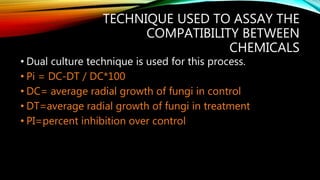
• Dual culture technique is used for this process.
• Pi = DC-DT / DC*100
• DC= average radial growth of fungi in control
• DT=average radial growth of fungi in treatment
• PI=percent inhibition over control
REFERENCES
1. Ravi Chandra N.G – 2018- Agrochemicals in plant
disease management. PGR publishers, New Delhi
– of.no: 170,172,189
2. https://www.researchgate.net
3. ecourseonline.iasri.res.in
4. journal.plog.org

FUNGICIDES COMPATIABILITY WITH AGRO-CHEMICALS

  • 1.
    PAT202.PRINCIPLES OF INTEGRATED PLANTDISEASE MANAGEMENT.(1+1) FUNGICIDES COMPATIBILITY WITH AGROCHEMICALS
  • 2.
    INTRODUCTION • Fungicides arebiological chemical compounds or biological organisms used to kill the parasitic fungi or their spores. Chemical which is used to control oomycetes, which are not fungi also referred as fungicides. • Fungicides can either be contact,translaminar or systematic.Contact fungicides are not taken up into the plant tissue& protect only the plant where the spray is deposited.
  • 3.
    •Translaminar fungicides redistributedthe fungicide from the upper, sprayed leaf surface to the lower, unsprayed surface. •Systemic fungicides are taken up and redistributed through the vessels. •Few fungicides move to all parts of a plant.
  • 4.
    AGROCHEMICALS •Agrochemicals are pesticides,herbicides or fertilizers used for the management of ecosystem in agricultural sectors. Rudimentary variations on agrochemicals have been used for millennia to improve crop yields and control the population of agricultural pests.
  • 5.
    INTERACTION OF FUNGICIDESWITH OTHER AGROCHEMICALS • Simultaneous or sequential application of fungicides is followed in a single cropping systems. • These chemicals are may undergo a change in physical & chemical characters with which could lead to enhancement or reduction in the efficiency of one or more compounds. • The interaction effects were seen much later in the growing season or in the next season due to build up of persistent chemicals or their residues on soil.
  • 6.
    TYPES OF EFFECTSBY THE INTERACTION • Additive effect: It is a effect of a combination, which is equal to the sum of the effects of the components taken independently. • Synergistic effect: The total effect of a combination is greater or more prolonged than the sum of the effects of the two taken independently. • Antagonistic effect: The total effect of a combination is smaller than the effect of the most active component applied alone. • Independent effect: The total effect of a combination is equal to the effort of the most active compound applied alone.
  • 7.
    • Enhancement effect:The effect of a fungicides and non-toxic adjuvant applied in combination on a plant is said to have an enhancement effect. If the response is greater than that obtained,when the herbicide is used to at the same rates without the adjuvant. Example: Mixing Ammonium sulphate with glyphosphate. Advance of mixed fungicide with other chemical over single fungicide. • A reduction in cost of cultivation by saving time & labour. • A reduction in soil compaction by eliminating multiple field operations. • An improvement in crop safety by using minimum dose of fungicide. • A delay in attacking of resistant fungi species.
  • 8.
    COMBINATION OF FUNGICIDES WITHOTHER CHEMICALS 1. Azoxytrobin 11%+Tebuconazole 18.3% SC formulation Azoxytrobin inhibit mitochondrial respiration and Tebuconazole inhibit sterol production at different sites of fungi, which offers effect the cell membrane structure and function. Both are systemic with aeropetal movement and translaminar action, having broad spectrum fungicides action with preventive control. Formulation has a dual mode of control & action,hence it works at multiple stages of fungal development. Ex) Alliance, sukoyaka ,custodia These are effective against fruit rot,powdery mildew and die-back of chilli and sheath blight of rice.
  • 9.
    2. Azoxytrobin 18.2%w/w + Diffenoconazole 11.4%w/w SC This is combination of fungicides with different mode of action. It has a new ingredient called Diffenoconazole combined with broad spectrum fungicide azoxytrobin,that works together towards effective control disease with reducing the risk of harmful effects. Azoxytrobin provides enhanced root,leaf colour and shade tolerance. Controlled diseases by this combination: Chilli anthracnose,paddy sheath blight.
  • 10.
    COMPATIBILITY OF FUNGICIDES WITHINSECTICIDES Combined application of fungicides with insecticides may result in either synergism or antagonism between them. Synergism is formed when the association of fungicides with insecticides leads to joint action that is superior to the arithmetical sum of action exercised by the single fungicide with or insecticide. Ex)Cercospora leaf spot of sesame Antagonism is the condition found when the efficiency of association is below the arithmetical sum of action expressed by that single fungicide or insecticide. The combination of monocrotophos with mancozeb showed decreased insecticidal activity against red cotton bug.
  • 11.
    HERBICIDE- FUNGICIDE INTERACTION • Insterlized soil, Chloroxuron is not causing any apparent injury to pea plants, while in the presence of Rhizoctonia solani in the unsterilised soil it causes injury. • Oxadiazon reduce the incidence of stem rot caused by soil borne pathogen Sclerotia rolfsii in groundnut. • Diuron& triazine which inhibit photosynthesis may make the plans more susceptible to tobacco mosaic virus. On the other hand diuron may decrease the incidence of root rot in Wheat.
  • 12.
    TECHNIQUE USED TOASSAY THE COMPATIBILITY BETWEEN CHEMICALS • Dual culture technique is used for this process. • Pi = DC-DT / DC*100 • DC= average radial growth of fungi in control • DT=average radial growth of fungi in treatment • PI=percent inhibition over control
  • 13.
    REFERENCES 1. Ravi ChandraN.G – 2018- Agrochemicals in plant disease management. PGR publishers, New Delhi – of.no: 170,172,189 2. https://www.researchgate.net 3. ecourseonline.iasri.res.in 4. journal.plog.org